What This Calculator Works Out?
An Hourly Pay Calculator turns your hourly rate into gross daily, weekly, monthly and annual earnings, then estimates your take-home pay after applicable deductions. Add your tax code, pension rate, student loan plan, overtime or bonus for a more accurate figure. Useful for comparing job offers, checking part-time or shift earnings, or seeing how a pay rise changes your annual income.
How to Calculate Hourly Wage into Annual Salary
Annual Salary = Hourly Rate × Hours per Week × Weeks Worked per Year
| Input |
Value |
| Hourly Rate |
£18 |
| Hours per Week |
37.5 |
| Weeks per Year |
52 |
| Result |
£18 × 37.5 × 52 = £35,100 |
This is your gross figure, before Income Tax, National Insurance, pension and other deductions. A standard full-time year works out to roughly 1,950 hours (37.5 × 52) useful to know if you need to work out a figure by hand.
From Hourly Rate to Weekly and Monthly Pay
The same formula scales down: multiply your hourly rate by your weekly hours for weekly pay, then divide your annual figure by 12 for a monthly estimate. At £18/hour and 37.5 hours a week, that's £675 a week and roughly £2,925 a month, before deductions. The calculator above shows all four figures daily, weekly, monthly and annual at once.
This calculator provides an estimate for informational purposes only. Actual payslips may vary depending on your employer, tax code, payroll system, and individual circumstance.
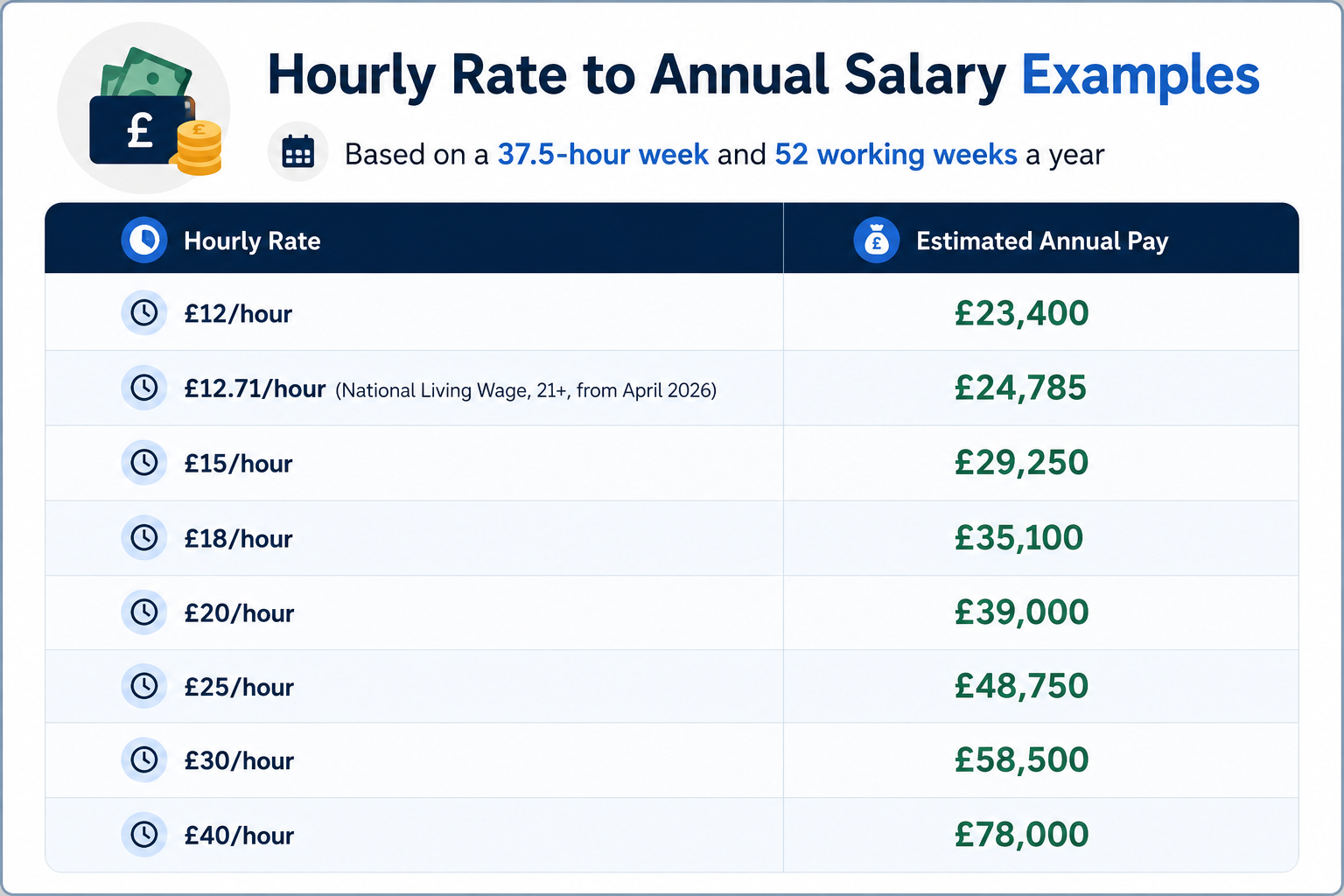
Hourly Rate to Annual Salary Examples
Based on a 37.5-hour week and 52 working weeks a year:
| Hourly Rate |
Estimated Annual Pay |
| £12/hour |
£23,400 |
| £12.71/hour (National Living Wage, 21+, from April 2026) |
£24,785 |
| £15/hour |
£29,250 |
| £18/hour |
£35,100 |
| £20/hour |
£39,000 |
| £25/hour |
£48,750 |
| £30/hour |
£58,500 |
| £40/hour |
£78,000 |
Figures are gross, before deductions. Confirm the current National Living Wage rate on
GOV.UK.
Working Hours Comparison
Same hourly rate, different weekly hours shows how much your schedule affects annual pay:
| HOURLY RATE |
WEEKLY HOURS |
WEEKLY PAY |
ESTIMATED ANNUAL PAY |
| £15.00 |
20 hours |
£300.00 |
£15,600 |
| £15.00 |
30 hours |
£450.00 |
£23,400 |
| £15.00 |
37.5 hours |
£562.50 |
£29,250 |
| £15.00 |
40 hours |
£600.00 |
£31,200 |
| £15.00 |
45 hours |
£675.00 |
£35,100 |
If you're starting from an annual salary and want to work out the equivalent hourly rate, use our dedicated
Salary to Hourly Calculator or
Hourly Rate Calculator they're built specifically for that direction. This page focuses on the opposite: turning your hourly wage into weekly, monthly and annual pay.
Take-Home Pay After Tax, NI, Pension and Student Loan
Your hourly wage is gross pay. Take-home (net) pay is what's left after:
| DEDUCTION |
WHAT IT MEANS |
| Income Tax |
Charged on earnings above your Personal Allowance. |
| National Insurance |
Contributions based on your earnings. |
| Workplace Pension |
Deducted if you're enrolled in a workplace pension scheme. |
| Student Loan |
Repayments based on your specific loan plan and income threshold. |
| Salary Sacrifice |
Salary exchanged for non-cash workplace benefits. |
Example: £18/hour at 37.5 hours a week gives a gross annual figure of £35,100 your actual take-home will be lower once tax, NI and any pension or student loan deductions apply. The exact amount depends on your tax code, pension contribution, student loan plan, and whether you're in England, Scotland, Wales or Northern Ireland. Check your tax code against
GOV.UK if you're unsure.
For a deeper breakdown of gross vs net figures, see our
UK Tax Brackets 2026/27 page.
Overtime and Bonus Pay
Overtime and bonus payments are added on top of your base hourly earnings and can be included directly in the calculator above. Because extra pay can also increase your Income Tax, NI and student loan repayments, it's worth adding it in for a realistic total rather than estimating separately.
For overtime-specific rates and rules (time-and-a-half, double time), see our
Overtime Pay Calculator and
Double Time Pay Calculator.
Hourly Wage vs Annual Salary
| HOURLY WAGE |
ANNUAL SALARY |
| Paid for every hour worked |
Fixed yearly income |
| Changes with hours worked |
Usually the same each month |
| Overtime increases pay directly |
Overtime often paid separately (or not paid) |
| Common for part-time/shift work |
Common for full-time roles |
Useful when comparing a job offer paying an hourly rate against one quoting a fixed salary factor in weekly hours, holiday pay and overtime opportunities, not just the headline number.
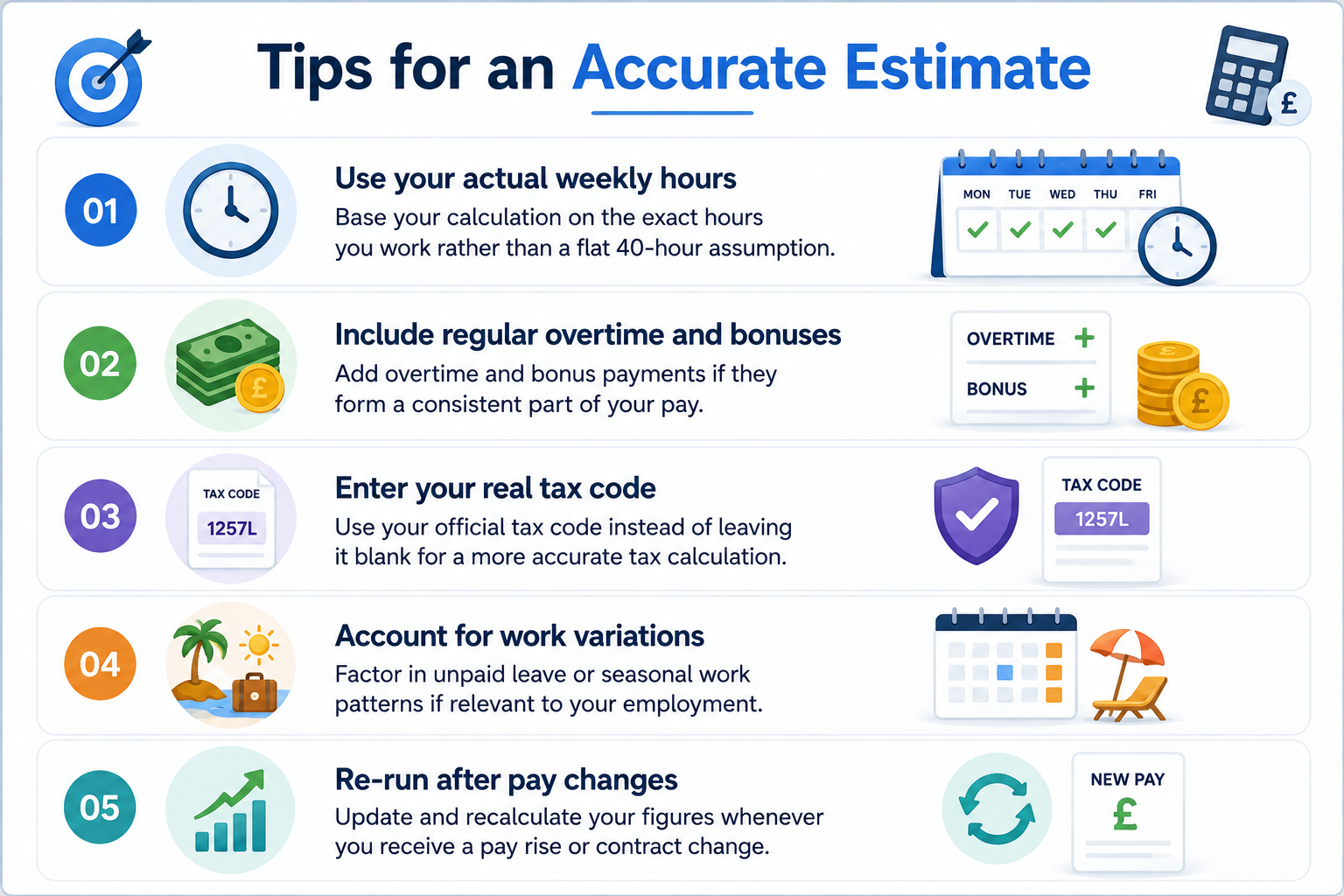
Tips for an Accurate Estimate
- Use your actual weekly hours: Base your calculation on the exact hours you work rather than a flat 40-hour assumption.
- Include regular overtime and bonuses: Add overtime and bonus payments if they form a consistent part of your pay.
- Enter your real tax code: Use your official tax code instead of leaving it blank for a more accurate tax calculation.
- Account for work variations: Factor in unpaid leave or seasonal work patterns if relevant to your employment.
- Re-run after pay changes: Update and recalculate your figures whenever you receive a pay rise or contract change.