
Holiday Pay Calculator
Estimate your UK holiday pay, accrued holiday entitlement, paid leave value and holiday hours based on your hourly rate, working pattern and statutory holiday allowance.
Enter Your Work Details
Estimated Holiday Pay
Holiday Pay Calculator UK - Estimate What Your Paid Leave Is Worth
Planning time off is easier when you know how much you'll be paid. Whether you're a full-time employee, part-time worker, shift worker or on a zero-hour contract, this Holiday Pay Calculator helps you estimate your paid leave quickly and accurately.
Holiday pay isn't always based on your basic wage. Depending on your working pattern, it may also include regular overtime, commission, shift allowances and other payments that form part of your normal earnings. If your hours or income vary, calculating holiday pay manually can quickly become complicated.
This guide explains how holiday pay is calculated in the UK, who qualifies for paid annual leave and how different employment types can affect your entitlement. You'll also find worked examples, practical scenarios, comparison tables and FAQs to help you understand your holiday pay with confidence.
Note: This calculator provides an estimate only. Actual holiday pay may vary depending on your employment contract, payroll arrangements, regular earnings and current UK employment legislation.
What Is Holiday Pay?
In the UK, most workers are legally entitled to 5.6 weeks (28 days for someone working five days a week) of paid annual leave, although some employers choose to offer additional contractual holiday.
The purpose of holiday pay is to ensure workers do not lose income when taking time off to rest, recover, or spend time with family. In many cases, holiday pay is based on your normal earnings rather than simply your basic wage. This means that regular overtime, commission, and certain allowances may also be included when calculating how much you should receive.
How holiday pay is calculated depends on your working pattern:
| Employment Type | Holiday Pay Basis |
|---|---|
| Fixed hours & fixed pay | Normal weekly or monthly pay during annual leave. |
| Hourly workers | Based on normal hourly earnings and contracted working hours. |
| Shift workers | May include regular shift allowances where applicable. |
| Irregular hours | Usually based on average weekly pay over the statutory reference period. |
| Zero-hour contracts | Based on average earnings from previous paid weeks. |
Note: The exact method used depends on your employment status, working pattern and the latest UK holiday pay regulations. Your employer should calculate holiday pay in line with statutory requirements and your employment contract.
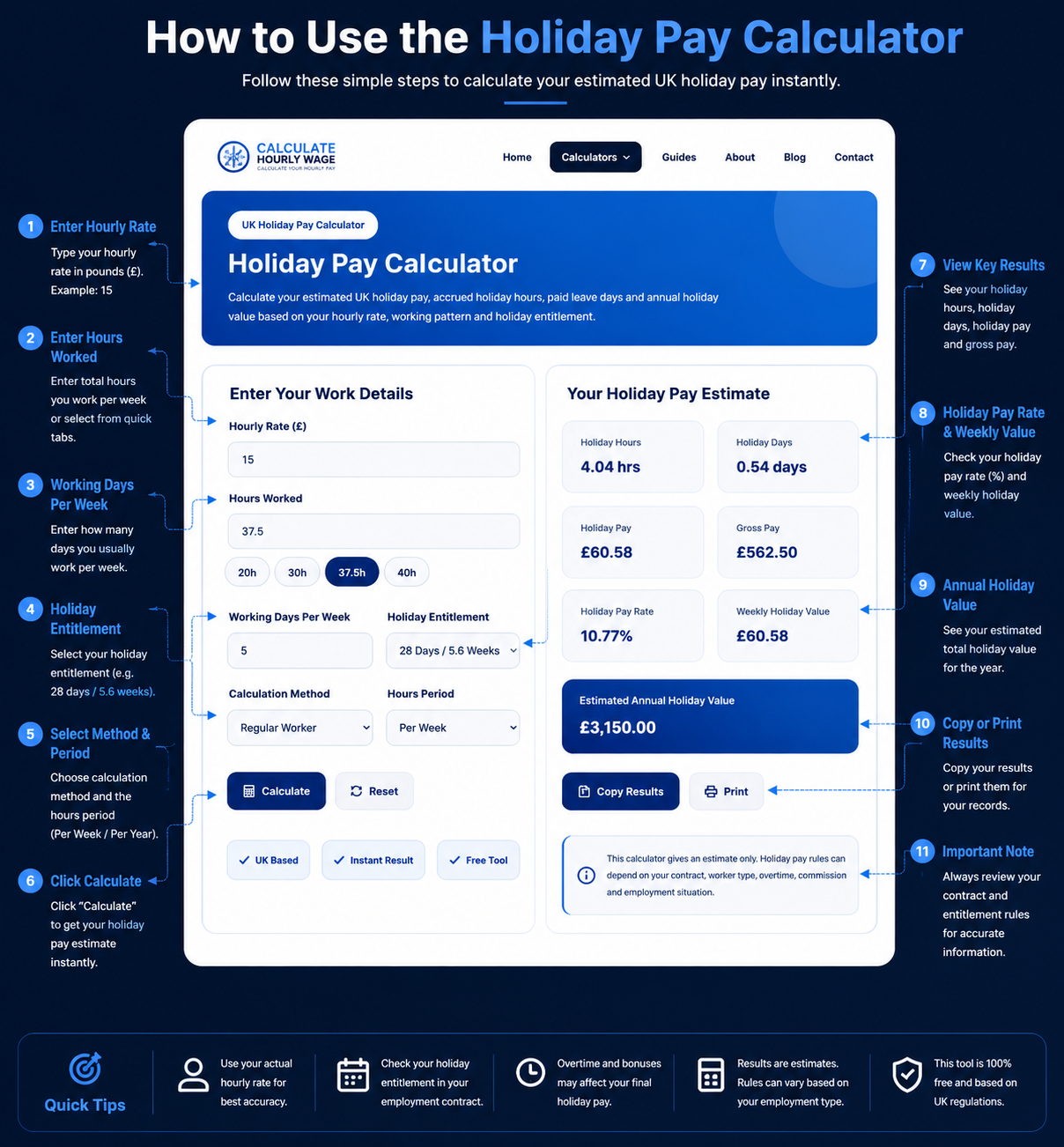
How to Use the Holiday Pay Calculator
Using our Holiday Pay Calculator is quick and straightforward. Follow the steps below to estimate how much holiday pay you could receive based on your earnings and working pattern.
| Step | Instructions & Details |
|---|---|
| Step 1: Select Pay Type | Choose how you're paid (e.g., hourly pay, weekly salary, monthly salary, or annual salary). Selecting the correct pay type ensures your holiday pay is calculated using the appropriate method. |
| Step 2: Enter Earnings | Provide your current pay information (hourly rate, weekly wage, monthly salary, or annual salary). If your earnings vary from week to week, use your average earnings where applicable. |
| Step 3: Enter Working Hours | Add the number of hours you normally work each week. If your hours change regularly, enter your average weekly hours to produce a more accurate estimate. |
| Step 4: Include Additional Pay |
Include extra payments that form part of your normal earnings if supported:
|
| Step 5: Click Calculate | Click the Calculate button to instantly estimate your holiday pay based on the information provided. |
Understanding Your Results
After calculating, you'll receive an estimate showing:
- Estimated holiday pay
- Accrued holiday hours
- Holiday days earned
- Weekly holiday value
- Estimated annual holiday value
- Holiday pay as a percentage of your earnings
These figures can help you understand your paid leave entitlement and compare the estimate with your payslips or payroll calculations.
Tips for More Accurate Results
- Enter your most recent pay information.
- Use your normal weekly working hours.
- Select the correct annual holiday entitlement.
- If your working hours vary, use a realistic weekly average.
- Recalculate whenever your pay or working pattern changes.
Following these steps helps produce a more reliable holiday pay estimate and reduces the risk of calculation errors.
Holiday Pay Formula
The method used to calculate holiday pay depends on your employment type and pay structure. Workers with fixed hours usually receive their normal pay during annual leave, while those with variable hours are typically paid using average weekly earnings over the relevant reference period.
1. Hourly Workers
Holiday Pay = Hourly Rate × Hours of Leave Taken
| Calculation Step | Details / Value |
|---|---|
| Hourly Rate | £18 |
| Holiday Taken | 37.5 hours (1 week) |
| Calculation Formula | £18 × 37.5 |
| Estimated Holiday Pay | £675 |
2. Weekly Paid Employees
Holiday Pay = Normal Weekly Pay
| Calculation Step | Details / Value |
|---|---|
| Weekly Salary | £620 |
| Holiday Taken | 1 week |
| Estimated Holiday Pay | £620 |
3. Monthly Salaried Employees
Most salaried employees continue receiving their normal monthly salary while taking paid annual leave.
| Calculation Step | Details / Value |
|---|---|
| Monthly Salary | £3,000 |
| Holiday Taken | 1 month |
| Estimated Holiday Pay | £3,000 |
Taking one week of annual leave during the month usually does not reduce your monthly salary.
4. Workers with Irregular Hours or Variable Pay
For workers whose hours or earnings change regularly, holiday pay is generally based on average weekly earnings over the relevant reference period, excluding weeks where no pay was received.
| Calculation Step | Details / Value |
|---|---|
| Average Weekly Earnings | £540 |
| Holiday Taken | 1 week |
| Estimated Holiday Pay | £540 |
Holiday Pay Formula by Worker Type
| Worker Type | Basic Formula |
|---|---|
| Hourly Worker | Hourly Rate × Hours of Leave |
| Weekly Paid | Normal Weekly Pay |
| Monthly Salary | Normal Monthly Salary |
| Variable Pay | Average Weekly Earnings |
Why Different Formulas Are Used
Different payment methods exist because not every worker has the same working pattern or pay structure. Employees with fixed salaries generally receive their normal pay during annual leave, while workers with variable hours, overtime or commission may have their holiday pay based on average earnings. Using the appropriate calculation method provides a more realistic estimate of paid.

How Holiday Pay Is Calculated in the UK
Holiday pay in the UK is calculated according to your working pattern and normal earnings. Employees with fixed hours usually receive their normal pay during annual leave, while those with irregular hours or variable pay are generally paid using average earnings over the relevant reference period. The aim is to ensure workers are not financially disadvantaged when taking statutory paid leave.
Statutory Holiday Entitlement
Under the Working Time Regulations, most workers in the UK are entitled to 5.6 weeks of paid annual leave each leave year.
For someone working a standard five-day week, this is equivalent to:
| Working Pattern | Annual Holiday Entitlement |
|---|---|
| 5 days per week | 28 days |
| 4 days per week | 22.4 days |
| 3 days per week | 16.8 days |
| 2 days per week | 11.2 days |
| 1 day per week | 5.6 days |
Some employers offer more paid leave than the statutory minimum as part of the employment contract.
For full details on statutory leave, see the official GOV.UK Holiday Entitlement guidance.
Holiday Pay for Employees with Fixed Hours
If you work fixed hours and receive the same pay each pay period, your holiday pay is normally the same as your usual wage or salary.
| Calculation Step | Details / Value |
|---|---|
| Weekly Salary | £700 |
| Holiday Taken | 1 week |
| Estimated Holiday Pay | £700 |
| Calculation Note | No additional calculations are normally required. |
Holiday Pay for Employees with Variable Hours or Pay
Holiday pay is generally based on average earnings over the statutory 52 paid-week reference period, excluding weeks in which no pay was received.
This approach is designed to provide a fair reflection of your usual income rather than using a single week's pay that may be unusually high or low.
This often applies to:
- Zero-hour contract workers
- Casual workers
- Seasonal workers
- Agency workers
- Shift workers with varying hours
Why Holiday Pay Can Differ Between Employees
Holiday pay may vary because of:
- Different working patterns
- Regular overtime or commission
- Shift allowances
- Variable weekly earnings
- Contractual pay arrangements
This is why using a holiday pay calculator can provide a more accurate estimate than relying on a simple hourly rate alone.
Holiday Pay for Different Types of Workers
Not all employees work the same hours or receive the same type of pay. Some work fixed schedules with a monthly salary, while others have variable hours, shift patterns, or zero-hour contracts. As a result, the way holiday pay is calculated can differ depending on your employment arrangement.
Below is an overview of how holiday pay typically applies to different types of workers in the UK.
Holiday Pay for Hourly Workers
If you're paid by the hour, your holiday pay is generally based on your normal hourly rate and the number of hours you would usually work during your leave.
| Calculation Step | Details / Value |
|---|---|
| Hourly Rate | £16 |
| Weekly Hours | 35 hours |
| Calculation Formula | £16 × 35 |
| Estimated Holiday Pay | £560 |
If your hours vary each week, your employer may calculate your holiday pay using your average earnings over the relevant reference period instead of a fixed number of hours.
Holiday Pay for Salaried Employees
Employees who receive a fixed annual or monthly salary usually continue to receive their normal salary while taking annual leave.
| Calculation Step | Details / Value |
|---|---|
| Annual Salary | £36,000 |
| Monthly Salary / Holiday Pay | £3,000 |
Taking one week's holiday generally does not reduce your monthly salary, as holiday pay is already included in your normal earnings.
Holiday Pay for Part-Time Workers
Part-time workers have the same legal right to paid annual leave as full-time employees, but their entitlement is calculated on a pro-rata basis according to the number of days or hours they work.
| Calculation Step | Details / Value |
|---|---|
| Working Pattern | 3 days per week |
| Calculation Formula | 3 × 5.6 days |
| Statutory Holiday Entitlement | 16.8 days per year |
When she takes annual leave, she receives holiday pay based on her normal earnings for those working days.
Because working fewer hours does not remove your entitlement to paid holiday it simply adjusts the amount of leave you receive.
Holiday Pay for Zero-Hour Contract Workers
Zero-hour contract workers often have changing hours from week to week.
Because there is no fixed working pattern, holiday pay is generally based on average earnings over the relevant reference period, excluding weeks where no pay was received.
This helps ensure your holiday pay reflects what you normally earn rather than a particularly busy or quiet week.
Zero-hour workers are still legally entitled to paid annual leave.
Holiday Pay for Shift Workers
| Shift Allowance Type | Payment Details |
|---|---|
| Shift Premiums | Additional pay for working specific shift schedules |
| Night Shift Allowances | Extra compensation for unsocial night hours |
| Weekend Enhancements | Higher pay rate for weekend shifts |
| Rotating Shift Payments | Allowance for alternating shift patterns |
Employees who regularly work day, night, weekend or rotating shifts may have these payments reflected in their holiday pay if they form part of their normal earnings.
Comparison of Holiday Pay by Worker Type
| Worker Type | How Holiday Pay Is Usually Calculated |
|---|---|
| Full-time employee | Normal salary or weekly pay |
| Hourly worker | Hourly rate × normal hours worked |
| Salaried employee | Normal monthly or annual salary |
| Part-time worker | Pro-rata entitlement based on working pattern |
| Zero-hour worker | Average earnings over the relevant reference period |
| Shift worker | Normal earnings, including regular shift payments where applicable |
Which Calculation Applies to You?
The correct method depends on several factors, including:
- Whether your hours are fixed or variable
- How you're paid (hourly, weekly, or monthly)
- Whether you regularly earn overtime or commission
- Your employment contract
- Your usual working pattern
Our Holiday Pay Calculator provides an estimate based on the information you enter. Comparing the result with your recent payslips can help you understand your expected holiday pay and identify any significant differences before contacting your employer or payroll department.
Worked Examples of Holiday Pay Calculations
The examples below show how holiday pay is typically calculated for different types of workers in the UK. Although actual payments depend on your employment contract and payroll arrangements, these scenarios demonstrate the general calculation methods.
Example 1: Holiday Pay for an Hourly Worker
Scenario: James works full-time in a retail store and is paid by the hour.
| Details | Value |
|---|---|
| Hourly Rate | £18.00 |
| Hours Worked Per Week | 37.5 |
| Holiday Taken | 1 Week |
| Calculation (Rate × Hours) | £18 × 37.5 |
| Estimated Holiday Pay | £675 |
Example 2: Holiday Pay for a Salaried Employee
Scenario: Emma receives a fixed monthly salary.
| Details | Value |
|---|---|
| Annual Salary | £39,000 |
| Monthly Salary | £3,250 |
| Holiday Taken | 1 Week |
| Estimated Holiday Pay | £3,250 (Normal Monthly Salary) |
Because Emma works fixed hours and receives a fixed salary, taking one week of annual leave does not reduce her monthly income. She continues to receive her normal monthly salary.
Example 3: Holiday Pay for a Part-Time Worker
Scenario: David works three days each week.
| Details | Value |
|---|---|
| Hourly Rate | £15 |
| Hours Per Day | 8 |
| Working Days Per Week | 3 |
| Weekly Hours Calculation | 8 × 3 = 24 hours |
| Estimated Holiday Pay | £15 × 24 = £360 (for one week's leave) |
Example 4: Holiday Pay for a Zero-Hour Contract Worker
Scenario: Sophie's weekly earnings vary depending on the number of shifts she works. Her recent average weekly earnings are calculated below.
| Details | Value |
|---|---|
| Week 1 Earnings | £480 |
| Week 2 Earnings | £520 |
| Week 3 Earnings | £510 |
| Week 4 Earnings | £490 |
| Average Weekly Earnings | (480 + 520 + 510 + 490) ÷ 4 = £500 |
| Estimated Holiday Pay | £500 for one week's holiday |
This example demonstrates why average earnings are often used for workers whose hours change regularly.
Example 5: Holiday Pay When Leaving a Job
Scenario: Ahmed resigns from his job but still has 5 days of unused annual leave.
| Details | Value |
|---|---|
| Weekly Salary | £650 |
| Working Days Per Week | 5 |
| Daily Pay Calculation | £650 ÷ 5 = £130 |
| Unused Leave | 5 days |
| Payment for Unused Holiday | 5 days × £130 = £650 |
In many cases, unused statutory holiday is paid with the employee's final salary, although this depends on the amount of leave accrued and already taken.
Why These Examples Matter
These examples illustrate how different pay structures and working patterns can affect holiday pay. Compare your own circumstances with the examples above to better understand the estimate produced by the calculator.
Using these examples alongside the Holiday Pay Calculator can help you:
- Estimate your expected holiday pay.
- Understand how different payment methods affect the result.
- Compare the calculator's estimate with your payslip.
- Spot potential payroll errors before raising them with your employer.
Holiday Pay vs Holiday Entitlement
Many people use the terms holiday pay and holiday entitlement interchangeably, but they refer to two different things. Understanding the distinction can help you check whether you're receiving both the correct amount of paid leave and the correct payment while you're away from work.
What Is Holiday Entitlement?
Holiday entitlement is the amount of paid annual leave you are entitled to take during your leave year. Under UK law, most workers are entitled to 5.6 weeks of paid holiday each year, although employers may offer more as part of their employment contracts.
Your entitlement depends on your working pattern. Full-time employees often receive 28 days of statutory leave (including bank holidays if the employer includes them), while part-time workers receive a pro-rata entitlement.
If you're unsure about your statutory leave, check the official UK government guidance on Holiday Entitlement Rights to see how paid annual leave works for different types of workers.
Holiday Pay vs Holiday Entitlement Comparison
| Feature | Holiday Entitlement | Holiday Pay |
|---|---|---|
| What is it? | Paid leave allowance | Payment received during leave |
| Measured in | Days, weeks, or hours | Pounds (£) |
| Based on | Working pattern | Normal earnings |
| Changes if hours vary? | Yes | Yes |
| Required by law? | Yes (minimum entitlement) | Yes (for eligible leave) |
| Purpose | Gives time away from work | Protects your income while on leave |
Whether you're employed full-time, part-time, paid hourly or work variable hours, the calculator uses the information you enter to estimate your holiday pay based on your working pattern and earnings.
How Holiday Entitlement Is Built Up
Depending on your employment arrangement, holiday entitlement may be:
- Given in full at the start of the leave year.
- Built up (accrued) gradually throughout the year.
- Calculated based on hours worked for workers with irregular schedules.
- Accrued throughout the leave year (where applicable).
If you leave your job before using all of your accrued holiday, you may receive payment for any unused statutory leave. Likewise, if you have taken more holiday than you've accrued, your employer may adjust your final pay if permitted by your contract.
Common Misunderstandings
Many workers misunderstand how annual leave and pay work together. Here are four common myths clarified:
- Holiday pay is a separate bonus: It isn't—it's simply your normal pay while you're taking time off on leave.
- Bank holidays automatically increase holiday entitlement: Not always; this depends entirely on your employment contract.
- Part-time workers are not entitled to paid holiday: They are—they simply receive a pro-rata entitlement based on their hours.
- Hourly paid workers do not receive holiday pay: They do, provided they qualify for statutory paid leave.
Quick Reference Guide
| If You Want to Know... | Look At... |
|---|---|
| How many days off you can take | Holiday Entitlement |
| How much you'll be paid while off | Holiday Pay |
| Whether your leave has been used correctly | Holiday Entitlement Record |
| Whether your employer paid the correct amount | Holiday Pay Calculation |
Knowing the difference between holiday entitlement and holiday pay makes it much easier to understand your rights, plan annual leave, and verify that your employer's calculations are accurate.
Common Holiday Pay Mistakes
Holiday pay calculations can be confusing, particularly if you work variable hours or receive overtime or commission. Avoiding these common mistakes can help you estimate your holiday pay more accurately.
| Common Mistake | Why It Matters & How to Avoid It |
|---|---|
| 1. Confusing Holiday Pay with Entitlement | Holiday entitlement is the amount of paid leave you can take, while holiday pay is the actual money you receive. Keep these concepts separate when checking your payslips. |
| 2. Using Only Your Basic Pay | Holiday pay may include more than your basic wage. Regular overtime, commission, or shift allowances form part of your normal earnings. |
| 3. Excluding Regular Overtime/Commission | If overtime or commission is a regular part of your income, leaving it out will result in an inaccurate, lower estimate. |
| 4. Using Outdated Pay Information | Always enter your latest hourly rate or salary. Using old pay rates produces incorrect results, especially after a recent pay rise. |
| 5. Entering Incorrect Working Hours | Use the hours you actually work normally rather than contracted hours if they regularly differ. |
| 6. Ignoring Average Earnings | If your hours or pay vary from week to week, using a single week's earnings won't reflect normal pay. Average earnings over a reference period are far more reliable. |
| 7. Assuming Bank Holidays Are Extra | Bank holidays aren't always additional paid leave. Some employers include them within your 5.6 weeks statutory entitlement. Check your contract. |
| 8. Not Checking Your Contract | Your employment contract may provide enhanced benefits beyond the statutory minimum, such as extra annual leave or higher rates. |
| 9. Relying Only on the Calculator | A calculator gives an estimate. Always compare the result with recent payslips and verify significant differences with your employer or payroll team. |
Quick Checklist Before Calculating
Before calculating your holiday pay, make sure you have the following details ready:
- Your latest hourly rate or annual/monthly salary
- Your normal working hours (or average weekly hours)
- Recent payslips (showing basic pay, overtime, and bonuses)
- Details of any regular overtime, commission, or shift allowances
- Your current employment contract
- Your current remaining holiday balance
If you're uncertain whether your employer has calculated your holiday pay correctly, you can review the official Acas Holiday Pay Guidance before contacting your payroll department.
Expert Tips for Calculating Holiday Pay
Whether you're checking your payslip or planning annual leave, following these best practices will help you estimate your holiday pay accurately.
Keep Copies of Your Payslips
Your payslips provide an essential paper trail. They display your basic pay, overtime, commission, shift allowances, and total earnings making them your best resource to verify if holiday pay looks reasonable.
Record Your Working Hours
If your hours change each week, keeping an ongoing log of the hours you actually work makes calculating average earnings much easier and more precise.
Update Figures After Every Pay Rise
Whenever your hourly rate or salary changes, update your figures immediately before running any calculation to avoid using outdated numbers.
Include Regular Additional Earnings
Don't overlook extra payments that form part of your normal income, including:
- Regular overtime
- Shift premiums & unsociable hours pay
- Sales commission
- Productivity & performance bonuses
Review Your Leave Balance Regularly
Knowing how much annual leave you have remaining helps you plan holidays effectively, avoid losing accrued leave at year-end, and understand payouts if you leave your job.
Plan Leave Around Your Work Schedule
If your workload or income varies seasonally throughout the year, planning leave in advance helps you balance both your workload and your personal finances.
Compare Estimates with Your Payslip
After using the calculator, compare the estimated figure with the holiday pay line on your payslip. A slight variation may occur, but any major discrepancy should be investigated.
Check Your Employment Contract
Many employers offer contractual benefits beyond the statutory minimum, such as extra leave days, enhanced holiday pay rates, or company-specific holiday policies.
Keep Your Personal Records Updated
Maintain a simple digital or paper record of:
- Total hours worked per week
- Overtime and commission earned
- Leave days taken & remaining balance
Use the Calculator as a Quick Estimate
A Holiday Pay Calculator is designed to provide a fast, reliable estimate. For the best result: enter accurate details, review recent earnings, check your contract, and compare with official payroll records.
Frequently Asked Questions
Holiday pay depends on your working pattern and how you're paid. Employees with fixed hours usually receive their normal pay during annual leave, while workers with variable hours or irregular earnings typically have their holiday pay based on their average earnings over the relevant reference period.
Most employees and workers in the UK are legally entitled to paid annual leave, including:
- Full-time employees
- Part-time employees
- Hourly paid workers
- Zero-hour contract workers
- Agency workers
- Casual workers
- Seasonal workers
Self-employed individuals are generally not entitled to statutory holiday pay.
If overtime is worked regularly and forms part of your normal earnings, it may be included in your holiday pay calculation. Occasional or irregular overtime is less likely to affect your holiday pay.
Yes. Regular commission that forms part of your normal earnings may be included when calculating holiday pay. This helps ensure employees are not financially disadvantaged for taking annual leave.
Yes. Part-time employees have the same legal right to paid annual leave as full-time employees. Their holiday entitlement and holiday pay are simply calculated on a pro-rata basis according to the hours or days they normally work.
Most workers are entitled to 5.6 weeks of paid annual leave each leave year. For someone working five days a week, this is usually 28 days, although your employer may provide additional contractual leave.
If you leave your employment with unused accrued statutory holiday, you may receive payment for the remaining balance with your final salary. If you've taken more holiday than you've accrued, your employer may make a deduction if your employment contract allows it.
Yes. Holiday pay is treated the same as your normal earnings, meaning it is generally subject to Income Tax and National Insurance contributions where applicable.
Yes. If you know your hourly rate or salary, normal working hours, and any regular additional earnings, you can estimate your holiday pay manually. However, using a Holiday Pay Calculator is usually quicker and helps reduce calculation errors.
Your holiday pay may differ if:
- Your working hours change regularly.
- You recently received a pay rise.
- Overtime or commission has been included or excluded.
- Your employer uses average earnings for variable pay.
- Your employment contract contains additional holiday pay provisions.
If you're unsure about the amount you've received, compare it with your recent payslips or speak with your employer's payroll department.
Conclusion
Our Holiday Pay Calculator helps you quickly estimate how much you could receive while taking annual leave. Whether you're paid hourly, weekly, monthly, or have irregular hours, simply enter your details to get an instant estimate.
Although the calculator provides a reliable estimate, your actual holiday pay may vary depending on your employment contract, payroll arrangements, and current UK employment rules.
To improve accuracy, compare your results with your recent payslips and keep your earnings information up to date. If you regularly check your pay, you may also find our other salary and wage calculators useful for managing your finances and understanding your income throughout the year.
For more detailed information about your statutory rights, you can also read the official UK government guidance on UK Holiday Pay Guidance.
Popular UK Salary Calculators
Explore more free UK salary calculators to convert wages, estimate earnings, compare different pay options, and make informed financial decisions.
Hourly Rate Calculator
Calculate your hourly wage from your annual salary, monthly income or weekly earnings.
Calculate Now →Salary to Hourly Calculator
Convert your annual or monthly salary into an hourly wage using standard UK working hours.
Calculate Now →Hourly Wage Calculator
Calculate annual, monthly, weekly and daily pay from your hourly wage with advanced UK tax options.
Calculate Now →Shift Pay Calculator
Calculate earnings for day, evening, night and rotating shifts in just a few clicks.
Calculate Now →Overtime Pay Calculator
Work out overtime earnings using your hourly rate and overtime multiplier.
Calculate Now →