Hourly Rate Calculator UK – Instantly Calculate Your Daily, Weekly, Monthly & Annual Pay
If you're paid by the hour, knowing your hourly wage doesn't always show what you'll actually earn over a week, month or year. Whether you're comparing job offers, planning your budget, estimating overtime or checking the value of your working hours, calculating your total income manually can be time-consuming.
Our Hourly Rate Calculator UK converts your hourly wage into estimated daily, weekly, monthly and annual gross pay based on your hourly rate, working hours, weeks worked each year and any overtime. Results are calculated instantly, giving you a clearer picture of your earnings before Income Tax, National Insurance, pension contributions and other deductions.
If you're unsure how these deductions affect your take-home pay, you can read the UK Government's guidance on Income Tax and National Insurance .
Unlike simple pay conversion tools that display only one figure, this calculator provides a complete breakdown of your estimated earnings in one place. It's suitable for full-time employees, part-time workers, contractors, freelancers, agency staff and anyone who regularly works overtime.
Whether you're comparing an hourly-paid role with a salaried position, estimating overtime earnings or planning your household budget, these calculations provide a quick estimate to support better financial decisions.
How Is Annual Salary Calculated from an Hourly Rate?
Converting an hourly rate into an estimated annual salary requires three key pieces of information: your hourly pay, the number of hours you work each week and the number of weeks you work during the year. This calculator performs the calculation automatically, helping you avoid manual errors.
Formula
| Item | Value |
|---|---|
| Formula | Annual Salary = Hourly Rate × Hours per Week × Weeks Worked per Year |
Example Calculation
| Example | Value |
|---|---|
| Hourly Rate | £15 |
| Hours per Week | 37.5 hours |
| Weeks Worked per Year | 52 weeks |
| Calculation | £15 × 37.5 × 52 = £29,250 |
| Estimated Annual Salary | £29,250 per year |
If you regularly work paid overtime, enter your average overtime hours and overtime rate to include those earnings in your estimate. This provides a more realistic view of your potential annual income than using your basic hourly wage alone.
How the Hourly Rate Calculator Works
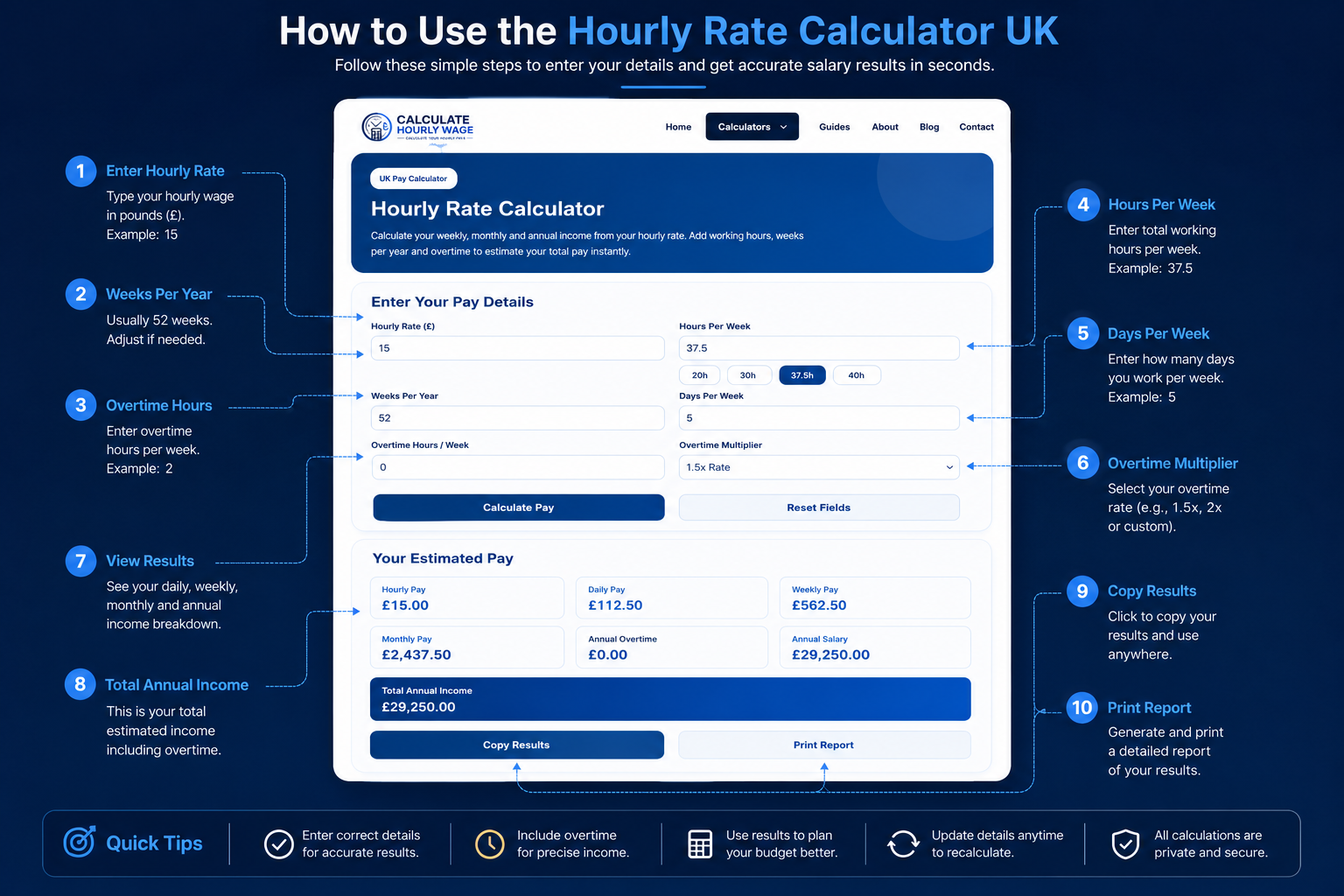
Once you've entered your hourly rate, working hours, weeks worked per year and any overtime, the calculator automatically performs a series of calculations to estimate your daily, weekly, monthly and annual gross earnings based on your working pattern.
Calculation Formulas Used
| Calculation | Formula |
|---|---|
| Weekly Pay | Hourly Rate × Hours Worked per Week |
| Daily Pay | Weekly Pay ÷ Working Days per Week |
| Annual Salary | Weekly Pay × Weeks Worked per Year |
| Monthly Pay | Annual Salary ÷ 12 |
| Annual Overtime | Overtime Hours × Overtime Rate × Weeks Worked |
| Total Annual Income | Annual Salary + Annual Overtime |
Since working hours, overtime and weeks worked each year vary from person to person, using a calculator is generally quicker and more reliable than performing manual calculations.
Common UK Working Hours
| Working Pattern | Typical Weekly Hours |
|---|---|
| Part-time | 16–30 hours |
| Standard Full-time | 37.5 hours |
| Full-time | 40 hours |
| Full-time with Regular Overtime | 45+ hours |
Why Use an Hourly Rate Calculator?
Although calculating hourly pay sounds straightforward, estimating your overall earnings becomes more complicated when overtime, unpaid leave, changing schedules or part-time hours are involved. An Hourly Rate Calculator UK converts a single hourly wage into estimated daily, weekly, monthly and annual earnings, giving you a clearer picture of your income.
The calculator is especially useful when comparing job offers. Some employers advertise an annual salary, while others quote an hourly rate. Converting both into the same format makes it easier to compare roles and understand which option better suits your financial goals.
It's equally useful for budgeting. Knowing your estimated weekly, monthly and annual income makes it much easier to plan for rent, household bills, savings and other regular expenses without relying on rough estimates.
If you regularly work overtime, the calculator estimates those additional earnings separately from your standard pay, making it easier to understand how extra hours can increase your total annual income.
Who Should Use This Calculator?
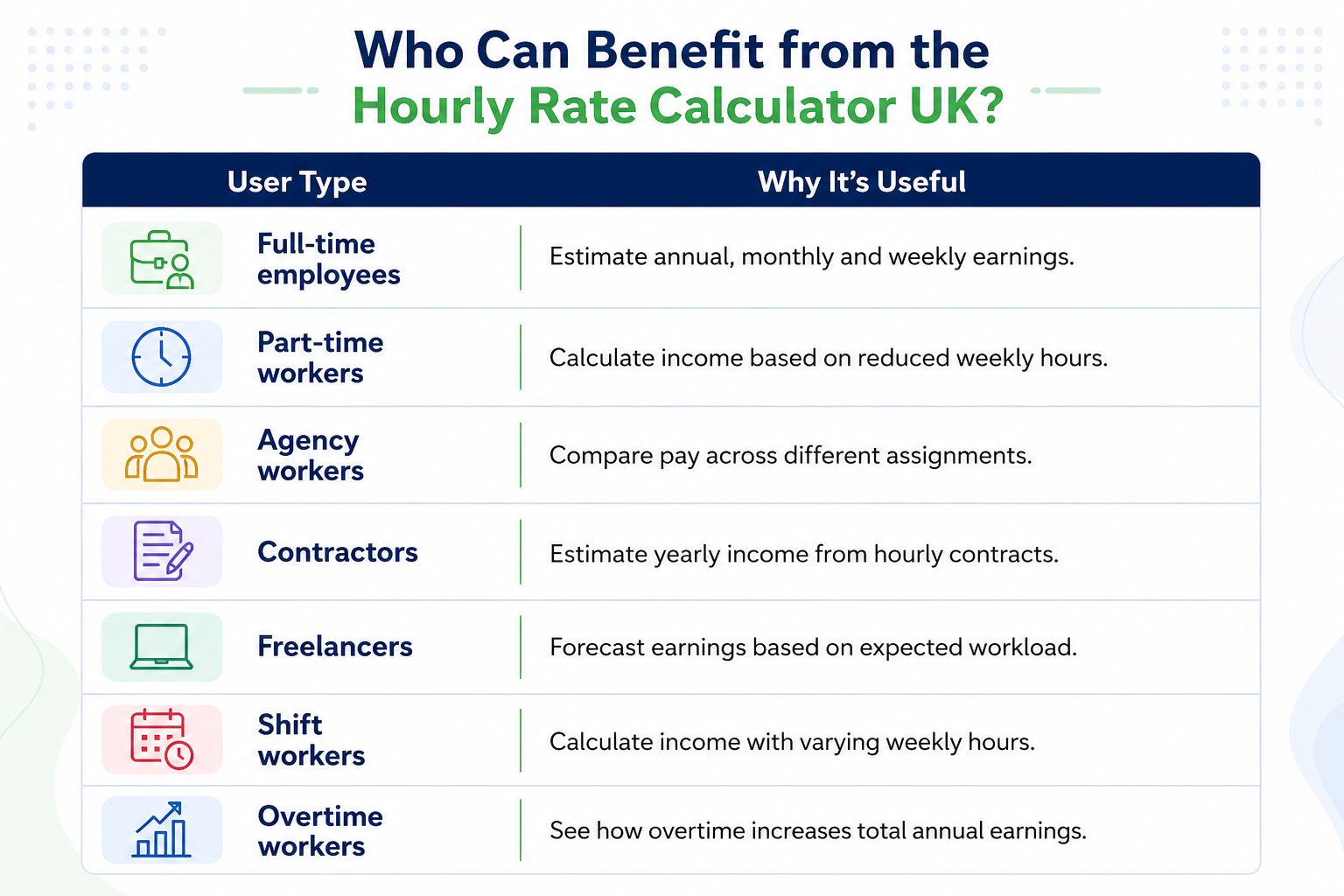
| User Type | Why It's Useful |
|---|---|
| Full-time employees | Estimate annual, monthly and weekly earnings. |
| Part-time workers | Calculate income based on reduced weekly hours. |
| Agency workers | Compare pay across different assignments. |
| Contractors | Estimate yearly income from hourly contracts. |
| Freelancers | Forecast earnings based on expected billable hours. |
| Shift workers | Calculate income with varying weekly hours. |
| Overtime workers | See how overtime increases total annual earnings. |
Instead of recalculating your earnings whenever your pay rate or working hours change, simply update your details and the calculator will instantly estimate your daily, weekly, monthly and annual gross income. This makes it easy to compare different working patterns and plan your finances with greater confidence.
Common Hourly Rates in the UK
Many workers want to understand how an hourly wage translates into weekly, monthly and annual earnings. The table below shows estimated gross pay for common hourly rates in the UK, based on a standard full-time schedule of 37.5 hours per week over 52 weeks per year.
| Hourly Rate | Weekly Pay | Monthly Pay | Estimated Annual Salary |
|---|---|---|---|
| £12.71 | £476.63 | £2,065.38 | £24,784.50 |
| £15.00 | £562.50 | £2,437.50 | £29,250.00 |
| £18.00 | £675.00 | £2,925.00 | £35,100.00 |
| £20.00 | £750.00 | £3,250.00 | £39,000.00 |
| £25.00 | £937.50 | £4,062.50 | £48,750.00 |
| £30.00 | £1,125.00 | £4,875.00 | £58,500.00 |
Why These Figures Are Only Estimates
The examples above are based on a standard full-time working pattern of 37.5 hours per week for 52 weeks per year. However, not every worker follows the same schedule.
If you work part-time, take unpaid leave, have seasonal employment or regularly work overtime, your actual earnings may differ from these estimates.
For a personalised estimate, enter your own hourly rate, weekly hours, weeks worked each year and any overtime into the calculator above.
Real-Life Hourly Pay Examples
Hourly earnings can vary significantly depending on your working hours and overtime. The examples below show how different employment situations can affect annual income.
Example 1: Full-Time Employee
Sarah earns £15 per hour and works 37.5 hours per week for 52 weeks each year.
Example Results
| Pay Period | Amount |
|---|---|
| Hourly Rate | £15.00 |
| Weekly Pay | £562.50 |
| Monthly Pay | £2,437.50 |
| Annual Salary | £29,250.00 |
This represents a typical full-time employee earning a consistent hourly wage without overtime.
Example 2: Part-Time Worker
James works 20 hours per week and earns £14 per hour.
Example Results
| Pay Period | Amount |
|---|---|
| Hourly Rate | £14.00 |
| Weekly Pay | £280.00 |
| Monthly Pay | £1,213.33 |
| Annual Salary | £14,560.00 |
A part-time schedule naturally results in lower yearly earnings, even when the hourly rate itself is competitive.
Example 3: Warehouse Worker With Overtime
Ahmed earns £16 per hour, works 40 hours each week and completes 5 overtime hours per week at 1.5× pay.
Example Results with Overtime
| Income Type | Amount |
|---|---|
| Standard Annual Salary | £33,280.00 |
| Estimated Annual Overtime | £6,240.00 |
| Total Annual Income | £39,520.00 |
This example shows how regular overtime can significantly increase your yearly income compared with your basic hourly pay alone.
Example 4: Agency Worker
Emma works through an agency and earns £18 per hour. Since her weekly shifts change depending on availability, her income can vary throughout the year.
By entering her current working hours into the calculator, she can quickly estimate her expected weekly, monthly and annual earnings based on her actual schedule.
| Pay Period | Amount |
|---|---|
| Hourly Rate | £18.00 |
| Weekly Pay (35 hrs) | £630.00 |
| Monthly Pay | £2,730.00 |
| Estimated Annual Salary | £32,760.00 |
Example 5: Freelancer or Contractor
Daniel charges clients £30 per hour. However, some weeks he works full-time while others are quieter.
Instead of assuming every week is identical, he adjusts his working hours and weeks per year to create a more realistic estimate of his expected annual income.
This approach is especially useful for freelancers and contractors whose workload changes throughout the year.
| Pay Period | Amount |
|---|---|
| Hourly Rate | £30.00 |
| Weekly Pay (30 hrs) | £900.00 |
| Monthly Pay | £3,900.00 |
| Estimated Annual Salary (48 weeks) | £43,200.00 |
What Information Affects Your Hourly Pay Estimate
Your estimated earnings depend on more than your hourly rate alone. The calculator uses several inputs to provide a more accurate estimate of your daily, weekly, monthly and annual income.
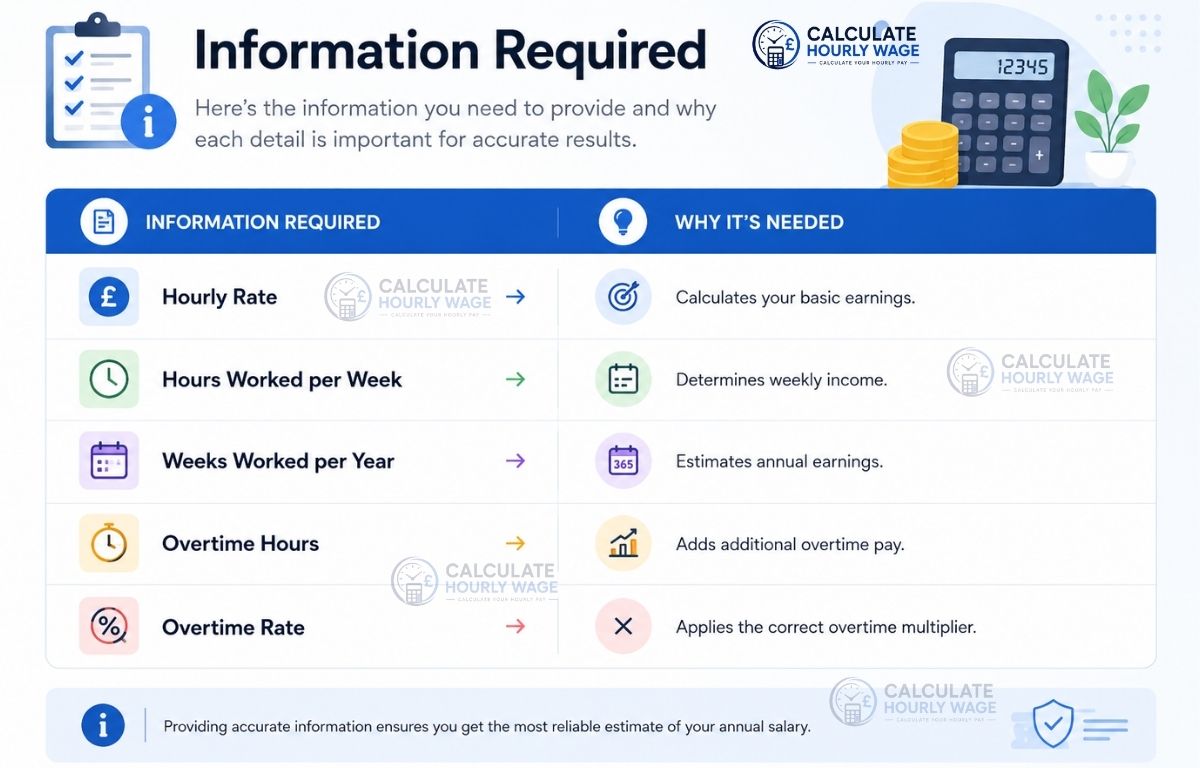
| Information Required | Why It's Needed |
|---|---|
| Hourly Rate | Calculates your basic earnings. |
| Hours Worked per Week | Determines weekly income. |
| Weeks Worked per Year | Estimates annual earnings. |
| Overtime Hours | Adds additional overtime pay. |
| Overtime Rate | Applies the correct overtime multiplier. |
Because every worker's schedule is different, entering your own working hours and pay details will produce a far more accurate estimate than relying on standard examples alone.