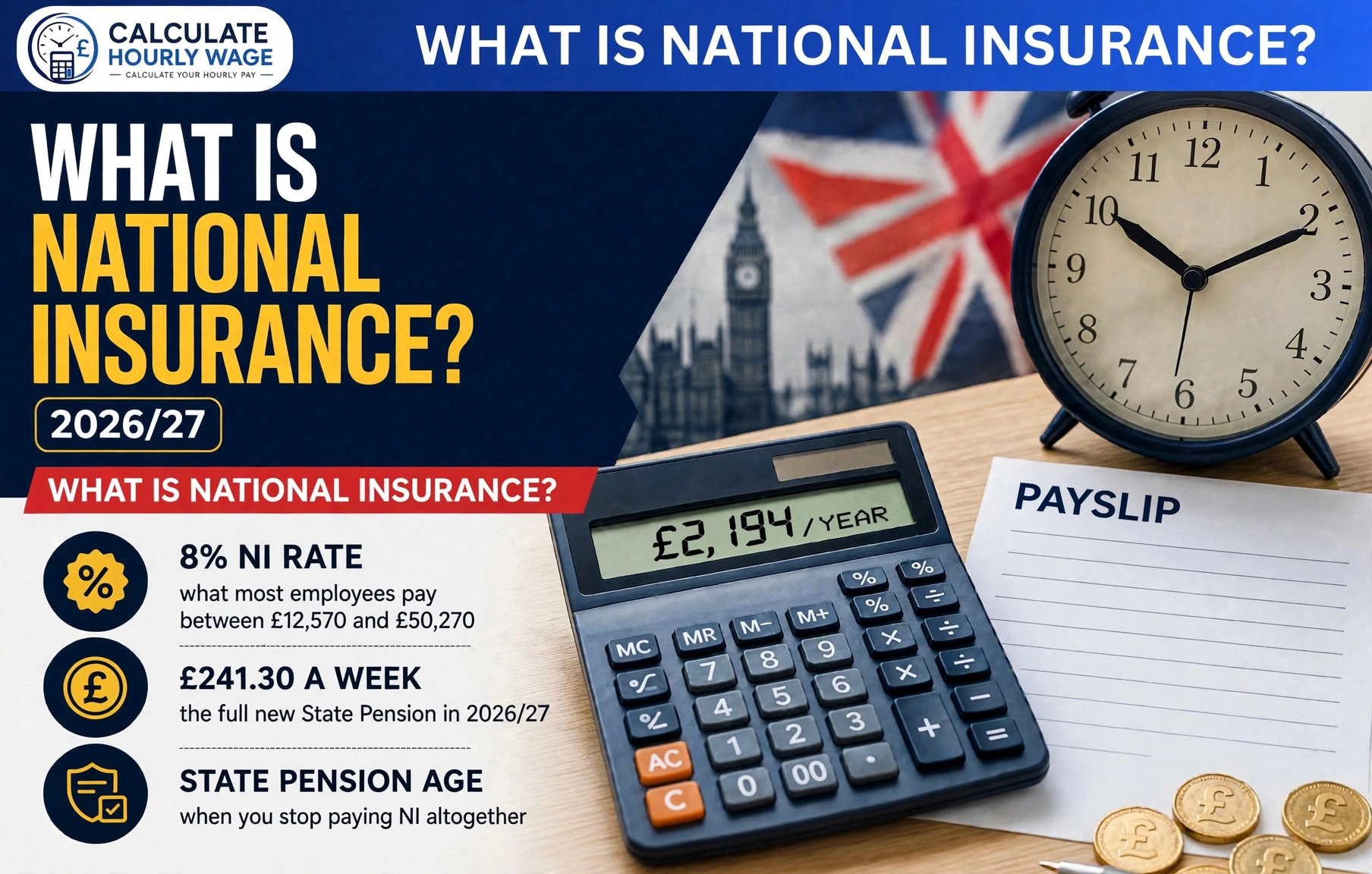
If you want to know what is National Insurance in the UK, the short answer is this: it is a contribution taken from your pay that builds your right to the State Pension and certain state benefits, and helps fund the NHS. It is not the same as Income Tax, even though both are taken from your wages before the money reaches your bank account. For most employees in 2026/27, National Insurance is 8% of earnings between £12,570 and £50,270 a year, and 2% on anything above that — and you stop paying it altogether once you reach State Pension age.
That one line on your payslip does more work than most people realise. It is the reason you qualify for a State Pension when you retire and the reason you can claim contribution-based Jobseeker’s Allowance if you lose your job. This guide explains what it is, what it pays for, who pays it, what it costs, and when it stops.
What Is National Insurance in the UK? The Short Answer
National Insurance is a system of contributions paid by employees, employers and self-employed people in the UK. Your employer takes your share out of your pay through PAYE, the same system that deducts your Income Tax, and you can see the amount on every payslip. If you are self-employed, you pay it through Self Assessment instead.
The idea is simple: workers and employers pay in while earning, and the money funds state support when people need it — in retirement, off sick, or out of work. Unlike Income Tax, which goes into the government’s general pot, National Insurance goes into a separate National Insurance Fund linked to specific benefits.
That link is what makes National Insurance different from an ordinary tax: paying it builds up your personal National Insurance record, which decides whether you qualify for the new State Pension and how much of it you get.
You need a National Insurance number for the whole system to work: it makes sure your contributions and tax are recorded against your name only, and most people receive theirs shortly before their 16th birthday.
What Does National Insurance Pay For?
National Insurance contributions count towards the benefits and pensions in the table below, and a share also goes to the NHS. The list is set out on GOV.UK — and it is narrower than many people think.
| What it funds | Who it covers |
|---|---|
| New State Pension | Employees, self-employed, voluntary contributors |
| Basic and Additional State Pension (pre-2016 rules) | Employees and voluntary contributors |
| New Style Jobseeker’s Allowance | Employees |
| Contribution-based Employment and Support Allowance | Employees and self-employed |
| Maternity Allowance | Employees and self-employed |
| Bereavement Support Payment | Employees and self-employed |
| NHS funding (a share of contributions) | Everyone who pays in |
The State Pension is by far the biggest thing National Insurance pays for: the regular payment the government makes to you once you reach State Pension age. In 2026/27 the full new State Pension is £241.30 a week, and you need 35 qualifying years on your record to receive it.
Your contributions also buy access to contributory benefits while you are of working age. If you lose your job, new Style Jobseeker’s Allowance is available because of the Class 1 contributions you paid as an employee. If illness stops you working, contribution-based Employment and Support Allowance works the same way. Maternity Allowance and Bereavement Support Payment work the same way. None of these are automatic — you need enough contributions in the right years — but without a National Insurance record, you cannot claim them at all. A share of your contributions also helps fund the NHS, though most NHS funding comes from general taxation — and National Insurance does not pay for Universal Credit, Housing Benefit or Child Benefit.
Who Pays National Insurance?
GOV.UK says you pay mandatory National Insurance if you are 16 or over and either an employee earning more than £242 a week from one job, or self-employed with profits over £12,570 a year. Employers pay too.
Employees pay Class 1 National Insurance. Your employer deducts it from your wages before you are paid, through PAYE, and it shows on your payslip as a separate line from Income Tax. You pay it on each job separately, and the £242-a-week threshold applies per job, not across all your jobs — one reason a second job can feel so heavily taxed.
Employers also pay Class 1 National Insurance on top of your salary. In 2026/27 the employer rate is 15% on earnings above £5,000 a year (the secondary threshold of £96 a week) — money you never see on your payslip: on a £40,000 salary, your employer pays £5,250 a year on top of your wages.
Self-employed people pay Class 4 National Insurance on profits over £12,570 a year — 6% up to £50,270 and 2% above that — and they may choose to pay Class 2 as well. Class 2 costs £3.65 a week, but for most self-employed people with profits of £7,105 or more it is treated as paid automatically.
People who are not working do not usually pay National Insurance, but they may still build up their record. National Insurance credits are given to people who are unemployed and claiming benefits, off sick, caring for someone, or on maternity or parental leave, and those credits count as qualifying years just like paid contributions. If you are not working and not getting credits, you can choose to pay voluntary Class 3 contributions — £18.40 a week in 2026/27.
How Much National Insurance Do You Pay in 2026/27?
For most employees the 2026/27 rates are straightforward: nothing on the first £12,570 you earn in a year — the Primary Threshold, set at the same level as the Personal Allowance — then 8% on earnings between £12,570 and £50,270, and 2% above that.
| Your earnings (2026/27) | Weekly | Monthly | Annual | NI rate |
|---|---|---|---|---|
| Up to the Primary Threshold | Up to £242 | Up to £1,048 | Up to £12,570 | 0% |
| Primary Threshold to Upper Earnings Limit | £242 to £967 | £1,048 to £4,189 | £12,570 to £50,270 | 8% |
| Above the Upper Earnings Limit | Over £967 | Over £4,189 | Over £50,270 | 2% |
Two features surprise people. First, the rate falls at the top: once your earnings pass £50,270, National Insurance drops from 8% to 2%, even though Income Tax rises from 20% to 40% at the same point. Second, National Insurance is worked out separately for each pay period, not added up over the year like Income Tax — so a one-off bonus can push one month’s pay into the 2% band even if your annual salary is well below £50,270.
GOV.UK’s worked example: on £1,000 a week, you pay nothing on the first £242, 8% (£58) on the £725 between £242 and £967, and 2% (£0.66) on the remaining £33 — £58.66 in total. Employers pay 15% on everything above £5,000 a year, with no upper limit. The Autumn Budget on 28 October 2026 left these rates unchanged for 2027/28, and the thresholds are frozen until at least April 2031; the Lower Earnings Limit rises from £129 to £133 a week in April 2027. Work out your own NI bill with our National Insurance calculator to see exactly what these rates mean for your salary.
Worked Examples: What National Insurance Costs at Real Salaries
The examples below use the 2026/27 rates and a standard 1257L tax code, with no pension contributions or other deductions.
Example 1: £25,000 salary. Sarah earns £25,000 a year. Her National Insurance is 8% of the £12,430 she earns above the £12,570 threshold: £994.40 a year, or £82.87 a month. Her Income Tax is 20% of the same £12,430: £2,486 a year. Together they come to £3,480.40 a year, leaving take-home pay of £21,519.60 a year, or £1,793.30 a month.
Example 2: £40,000 salary. James earns £40,000 a year. His National Insurance is 8% of £27,430 (£2,194.40 a year, £182.87 a month) and his Income Tax is 20% of the same £27,430 (£5,486 a year), leaving take-home pay of £32,319.60 a year, or £2,693.30 a month. His employer pays another £5,250 a year on top — 15% of the £35,000 above the £5,000 secondary threshold.
Example 3: £60,000 salary. Amira earns £60,000 a year. Her National Insurance is 8% of the £37,700 between £12,570 and £50,270 (£3,016) plus 2% of the £9,730 above £50,270 (£194.60) — £3,210.60 a year, or £267.55 a month. Her Income Tax is £11,432 a year, leaving take-home pay of £45,357.40 a year, or £3,779.78 a month. The extra £10,000 Amira earns over £50,270 costs her only £194.60 in National Insurance, against £3,892 in Income Tax.
| Salary | NI per year | NI per month | Income Tax per year | Take-home per month |
|---|---|---|---|---|
| £25,000 | £994.40 | £82.87 | £2,486 | £1,793.30 |
| £40,000 | £2,194.40 | £182.87 | £5,486 | £2,693.30 |
| £60,000 | £3,210.60 | £267.55 | £11,432 | £3,779.78 |
See these figures for your own salary with our annual salary calculator or our salary to hourly calculator.
National Insurance vs Income Tax: What’s the Difference?
People often treat National Insurance and Income Tax as the same thing, but they work differently in almost every way that matters.
| National Insurance | Income Tax | |
|---|---|---|
| What it funds | State Pension, contributory benefits, part of the NHS | General government spending |
| Paid on | Earnings from work only | Earnings, savings interest, dividends, rent, pensions |
| Threshold | £12,570 a year (Primary Threshold) | £12,570 a year (Personal Allowance) |
| Main rate | 8% | 20% |
| Top rate | 2% above £50,270 (rate falls) | 40% above £50,270, 45% above £125,140 (rate rises) |
| Calculated | Each pay period separately | Cumulatively over the tax year |
| Stops at State Pension age? | Yes | No |
| Builds entitlement? | Yes — State Pension and benefits | No |
The biggest practical difference is that Income Tax is cumulative and National Insurance is not: Income Tax is worked out on everything earned since 6 April, so overpayments correct themselves, while National Insurance is worked out on each week’s or month’s pay in isolation.
The second difference is what counts: National Insurance is charged only on earnings from work, while Income Tax also covers savings interest, dividends, rental income and pension income — so a retiree living on a pension still pays Income Tax but no National Insurance. And the rates pull in opposite directions: Income Tax rises — 20%, then 40%, then 45% — while National Insurance falls at the top, from 8% to 2%. Combined, the marginal rate is 28% between £12,570 and £50,270, and 42% above it.
The Classes of National Insurance
National Insurance is divided into classes, and the class you pay depends on your employment status and how much you earn.
| Class | Who pays it | 2026/27 rate |
|---|---|---|
| Class 1 (employee) | Employees earning over £242 a week | 8% up to £50,270, 2% above |
| Class 1 (employer) | Employers on earnings over £5,000 a year | 15% |
| Class 1A and 1B | Employers, on expenses and benefits | 15% |
| Class 2 | Self-employed (voluntary) | £3.65 a week |
| Class 3 | Voluntary, to fill gaps in your record | £18.40 a week |
| Class 4 | Self-employed on profits over £12,570 | 6% up to £50,270, 2% above |
Class 1 is the one most people know: the employee deduction on the payslip, plus the employer’s share on top. Classes 1A and 1B are employer-only charges on things like company cars and private medical insurance — you never pay them yourself.
Class 4 is the self-employed equivalent of the employee rate, charged on annual profits: 6% on profits between £12,570 and £50,270, and 2% above that. Class 2 is a flat £3.65 a week, but for most self-employed people it is treated as paid automatically once profits reach £7,105.
Class 3 is the voluntary class, for people with gaps in their record who want to buy extra qualifying years. At £18.40 a week, one full year costs about £956.80, and each qualifying year you add is worth roughly £6.89 a week of State Pension for life. But voluntary contributions do not always increase your pension — if you already have 35 qualifying years, or were contracted out before 2016, extra years may add nothing. Always check your forecast before paying.
How National Insurance Builds Your State Pension
The State Pension is the main reason National Insurance exists: your National Insurance record decides how much pension you get. Every tax year in which you pay enough National Insurance — or are credited with enough — counts as a qualifying year, meaning a year in which your earnings reached at least the Lower Earnings Limit of £6,708 a year (£129 a week). Earn between £6,708 and £12,570 and you pay no National Insurance at all, but the year still counts.
For the new State Pension, which applies to everyone reaching State Pension age on or after 6 April 2016, you need at least 10 qualifying years to receive anything at all, and 35 for the full amount. Between 10 and 35 years you get a proportion: in 2026/27 the full new State Pension is £241.30 a week, so each qualifying year is worth about £6.89 a week, or around £358 a year, for the rest of your life.
That arithmetic is what makes gaps in your record so expensive. Missing five qualifying years costs you about £34.45 a week — nearly £1,792 a year — for every year of your retirement. Over a twenty-year retirement, that is more than £35,000. It is also why the government lets you fill gaps with voluntary Class 3 contributions, and why it is worth checking your record long before you retire.
The pension rises each year under the triple lock: by the highest of average earnings growth, Consumer Prices Index inflation, or 2.5%. In April 2026 the full new State Pension rose by 4.8%, from £230.25 to £241.30 a week, and the Budget on 28 October 2026 kept the triple lock in place up to and including the April 2029 uprating.
There is one important exception to the 35-year rule. If your National Insurance record started before April 2016, transitional rules apply — particularly if you were contracted out of the Additional State Pension through a workplace or personal pension scheme. If that applies to you, the only reliable figure is your own State Pension forecast.

When Do You Stop Paying National Insurance?
You stop paying Class 1 National Insurance when you reach State Pension age — even if you keep working. State Pension age is currently 66, and it is rising to 67 between 2026 and 2028 for people born on or after 6 April 1960. If you are self-employed, you stop paying Class 4 from 6 April (the start of the tax year) after you reach State Pension age.
Income Tax never stops, so working past State Pension age means your employer stops deducting National Insurance but keeps deducting Income Tax. For someone earning £40,000, that is an extra £182.87 a month in take-home pay — a pay rise that arrives with no negotiation at all.
There is a practical catch: your employer can only stop deducting National Insurance if they know you have reached State Pension age, so make sure your date of birth is correct on your payroll record. If your employer keeps deducting it by mistake, you can claim a refund from HMRC.
How to Check Your National Insurance Record
The single most useful thing you can do after reading this guide is to check your own record. It takes a few minutes, it is free, and it shows how many qualifying years you have, which years have gaps, and how much State Pension you are on track to receive.
Go to GOV.UK and search for “Check your National Insurance record”, or use the “Check your State Pension forecast” service. You will need to sign in with a Government Gateway user ID or GOV.UK One Login, and you may be asked to verify your identity with photo ID. Both services are also in the HMRC app.
Your record shows every tax year from the age of 16, marked as a full year or a year that is not full. For each gap year, the forecast service usually tells you whether you can fill it, what it would cost, and how much extra pension it would buy you. If the record looks wrong, contact HMRC’s National Insurance helpline — old payslips and P60s are the evidence it will ask for, so keep them.
The Bottom Line
So, what is National Insurance in the UK? It is the contribution that buys your State Pension and your access to contributory benefits, and helps fund the NHS. Most employees pay 8% on earnings between £12,570 and £50,270 and 2% above that, their employer pays 15% on top, and the whole thing stops at State Pension age. Unlike tax, it builds you something: a record that decides what the state pays you when you retire.
The practical steps are simple. Check your payslip to see what you are paying, and check your National Insurance record on GOV.UK to see how many qualifying years you have. If you want to know what National Insurance costs you on your exact salary, work out your own NI bill with our National Insurance calculator — then use our annual salary calculator to see the full picture. If your payslip still confuses you, our guide on how to read your payslip explains every line, and our guide to emergency tax codes explains what happens when you start on the wrong code.
Frequently Asked Questions
What is National Insurance in the UK?
National Insurance is a contribution paid by employees, employers and self-employed people in the UK. It builds your entitlement to the State Pension and certain contributory benefits, and part of it helps fund the NHS. In 2026/27 most employees pay 8% on earnings between £12,570 and £50,270 a year, and 2% above that.
What does National Insurance pay for?
National Insurance pays for the State Pension, contribution-based Jobseeker’s Allowance and Employment and Support Allowance, Maternity Allowance and Bereavement Support Payment, and a share of NHS funding. It does not pay for Universal Credit, Child Benefit or most other means-tested benefits, which come from general taxation.
How much National Insurance do I pay on a £40,000 salary?
On a £40,000 salary in 2026/27 you pay £2,194.40 a year, or £182.87 a month — 8% of the £27,430 you earn above the £12,570 Primary Threshold. Your employer pays a further £5,250 a year on top of your salary.
Do I pay National Insurance on a second job?
Yes. National Insurance is charged separately on each job, with the £242-a-week threshold applying to each job on its own. If both jobs pay more than £242 a week, you pay National Insurance on both. Income Tax works differently — your Personal Allowance is normally given to your main job only, so a second job is usually taxed at 20% on every pound.
When do I stop paying National Insurance?
You stop paying Class 1 National Insurance when you reach State Pension age, currently 66 and rising to 67 between 2026 and 2028, even if you keep working. If you are self-employed, you stop paying Class 4 from the 6 April after you reach State Pension age. Income Tax does not stop — you keep paying it on earnings above the Personal Allowance.
Does National Insurance count towards my State Pension?
Yes — that is its main purpose. Each tax year in which you pay enough National Insurance, or receive National Insurance credits, counts as a qualifying year. You need at least 10 qualifying years for any new State Pension and 35 for the full amount, which is £241.30 a week in 2026/27. You can check your record and forecast free on GOV.UK.
Sources
- GOV.UK — National Insurance: introduction: https://www.gov.uk/national-insurance
- GOV.UK — Rates and thresholds for employers 2026 to 2027: https://www.gov.uk/guidance/rates-and-thresholds-for-employers-2026-to-2027
- GOV.UK — National Insurance rates and categories: https://www.gov.uk/national-insurance-rates-letters/print
- GOV.UK — The new State Pension: what you’ll get: https://www.gov.uk/new-state-pension/what-youll-get
- GOV.UK — Voluntary National Insurance: https://www.gov.uk/voluntary-national-insurance-contributions
- GOV.UK — Check your National Insurance record: https://www.gov.uk/check-national-insurance-record