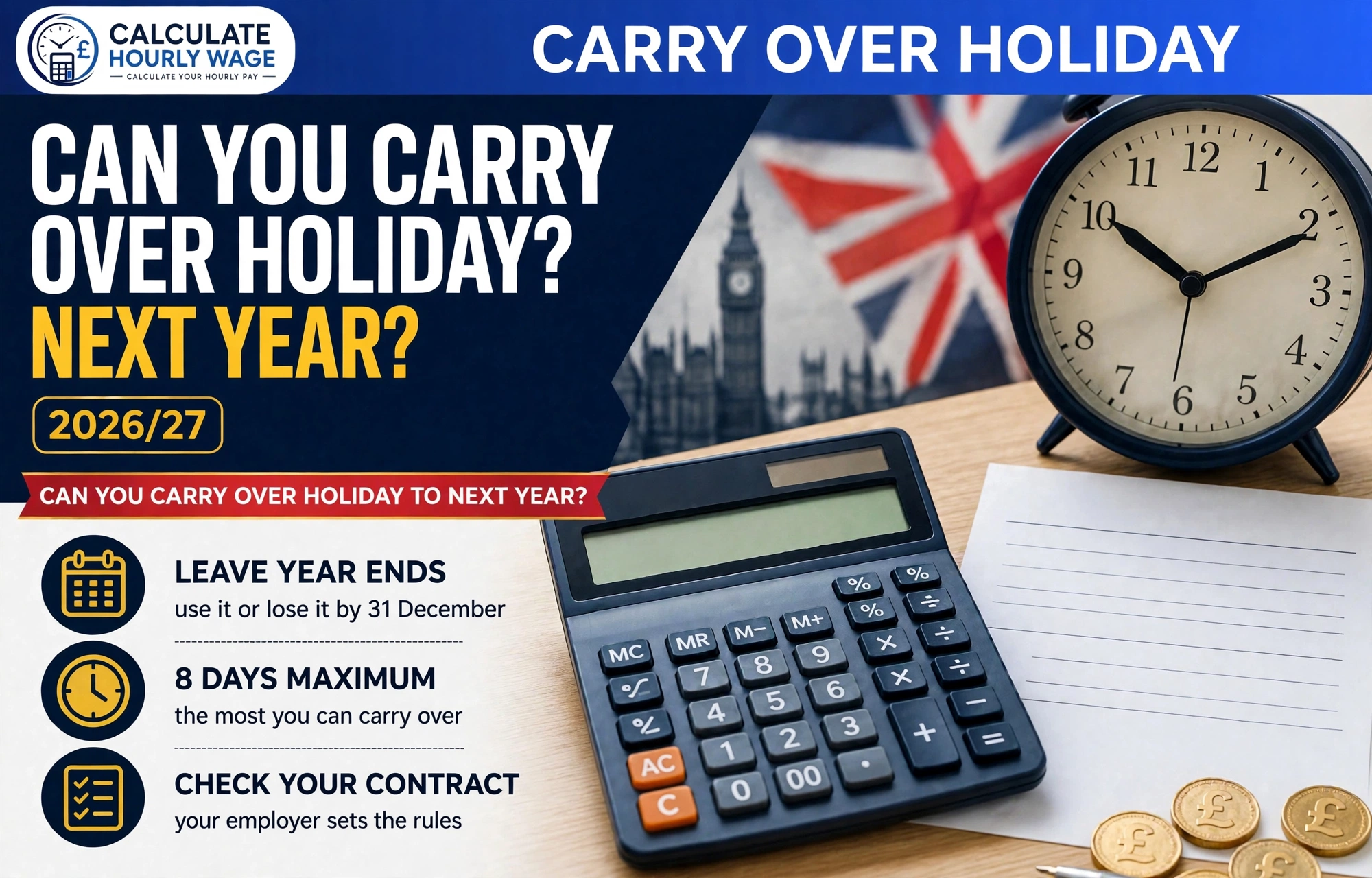
If you are asking can you carry over annual leave in the uk, here is the direct answer: yes, but only within limits, and your contract decides how much. If you get the standard 28 days of statutory leave, you can carry over a maximum of 8 days into the next leave year — and only if your employer agrees. The other 20 days must be taken in the year they belong to, or they are lost. There are important exceptions: if you were sick, on parental leave, or your employer never gave you a fair chance to take your leave, the law can force your employer to let you carry over far more — in some cases your whole entitlement.
That short answer hides a lot of detail, and the detail is where people lose days they were entitled to keep. This article works through the rules step by step: how much you can carry over, the situations where carry-over is a legal right rather than a favour, what happens to the days once they are carried over, and what to do before your leave year runs out.
Can You Carry Over Annual Leave in the UK? The Rules in Brief
Almost every worker in the UK is legally entitled to 5.6 weeks of paid holiday a year, known as statutory leave entitlement. For someone working a five-day week, that works out at 28 days. The basic rule, set out in the government’s own guidance, is that workers must take their statutory leave during the leave year it is for. The leave year is the period your employer sets — often 1 January to 31 December, but it can be any 12 months, and your employer should have told you the dates when you started.
Carrying leave over is not the default. The government’s guidance puts it plainly: your contract says how many days of leave you can carry over into the next year. If you get 28 days of leave, you can carry over a maximum of 8 days. If you get more than 28 days, your employer may allow you to carry over any additional untaken leave on top of that. So the first thing to check is not the law in general, but your own contract, staff handbook or intranet — that is where the number that applies to you lives.
There is a second, separate set of rules that overrides the contract. In certain situations — sickness, family-related leave, and cases where the employer itself stopped you taking leave — the law gives you a right to carry over leave whether your contract allows it or not. Those exceptions are covered below, because they are the situations in which people most often lose out by assuming the answer is simply “no”.
The Two Parts of Your Holiday — and Why Only One Carries Over
The 8-day maximum is not a random number. Your 5.6 weeks of statutory leave is actually made up of two parts, and they are treated differently. The first part is 4 weeks — 20 days for a full-time worker on a five-day week. The second part is 1.6 weeks — 8 days for that same worker. Add them together and you get 5.6 weeks, or 28 days.
The 4-week part is the core of the entitlement. It exists to protect your health: everyone needs a proper break every year, so this block is meant to be taken in the year it belongs to. There is no general right to carry it over, and your employer cannot pay you for it instead of letting you take it. The 1.6-week part is the extra leave the UK adds on top of the European minimum, and it is this part that your contract can allow you to carry over — which is why the maximum carry-over for someone on 28 days is exactly 8 days.
This split also explains why the rules feel uneven. If you have only used 12 of your 28 days by December, you cannot simply roll all 16 unused days into January. At most 8 of them — the 1.6-week part — can move across, and only if your contract allows it. The other 8 unused days belong to the 4-week part and are lost unless one of the exceptions below applies.
How Much Annual Leave Can You Carry Over?
The amount you can carry over depends on three things: how many days you get in total, how many you have left unused, and what your contract says. The table below shows the usual position for a full-time worker on 28 days, and for two common variations.
| Your annual leave | Days you can carry over | Notes |
|---|---|---|
| 28 days (statutory only) | Up to 8 days | Only if your contract allows it; the 8 days are the 1.6-week part |
| 33 days (28 statutory + 5 contractual) | Up to 8 statutory days, plus up to 5 contractual days if your employer allows | Extra days follow your contract, not the statutory rules |
| 25 days (part-time, 5 days pro-rated) | Up to 4.8 days | Pro-rata: 1.6 weeks of your working pattern (see the part-time example below) |
A worked example makes this concrete. Take Sarah, who works full time, five days a week, and gets 28 days of leave a year. Her leave year runs from 1 January to 31 December. By mid-December she has taken 20 days, leaving 8 days unused. Her contract allows carry-over, so she can move all 8 unused days into the new year. She now starts January with 8 carried-over days plus her fresh 28, giving her 36 days to use in the new year. If her contract instead said carry-over is not allowed, those 8 days would simply disappear on 31 December.
Now take the same Sarah, but suppose she has only taken 12 days by December, leaving 16 unused. Even with a contract that allows carry-over, she can move at most 8 days across. The other 8 days are lost, because they belong to the 4-week part of her entitlement that must be taken in the year. This is the trap that catches people who save all their leave for December: the 8-day cap means you cannot rescue a whole year’s worth of untaken leave in one go.
A second example shows how the extra contractual days work. James gets 33 days a year — the statutory 28 plus 5 extra days his employer offers. He has 10 days left at year-end. He can carry over up to 8 statutory days, and his contract also allows the 5 extra days to be carried over, so he can move 13 days in total. But that second part depends entirely on his employer’s policy: another employer offering the same 33 days could allow only the statutory 8 and refuse the extra 5. The extra days above 28 are contractual leave, not statutory leave, so the statutory rules do not apply to them in the same way — again, the contract is the document that decides.
Part-time workers follow the same logic, just with smaller numbers. If you work three days a week, your statutory entitlement is 5.6 weeks of your working pattern — 3 × 5.6 = 16.8 days. The 1.6-week part of that is 3 × 1.6 = 4.8 days, so the most you could carry over is 4.8 days (in practice your employer may round this to 4.5 or 5 days). If you want to check your own entitlement, use our holiday leave accrual calculator — it works out your pro-rata figure from the days you work each week.

When Your Employer Must Let You Carry Over Holiday
Everything above assumes a normal year. But the law recognises that sometimes a worker cannot take their leave through no fault of their own, and in those cases carry-over becomes a right, not a favour. Your contract cannot take these rights away.
The first situation is sickness. If you could not take your leave because you were sick, you can carry over up to 20 of your 28 days’ leave entitlement if you work regular hours for the whole year. If you work irregular hours or for part of the year, you can carry over up to 28 days.
The second situation is family-related leave. If you cannot take some or all of your leave because you are on parental leave — maternity, paternity or adoption leave, for example — you can carry over your untaken leave into next year. Your entitlement keeps building up during family leave exactly as it does while you are at work, so a worker returning from maternity leave in November is not expected to squeeze a whole year’s holiday into the weeks before Christmas. The same protection applies to other family-related leave covered by the government’s guidance.
The third situation is where the employer itself is at fault. Workers can carry over their whole leave entitlement if any of the following apply: they did not receive rolled-up holiday pay that they were entitled to; they were not given a reasonable opportunity to take their leave; or they were not told that they would lose their leave if they did not take it by the end of the leave year. This is the rule that matters most in workplaces where leave requests are routinely refused at busy times, or where nobody ever reminds staff to book their days. An employer that blocks your leave all year cannot then use the year-end as a reason to wipe it out.
What Happens to the Days You Carry Over?
Carried-over days are not extra holiday on top of everything else — they are last year’s leave, used in this year’s calendar. They are paid at your normal rate when you take them, just like any other day of statutory leave. For a worker on £15 an hour working a 7.5-hour day, each carried-over day is worth £112.50 when taken. At the National Living Wage of £12.71 an hour, which has applied to workers aged 21 and over since 1 April 2026, a carried-over day is worth £95.33. The money is not the issue — the days are paid the same either way. What matters is the deadline.
Most employers set a deadline for using carried-over leave — commonly the end of March, or the end of the first quarter of the new leave year. The statutory rules do not fix a single deadline for contractual carry-over, so again your contract or handbook is the document that sets it. Treat the deadline as firm: days carried over and then not used by the deadline are usually lost for good, and there is no second carry-over. If your employer allows 8 days to be carried over to 31 March, plan to use them before then, and do not assume they will be rolled forward again.
Can You Be Paid for Untaken Holiday Instead?
This is one of the most common questions, and the answer is almost always no. While you are still employed, your employer cannot pay you in place of your statutory leave, and you cannot ask to be paid for it either. The law is designed that way on purpose: the point of paid holiday is that you actually take the time off, not that you sell it back for extra money.
There are only two exceptions. The first is when your employment ends: then your employer must pay you for any untaken statutory leave, including days you carried over from the previous year. Our article on what happens to unused holiday when you leave your job explains that final-pay calculation in full. The second is rolled-up holiday pay, which is a different system entirely: for irregular-hours and part-year workers, an employer can add a 12.07% uplift to pay on each payslip instead of paying separately when leave is taken. That uplift is the holiday pay, paid in advance — it is not a way of cashing in ordinary leave, and it only applies to irregular-hours and part-year workers for leave years from 1 April 2024. Our article on rolled-up holiday pay explains how that system works and how to tell whether you are on it.
If your employer offers you money for untaken statutory leave while you are still employed, be cautious: it is not a lawful arrangement for the statutory part of your leave, and accepting it does not create a right to the money. The safe route is to take the leave, or carry over what the rules allow.
Carrying Over Leave on a Zero-Hours or Part-Time Contract
The carry-over rules apply to everyone, but they work slightly differently for workers whose hours are not fixed. If you are on a zero-hours contract or work irregular hours, your leave accrues at 12.07% of the hours you work in each pay period, for leave years from 1 April 2024. That accrual builds up your entitlement hour by hour, rather than giving you a fixed number of days at the start of the year. Our article on zero-hours holiday accrual explains the 12.07% rule with worked examples.
For carry-over, the key difference is the sick-leave rule. If you work irregular hours or for part of the year and you could not take your leave because you were sick, you can carry over up to 28 days of your leave entitlement — the full 5.6 weeks — rather than the 20 days that applies to regular-hours workers.
Part-time workers with regular hours are in the same position as full-time workers, just with pro-rata numbers. Your 5.6 weeks is worked out on your own working pattern, and the 1.6-week part — the most you can carry over under a normal contract — is worked out the same way. A worker on two days a week gets 11.2 days a year, and could carry over up to 3.2 days. Our article on part-time holiday entitlement works through the pro-rata calculation, and our holiday leave accrual calculator will give you your exact figure from the days you work.
One common mistake for irregular-hours workers is to assume that carried-over leave and rolled-up holiday pay are the same thing. They are not. If you receive rolled-up holiday pay, the uplift on each payslip is your holiday pay, and there is no separate balance of days to carry over. If you accrue hours of leave instead, those hours are a balance that can be carried over under the rules above. Check your payslip: rolled-up holiday pay must be itemised separately, so you can tell which system you are on.
What to Do Before Your Leave Year Ends
The single most useful habit is to check your balance early — October, not December. By October you can still see how many days you have left, how many the 8-day cap will let you carry over, and how many you would lose if you did nothing. A quick check against your contract tells you whether carry-over is allowed at all, and by what date carried-over days must be used.
Work through these steps in order. First, find your leave year dates and your total entitlement — your contract or handbook should state both. Second, count the days you have taken and the days you have left, using your payslips or your employer’s holiday system. Third, check the carry-over clause: how many days can be carried over, and by when must they be used. Fourth, book the days you cannot carry over before the year ends, giving proper notice — as a general rule, at least twice as long as the leave you want to take, plus one day. If your employer refuses the dates, ask for the refusal in writing and for alternative dates; an employer can refuse a particular time, but it cannot refuse to let you take the leave at all.
If you think one of the exceptions applies — you were sick, on parental leave, or your employer blocked your leave or never warned you about losing it — raise it in writing before the year ends, and keep a copy. State the dates you were unable to take leave and ask the employer to confirm in writing how many days will be carried over. Employers must now keep detailed leave records for at least six years, so they should be able to show you the same figures you are working from.

The Bottom Line on Carrying Over Annual Leave in the UK
Can you carry over annual leave in the uk? Yes — up to 8 days if you get the standard 28 days, and only if your contract allows it. Those 8 days are the 1.6-week part of your statutory entitlement; the other 20 days, the 4-week part, must be taken in the year or they are lost. If you get more than 28 days, the extra contractual days follow your employer’s own rules and may also be carried over. If you were sick, on parental leave, or your employer blocked your leave, the law can require much more — up to 20 days for sickness, up to 28 days for irregular-hours workers, and your whole entitlement if your employer prevented you from taking it.
The practical rule is simple: do not leave it to December. Check your contract, count your days in October, book what you cannot carry over, and put any exception in writing before the year ends. The days you save are paid days off you have already earned — and once the leave year closes, most of them cannot be got back.
Sources
- GOV.UK — Holiday entitlement
- GOV.UK — Holiday pay and entitlement reforms from 1 January 2024
- GOV.UK — National Minimum Wage and National Living Wage rates
Frequently Asked Questions
Can you carry over annual leave in the uk if your contract says nothing about it?
If your contract is silent, the statutory position is that you cannot carry over the 4-week part of your leave, but your employer may allow the 1.6-week part (up to 8 days for a full-time worker) to be carried over. Check your contract, staff handbook or intranet first — most employers state their carry-over policy there. If you were sick, on parental leave, or your employer did not give you a reasonable opportunity to take your leave, the law gives you a right to carry over regardless of what the contract says.
How many days of annual leave can I carry over to next year?
If you get 28 days of statutory leave, the maximum you can carry over under a normal contract is 8 days. If you get more than 28 days, your employer may also allow you to carry over the additional contractual days. The 8-day figure is the 1.6-week part of your 5.6-week entitlement; the other 20 days (the 4-week part) must normally be taken in the year.
Can I carry over annual leave if I was off sick?
Yes. If you could not take your leave because you were sick, you can carry over up to 20 of your 28 days if you work regular hours for the whole year, or up to 28 days if you work irregular hours or for part of the year. Your employer cannot refuse this carry-over even if your contract says leave cannot be carried over.
What happens to carried-over holiday if I leave my job?
Your employer must pay you for any untaken statutory leave when your employment ends, including days you carried over from the previous year. Payment in lieu of statutory leave is only allowed when employment ends — you cannot be paid for untaken leave while you are still employed.
Do carried-over days have a deadline?
Usually yes. Most employers set a deadline for using carried-over leave, commonly the end of March or the end of the first quarter of the new leave year. The deadline is set by your contract or handbook, not by a single statutory date, so check what yours says and treat it as firm — days not used by the deadline are normally lost.
Can part-time workers carry over annual leave?
Yes, on the same principles but with pro-rata numbers. If you work three days a week, your entitlement is 16.8 days a year, and the most you could normally carry over is 4.8 days (the 1.6-week part of your pattern). The same exceptions apply: sickness, parental leave, or an employer that prevented you from taking leave can require a larger carry-over.