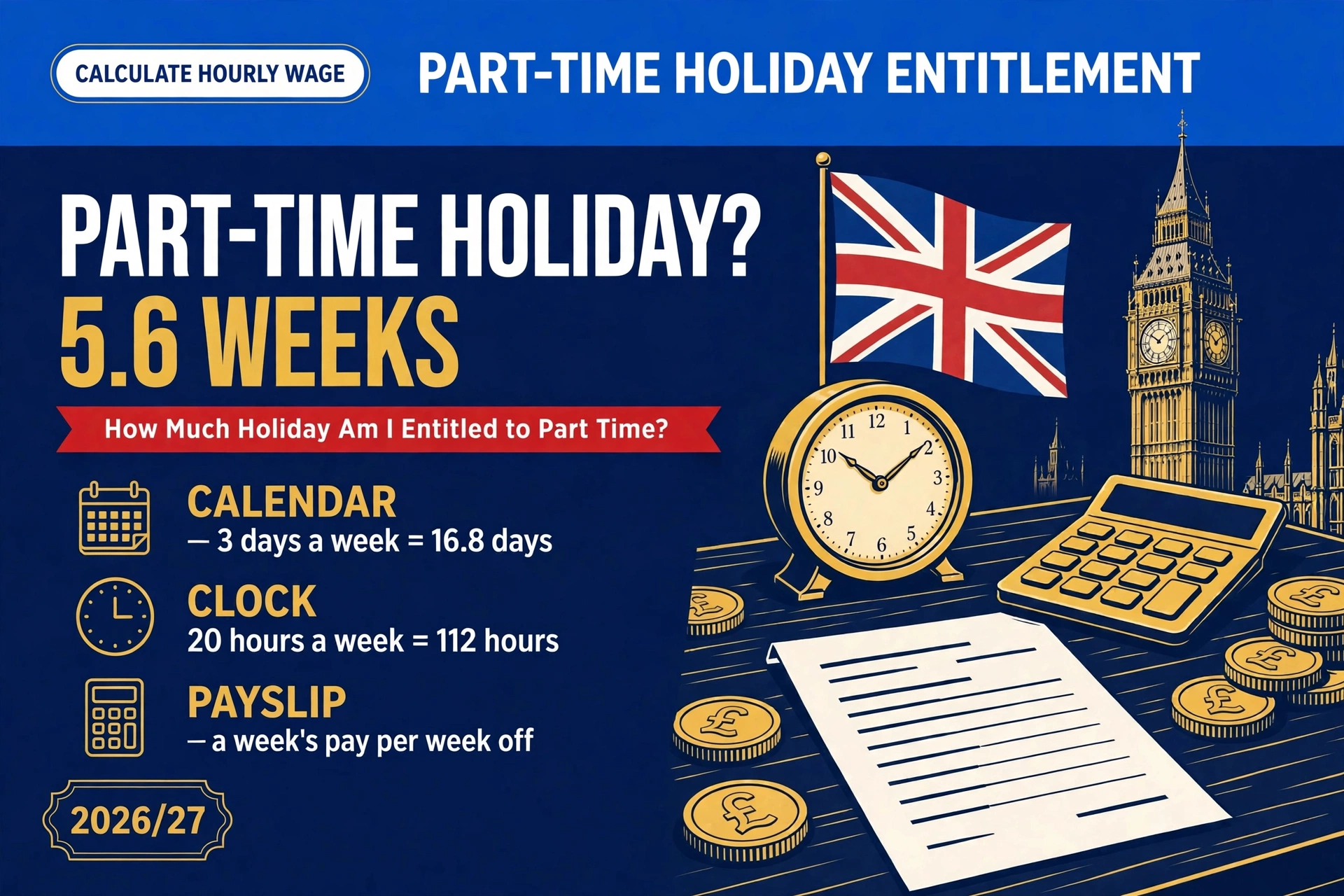
If you work part time, how much holiday am I entitled to part time is a question worth getting exactly right, because the answer is often less than the 28 days full-time colleagues talk about — and that smaller number is correct, not a mistake. The short answer is this: almost every worker in the UK is legally entitled to at least 5.6 weeks of paid holiday a year, and for a part-time worker that 5.6 weeks is scaled down in proportion to the days or hours worked. A worker on three days a week gets at least 16.8 days a year. A worker on two days a week gets at least 11.2 days. The weeks stay the same; the days change.
That distinction is the whole trick. Part-time workers do not get a smaller number of weeks. They get the same 5.6 weeks as everyone else, but because their working week is shorter, 5.6 weeks of their time adds up to fewer days. A full-time worker’s 5.6 weeks is 28 days because they work five days a week. Your 5.6 weeks might be 16.8 days, or 22.4 days, or a number of hours instead of days. Once you understand that, you can check your own entitlement in under a minute, and you can spot straight away if your employer has given you too little.
Every statutory figure here comes from GOV.UK, and the sources are listed at the end so you can check them yourself.
The Legal Minimum: 5.6 Weeks, Whatever Your Hours
GOV.UK states the rule plainly: almost all people classed as workers are legally entitled to 5.6 weeks of paid holiday a year, known as statutory leave entitlement or annual leave. That covers agency workers, workers with irregular hours, and part-year workers as well as regular part-time and full-time staff. There is no qualifying period. You start building up holiday from your first day, although your employer may use an accrual system in your first year, which is covered later in this guide.
For a worker on a five-day week, 5.6 weeks works out to 28 days a year (5.6 × 5 = 28). That 28 days is also the cap: statutory paid holiday entitlement is limited to 28 days, so someone working six days a week is still only entitled to 28 days, not 33.6.
Your employer can offer more than the legal minimum, and many do. If your contract says 25 days plus bank holidays, or 30 days, that contractual figure replaces the statutory minimum as your actual entitlement. What your employer cannot do is offer less than 5.6 weeks pro rata. If your contract gives you less, the statutory minimum overrides it.
The Simple Formula: Days Worked Per Week × 5.6
For a part-time worker who works the same days every week, the calculation is one multiplication. GOV.UK gives the example itself: a part-time worker on three days a week must get at least 16.8 days of leave a year, because 3 × 5.6 = 16.8.
Here is the full scale for regular weekly patterns:
| Days worked per week | Calculation | Minimum statutory leave per year |
|---|---|---|
| 5 days (full time) | 5 × 5.6 | 28 days |
| 4.5 days | 4.5 × 5.6 | 25.2 days |
| 4 days | 4 × 5.6 | 22.4 days |
| 3 days | 3 × 5.6 | 16.8 days |
| 2.5 days | 2.5 × 5.6 | 14 days |
| 2 days | 2 × 5.6 | 11.2 days |
| 1 day | 1 × 5.6 | 5.6 days |
Notice that the answers are often fractions of a day. That is normal, not a rounding error: a worker on three days a week really is entitled to 16.8 days, which is 16 full days plus four-fifths of a day. How that part-day is taken is up to the employer, and many employers round the entitlement up to 17 days because it is easier to manage. What the employer must not do is round it down, because that would take you below the statutory minimum.
To work out your exact accrual with your own pattern, try our holiday leave accrual calculator: enter your working pattern and it works out your entitlement on the same 5.6-week rule used here.

Worked Example: Three Days a Week
Take Priya, who works Monday, Wednesday and Friday in a shop, 8 hours each day, and is paid £13 an hour. She works the same three days every week, all year round.
Her annual leave entitlement is 3 × 5.6 = 16.8 days. In weeks, that is still 5.6 weeks of her working pattern — 5.6 weeks of Mondays, Wednesdays and Fridays. If she takes a full week off, she uses 3 days of her allowance, so her 16.8 days give her 5.6 weeks away from work, exactly the same amount of time off, in weeks, as a full-time colleague who takes 28 days.
Her holiday pay for a week off is a week’s pay: 24 hours × £13 = £312. Over the full year, her paid holiday is worth 5.6 × £312 = £1,747.20. That is the value of the leave itself, not extra pay on top of her wages — she is paid her normal weekly pay while she is on holiday, rather than working those hours. If you want to check what a week of your own leave is worth, our holiday pay calculator works it out from your hours and rate.
Now take a second example. Daniel works four days a week, Tuesday to Friday, 7.5 hours a day. His entitlement is 4 × 5.6 = 22.4 days, which his employer may round up to 22.5 or 23 days. His full-time colleagues on five days get 28 days. Daniel is not being short-changed: 22.4 days is 5.6 weeks of his four-day pattern, the same proportion of the year off as his colleagues get.
When Your Days Are Different Lengths: Work in Hours
The days formula works cleanly when every working day is the same length. It gets messy when it is not. If you work a long Monday, a short Wednesday and a half-day Friday, counting leave in days no longer reflects the time you actually take off, and it can quietly underpay you or overcharge your allowance.
The fix is to work in hours instead. The formula is the same, with hours in place of days: weekly hours × 5.6 = annual leave in hours.
For example, a worker on 20 hours a week is entitled to 20 × 5.6 = 112 hours of paid holiday a year. A worker on 24 hours a week gets 24 × 5.6 = 134.4 hours. A worker on 16 hours a week gets 16 × 5.6 = 89.6 hours. When that worker books a day off, the hours of that particular day come off the balance — a long Monday costs more hours than a half-day Friday, which is fair, because that is the time they are actually away.
If your days vary in length, ask your employer whether your leave is tracked in hours. A day-based system can still be lawful if it never leaves you below the statutory minimum in hours, but the hours method is the one that cannot quietly drift.

Part-Time Workers Must Not Be Treated Less Favourably
The pro-rata calculation is not just good practice. GOV.UK’s guidance on part-time workers’ rights says that part-time workers are protected from being treated less favourably than equivalent full-time workers just because they are part time. Holiday entitlement is on the list of things that must be applied pro rata, alongside pay rates, pension opportunities, training and promotion opportunities.
In practice, that means your employer cannot give you, say, 10 days when the formula says 16.8, and cannot exclude you from a holiday scheme that full-time staff get, unless they can show a good reason for the difference — what the law calls objective justification.
If you think you have been treated less favourably, GOV.UK’s advice is to raise it with your employer or trade union representative first. You also have the right to ask your employer for a written statement of the reasons for the treatment. That request should be in writing, and the employer must reply in writing within 21 days. Most cases are settled once the figures are put on the table, because the formula leaves little room for argument.
One exception is worth knowing. Part-time workers may not get overtime pay until they have worked more than the normal hours of a full-time worker. That is a specific exception in the part-time workers’ rules, and it does not affect holiday entitlement. Your leave is still 5.6 weeks pro rata even if your overtime threshold is set at full-time hours.
Bank Holidays: Inside Your Allowance or On Top?
Bank holidays cause more confusion than almost any other part of part-time holiday, and the confusion usually comes from one misunderstanding: there is no separate legal right to paid bank holidays. GOV.UK is clear that bank or public holidays do not have to be given as paid leave, and that an employer can choose to include bank holidays as part of a worker’s statutory annual leave.
What that means in practice depends on your contract, and there are two common setups. In the first, your contract says something like “28 days including bank holidays” for full-time staff. Your pro-rata share is then your days figure from the table above, and bank holidays come out of it. In the second setup, the contract says “28 days plus bank holidays” for full-time staff. The bank holidays are then extra, on top of the statutory minimum, and a part-time worker should get a pro-rata share of those too.
The pro-rata share of bank holidays is where part-timers who do not work Mondays sometimes lose out. In England and Wales there are usually 8 bank holidays a year, and most of them fall on Mondays. A part-time worker who never works Mondays might be told they get no bank holiday leave at all, while a colleague who works Mondays gets all 8 days off paid. That is not a fair pro-rata outcome. The usual fair approach is to give the part-timer the same proportion of bank holidays as their working pattern: a three-day-a-week worker gets 3 ÷ 5 × 8 = 4.8 days of bank holiday entitlement for the year, whether or not the bank holidays fall on their working days.
Starting Mid-Year and Your First Year
If you start part way through your employer’s leave year, you are only entitled to part of your annual leave for that first year, in proportion to how much of the year is left. GOV.UK’s guidance on the accrual system explains how this works for regular-hours workers: under an accrual system, you build up one-twelfth of your annual leave in each month of your first year.
Take Priya again, on three days a week with a 16.8-day annual entitlement. After three months in the job, she has accrued 16.8 ÷ 12 × 3 = 4.2 days. After six months, she has 8.4 days. Some employers let new starters take their full annual entitlement from day one and then settle the balance if they leave early, which is more generous and perfectly lawful. Others hold strictly to the monthly build-up. Either way, by the start of your second leave year you should have the full annual figure available.
GOV.UK also gives a useful example for someone who starts part way through a month: a five-day worker entitled to 28 days who starts on 13 January in a leave year beginning 1 January is entitled to 2.5 days for January, because 28 ÷ 12 = 2.33, rounded up to the nearest half day. The same rounding-up principle applies to your part-time figure.
Your employer’s leave year might run from January to December, from April to March, or from your start date. Your employer should tell you the dates of the statutory leave year when you start. If no leave year is set out in your contract, GOV.UK says it starts on the first day of a new job for anyone who started after 1 October 1998.
Irregular Hours Are Different: The 12.07% Rule
Everything so far assumes you work regular hours — the same pattern, week after week, for the whole year. If your hours change from week to week, or you only work for part of the year, the rules work differently, and it is important not to mix the two systems up.
Irregular-hours and part-year workers build up leave as they work, rather than getting a fixed number of days up front. For leave years beginning on or after 1 April 2024, their entitlement is 12.07% of the hours they worked in each pay period. That figure is simply 5.6 weeks divided by the 46.4 working weeks left in the year (52 − 5.6 = 46.4), expressed as a percentage. So a worker who puts in 30 hours in a weekly pay period accrues 30 × 12.07 ÷ 100 = 3.621 hours of leave, which GOV.UK rounds up to 4 hours.
A related point is rolled-up holiday pay, where an extra amount is added to each payslip instead of paying you while you are on leave. GOV.UK says employers cannot use rolled-up holiday pay for regular-hours workers, whether full time or part time. If you work a regular part-time pattern and your payslip shows a holiday uplift instead of paid time off, that is worth querying. Our guide to rolled-up holiday pay explains the distinction.
Holiday Pay for Part-Time Workers: A Week’s Pay Per Week
Getting the right number of days is only half the story. The other half is being paid correctly while you are off. GOV.UK’s rule is that workers are entitled to a week’s pay for each week of statutory leave they take, and a week’s pay is worked out according to the kind of hours you work and how you are paid.
For a part-time worker on regular hours and fixed pay, a week’s pay is simply your normal weekly pay. Priya, on 24 hours at £13 an hour, gets £312 for each week of leave she takes.
There is one detail that catches people out. For regular-hours workers, the first 4 weeks of statutory leave must be paid at the “normal” rate of pay, which includes commission, regular overtime payments and payments linked to length of service or professional qualifications. The remaining 1.6 weeks can be paid at the “basic” rate. If your holiday pay drops in a way you cannot explain, check whether regular overtime or commission has been left out — it should be in there for the first 4 weeks at least. Our guide to reading a payslip shows where to look.
Booking Leave, Notice, and Refusals
The general notice rule for taking leave is that you must give at least twice as much notice as the amount of leave you want to take, plus one day — so 3 days’ notice for 1 day of leave. Your employer can refuse a request or cancel leave they have already approved, but they must give as much notice as the amount of leave requested, plus one day. If your contract says something different about notice, the contract applies instead.
Your employer can also tell you when to take leave, for example over bank holidays or Christmas, or restrict leave during busy periods, as long as they give the required notice. What they cannot do is refuse to let you take your statutory leave at all.
What Changes If Your Hours Change
Part-time patterns change. You might go from three days to four, drop a day to look after family, or pick up an extra day for a few months. When your pattern changes, your entitlement changes with it, and the cleanest way to handle it is to work out the entitlement for each pattern separately and add them together for the leave year.
For example, suppose you work three days a week for the first six months of the leave year, then move to four days a week for the second six months. Your entitlement for the year is half of the three-day figure plus half of the four-day figure: (16.8 ÷ 2) + (22.4 ÷ 2) = 8.4 + 11.2 = 19.6 days.
If your hours change permanently, ask your employer to confirm your new annual figure in writing, and check it against the table in this guide. If your hours change temporarily, for example covering a colleague for a month, the change may not alter your annual entitlement at all, because your underlying pattern has not changed.
Common Mistakes That Cost Part-Time Workers Leave
A few errors come up again and again, and they are all easy to spot once you know the formula. The first is being given a figure that is not a true pro-rata calculation — for example, a three-day worker given 20 days because “that seems fair”, when the minimum is 16.8 and the contract may promise more. Always check against the formula, not against what feels generous.
The second is bank holidays being counted twice or not at all. If your contract says your allowance includes bank holidays, bank holiday days off come out of your total. If it says they are on top, they do not. Either setup is lawful, but the total must still reach at least 5.6 weeks pro rata.
The third is rounding down. Fractions of a day are rounded up, never down. If your calculation gives 16.8 days and your employer records 16, that is 0.8 of a day short, and it should be corrected. The fourth is irregular-hours rules being applied to a regular pattern, or the other way round. If your pattern is fixed, you get a fixed entitlement. If it genuinely varies, you accrue at 12.07%.
The fifth mistake is forgetting that the statutory minimum is a floor, not a target. If your contract promises more — 25 days pro rata, or 30 days plus bank holidays — that contractual figure is your entitlement, and the statutory calculation is only the safety net underneath it. Always check your contract first, and use this guide to check that the contract figure is at least as generous as the law requires.
How Much Holiday Am I Entitled to Part Time? The Quick Check
If you only remember one thing from this guide, make it the formula: days worked per week × 5.6 = your minimum annual leave in days. Or, if your days vary in length: weekly hours × 5.6 = your minimum annual leave in hours. Check the result against your contract, round fractions up rather than down, and remember that bank holidays are either inside that figure or on top of it depending on what your contract says.
For the most common patterns, the answers are: one day a week, 5.6 days; two days, 11.2 days; three days, 16.8 days; four days, 22.4 days; five days, 28 days. If your figure is lower than the table says, ask your employer to show their calculation.
To work out your own figure precisely, use our holiday leave accrual calculator: enter your days or hours per week and it applies the same 5.6-week rule to your pattern. And if you leave your job with holiday still owed, the payment-in-lieu rules are explained here: what happens to unused holiday when you leave your job.
Frequently Asked Questions
How much holiday am I entitled to part time if I work 3 days a week?
You are entitled to at least 16.8 days of paid holiday a year (3 × 5.6). Your employer may round this up to 17 days, but must not round it down. That 16.8 days is 5.6 weeks of your three-day pattern, the same amount of time off in weeks as a full-time colleague gets.
How much holiday am I entitled to part time if I work 2 days a week?
You are entitled to at least 11.2 days of paid holiday a year (2 × 5.6). If your contract offers more than the statutory minimum, your contractual figure applies instead, and the 11.2 days is the floor underneath it.
Do part-time workers get bank holidays off?
There is no separate legal right to paid bank holidays. Your employer may include bank holidays inside your statutory allowance or give them on top, depending on your contract. A part-time worker should get a pro-rata share of bank holidays either way — for example, a three-day-a-week worker’s fair share of 8 bank holidays in England and Wales is 4.8 days for the year.
Is my holiday entitlement worked out in days or hours?
It depends on your pattern. If you work the same days every week and each day is the same length, days work fine: days per week × 5.6. If your days vary in length, hours are fairer: weekly hours × 5.6 gives your annual leave in hours, and each day off costs the hours of that particular day.
What happens to my holiday if I start halfway through the year?
You get a proportion of your annual entitlement for the part of the leave year you work. Under an accrual system, you build up one-twelfth of your annual leave each month in your first year, so a three-day worker with a 16.8-day entitlement accrues 4.2 days after three months.
Can my employer give me less holiday because I work part time?
No, not below the pro-rata minimum. Part-time workers are protected from less favourable treatment than equivalent full-time workers, and holiday is applied pro rata. If you believe you have been given too little, ask your employer for a written statement of reasons — they must reply in writing within 21 days.
Sources
- GOV.UK — Holiday entitlement: https://www.gov.uk/holiday-entitlement-rights
- GOV.UK — Part-time workers’ rights: https://www.gov.uk/part-time-worker-rights
- GOV.UK — Holiday pay: https://www.gov.uk/holiday-pay
- GOV.UK — Calculate holiday entitlement (calculator): https://www.gov.uk/calculate-your-holiday-entitlement