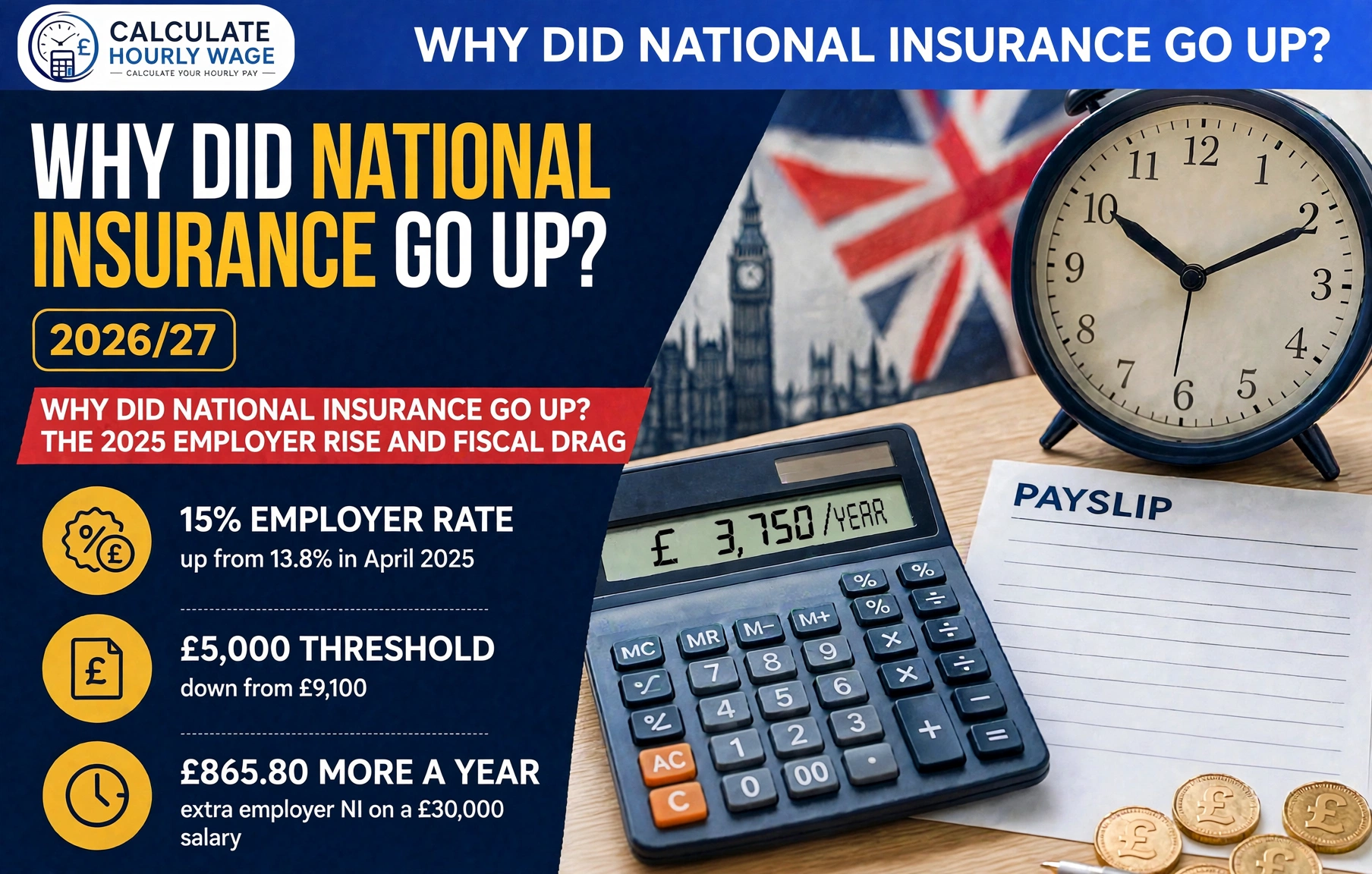
If you are wondering why has National Insurance increased in the UK, the short answer is that the government raised the part employers pay — not the part that comes out of your wages. From 6 April 2025, the employer rate went up from 13.8% to 15%, and the point at which employers start paying dropped from £9,100 a year to £5,000. At the same time, the thresholds that decide how much National Insurance you pay stayed frozen, so as pay rises, more of it gets caught — a quiet second rise that nobody announced. This guide explains what changed, why the government did it, exactly how much more it costs, and what it means for your payslip and your next pay rise.
Why Has National Insurance Increased in the UK? The Short Answer
National Insurance went up for one main reason: the government needed more money, and it chose to take it from employers rather than from workers’ pay packets. The change was announced in the Autumn Budget on 30 October 2024 and took effect on 6 April 2025, the first day of the 2025/26 tax year. It is the biggest rise in employer National Insurance in decades, and it is still in force in 2026/27 — the Autumn Budget of 28 October 2026 left it untouched for 2027/28.
Three things changed at once:
| What changed | Before April 2025 | From April 2025 |
|---|---|---|
| Employer National Insurance rate | 13.8% | 15% |
| Secondary Threshold — where employers start paying | £9,100 a year | £5,000 a year |
| Employment Allowance — the discount for eligible employers | £5,000 a year | £10,500 a year |
The first two changes push the cost up; the third pulls it back down for smaller employers. The rate rise and the lower threshold hit every employer, on every employee, from the first £5,000 of pay onwards. The bigger Employment Allowance softens the blow, but it is a fixed amount per business, not per employee, so it helps a small firm far more than a large one.
What Changed in April 2025
To understand the rise, it helps to know that National Insurance has two sides. Employees pay Class 1 on their own earnings — 8% between £12,570 and £50,270, and 2% above that. Employers pay a separate charge, secondary Class 1, on top of each employee’s wages. The April 2025 rise touched only the employer side: if you are an employee, your National Insurance rate did not change at all.
The employer rate went from 13.8% to 15% — a rise of 1.2 percentage points, which sounds small, but it applies to almost all of every employee’s pay, so it adds up fast. On a £30,000 salary, the rate rise alone is worth hundreds of pounds a year, before the threshold change is even counted.
The threshold change matters just as much. The Secondary Threshold is the point at which an employer starts paying National Insurance on an employee’s earnings. It fell from £9,100 a year (£175 a week) to £5,000 a year (£96 a week), so employers now pay on an extra £4,100 of every employee’s salary. Even a part-time worker on £8,000 a year, who cost their employer nothing in National Insurance before April 2025, now costs 15% of £3,000 — £450 a year.
The same 15% rate now applies to Class 1A National Insurance on expenses and benefits, such as company cars and private health insurance, and to Class 1B on items in a PAYE Settlement Agreement. So the rise reached beyond basic salaries into the perks employers provide too.
The government did soften the change for smaller employers. The Employment Allowance — a discount eligible employers can take off their National Insurance bill — more than doubled, from £5,000 to £10,500 a year. And the old rule that blocked employers with a National Insurance bill over £100,000 from claiming it was removed entirely, so larger businesses can now claim it too. There are still limits: a company with only one director, who is also its only employee, cannot claim, and businesses that do more than half their work in the public sector are excluded.
Worked Examples: How Much More Employers Pay
The numbers below compare the old rules (13.8% above £9,100) with the new rules (15% above £5,000) on the same salary, so you can see the rise like for like. These figures are before the Employment Allowance.
Example 1: £30,000 salary. Before April 2025, the employer paid 13.8% of the £20,900 above the £9,100 threshold: £2,884.20 a year. Now the employer pays 15% of the £25,000 above the £5,000 threshold: £3,750 a year. That is an extra £865.80 a year for one employee — about £72.15 a month. See the increase on your own pay with our National Insurance calculator.
Example 2: £40,000 salary. Before, the employer paid 13.8% of £30,900: £4,264.20 a year. Now the employer pays 15% of £35,000: £5,250 a year — an increase of £985.80 a year, or £82.15 a month.
Example 3: £60,000 salary. Before, the employer paid 13.8% of £50,900: £7,024.20 a year. Now the employer pays 15% of £55,000: £8,250 a year — an increase of £1,225.80 a year, or £102.15 a month.
Example 4: a full-time worker on the National Living Wage. At £12.71 an hour for 37.5 hours a week, a full-time worker earns £24,784.50 a year. Under the old rules, the employer would have paid 13.8% of £15,684.50: £2,164.46 a year. Under the new rules, the employer pays 15% of £19,784.50: £2,967.68 a year. That is £803.22 more a year for a single minimum-wage worker — and for a care home, a nursery or a shop with twenty such workers, the extra cost runs past £16,000 a year before any allowance.

Why the Government Raised It
The government raised employer National Insurance to bring in money for public services — above all the NHS and social care, which is where most National Insurance money ends up. It goes into the National Insurance Fund, which pays for the State Pension and contributory benefits, and a share is passed to the NHS. When the government needs more for those things, raising National Insurance is one of the few levers it can pull quickly.
There was also a political reason for choosing the employer side. Before the 2024 general election, the government had promised not to raise the headline rates of Income Tax, National Insurance or VAT for working people. Raising the rate employees pay would have broken that promise in plain sight; raising the rate employers pay did not — technically, no worker’s payslip changed. The promise was kept in the letter, even though many economists argue the cost lands on workers in the end anyway, through slower pay rises and fewer job openings.
That is the honest argument on both sides. The government’s case is that employers can absorb the cost, that the bigger Employment Allowance protects small businesses, and that the money funds services everyone uses. The counter-argument is that a tax on employing people is, in practice, a tax on jobs: it makes each worker more expensive, so employers hire more slowly, offer smaller pay rises, or pass the cost on in higher prices. Both things can be true at once — the money does fund the NHS, and it does make hiring more expensive.
Fiscal Drag: The Quiet Rise Nobody Announced
There is a second reason National Insurance keeps going up, and it is quieter than the April 2025 rise — so quiet that no Chancellor has ever announced it as a tax rise at all. It is called fiscal drag, and it works like this: the thresholds that decide how much National Insurance you pay stay fixed, while your pay goes up with inflation and pay rises. Every year, a bigger slice of your salary falls above the threshold, so you pay more — even though the rate has not changed by a single percentage point.
The Primary Threshold — the point where employees start paying National Insurance — has been £12,570 since April 2022. The Upper Earnings Limit — where the rate drops from 8% to 2% — has been £50,270 for just as long. Both are now frozen by law until 5 April 2031, and the Personal Allowance for Income Tax is frozen for the same period. The freeze was first set to run to 2028, then extended at the 2025 Budget to 2031. That is nine years with the same thresholds, while prices and wages keep rising.
Here is what that looks like in practice. Imagine you earn £40,000 a year. Your employee National Insurance is 8% of the £27,430 above the £12,570 threshold: £2,194.40 a year. Your Income Tax is 20% of the same £27,430: £5,486. Together they come to £7,680.40, leaving you £32,319.60 a year.
Now imagine you get a £2,000 pay rise to £42,000. Your National Insurance becomes 8% of £29,430: £2,354.40 — up £160. Your Income Tax becomes 20% of £29,430: £5,886 — up £400. Of your £2,000 rise, £560 goes straight to the taxman, and you keep £1,440. That is a 28% marginal rate on the rise, and it is entirely caused by the frozen threshold: if the threshold had risen with your pay, you would have kept more of it. Work out your own figures with our annual salary calculator.
The drag bites harder the longer it goes on. A worker whose pay rises 3% a year will see their National Insurance bill grow faster than their pay every single year, because each rise is taxed in full while the tax-free slice never grows. Over five or ten years, that adds up to hundreds of pounds a year — money that never appears as a headline tax rise, because no rate ever changed.
The same drag applies to employers. Their threshold is frozen at £5,000 until 2031 as well, so every pay rise they give pushes more of each employee’s salary into the 15% band. The April 2025 rise was a one-off step up; fiscal drag is the slow climb that follows it, year after year, with no further announcement needed.

What Employees Actually Pay Now
If you are an employee, the April 2025 rise did not change your National Insurance rate — but it is worth knowing what you do pay, because the figures on your payslip are the ones that matter to you.
In 2026/27, employees pay 8% on earnings between £12,570 and £50,270, and 2% on everything above £50,270. You pay nothing on the first £12,570. Your employer deducts it through PAYE, so you never see the money — it comes out before your pay reaches your bank account, alongside Income Tax. You can check the lines on your own payslip against this with our guide to how to read your payslip.
On a £40,000 salary, that works out as 8% of £27,430: £2,194.40 a year, or £182.87 a month. On a £60,000 salary, it is 8% of £37,700 (£3,016) plus 2% of the £9,730 above £50,270 (£194.60): £3,210.60 a year.
It is worth remembering that employees are actually paying less National Insurance than they were at the start of 2024. The main rate was 12% until 6 January 2024, when it was cut to 10%, and then cut again to 8% from 6 April 2024. On a £40,000 salary, the rate at 12% would have meant £3,291.60 a year; at 8% it is £2,194.40 — a saving of £1,097.20 a year. So while employer National Insurance went up sharply in April 2025, employee National Insurance is still lower than it was two years ago. The two sides of the same tax have moved in opposite directions, which is why the story feels confusing: both “National Insurance went up” and “National Insurance went down” are true, depending on whose side you are looking at.
What It Means for Small Employers and Jobseekers
For a small employer, the April 2025 rise is real money — but the Employment Allowance changes the picture a lot. At £10,500 a year, the allowance covers the employer National Insurance on the first £70,000 of pay above the £5,000 threshold (because £10,500 divided by 15% is £70,000). A business with one employee on £30,000 pays £3,750 in employer National Insurance — and the allowance wipes it out entirely, leaving nothing to pay. A business with five employees on £30,000 each pays £18,750 in total, minus the £10,500 allowance, leaving £8,250.
That is why the smallest employers felt the rise least. The employers who felt it most are the ones in the middle: big enough that the £10,500 allowance is a small share of their bill, but not so big that they can absorb it easily. A firm with fifty employees on £30,000 each pays £187,500 in employer National Insurance, and the allowance covers barely 5% of it.
For jobseekers, the rise shows up in subtler ways. When each new hire costs an extra £800 to £1,200 a year in National Insurance, employers think twice before creating a role, and they think harder about whether the role needs to be full-time. Some have slowed hiring; some have offered smaller pay rises, because the pay rise itself now costs 15% more on top; some have raised prices to cover the cost.
If you are job hunting, two things are worth knowing. First, the employer National Insurance on your salary is a real cost your employer pays on top of your wages — on a £30,000 salary, the true cost of employing you is £33,750 before pension and other costs, so a salary offer is never the whole story. Second, the Employment Allowance means a small employer can often afford to hire their first employee more cheaply than the headline rate suggests, so do not assume a small firm cannot afford you.
A Short History of National Insurance Rises
National Insurance has not stood still in the last few years — it has gone up, come down, and gone up again, and the whiplash is part of why people are confused about it now.
April 2022 — the Health and Social Care Levy. National Insurance rates rose by 1.25 percentage points for employees, employers and the self-employed, to pay for health and social care after the pandemic. The employee rate went from 12% to 13.25%. The plan was for the levy to become a separate tax from April 2023.
November 2022 — the rise is reversed. Just seven months later, the new Chancellor reversed the increase from 6 November 2022, and the levy itself was cancelled. The employee rate went back to 12%, and the money for health and social care came from general taxation instead.
January and April 2024 — two cuts for employees. The main employee rate was cut from 12% to 10% on 6 January 2024, and then from 10% to 8% on 6 April 2024. The self-employed rate, Class 4, was cut from 9% to 6% at the same time, and compulsory Class 2 was abolished — our guide to self-employed National Insurance explains Class 2 and Class 4 in full. These were the biggest employee National Insurance cuts in years, and they are the reason employees pay less today than they did in 2023.
April 2025 — the employer rise. The employer rate went from 13.8% to 15%, the threshold fell from £9,100 to £5,000, and the Employment Allowance rose from £5,000 to £10,500. Employee rates did not change. This is the rise this article is about.
October 2026 — no change. The Autumn Budget on 28 October 2026 left all National Insurance rates and thresholds unchanged for 2027/28. The employer rate stays at 15%, the threshold stays at £5,000, and the Employment Allowance stays at £10,500. The only National Insurance figures that move in April 2027 are small ones: the Lower Earnings Limit rises to £133 a week (£6,916 a year), voluntary Class 2 rises to £3.80 a week, and voluntary Class 3 rises to £19.05 a week.
What Might Happen Next
The honest answer is that nobody knows for certain — but the direction of travel is written into the law as it stands. The thresholds are frozen until 5 April 2031, which means fiscal drag will keep raising the amount you pay every time your pay goes up, for the next four years at least. A future Chancellor could unfreeze them early, but no government has done so yet — frozen thresholds are worth billions a year to the Treasury, and they are politically painless because no rate ever appears to rise.
For employees, the practical lesson is simple: your National Insurance rate is unlikely to rise in the next few years, but your bill will still creep up with every pay rise while the thresholds stay frozen. For employers, the 15% rate and the £5,000 threshold are now the settled facts of life, and the Employment Allowance is the main relief available — if you employ staff and have not claimed it, check whether you can. If you want the full background, our guide to what National Insurance is covers the basics.
The Bottom Line
National Insurance went up because the government raised the employer side of it in April 2025 — the rate from 13.8% to 15%, and the starting point down from £9,100 to £5,000 a year — to fund public services without raising the tax that comes out of workers’ pay. On a £30,000 salary, that costs an employer £865.80 more a year; on £60,000, it is £1,225.80 more. The bigger Employment Allowance of £10,500 softens the blow for small employers, and employees actually pay less than they did in 2023, after two rate cuts in 2024. But the quieter rise — frozen thresholds that have not moved since 2022 and will not move until 2031 — affects everyone, and it will keep pushing your bill up with every pay rise.
Frequently Asked Questions
Why has National Insurance increased in the UK?
National Insurance increased in the UK mainly because the government raised the employer rate from 13.8% to 15% and cut the threshold where employers start paying from £9,100 to £5,000 a year, from 6 April 2025. The money funds public services, above all the NHS and social care. Employee rates did not change — but frozen thresholds mean workers still pay more as their pay rises, which is fiscal drag.
Did my National Insurance go up in April 2025?
If you are an employee, no — your rate stayed at 8% between £12,570 and £50,270, and 2% above that. What went up was the National Insurance your employer pays on top of your wages: 15% instead of 13.8%, starting from £5,000 of pay instead of £9,100. You may still feel the effect indirectly, through smaller pay rises or slower hiring.
How much extra does the National Insurance rise cost an employer?
On a £30,000 salary, an employer pays £865.80 more a year — £3,750 instead of £2,884.20. On £40,000 it is £985.80 more, and on £60,000 it is £1,225.80 more. These figures are before the Employment Allowance, which gives eligible employers up to £10,500 a year off their bill.
What is fiscal drag and how does it raise National Insurance?
Fiscal drag happens when tax thresholds stay frozen while pay rises. The employee National Insurance threshold has been £12,570 since April 2022 and is frozen until 5 April 2031. So when your pay goes from £40,000 to £42,000, your National Insurance rises from £2,194.40 to £2,354.40 a year — an extra £160 — even though the 8% rate never changed. Every pay rise pushes more of your salary above the fixed threshold.
Will National Insurance go up again in 2027?
No — the Autumn Budget on 28 October 2026 left all National Insurance rates and thresholds unchanged for 2027/28. The employer rate stays at 15%, the threshold stays at £5,000, and the Employment Allowance stays at £10,500. Only small figures move: the Lower Earnings Limit rises to £133 a week, voluntary Class 2 to £3.80 a week, and voluntary Class 3 to £19.05 a week. The thresholds stay frozen until 5 April 2031.
Why did National Insurance go up in 2022 and then come back down?
In April 2022, National Insurance rates rose by 1.25 percentage points to fund the Health and Social Care Levy — the employee rate went from 12% to 13.25%. Seven months later, in November 2022, the new Chancellor reversed the rise and cancelled the levy, taking the employee rate back to 12%. The extra money paid between April and November 2022 was not refunded.
Sources
- GOV.UK — Rates and allowances: National Insurance contributions: https://www.gov.uk/government/publications/rates-and-allowances-national-insurance-contributions/rates-and-allowances-national-insurance-contributions
- GOV.UK — National Insurance rates and categories: https://www.gov.uk/national-insurance-rates-letters/print
- GOV.UK — Budget 2026: Overview of tax legislation and rates: https://www.gov.uk/government/publications/budget-2026-overview-of-tax-legislation-and-rates-ootlar/budget-2026-overview-of-tax-legislation-and-rates-ootlar
- GOV.UK — Budget 2026 Annex A: rates and allowances: https://www.gov.uk/government/publications/budget-2026-overview-of-tax-legislation-and-rates-ootlar/annex-a-rates-and-allowances
- GOV.UK — Reduction to the main rates of primary Class 1 and Class 4 National Insurance contributions: https://www.gov.uk/government/publications/changes-to-national-insurance-contributions-from-6-april-2024/reduction-to-the-main-rates-of-primary-class-1-and-class-4-national-insurance-contributions
- GOV.UK — Claim Employment Allowance: https://www.gov.uk/claim-employment-allowance
- GOV.UK — National Insurance: introduction: https://www.gov.uk/national-insurance