
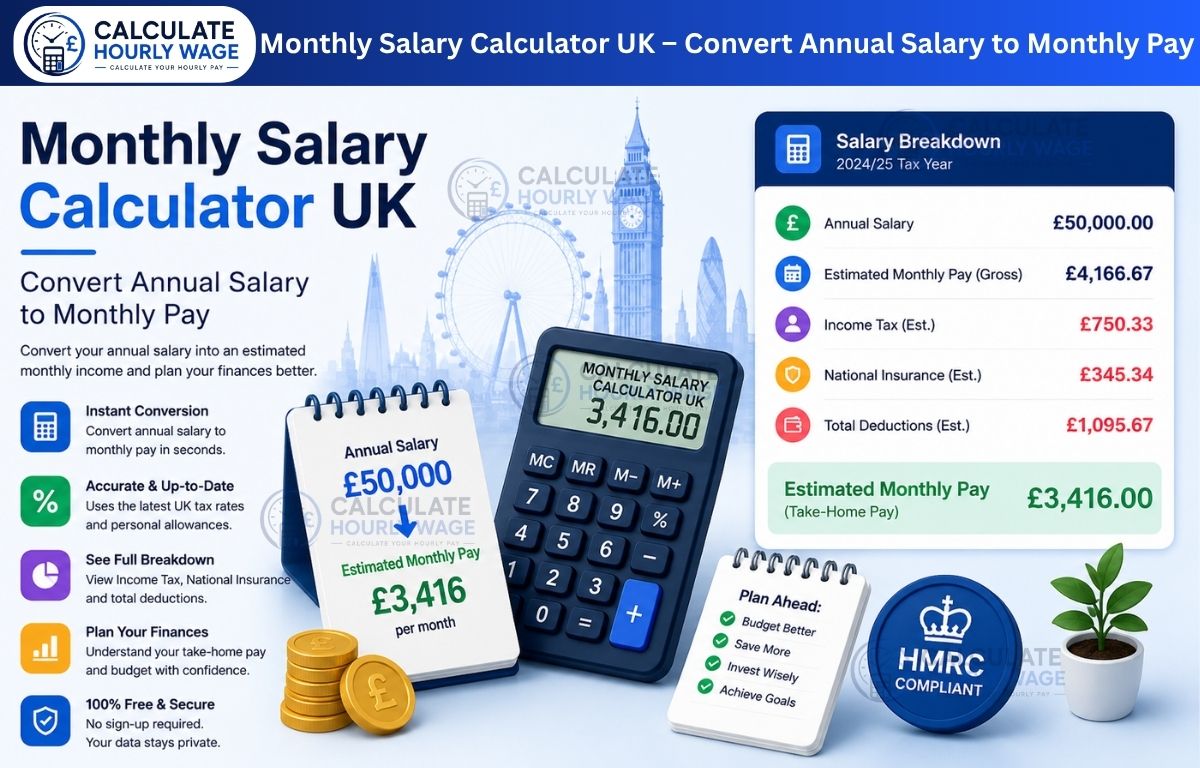
Imagine receiving a job offer that shows an annual salary of £50,000. At first, it sounds impressive. But then you think:
Will it comfortably cover my rent, utility bills, groceries, transport, savings, and other expenses?
That’s exactly why a Monthly Salary Calculator UK has become one of the most useful financial planning tools for employees and job seekers. Instead of leaving you to estimate taxes and deductions manually, it converts your yearly salary into an estimated monthly income, helping you understand what you’ll actually take home.
Calculator
What Is a Monthly Salary Calculator UK?
A Monthly Salary Calculator UK is an online tool that estimates your monthly earnings based on your annual salary and accounts for UK payroll deductions.
Instead of simply dividing your salary by twelve, a reliable calculator considers factors such as:
- Income Tax
- National Insurance Contributions (NIC)
- Pension contributions
- Student Loan repayments
- Salary sacrifice arrangements
- Selected UK tax year
The result is a far more realistic estimate of your monthly take-home pay.
What Does Monthly Salary Mean?
Monthly salary is the amount an employee earns each month.
There are two versions of monthly salary:
- Gross Monthly Salary – before any deductions.
- Net Monthly Salary – the amount received after deductions.
Understanding both figures is essential because employers usually show gross salary, while your budget depends on net salary.
How Is Monthly Pay Calculated?
The simplest calculation is:
Gross Monthly Salary = Annual Gross Salary ÷ 12
For example:
| Annual Salary | Gross Monthly Salary |
| £24,000 | £2,000 |
| £36,000 | £3,000 |
| £48,000 | £4,000 |
| £60,000 | £5,000 |
However, this calculates only gross pay.
Your actual monthly income depends on several payroll deductions.
Read More: gov.ukWhy Convert Annual Salary to Monthly Pay?
Annual salaries help employers compare compensation packages.
Monthly salaries help individuals manage real life.
Knowing your monthly income allows you to:
- Create realistic budgets
- Compare employment offers
- Estimate savings potential
- Calculate mortgage affordability
- Plan household expenses
- Avoid financial surprises
Ultimately, your monthly income is what determines your everyday spending power.
How Does the Monthly Salary Calculator UK Work?
Modern salary calculators make complex tax calculations quick and easy.
| Step | Details |
|---|---|
| Step 1: Enter Your Annual Salary | Start by entering your annual gross salary before deductions. Example:£42,000 per year |
| Step 2: Choose the Tax Year | UK tax rates and thresholds change over time.Selecting the correct tax year ensures calculations reflect the latest: • Personal Allowance • Income Tax bands • National Insurance rates • Student Loan thresholds Using the wrong tax year may produce inaccurate results. |
| Step 3: Apply Income Tax and National Insurance | The calculator estimates legal deductions including: • Income Tax • National Insurance • Workplace pension • Student Loan repayments • Salary sacrifice (if applicable) Each deduction affects your final take-home pay. |
| Step 4: View Your Estimated Monthly Salary | After processing the information, the calculator displays: • Annual Gross Salary • Monthly Gross Salary • Annual Tax • National Insurance • Pension deductions • Estimated Net Monthly Salary |
This gives you a complete overview of your earnings.
Why Use a Monthly Salary Calculator UK?
Plan Your Monthly Budget
You can create a budget when you know your actual income. You can plan your expenses,investments and savings confidently.
Compare Job Offers
- Two salaries may look similar annually but produce different monthly take-home pay after deductions.
- Comparing monthly income often reveals which offer is truly more valuable.
Estimate Your Take-Home Pay
- Many employees mistakenly assume their advertised salary is what they’ll receive.
- A salary calculator eliminates this misunderstanding by estimating net pay.
Understand Salary Deductions
- Payroll deductions can seem confusing at first.
- A calculator clearly shows how Income Tax, National Insurance, pensions, and other deductions reduce gross earnings.
What Information Do You Need?
Accurate estimates depend on accurate inputs.
| Term | Description |
|---|---|
| Gross Salary | Your salary before any deductions. |
| Tax Code | Your tax code determines how much Income Tax is deducted.Using the correct code improves calculation accuracy. |
| Pension Contributions | Many UK employees contribute to workplace pensions.Higher pension contributions reduce taxable income but also affect monthly take-home pay. |
| Student Loan Repayments | If you’re repaying a UK student loan, repayments may be deducted automatically once your income exceeds the applicable threshold. |
| Salary Sacrifice (If Applicable) | Salary sacrifice arrangements such as pension contributions or cycle-to-work schemes reduce taxable salary before tax is calculated. |
What Affects Your Monthly Salary?
Several factors affect the amount you actually receive each month.
Income Tax
Income Tax is calculated progressively.
As earnings increase, higher portions of income may fall into higher tax bands.
Read More: Income Tax Calculator UKNational Insurance Contributions
Employees usually pay National Insurance once earnings exceed the relevant thresholds.
These contributions help fund state benefits and the NHS.
Workplace Pension
Many employees are automatically enrolled in a workplace pension, with a percentage of their salary deducted from each pay cheque. It helps to build long-term retirement savings, but it lowers take-home pay.
Bonuses and Overtime
Extra earnings can increase monthly income.
However, they may also increase Income Tax and National Insurance deductions during that pay period.
Read More: Bonus Tax Calculator UKOther Payroll Deductions
Additional deductions may include:
- Union fees
- Charitable giving
- Private healthcare
- Company benefits
- Childcare schemes
These vary between employers.
Annual Salary to Monthly Salary Conversion Examples
The examples below illustrate gross monthly salary before deductions.
| Annual Salary | Gross Monthly Salary |
| £25,000 | £2,083.33 |
| £35,000 | £2,916.67 |
| £50,000 | £4,166.67 |
| £75,000 | £6,250.00 |
£25,000 Annual Salary
- Gross Monthly Salary: £2,083.33
- After Income Tax and National Insurance, monthly take-home pay will be lower depending on your personal circumstances.
£35,000 Annual Salary
- Gross Monthly Salary: £2,916.67
- This salary commonly falls within the basic Income Tax band, although exact deductions depend on tax code and pension contributions.
£50,000 Annual Salary
- Gross Monthly Salary: £4,166.67
- Employees near this salary often pay noticeably more Income Tax than lower earners, making net pay calculations increasingly important.
£75,000 Annual Salary
- Gross Monthly Salary: £6,250.00
- Higher earnings typically result in larger Income Tax liabilities, meaning gross salary can differ significantly from monthly take-home pay.
Gross Monthly Salary vs Net Monthly Salary
Understanding this distinction prevents one of the most common payroll mistakes.
What Is Gross Monthly Salary?
- Gross monthly salary is your earnings before deductions.
- It includes your contractual salary without subtracting taxes or payroll contributions.
What Is Net Monthly Salary?
- Net monthly salary is the amount deposited into your bank account after deductions have been applied.
- This is the figure most people use when budgeting.
Quick Comparison Table
| Feature | Gross Salary | Net Salary |
| Before Tax | ✔ | ✘ |
| After Tax | ✘ | ✔ |
| Includes Pension Deductions | No | Yes |
| Used in Job Offers | Yes | No |
| Money You Receive | No | Yes |
Who Can Benefit from a Monthly Salary Calculator UK?
Employees
Employees can estimate monthly earnings before accepting promotions or salary increases.
Job Seekers
Comparing annual salaries is useful.
Comparing monthly take-home pay is even better.
Freelancers Comparing Employment Offers
Freelancers considering permanent employment can compare projected monthly income against their current earnings.
HR and Payroll Professionals
Payroll teams can use salary estimates to explain deductions and salary structures to employees more effectively.
Common Mistakes When Calculating Monthly Salary
| Common Mistake | Explanation |
|---|---|
| Confusing Gross Pay with Net Pay | This is the most common mistake.Gross salary isn’t the amount you’ll receive after payroll deductions. |
| Ignoring Tax Deductions | Simply dividing annual salary by twelve ignores Income Tax and National Insurance, resulting in unrealistic expectations. |
| Selecting the Wrong Tax Year | Using outdated tax thresholds can significantly change estimated take-home pay.Always select the correct tax year. |
| Forgetting Pension Contributions | Even small pension contributions reduce monthly net income.Failing to include them creates inaccurate estimates. |
| Assuming Bonuses Are Included | Bonuses are often paid separately and may be taxed differently depending on payroll timing. Don’t assume they’re automatically included unless entered into the calculator. |
How do I calculate my monthly salary from my annual salary?
Divide your annual gross salary by 12 for gross monthly pay. To estimate net monthly salary, deduct Income Tax, National Insurance, pension contributions, and any other payroll deductions.
Does the calculator include Income Tax and National Insurance?
Yes. Most UK monthly salary calculators estimate both Income Tax and National Insurance contributions based on the selected tax year and salary details.
Can I calculate both gross and net monthly pay?
Yes. A comprehensive calculator shows both gross monthly salary and estimated net monthly take-home pay.
Is the calculator accurate for all UK tax bands?
Yes, provided you enter accurate information such as salary, tax code, pension contributions, and the correct tax year.
Can I use it if I receive bonuses or overtime?
Yes. Many calculators allow additional earnings to be included so you can estimate their effect on your monthly pay.
Does it work for weekly or hourly paid employees?
Yes. If your annual salary can be estimated from your hourly wage or weekly earnings, the calculator can convert it into monthly pay.
Final Thoughts
Understanding your annual salary is useful, but understanding your monthly take-home pay is what truly shapes your financial decisions. A Monthly Salary Calculator UK bridges that gap by turning a yearly figure into practical, real-world insights.
Whether you’re evaluating a new job, planning a budget, or preparing for future expenses, knowing your estimated monthly income helps you make informed decisions with greater confidence.