

Imagine you’ve just received a new job offer. The recruiter tells you the role pays £16.50 per hour, but you’re trying to work out whether that’s enough to cover your monthly rent, bills, groceries, and savings goals. Or perhaps you’re considering taking on extra shifts and want to know how much your monthly income could increase before accepting them.
These are common situations where an hourly to monthly salary calculator UK becomes incredibly useful. While an hourly rate tells you how much you earn for each hour worked, it doesn’t immediately show what that means for your monthly finances. Converting hourly pay into a monthly salary gives you a clearer picture of your income, making it easier to compare job offers, create a realistic budget, and plan for future expenses.
In this guide, you’ll learn how hourly pay is converted into monthly salary using standard UK working patterns, when the calculation changes, and the factors that can affect your actual earnings. You’ll also find practical examples, comparison tables, common mistakes to avoid, and expert tips to help you estimate your monthly income with greater confidence.
Hourly to Monthly Salary Calculator UK
Whether you’re comparing job offers, planning your monthly budget, or checking your expected earnings, use the calculator below to convert your hourly wage into an estimated monthly salary.
Enter:
- Your hourly pay rate
- Hours worked per week
- Paid weeks per year (typically 52 for full-year employment)
The calculator will estimate:
- Monthly salary
- Weekly earnings
- Annual salary
Click Here: Hourly Rate Calculator
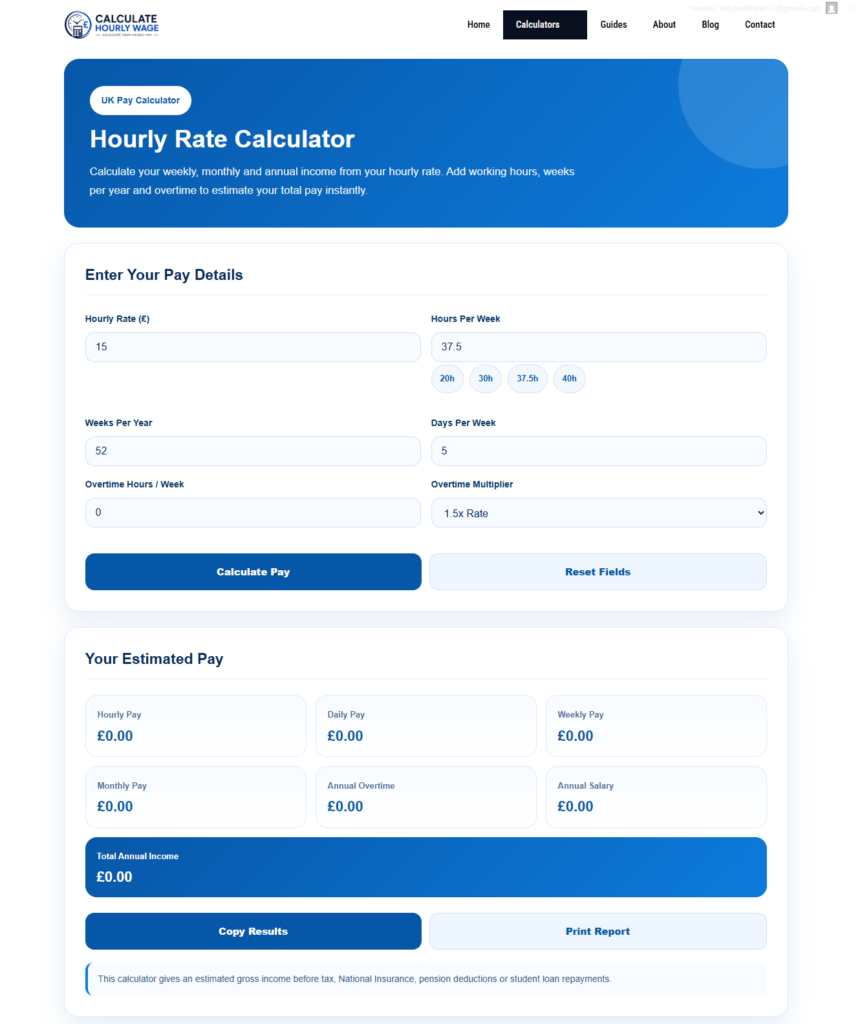
Convert Your Hourly Wage to Monthly Salary
To convert an hourly wage into a monthly salary in the UK, multiply your hourly rate by the number of hours worked each week, then multiply by the number of paid weeks in a year and divide the result by 12. This provides an average monthly gross salary and is suitable for most full-time and part-time employees with consistent working hours.
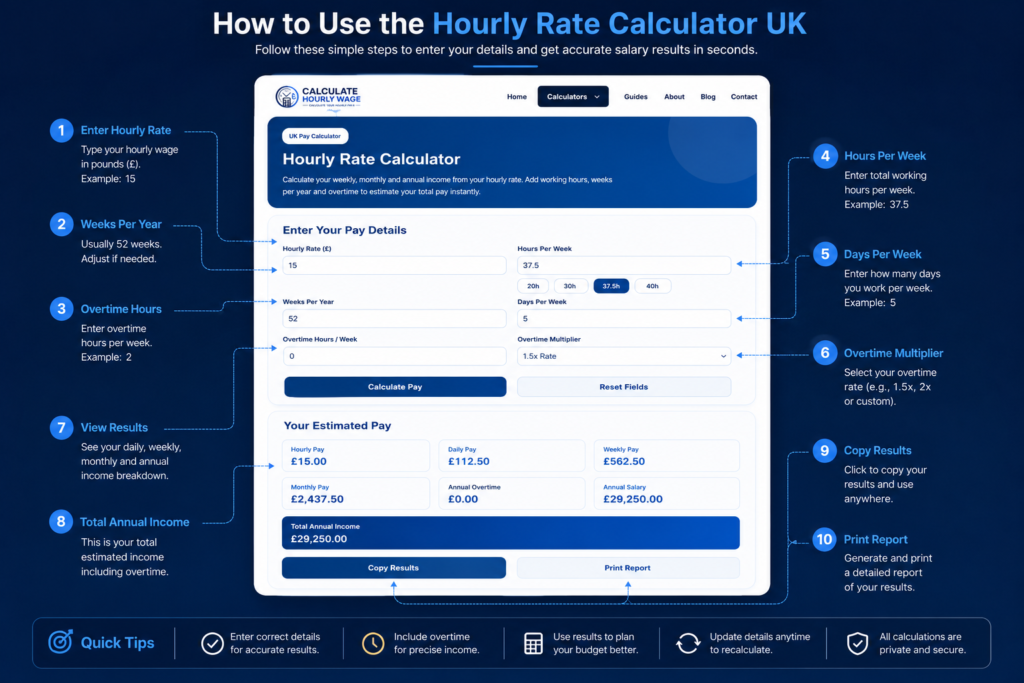
How Do You Convert an Hourly Wage to Monthly Salary?
Converting hourly pay into a monthly salary is straightforward once you understand the relationship between your hourly rate, weekly working hours, and the number of weeks you are paid during the year.
Rather than guessing your monthly income, using a consistent formula gives a much more reliable estimate for budgeting, comparing job offers, and planning your finances.
The Basic Hourly to Monthly Salary Formula
Formula
| Step | Formula |
|---|---|
| Weekly Pay | Hourly Rate × Hours per Week |
| Annual Salary | Weekly Pay × Paid Weeks per Year |
| Monthly Salary | Annual Salary ÷ 12 |
Or written as one equation:
Monthly Salary = (Hourly Rate × Weekly Hours × Paid Weeks) ÷ 12
This formula calculates gross monthly salary, meaning it does not deduct Income Tax, National Insurance, pension contributions, or other payroll deductions.
Step-by-Step Calculation
If you’re unsure how the formula works, follow these four simple steps:
| Step | Calculation |
|---|---|
| 1. Find your hourly wage. | Example: £17.50/hour |
| 2. Multiply by your weekly working hours. | £17.50 × 37.5 = £656.25 per week |
| 3. Multiply by the number of paid weeks in a year. | £656.25 × 52 = £34,125 annually |
| 4. Divide by 12 months. | £34,125 ÷ 12 = £2,843.75 per month |
This method works well for employees with fixed working hours. If your hours change frequently, calculate your average weekly hours over several recent payslips before using the formula.
If you want to estimate your take-home pay after deductions, see:
Read More: National Insurance Calculator UKWhy UK Calculators Use 52 Paid Weeks
One of the most common questions users ask is why most salary calculators assume 52 weeks rather than simply multiplying by four weeks each month.
The answer is that a calendar year contains 52 weeks, not 48.
Although some months have four weeks and others have more, dividing the total annual salary by 12 yields a more accurate monthly average.
For employees who receive paid annual leave, those holiday weeks are usually included in the 52 paid weeks.
However, there are situations where you may need to enter a different number:
- Seasonal employment
- Fixed-term contracts
- Unpaid leave
- Career breaks
- Freelance contracts with unpaid periods
Using the correct number of paid weeks produces a more realistic monthly estimate.
Visit Now: GOV.UKStandard Full-Time Working Hours in the UK
While there is no legal definition of a standard working week, many UK employers use one of the following schedules:
| Weekly Hours | Typical Employment |
|---|---|
| 20 | Part-time |
| 25 | Part-time |
| 30 | Reduced hours |
| 35 | Office-based roles |
| 37.5 | Common full-time contract |
| 40 | Standard full-time |
| 45+ | Includes regular overtime |
Your contracted weekly hours directly affect your monthly earnings, even if your hourly rate remains the same.
For example:
- £15/hour for 20 hours per week produces a very different monthly income than £15/hour for 40 hours per week.
Always use your contracted hours rather than estimating.
When the Formula Changes
Although the standard formula works well for many employees, it isn’t suitable for every situation.
Part-Time Jobs
Part-time workers simply enter their contracted weekly hours.
If your hours remain consistent, the calculation remains accurate.
Overtime
If overtime is paid at a different hourly rate, it should usually be calculated separately.
For example:
- Standard rate: £16/hour
- Overtime: £24/hour
Combining both rates into a single hourly figure can produce misleading results.
Instead, calculate your regular pay and overtime separately before adding them together.
Read More: Overtime Pay Calculator UKVariable Working Hours
Some employees work different hours each week.
Examples include:
- Hospitality
- Retail
- Agency work
- Care workers
- Shift workers
In these cases, using your average weekly hours over several weeks generally provides a more realistic monthly estimate.
Unpaid Leave
If you know you’ll take unpaid leave during the year, reduce the number of paid weeks accordingly.
This prevents overestimating your annual and monthly income.
For example:
| Standard Paid Weeks | Alternative Paid Weeks |
|---|---|
| 52 paid weeks | 50 paid weeks |
If you expect two unpaid weeks during the year.
Shift Workers and Variable Shift Patterns
Many UK employees do not work the same number of hours every week. This is common in:
- NHS and healthcare
- Hospitality
- Retail
- Emergency services
- Security
- Warehousing
- Manufacturing
If your weekly hours change, avoid calculating your salary from a single week’s pay.
Instead:
- Collect your last 8–12 weeks of payslips.
- Calculate your average weekly hours.
- Use that average in the calculator.
This usually produces a far more reliable monthly estimate.
Hourly to Monthly Salary Conversion Examples
Understanding the formula becomes much easier when applied to real-world situations. The examples below demonstrate how different hourly rates, working hours, and employment arrangements affect monthly salary estimates.
Example 1 – Full-Time Employee
Hourly Rate: £15.00
Hours per Week: 37.5
Paid Weeks: 52
| Calculation | Result |
|---|---|
| Weekly Pay | £562.50 |
| Annual Salary | £29,250 |
| Monthly Salary | £2,437.50 |
This is a typical example of a full-time office employee working standard contracted hours.
Example 2 – Part-Time Employee
Hourly Rate: £14.20
Hours per Week: 22
Paid Weeks: 52
| Calculation | Result |
|---|---|
| Weekly Pay | £312.40 |
| Annual Salary | £16,244.80 |
| Monthly Salary | £1,353.73 |
This type of calculation is useful for students, parents returning to work, or anyone balancing employment with other commitments.
Example 3 – Higher Hourly Wage
Hourly Rate: £22.50
Hours per Week: 40
Paid Weeks: 52
| Calculation | Result |
|---|---|
| Weekly Pay | £900.00 |
| Annual Salary | £46,800 |
| Monthly Salary | £3,900.00 |
Higher hourly rates are common in specialist trades, IT contracting, engineering, and certain healthcare roles.
Example 4 – Overtime Included
A warehouse supervisor earns a standard hourly rate but regularly works paid overtime.
Regular Hourly Rate: £18.00
Regular Hours: 37.5 hours/week
Overtime Rate: £27.00 (time and a half)
Overtime Hours: 5 hours/week
Paid Weeks: 52
| Calculation | Amount |
|---|---|
| Regular Weekly Pay | £675.00 |
| Overtime Weekly Pay | £135.00 |
| Total Weekly Pay | £810.00 |
| Annual Earnings | £42,120.00 |
| Monthly Salary | £3,510.00 |
Why this matters: If you ignored the higher overtime rate and treated every hour as £18, your estimated monthly income would be lower than your actual earnings
Example 5 – Reduced Paid Weeks
Some workers take unpaid leave each year.
Hourly Rate: £17.00
Hours per Week: 40
Paid Weeks: 50
| Calculation | Amount |
|---|---|
| Weekly Pay | £680.00 |
| Annual Salary | £34,000.00 |
| Monthly Salary | £2,833.33 |
Using 52 weeks instead of 50 would overestimate annual earnings by £1,360.
Example 6 – Zero-Hour Contract
A hospitality employee has no guaranteed weekly hours but averages 24 hours each week over several months.
Hourly Rate: £13.80
Average Weekly Hours: 24
Paid Weeks: 52
| Calculation | Amount |
|---|---|
| Weekly Pay | £331.20 |
| Annual Salary | £17,222.40 |
| Monthly Salary | £1,435.20 |
For zero-hour contracts, using an average based on recent payslips is generally more accurate than estimating future hours.
Example 7 – Weekend Worker
Someone works only Saturdays and Sundays.
Hourly Rate: £19.00
Hours per Week: 16
Paid Weeks: 52
| Calculation | Amount |
|---|---|
| Weekly Pay | £304.00 |
| Annual Salary | £15,808.00 |
| Monthly Salary | £1,317.33 |
This type of calculation is useful for people earning extra income alongside full-time study or another job.
Example 8 – Freelance Hourly Contractor
A freelance designer charges clients by the hour.
Hourly Rate: £35.00
Average Billable Hours: 30/week
Working Weeks: 48
| Calculation | Amount |
|---|---|
| Weekly Income | £1,050.00 |
| Annual Income | £50,400.00 |
| Monthly Average | £4,200.00 |
Freelancers often work fewer than 52 weeks because holidays, business development, and unpaid administrative work reduce billable time.
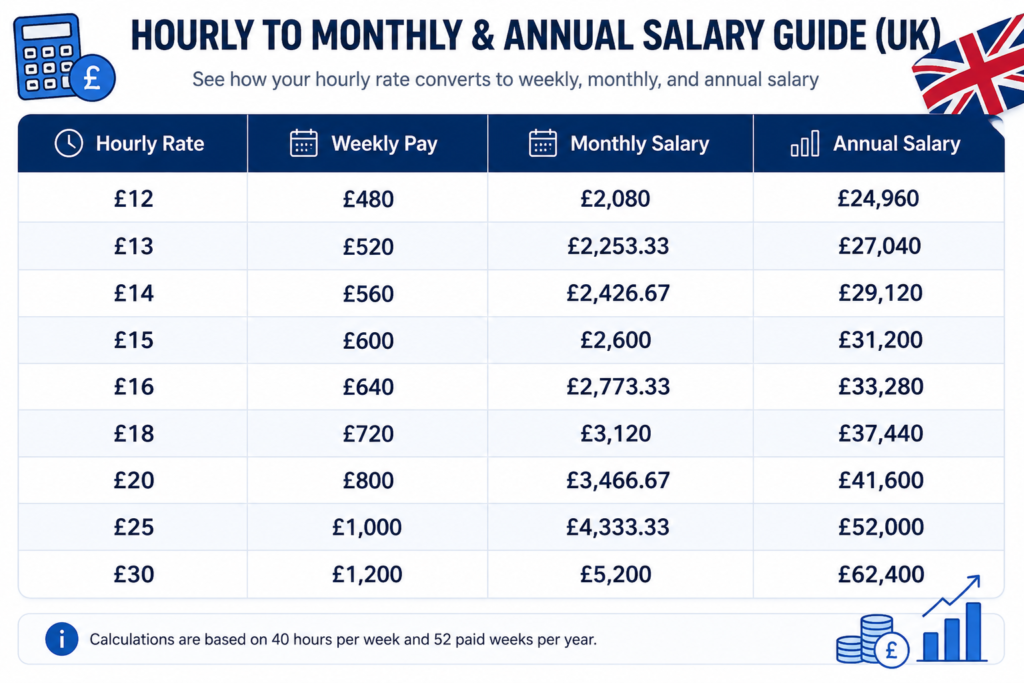
Hourly Rate to Monthly Salary Conversion Table
The table below provides estimated gross earnings based on 40 hours per week and 52 paid weeks per year.
| Hourly Rate | Weekly Pay | Monthly Salary | Annual Salary |
|---|---|---|---|
| £12 | £480 | £2,080 | £24,960 |
| £13 | £520 | £2,253.33 | £27,040 |
| £14 | £560 | £2,426.67 | £29,120 |
| £15 | £600 | £2,600 | £31,200 |
| £16 | £640 | £2,773.33 | £33,280 |
| £18 | £720 | £3,120 | £37,440 |
| £20 | £800 | £3,466.67 | £41,600 |
| £25 | £1,000 | £4,333.33 | £52,000 |
| £30 | £1,200 | £5,200 | £62,400 |
These figures are estimates before deductions and assume consistent working hours throughout the year.
How Different Working Hours Affect Your Monthly Salary
Your hourly wage tells only part of the story. The number of hours you work each week can have an even greater impact on your monthly earnings.
Even if two employees receive the same hourly rate, the one working more contracted hours will naturally earn a higher monthly salary.
| Weekly Hours | Details |
|---|---|
| 20 Hours per Week | Twenty hours each week is common for: • Students • Semi-retired workers • Parents with childcare responsibilities • People working alongside another job. This arrangement offers flexibility but results in lower monthly income than full-time employment. |
| 30 Hours per Week | Many employers consider 30 hours a reduced-hours contract. It provides a balance between work and personal commitments while still generating a relatively stable monthly salary. |
| 37.5 Hours per Week | A 37.5-hour week is one of the most common full-time contracts across the UK. Many office-based employees work: • 7.5 hours per day • Five days each week. This schedule is widely used in salary calculations. |
| 40 Hours per Week | A 40-hour working week remains common in sectors such as: • Manufacturing • Construction • Logistics • Retail • Customer service. When comparing job offers, always check whether the advertised salary assumes 37.5 or 40 hours. The difference may amount to several thousand pounds each year. |
| 45+ Hours with Overtime | Some industries regularly involve overtime. Examples include: • Healthcare • Warehousing • Emergency services • Transport • Hospitality. If overtime is paid at a premium rate, calculate it separately instead of increasing your standard weekly hours. This provides a much more accurate estimate of your monthly income. |
Comparison Table
| Weekly Hours | Monthly Salary at £16/hour |
|---|---|
| 20 | £1,386.67 |
| 30 | £2,080.00 |
| 37.5 | £2,600.00 |
| 40 | £2,773.33 |
| 45 | £3,120.00 |
Gross vs Net Monthly Salary
One of the biggest sources of confusion is the difference between gross salary and net salary.
Understanding this distinction helps you avoid unrealistic budgeting and better interpret your payslip.
| Comparison | Gross Salary | Net Salary (Take-Home Pay) |
|---|---|---|
| What it Means | Gross salary is the amount you earn before any deductions are made. | Net salary, often called take-home pay, is what remains after payroll deductions. |
| Used For | It is the figure most employers advertise in job listings and the amount used by hourly-to-monthly salary calculators. | This is the amount available for spending and saving each month. |
| May Include | • Regular hourly pay • Contracted hours • Paid holiday • Some contractual allowances | None(after deductions) |
| Common Deductions | None (before deductions) | • Income Tax • National Insurance contributions • Workplace pension contributions • Student loan repayments • Salary sacrifice arrangements |
| Important Note | However, it does not represent the amount that reaches your bank account. | This is the actual amount deposited into your bank account after applicable deductions. |
Read More: Salary To Hourly Rate UK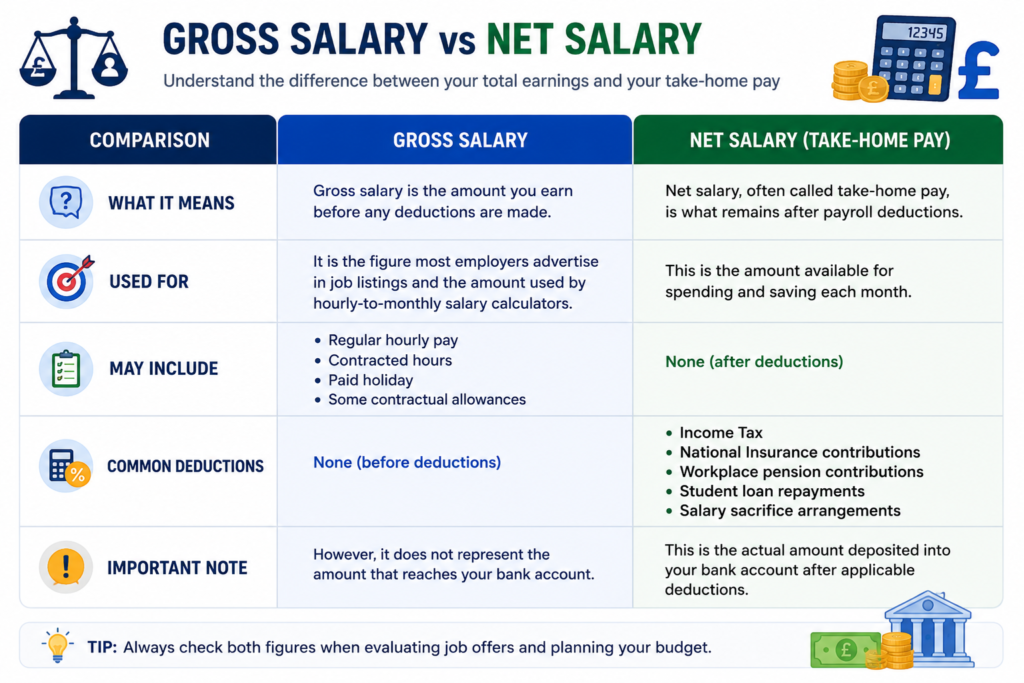
Why Your Payslip May Be Different
If your payslip doesn’t exactly match the estimate from an hourly to monthly salary calculator, it doesn’t necessarily mean the calculation is wrong. Payroll calculations often include additional factors that a basic conversion formula does not.
Common reasons include:
- Income Tax deductions under PAYE
- National Insurance contributions
- Pension contributions
- Student loan repayments
- Overtime paid at different rates
- Bonuses or commission
- Unpaid leave
- Sick pay or statutory payments
- Payroll cut-off dates
- Variable working hours
For example, if you normally work 37.5 hours per week but complete additional overtime during one pay period, your payslip will naturally be higher than the standard monthly estimate.
Likewise, taking unpaid leave or joining a workplace pension scheme may reduce your take-home pay without changing your contracted hourly rate.
Factors That Reduce Take-Home Pay
Your gross monthly salary is only the starting point. Several deductions can affect the amount deposited into your bank account.
Income Tax
Employees usually pay Income Tax through the PAYE (Pay As You Earn) system once their taxable income exceeds the applicable allowance.
Read More: Income Tax Calculator UKNational Insurance
National Insurance contributions help fund state benefits and are calculated separately from Income Tax.
The amount you pay depends on your earnings and current contribution rules.
Read More: National Insurance Calculator UKWorkplace Pension
Many UK employees are automatically enrolled into a workplace pension.
Although pension contributions reduce your immediate take-home pay, they help build retirement savings and may include employer contributions.
Student Loan Repayments
If you have a student loan, repayments may begin once your earnings exceed the applicable repayment threshold.
These deductions vary depending on your repayment plan.
Other Payroll Deductions
Some employers also deduct:
- Salary sacrifice benefits
- Union membership fees
- Childcare schemes
- Cycle-to-work schemes
- Charitable payroll giving
These deductions can explain why two employees with the same hourly wage receive different net salaries.
Practical Scenarios
The following situations demonstrate how an hourly to monthly salary calculator can help with everyday financial decisions.
Comparing Two Job Offers
Suppose you’re choosing between two positions.
| Job | Hourly Rate | Hours per Week |
|---|---|---|
| Job A | £16.50/hour | 40 hours per week |
| Job B | £18.00/hour | 35 hours per week |
Although Job B offers a higher hourly rate, Job A may generate a higher monthly income because of the additional weekly hours.
Rather than focusing only on the advertised hourly wage, compare the estimated monthly and annual earnings before making your decision.
Planning a Monthly Budget
Before signing a tenancy agreement or applying for a mortgage, it’s sensible to estimate your monthly income.
Knowing your expected gross and net earnings helps you plan for:
- Rent or mortgage payments
- Utility bills
- Food
- Transport
- Insurance
- Savings
- Emergency expenses
A monthly salary estimate provides a more practical budgeting figure than an hourly wage.
Working Part-Time While Studying
Students often work flexible hours around lectures and exams.
By adjusting weekly hours in the calculator, it’s easy to estimate how changes in your schedule affect monthly income.
This can help you decide whether to take additional shifts during holidays or reduce working hours during exam periods.
Estimating Overtime Earnings
Many employees regularly work overtime but struggle to estimate how much it adds to their monthly pay.
Instead of guessing, calculate:
- Regular contracted earnings.
- Overtime earnings separately.
- Combine both figures for a more realistic monthly estimate.
This approach is particularly useful when overtime rates differ from standard hourly pay.
Read More: Overtime Pay Calculator UKSwitching from Hourly Pay to a Salaried Role
If you’re moving from an hourly-paid position to a fixed annual salary, converting both into comparable monthly figures makes the decision easier.
Rather than comparing hourly rates alone, you’ll see:
- Monthly income
- Annual earnings
- Financial stability
- Predictable budgeting
This provides a fair comparison between different types of employment contracts.
Common Mistakes When Calculating Monthly Salary
Even simple salary calculations can produce misleading results if incorrect assumptions are used.
Avoid these common mistakes.
| Mistake | Why It Matters |
|---|---|
| 1. Using Four Weeks Per Month | Many people multiply weekly pay by four. In reality, a year contains 52 weeks, so the average monthly salary is calculated by dividing annual earnings by 12. |
| 2. Entering Incorrect Weekly Hours | Use your contracted or average weekly hours rather than estimating.Small differences each week can noticeably affect annual earnings. |
| 3. Ignoring Paid Holiday | Most employees receive paid annual leave.If your holiday is paid, those weeks should normally be included in the calculation. |
| 4. Forgetting Overtime | Regular overtime can significantly increase monthly earnings.Calculate it separately whenever overtime is paid at a different rate. |
| 5. Confusing Gross and Net Salary | Gross salary is before deductions.Net salary is what reaches your bank account.Budgeting using gross income may lead to unrealistic spending plans. |
| 6. Using the Wrong Number of Paid Weeks | Not everyone works 52 paid weeks.If you expect unpaid leave or seasonal work, adjust the paid weeks accordingly. |
| 7. Ignoring Unpaid Leave | Periods without pay reduce annual and monthly earnings.Always account for known unpaid leave when estimating salary. |
| 8. Assuming Every Month Pays the Same | Although the average monthly salary is useful for planning, actual monthly earnings may vary because of: • Overtime • Shift patterns • Bonuses • Unpaid leave • Payroll timing |
| 9. Misreading Your Payslip | Some deductions are made automatically through payroll. Comparing gross salary with net pay without considering deductions often confuses. |
| 10. Comparing Jobs Using Hourly Rate Alone | A higher hourly wage doesn’t always mean a higher annual income. Always compare: • Weekly hours • Paid weeks • Overtime opportunities • Pension contributions • Benefits • Monthly salary. This provides a much more meaningful comparison. |
Expert Tips for More Accurate Salary Estimates
Using a calculator correctly is just as important as using one.
Follow these practical tips to improve the accuracy of your estimates.
| Expert Tip | Explanation |
|---|---|
| 1. Use Your Contracted Weekly Hours | If your hours are fixed, enter the exact number stated in your employment contract. |
| 2. Use Average Hours for Variable Schedules | If your hours change regularly, calculate an average using several recent payslips rather than relying on a single week. |
| 3. Keep Overtime Separate | Treat overtime as additional income instead of increasing your standard hourly rate. This produces more reliable results. |
| 4. Check Annual Salary Before Negotiating | Employers often discuss salaries annually.Knowing your estimated annual earnings helps you compare offers more effectively. |
| 5. Compare Gross Before Comparing Net | Gross salary provides a consistent basis when evaluating different jobs.Net pay varies according to personal circumstances and deductions. |
| 6. Review Your Payslips Regularly | Comparing calculator estimates with actual payslips helps identify unexpected payroll deductions or changes. |
| 7. Update Your Calculations Each Tax Year | Tax rates, National Insurance thresholds, and minimum wage rules can change over time.Using current figures keeps your estimates relevant. |
| 8. Consider Seasonal Changes | If your industry has busy and quiet periods, calculate income using realistic annual averages rather than your busiest month. |
| 9. Plan Your Budget Using Average Monthly Income | Avoid basing monthly spending on unusually high overtime earnings.Budgeting around your average monthly income helps create a more stable and realistic financial plan. |
How do I convert hourly pay into monthly salary in the UK?
Multiply your hourly rate by the number of hours you work each week, then multiply by the number of paid weeks in a year. Finally, divide the annual amount by 12 to estimate your average monthly gross salary.
How much is £15 an hour per month?
If you work 40 hours per week for 52 paid weeks, earning £15 per hour equates to:
Weekly pay: £600
Annual salary: £31,200
Monthly salary: £2,600 (gross)
Your actual take-home pay will depend on Income Tax, National Insurance, pension contributions, and any other deductions.
How much is £20 an hour per month?
For someone working 40 hours each week over 52 paid weeks, £20 per hour equals:
Weekly pay: £800
Annual salary: £41,600
Monthly salary: £3,466.67 (gross)
Is this calculator before or after tax?
A standard hourly to monthly salary calculator estimates gross salary, which is your earnings before deductions.
Can I include overtime?
Yes. If your overtime is paid at the same hourly rate, you can include the additional hours in your weekly total.
If overtime is paid at a higher rate, calculate your regular earnings and overtime separately for a more accurate estimate.
How many working hours are there in an average month?
There isn’t a fixed number because months vary in length.
Most calculators use this approach:
Hourly Rate × Weekly Hours × 52 ÷ 12
This provides an average monthly salary across the year.
Why is my payslip different from the calculator?
Your payslip may include factors such as:
Income Tax
National Insurance
Pension contributions
Student loan repayments
Overtime
Bonuses
Unpaid leave
Payroll timing
Because of these variables, your actual monthly pay may differ from a simple salary estimate.
What if I work different hours every week?
If your schedule changes regularly, calculate your average weekly hours over several weeks before using the calculator.
This usually provides a more realistic monthly estimate than using a single week’s hours.
Can freelancers use this calculator?
Yes.
Freelancers and contractors who charge by the hour can estimate their monthly income by entering:
Average hourly rate
Average billable hours per week
Expected working weeks each year
Keep in mind that periods without client work should be excluded from paid weeks.
Does a paid holiday affect monthly salary?
Yes.
If your employment contract includes paid annual leave, those weeks are normally included in your paid weeks, meaning your average monthly salary already reflects holiday pay.
How do part-time hours change monthly earnings?
Part-time employees simply enter their contracted weekly hours.
Working fewer hours reduces weekly, monthly, and annual earnings proportionally, even if the hourly rate remains the same.
Can I convert monthly salary back into an hourly rate?
Yes.
If you already know your monthly or annual salary, you can convert it back into an hourly wage using your weekly working hours.
How accurate is an hourly to monthly salary calculator?
A calculator provides a reliable estimate when you enter accurate information, including:
Hourly rate
Weekly working hours
Paid weeks each year
However, it cannot account for every payroll variable, such as bonuses, commissions, changing overtime, or individual tax circumstances.
Conclusion
An hourly to monthly salary calculator UK is a practical tool for turning an hourly wage into an easy-to-understand monthly income estimate. Whether you’re comparing job offers, planning your household budget, estimating overtime earnings, or checking that your pay aligns with your employment contract, converting hourly pay into monthly salary provides a clearer picture of your finances.
Remember that the most accurate results come from using your actual hourly rate, contracted weekly hours, and the correct number of paid weeks each year. While the calculator estimates your gross monthly salary, your take-home pay may differ because of deductions such as Income Tax, National Insurance, workplace pension contributions, and other payroll adjustments.
For a complete understanding of your earnings, combine this calculator with tools that estimate after-tax income, overtime pay, and other salary conversions. Using the right information and the right calculators together will help you make more informed decisions about employment, budgeting, and long-term financial planning.