
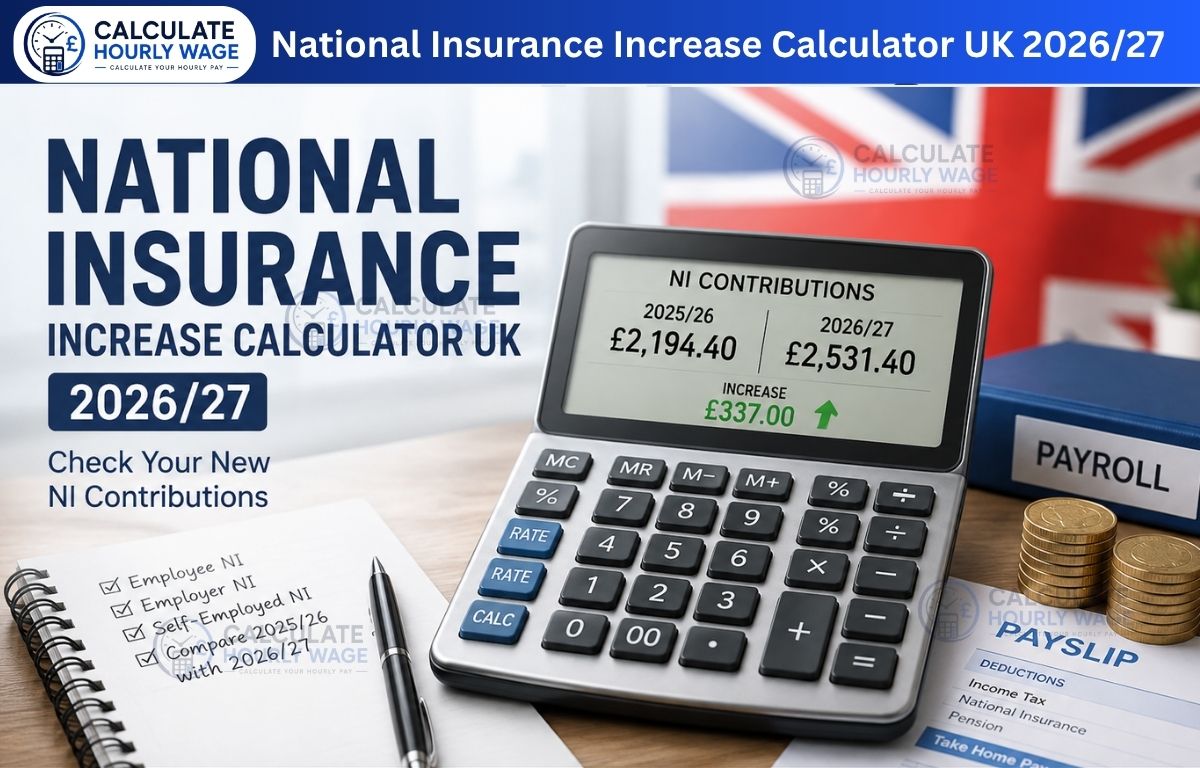
Use a National Insurance increase calculator UK to compare your estimated National Insurance contributions for 2025/26 and 2026/27.
The result depends on whether you are:
- An employee paying Class 1 National Insurance
- An employer paying employer NIC
- Self-employed and paying Class 4 National Insurance
For a useful year-on-year comparison, enter the same salary or profit for both tax years. The calculator should then show:
2025/26 NI → 2026/27 NI → difference in £ → average monthly or weekly difference
Click Here:
For standard employees, the main Class 1 rates for 2026/27 remain 8% on earnings between the Primary Threshold and Upper Earnings Limit, and 2% on earnings above the Upper Earnings Limit.
The significant change is on the employer side. The standard employer NIC rate is 15%, while the Secondary Threshold is £5,000. This can increase an employer’s payroll cost even though the employee’s own NI rates have not increased.
Self-employed people use different rules. Class 4 National Insurance is calculated from relevant profits rather than an employee salary.
Did National Insurance Increase in 2026/27?
There was no new increase to the standard employee Class 1 rates for 2026/27. The main change affecting National Insurance costs was the increase in employer NIC.
That distinction matters because a search for “National Insurance increase” can refer to either the amount deducted from an employee’s pay or the amount an employer pays on top of an employee’s wages.
What changed for employees?
For a standard employee, the 2026/27 calculation uses:
- 0% below the Primary Threshold
- 8% between the Primary Threshold and Upper Earnings Limit
- 2% above the Upper Earnings Limit
The Primary Threshold is £12,570 a year, and the Upper Earnings Limit is £50,270 a year.
An employee earning £30,000 therefore does not pay 8% on the full £30,000. Only the £17,430 above the Primary Threshold falls into the main 8% band.
What changed for employers?
Employer NIC is calculated separately from the employee’s contribution.
For 2026/27, the standard employer rate is 15% on earnings above the £5,000 Secondary Threshold.
For Example
| Employer salary | Secondary Threshold | Earnings above threshold | Employer NIC rate | Employer NIC |
|---|---|---|---|---|
| £30,000 | £5,000 | £25,000 | 15% | £3,750 |
That £3,750 is the employer NIC before any applicable Employment Allowance or other special treatment.
What changed for self-employed workers?
Self-employed National Insurance is based on profits rather than employment salary.
Class 4 contributions use different percentage bands from employee Class 1 NIC. The main Class 4 rate is 6%, with 2% applying above the upper profit limit.
Class 2 should be considered separately. It is not simply another percentage to apply to self-employed profits, and voluntary contribution arrangements can be relevant in some circumstances.
Why might your NI have increased even if the rate did not?
Your NI deduction can increase without a change to the headline employee rate. Common reasons include:
- A higher salary
- A bonus or commission payment
- Earnings crossing a contribution threshold
- Irregular monthly or weekly pay
- A different payroll period
- Comparing an annual estimate with a single payslip
The first question should therefore be “Has my rate changed?” followed by “Has my NIable pay changed?”
2025/26 vs 2026/27 National Insurance Changes
| Item | 2025/26 | 2026/27 | Effect |
|---|---|---|---|
| Employee Class 1 rates | 8% / 2% | 8% / 2% | No change to standard headline rates |
| Employer NIC rate | 13.8% | 15% | Higher employer NIC |
| Employer Secondary Threshold | £9,100 | £5,000 | Employer NIC applies from a lower earnings level |
| Employee Primary Threshold | £12,570 | £12,570 | No change |
| Employee Upper Earnings Limit | £50,270 | £50,270 | 2% applies above this level |
| Employment Allowance | Previous rules | Up to £10,500 | Can reduce eligible employer NIC |
The key point is that the employer NIC increase should not be presented as a new employee Class 1 rate increase.
How Much More National Insurance Will You Pay?
If you are a standard employee with the same salary and circumstances in both tax years, the simplified annual calculation produces the same employee NI figure because the headline employee rates and thresholds shown above are unchanged.
That means the calculator should not automatically show an “increase” simply because the tax year has changed.
NI by salary
The following figures are simplified annual employee Class 1 calculations.
| Annual salary | 2025/26 employee NI | 2026/27 employee NI | Difference | Average monthly NI |
|---|---|---|---|---|
| £20,000 | £594.40 | £594.40 | £0 | £49.53 |
| £25,000 | £994.40 | £994.40 | £0 | £82.87 |
| £30,000 | £1,394.40 | £1,394.40 | £0 | £116.20 |
| £35,000 | £1,794.40 | £1,794.40 | £0 | £149.53 |
| £40,000 | £2,194.40 | £2,194.40 | £0 | £182.87 |
| £50,000 | £2,994.40 | £2,994.40 | £0 | £249.53 |
| £60,000 | £3,210.60 | £3,210.60 | £0 | £267.55 |
| £100,000 | £4,010.60 | £4,010.60 | £0 | £334.22 |
These are annual estimates, not guaranteed payslip deductions. Payroll systems calculate NI according to the relevant pay period and can produce different individual deductions where earnings are irregular or other circumstances apply.
Visit Now: GOV.UKHow much NI do you pay on £30,000?
| Calculation step | Amount |
|---|---|
| Annual salary | £30,000 |
| Primary Threshold | £12,570 |
| Earnings above Primary Threshold | £17,430 |
| Employee NI rate | 8% |
| NI on £17,430 | £1,394.40 |
| Estimated annual employee NI | £1,394.40 |
| Average monthly NI | £116.20 |
This is the same simplified annual result for 2025/26 and 2026/27 when the salary and circumstances are unchanged.
How much NI do you pay on £50,000?
| Calculation step | Amount |
|---|---|
| Annual salary | £50,000 |
| Primary Threshold | £12,570 |
| Upper Earnings Limit | £50,270 |
| Earnings above Primary Threshold | £37,430 |
| Employee NI rate | 8% |
| NI on £37,430 | £2,994.40 |
| Estimated annual employee NI | £2,994.40 |
| Average monthly NI | £249.53 |
Once earnings exceed £50,270, the portion above that limit is calculated at 2%.
What happens to NI above the Upper Earnings Limit?
The employee rate does not remain at 8% for the entire salary.
For a £60,000 salary:
- £37,700 falls between £12,570 and £50,270 and is charged at 8%.
- £9,730 is above £50,270 and is charged at 2%.
The calculation is:
| Calculation step | Amount |
|---|---|
| Earnings in the 8% band | £37,700 |
| NI at 8% | £3,016.00 |
| Earnings above Upper Earnings Limit | £9,730 |
| NI at 2% | £194.60 |
| Total estimated employee NI | £3,210.60 |
This tiered calculation is why someone earning more than £50,270 does not pay 8% of their entire salary in employee NI.
How Is National Insurance Calculated in 2026/27?
The calculation depends on the type of National Insurance being assessed. Employee Class 1, employer NIC and self-employed Class 4 should not be put through the same formula.
Read More: National Insurance Calculator UK – Ultimate Guide to NI Contributions 2026/27Employee National Insurance calculation
For a standard employee, the simplified annual formula is:
Employee NI = 8% of earnings between £12,570 and £50,270 + 2% of earnings above £50,270
Earnings below £12,570 are not charged at the standard employee Class 1 rate.
For example
| Calculation step | Amount |
|---|---|
| Annual salary | £40,000 |
| Primary Threshold | £12,570 |
| Earnings above Primary Threshold | £27,430 |
| Employee NI rate | 8% |
| Estimated annual employee NI | £2,194.40 |
Formula Box
Employee NI = [min(salary, £50,270) – £12,570] × 8% + [salary above £50,270] × 2%
The formula is a simplified annual estimate. Actual payroll deductions are normally calculated using the relevant weekly or monthly pay period.
Employer National Insurance calculation
Employer NIC uses a separate threshold and should not be confused with the employee deduction.
| Calculation step | Amount |
|---|---|
| Employee salary | £30,000 |
| Employer Secondary Threshold | £5,000 |
| Earnings above threshold | £25,000 |
| Employer NIC rate | 15% |
| Employer NIC | £3,750 |
This is the employer’s NIC before considering Employment Allowance or special categories.
Self-employed National Insurance calculation
Self-employed workers calculate Class 4 NI from relevant profits rather than employment earnings.
| Calculation step | Amount |
|---|---|
| Self-employed profit | £40,000 |
| Class 4 threshold | £12,570 |
| Profits above threshold | £27,430 |
| Class 4 NI rate | 6% |
| Estimated Class 4 NI | £1,645.80 |
This is a simplified Class 4 estimate. The person’s full self-employed position may also involve separate Class 2 rules, so the employee formula should not be reused for self-employed income.
Annual, monthly and weekly NI calculations
The pay period affects how NI is calculated.
| Pay frequency | What the calculation uses | Best use |
|---|---|---|
| Annual | Annual earnings and thresholds | Comparing tax years |
| Monthly | Monthly payroll figures | Checking a monthly payslip |
| Weekly | Weekly payroll figures | Checking a weekly payslip |
Dividing annual NI by 12 gives an average monthly figure. It does not necessarily reproduce the exact NI deduction on each monthly payslip.
Why Is the NI on My Payslip Different From the Calculator?
An annual calculator and a payroll system can produce different figures without either calculation being wrong.
The main reason is that a calculator may estimate an annual position while payroll calculates NI for a specific pay period.
Monthly payroll vs annual calculation
If you are paid monthly, your employer normally calculates employee NIC using the applicable monthly payroll thresholds. Weekly-paid employees are treated using weekly figures.
This matters when income changes during the year.
A simple annual calculation can show the expected overall position, but it should not be treated as a reconstruction of every payslip.
Read More: PAYE Calculator UK – Best PAYE Tax & Net Pay Guide 2026/27Bonuses and irregular payments
A bonus, commission payment or other irregular earnings can increase NI deducted in the period in which it is paid.
Worked Example: Employee Receiving a Bonus
Suppose an employee normally receives £2,500 a month but receives an additional £1,000 bonus in one month.
That month has higher NIable earnings than a normal month. The NI deduction can therefore be higher.
The correct comparison is:
Normal gross pay → bonus month gross pay → NI deducted in each period
A higher NI deduction in the bonus month does not, by itself, show that the NI rate has increased.
Read More: Bonus Tax Calculator UK – How Much Tax Will You Pay on a Bonus in 2026/27Two jobs and multiple payrolls
If you have two jobs, each employment generally has its own payroll calculation.
Practical Scenario: Employee With Two Jobs
Suppose you earn £20,000 from one employer and £20,000 from another.
Do not automatically enter £40,000 into a single-employment NI calculation and assume that this will reproduce your actual deductions.
Each employer operates its own payroll. Your combined position can therefore differ from a simple single-job estimate.
Directors and different NI calculation methods
Company directors can be subject to different National Insurance calculation arrangements because director NIC can involve an annual earnings period.
As a result, a director’s payslip may not follow the same pattern as an ordinary employee paid a fixed amount each month.
For a director calculation, use the appropriate HMRC payroll guidance rather than relying only on a standard salary calculator.
When should you check your payroll calculation?
If the figure on your payslip differs from your calculator result, check:
- Gross NIable pay for the period
- Pay frequency
- Bonuses or irregular payments
- Whether you are a company director
- Whether you have more than one employment
- Whether you are comparing an annual estimate with a single payslip
A difference between the two figures does not automatically mean an error.
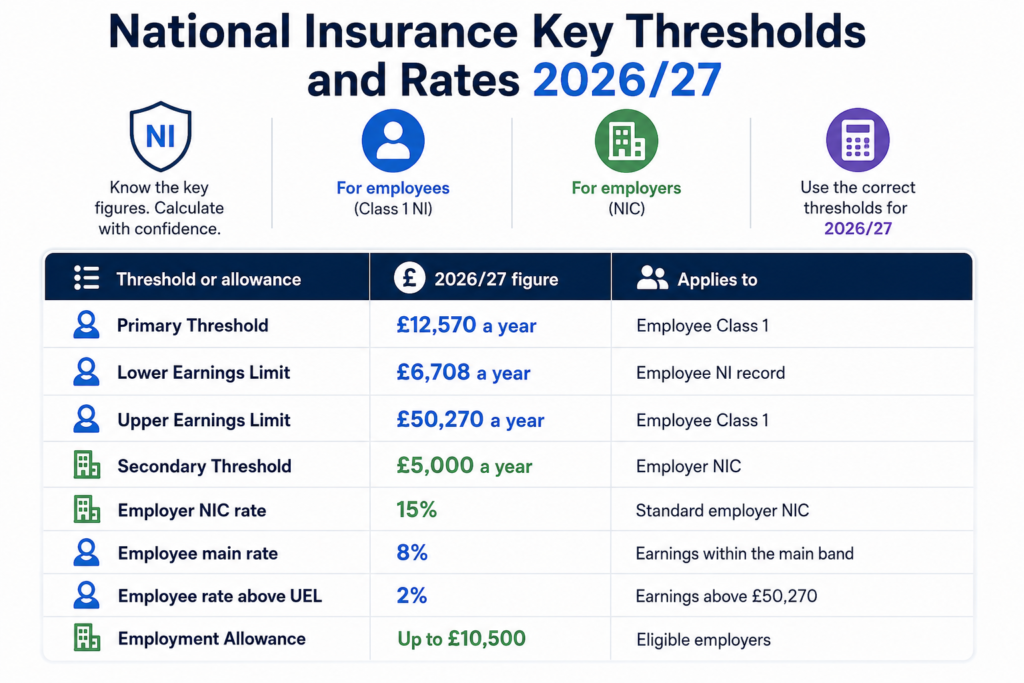
National Insurance Thresholds and Rates for 2026/27
The thresholds determine which part of earnings or profits falls into each National Insurance band.
| Threshold or allowance | 2026/27 figure | Applies to |
|---|---|---|
| Primary Threshold | £12,570 a year | Employee Class 1 |
| Lower Earnings Limit | £6,708 a year | Employee NI record |
| Upper Earnings Limit | £50,270 a year | Employee Class 1 |
| Secondary Threshold | £5,000 a year | Employer NIC |
| Employer NIC rate | 15% | Standard employer NIC |
| Employee main rate | 8% | Earnings within the main band |
| Employee rate above UEL | 2% | Earnings above £50,270 |
| Employment Allowance | Up to £10,500 | Eligible employers |
Primary Threshold
The Primary Threshold is £12,570 a year, equivalent to £242 a week.
For a standard employee, earnings below this level are not charged at the main Class 1 employee rate.
Lower Earnings Limit
The Lower Earnings Limit is £6,708 a year.
It is relevant to the National Insurance record even where employee NIC is not actually deducted.
This means “no NI deducted” does not necessarily mean “no NI record benefit”.
Upper Earnings Limit
The Upper Earnings Limit is £50,270 a year, or £967 a week.
The employee rate is 8% within the main band and falls to 2% on earnings above the UEL.
Secondary Threshold
The employer Secondary Threshold is £5,000 a year.
Employer NIC is charged above this threshold at the standard 15% rate, subject to applicable reliefs and special categories.
Employment Allowance
Eligible employers can receive up to £10,500 of Employment Allowance for 2026/27.
This can reduce the employer’s overall National Insurance liability.
It is an employer relief, not an allowance that reduces an employee’s own Class 1 deduction.
Self-employed NI thresholds
Self-employed workers use profit-based thresholds and Class 4 rates rather than employee Class 1 thresholds.
The main Class 4 rates identified here are:
- 6% within the main contribution band
- 2% above the upper profit limit
Class 2 has separate rules and should be assessed separately where relevant.
National Insurance and Your Take-Home Pay
NI vs Income Tax
National Insurance and Income Tax are separate deductions.
They have different thresholds, rates and calculation methods. Your tax code primarily determines your Income Tax treatment and does not simply change your employee NI rate.
When checking a payslip, look at the Income Tax and NI deductions separately.
Read More: Income Tax Calculator UK 2026/27 – Accurate & Free CalculatorHow an NI change affects monthly take-home pay
NI is only one part of the difference between gross salary and take-home pay.
For example, on a £40,000 salary, the simplified annual employee NI estimate is £2,194.40, or an average of £182.87 per month.
That does not mean take-home pay is £40,000 minus £2,194.40. Income Tax and any other applicable deductions also need to be considered.
Salary sacrifice and National Insurance
Some qualifying salary-sacrifice arrangements can change the earnings subject to National Insurance.
The treatment depends on the type of benefit and the arrangement used by the employer. Salary sacrifice should therefore not be treated as a universal way to reduce NI.
If you are comparing take-home pay before and after salary sacrifice, compare both the gross salary and the NIable salary used by payroll.
National Insurance Increase Examples for Different Situations
The most useful examples are those that show why the calculation changes between different types of worker.
Employee earning £25,000
| Calculation step | Amount |
|---|---|
| Annual salary | £25,000 |
| Primary Threshold | £12,570 |
| Earnings above Primary Threshold | £12,430 |
| Employee NI rate | 8% |
| Estimated annual employee NI | £994.40 |
| Average monthly NI | £82.87 |
For the same salary and circumstances, the simplified annual employee NI does not increase between 2025/26 and 2026/27 because the headline employee rates remain unchanged.
Employee earning £40,000
| Calculation step | Amount |
|---|---|
| Annual salary | £40,000 |
| Primary Threshold | £12,570 |
| Earnings above Primary Threshold | £27,430 |
| Employee NI rate | 8% |
| Estimated annual employee NI | £2,194.40 |
| Average monthly NI | £182.87 |
Employee earning £60,000
| Calculation step | Amount |
|---|---|
| Annual salary | £60,000 |
| Earnings charged at 8% | £37,700 |
| NI at 8% | £3,016.00 |
| Earnings above Upper Earnings Limit | £9,730 |
| NI at 2% | £194.60 |
| Total estimated employee NI | £3,210.60 |
This shows why earnings above the UEL are not charged at the full 8% employee rate.
Part-time employee earning £8,000
An £8,000 salary is below the £12,570 Primary Threshold, so the simplified calculation produces £0 employee Class 1 NIC.
However, the Lower Earnings Limit is relevant to the employee’s National Insurance record. Paying no employee NIC does not automatically mean the earnings have no relevance to State Pension entitlement.
Self-employed worker earning £40,000 profit
| Calculation step | Amount |
|---|---|
| Self-employed profit | £40,000 |
| Class 4 threshold | £12,570 |
| Profits above threshold | £27,430 |
| Class 4 NI rate | 6% |
| Estimated Class 4 NI | £1,645.80 |
This should not be treated as the person’s complete self-employed tax liability because Income Tax and any relevant Class 2 position are separate.
Employer paying an employee £30,000
Employer NIC is calculated separately:
| Calculation step | Amount |
|---|---|
| Employee salary | £30,000 |
| Employer Secondary Threshold | £5,000 |
| Earnings above threshold | £25,000 |
| Employer NIC rate | 15% |
| Estimated employer NIC | £3,750 |
This is before Employment Allowance or other applicable reliefs.
Under-21 employee or qualifying apprentice
Some employees fall into special employer NIC categories.
An eligible employer can have a 0% employer NIC rate on earnings up to the relevant Upper Secondary Threshold for an under-21 employee or qualifying apprentice.
The employee’s own Class 1 calculation remains separate.
This is another reason to avoid using the employee’s NI deduction as a shortcut for calculating employer NIC.
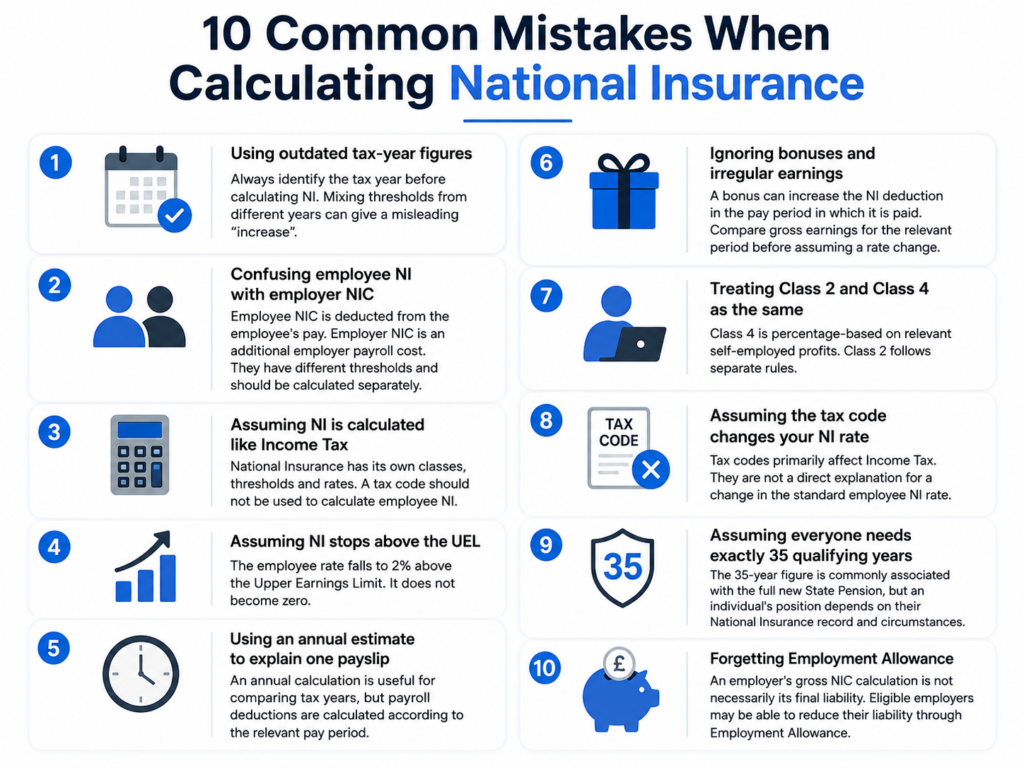
Common National Insurance Increase Calculator UK Mistakes
Using outdated tax-year figures
Always identify the tax year before calculating NI. Comparing a 2025/26 figure with a 2026/27 figure using mixed thresholds can produce a misleading “increase”.
Confusing employee NI with employer NIC
Employee NIC is deducted from the employee’s pay.
Employer NIC is an additional employer payroll cost.
They have different thresholds and should be calculated separately.
Assuming NI is calculated like Income Tax
National Insurance has its own classes, thresholds and rates. A tax code should not be used to calculate employee NI.
Assuming NI stops above the UEL
The employee rate falls to 2% above the Upper Earnings Limit. It does not become zero.
Using an annual estimate to explain one payslip
An annual calculation is useful for comparing tax years, but payroll deductions are calculated according to the relevant pay period.
Ignoring bonuses and irregular earnings
A bonus can increase the NI deduction in the pay period in which it is paid. Compare gross earnings for the relevant period before assuming a rate change.
Treating Class 2 and Class 4 as the same
Class 4 is percentage-based on relevant self-employed profits. Class 2 follows separate rules.
Assuming the tax code changes your NI rate
Tax codes primarily affect Income Tax. They are not a direct explanation for a change in the standard employee NI rate.
Assuming everyone needs exactly 35 qualifying years
The 35-year figure is commonly associated with the full new State Pension, but an individual’s position depends on their National Insurance record and circumstances.
Forgetting Employment Allowance
An employer’s gross NIC calculation is not necessarily its final liability. Eligible employers may be able to reduce their liability through Employment Allowance.
Expert Tips for Checking Your NI Increase
Compare like with like
For a meaningful year-on-year comparison, keep the salary, employment type and other relevant circumstances the same.
If both your salary and the NI rules change, you cannot attribute the entire difference to National Insurance.
Check your pay frequency
Compare a monthly payslip with a monthly calculation and a weekly payslip with a weekly calculation.
Use annual figures mainly for tax-year comparisons.
Check for bonuses and irregular payments
If one payslip shows much higher NI than normal, first check whether gross earnings were higher in that period.
Identify the correct NI category
Before using a calculator, establish whether the figure represents:
- Employee salary
- Employer payroll cost
- Self-employed profit
The same £30,000 figure produces different results under these three calculations.
Use official guidance for unusual cases
Directors, multiple employments, special employee categories and unusual payroll arrangements may require more detailed treatment than a standard calculator.
Expert Tip: If your calculator result differs from your payslip, check the pay period, NIable earnings, bonuses, employment type and calculation method before assuming the payroll deduction is incorrect.
Did employee National Insurance increase in 2026/27?
The standard employee Class 1 headline rates remain 8% and 2%. The major change described here is the increase in employer NIC to 15% and the reduction in the employer Secondary Threshold to £5,000.
How much National Insurance will I pay on £30,000?
Using the simplified annual employee calculation:
£30,000 – £12,570 = £17,430
£17,430 × 8% = £1,394.40
The estimated annual employee NI is £1,394.40.
How much National Insurance will I pay on £50,000?
The amount above the Primary Threshold is:
£50,000 – £12,570 = £37,430
At 8%, that gives estimated annual employee NI of £2,994.40.
What is the Primary Threshold for National Insurance?
For 2026/27, the employee Primary Threshold is £12,570 a year, equivalent to £242 a week.
What is the employer Secondary Threshold?
The 2026/27 employer Secondary Threshold is £5,000 a year. Standard employer NIC is charged above this threshold at 15%, subject to relevant reliefs and special categories.
What happens to National Insurance above the Upper Earnings Limit?
The employee rate falls from 8% to 2% on earnings above the £50,270 Upper Earnings Limit.
Why is my National Insurance deduction higher than expected?
Check whether your gross pay was higher than usual, particularly because of a bonus or irregular payment. Also check your pay frequency, employment type and whether you are comparing a payslip with an annual estimate.
Does a bonus increase National Insurance?
A bonus increases earnings in the relevant payroll period and can therefore increase the NI deducted for that period.
How is National Insurance calculated if I have two jobs?
Each employment generally has its own payroll calculation. Do not automatically combine the two salaries and treat them as one employment when estimating individual payroll deductions.
What is the difference between Class 2 and Class 4 National Insurance?
Class 4 is a percentage-based contribution on relevant self-employed profits. Class 2 follows separate rules and can be relevant to a person’s National Insurance record.
Does National Insurance count towards my State Pension?
National Insurance contributions and qualifying years are relevant to your National Insurance record and State Pension position. Earnings around or above the Lower Earnings Limit can also matter even where employee NIC is not deducted.
What is Employment Allowance?
Employment Allowance can reduce the employer’s National Insurance liability. Eligible employers can receive up to £10,500 for 2026/27.
Conclusion
The National Insurance Increase Calculator UK helps you compare your estimated NI contributions between 2025/26 and 2026/27. For most employees, the main Class 1 rates remain unchanged, while the major increase affects employer National Insurance. Your actual NI can also vary with salary, bonuses, pay frequency and employment type. Use the calculator to check your figures, then compare unusual results with your payslip and official HMRC guidance.