A colleague once mentioned her new job paid £38,000 a year, and without thinking, you compared it to your own £34,000 salary and assumed she’d landed the better deal. Then she mentioned she was working 45 hours a week, while you were on a 37.5-hour contract. Suddenly the comparison wasn’t so simple.
This happens more often than people realise. Two salaries can look completely different on paper and turn out to be almost identical once you break them down to what they’re actually worth per hour. It’s also why so many people search for this calculation right before a job interview, a pay rise conversation, or a decision between a salaried role and freelance work.
The annual salary figure on a contract or job advert tells you very little on its own. What matters is how many hours you’re trading for that money, and that’s where converting a salary to an hourly rate becomes genuinely useful, not just a maths exercise.
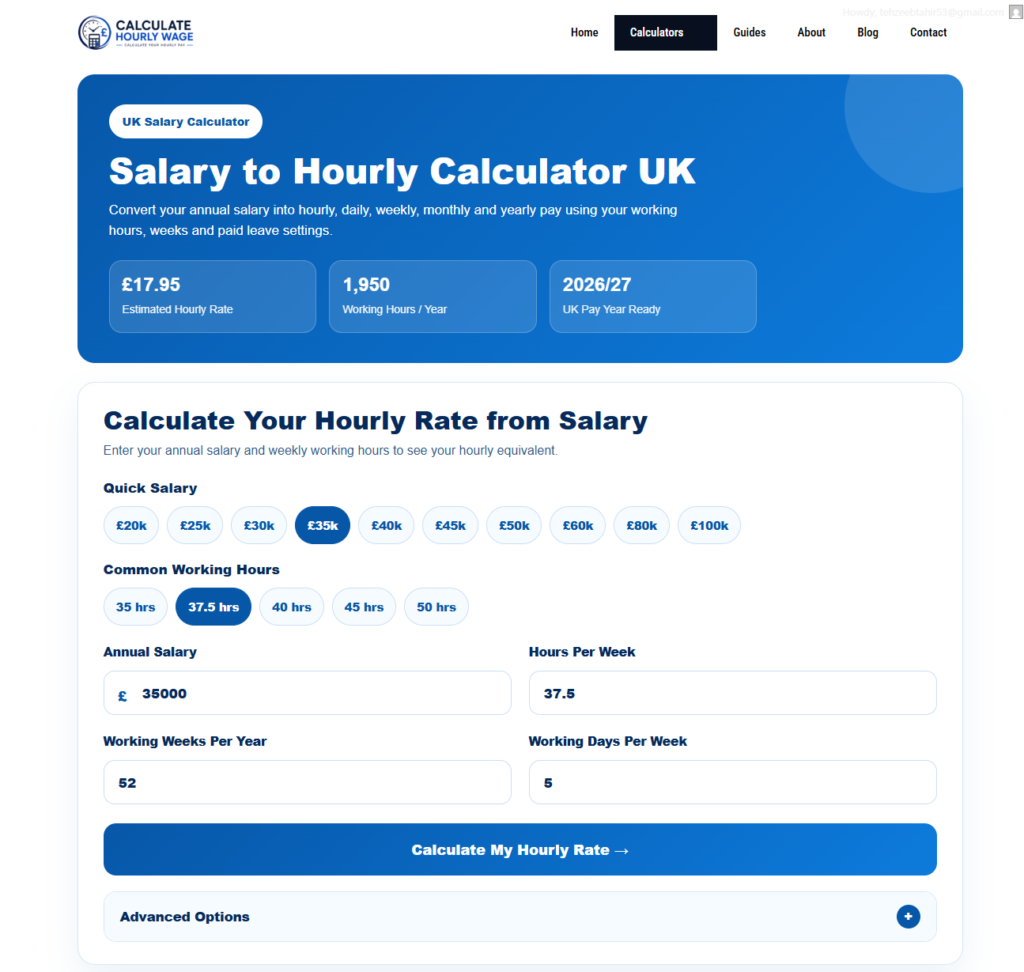
Want the answer without doing the maths yourself? Use the calculator below.
Click here: Salary to Hourly Calculator UK
Quick Answer
To calculate your hourly rate from an annual salary, divide your salary by your total working hours per year (hours per week × weeks per year).
| Formula | Example |
|---|---|
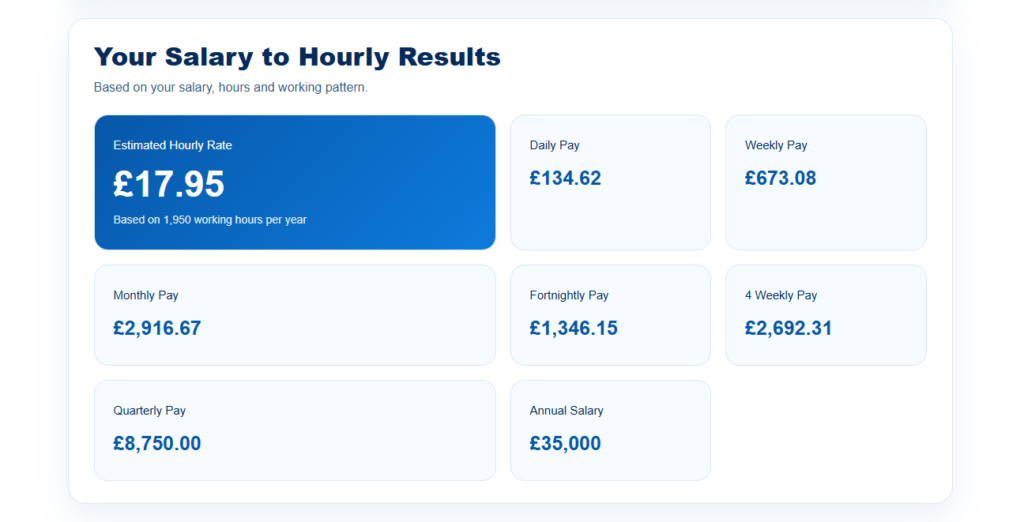
| Annual Salary ÷ (Hours per Week × Weeks per Year) = Hourly Rate | £35,000 ÷ 1,950 hours (37.5-hour week × 52 weeks) = £17.95/hour (gross) |
This is your contracted hourly rate, before Income Tax, National Insurance, or unpaid overtime are taken into account.
How to Use the Salary to Hourly Calculator UK
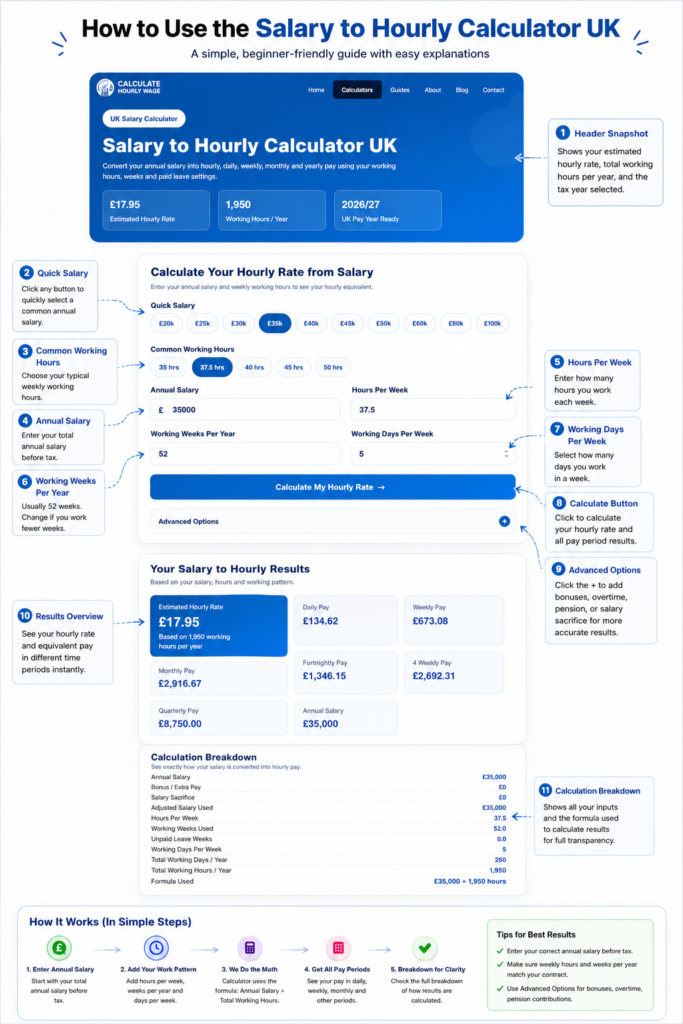
What “Salary to Hourly Rate” Actually Means
For most people, this calculation simply answers: if I broke my annual salary down evenly across every hour I’m contracted to work, what would that work out to? It’s a useful, honest number but a starting point, not the full picture.
Gross Hourly Rate vs Net (Take-Home) Hourly Rate
Your gross hourly rate is your salary divided by your working hours, before any deductions. It’s the figure used in job adverts and contracts, which makes it the cleanest way to compare one role against another.
Your net (take-home) hourly rate is what you actually keep per hour once Income Tax, National Insurance, pension contributions, and student loan repayments are deducted. It’s the number that matters when working out what an extra hour of work or a pay rise is genuinely worth to you.
The Salary to Hourly Rate Formula
Formula: Annual Salary ÷ (Hours per Week × Weeks per Year) = Hourly Rate
This is the standard method used across the UK, and the same logic most payroll systems apply.
Step-by-Step Manual Calculation
Step 1 — Find Your Annual Salary
Use your contracted gross salary, not your take-home pay.
Step 2 — Find Your Weekly Hours
Check your employment contract (commonly 35, 37.5, or 40 hours).
Step 3 — Choose the Number of Weeks
Most people use 52 weeks, as paid annual leave is already included.
Step 4 — Calculate Annual Hours
Hours per week × Weeks per year
Step 5 — Calculate Your Hourly Rate
Annual salary ÷ Total annual hours = Gross hourly rate
| Formula | Example |
|---|---|
| Annual Salary ÷ (Hours per Week × Weeks per Year) = Hourly Rate | 37.5 × 52 = 1,950 hours£32,000 ÷ 1,950 = £16.41/hour |
Converting Monthly or Weekly Pay
If you’re paid monthly, multiply by 12 to annualise first, then apply the same formula:
| Formula | Example |
|---|---|
| (Monthly Salary × 12) ÷ (Hours per Week × Weeks per Year) = Hourly Rate | £2,750 × 12 = £33,000£33,000 ÷ 1,950 = £16.92 per hour |
| Weekly Salary ÷ Contracted Hours = Hourly Rate | £625 ÷ 35 = £17.86 per hour |
A common mistake is multiplying a monthly salary by 13 instead of 12; a monthly salary already covers the full 52 weeks, just split into 12 payments.
How Many Working Hours Are in a UK Year?
Most calculators assume 52 weeks and stop there. But the weeks you’re paid for and the weeks you actually work aren’t quite the same thing.
Standard Calculation: 37.5 or 40 Hours × 52 Weeks
| Working Pattern | Annual Hours |
|---|---|
| 37.5 hours × 52 weeks | 1,950 hours |
| 40 hours × 52 weeks | 2,080 hours |
This assumes your salary already includes paid holiday, so leave weeks aren’t subtracted. It’s the convention most job adverts and payroll systems use.
Holiday-Adjusted Working Hours (Why 1,740 Hours Is More Accurate)
You can make it much easier to scan by using two tables:
Holiday-Adjusted Calculation
| Step | Value |
|---|---|
| Statutory annual leave | 28 days (5.6 weeks) |
| Working weeks | 46.4 weeks |
| Annual working hours (37.5 hrs/week) | 1,740 hours |
Use the holiday-adjusted method when you want the true value of hours actually worked, useful when weighing up overtime or a side project.
Standard method
Since your salary is earned across fewer actual working hours, your effective hourly rate is slightly higher than the standard calculation suggests.
| Calculation Method | Hourly Rate |
|---|---|
| £32,000 ÷ 1,740 hours (Holiday-adjusted) | £18.39/hour |
| £32,000 ÷ 1,950 hours (Standard) | £16.41/hour |
Use the standard method when comparing job adverts or contracts.
Note: Some payroll systems use 52.14 weeks instead of 52 to account for a year being slightly longer than 52 exact weeks. The difference is only a few pence per hour and rarely matters outside overtime calculations.
Table 1: Standard vs Holiday-Adjusted Working Hours
| Basis | Weeks Used | Hours/Week | Annual Hours | £32,000 → Hourly Rate |
|---|---|---|---|---|
| Standard (paid weeks) | 52 | 37.5 | 1,950 | £16.41 |
| Holiday-adjusted | 46.4 | 37.5 | 1,740 | £18.39 |
| Standard (paid weeks) | 52 | 40 | 2,080 | £15.38 |
| Holiday-adjusted | 46.4 | 40 | 1,856 | £17.24 |
Salary to Hourly Rate by Common UK Salaries
A quick reference, based on a standard 37.5-hour week and 52 weeks:
Table 2: Salary to Hourly Rate
| Annual Salary | Hourly Rate (Gross) |
|---|---|
| £20,000 | £10.26 |
| £25,000 | £12.82 |
| £30,000 | £15.38 |
| £35,000 | £17.95 |
| £40,000 | £20.51 |
| £50,000 | £25.64 |
| £60,000 | £30.77 |
| £75,000 | £38.46 |
| £100,000 | £51.28 |
These are gross figures.
Read more: Income Tax Calculator UK How Weekly Hours Change Your Hourly Rate
Two people on the same salary can end up with very different hourly rates, purely because of their weekly hours.
Table 3: Weekly Hours Comparison at a Fixed £40,000 Salary
| Weekly Hours | Annual Hours | Hourly Rate |
|---|---|---|
| 35 | 1,820 | £21.98 |
| 37.5 | 1,950 | £20.51 |
| 40 | 2,080 | £19.23 |
| 45 | 2,340 | £17.09 |
The gap between the 35-hour and 45-hour version is nearly £5 an hour a 28% difference despite identical pay. This is exactly why the headline salary figure alone can be misleading.
Worked Examples: Calculating Hourly Rate Step by Step
| Example | Calculation | Result |
|---|---|---|
| 1. Standard Salary (37.5-Hour Week) | £36,500 ÷ (37.5 × 52) = £36,500 ÷ 1,950 | £18.72/hour |
| 2. Standard Salary (40-Hour Week) | £42,000 ÷ (40 × 52) = £42,000 ÷ 2,080 | £20.19/hour |
| 3. Monthly Salary Annualised | £3,100 × 12 = £37,200 → £37,200 ÷ 1,950 | £19.08/hour |
| 4. Part-Time (Pro-Rata, 3-Day Week) | FTE: £30,000 ÷ 1,950 = £15.38/hour22.5 × 52 = 1,170 hours × £15.38 = £18,000 pro-rata salary | £15.38/hour |
| 5. Holiday-Adjusted Hours | 46.4 working weeks × 37.5 = 1,740 hours → £38,000 ÷ 1,740 | £21.84/hour (vs £19.49/hour using the standard 1,950-hour method) |
| 6. Unpaid Overtime | £36,000 ÷ (42.5 × 52) = £36,000 ÷ 2,210 | £16.29/hour (over £2/hour lower than the contracted rate of £18.46/hour) |
| 7. Gross to Net (2026/27 Tax Year) | Gross: £40,000 ÷ 1,950 = £20.51/hourTake-home: ~£31,920 ÷ 1,950 | £16.37/hour (around 20% lower than gross) |
Read More: National Insurance Calculator UKPart-Time, Pro-Rata, and Term-Time Hourly Rates
Calculating Pro-Rata Hourly Rate from an FTE Salary
If a job advert quotes a full-time equivalent (FTE) salary but you’ll work fewer hours, your hourly rate is based on the FTE figure, not your reduced pay packet:
- Take the FTE annual salary.
- Divide by FTE annual hours (e.g. 1,950 for 37.5 hrs/week).
- Multiply that hourly rate by your actual annual hours for your real pro-rata salary.
Always check whether a quoted salary is the FTE figure or the actual pro-rata amount before comparing roles.
Term-Time-Only and Zero-Hours Contracts
Term-time contracts are usually paid across 39–42 working weeks, even though pay is often spread evenly over 12 months. Use the actual weeks worked, not the months paid over, for an accurate hourly rate.
For zero-hours contracts, take total pay over a defined period (e.g. the last 12 weeks, per Working Time Regulations averaging rules) and divide by hours actually worked in that period, giving an average rather than a fixed rate.
Gross vs Net Hourly Rate After Tax and NI (2026/27)
Worked Example
| Item | Value |
|---|---|
| Annual Salary | £45,000 |
| Working Hours | 37.5 hrs/week (1,950 hours/year) |
| Gross Hourly Rate | £23.08/hour |
| Income Tax (2026/27) | ≈ £6,486 |
| Employee National Insurance | ≈ £3,244 |
| Estimated Take-Home Pay | ≈ £35,270/year |
| Net Hourly Rate | £18.09/hour |
| Difference from Gross | ≈ 21.6% lower |
Under 2026/27 Income Tax and Class 1 employee National Insurance (standard 1257L tax code, no pension), a £45,000 salary leaves an estimated take-home pay of about £35,270. This gap widens slightly at higher salaries once earnings cross the Higher Rate threshold.
Pension and Student Loan Impact
| Item | Value |
|---|---|
| Annual Salary | £45,000 |
| Pension Contribution (5%) | £2,250 |
| Effect on Tax | Slightly reduces Income Tax |
| Effect on Take-Home Pay | Net hourly rate falls further |
| Student Loan Repayments | 9% above the relevant threshold (for most Plan types) |
A 5% pension contribution on the £45,000 example removes a further £2,250 from gross pay before tax, slightly reducing the tax owed too. Take-home falls further, but that money isn’t lost; it’s building a pension pot, worth remembering when comparing net hourly rates across roles with different schemes.
Student loan repayments reduce your net hourly rate in the same way, with most plans requiring 9% repayments on earnings above the relevant repayment threshold.
Table 4: Gross vs Net Hourly Rate (2026/27, 37.5-hour week, no pension/student loan)
| Annual Salary | Gross Rate | Approx. Net Rate |
|---|---|---|
| £25,000 | £12.82 | £11.15 |
| £30,000 | £15.38 | £13.11 |
| £40,000 | £20.51 | £16.37 |
| £50,000 | £25.64 | £19.79 |
| £60,000 | £30.77 | £22.85 |
Estimates based on 2026/27 rates, standard 1257L code, England/Wales/NI rules. Scottish taxpayers will see slightly different results due to separate tax bands.
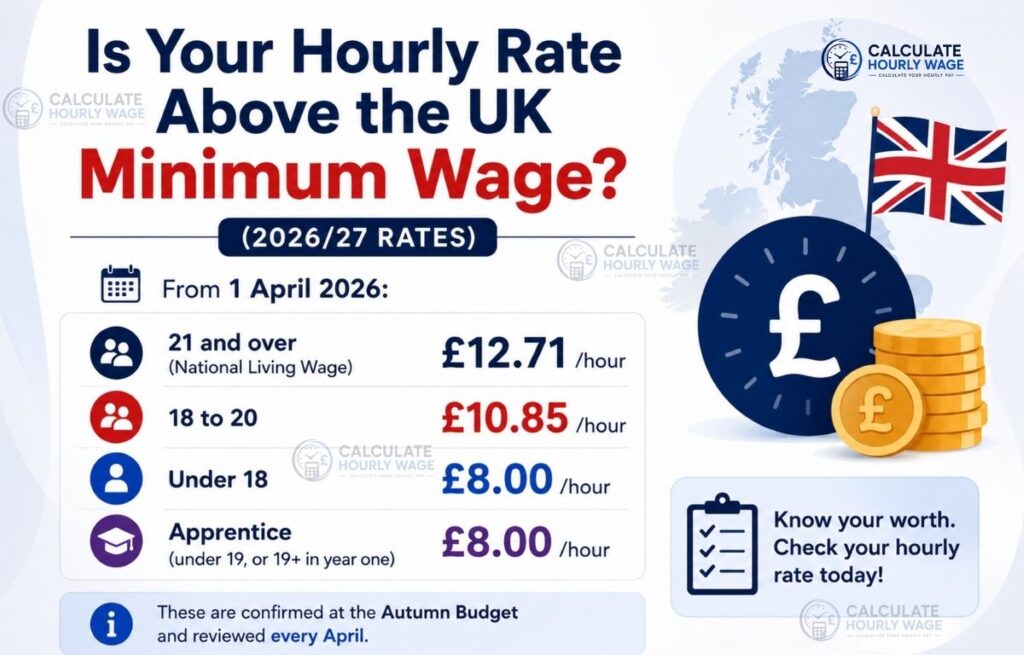
Is Your Hourly Rate Above the UK Minimum Wage? (2026/27 Rates)
From 1 April 2026:
- 21 and over (National Living Wage): £12.71/hour
- 18 to 20: £10.85/hour
- Under 18: £8.00/hour
- Apprentice: £8.00/hour (under 19, or 19+ in year one)
These are confirmed at the Autumn Budget and reviewed every April.
Table 5: Minimum Wage by Age Band (2026/27)
| Age Band | Hourly Rate | Annual Salary (37.5 hrs/week) |
|---|---|---|
| 21+ (NLW) | £12.71 | £24,785 |
| 18–20 | £10.85 | £21,158 |
| Under 18 | £8.00 | £15,600 |
| Apprentice | £8.00 | £15,600 |
If your calculated rate falls below your age band’s minimum, check your payslip for deductions (uniforms, tools, training costs) that might be reducing effective pay below the legal floor.
Visit Now: Gov.UKWhy Your Effective Hourly Rate Is Often Lower Than Your Contracted Rate
| Factor | Impact on Your Hourly Rate |
|---|---|
| Unpaid Overtime | Extra hours with no extra pay increase your total working hours while your salary stays fixed, lowering your effective hourly rate (see Example 6 above). |
| Commute Time | A 45-minute each-way commute adds 7.5 unpaid hours per week. It isn’t shown on your payslip, but it increases your real time commitment. |
| Hidden Costs | Expenses such as petrol, parking, work lunches, and subscriptions reduce your take-home pay without changing your contracted hourly rate on paper. |
Using Hourly Rate to Compare Job Offers and Negotiate Pay
Converting salary to hourly rate is one of the most useful ways to compare offers with different hours, and to build a case for a pay rise.
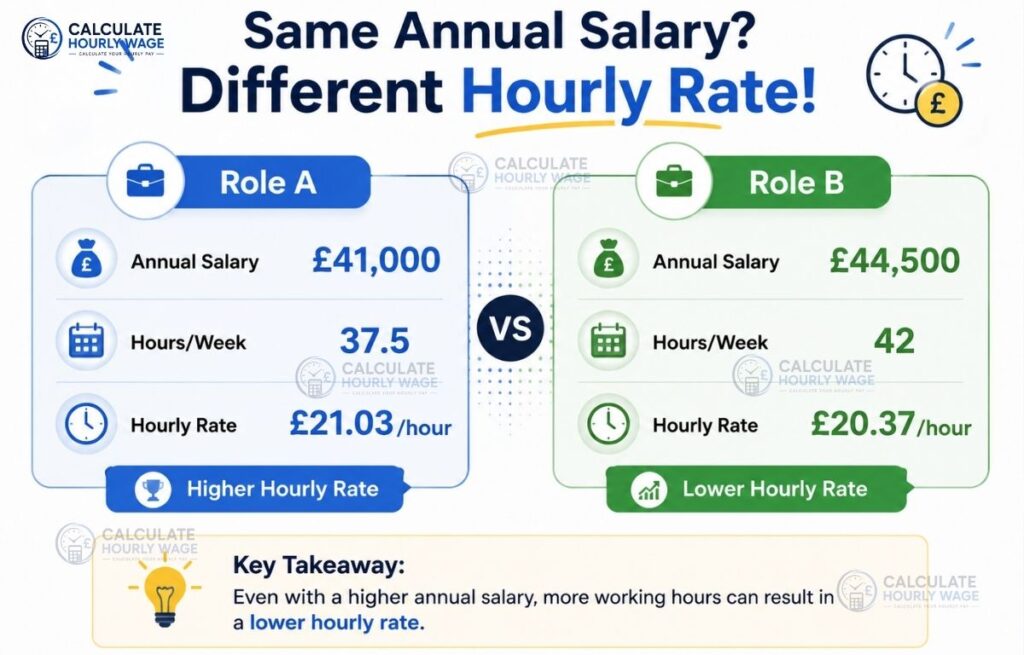
| Role | Annual Salary | Hours/Week | Hourly Rate |
|---|---|---|---|
| Role A | £41,000 | 37.5 | £21.03/hour |
| Role B | £44,500 | 42 | £20.37/hour |
Although Role B has the higher headline salary, Role A pays more per hour. That’s worth considering if your time outside work matters to you.
Read More: Overtime Pay Calculator UKConverting Salary to an Equivalent Freelance Day Rate
Freelancers need to cover their own tax, pension, holiday pay, and unbillable time costs a salary already absorbs. A common approach is multiplying your salaried hourly rate by 1.5–2, then converting to a day rate using typical billable hours per day.
| Scenario | Rate |
|---|---|
| Salaried Hourly Rate | £24/hour |
| Recommended Freelance Rate | £36–£48/hour |
| Daily Income (6 Billable Hours) | £216–£288/day |
A salaried rate of £24/hour might translate into a freelance target of £36–£48/hour. At 6 billable hours a day, that’s roughly £216–£288 per day. The higher freelance rate is intentional;l it covers unpaid admin, marketing, holidays, sick leave, taxes, business costs, and gaps between client work, rather than representing overcharging.
Read More: Salary to Hourly Calculator UKCommon Mistakes When Calculating Salary to Hourly Rate
- Using 52 weeks without checking for term-time or unpaid leave arrangements.
- Confusing gross hourly rate with net (take-home) hourly rate.
- Ignoring unpaid overtime, which quietly lowers real hourly value.
- Assuming a 40-hour week when the contract states 37.5.
- Forgetting holiday days are paid but not worked, affecting “true” hours.
- Annualising monthly pay by multiplying by 13 instead of 12.
- Applying a full-time rate to a pro-rata role without adjusting from the FTE salary.
- Comparing a salaried rate directly to a freelance day rate without accounting for tax and unbillable time.
- Overlooking commute time and work-related costs when judging a job’s real value.
- Using outdated minimum wage or tax figures, both of which change every April.
Expert Tips for Getting an Accurate Hourly Rate
| Recommendation | Why It Matters |
|---|---|
| Confirm your contracted weekly hours before calculating. | Don’t assume 37.5 or 40 hours. |
| Use 1,950 hours as your default baseline. | Unless your contract says otherwise. |
| Convert both job offers to an hourly rate before comparing. | The higher salary doesn’t always pay more per hour. |
| Keep gross and net hourly rates separate. | They measure different things and shouldn’t be compared directly. |
| Calculate pro-rata roles from the FTE salary first. | Then apply your actual contracted hours. |
| Track unpaid overtime separately. | It’s usually the biggest hidden reducer of your effective hourly rate. |
| Recheck your figures every April. | Minimum wage and tax thresholds are updated annually. |
| Moving to freelance? | Aim for 1.5–2× your salaried hourly rate. |
| Use holiday-adjusted hours (1,740) when appropriate. | It reflects the true value of hours actually worked, rather than the standard 1,950-hour method. |
| Check for legitimate deductions before assuming underpayment. | This helps determine whether you’re actually below the minimum wage. |
Practical Scenarios
| Scenario | Example | Key Takeaway |
|---|---|---|
| Two Job Offers | £39,000 at 35 hrs/week = £21.43/hour vs £43,000 at 42 hrs/week = £19.68/hour | The lower annual salary actually pays more per hour. |
| Suspected Underpayment | £11.20/hour, but regularly working 30 minutes unpaid after each shift | The effective hourly rate may fall below the National Living Wage, making it worth raising with HR. |
| Moving to a Three-Day Week | £22,800 pro-rata from a £38,000 FTE salary at 22.5 hrs/week | Check that the pro-rata salary matches the contracted hours instead of accepting the figure at face value. |
| Pay Rise Conversation | Hourly rate remains £17.50/hour for three years, despite taking on supervisory duties | A stagnant hourly rate can provide a clear starting point for a pay review. |
| Considering Freelance Work | £19/hour salaried role → £30–£38/hour freelance target | Freelance rates should reflect tax, holidays, business costs, and gaps between contracts—not just your salaried rate. |
How do I calculate my hourly rate from my annual salary in the UK?
Divide your salary by total working hours per year. £35,000 ÷ 1,950 hours = £17.95/hour, based on a 37.5-hour week.
What is the formula for salary to hourly rate?
Annual Salary ÷ (Hours per Week × Weeks per Year) = Hourly Rate.
How many hours are in a UK working year?
1,950 hours (37.5 hrs × 52 weeks), or 2,080 at 40 hours. Subtracting statutory holiday gives roughly 1,740 or 1,856.
Is hourly rate calculated gross or net?
Usually gross, since that’s what’s used in adverts and contracts. Net (take-home) rate is typically 15–22% lower.
How do I calculate hourly rate from monthly salary?
Multiply monthly pay by 12, then divide by annual hours: £3,000 × 12 = £36,000 ÷ 1,950 = £18.46/hour.
How do I calculate hourly rate from weekly pay?
Divide by contracted weekly hours: £650 ÷ 37.5 = £17.33/hour.
What is the UK minimum wage per hour 2026/27?
£12.71 for ages 21+, £10.85 for 18–20, £8.00 for under-18s and apprentices, from 1 April 2026.
How does part-time salary convert to hourly rate?
Use the full-time-equivalent salary divided by full-time hours — the rate applies regardless of hours actually worked.
Does holiday allowance affect my hourly rate?
Yes — subtracting 5.6 weeks of statutory leave from 52 gives fewer actual working hours, slightly raising your effective rate.
How do I calculate hourly rate with unpaid overtime?
Add unpaid hours to your contracted hours, then divide salary by the new, higher total.
What’s the difference between gross and net hourly rate?
Gross is salary ÷ hours before deductions; net uses take-home pay after tax, NI, pension, and student loan.
How do I compare two job offers with different hours?
Convert each to an hourly rate using its own weekly hours — the higher salary isn’t always the better hourly deal.
Is 37.5 or 40 hours standard for full-time UK jobs?
Both are common; office and public sector roles often use 37.5, private/industrial roles often use 40. Check your contract.
How do I calculate hourly rate as a freelancer?
Multiply your salaried hourly rate by roughly 1.5–2 to cover tax, holiday pay, and unbillable time, then convert to a day rate.
Does my hourly rate change with National Insurance and tax?
Gross rate stays the same; net rate drops by roughly 15–22% depending on salary.
How do I know if my salary is below minimum wage per hour?
Recalculate using actual hours (including unpaid overtime) and compare to the rate for your age band.
What is a pro-rata hourly rate?
The hourly rate from a full-time-equivalent salary, applied to someone working reduced hours — the rate itself doesn’t change.
How do I convert term-time-only salary to an hourly rate?
Use actual weeks worked (typically 39–42), not the 12 months pay is spread over.
Why is my actual hourly rate lower than my contracted rate?
Usually unpaid overtime — more hours worked without more pay lowers the effective rate.
How often do minimum wage and tax rates change in the UK?
Every 1 April, following Autumn Budget confirmation of Low Pay Commission recommendations and updated tax thresholds.
Conclusion
Converting your salary to an hourly rate takes the guesswork out of comparing jobs and understanding what your time is worth. Once you’ve run the formula a couple of times, it becomes second nature a habit worth keeping before accepting an offer, negotiating a rise, or weighing up freelance work. If you’d rather skip the manual maths, the calculator above will do the full gross and net conversion in seconds.