

Imagine you’ve received two job offers.
The first advertises £16.50 per hour, while the second offers an annual salary of £33,000. At first, it’s difficult to tell which role pays more. Add different working hours, overtime or part-time schedules and the comparison becomes even more confusing.
This is a common challenge for job seekers, employees considering a promotion and students entering the workforce. Understanding your annual salary gives you a clear picture of your earning potential and makes it easy to compare different pay structures.
That’s where an annual salary calculator UK becomes useful. It quickly converts hourly, daily, weekly or monthly pay into an estimated annual salary, helping you compare jobs, plan your finances and assess the impact of different working hours.
In this guide, you’ll learn how annual salary calculations work, the formulas used and the common mistakes to avoid, along with practical examples to help you calculate your earnings confidently.
Click Here: Hourly Wage Calculator UK
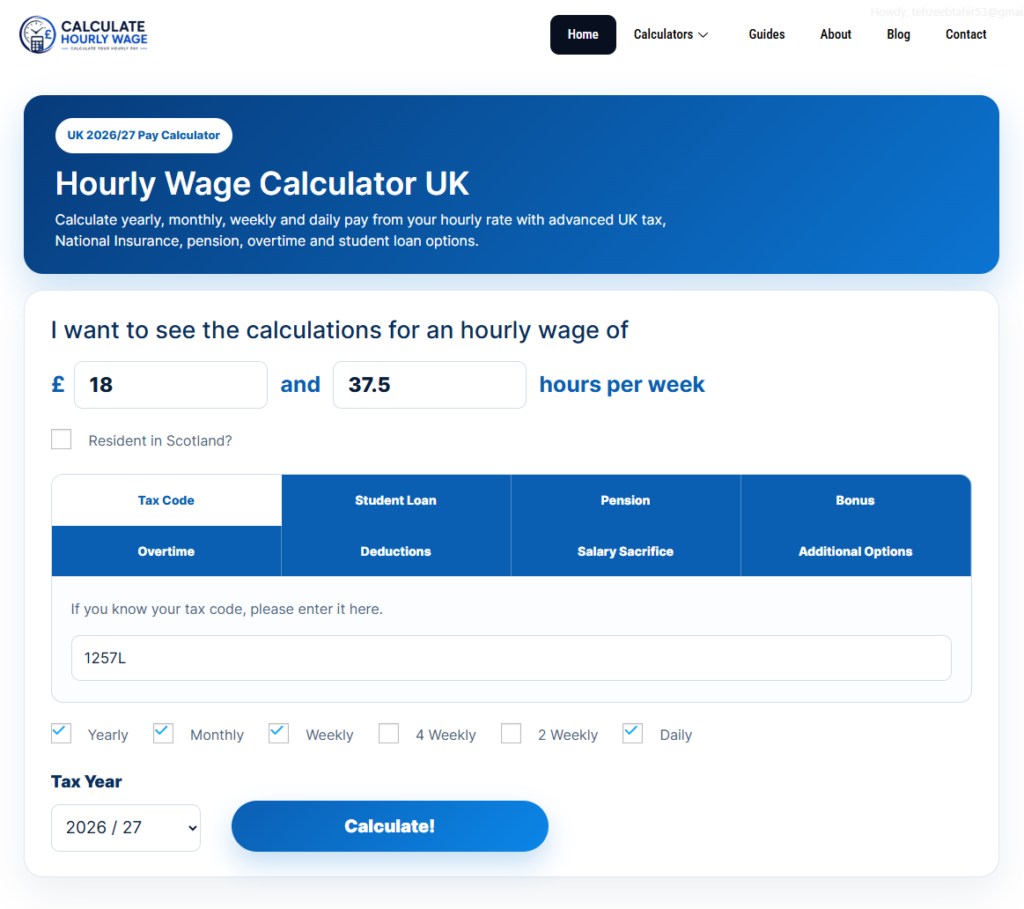
How To Use Hourly Wage Calculator UK

An annual salary calculator UK converts your hourly, daily, weekly or monthly pay into an estimated yearly salary based on your working pattern.
The standard formula is:
Hourly Rate × Hours Worked Per Week × Weeks Worked Per Year = Annual Gross Salary
For example
| Description | Value |
|---|---|
| Hourly Rate | £18 |
| Hours per Week | 37.5 |
| Weeks per Year | 52 |
| Calculation | £18 × 37.5 × 52 |
| Estimated Gross Annual Salary | £35,100 |
This is your salary before deductions such as Income Tax, National Insurance, pension contributions and salary sacrifice arrangements.
What Is an Annual Salary?
An annual salary is the total amount an employee earns over one year before deductions. Employers typically quote salaries annually because they provide a consistent way to compare different jobs.
Unlike hourly-paid work, where earnings depend on the hours worked, a salaried employee receives a fixed yearly amount. Monthly payslips may vary slightly due to overtime, bonuses or unpaid leave, but the contracted annual salary usually remains the same.
For example:
- An employee earning £32,000 per year receives the same annual salary regardless of how many working days are in each month.
- An employee earning £16 per hour may earn more or less each year depending on the number of hours worked.
Understanding this difference makes it easier to compare salaried and hourly-paid roles.
Annual Salary vs Annual Income
Although these terms are often used interchangeably, they are not identical.
| Annual Salary | Annual Income |
|---|---|
| Fixed yearly pay agreed with an employer | Total income received during the year |
| Usually excludes investment income | May include bonuses, dividends, rental income, and interest |
| Based on your employment contract | Includes income from all sources |
For most employees, annual salary makes up the largest part of their annual income. However, if you receive bonuses, commission, freelance income, or investment returns, your total annual income may be higher than your contracted salary.
Gross vs Net Annual Salary
One of the biggest sources of confusion is the difference between gross salary and net salary.
| Gross Annual Salary | Net Annual Salary (Take-Home Pay) |
|---|---|
| The amount you earn before any deductions are made. Employers nearly always advertise salaries using the gross figure. | The amount you receive after deductions have been taken from your gross salary. |
| Common Deductions from Gross Salary |
|---|
| PAYE Income Tax |
| National Insurance contributions |
| Workplace pension contributions |
| Salary sacrifice deductions (where applicable) |
For example:
| Description | Amount |
|---|---|
| Gross Annual Salary | £38,000 |
| Income Tax | Deducted |
| National Insurance | Deducted |
| Pension Contributions | Deducted |
| Net Annual Income | Lower than £38,000 |
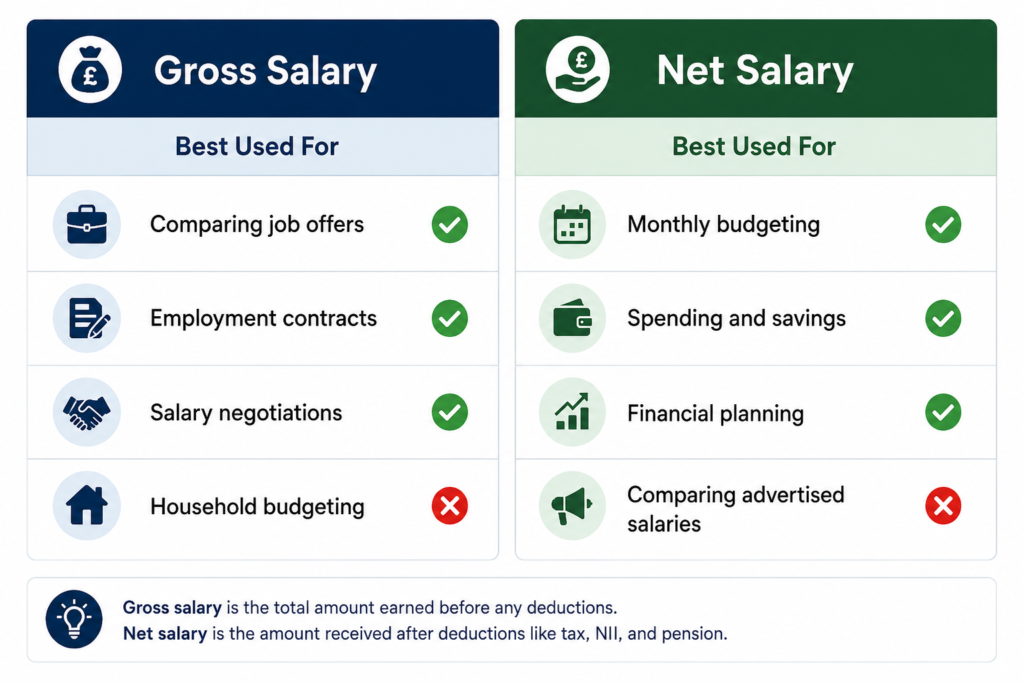
If your goal is to compare job offers, use the gross salary because it provides a consistent basis for comparison.
If you’re planning your household budget, your net income is more relevant because it reflects the money available to spend or save.
Read More: Net to Gross Salary Calculator UK How to Calculate Annual Salary
Knowing the formula for calculating an annual salary helps you understand how different work patterns affect your earnings. While an online calculator performs these calculations instantly, it’s useful to understand the assumptions used.
Annual Salary Formula
The formula depends on how you’re paid.
Hourly Pay to Annual Salary
| Item | Value |
|---|---|
| Formula | Hourly Rate × Hours per Week × Weeks Worked per Year |
| Hourly Rate | £17 |
| Hours Each Week | 37.5 |
| Working Weeks | 52 |
| Calculation | £17 × 37.5 × 52 |
| Annual Salary | £33,150 |
Daily Rate to Annual Salary
| Item | Value |
|---|---|
| Formula | Daily Rate × Days Worked per Week × Weeks Worked per Year |
| Daily Rate | £180 |
| Working Days per Week | 5 |
| Working Weeks | 52 |
| Calculation | £180 × 5 × 52 |
| Annual Salary | £46,800 |
Weekly Pay to Annual Salary
| Item | Value |
|---|---|
| Formula | Weekly Pay × Weeks Worked per Year |
| Weekly Pay | £720 |
| Working Weeks | 52 |
| Calculation | £720 × 52 |
| Annual Salary | £37,440 |
Monthly Salary to Annual Salary
| Item | Value |
|---|---|
| Formula | Monthly Salary × 12 |
| Monthly Salary | £2,950 |
| Calculation | £2,950 × 12 |
| Annual Salary | £35,400 |
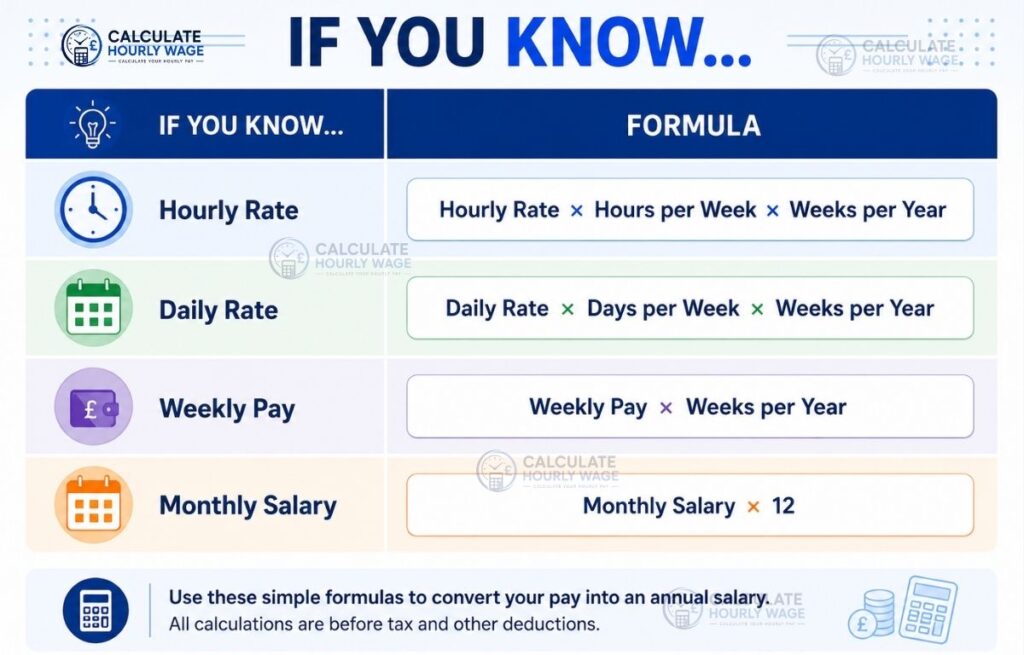
Formula Summary
| If You Know… | Formula |
|---|---|
| Hourly Rate | Hourly Rate × Hours per Week × Weeks per Year |
| Daily Rate | Daily Rate × Days per Week × Weeks per Year |
| Weekly Pay | Weekly Pay × Weeks per Year |
| Monthly Salary | Monthly Salary × 12 |
These formulas estimate gross annual salary. They do not automatically account for overtime premiums, unpaid leave, bonuses, tax, or pension deductions.
Standard Working Assumptions
| Input | Description |
|---|---|
| Hours Worked per Week | The number of hours you work each week. |
| Weeks Worked per Year | The total number of weeks you work during the year. |
Typical Full-Time Working Hours in the UK
| Working Pattern | Hours per Week |
|---|---|
| Standard Full-Time | 35 hours |
| Common Full-Time | 37.5 hours |
| Full-Time (Maximum Common Standard) | 40 hours |
Most calculators assume 52 working weeks, as annual salaries are generally quoted for the full year. However, this may not suit everyone.
Use fewer weeks if you are:
- A seasonal worker
- An agency worker with gaps between assignments
- A contractor taking unpaid holidays
- A part-time employee with fewer working hours
If your hours vary each week, calculate your average weekly hours from several recent payslips for a more accurate estimate.
When comparing job offers, always use the same working hours and weeks so the comparison is consistent.
Read More: Salary to Hourly Calculator UKConvert Different Pay Periods into Annual Salary
Whether you’re paid hourly, daily, weekly, or monthly, converting your earnings into an annual salary makes it easier to compare jobs and understand your yearly income.
Hourly Wage to Annual Salary
Hourly pay is common in retail, hospitality, healthcare, warehousing, and customer service.
Formula
Hourly Rate × Hours per Week × Weeks Worked per Year
| Hourly Rate | Hours/Week | Weeks/Year | Annual Salary |
|---|---|---|---|
| £12.71 | 37.5 | 52 | £24,784.50 |
| £15.00 | 40 | 52 | £31,200 |
| £18.50 | 37.5 | 52 | £36,075 |
| £22.00 | 35 | 52 | £40,040 |
If your weekly hours vary, use your average hours from recent payslips for a more accurate estimate.
Read More: Hourly Wage Calculator UKDaily Rate to Annual Salary
Daily rates are common for contractors, consultants, freelancers, and temporary workers.
Formula
Daily Rate × Days per Week × Weeks Worked per Year
| Daily Rate | Days/Week | Weeks/Year | Annual Salary |
|---|---|---|---|
| £120 | 5 | 52 | £31,200 |
| £180 | 5 | 52 | £46,800 |
| £250 | 5 | 52 | £65,000 |
| £350 | 5 | 48 | £84,000 |
Using 48 weeks instead of 52 may better reflect unpaid holidays or breaks between contracts.
Read More: Daily Rate Calculator UKWeekly Salary to Annual Salary
If you’re paid weekly, multiply your weekly earnings by the number of weeks worked each year.
Formula
Weekly Pay × Weeks Worked per Year
| Weekly Pay | Weeks Worked | Annual Salary |
|---|---|---|
| £500 | 52 | £26,000 |
| £650 | 52 | £33,800 |
| £820 | 52 | £42,640 |
| £950 | 48 | £45,600 |
If overtime is included in your weekly pay but isn’t guaranteed, calculate it separately for a more realistic annual estimate.
Read More: Weekly Salary Calculator UKMonthly Salary to Annual Salary
Monthly salaries are common in permanent office-based roles.
The conversion is simple because there are 12 months in a year.
Formula
Monthly Salary × 12
Examples:
| Monthly Salary | Annual Salary |
|---|---|
| £2,000 | £24,000 |
| £2,500 | £30,000 |
| £3,250 | £39,000 |
| £4,000 | £48,000 |
Remember that some payslips include overtime, commission, or bonuses alongside your regular monthly salary. If these payments vary, calculate them separately instead of assuming they’ll occur every month.
Read More: Monthly Salary Calculator UKAnnual Salary Back to Hourly Rate
Sometimes you already know your annual salary but want to understand what it equates to per hour.
This is useful when:
- Comparing a salaried role with an hourly-paid position.
- Negotiating a pay increase.
- Evaluating freelance opportunities.
- Understanding the value of overtime.
The calculation is:
| Item | Value |
|---|---|
| Formula | Annual Salary ÷ Weeks Worked ÷ Hours Worked Per Week |
| Annual Salary | £39,000 |
| Hours per Week | 37.5 |
| Weeks Worked | 52 |
| Calculation | £39,000 ÷ 52 ÷ 37.5 |
| Hourly Rate | £20.00 per hour |
Always use your actual contracted hours rather than assuming a 40-hour week; otherwise the comparison may be misleading.
Read More: Salary to Hourly Calculator UKWorked Examples
The following examples demonstrate how different working arrangements can produce very different annual salaries, even when the pay rate appears similar.
Example 1 – Full-Time Hourly Worker
Emma works in customer support.
| Details | Value |
|---|---|
| Hourly Rate | £16.80 |
| Weekly Hours | 37.5 |
| Working Weeks | 52 |
| Calculation | £16.80 × 37.5 × 52 |
| Annual Gross Salary | £32,760 |
This is her estimated annual salary before deductions for Income Tax, National Insurance, and pension contributions.
Example 2 – Part-Time Employee
Daniel works three days each week in a local college.
| Details | Value |
|---|---|
| Hourly Rate | £19 |
| Weekly Hours | 22.5 |
| Working Weeks | 52 |
| Calculation | £19 × 22.5 × 52 |
| Annual Salary | £22,230 |
Although Daniel earns a higher hourly rate than Emma, his annual earnings are lower because he works fewer hours.
Example 3 – Monthly Salary Conversion
Sophie receives a fixed salary each month.
| Details | Value |
|---|---|
| Monthly Salary | £3,150 |
| Calculation | £3,150 × 12 |
| Annual Salary | £37,800 |
Because she is salaried, the number of working days in each month does not change her contracted annual pay.
Example 4 – Daily Rate Contractor
James works as an IT contractor.
| Details | Value |
|---|---|
| Daily Rate | £275 |
| Working Days per Week | 5 |
| Working Weeks | 46 |
| Calculation | £275 × 5 × 46 |
| Annual Income Estimate | £63,250 |
James deliberately uses 46 weeks instead of 52 because he plans unpaid holidays and expects occasional gaps between contracts.
Example 5 – Employee with Regular Overtime
Aisha works in logistics.
| Details | Value |
|---|---|
| Hourly Rate | £17 per hour |
| Contracted Hours | 37.5 hours per week |
| Overtime Hours | 5 hours per week (paid at the same hourly rate) |
| Regular Pay | £17 × 37.5 × 52 = £33,150 |
| Overtime | £17 × 5 × 52 = £4,420 |
| Estimated Annual Earnings | £37,570 |
If overtime is guaranteed throughout the year, including it provides a more realistic estimate. If overtime varies significantly, treat it as additional income rather than part of your core salary.
How Working Hours Affect Annual Salary
Your hourly rate is only part of the calculation. Your weekly working hours have an equally important impact on your annual salary, and even small changes can significantly affect your yearly earnings.
Full-Time Working Hours
There is no legal definition of full-time employment in the UK, but many employers use one of these working patterns:
- 35 hours per week
- 37.5 hours per week
- 40 hours per week
For someone earning £18 per hour, the estimated annual salary would be:
| Weekly Hours | Estimated Annual Salary |
|---|---|
| 35 | £32,760 |
| 37.5 | £35,100 |
| 40 | £37,440 |
When comparing job offers, consider both the hourly rate and contracted hours, as more hours can result in a higher annual salary despite a lower hourly wage.
Part-Time Working Hours
Part-time employees work fewer contracted hours, commonly 15, 20, 24, or 30 hours per week.
To estimate your annual salary, use your actual weekly hours in the standard formula rather than estimating based on the number of days worked.
Variable Weekly Hours
If your hours change regularly, as they often do for agency workers, seasonal staff, hospitality employees, healthcare workers, and zero-hour contract workers, use your average weekly hours from several recent payslips instead of a single week’s earnings.
This provides a more realistic annual salary estimate.
Overtime and Extra Shifts
Regular overtime can increase your annual earnings, but it should only be included if it is consistent or contractually guaranteed.
Exclude overtime that is occasional or seasonal, and calculate enhanced overtime rates (such as time-and-a-half or double time) separately before adding them to your annual estimate.
Read More: Overtime Pay Calculator UKWhat Should Be Included in Your Annual Salary Calculation?
An annual salary estimate should include guaranteed earnings while keeping variable income separate where appropriate.
Regular Pay
Start with your contracted earnings, including:
- Hourly wage
- Weekly pay
- Monthly salary
- Annual salary
This provides the most reliable baseline when comparing jobs or estimating yearly income.
Overtime
Include overtime only if it is:
- Guaranteed by your contract
- Worked consistently
- A regular part of your working pattern
If overtime is optional or irregular, estimate it separately instead of adding it to your basic annual salary.
Bonuses and Commission
Bonuses and commission should normally be treated as additional earnings because they are not always guaranteed.
| Income Source | Amount |
|---|---|
| Basic Salary | £34,000 |
| Estimated Annual Bonus | £2,500 |
| Total Potential Earnings | £36,500 |
Separating guaranteed salary from variable income provides a clearer picture of your expected earnings.
Holiday Pay
For salaried employees, paid annual leave is usually included in the contracted salary.
Hourly-paid workers may receive holiday pay separately, so check your employment contract or payslip before including it in your calculation.
Pension Contributions
Workplace pension contributions reduce your take-home pay, but they do not change your gross annual salary.
If you’re budgeting based on disposable income, estimate your net pay using:
Salary Sacrifice Arrangements
Some employers offer salary sacrifice schemes, allowing employees to exchange part of their salary for benefits such as:
- Additional pension contributions
- Cycle to Work schemes
- Electric vehicle leasing
- Childcare schemes (where applicable)
These schemes can affect your taxable income and take-home pay, so consider them when comparing job offers.
Visit Now: GOV.UKGross Salary vs Net Salary Comparison
Understanding the difference between gross and net salary helps you compare jobs accurately and plan your finances.
Why Gross Salary Is Used
Employers usually advertise gross annual salary because it provides a consistent basis for comparison. Individual deductions—such as Income Tax, National Insurance, pension contributions, student loan repayments, and salary sacrifice—vary from person to person.
When Net Salary Is More Useful
Your net salary is more useful for budgeting because it reflects the amount you actually receive after deductions.
It can help you:
- Plan monthly expenses
- Estimate savings
- Assess mortgage affordability
- Manage household finances
Annual Salary vs Pro-Rata Salary
Many employees confuse an annual salary with a pro-rata salary, but they represent different things.
An annual salary assumes you work your full contracted hours for the entire year.
A pro-rata salary adjusts that annual figure based on reduced working hours, fewer working days, or part-year employment.
For example:
| Contract | Annual Salary |
|---|---|
| Full-time (37.5 hrs/week) | £36,000 |
| 3 days per week (60%) | £21,600 |
| Half-time (50%) | £18,000 |
Understanding the distinction is especially important if you’re comparing:
- Part-time jobs
- School or college contracts
- NHS roles
- Public sector vacancies
- Flexible working arrangements
If your job advert states that the salary is pro-rata, always calculate your expected annual earnings based on your actual working pattern rather than the full-time equivalent (FTE).
Practical Salary Conversion Scenarios
These examples show how annual salary calculations can help in everyday situations.
| Scenario | Description |
|---|---|
| Comparing Two Job Offers | Compare an hourly-paid role with a salaried position by converting both into annual earnings using the same working hours and weeks. |
| Calculating a Graduate Salary | Convert a monthly salary into an annual figure to understand the total value of a graduate job offer. |
| Estimating Part-Time Earnings | Use your contracted weekly hours to estimate annual earnings from part-time work. |
| Working Regular Overtime | Keep guaranteed overtime separate from occasional overtime to produce a more realistic annual salary estimate. |
| Converting a Contractor Day Rate | Contractors should calculate annual earnings using realistic working weeks rather than assuming they will work all 52 weeks. |
Before Comparing Two Job Offers, Check These Factors
Two jobs with the same annual salary do not always provide the same overall value.
| Factor | Why It Matters |
|---|---|
| Annual gross salary | Standard comparison figure |
| Weekly working hours | Longer hours reduce your effective hourly rate |
| Paid overtime | Can significantly increase earnings |
| Pension contribution | A higher employer contribution increases total compensation |
| Annual leave entitlement | More paid leave may improve work-life balance |
| Bonus or commission | Variable income should be assessed separately |
| Flexible working | May reduce commuting costs and improve lifestyle |
| Salary sacrifice schemes | Can affect taxable income and take-home pay |
Looking beyond salary alone gives a more accurate picture of the overall value of a job offer.
Common Mistakes When Calculating Annual Salary
Avoid these common errors:
- Using incorrect weekly working hours.
- Assuming you’ll work all 52 weeks.
- Confusing gross salary with net salary.
- Ignoring unpaid leave.
- Including occasional overtime as guaranteed income.
- Treating bonuses as fixed earnings.
- Confusing monthly pay with four-week payroll cycles.
- Forgetting pension deductions affect take-home pay.
- Comparing jobs using different assumptions.
- Using outdated working hours after a contract change.
Expert Tips for More Accurate Annual Salary Calculations
Recruiters, payroll professionals, and financial advisers generally compare salaries using gross annual pay because it provides a consistent benchmark across employers.
For the most accurate estimate:
- Use the hours stated in your employment contract rather than estimated working hours.
- Average your weekly hours if you work shifts or variable schedules.
- Keep guaranteed salary separate from bonuses and irregular overtime.
- Review your latest payslip after every pay rise or contract change.
- Contractors should use realistic working weeks instead of assuming 52 billable weeks.
- Compare jobs using gross salary, but plan your household budget using estimated net pay.
- If you’re unsure whether a payment forms part of your salary, check your employment contract or latest PAYE payslip.
These small adjustments can significantly improve the accuracy of salary comparisons.
How do I calculate my annual salary from an hourly wage?
Multiply your hourly rate by the number of hours you work each week, then multiply that figure by the number of weeks you expect to work during the year.
Formula:
Hourly Rate × Hours per Week × Weeks Worked Per Year
For example, if you earn £18 per hour, work 37.5 hours each week, and work 52 weeks, your estimated annual gross salary is £35,100.
Is annual salary before or after tax?
In most cases, an annual salary refers to your gross salary, which is the amount you earn before deductions such as:
PAYE Income Tax
National Insurance contributions
Workplace pension contributions
How many working weeks should I use?
For most permanent employees, 52 weeks is appropriate because annual salaries are generally quoted across the full calendar year.
However, you may wish to use fewer weeks if you:
Take unpaid leave.
Work seasonally.
Are self-employed.
Work on short-term contracts with gaps between projects.
Using realistic working weeks gives a more accurate estimate of your yearly earnings.
Can I calculate annual salary from monthly pay?
Yes.
Simply multiply your monthly salary by 12.
For example:
Monthly salary: £2,800
Annual salary: £33,600
This works well for employees receiving a fixed monthly salary.
Does overtime count towards annual salary?
It depends.
Include overtime if it is:
Guaranteed.
Worked consistently.
Part of your regular working pattern.
If overtime is occasional or unpredictable, calculate it separately rather than including it in your basic annual salary estimate.
How do I calculate annual salary for part-time work?
The process is the same as for full-time work.
Use your actual contracted weekly hours instead of full-time hours.
For example:
Hourly rate: £16
Weekly hours: 20
Weeks worked: 52
Annual salary:
£16 × 20 × 52 = £16,640
Does annual salary include bonuses?
Generally, no.
Your contracted annual salary is separate from variable earnings such as:
Performance bonuses
Sales commission
Profit-sharing
Incentive payments
If bonuses are expected each year, it’s often helpful to estimate them separately so you can distinguish guaranteed income from potential earnings.
Can I convert a daily rate into annual salary?
Yes.
Multiply your daily rate by the number of days worked each week and then by the number of working weeks in the year.
For contractors and freelancers, remember to account for unpaid holidays and any planned breaks between contracts.
What is the difference between annual salary and annual income?
Although the terms are sometimes used interchangeably, they have different meanings.
Annual salary is the fixed amount agreed with your employer.
Annual income includes your salary plus any additional income, such as bonuses, freelance work, investment returns, or rental income.
Understanding this distinction is useful when applying for loans, mortgages, or comparing employment opportunities.
Can I calculate annual salary if my working hours change each week?
Yes.
If you have variable hours, calculate your average weekly hours using several recent payslips rather than relying on a single week’s earnings.
This provides a more balanced estimate of your expected annual income, particularly if you work shifts, agency roles, or zero-hour contracts.
Conclusion
Whether you’re comparing job offers, negotiating a salary, or planning your budget, knowing your annual salary makes it easier to understand the true value of your earnings.
An annual salary calculator UK quickly converts hourly, daily, weekly, or monthly pay into an estimated yearly salary, helping you compare different pay structures with confidence.
For the most accurate results, use your actual working hours, expected working weeks, and any regular overtime. If you also want to estimate your take-home pay, explore our Income Tax, National Insurance, and Take-Home Pay calculators for a more complete view of your finances.