

Imagine you’ve just received a job offer. The salary looks attractive at £38,000 per year, but your first thought isn’t about the annual figure it’s much simpler: “How much will I actually have each week?”
Whether you’re comparing two job offers, planning a household budget, considering a part-time role, or negotiating a pay rise, weekly income is often the number that matters most. Rent, groceries, transport, and everyday expenses are typically managed weekly, making it easier to understand your finances when you know your weekly earnings.
That’s where a weekly salary calculator UK becomes useful. Instead of manually dividing your annual salary or working through payroll calculations, you can quickly estimate your weekly gross pay and better understand how your earnings fit into your financial plans.
Calculate Your Weekly Salary Instantly
Enter your salary details into our calculator to convert your annual, monthly, daily, or hourly pay into an estimated weekly salary in seconds.
Click Here: Hourly Wage Calculator UK
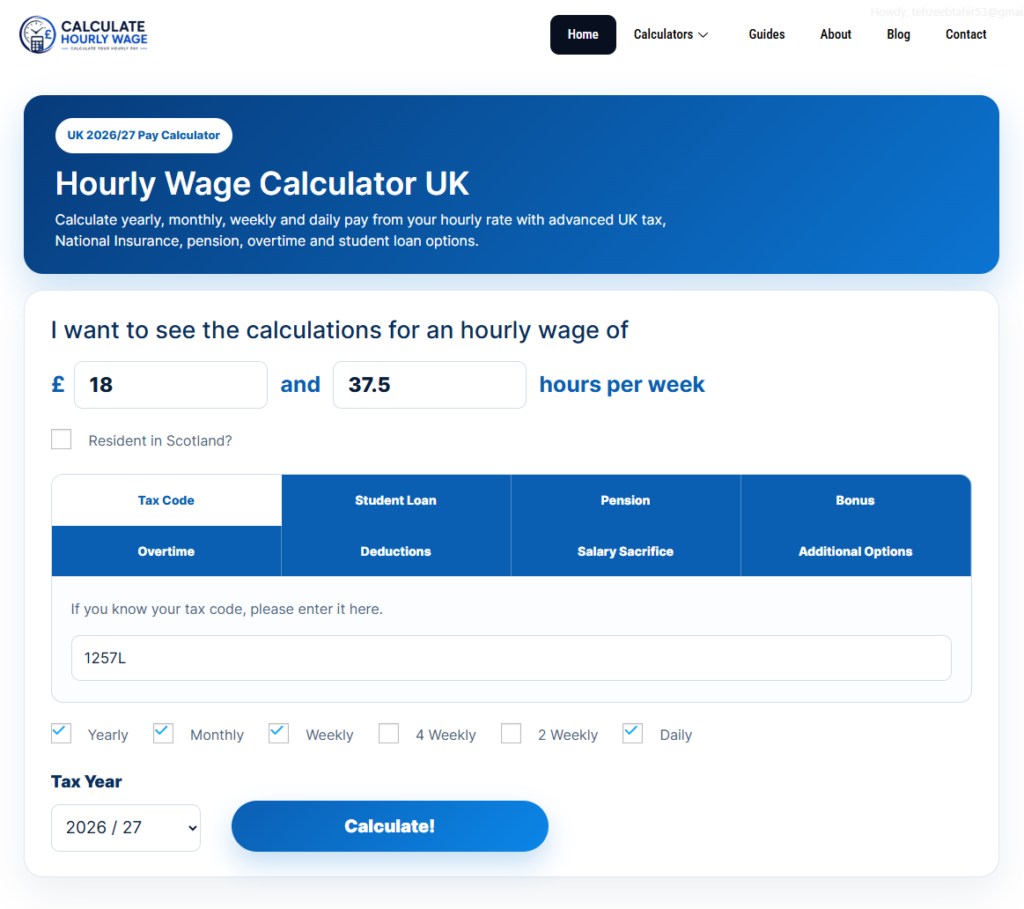
How to use the Hourly Wage Calculator UK

Quick Answer
A weekly salary calculator UK helps you estimate your gross weekly earnings from an annual, monthly, daily, or hourly income. For most salaried employees, the calculation is:
| Annual Salary | Calculation | Weekly Salary |
|---|---|---|
| £26,000/year | £26,000 ÷ 52 | £500/week |
| £41,600/year | £41,600 ÷ 52 | £800/week |
| £52,000/year | £52,000 ÷ 52 | £1,000/week |
These figures represent gross weekly pay before deductions. Your actual take-home pay may be lower after Income Tax, National Insurance, workplace pension contributions, student loan repayments, or salary sacrifice arrangements. If you’re budgeting rather than comparing salaries, use a take-home pay calculator alongside this weekly salary calculator.
Visit Now: GOV.UKWhat Is a Weekly Salary Calculator?
A weekly salary calculator is a simple tool that estimates how much you earn each week based on your salary or wage. Rather than performing manual calculations, it converts your earnings into an easy-to-understand weekly figure.
This is particularly useful because salaries in the UK are commonly advertised as annual amounts, while many people naturally budget weekly.
The calculator provides an estimate of gross weekly pay, helping you understand your earnings before statutory deductions are applied.
What the Calculator Does
Depending on the information you enter, the calculator can convert:
- Annual salary to weekly salary
- Monthly salary to weekly salary
- Hourly wage to weekly earnings
- Daily rate to weekly pay
- Pro-rata salary to weekly earnings
Many calculators also allow you to adjust working hours, overtime, or contracted weeks to produce a more accurate estimate for your circumstances.
Who Should Use It?
A weekly salary calculator is valuable for many different people.
| Who Should Use It? | How It Helps |
|---|---|
| Employees | If you’re employed full-time, you can quickly see how your annual salary translates into weekly earnings, making budgeting much easier. |
| Job Seekers | When comparing job offers, looking only at the annual salary doesn’t always provide the full picture. Weekly figures make it easier to compare different opportunities alongside your regular living expenses. |
| Part-Time Workers | If you work fewer hours than a standard full-time employee, calculating your weekly income helps you understand exactly what you’ll earn based on your contracted hours. |
| Full-Time Workers | Employees receiving annual salaries can estimate weekly earnings without manually performing calculations each time they receive a salary offer. |
| Contractors | Contractors often receive daily or hourly rates. Converting those rates into weekly earnings helps estimate income over typical working weeks. |
| Employers | Employers and payroll teams may also use weekly salary calculations when discussing employment contracts, payroll planning, or preparing salary offers. |
How to Calculate Weekly Salary in the UK
Although a calculator makes the process almost instant, it’s useful to understand how the calculation works. Knowing the formula also helps you verify salary offers and payroll estimates.
Weekly Salary Formula
For employees paid an annual salary:
Weekly Salary = Annual Salary ÷ 52
The calculation assumes a standard calendar year containing 52 weeks.
For example:
| Annual Salary | Weekly Salary (Gross) |
|---|---|
| £24,000 | £461.54 |
| £30,000 | £576.92 |
| £40,000 | £769.23 |
| £52,000 | £1,000.00 |
| £65,000 | £1,250.00 |
These figures represent gross weekly salary, meaning they do not include payroll deductions.
Why Annual Salary Is Divided by 52 Weeks
Most UK employment contracts express salary as an annual amount.
Since there are 52 weeks in a standard year, dividing annual earnings by 52 provides a straightforward estimate of weekly pay.
This approach works well for salaried employees with consistent earnings throughout the year.
However, your actual payslip may differ slightly if:
- You’re paid every four weeks.
- You’re paid fortnightly.
- You receive irregular overtime.
- You receive bonuses or commission.
- Your employer rounds payroll figures.
The calculator therefore provides an estimate rather than an exact payroll calculation.
Gross Weekly Salary vs Net Weekly Salary
Understanding the difference between gross and net salary is essential.
| Gross Weekly Salary | Net Weekly Salary |
|---|---|
| Earnings before deductions | Earnings after deductions |
| Used in employment contracts | Money you actually receive |
| Includes taxable income | Reflects take-home pay |
| Doesn’t account for payroll deductions | Includes tax, NI, pension and other deductions |
For household budgeting, use your net weekly salary, while gross weekly salary is the better figure for comparing job offers or negotiating pay.
Read More: National Insurance Calculator UKFactors That Can Affect Your Weekly Pay
While the basic formula is simple, several factors can change the amount you actually receive each week.
| Factor | How It Affects Your Weekly Pay |
|---|---|
| Income Tax | Income Tax is deducted through the PAYE system based on your taxable income and tax code. Higher salaries generally result in higher tax deductions. |
| National Insurance | Most employees also pay National Insurance contributions, reducing take-home pay while contributing towards certain state benefits. |
| Pension Contributions | If you’re enrolled in a workplace pension, contributions are usually deducted before you receive your wages. Depending on your pension arrangement, this can noticeably reduce your weekly take-home pay. |
| Student Loan Repayments | Graduates with eligible student loans may have repayments deducted automatically once earnings exceed the applicable threshold. |
| Salary Sacrifice | Some employees exchange part of their salary for benefits such as additional pension contributions or cycle-to-work schemes. Although this may reduce gross salary, it can also reduce taxable income. |
| Overtime and Bonuses | Regular overtime, performance bonuses, shift allowances, and commission payments can all increase weekly earnings. However, because these payments are often variable, they shouldn’t always be included when estimating regular weekly income. |
When the Standard Weekly Salary Formula Doesn’t Apply
Although dividing annual salary by 52 works for most employees, there are situations where a different approach is needed.
Irregular Working Hours
Employees with changing weekly hours, such as hospitality or retail workers, may earn different amounts each week.
Using your average weekly hours over several weeks will usually provide a more realistic estimate.
Zero-Hour Contracts
Workers on zero-hour contracts have no guaranteed weekly income.
Instead of using annual salary, calculate:
Hourly Rate × Actual Hours Worked
for each week.
Commission-Based Roles
Sales professionals may receive a lower basic salary plus commission.
In this case:
- Calculate guaranteed weekly salary separately.
- Estimate commission independently.
- Avoid treating commission as guaranteed income.
Self-Employed Contractors
If you’re self-employed, weekly earnings depend on invoices rather than payroll.
Daily or hourly rate calculations are generally more useful than annual salary conversions.
Seasonal Employment
Workers in education, tourism, agriculture, or retail may experience periods of higher and lower earnings throughout the year.
An annual average remains useful for long-term budgeting, but it may not reflect actual weekly income during busy or quiet seasons.
Calculate Weekly Salary from Different Pay Types
Not everyone receives an annual salary. Depending on your employment arrangement, you may be paid monthly, hourly, daily, or on a pro-rata basis.
Fortunately, all of these payment methods can be converted into an estimated weekly salary.
Annual Salary to Weekly Salary
This is the most common calculation for UK employees.
Divide your annual salary by 52.
For example:
| Annual Salary | Weekly Salary |
|---|---|
| £28,000 | £538.46 |
| £35,000 | £673.08 |
| £45,000 | £865.38 |
| £55,000 | £1,057.69 |
This method is ideal for salaried employees with fixed annual contracts.
Monthly Salary to Weekly Salary
If you’re paid monthly, you can estimate weekly salary using the following formula:
Monthly Salary × 12 ÷ 52
| Salary Details | Amount |
|---|---|
| Monthly salary | £3,000 |
| Annual salary | £36,000 |
| Weekly salary | £692.31 |
This method gives a reliable estimate regardless of the month you’re paid.
Read More: Monthly Salary Calculator UKHourly Wage to Weekly Salary
Employees paid by the hour can estimate weekly earnings by multiplying their hourly rate by the number of hours worked each week.
Formula:
Hourly Rate × Hours Worked Per Week
Example:
| Earnings Details | Amount |
|---|---|
| Hourly wage | £17.50 |
| Hours worked | 37.5 |
| Weekly earnings | £656.25 |
If your hours vary each week, simply adjust the hours worked to estimate your expected weekly income.
Read More: Hourly Wage Calculator UKDaily Rate to Weekly Salary
Contractors and freelancers often charge a daily rate.
To estimate weekly earnings:
Daily Rate × Days Worked Per Week
Example:
| Earnings Details | Amount |
|---|---|
| Daily rate | £180 |
| Five working days | 5 |
| Weekly earnings | £900 |
This method is particularly useful for consultants, agency workers, and self-employed professionals.
Pro-Rata Salary to Weekly Salary
A pro-rata salary reflects reduced working hours or fewer working weeks than a full-time employee.
For example, someone working three days per week instead of five will generally receive a proportionate salary.
To estimate weekly earnings:
- Determine your annual pro-rata salary.
- Divide the annual amount by 52.
- Compare it with the equivalent full-time salary if needed.
This calculation is commonly used by:
- Teachers
- NHS employees
- Parents returning to work
- Flexible workers
- Employees with reduced hours
Weekly Salary Calculation Examples
Seeing the calculation in action often makes it easier to understand how weekly pay is worked out. The following examples use different pay arrangements to demonstrate how the figures are calculated.
Note: These examples show gross weekly salary before Income Tax, National Insurance, pension contributions, or any other payroll deductions unless stated otherwise.
Example 1 – £25,000 Annual Salary
Sarah has accepted her first graduate role with an annual salary of £25,000.
Calculation
Annual Salary ÷ 52
£25,000 ÷ 52 = £480.77
| Salary Details | Amount |
|---|---|
| Annual Salary | £25,000 |
| Weekly Salary | £480.77 |
Sarah can expect to earn approximately £480.77 per week before deductions.
Example 2 – £35,000 Annual Salary
James receives a salary increase to £35,000 per year.
Calculation
£35,000 ÷ 52 = £673.08
| Salary Details | Amount |
|---|---|
| Annual Salary | £35,000 |
| Weekly Salary | £673.08 |
Although his gross weekly salary is £673.08, his actual take-home pay will depend on:
- PAYE Income Tax
- National Insurance
- Pension contributions
- Student loan repayments (if applicable)
Read More: Paye Calculator UKExample 3 – £45,000 Annual Salary with Pension Contributions
Emma earns £45,000 per year and contributes 5% of her salary to her workplace pension.
Step 1: Calculate Gross Weekly Salary
£45,000 ÷ 52
= £865.38
Step 2: Consider Payroll Deductions
Emma’s payslip may include deductions for:
- PAYE Income Tax
- National Insurance
- Workplace pension contributions
- Student loan repayments (if applicable)
Although her gross weekly salary is £865.38, her take-home pay will be lower after these deductions.
Rather than guessing, she can estimate her net income using:
Example 4 – £18 per Hour (37.5 Hours per Week)
Daniel is paid hourly rather than receiving an annual salary.
| Calculation Details | Amount |
|---|---|
| Hourly rate | £18 |
| Weekly hours | 37.5 |
| Calculation | £18 × 37.5 |
| Weekly earnings | £675.00 |
This approach works well for employees with fixed weekly hours.
Example 5 – Part-Time Employee Working 20 Hours per Week
Olivia works part-time while studying.
| Calculation Details | Amount |
|---|---|
| Hourly rate | £16 |
| Hours each week | 20 |
| Calculation | £16 × 20 |
| Weekly earnings | £320 per week |
If Olivia increases her hours during holidays, she can change the hours worked to estimate her revised weekly income.
Weekly Salary Comparison Tables
Comparison tables help you estimate earnings without carrying out calculations yourself. They’re also useful when comparing job offers or planning future salary goals.
Annual Salary to Weekly Salary Conversion Table
| Annual Salary | Weekly Salary |
|---|---|
| £20,000 | £384.62 |
| £25,000 | £480.77 |
| £30,000 | £576.92 |
| £35,000 | £673.08 |
| £40,000 | £769.23 |
| £45,000 | £865.38 |
| £50,000 | £961.54 |
| £60,000 | £1,153.85 |
| £70,000 | £1,346.15 |
| £80,000 | £1,538.46 |
Gross Weekly Salary vs Estimated Net Weekly Salary
The exact net amount depends on your personal tax situation, but the following comparison highlights the difference.
| Gross Weekly Salary | Before Payroll Deductions | Estimated Take-Home Pay Depends On |
|---|---|---|
| £500 | Income Tax not deducted | Tax code, NI, pension |
| £700 | Gross earnings only | Tax band, pension, student loan |
| £900 | Before deductions | PAYE, NI, salary sacrifice |
| £1,100 | Contracted earnings | Individual payroll circumstances |
Note: Take-home pay varies between employees with the same salary because payroll deductions depend on personal circumstances.
Hourly Wage to Weekly Earnings (35, 37.5 & 40 Hours)
| Hourly Rate | 35 Hours | 37.5 Hours | 40 Hours |
|---|---|---|---|
| £12 | £420.00 | £450.00 | £480.00 |
| £15 | £525.00 | £562.50 | £600.00 |
| £18 | £630.00 | £675.00 | £720.00 |
| £20 | £700.00 | £750.00 | £800.00 |
| £25 | £875.00 | £937.50 | £1,000.00 |
This table is particularly useful for workers with fixed hourly contracts.
Full-Time vs Part-Time Weekly Earnings
| Employment Type | Typical Weekly Hours | Weekly Earnings* |
|---|---|---|
| Full-Time | 37.5 | Higher |
| Four-Day Week | 30 | Moderate |
| Part-Time | 20 | Lower |
| Casual Hours | Variable | Varies |
Actual earnings depend on hourly rate or salary.
Weekly Salary Breakdown Before and After Typical Payroll Deductions
| Payroll Item | Gross Pay | Net Pay Impact |
|---|---|---|
| Basic Salary | ✓ | ✓ |
| Income Tax | Included in Gross | Deducted |
| National Insurance | Included in Gross | Deducted |
| Pension | Included in Gross | Usually Deducted |
| Student Loan | Included in Gross | May Be Deducted |
| Overtime | Added to Gross | Taxable |
This table helps explain why the amount on your payslip is often different from your calculated gross weekly salary.
Practical Weekly Salary Scenarios
Understanding the calculation is useful, but applying it to real-life situations is where it becomes truly valuable.
Comparing Two Job Offers
Suppose you’re choosing between:
- Job A: £36,000 per year
- Job B: £39,000 per year
Converting both salaries into weekly figures allows you to compare the difference more realistically.
A difference of only a few thousand pounds annually can translate into a noticeable increase in weekly disposable income.
Switching from Hourly Pay to Salary
Many employees move from temporary or agency work into permanent salaried positions.
Using a weekly salary calculator helps compare:
- Current hourly earnings
- Proposed annual salary
- Expected weekly income
- Whether the salary offer represents an improvement
This avoids comparing completely different pay structures.
Estimating Weekly Income for Part-Time Work
Someone returning to work after parental leave may reduce their hours from five days to three days per week.
Instead of focusing only on annual salary, calculating weekly earnings makes it easier to determine whether the reduced income still covers essential household expenses.
Budgeting Weekly Pay Before Accepting a New Job
Budgeting Weekly Pay Before Accepting a New Job
Suppose you’re offered two positions:
| Job | Annual Salary | Weekly Gross Salary |
|---|---|---|
| Company A | £34,000 | £653.85 |
| Company B | £37,500 | £721.15 |
At first, the annual difference is £3,500.
However, viewing it as a weekly amount shows you’ll earn roughly £67 more each week before deductions.
Looking at weekly figures often makes salary comparisons much easier, especially when deciding whether a higher-paying role justifies a longer commute or additional responsibilities.
Understanding Weekly Earnings with Overtime
A warehouse employee regularly works five hours of overtime each week.
Their basic weekly salary provides a useful baseline, while overtime can be treated as additional income rather than guaranteed earnings.
Separating regular pay from overtime creates a more realistic household budget, particularly if overtime isn’t available every week.
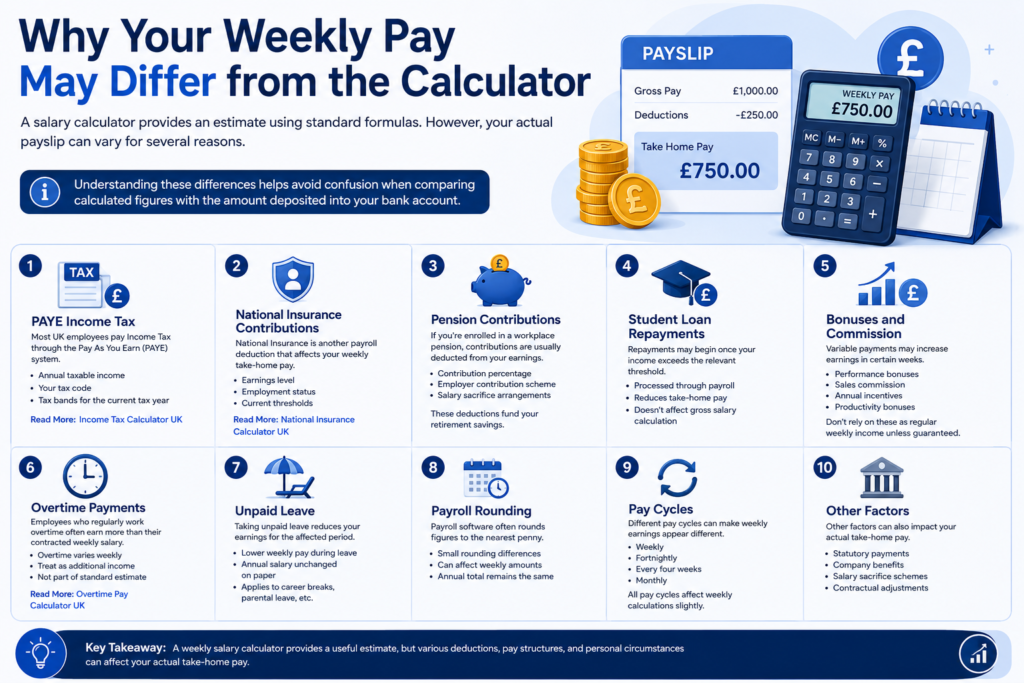
Why Your Weekly Pay May Differ from the Calculator
A salary calculator provides an estimate using standard formulas. However, your actual payslip can vary for several reasons.
Understanding these differences helps avoid confusion when comparing calculated figures with the amount deposited into your bank account.
PAYE Income Tax
Most UK employees pay Income Tax through the Pay As You Earn (PAYE) system.
Your employer deducts tax before your wages are paid.
The amount depends on factors such as:
- Your annual taxable income
- Your tax code
- Tax bands for the current tax year
As a result, two employees with similar salaries may receive different take-home pay.
Read More: Income Tax Calculator UKNational Insurance Contributions
National Insurance is another payroll deduction that affects your weekly take-home pay.
Contribution amounts depend on:
- Earnings level
- Employment status
- Current National Insurance thresholds
Gross salary calculators don’t deduct these contributions automatically.
Read More: National Insurance Calculator UKPension Contributions
If you’re enrolled in a workplace pension, contributions are usually deducted from your earnings.
The deduction amount varies depending on:
- Contribution percentage
- Employer contribution scheme
- Salary sacrifice arrangements
While pension deductions reduce immediate take-home pay, they contribute towards your retirement savings.
Student Loan Repayments
If you have a UK student loan, repayments may begin once your income exceeds the relevant repayment threshold.
These deductions are processed through payroll and can reduce your weekly take-home income.
However, they won’t affect your gross weekly salary calculation.
Bonuses and Commission
Some roles include variable payments such as:
- Performance bonuses
- Sales commission
- Annual incentives
- Productivity bonuses
These payments may significantly increase earnings during certain weeks but shouldn’t be relied upon as regular weekly income unless they’re guaranteed.
Overtime Payments
Employees who regularly work overtime often earn more than their contracted weekly salary.
Because overtime can vary from week to week, it’s best treated as additional income rather than part of your standard salary estimate.
Read More: Overtime Pay Calculator UKUnpaid Leave
Taking unpaid leave reduces your earnings for the affected pay period.
Your annual salary may remain unchanged on paper, but your actual weekly pay during that period will be lower.
This is particularly relevant for employees taking career breaks, parental leave, or unpaid time off.
Payroll Rounding and Pay Cycles
Payroll software often rounds figures to the nearest penny.
Additionally, some employers pay:
- Weekly
- Fortnightly
- Every four weeks
- Monthly
These different pay cycles can make weekly earnings appear slightly different from simple annual salary calculations, even when the annual total remains the same.
Common Mistakes When Calculating Weekly Salary
Even though the basic formula is straightforward, it’s easy to make small errors that lead to inaccurate estimates. Understanding these common mistakes can help you calculate your weekly earnings with greater confidence.
Confusing Gross and Net Salary
This is one of the most common mistakes.
- Gross salary is your earnings before deductions.
- Net salary is the amount you receive after Income Tax, National Insurance, pension contributions, and any other payroll deductions.
If you’re comparing job offers, use gross salary. If you’re planning your budget, focus on net salary.
Using the Wrong Number of Weeks
A standard annual salary is generally divided by 52 weeks.
Some people mistakenly divide by:
- 48 weeks
- 50 weeks
- 12 months
This produces inaccurate weekly figures.
Unless you’re calculating earnings for a specific contract that only covers part of the year, dividing by 52 is the standard approach.
Ignoring Payroll Deductions
A weekly salary calculator normally estimates gross weekly earnings.
If you assume that figure is the amount you’ll receive in your bank account, your budget could quickly become unrealistic.
Always remember that deductions may include:
- Income Tax
- National Insurance
- Pension contributions
- Student loan repayments
- Salary sacrifice arrangements
Forgetting Pension Contributions
Many employees are automatically enrolled in a workplace pension.
Although pension contributions help build long-term retirement savings, they also reduce weekly take-home pay.
When estimating disposable income, include pension deductions where applicable.
Excluding Overtime or Bonuses Incorrectly
Some employees make the opposite mistake:
- assuming overtime is always available, or
- ignoring regular overtime completely.
A better approach is to separate:
- Guaranteed weekly earnings
- Variable earnings, such as overtime, commission, and bonuses.
This creates a more reliable financial plan.
Miscalculating Part-Time Hours
If you’re paid hourly, using the wrong weekly hours can significantly change your estimate.
For example:
- 20 hours/week
- 22.5 hours/week
- 25 hours/week
may appear similar but produce noticeably different weekly earnings.
Always use your contracted hours where possible.
Using Outdated Tax-Year Figures
Tax thresholds and payroll rules can change from one tax year to the next.
Using outdated assumptions may affect estimates for:
- Income Tax
- National Insurance
- Student loan repayments
- Pension limits
When estimating take-home pay, always use figures relevant to the 2026/27 UK tax year.
Expert Tips for Estimating Weekly Earnings Accurately
A calculator provides a strong starting point, but a few best practices can make your estimate even more useful.
Use Current UK Tax-Year Figures
Tax rules, thresholds, and payroll rates change over time.
If you’re estimating take-home pay rather than gross salary, make sure the calculator reflects the latest UK tax year.
Check Your PAYE Tax Code
Your tax code determines how much Income Tax is deducted.
If your code is incorrect, your weekly payslip may differ from your expectations.
It’s worth reviewing your payslip regularly and contacting your employer if something looks unusual.
Compare Gross Salaries Before Negotiating
When discussing a new role or negotiating a pay rise, compare gross annual or weekly salaries rather than take-home pay.
Net salary can vary between individuals because of:
- Pension contributions
- Student loans
- Tax codes
- Salary sacrifice arrangements
Gross salary provides a fairer comparison.
Separate Regular Salary from Variable Income
If your earnings include:
- Overtime
- Commission
- Shift allowances
- Bonuses
treat these as additional income rather than guaranteed weekly pay.
This approach helps you:
- create a realistic budget,
- avoid overspending during quieter periods, and
- build a financial buffer when variable income is higher than expected.
Review Your Payslip Against Calculator Results
A salary calculator provides an estimate, while your payslip reflects your actual payroll calculation.
Compare the two occasionally to understand:
- how deductions affect your earnings,
- whether your tax code appears correct,
- whether pension contributions match your expectations, and
- how overtime or bonuses influence your weekly pay.
If there’s a significant difference, your payroll department should be able to explain the calculation.
How do I calculate weekly salary from annual salary in the UK?
Divide your annual salary by 52 weeks.
For example:
Annual salary: £41,600
Weekly salary: £800
This gives your gross weekly salary before deductions.
Is weekly salary calculated before or after tax?
Most salary calculators show gross weekly salary, which is your earnings before deductions.
Your actual take-home pay will usually be lower after Income Tax, National Insurance, pension contributions, and any other payroll deductions.
Why is annual salary divided by 52 weeks?
A calendar year contains 52 weeks, making it the standard method for converting annual salary into weekly earnings.
This provides a consistent estimate for most salaried employees.
Can I calculate weekly salary from my hourly wage?
Yes.
Multiply your hourly rate by the number of hours you work each week.
For example:
£18 per hour
37.5 hours
Weekly earnings:
£675
How do overtime payments affect weekly salary?
Overtime increases your weekly earnings but is usually considered variable income.
If overtime isn’t guaranteed every week, it’s best to calculate it separately from your regular salary.
Why doesn’t my weekly payslip exactly match the calculator?
Several factors can create differences, including:
Income Tax
National Insurance
Pension contributions
Student loan repayments
Payroll rounding
Bonuses
Overtime
Unpaid leave
Pay frequency
The calculator provides an estimate rather than an exact payroll calculation.
How is weekly salary calculated for part-time employees?
Part-time employees can calculate weekly earnings by:
dividing their annual pro-rata salary by 52, or
multiplying their hourly wage by weekly contracted hours.
The correct method depends on how they’re paid.
Do pension contributions reduce weekly take-home pay?
Yes.
If you contribute to a workplace pension, the amount deducted usually reduces your net weekly income, although it also helps build retirement savings.
Can I estimate weekly salary for the 2026/27 tax year?
Yes.
A calculator using the latest UK tax-year assumptions provides a reliable estimate of weekly earnings.
For the most accurate take-home pay, combine it with an Income Tax and National Insurance calculator.
Conclusion
A weekly salary calculator UK makes it simple to convert annual, monthly, daily, or hourly earnings into an easy-to-understand weekly figure. Whether you’re comparing job offers, planning your household budget, negotiating a new salary, or checking your expected income, knowing your weekly earnings gives you a clearer picture of your finances.
While the standard calculation—annual salary ÷ 52—provides a reliable estimate of gross weekly pay, remember that your actual take-home amount may differ due to Income Tax, National Insurance, pension contributions, student loan repayments, overtime, and other payroll adjustments.