
A job offer can look attractive when it says “£30,000 per year” or “£2,500 per month.” But the number becomes clear when you find out how much you earn for each hour.
Two employees earn the same annual salary, one working for longer hours, weekends or unpaid breaks. At the same time, someone with a lower salary earns more per hour because their weekly hours are shorter.
That is why an hourly rate calculator UK becomes useful. It turns your salary into a simple hourly amount, helping you to understand the real value of your work before payday arrives.
If you are comparing job offers, checking a payslip, planning overtime or deciding if freelance work is worth it then knowing your hourly pay can change the way you view your income.
Calculator
How Does an Hourly Rate Calculator UK Work?
An hourly rate calculator UK works by dividing your pay by the number of hours you work.
The calculator can use different starting points depending on how you are paid. You may receive an annual salary, a monthly wage, weekly earnings or a daily rate.
For example a salaried employee enters their yearly income and weekly working hours. A part-time worker may enter weekly pay and the number of hours worked. Similarly, a contractor uses a daily rate to estimate what each working hour is worth.
The result is usually your gross hourly rate. This means the figure is before Income Tax, National Insurance, pension contributions, student loan deductions or other deductions.
| Calculation Type | Details |
|---|---|
| Convert Annual Salary Into an Hourly Rate | If you know your yearly salary, the calculator estimates how much you earn per hour across the whole year. This is especially useful for full-time employees with fixed salaries. |
| Calculate Hourly Pay From Monthly Salary | Monthly pay can feel easier to understand because it appears on your payslip. However, monthly wages do not immediately show the value of each working hour. By converting monthly salary into annual income first, you can calculate a more accurate hourly figure. |
| Work Out Hourly Earnings From Weekly Wages | Weekly calculations are helpful for part-time workers, agency staff, shift workers, and employees with variable schedules. If your weekly hours change regularly, you can use an average number of hours to get a more realistic estimate. |
| Estimate Pay Per Hour From a Daily Wage | Daily-rate workers can divide their daily wage by the number of paid working hours in a day. For example: A contractor earning £160 per day for 8 hours has a standard hourly rate of £20. However, if the working day is 10 hours, the actual hourly value falls to £16. This is why working hours matter just as much as the daily figure. |
| Calculate Your Hourly Wage From an Annual Salary | Annual salaries often sound larger than they feel in real life. A figure such as £28,000, £35,000, or £45,000 may look attractive, but the real question is how many hours you must work to earn it. The basic calculation is: Hourly Rate = Annual Salary ÷ Total Working Hours Per Year. To find your yearly working hours, multiply your weekly working hours by the number of paid weeks you work each year. |
For most full-time employees, this is usually 52 weeks.
Example Calculation
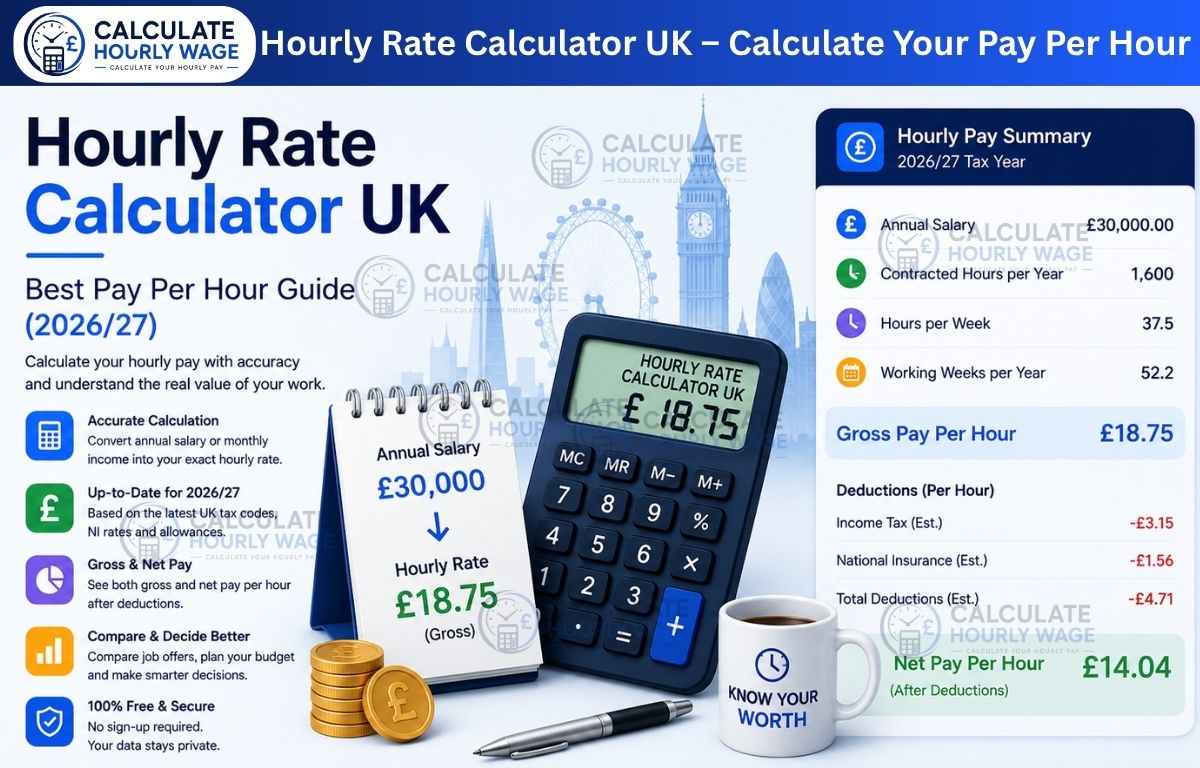
Imagine you earn £30,000 per year and work 37.5 hours each week.
| Detail | Amount |
| Annual salary | £30,000 |
| Weekly working hours | 37.5 hours |
| Weeks per year | 52 |
| Total yearly working hours | 1,950 hours |
| Estimated hourly rate | £15.38 |
The calculation is:
£30,000 ÷ 1,950 = £15.38 per hour
This is your gross hourly rate before deductions.
Convert Your Monthly Salary Into an Hourly Rate
Monthly pay can make income feel predictable. However, it can also hide the true value of your time.
| Formula Type | Details |
|---|---|
| Weekly Wage Formula | Hourly Rate = Weekly Pay ÷ Weekly Working Hours |
| Example | If you earn £480 per week and work 32 hours: £480 ÷ 32 = £15 per hour |
| Daily Wage Formula | Hourly Rate = Daily Pay ÷ Daily Working Hours |
| Example | If you earn £120 per day and work 7.5 hours: £120 ÷ 7.5 = £16 per hour |
Monthly Salary Example
Suppose you earn £2,000 per month and work 40 hours per week.
| Detail | Amount |
| Monthly salary | £2,000 |
| Annual salary | £24,000 |
| Weekly working hours | 40 hours |
| Total yearly hours | 2,080 hours |
| Estimated hourly rate | £11.54 |
The calculation is:
£24,000 ÷ 2,080 = £11.54 per hour
This example shows why two people with similar monthly salaries may have very different hourly earnings.
Find Your Hourly Pay From Weekly or Daily Wages
Not every worker receives a fixed annual salary. Part-time employees, temporary staff, warehouse workers, hospitality teams, care workers, and agency workers may be paid weekly or daily.
In these situations, hourly pay can be calculated quickly.
| Formula Type | Details |
|---|---|
| Weekly Wage Formula | Hourly Rate = Weekly Pay ÷ Weekly Working Hours |
| Example | If you earn £480 per week and work 32 hours: £480 ÷ 32 = £15 per hour |
| Daily Wage Formula | Hourly Rate = Daily Pay ÷ Daily Working Hours |
| Example | If you earn £120 per day and work 7.5 hours: £120 ÷ 7.5 = £16 per hour |
However, unpaid lunch breaks can change the calculation. If your shift lasts eight hours but includes a 30-minute unpaid break, you may only be paid for 7.5 hours.
What Details Do You Need to Calculate Your Hourly Rate?
A reliable result depends on entering the correct details.
Your gross salary or wage is the starting point. This is your pay before deductions.
You also need your weekly working hours. Make sure these are paid hours, not simply the time you are present at work.
The number of paid weeks per year matters too. Most employees use 52 weeks, although unpaid leave, seasonal work and contract gaps may reduce this number.
Overtime should be considered separately if it is paid at a higher rate.
Bonuses, commission, tips and performance payments may also affect your overall earnings. However, they should not always be treated as guaranteed income.
Read More: Daily Wage Calculator UKHourly Rate Calculation Formula Explained
| Item | Details |
|---|---|
| Main Formula | Hourly Rate = Annual Salary ÷ Total Working Hours Per Year |
| Total Working Hours Per Year | Weekly Working Hours × Number of Working Weeks Per Year |
| Example (Yearly Working Hours) | For a typical employee working 37.5 hours each week: 37.5 × 52 = 1,950 yearly hours |
| Example (Hourly Rate) | If the annual salary is £30,000: £30,000 ÷ 1,950 = £15.38 per hour |
This formula gives you a clear starting point. However, it becomes more accurate when you consider unpaid breaks, overtime, holiday arrangements, and variable shift patterns.
Example: How Much Is £30,000 a Year Per Hour in the UK?
A £30,000 annual salary is a common benchmark for many UK workers. Still, the hourly value depends on your contract.
For someone working 37.5 hours per week over 52 weeks:
| Salary | Weekly Hours | Yearly Hours | Hourly Rate |
| £30,000 | 37.5 | 1,950 | £15.38 |
| £30,000 | 40 | 2,080 | £14.42 |
| £30,000 | 35 | 1,820 | £16.48 |
| £30,000 | 30 | 1,560 | £19.23 |
Surprisingly, the same salary can have a very different hourly value depending on working hours.
This is why annual salary alone should never be the only figure you compare when choosing a job.
Read More: gov.ukFull-Time vs Part-Time Hourly Pay Calculation
Full-time and part-time work can create very different pay outcomes.
A full-time employee may earn a higher annual salary, but longer weekly hours can reduce the hourly value.
Meanwhile, a part-time employee may earn less overall but have a stronger hourly rate.
For example, a full-time worker earning £32,000 for 40 hours per week earns approximately £15.38 per hour.
A part-time worker earning £18,000 for 20 hours per week earns approximately £17.31 per hour.
The part-time employee earns less across the year. However, each hour of their time is worth more.
This comparison can be valuable when balancing income with childcare, studies, commuting, health, side work or personal responsibilities.
Does Overtime Change Your Hourly Rate?
Overtime increases your earnings when employers offer higher pay rates.
A standard overtime rate is time-and-a-half. This means you earn 1.5 times your normal hourly rate.
For example, if your standard hourly rate is £15:
£15 × 1.5 = £22.50 per overtime hour
Some employers offer double time for Sundays, night shifts, bank holidays or emergency cover.
But overtime rates are not guaranteed by law in every job. They depend on your employment contract, workplace policy or collective agreement.
So always check if your overtime is paid/unpaid or included in your salary at a higher rate.
Read More: Overtime Pay Calculator UKGross Hourly Rate vs Net Hourly Pay
| Topic | Details |
|---|---|
| Gross Hourly Rate | Your gross hourly rate is your pay before deductions. |
| Net Hourly Pay | Your net hourly pay is what you actually keep after Income Tax, National Insurance, pension contributions, student loan repayments, and other deductions. |
| Example | Your gross hourly rate may be £15.38. However, your take-home hourly amount could be lower depending on your tax code and deductions. |
| Why It Matters | This difference matters when planning monthly bills, savings goals, travel costs, or household spending. |
| Calculator Tip | An hourly rate calculator usually gives a gross estimate. For an accurate take-home figure, use a salary calculator that includes Income Tax and National Insurance. |
Why Your Hourly Pay Can Change Each Month
Your standard hourly rate may remain the same, but your actual monthly earnings can still change.
Overtime is one common reason. Extra shifts can increase your pay even if your basic salary stays fixed.
Bonuses and commission can also raise your income during certain months.
Unpaid leave, sickness absence, reduced shifts and missed work can lower your pay.
Holiday pay may work differently depending on whether you are salaried, hourly paid, zero-hours or agency staff.
As a result, it is useful to calculate both your standard hourly rate and your actual monthly hourly average.
UK Minimum Wage and Your Hourly Earnings
Once you know your hourly pay, you can compare it with the current UK minimum wage for your age group and employment status.
This is particularly important for younger workers, apprentices, hospitality staff, casual workers and people with variable shifts.
Your employer must make sure your average pay meets the legal minimum wage rules for the relevant pay period.
But the calculation can become complicated when unpaid working time, deductions for uniforms, housing arrangements or travel between work locations are involved.
If your calculated hourly pay seems unusually low, review your contract, payslip and paid working hours carefully.
Current rates (2026)
The rates change on 1 April every year.
| 21 and over | 18 to 20 | Under 18 | Apprentice | |
| April 2026 | £12.71 | £10.85 | £8 | £8 |
Common Mistakes When Calculating Hourly Pay
| Common Mistake | Explanation |
|---|---|
| Forgetting to Exclude Unpaid Breaks | An 8-hour shift does not always mean 8 paid hours. If you receive a 30-minute unpaid lunch break, your paid time may only be 7.5 hours. |
| Entering Incorrect Weekly Working Hours | Some employees enter contracted hours but forget regular extra time. Others include unpaid breaks by mistake. Use the hours you are actually paid for. |
| Ignoring Overtime Payments | If overtime is paid at a higher rate, adding it into normal hours can make your calculation inaccurate. Calculate standard pay and overtime pay separately. |
| Mixing Gross Salary With Net Pay | Gross pay is before deductions, while net pay is after deductions. Mixing the two can make your hourly estimate misleading. |
| Using the Wrong Number of Working Weeks Per Year | Most permanent employees use 52 weeks. However, freelancers, contractors, seasonal workers and people taking unpaid leave may work fewer paid weeks. |
Who Can Use an Hourly Rate Calculator?
An hourly rate calculator UK can help full-time employees understand the true value of their salary.
| Who Can Benefit? | How Hourly Rate Calculations Help |
|---|---|
| Part-Time Workers | Compare different shift patterns and job offers. |
| Freelancers | Set rates that cover business costs, unpaid holidays, administration time, and tax responsibilities. |
| Contractors | Compare daily rates with hourly opportunities. |
| Shift Workers | Check whether night work, weekend shifts, and higher rates are worth the extra time. |
| Job Seekers | Compare salary offers beyond the headline annual figure. |
| Employers | Estimate payroll costs, budget staff hours, and plan new roles. |
Use Our Hourly Rate Calculator UK for Accurate Pay Estimates
Instead of guessing what your salary is worth, enter your pay amount and working hours into our Hourly Rate Calculator UK.
You can quickly estimate your hourly earnings from annual salary, monthly wages, weekly pay or daily rates.
Try different working-hour scenarios before accepting a job offer, agreeing to overtime or changing your contract. A few minutes of calculation can reveal whether a pay package truly matches your time.
How Do I Calculate My Hourly Rate From My Annual Salary in the UK?
Divide your annual salary by your total working hours for the year. To find yearly hours, multiply your weekly working hours by 52.
What Is £25,000 a Year Per Hour in the UK?
For someone working 37.5 hours per week, a £25,000 annual salary is approximately £12.82 per hour before tax.
What Is £30,000 a Year Per Hour in the UK?
At 37.5 hours per week, a £30,000 annual salary works out at approximately £15.38 per hour before deductions.
How Much Is £35,000 a Year Per Hour?
If you work 37.5 hours per week, a £35,000 yearly salary is around £17.95 per hour before tax.
How Do I Calculate My Hourly Rate From a Monthly Salary?
Multiply your monthly salary by 12 to get your annual salary. Then divide that amount by your total yearly working hours.
Does an Hourly Rate Include Tax and National Insurance?
Most hourly rate calculations show gross pay before tax. Your net hourly pay will be lower after tax, National Insurance, pension contributions, and other deductions.
Are Paid Breaks Included in Hourly Pay Calculations?
This depends on your employment contract. Paid breaks may be included, while unpaid breaks should usually be excluded from your working hours.
How Do I Calculate Overtime Pay in the UK?
Multiply your standard hourly rate by the overtime rate offered by your employer. For example, time-and-a-half is calculated as your hourly rate multiplied by 1.5.
Can Freelancers Use an Hourly Rate Calculator?
Yes. Freelancers can use it to set a suitable rate by considering their target income, billable hours, business costs, holidays, and unpaid time off.
Is Hourly Pay Better Than a Salary?
It depends on the role and your preferences. Hourly pay can provide extra earnings through overtime, while a salary often gives predictable monthly income.
How Many Working Hours Are There in a Year in the UK?
If you work 37.5 hours per week for 52 weeks, you work 1,950 hours per year. This can change depending on holiday entitlement, unpaid leave, and your work schedule.
Can I Use an Hourly Rate Calculator to Compare Job Offers?
Yes. You can compare salaries, weekly working hours, overtime opportunities, and benefits to see which job provides better value per hour.
Conclusion
A salary figure only tells part of the story. Your hourly rate reveals what your time is actually worth.
Use an Hourly Rate Calculator UK to compare pay, understand working hours, and make smarter career decisions before accepting your next offer.