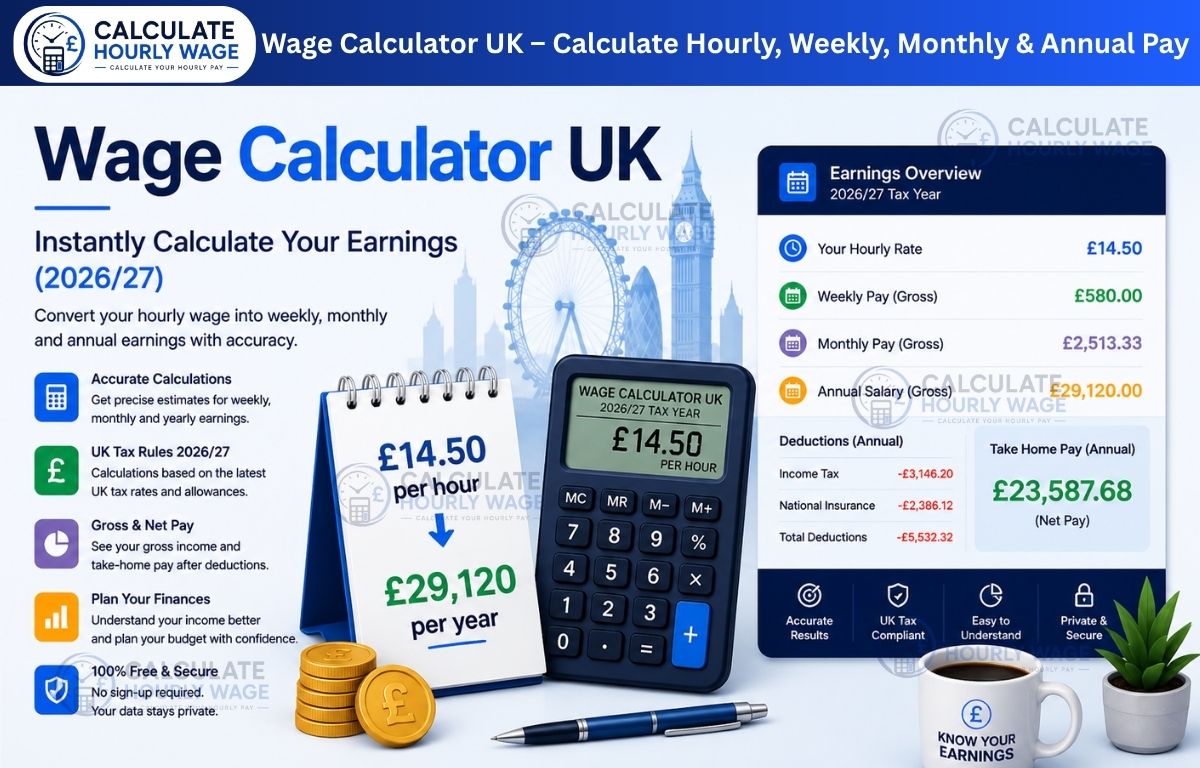
A new job can sound promising when the advert says, “£14.50 per hour.” The number feels simple at first. Work one hour, earn £14.50.
But the moment you start planning your rent, bills, savings, travel costs or monthly budget, that hourly figure becomes harder to picture. How much will you earn in a week? What will your yearly income look like? Will your take-home pay be enough after tax, National Insurance and pension deductions?
A Wage Calculator UK makes those numbers easy to understand. It helps you to convert an hourly rate into weekly, monthly and annual earnings, while giving you a clear view of what your work could be worth over time.
If you are comparing job offers, checking part-time income, working regular overtime or trying to understand your payslip, this guide explains how to calculate your wages accurately.
Calculator
What Is a Wage Calculator UK?
A Wage Calculator UK helps you estimate your earnings based on your hourly wage, working hours and paid weeks per year.
It can show your estimated:
- Daily pay
- Weekly pay
- Monthly pay
- Annual salary
- Gross earnings before deductions
- Take-home pay after deductions
The calculator is useful because hourly pay does not always show the full picture. Two people can earn the same hourly rate but have different yearly earnings depending on their hours, holiday pay, overtime and working pattern.
What a UK wage calculator can calculate
A wage calculator can help you work out several types of income.
| Item | Details |
|---|---|
| Weekly Gross Pay | If you earn £15 per hour and work 37.5 hours each week: £15 × 37.5 = £562.50 weekly gross pay |
| Annual Gross Pay | If you work 52 paid weeks per year: £562.50 × 52 = £29,250 annual gross pay |
The calculator can then divide that figure into monthly, weekly and daily estimates.
Who should use an earnings calculator?
A Wage Calculator UK can be useful for:
- Full-time employees
- Part-time workers
- Agency workers
- Retail employees
- Hospitality staff
- Warehouse workers
- Care workers
- Delivery drivers
- Construction workers
- Shift workers
- Zero-hours contract workers
- Freelancers with regular hourly income
- Anyone comparing hourly and salaried jobs
Wage calculator vs salary calculator vs hourly rate calculator
These tools are closely related, but they start with different information.
| Calculator Type | What You Enter | What It Helps You Find |
|---|---|---|
| Wage Calculator UK | Hourly rate and hours worked | Weekly, monthly and annual earnings |
| Salary Calculator | Annual salary | Monthly, weekly and daily salary |
| Hourly Rate Calculator | Annual or monthly salary | Estimated hourly pay |
| Take-Home Pay Calculator | Gross income and deductions | Estimated net pay after tax |
A wage calculator is usually the best starting point when your pay is based on an hourly rate.
Why Calculating Your Wages Matters
Your hourly wage may look clear on paper, but it does not always reflect what your income will be over a full year.
Your final earnings can change because of:
- Weekly working hours
- Paid or unpaid breaks
- Paid holiday entitlement
- Overtime rates
- Shift allowances
- Bonuses
- Commission
- Unpaid leave
- Tax and National Insurance deductions
- Pension contributions
- Student loan repayments
Understand your gross pay before deductions
Gross pay is the amount you earn before deductions.
For example, if your hourly rate and working pattern produce an annual figure of £31,200, that does not mean £31,200 will reach your bank account.
Your actual take-home pay may be lower after deductions such as:
- Income Tax
- National Insurance
- Workplace pension contributions
- Student loan repayments
- Other payroll deductions
A Wage Calculator UK gives you a useful gross-pay estimate first. You can then use a take-home pay calculator to estimate what you may receive after deductions.
Estimate monthly income for budgeting.
Most household expenses are monthly. Rent, mortgage payments, utility bills, phone contracts, food, transport and savings goals are easier to manage when you understand your likely monthly income.
For example:
£31,200 annual salary ÷ 12 = £2,600 gross monthly pay
This is not your final take-home pay, but it gives you a clearer starting point for planning.
Compare hourly, weekly and annual job offers.
A job paying £16 per hour looks better than a job offering £30,000 per year. However, the better offer depends on the number of guaranteed hours and the benefits included.
Read More:Net to Gross Salary Calculator UKFor example:
| Job Offer | Pay | Hours | Estimated Annual Gross Pay |
|---|---|---|---|
| Job A | £16 per hour | 37.5 hours per week | £31,200 |
| Job B | £30,000 salary | Full-time | £30,000 |
Job A has a higher estimated annual figure. However, Job B may include better pension contributions, paid sick leave, annual bonuses or more stable working hours.
Check whether your pay reflects your contracted hours
A wage calculation can also help you check whether your earnings match your contract.
If your payslip seems lower than expected, check:
- If your breaks are unpaid
- If you were paid for all hours worked
- If overtime was included
- If holiday pay was handled correctly
- If deductions changed your net pay
- If your weekly hours vary
How the Wage Calculator UK Works
The calculator uses a simple formula to estimate your pay.
Annual Pay = Hourly Rate × Weekly Paid Hours × Paid Weeks Per Year
For most full-time workers with paid holiday, 52 weeks is often used. However, this may not be correct for everyone.
Enter your hourly wage, working hours and pay period
Start with your normal hourly rate and the number of paid hours you work each week.
| Item | Details |
|---|---|
| Example | Hourly wage: £15 Weekly paid hours: 37.5 Paid weeks per year: 52 |
| Calculation | £15 × 37.5 × 52 = £29,250 annual gross pay |
Choose weekly, monthly or annual earnings
Once your hourly wage is entered, the calculator can show your earnings across different time periods.
| Pay Period | Formula |
|---|---|
| Daily pay | Weekly pay ÷ days worked per week |
| Weekly pay | Hourly rate × weekly paid hours |
| Monthly pay | Annual pay ÷ 12 |
| Annual pay | Hourly rate × weekly hours × paid weeks |
Include paid weeks, overtime and bonuses where relevant
Your standard hourly wage is only part of your income if you regularly work overtime or receive additional payments.
You may also need to include:
- Overtime at normal rate
- Time-and-a-half overtime
- Double-time overtime
- Night-shift allowances
- Weekend pay
- Performance bonuses
- Regular commission
- Tips, where applicable
However, it is sensible to keep guaranteed pay separate from variable income when budgeting.
Understand gross pay and estimated take-home pay
Gross pay is your income before deductions.
Take-home pay is what remains after deductions such as tax, National Insurance, pension contributions and student loan repayments.
Your net pay can change even when your hourly rate stays the same. This can happen because of overtime, bonuses, tax code changes or changes in pension contributions.
Wage Calculation Formula: How to Work Out Your Earnings
The following formulas can help you calculate your wages manually.
| Formula Type | Formula | Example |
|---|---|---|
| Hourly Wage to Daily Pay Formula | Daily Pay = Hourly Rate × Paid Hours Per Day | If you earn £15 per hour and work 7.5 paid hours per day: £15 × 7.5 = £112.50 daily gross pay |
| Hourly Wage to Weekly Pay Formula | Weekly Pay = Hourly Rate × Weekly Paid Hours | £15 × 37.5 = £562.50 weekly gross pay |
| Hourly Wage to Monthly Pay Formula | Monthly Pay = Annual Pay ÷ 12 | £29,250 ÷ 12 = £2,437.50 gross monthly pay |
| Hourly Wage to Annual Salary Formula | Annual Salary = Hourly Rate × Weekly Hours × Paid Weeks | £18 × 37.5 × 52 = £35,100 annual gross pay |
| Salary to Hourly Wage Formula | Hourly Rate = Annual Salary ÷ Weekly Hours ÷ Paid Weeks | A £35,100 salary based on 37.5 hours per week and 52 paid weeks: £35,100 ÷ 37.5 ÷ 52 = £18 per hour |
How to Use a Wage Calculator UK Step by Step
Step 1: Enter your hourly pay rate
Use your standard hourly rate from your employment contract or payslip.
If your rate changes for evenings, weekends or overtime, calculate those separately where possible.
Step 2: Add your paid working hours each week
Enter your paid hours rather than the total time you spend at work.
For example, you may be at work for 40 hours each week but receive five unpaid one-hour lunch breaks. In that case, you may only be paid for 35 hours.
Step 3: Select the number of paid weeks per year
Use 52 weeks if you are paid throughout the year, including annual leave.
Use fewer weeks if you have unpaid holiday, seasonal work, unpaid leave or irregular shifts.
Step 4: Add regular overtime, shift pay or bonuses
Include regular additional income only if it is likely to continue.
For example, if you work 10 overtime hours each month at time and a half, calculate that separately from your contracted pay.
Step 5: Review your weekly, monthly and yearly earnings
Use the results for practical decisions such as:
- Comparing job offers
- Planning a monthly budget
- Estimating affordability
- Reviewing your payslip
- Setting savings goals
- Understanding the value of overtime
Wage Calculator UK Examples for Different Work Patterns
Example 1: Full-time employee working 37.5 hours per week
| Item | Details |
|---|---|
| Example | A worker earns £15 per hour and works 37.5 paid hours each week. |
| Weekly Pay | £15 × 37.5 = £562.50 weekly pay |
| Annual Gross Pay | £562.50 × 52 = £29,250 annual gross pay |
| Monthly Gross Pay | £29,250 ÷ 12 = £2,437.50 monthly gross pay |
Example 2: Employee working 40 hours per week
| Item | Details |
|---|---|
| Example | A worker earns £14 per hour and works 40 paid hours each week. |
| Weekly Pay | £14 × 40 = £560 weekly pay |
| Annual Gross Pay | £560 × 52 = £29,120 annual gross pay |
| Monthly Gross Pay | £29,120 ÷ 12 = £2,426.67 monthly gross pay |
Example 3: Part-time worker with fixed weekly hours
| Item | Details |
|---|---|
| Example | A part-time employee earns £13 per hour and works 22 hours per week. |
| Weekly Pay | £13 × 22 = £286 weekly pay |
| Annual Gross Pay | £286 × 52 = £14,872 annual gross pay |
| Note | Part-time workers should always use their actual paid weekly hours for the most accurate estimate. |
Example 4: Worker with regular paid overtime
| Item | Details |
|---|---|
| Example | A worker earns £18 per hour and works 37.5 contracted hours each week. They also work 10 overtime hours per month at time and a half. |
| Normal Annual Pay | £18 × 37.5 × 52 = £35,100 |
| Overtime Rate | £18 × 1.5 = £27 per hour |
| Annual Overtime Pay | £27 × 10 × 12 = £3,240 |
| Estimated Total Annual Gross Earnings | £35,100 + £3,240 = £38,340 |
Example 5: Zero-hours contract worker with variable weekly earnings
A worker earns £13.50 per hour but averages 20 paid hours each week.
£13.50 × 20 × 52 = £14,040 annual gross estimate
However, zero-hours work can change from month to month. It may be more useful to calculate different scenarios.
| Average Weekly Hours | Estimated Annual Gross Pay |
|---|---|
| 15 hours | £10,530 |
| 20 hours | £14,040 |
| 25 hours | £17,550 |
| 30 hours | £21,060 |
Hourly Wage to Weekly, Monthly and Annual Pay Table
The following tables assume 52 paid weeks per year and show gross earnings before tax and deductions.
Hourly rate conversion table for 35-hour working weeks
| Hourly Rate | Weekly Pay | Monthly Pay | Annual Pay |
|---|---|---|---|
| £12.21 | £427.35 | £1,851.85 | £22,222.20 |
| £13 | £455 | £1,971.67 | £23,660 |
| £15 | £525 | £2,275 | £27,300 |
| £18 | £630 | £2,730 | £32,760 |
| £20 | £700 | £3,033.33 | £36,400 |
Hourly rate conversion table for 37.5-hour working weeks
| Hourly Rate | Weekly Pay | Monthly Pay | Annual Pay |
|---|---|---|---|
| £12.21 | £457.88 | £1,984.13 | £23,809.50 |
| £13 | £487.50 | £2,112.50 | £25,350 |
| £15 | £562.50 | £2,437.50 | £29,250 |
| £18 | £675 | £2,925 | £35,100 |
| £20 | £750 | £3,250 | £39,000 |
Hourly rate conversion table for 40-hour working weeks
| Hourly Rate | Weekly Pay | Monthly Pay | Annual Pay |
|---|---|---|---|
| £12.21 | £488.40 | £2,116.40 | £25,396.80 |
| £13 | £520 | £2,253.33 | £27,040 |
| £15 | £600 | £2,600 | £31,200 |
| £18 | £720 | £3,120 | £37,440 |
| £20 | £800 | £3,466.67 | £41,600 |
How monthly pay differs when using 52 weeks or 12 months
Weekly pay and monthly pay are not calculated in the same way.
| Item | Details |
|---|---|
| Example | If you earn £600 per week: |
| Annual Pay | £600 × 52 = £31,200 annual pay |
| Average Monthly Gross Pay | £31,200 ÷ 12 = £2,600 average monthly gross pay |
A calendar month is not always four weeks long. This is why multiplying weekly pay by four gives £2,400, while dividing annual pay by 12 gives £2,600.
For monthly budgeting, annual pay divided by 12 is usually the more useful figure.
Read More:gov.ukGross Pay vs Take-Home Pay in the UK
What gross wages mean on a payslip
Gross wages are your earnings before deductions.
They may include:
- Basic pay
- Overtime
- Shift allowances
- Bonuses
- Commission
- Holiday pay
Income Tax and National Insurance deductions
Your employer may deduct Income Tax and National Insurance through PAYE.
The amount can depend on:
- Your total income
- Your tax code
- Whether you live in Scotland
- Overtime and bonuses
- Other taxable benefits
Pension contributions and student loan repayments
Workplace pension contributions and student loan repayments can also reduce your take-home pay.
These deductions may change if your income rises, your pension contribution changes or you move into a different repayment position.
Why your take-home pay can change each month
Your hourly rate may stay the same, but your net pay can change because of:
- Different overtime hours
- Bonus payments
- Changes in tax code
- Unpaid leave
- Pension adjustments
- Student loan deductions
- Variable shift allowances
Factors That Can Affect Your Wage Calculation
| Factor | Details |
|---|---|
| Paid and Unpaid Breaks | Only include paid hours in your calculation. Unpaid lunch breaks can reduce your weekly paid hours significantly. |
| Annual Leave and Bank Holidays | If you receive paid holiday, you can usually use 52 paid weeks. If holiday is unpaid, reduce the number of paid weeks. Bank holidays are not automatically additional paid leave for every worker. Check your employment contract. |
| Overtime Rates and Weekend Pay | Overtime may be paid at your normal rate, time and a half, or double time. Weekend and bank-holiday shifts may also have higher rates. |
| Night Shifts and Unsociable-Hours Allowances | Some jobs include additional pay for nights, weekends or unsociable hours. This is common in care, healthcare, transport, security, and hospitality roles. |
| Bonuses, Commission and Tips | Bonuses and commission can increase your annual income, but they may not be guaranteed. Tips can also vary and may be taxed depending on how they are paid. |
| PAYE Tax Code Changes | A tax code change can affect your take-home pay. If your payslip suddenly looks different, review your tax code and check whether HMRC has updated your records. |
Minimum Wage and National Living Wage Checks
Your hourly wage should meet the legal minimum that applies to you.
How to check if your hourly wage meets UK minimum wage rules
To check your pay properly, look at your average earnings across your actual working time.
This may include time spent:
- Working required shifts
- Completing mandatory training
- Carrying out required tasks before or after shifts
- Travelling between jobs in some roles
Age-related minimum wage rates
Minimum wage rules can vary by age and employment status. Rates can also change each tax year, so always check the current rate before making a comparison.
Apprenticeship wage rules
Apprentices may have different minimum wage rules depending on their age and stage of apprenticeship.
Check your apprenticeship agreement and current minimum wage guidance if you are unsure.
What to do if you think you are being underpaid
Start by checking your payslip, contract, paid hours and deductions. If the figures still appear wrong, raise the issue with your employer and seek independent employment advice if needed.
Read More:Income Tax Calculator UKWage Calculator UK for Employees, Freelancers and Contractors
Wage calculations for PAYE employees
PAYE employees can use the calculator to estimate gross pay and then account for tax, National Insurance, pension and student loan deductions.
Calculating earnings as a freelancer
Freelancers can use an hourly wage calculation to estimate revenue. However, revenue is not the same as profit.
Self-employed workers may need to account for:
- Business expenses
- Equipment costs
- Insurance
- Travel
- Professional fees
- Tax payments
- National Insurance contributions
- Unpaid holiday and sick days
Contractor day rate to hourly rate calculations
| Item | Details |
|---|---|
| Formula | Hourly Rate = Day Rate ÷ Paid Hours Per Day |
| Example | For example, a £240 day rate over 8 paid hours: £240 ÷ 8 = £30 per hour |
Why self-employed income needs separate tax planning
Employees usually have tax deducted through PAYE. Self-employed workers may need to set aside money for tax and National Insurance themselves.
A high hourly rate can still produce lower usable income if business costs and unpaid time off are ignored.
Common Wage Calculation Mistakes to Avoid
| Common Mistake | Explanation |
|---|---|
| Forgetting Unpaid Breaks | Do not include unpaid lunch breaks as paid working time. |
| Using the Wrong Number of Paid Weeks | Using 52 weeks can overestimate income if you have unpaid holiday, seasonal work, or unpaid leave. |
| Treating Overtime as Guaranteed Income | Regular overtime can be included in an earnings estimate, but it should not always be treated as secure income for long-term commitments. |
| Confusing Gross Wages With Net Pay | Gross pay is not the same as take-home pay. Tax, National Insurance, pension, and student loan deductions can make a noticeable difference. |
| Ignoring Holiday Pay Entitlement | Check whether holiday pay is included, paid separately or unpaid. This can change your annual estimate. |
Tips to Get a More Accurate Earnings Estimate
- Use your contracted paid hours rather than assumed hours.
- Check whether breaks are paid or unpaid.
- Keep basic wages separate from overtime and bonuses.
- Review your payslip for deductions and allowances.
- Check your employment contract for holiday pay details.
- Use fewer than 52 weeks if you have unpaid time off.
- Recalculate after a pay rise or change in hours.
- Use a take-home pay calculator for more realistic monthly budgeting.
Related UK Pay and Salary Calculators
You may also find these calculators useful:
- Salary to Hourly Calculator UK
- Hourly to Salary Calculator UK
- Monthly Salary Calculator UK
- Pro Rata Salary Calculator UK
- Take-Home Pay Calculator UK
- Overtime Pay Calculator UK
- Holiday Pay Calculator UK
How do I calculate my wages in the UK?
Multiply your hourly rate by your weekly paid hours. Then multiply the result by the number of paid weeks you work each year.
Hourly rate × weekly hours × paid weeks = annual gross pay
How much is £12.21 an hour per year in the UK?
At 37.5 hours per week for 52 paid weeks, £12.21 per hour equals £23,809.50 per year before deductions.
How do I work out my weekly pay from an hourly wage?
Multiply your hourly rate by the number of paid hours you work each week.
For example, £15 per hour for 37.5 hours equals £562.50 per week before deductions.
How do I calculate monthly pay from weekly wages?
Multiply your weekly pay by 52 and divide by 12.
For example, £600 weekly pay equals £31,200 per year, which is £2,600 gross per month.
Does a wage calculator include tax and National Insurance?
A basic wage calculator usually shows gross pay. Some advanced calculators can estimate Income Tax, National Insurance, pension contributions and student loan repayments.
How do unpaid breaks affect my wage calculation?
Unpaid breaks reduce your paid hours. If you work at your workplace for 40 hours but have five unpaid lunch hours, you may only be paid for 35 hours.
How do I calculate wages if I work different hours every week?
Use your average weekly paid hours over several months. You can also calculate low, average and busy-period scenarios for a more realistic estimate.
Should overtime be included in annual earnings?
Include overtime if it is regular and expected. However, keep it separate from guaranteed contracted pay when planning long-term finances.
What is the difference between gross pay and take-home pay?
Gross pay is your earnings before deductions. Take-home pay is the amount you receive after Income Tax, National Insurance, pension contributions and other deductions.
Can I use a wage calculator for part-time work?
Yes. Enter your actual paid weekly hours and paid weeks per year. The same formula works for full-time, part-time and flexible work patterns.
Use a Wage Calculator UK to Plan Your Earnings With Confidence
An hourly rate is useful, but it only tells part of the story. Your real earnings depend on paid hours, working weeks, overtime, holiday entitlement and deductions.
Use a Wage Calculator UK to turn your hourly pay into clear weekly, monthly and annual figures. Once you understand your gross earnings, you can budget more confidently, compare job offers properly and make better decisions about your income.