Starting a new job is exciting, but comparing salaries isn’t always straightforward. A £35,000 annual salary might look better than a £32,000 offer, but what if one role requires a 35-hour week while the other expects 40 hours? Your actual hourly earnings could tell a very different story.
Whether you’re comparing job offers, negotiating a pay rise, planning your budget, or simply curious about your earnings, converting your salary into an hourly rate makes it much easier to understand the value of your time.
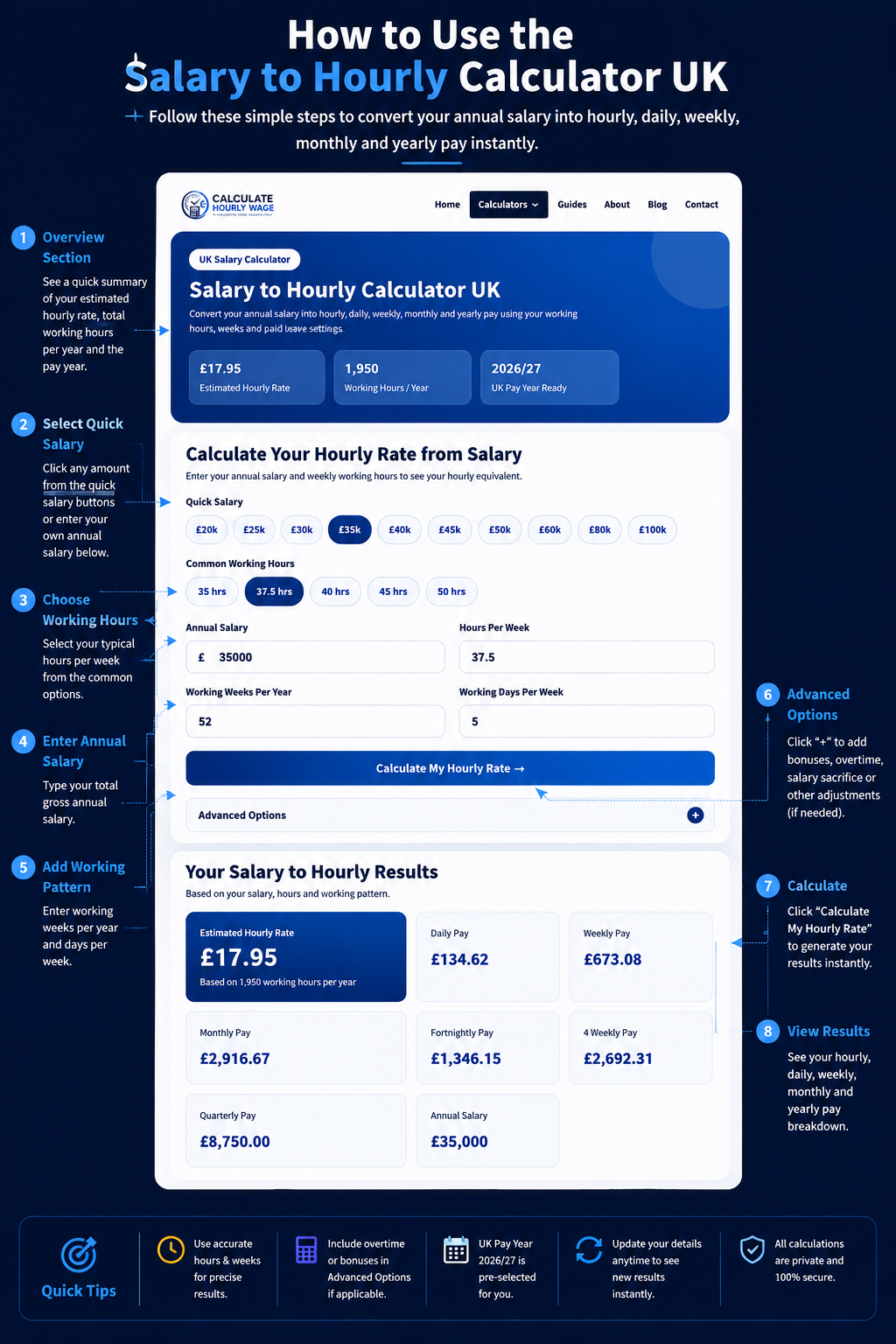
Use our free Salary to Hourly Calculator UK to instantly estimate your result before exploring the detailed guide below.
CALCULATOR
Calculate Your Hourly Wage Now
Enter your annual salary and weekly working hours to see your estimated:
- Hourly wage
- Daily pay
- Weekly salary
- Monthly salary
- Annual earnings
Results are estimates based on the information you provide. Actual take-home pay may vary depending on your tax code, National Insurance, pension contributions, student loan repayments, salary sacrifice arrangements, and other payroll deductions.
What Is a Salary-to-Hourly Calculator?
Quick Definition
A Salary to Hourly Calculator UK converts your annual salary into an estimated hourly wage using your contracted weekly working hours. It can also show your monthly, weekly and daily earnings, making it easier to compare salaries and understand your income.
Instead of manually calculating how much you earn each hour, the calculator performs the maths instantly using standard UK working patterns. This is especially useful when comparing different jobs or deciding whether overtime or part-time work is worthwhile.
What the Calculator Converts
A salary-to-hourly calculator can break your income into several useful pay periods.
| Pay Type | What It Shows |
|---|---|
| Annual Salary | Your yearly gross earnings before deductions |
| Monthly Salary | Estimated monthly pay before tax |
| Weekly Pay | Average weekly earnings |
| Daily Pay | Estimated daily earnings based on your working week |
| Hourly Wage | Estimated hourly rate using your weekly working hours |
Having your salary broken down into different pay frequencies makes budgeting, job comparisons and financial planning much simpler.
Who Should Use This Calculator?
This calculator is useful for anyone who wants a clearer picture of their earnings.
It can help:
- Full-time employees
- Part-time workers
- Job seekers comparing offers
- Employers preparing salary packages
- Recruiters discussing pay rates
- Freelancers moving into permanent employment
- Agency workers comparing hourly and salaried positions
If you’re switching between hourly and salaried roles, this calculator provides a quick way to compare the two payment methods under the same assumptions.
How to Convert Salary to Hourly Pay in the UK
Although a calculator gives you an instant answer, it’s useful to understand how the calculation works.
Salary to Hourly Formula
Formula
Annual Salary ÷ (Weekly Hours × 52) = Gross Hourly Wage
This formula assumes you work the same number of paid hours each week throughout the year.
Standard UK Working Hours
There is no single full-time working week in the UK. Employers commonly use one of these schedules:
| Weekly Hours | Typical Roles |
|---|---|
| 35 hours | Civil service, office-based roles |
| 37.5 hours | NHS, many private sector employers |
| 40 hours | Retail, hospitality, manufacturing and many trade occupations |
Because working hours vary, two people earning the same annual salary may have different hourly rates.
Annual Working Hours Explained
To calculate an hourly wage, multiply your weekly contracted hours by 52 weeks.
For example:
| Weekly Hours | Annual Hours |
|---|---|
| 35 | 1,820 |
| 37.5 | 1,950 |
| 40 | 2,080 |
The more hours you work each year, the lower your hourly rate will be for the same annual salary.
How to Calculate Your Hourly Pay Manually
Follow these simple steps:
- Find your annual gross salary.
- Check your contracted weekly working hours.
- Multiply your weekly hours by 52.
- Divide your annual salary by your total annual hours.
- The result is your estimated gross hourly wage.
For example:
- Annual salary: £30,000
- Weekly hours: 40
- Annual hours: 40 × 52 = 2,080
- Hourly rate: £30,000 ÷ 2,080 = £14.42 per hour
This is your gross hourly rate before deductions such as Income Tax and National Insurance.
Salary to Hourly Conversion Examples
The examples below assume a standard 37.5-hour working week (1,950 hours per year). Actual figures will differ if your contracted hours are higher or lower.
| Annual Salary | Details |
|---|---|
| £20,000 Salary | Annual salary: £ 20,000. Estimated hourly wage:£20,000 ÷ 1,950 = £10.26 per hour. Suitable for many entry-level or part-time equivalent roles. |
| £25,000 Salary | Annual salary: £25,000Estimated hourly wage:£12.82 per hourThis salary level is common in customer service, administration and junior professional roles. |
| £30,000 Salary | Annual salary: £30,000Estimated hourly wage:£15.38 per hourA useful benchmark when comparing graduate positions and experienced administrative roles. |
| £35,000 Salary | Annual salary: £35,000Estimated hourly wage:£17.95 per hourBefore accepting an offer, compare the contracted working hours rather than looking only at the annual salary. |
| £40,000 Salary | Annual salary: £40,000Estimated hourly wage:£20.51 per hourOnce deductions such as Income Tax and National Insurance are applied, your take-home hourly pay will be lower. |
| £50,000 Salary | Annual salary: £50,000Estimated hourly wage:£25.64 per hourIf you contribute to a workplace pension or repay a student loan, your net hourly earnings may differ from this gross figure. |
| £60,000 Salary | Annual salary: £60,000Estimated hourly wage:£30.77 per hourAt this income level, understanding the difference between gross and net hourly pay becomes increasingly important when planning your finances. |
| £75,000 Salary | Annual salary: £75,000Estimated hourly wage:£38.46 per hour |
Higher earners should also consider factors such as pension contributions, bonuses, and tax thresholds when estimating take-home pay.
Salary Comparison Table (37.5-Hour Week)
| Annual Salary | Monthly | Weekly | Daily (5 Days) | Hourly |
|---|---|---|---|---|
| £20,000 | £1,666.67 | £384.62 | £76.92 | £10.26 |
| £25,000 | £2,083.33 | £480.77 | £96.15 | £12.82 |
| £30,000 | £2,500.00 | £576.92 | £115.38 | £15.38 |
| £35,000 | £2,916.67 | £673.08 | £134.62 | £17.95 |
| £40,000 | £3,333.33 | £769.23 | £153.85 | £20.51 |
| £50,000 | £4,166.67 | £961.54 | £192.31 | £25.64 |
| £60,000 | £5,000.00 | £1,153.85 | £230.77 | £30.77 |
| £75,000 | £6,250.00 | £1,442.31 | £288.46 | £38.46 |
Practical Scenario: Comparing Two Job Offers
Imagine you receive these offers:
| Job | Annual Salary | Weekly Hours | Approx. Hourly Rate |
|---|---|---|---|
| Job A | £36,000 | 35 | £19.78 |
| Job B | £38,000 | 40 | £18.27 |
Although Job B pays a higher annual salary, Job A offers a higher hourly rate because you work fewer hours each week. Looking at both annual pay and hourly earnings can help you make a more informed decision.
Salary Breakdown by Pay Frequency
Once you know your annual salary, breaking it down into monthly, weekly, daily and hourly amounts makes it much easier to budget, compare job offers and understand your earnings.
While employers usually advertise an annual salary, most day-to-day financial decisions depend on how much money you receive each month or how much each working hour is worth.
Annual to Monthly
Monthly salary is simply your annual salary divided by 12.

Formula
Annual Salary ÷ 12 = Monthly Salary
Example
- Annual salary: £36,000
- Monthly salary: £3,000
This figure represents your gross monthly pay before Income Tax, National Insurance and other deductions.
Annual to Weekly
Weekly pay helps compare jobs with different working patterns.
Formula
Annual Salary ÷ 52 = Weekly Salary
Example:
- Annual salary: £36,000
- Weekly salary: £692.31
Annual to Daily
Daily earnings are useful when calculating unpaid leave, holiday value or freelance work.
Assuming a standard five-day working week:
Weekly Salary ÷ 5 = Daily Pay
Example:
- Weekly salary: £692.31
- Daily pay: £138.46
Annual to Hourly
Hourly pay depends on your contracted weekly hours.
Use this formula:
Annual Salary ÷ (Weekly Hours × 52) = Hourly Wage
If you work more hours each week, your hourly rate will be lower for the same annual salary.
Salary Breakdown Example
| Annual Salary | Monthly | Weekly | Daily | Hourly (37.5 hrs) |
|---|---|---|---|---|
| £25,000 | £2,083.33 | £480.77 | £96.15 | £12.82 |
| £35,000 | £2,916.67 | £673.08 | £134.62 | £17.95 |
| £45,000 | £3,750.00 | £865.38 | £173.08 | £23.08 |
| £55,000 | £4,583.33 | £1,057.69 | £211.54 | £28.21 |
| £65,000 | £5,416.67 | £1,250.00 | £250.00 | £33.33 |
Gross vs Net Hourly Pay
Many people calculate their hourly wage and then wonder why their payslip shows a lower amount.
The reason is simple: your salary is usually quoted as gross pay, while the amount you receive in your bank account is your net pay.
Understanding the difference is essential when comparing job offers or planning your monthly budget.
Gross Hourly Rate
Gross hourly pay is your earnings before deductions.
It is based on your:
- Annual salary
- Contracted working hours
It does not account for:
- Income Tax
- National Insurance
- Workplace pension
- Student loan repayments
- Salary sacrifice arrangements
This is the figure most employers advertise.
Net Hourly Rate
Net hourly pay is what you actually keep after payroll deductions.
Depending on your circumstances, deductions may include:
- PAYE Income Tax
- National Insurance contributions
- Workplace pension contributions
- Student loan repayments
- Other authorised deductions
Because these vary from person to person, two employees with the same salary may take home different hourly amounts.
Why Two Employees Can Have Different Hourly Take-Home Pay
Even if two colleagues both earn £40,000 per year, their net hourly pay may not be identical.
Common reasons include:
- Different tax codes
- Scottish Income Tax rates
- Pension contribution percentages
- Student loan repayment plans
- Salary sacrifice arrangements
- Taxable benefits provided by the employer
This is why gross salary should never be the only factor when comparing employment offers.
Gross vs Estimated Net Hourly Pay
Illustrative example only. Actual results depend on your personal tax position and payroll deductions.
| Gross Hourly Pay | Possible Net Hourly Pay* |
|---|---|
| £12.82 | Around £11–£12 |
| £15.38 | Around £13–£14 |
| £20.51 | Around £16–£18 |
| £25.64 | Around £19–£22 |
| £30.77 | Around £22–£25 |
Important: For a personalised estimate based on your tax code, pension and other deductions, use our Income Tax Calculator UK.
Calculate Your Take-Home Pay
Once you’ve converted your salary into an hourly wage, the next step is understanding how much you’ll actually receive after deductions.
Related Guide: Income Tax Calculator UK
Factors That Affect Your Hourly Wage
Your gross hourly rate is only part of the picture. Several payroll factors can influence how much money reaches your bank account.
Income Tax
Income Tax is deducted through the PAYE system once your taxable income exceeds the relevant allowance.
As your salary increases, a greater proportion of your income may be taxed at higher rates, reducing your take-home hourly pay.
National Insurance
Most employees also pay National Insurance contributions.
Although these deductions are separate from Income Tax, they also reduce your net hourly earnings.
The exact amount depends on your earnings and National Insurance category.
Workplace Pension
If you’re enrolled in a workplace pension, part of your salary is usually contributed towards your retirement savings.
Although this lowers your immediate take-home pay, it can provide valuable long-term financial benefits.
Student Loan Repayments
Graduates may repay student loans through payroll once earnings exceed the relevant repayment threshold.
Your repayment plan determines:
- When repayments begin
- How much is deducted
- The effect on your hourly take-home pay
Salary Sacrifice
Salary sacrifice arrangements reduce your contractual salary in exchange for benefits such as:
- Pension contributions
- Cycle to Work schemes
- Electric vehicle schemes
- Childcare support (where applicable)
Because your taxable salary is lower, your gross and net hourly calculations may change.
Scottish Income Tax
Employees who pay Scottish Income Tax are subject to different tax bands from those in England, Wales and Northern Ireland.
As a result, two people earning the same annual salary could receive different take-home pay depending on where they pay Income Tax.
Bonuses
Annual bonuses are usually treated separately from your basic salary.
Including them in a salary-to-hourly calculation may give a misleading picture of your regular earnings.
It’s generally better to calculate your base salary first, then assess bonus income separately.
Overtime
If overtime is paid at a higher rate—such as time-and-a-half or double time—it should not simply be averaged into your annual salary.
Instead:
- Calculate your standard hourly wage.
- Apply the overtime multiplier.
- Add overtime earnings separately.
This gives a more accurate picture of your total income.
Factors Affecting Hourly Pay
| Factor | Can Change Take-Home Pay? | Notes |
|---|---|---|
| Income Tax | ✓ | Depends on taxable income |
| National Insurance | ✓ | Based on NI rules |
| Workplace Pension | ✓ | Reduces immediate take-home pay |
| Student Loan | ✓ | Depends on repayment plan |
| Salary Sacrifice | ✓ | Reduces taxable salary |
| Scottish Tax | ✓ | Different tax bands apply |
| Bonuses | Sometimes | Usually calculated separately |
| Overtime | Sometimes | Depends on overtime rate |
Practical Scenario: Estimating the Value of Overtime
Sarah earns £32,000 per year and works 40 hours per week, giving her a standard hourly rate of approximately £15.38.
Her employer pays overtime at time-and-a-half.
Instead of earning £15.38, each overtime hour is worth around £23.07.
Knowing your standard hourly rate makes it much easier to estimate the value of extra shifts before agreeing to work them.
Estimate Your National Insurance Contributions
National Insurance can significantly affect your take-home hourly pay.
Related Guide: National Insurance Calculator UK
Choosing the Correct Weekly Hours
One of the biggest reasons people get different hourly results is using the wrong number of weekly working hours.
A £40,000 salary doesn’t always convert to the same hourly wage. The result depends on the number of paid hours in your employment contract.
Before using the calculator, check your contract or ask your employer how many paid hours you work each week.
35-Hour Contracts
A 35-hour week is common in many office-based roles, public sector organisations and some professional services.
Because you work fewer hours across the year, your hourly wage is generally higher than someone earning the same salary over a longer working week.
Example
Annual salary: £35,000
Annual hours:
35 × 52 = 1,820 hours
Estimated hourly wage:
£19.23 per hour
37.5-Hour Contracts
A 37.5-hour working week is one of the most common full-time schedules in the UK.
Many employers calculate this as:
- 7.5 paid hours per day
- Five working days each week
Annual working hours:
37.5 × 52 = 1,950 hours
Using this assumption allows for consistent salary comparisons across many industries.
40-Hour Contracts
Retail, hospitality, logistics, manufacturing and many trade occupations commonly use a 40-hour working week.
Annual working hours:
40 × 52 = 2,080 hours
Although the annual salary may be identical, the hourly rate will usually be lower than a 35 or 37.5-hour contract because more hours are worked during the year.
Variable Hours
Not everyone works fixed hours every week.
If your schedule changes regularly, consider calculating your average weekly paid hours over the past few months before using the calculator.
This provides a more realistic estimate of your hourly earnings.
Shift Workers
Shift workers often have rotating schedules, night shifts or compressed working patterns.
If your shifts vary, base your calculation on your contracted average weekly hours rather than your busiest week.
Remember that shift allowances and enhanced rates are usually paid separately from your basic salary.
Part-Time Employees
The same formula works for part-time employees.
Simply enter your actual contracted weekly hours.
For example:
- Annual salary: £18,000
- Weekly hours: 20
Annual hours:
20 × 52 = 1,040
Hourly wage:
£17.31 per hour
This helps compare part-time and full-time opportunities on an equal basis.
Comparing Different Working Weeks
| Weekly Hours | Annual Hours | £40,000 Salary | Hourly Rate |
|---|---|---|---|
| 35 | 1,820 | £40,000 | £21.98 |
| 37.5 | 1,950 | £40,000 | £20.51 |
| 40 | 2,080 | £40,000 | £19.23 |
Key takeaway: Always use the same weekly-hour assumption when comparing salaries. Otherwise, the comparison may be misleading.
Practical Scenario: Moving from Part-Time to Full-Time
David currently works 25 hours per week earning £19,500 annually.
His employer offers him a full-time position at 37.5 hours per week with a salary of £29,500.
Instead of comparing only the annual salaries, David converts both into hourly rates.
He discovers the hourly pay remains broadly similar, meaning the salary increase mainly reflects the additional hours worked rather than a higher rate of pay.
Convert Hourly Pay Back to Annual Salary
Already know your hourly rate?
Use our Hourly to Salary Calculator UK to estimate your annual income.
Why Calculator Results May Differ from Your Payslip
A salary calculator provides an estimate based on the information you enter.
Your actual payslip may show different figures because payroll calculations take several personal factors into account.
Understanding these differences can help avoid confusion.
Tax Code
Your PAYE tax code determines how much Income Tax is deducted.
An incorrect or emergency tax code can temporarily increase or reduce your deductions until HMRC updates your records.
Pension Deductions
Most workplace pension contributions are taken directly through payroll.
Depending on your pension arrangement, contributions may reduce your taxable income or be deducted after tax.
Either way, your take-home hourly pay may differ from the calculator estimate.
Student Loans
If you’re repaying a student loan, deductions begin only after your earnings exceed the applicable repayment threshold.
Different repayment plans produce different results
Salary Sacrifice
Salary sacrifice reduces your contractual salary before tax.
Although this can lower Income Tax and National Insurance, it also changes the salary used in your hourly calculation.
Irregular Hours
Employees who regularly work unpaid overtime, variable shifts or seasonal hours may find that their effective hourly earnings differ from the estimate.
The calculator assumes consistent paid hours throughout the year.
Payroll Timing
Monthly payroll cycles, overtime payments, bonuses and holiday adjustments can all affect individual payslips.
As a result, one month’s hourly earnings may differ from your annual average.
Important: For tax and payroll guidance, always refer to official information from HMRC and GOV.UK.
Salary to Hourly Conversion Table
The table below uses a 37.5-hour working week (1,950 hours annually).
| Annual Salary | Monthly | Weekly | Daily | Hourly |
|---|---|---|---|---|
| £20,000 | £1,666.67 | £384.62 | £76.92 | £10.26 |
| £25,000 | £2,083.33 | £480.77 | £96.15 | £12.82 |
| £30,000 | £2,500.00 | £576.92 | £115.38 | £15.38 |
| £35,000 | £2,916.67 | £673.08 | £134.62 | £17.95 |
| £40,000 | £3,333.33 | £769.23 | £153.85 | £20.51 |
| £50,000 | £4,166.67 | £961.54 | £192.31 | £25.64 |
| £60,000 | £5,000.00 | £1,153.85 | £230.77 | £30.77 |
| £75,000 | £6,250.00 | £1,442.31 | £288.46 | £38.46 |
| £100,000 | £8,333.33 | £1,923.08 | £384.62 | £51.28 |
Common Salary Questions
Which weekly hours should I use?
Use the number of paid hours stated in your employment contract. If your hours vary, calculate an average weekly figure.
Is my hourly wage calculated before tax?
Unless stated otherwise, salary-to-hourly calculators estimate your gross hourly wage before Income Tax and National Insurance.
Should bonuses be included?
No. It’s usually better to calculate your base salary separately and treat bonuses as additional income.
Why is my hourly rate lower than expected?
The most common reasons are:
- Using a 40-hour week instead of 37.5 hours
- Comparing gross and net pay
- Pension deductions
- Student loan repayments
- Salary sacrifice arrangements
Need to Calculate Overtime?
If you regularly work additional hours, our Overtime Calculator UK can estimate your overtime earnings based on your standard hourly rate.
1. How do I calculate my hourly wage from an annual salary in the UK?
Divide your annual salary by your total annual working hours.
Formula:
Annual Salary ÷ (Weekly Hours × 52)
2. Is my hourly rate calculated before or after tax?
Most salary-to-hourly calculators display your gross hourly rate before deductions.
3. How many working hours are used in UK salary calculations?
The most common assumptions are 35, 37.5 and 40 hours per week, depending on your employment contract.
4. Should I use 35, 37.5 or 40 hours?
Always use your contracted paid weekly hours for the most accurate estimate.
5. Why does my payslip show a different hourly rate?
Differences may result from:
Income Tax
National Insurance
Pension contributions
Student loan repayments
Bonuses
Overtime
Payroll adjustments
6. Does holiday pay affect my hourly wage?
Paid holiday is usually included within your annual salary. However, additional holiday arrangements or unpaid leave can affect your effective hourly earnings.
7. Does workplace pension reduce my hourly take-home pay?
Yes. Pension contributions generally reduce your net hourly pay, although they help build long-term retirement savings.
8. How do student loan repayments affect my hourly earnings?
Repayments reduce your take-home pay once your earnings exceed the relevant repayment threshold for your loan plan.
9. Can I calculate my hourly wage if I work part-time?
Yes. Simply enter your annual salary together with your contracted weekly hours.
10. Which UK tax year should I select when using the calculator?
Always choose the latest available UK tax year to reflect current tax rules and thresholds. If your calculator supports tax-year selection, ensure it matches the period for which you’re estimating your earnings.
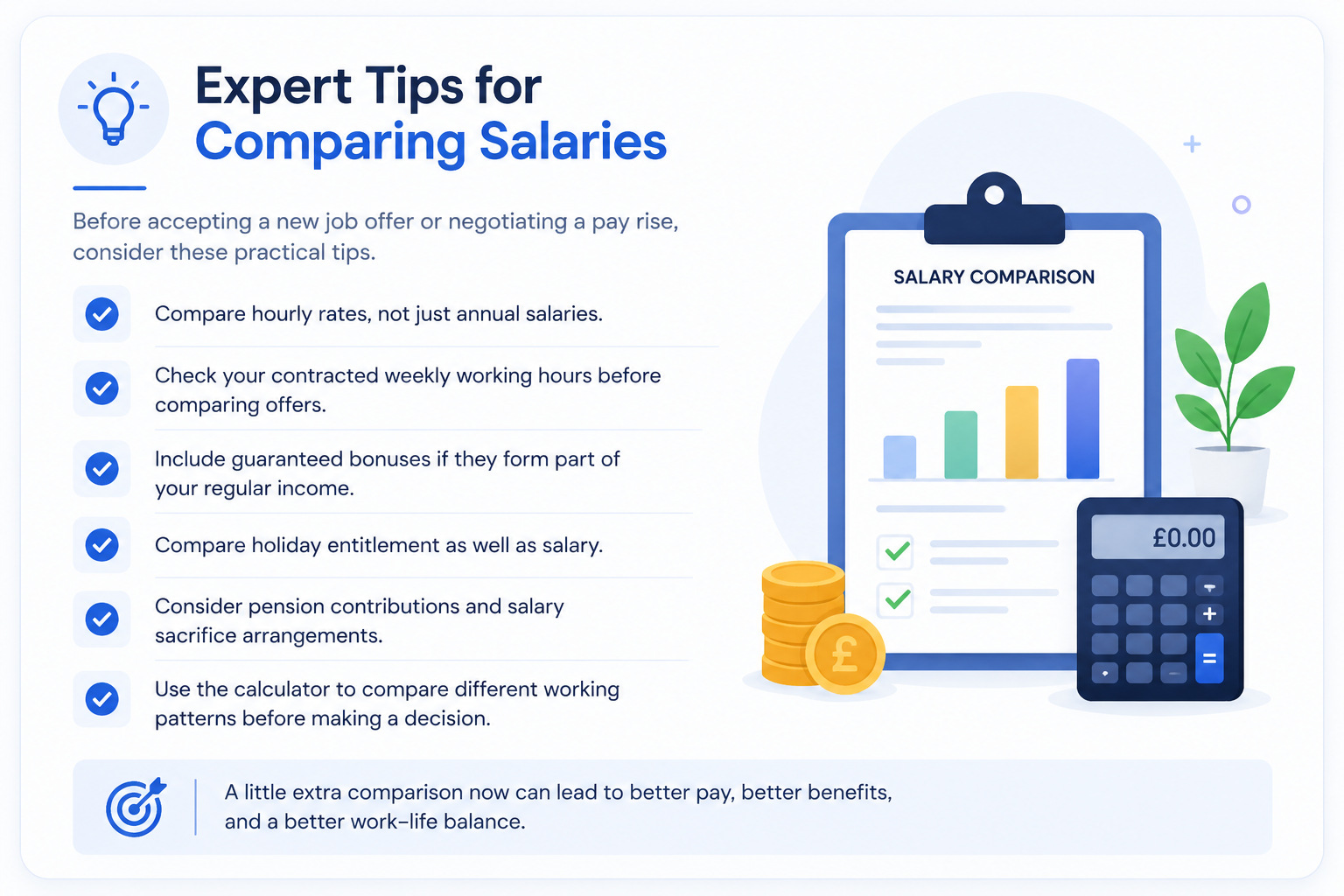
Expert Tips
- Confirm your contracted paid hours before converting your salary.
- Compare both gross and net hourly pay when evaluating job offers.
- Use the same weekly-hour assumption when comparing different salaries.
- Factor in pension contributions for a more realistic estimate of take-home pay.
- Recalculate your hourly wage after any pay rise, contract change or adjustment to your working hours.
Common Mistakes to Avoid
- Using the wrong weekly working hours.
- Comparing gross hourly pay with someone else’s net pay.
- Ignoring National Insurance deductions.
- Forgetting workplace pension contributions.
- Including bonuses in your basic salary calculation.
- Overlooking student loan repayments.
- Ignoring salary sacrifice arrangements.
- Assuming overtime is included in your annual salary.
- Using an outdated tax year.
- Expecting calculator estimates to exactly match your payslip.
Final Thoughts
Your annual salary only tells part of the story. Converting it into an hourly rate gives you a clearer understanding of what your time is worth and makes it easier to compare jobs, estimate overtime and plan your finances.
Use our Salary to Hourly Calculator UK to get an instant estimate, then explore our related guides for Income Tax Calculator UK, National Insurance Calculator UK, Hourly to Salary Calculator UK, Overtime Calculator UK and Pro Rata Salary Calculator UK to build a complete picture of your earnings.