
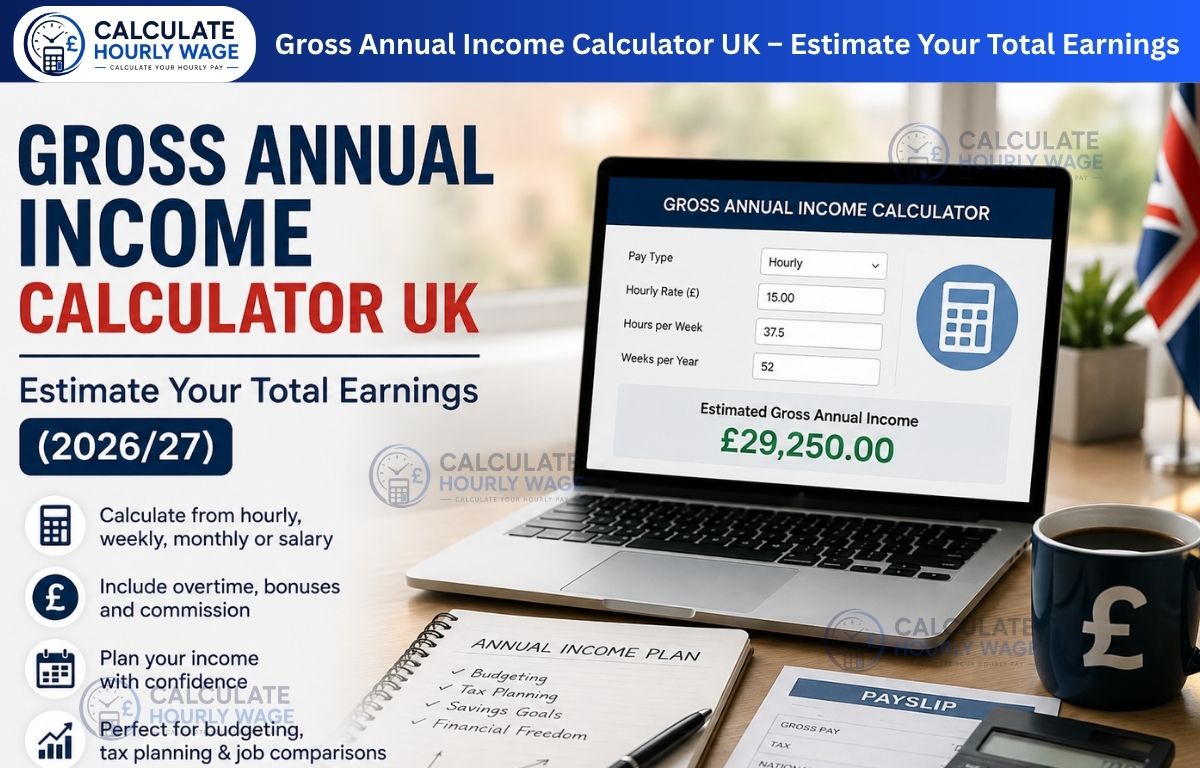
Use our Gross Annual Income Calculator UK to estimate how much you earn in a year before deductions such as Income Tax, National Insurance and pension contributions.
You can calculate an annual figure from an hourly rate, weekly pay, monthly pay or annual salary. Where relevant, you can also account for overtime, bonuses or commission.
Your result is an estimate of gross earnings before deductions. It is not the same as your take-home pay or the amount you will receive in your bank account.
What Is Gross Annual Income?
Gross annual income is the total amount you earn over a year before deductions such as Income Tax, National Insurance, pension contributions and other payroll deductions. It can refer to a contracted annual salary or, where earnings vary, the total amount you expect to earn from work over a year.
The exact meaning depends on how you are paid.
For someone on a fixed salary, gross annual income may be close to their contracted annual salary. For someone paid hourly, working overtime, or receiving commission, actual gross annual earnings can differ from their basic salary or normal pay.
It is also useful to separate gross income from net income. Gross income is the amount before deductions, while net income is what remains after applicable deductions have been taken.
Gross Annual Income vs Annual Salary
Gross annual income and annual salary are often used to mean the same thing, but they can describe different figures.
Your annual salary is normally the fixed amount agreed in your employment contract. For example, an employee might have a contracted salary of £32,000 a year.
Their actual gross earnings could be higher if they receive additional overtime or a bonus.
For example:
| Earnings | Amount |
|---|---|
| Basic annual salary | £32,000 |
| Overtime | £2,000 |
| Bonus | £1,000 |
| Total gross annual earnings | £35,000 |
In this example, the employee’s basic salary is £32,000, but their total gross earnings are £35,000.
This distinction is useful when comparing jobs, checking payroll figures or estimating how much you may actually earn during a year.
Gross Pay vs Taxable Pay vs Net Pay
A payslip can contain several different pay figures, and they should not automatically be treated as interchangeable.
| Pay figure | What it means |
|---|---|
| Gross pay | Earnings before deductions from your pay |
| Taxable pay | The amount relevant to Income Tax calculations after applicable adjustments |
| NI-able pay | The earnings used for National Insurance purposes under the relevant rules |
| Net pay | The amount left after deductions |
This is why the figures shown on a payslip may not all match.
If you are trying to find your actual earnings for a particular tax year, use the relevant payroll document rather than assuming every figure labelled as pay represents the same thing.
How to Calculate Gross Annual Income
The calculation you use depends on how you are paid.
| Pay Type | Gross Annual Income Calculation |
|---|---|
| Hourly-paid work | Gross annual income = hourly rate × hours worked per week × applicable weeks |
| Weekly pay | Gross annual income = weekly gross pay × applicable weeks |
| Regular monthly pay | Gross annual income = monthly gross pay × 12 |
For a fixed annual salary, your starting figure is normally the contracted annual salary. You can then add relevant overtime, bonuses or commission when calculating total gross earnings.
Calculate Gross Annual Income From an Hourly Rate
If you are paid by the hour, multiply your hourly rate by the number of hours you work and the number of applicable weeks.
Worked Example 1
Suppose you earn £15 an hour and work 30 hours per week.
| Description | Calculation |
|---|---|
| Hourly rate | £15 |
| Hours per week | 30 |
| Weeks per year | 52 |
| Annualised calculation | £15 × 30 × 52 = £23,400 |
| Estimated gross annual income | £23,400 |
The number of weeks matters. A consistent hourly worker may use 52 weeks when annualising regular weekly earnings, but someone with unpaid periods or irregular work may need a different calculation.
Read More: Hours and Wage Calculator UKCalculate Gross Annual Income From Weekly Pay
If you already know your gross weekly pay, you can annualise it by multiplying it by the applicable number of weeks.
Worked Example 2
If your gross weekly pay is £500 and you receive that amount for 52 weeks:
| Description | Calculation |
|---|---|
| Weekly gross income | £500 |
| Weeks per year | 52 |
| Annualised calculation | £500 × 52 = £26,000 |
| Annualised gross income | £26,000 |
The calculation changes if your working arrangement includes unpaid periods. Do not automatically assume that every worker should use the same number of paid weeks.
Calculate Gross Annual Income From Monthly Pay
For someone receiving a regular monthly gross amount, multiply the monthly figure by 12.
Worked Example 3
If your gross monthly pay is £2,500:
| Description | Calculation |
|---|---|
| Monthly gross income | £2,500 |
| Months per year | 12 |
| Annualised calculation | £2,500 × 12 = £30,000 |
| Estimated gross annual income | £30,000 |
This calculation works well for regular monthly salaries. If your monthly earnings change because of overtime, commission or variable hours, adding the actual or expected monthly amounts may give a more useful estimate.
Calculate Gross Annual Income From an Annual Salary
If your employment contract states an annual salary, that figure provides the starting point for your gross annual income.
Worked Example 4
Suppose your contracted salary is £35,000 a year.
| Description | Amount / Calculation |
|---|---|
| Basic gross annual salary | £35,000 |
| Overtime earnings | £1,500 |
| Bonus | £1,000 |
| Total gross earnings | £35,000 + £1,500 + £1,000 = £37,500 |
Your basic salary remains £35,000, but your total gross annual earnings are £37,500.
What Counts Towards Gross Annual Income?
Gross annual income can include more than your basic salary when you receive additional earnings.
The exact calculation depends on your working arrangement and the type of payment you receive.
Basic Salary
Your basic salary is the fixed amount agreed with your employer for your role.
For example, if your contract states an annual salary of £30,000, that is your basic annual salary.
It may not represent your final gross earnings for the year if you receive variable payments.
Overtime Pay
Overtime can increase your actual gross annual earnings above your basic salary.
Worked Example 5
Suppose your basic annual salary is £30,000 and you earn another £2,400 from overtime during the year.
| Description | Amount / Calculation |
|---|---|
| Gross annual income | £30,000 |
| Additional earnings | £2,400 |
| Total gross earnings | £30,000 + £2,400 = £32,400 |
Read More: Overtime Pay Calculator UKBonuses and Commission
Bonuses and commission can also increase your total gross earnings.
Worked Example 6
Imagine you earn:
| Description | Amount |
|---|---|
| Basic salary | £32,000 |
| Annual bonus | £2,000 |
| Commission | £1,500 |
| Estimated gross annual earnings | £32,000 + £2,000 + £1,500 = £35,500 |
For variable payments, use realistic figures when projecting. An expected bonus is not the same as an amount already earned and recorded through payroll.
Part-Time and Variable Hours
Part-time employees may have a fixed salary or may be paid according to the hours they actually work.
Practical Scenario 1: Part-time employee
A worker earns £14 an hour and normally works 20 hours a week. Using 52 weeks:
£14 × 20 × 52 = £14,560
That gives an annualised gross figure based on consistent weekly hours.
Practical Scenario 2: Variable-hours worker
A worker’s hours change from week to week. In this situation, multiplying one week’s pay by 52 may give an unrealistic result.
A better estimate may use a representative average based on the worker’s actual pattern, while clearly labelling the result as an estimate.
Gross Annual Income for Different Working Arrangements
Salaried Employees
For a salaried employee, the contracted annual salary normally provides the clearest starting point.
Paid holiday does not mean you should simply remove holiday weeks from the annual salary calculation. A salaried employee’s annual salary is generally structured around their employment arrangement rather than being calculated by subtracting paid holiday from 52 weeks.
For this reason, avoid treating a salaried employee as though they only earn for the weeks they are physically at work.
Hourly-Paid Employees
Hourly-paid workers need to consider:
- Hourly rate
- Hours worked
- Number of applicable weeks
- Whether hours are consistent
- Whether any periods are unpaid
Worked Example 7
A worker earns £16 per hour and normally works 35 hours each week.
| Description | Calculation |
|---|---|
| Hourly rate | £16 |
| Hours per week | 35 |
| Weeks per year | 52 |
| Annualised calculation | £16 × 35 × 52 = £29,120 |
The estimated annualised gross income is £29,120, assuming those hours and rate remain consistent.
If hours vary, the actual annual total may be different.
Freelancers and Contractors
Freelancers and contractors may not have a fixed annual salary.
Their annual gross income may need to be estimated from expected earnings over the year.
Practical Scenario 3: Freelancer with variable monthly income
A freelancer expects to earn:
- £2,000 in one month
- £2,800 in another
- £2,500 in another
Rather than multiplying one month’s income by 12, they can estimate annual gross earnings using their expected income pattern across the year.
The result is a projection rather than a guaranteed annual figure.
Multiple Jobs
Someone with two jobs may need to combine their gross earnings to estimate their total annual employment income.
Practical Scenario 4: Two jobs
Suppose a worker earns £20,000 from one job and £8,000 from another.
| Description | Amount / Calculation |
|---|---|
| First employment earnings | £20,000 |
| Second employment earnings | £8,000 |
| Combined gross employment earnings | £20,000 + £8,000 = £28,000 |
Each employer may maintain separate payroll records, so the worker may need to combine the relevant figures when looking at their overall income.
How Many Weeks Should You Use in the Calculation?
There is no single number of weeks that applies to every worker.
The appropriate figure depends on how the person is paid and whether there are unpaid periods.
A calculation may need to account for:
- Salaried employment
- Hourly-paid employment
- Part-time work
- Variable hours
- Unpaid periods
A common mistake is assuming that every worker should deduct holiday weeks from 52. That is not appropriate for a normal salaried employee whose annual salary already covers their paid employment arrangement.
Should You Use 52 Weeks?
Using 52 weeks can be appropriate when you are annualising a regular weekly income and the income applies across the year.
For example:
£600 per week × 52 = £31,200
But that does not mean every worker should use 52 weeks without checking their circumstances.
If someone has unpaid periods, irregular work or only works during particular parts of the year, their calculation should reflect that arrangement.
Expert Tip: Start with the actual way you are paid. Do not choose several weeks simply because it produces a convenient annual figure.
Gross Annual Income and the UK Tax Year
The phrase “annual income” can refer to different periods.
You may be looking at:
- A calendar year
- The UK tax year
- Your employment or payroll period
- A projected 12 months of future earnings
These periods are not necessarily the same.
This matters when comparing an estimate with official payroll records. A calculation based on your expected earnings over the next 12 months may not match the income recorded for a particular tax year.
2026/27 Tax Year
For 2026/27, the calculator can estimate your gross annual income, but gross income is not the same as your taxable income or take-home pay.
The calculation tells you how much you expect to earn before deductions. Tax calculations require separate consideration of Income Tax, National Insurance and other relevant factors.
Visit Now: GOV.UKWhere Can You Find Your Gross Annual Income?
If you need your actual recorded income rather than an estimate, your payroll documents can be more useful than an annualised calculation.
Your Payslip
A payslip can show different pay figures, including gross pay and other amounts used for payroll calculations.
Look carefully at the labels rather than assuming the largest or first pay figure is your annual income.
A single payslip normally relates to a particular pay period. To estimate a full year, you may need to annualise the figure if your pay is consistent.
If your pay varies, simply multiplying one payslip by 12 may not reflect your actual earnings.
Your P60
A P60 is relevant when looking at recorded earnings for a tax year.
This makes it useful when you need to check what you actually earned during that period rather than estimating what you might earn over the next 12 months.
A P60 figure and a calculator estimate can therefore answer different questions.
Your P45
A P45 is relevant when employment ends.
It can provide information about earnings recorded during the employment period, but it may not represent a complete tax year’s income.
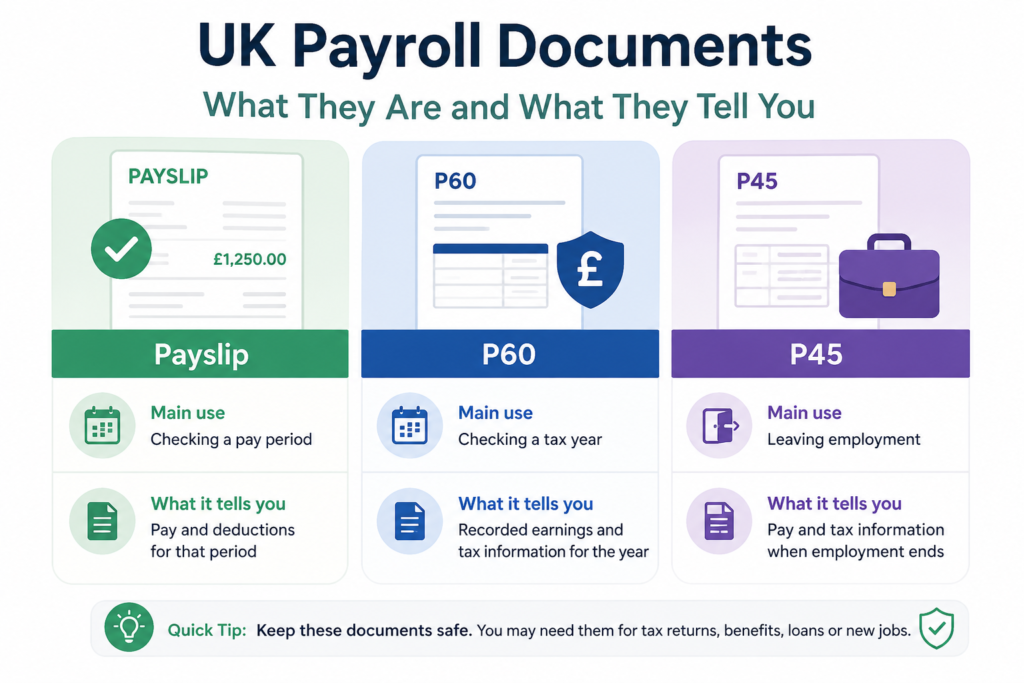
Comparison Table:
| Document | Main use | What it tells you |
|---|---|---|
| Payslip | Checking a pay period | Pay and deductions for that period |
| P60 | Checking a tax year | Recorded earnings and tax information for the year |
| P45 | Leaving employment | Pay and tax information when employment ends |
Gross Annual Income vs Take-Home Pay
Gross annual income is not the amount that necessarily reaches your bank account.
Your take-home pay is lower when applicable deductions are taken from your earnings.
Common Deductions From Gross Pay
Depending on your circumstances, deductions can include:
- Income Tax
- National Insurance
- Workplace pension contributions
- Student loan repayments
- Other applicable deductions
The exact deductions and amounts depend on the individual’s circumstances.
This is why two people with the same gross salary can potentially have different take-home pay.
Why Gross Income Is Not the Same as Taxable Income
Gross income is the amount you earn before deductions.
Taxable pay is a separate concept used when determining the amount relevant to Income Tax calculations. Other payroll calculations, including National Insurance, can have their own treatment.
The result is that gross pay, taxable pay, NI-able pay and net pay should not automatically be treated as the same figure.
If your goal is to find out what you will actually receive after deductions, use a [Gross-to-Net Salary Calculator] or [UK Tax Calculator].
Gross Annual Income Examples
The following examples bring together the main calculation methods.
| Worked Example | Description | Calculation | Result |
|---|---|---|---|
| Worked Example 8: Hourly pay | £15 per hour × 37.5 hours × 52 weeks | £15 × 37.5 × 52 = £29,250 | Estimated gross annual income: £29,250 |
| Worked Example 9: Monthly pay | £2,500 monthly gross pay × 12 | £2,500 × 12 = £30,000 | Estimated gross annual income: £30,000 |
| Worked Example 10: Salary plus additional earnings | £35,000 salary + £2,000 overtime + £1,000 bonus | £35,000 + £2,000 + £1,000 = £38,000 | Total gross earnings: £38,000 |
Worked Example 11: Variable hours
A worker’s hours change throughout the year. Instead of assuming one weekly figure applies to all 52 weeks, they can use a realistic annualised estimate based on their expected working pattern.
For example, if their estimated weekly gross earnings average £550 over the relevant working period:
£550 × applicable weeks
The result should be described as an estimate, particularly where future hours are uncertain.
| Pay basis | Example calculation | Annualised result |
|---|---|---|
| Hourly | £15 × 37.5 × 52 | £29,250 |
| Weekly | £600 × 52 | £31,200 |
| Monthly | £2,500 × 12 | £30,000 |
| Salary + extras | £35,000 + £2,000 + £1,000 | £38,000 |
Common Mistakes When Calculating Gross Annual Income
Confusing Gross Pay With Net Pay
Gross pay is before deductions. Net pay is what remains after applicable deductions.
Using a bank statement figure or take-home pay as your gross income will produce the wrong result.
Using Take-Home Pay as the Starting Figure
A calculator designed to estimate gross annual income should start with a gross pay figure wherever possible.
If you only know your net pay, you need a different type of calculation because the result depends on the deductions that apply to you.
Automatically Using 52 Weeks for Every Worker
52 weeks is useful for many annualised calculations, but it should not be applied blindly.
Check whether your earnings are paid throughout the year and whether you have unpaid periods.
Deducting Paid Holiday From a Salaried Employee’s Annual Salary
Paid holiday should not normally be treated as unpaid weeks that need to be removed from a salaried employee’s annual salary calculation.
The salary arrangement already accounts for paid employment across the year.
Forgetting Overtime, Bonuses or Commission
If you are trying to estimate total gross earnings rather than basic salary, include realistic additional earnings.
Otherwise, your estimate may understate your expected annual income.
Confusing Gross Pay With Taxable Pay
Different payroll figures can have different purposes. Check the label on your payslip or official document before using a figure in your calculation.
Mixing Calendar-Year and Tax-Year Figures
An annualised estimate for January to December may not match recorded earnings for the UK tax year.
Make sure the period you are comparing is the same.
Treating Projected Earnings as Actual Recorded Earnings
A calculator can estimate future income. It cannot turn an estimate into an official payroll record.
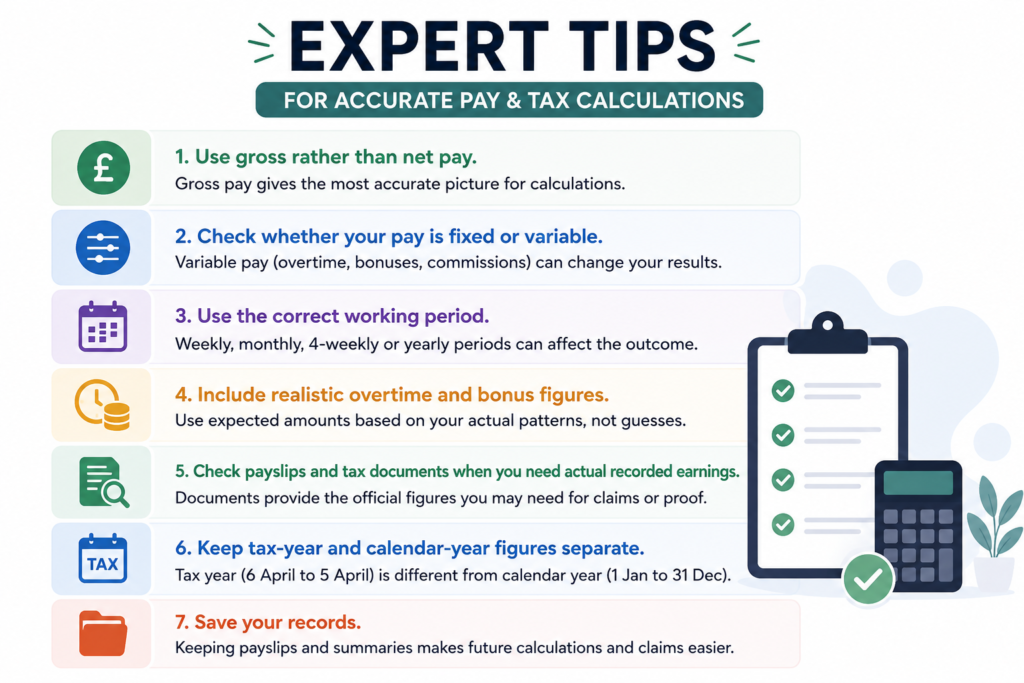
Expert Tips
- Use gross rather than net pay.
- Check whether your pay is fixed or variable.
- Use the correct working period.
- Include realistic overtime and bonus figures.
- Check payslips and tax documents when you need actual recorded earnings.
- Keep tax-year and calendar-year figures separate.
When Should You Use Gross Annual Income?
Gross annual income is useful whenever you need to understand your earnings before payroll deductions.
Comparing Job Offers
Practical Scenario 5: Comparing two employment packages
Imagine one job offers a higher basic salary while another offers a lower salary with regular overtime or a potential bonus.
Looking only at the headline salary may not show the difference in total expected earnings.
For example:
| Package | Basic salary | Additional expected earnings | Estimated gross earnings |
|---|---|---|---|
| Job A | £34,000 | £1,000 | £35,000 |
| Job B | £32,000 | £4,000 | £36,000 |
Job B has the higher estimated gross earnings in this example, although Job A has the higher basic salary.
The additional earnings are not guaranteed, so they should be assessed separately when comparing offers.
Salary and Pay Negotiation
Gross annual income can help you compare your current earnings with a proposed package.
Separate your basic salary from variable payments so that you can see whether a change is genuinely an increase in guaranteed pay or simply a larger potential total.
Personal Budgeting
Gross income can provide a useful starting point for understanding your overall earnings.
However, household spending decisions generally depend more directly on your available net income because deductions reduce what you actually receive.
Employment and Income Verification
A calculator is useful for estimating income, but some situations require recorded figures.
If you need to demonstrate what you actually earned, use the relevant payroll records rather than relying only on an estimated annual figure.
Gross Annual Income Calculator UK- What Your Result Means
Your calculator result represents an estimated gross annual income based on the figures and assumptions entered.
It should not automatically be treated as:
- Your basic annual salary
- Your actual recorded earnings
- Your taxable income
- Your net or take-home income
A result can be accurate as a mathematical estimate while still differing from your final recorded earnings.
When the Calculator Is an Estimate
Your result is more likely to be an estimate when your income includes:
- Variable hours
- Overtime
- Bonuses
- Commission
- Irregular work
For example, someone who expects to work extra hours next month cannot know their exact annual earnings unless those hours are actually worked and recorded.
The calculator can still provide a useful projection based on reasonable assumptions.
When to Use Your Actual Payroll Figures
Use payroll documents when you need to establish what you actually earned.
A payslip can help you check earnings for an individual pay period.
A P60 can help when checking recorded information for a tax year.
A P45 can be relevant when employment ends.
For future income planning, a calculator estimate may be more appropriate.
What is gross annual income?
Gross annual income is the amount you earn over a year before applicable deductions. It can refer to a fixed annual salary or total gross earnings where your pay includes variable amounts such as overtime, bonuses or commission.
How do I calculate gross annual income?
The formula depends on how you are paid. For hourly work, multiply your hourly rate by your weekly hours and applicable weeks. For regular monthly pay, multiply the monthly gross amount by 12.
How do I calculate gross annual income from an hourly rate?
Multiply your hourly rate by the number of hours you work and the applicable number of weeks.
For example, £15 per hour × 30 hours × 52 weeks gives an annualised figure of £23,400.
How do I calculate gross annual income from monthly pay?
If your monthly gross pay is consistent, multiply it by 12.
For example, £2,500 × 12 = £30,000.
Is gross annual income the same as annual salary?
Not always. Annual salary normally refers to your contracted basic salary. Gross annual income can include additional earnings such as overtime, bonuses or commission.
What is the difference between gross income and net income?
Gross income is before deductions. Net income is what remains after applicable deductions have been taken from your pay.
What does gross pay include?
Gross pay refers to earnings before deductions. Depending on your circumstances, it can include basic pay and additional earnings such as overtime, bonuses or commission.
Do overtime and bonuses count towards gross annual income?
They can increase your total gross earnings. If you are calculating total expected earnings rather than basic salary, include realistic overtime and bonus amounts.
Should I use 52 weeks to calculate annual income?
52 weeks can be appropriate when annualising regular weekly earnings. It should not automatically be used for every worker. Unpaid periods and variable working arrangements can change the calculation.
Where can I find my gross annual income on my payslip?
Your payslip may show gross pay for a particular pay period and other payroll figures. Check the labels carefully. A single payslip does not necessarily show your full annual earnings.
Conclusion
Calculating your gross annual income gives you a clear picture of your total earnings before deductions. Whether you are paid hourly, weekly, monthly or by salary, using the right figures and working period helps you get a more accurate estimate. Remember that gross income is different from take-home pay, taxable pay and your actual recorded earnings. For the most accurate figures, compare your estimate with your payslips or P60 where appropriate.