

Imagine you’ve just received a job offer with an annual salary of £36,000, but your employer tells you that you’ll be paid every two weeks instead of monthly. One of the first questions you’ll likely ask is, “How much will I receive each payday?”
The same applies if you’re already working and planning for rent, utility bills, groceries, or savings. While your annual salary shows what you earn over the year, knowing your bi-weekly (fortnightly) pay makes day-to-day budgeting much easier.
A bi-weekly pay calculator UK helps you quickly estimate your earnings without manually dividing your salary or calculating payroll periods. Whether you’re paid an annual salary, monthly salary, weekly wage, or hourly rate, converting your income into bi-weekly pay gives you a clearer picture of what to expect every payday.
This guide explains how bi-weekly pay works in the UK, how to calculate it accurately, the difference between gross and take-home pay, and the common mistakes to avoid when estimating your earnings.
Calculate Your Bi-Weekly Pay in Seconds
Instead of calculating your earnings manually, use our Bi-Weekly Pay Calculator UK to instantly estimate your bi-weekly (fortnightly) pay from your hourly rate, weekly wage, monthly salary, or annual income.
Whether you’re comparing job offers, planning your budget, or estimating your next payday, the calculator provides a quick and reliable estimate based on the information you enter.
CALCULATOR
What Is Bi-Weekly Pay?
Bi-weekly pay means you receive your wages once every two weeks, resulting in 26 paydays in a typical year.
In the UK, this payment schedule is more commonly called fortnightly pay. Although “bi-weekly pay” is a popular search term, most UK employers and payroll providers use fortnightly pay.
Employees paid fortnightly usually receive their wages on the same weekday every two weeks, making it easier to predict income and manage household finances.
Common industries that use fortnightly payroll include:
- Agency work
- Construction
- Manufacturing
- Healthcare and care services
- Retail and warehousing
- Shift-based roles
Although monthly payroll is the most common payment schedule in the UK, fortnightly payroll is still widely used in sectors where hours or overtime vary.
Is Bi-Weekly the Same as Fortnightly Pay?
Yes. In the UK, bi-weekly pay and fortnightly pay both mean you are paid every two weeks.
Confusion sometimes arises because the term bi-weekly can have different meanings in other countries.
| Term | UK Meaning | Common US Interpretation |
|---|---|---|
| Bi-weekly | Every two weeks | Every two weeks (sometimes confused with twice a week) |
| Fortnightly | Every two weeks | Rarely used |
| Semi-monthly | Twice per month | Twice per month |
For UK payroll, remember:
Fortnightly = Bi-weekly = Every 2 weeks = 26 pay periods per year
How Many Bi-Weekly Pay Periods Are There in a Year?
A year contains 52 weeks. Since each pay period covers two weeks, most employees receive:
52 ÷ 2 = 26 pay periods
Occasionally, an employer’s payroll calendar may include a 27th payday within a tax year. This doesn’t increase your annual salary—it only changes the timing of one payment.
For most calculations, dividing your annual salary by 26 provides a reliable estimate of your gross bi-weekly pay.
How to Use the Bi-Weekly Pay Calculator UK
A Bi-Weekly Pay Calculator UK lets you estimate your earnings without manually converting salaries or wages.
1. Enter Your Pay Information
Select the type of income you know:
- Annual salary
- Monthly salary
- Weekly pay
- Hourly wage
- Daily rate (if supported)
The calculator converts your chosen pay frequency into an estimated bi-weekly income using standard payroll calculations.
- Salaried employees: Use your annual salary for the most accurate estimate.
- Hourly workers: Enter your hourly rate and average weekly hours.
Tip: Enter your gross pay unless the calculator specifically asks for your take-home (net) pay.
Add Your Working Hours (If Paid Hourly)
Hourly-paid employees should also enter:
- Hours worked each week
- Regular contracted hours
- Average weekly hours if your schedule changes
For example:
| Item | Value |
|---|---|
| Hourly rate | £16 |
| Weekly hours | 37.5 |
| Weekly earnings | £16 × 37.5 = £600 |
| Bi-weekly earnings | £600 × 2 = £1,200 |
Using your normal contracted hours produces a better estimate than guessing based on unusually busy or quiet weeks.
Read More: Salary to Hourly Calculator UKInclude Overtime (Optional)
If you regularly work overtime, including it can provide a more realistic estimate of your expected earnings.
For example:
| Item | Value |
|---|---|
| Hourly rate | £18 |
| Regular hours | 37.5 |
| Overtime | 5 hours |
| Overtime rate | 1.5× |
| Regular weekly earnings | £18 × 37.5 = £675 |
| Overtime earnings | £27 × 5 = £135 |
| Total weekly pay | £810 |
| Estimated bi-weekly pay | £1,620 |
If your overtime varies from week to week, remember that the calculator provides an estimate rather than a guaranteed payday amount.
Read More: Overtime Pay Calculator UKView Your Estimated Bi-Weekly Earnings
Once you’ve viewed your estimated earnings
After entering your information, the calculator estimates your gross earnings for a two-week pay period.
Many calculators also display equivalent earnings as:
- Hourly pay
- Daily pay
- Weekly pay
- Monthly salary
- Annual salary
This makes it easier to compare different pay frequencies and evaluate job offers.
Most bi-weekly calculators estimate gross pay only. Your actual take-home pay may be lower after deductions such as:
- Income Tax
- National Insurance
- Workplace pension contributions
- Student loan repayments
- Salary sacrifice arrangements
For a more accurate estimate of your take-home income, use a UK tax calculator alongside your bi-weekly pay calculation.
Read More: Income Tax Calculator UKHow Is Bi-Weekly Pay Calculated?
Although a calculator provides the quickest answer, understanding the underlying calculations helps you verify your payslip and estimate your income confidently.
Different formulas apply depending on how you’re paid, but each follows the same principle: convert your income into the amount earned over two weeks.
Annual Salary to Bi-Weekly Pay Formula
If you’re paid a fixed annual salary, calculating your bi-weekly earnings is straightforward.
Formula
Bi-Weekly Pay = Annual Salary ÷ 26
Since there are 26 two-week pay periods in a standard year, dividing your gross annual salary by 26 provides your estimated gross earnings for each payday.
Example:
| Item | Value |
|---|---|
| Annual salary | £39,000 |
| Calculation | £39,000 ÷ 26 = £1,500 |
| Estimated gross bi-weekly pay | £1,500 |
This method works well for employees with a fixed salary who are paid every two weeks.
Visit Now: GOV.UKHourly Wage to Bi-Weekly Pay Formula
For hourly-paid employees, your earnings depend on both your hourly rate and the number of hours you work.
The calculation is:
Bi-Weekly Pay = Hourly Rate × Weekly Hours × 2
Example:
| Item | Value |
|---|---|
| Hourly rate | £17 |
| Weekly hours | 35 |
| Weekly earnings | £17 × 35 = £595 |
| Bi-weekly earnings | £595 × 2 = £1,190 |
This approach is particularly useful for shift workers, agency staff, and employees with consistent weekly hours.
Weekly Pay to Bi-Weekly Pay Formula
If you already know your weekly earnings, calculating your bi-weekly pay is the simplest conversion of all.
Formula
Bi-Weekly Pay = Weekly Pay × 2
This works because a bi-weekly (fortnightly) pay period covers exactly two weeks.
Example:
| Item | Value |
|---|---|
| Weekly wage | £720 |
| Calculation | £720 × 2 = £1,440 |
| Estimated bi-weekly pay | £1,440 |
This method is particularly useful if your payslip already shows a weekly wage or if you’re comparing a weekly-paid role with a fortnightly-paid position.
Monthly Salary to Bi-Weekly Pay Formula
Converting a monthly salary into bi-weekly pay requires an extra step because there are 12 months but 26 bi-weekly pay periods in a year.
| Formula | Calculation |
|---|---|
| Annual Salary | Monthly Salary × 12 |
| Bi-Weekly Pay | Annual Salary ÷ 26 |
| Combined Formula | (Monthly Salary × 12) ÷ 26 |
Example:
| Item | Value |
|---|---|
| Monthly salary | £2,800 |
| Annual salary | £2,800 × 12 = £33,600 |
| Bi-weekly pay | £33,600 ÷ 26 = £1,292.31 |
| Estimated gross bi-weekly pay | £1,292.31 |
This conversion gives a more accurate result than simply doubling your monthly pay or dividing it into arbitrary periods.
Worked Calculation Examples
The following examples demonstrate how different payment methods can be converted into estimated bi-weekly earnings.
These examples assume gross pay and do not include deductions such as Income Tax or National Insurance.
Example 1 – £30,000 Annual Salary
Emily has accepted a new office role with a salary of £30,000 per year. Her employer pays staff every two weeks.
Calculation:
£30,000 ÷ 26 = £1,153.85
| Salary | Annual Amount | Bi-Weekly Pay |
|---|---|---|
| Gross Salary | £30,000 | £1,153.85 |
Emily can expect to receive approximately £1,153.85 before deductions each payday.
Example 2 – £40,000 Annual Salary
James is comparing two job offers. One employer pays monthly, while the other pays fortnightly.
| Item | Value |
|---|---|
| Annual salary | £40,000 |
| Calculation | £40,000 ÷ 26 = £1,538.46 |
Although the payment schedule differs, his annual salary remains the same. The only difference is how often he receives it.
Example 3 – £18 Per Hour (37.5 Hours Per Week)
Sophia works regular full-time hours.
| Hourly Rate | Weekly Hours | Estimated Bi-Weekly Pay |
|---|---|---|
| £18 | 37.5 | £1,350 |
This is a useful calculation for employees who are paid hourly but want to understand their expected fortnightly income.
Example 4 – Hourly Pay with Overtime
Daniel works in manufacturing and regularly completes overtime.
| Item | Value |
|---|---|
| Regular hours | 40 hours |
| Hourly rate | £16/hour |
| Overtime | 6 hours |
| Overtime rate | 1.5× |
| Regular pay | £16 × 40 = £640 |
| Overtime rate (hourly) | £24/hour |
| Overtime pay | £24 × 6 = £144 |
| Weekly earnings | £640 + £144 = £784 |
| Bi-weekly earnings | £784 × 2 = £1,568 |
Including overtime provides a more realistic estimate than using contracted hours alone.
Example 5 – Part-Time Employee
Aisha works part-time while studying.
| Item | Value |
|---|---|
| Hourly rate | £14 |
| Weekly hours | 22 |
| Weekly earnings | £14 × 22 = £308 |
| Bi-weekly pay | £308 × 2 = £616 |
Part-time employees can use the same calculation regardless of the number of hours they work.
Understanding Bi-Weekly, Fortnightly and Other UK Pay Schedules
Not every employer pays staff on the same schedule. Understanding the differences helps you compare job offers, organise your budget and avoid confusion when reading employment contracts.
| Pay Frequency | Typical Pay Periods Per Year | Common in the UK? |
|---|---|---|
| Weekly | 52 | Yes |
| Fortnightly (Bi-Weekly) | 26 | Yes |
| Four-Weekly | 13 | Yes |
| Monthly | 12 | Very Common |
| Semi-Monthly | 24 | Less Common |
Weekly Pay
Weekly payroll is common in industries where hours vary from week to week.
Examples include:
| Category | Details |
|---|---|
| Common industries | Hospitality, Retail, Construction, Seasonal work, Temporary employment |
| Advantages | Frequent income, Easier short-term budgeting, Overtime reflected quickly |
| Considerations | More frequent payroll processing, Smaller individual pay packets |
Fortnightly (Bi-Weekly) Pay
Fortnightly pay strikes a balance between weekly and monthly payroll.
Employees receive:
- 26 paydays each year
- Larger payments than weekly payroll
- More frequent income than monthly payroll
It is particularly common where employees work shifts or variable hours.
Many people also find fortnightly budgeting easier because pay arrives more regularly than monthly wages.
Four-Weekly Pay
Four-weekly payroll is different from fortnightly payroll.
Instead of every two weeks, employees are paid every four weeks.
This results in:
- 13 paydays per year
- Larger individual payments
- Different budgeting patterns
People sometimes confuse four-weekly payroll with monthly payroll, but they are not the same because four weeks equals 28 days rather than a calendar month.
Monthly Pay
Monthly payroll is the most common payment schedule across the UK.
Most salaried employees receive:
- One payday each month
- Twelve salary payments per year
Monthly payroll is widely used because it simplifies payroll administration for employers.
However, employees often need to budget carefully, especially during months with higher expenses.
Semi-Monthly Pay
Semi-monthly payroll means employees are paid twice each calendar month, usually on fixed dates such as the 15th and the last working day of the month.
Unlike fortnightly payroll:
- Semi-monthly provides 24 pay periods
- Fortnightly provides 26 pay periods
Although the difference appears small, the payment amounts will differ because the annual salary is divided into a different number of pay periods.
Which Payroll Schedule Is Most Common in the UK?
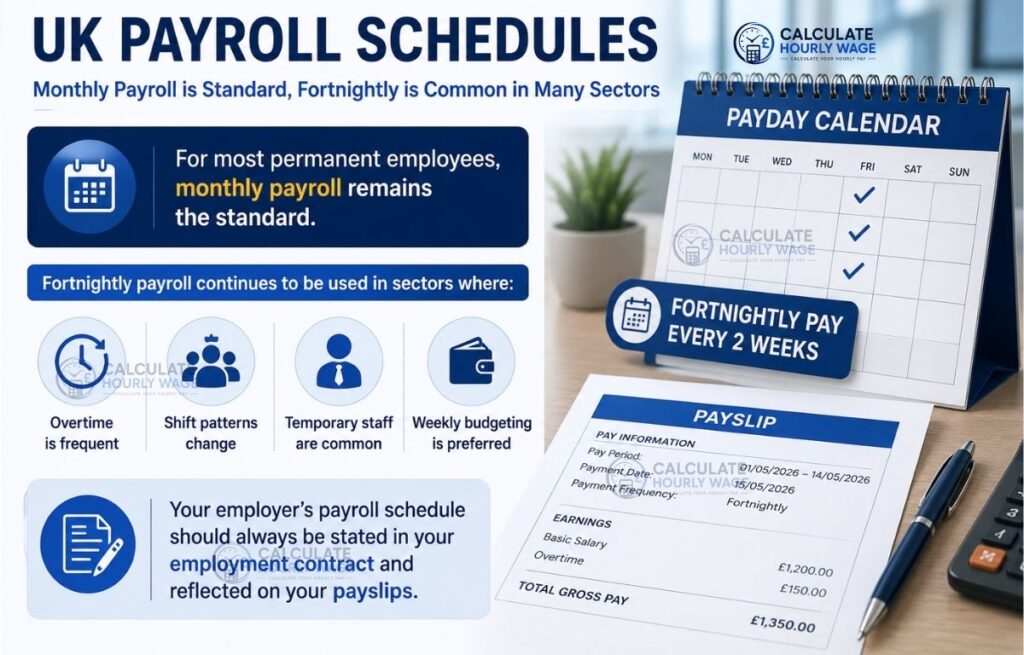
For most permanent employees, monthly payroll remains the standard.
However, fortnightly payroll continues to be used in sectors where:
- Overtime is frequent
- Shift patterns change
- Temporary staff are common
- Weekly budgeting is preferred
Your employer’s payroll schedule should always be stated in your employment contract and reflected on your payslips.
Gross Pay vs Net Pay – What Does the Calculator Estimate?
One of the most common misunderstandings is assuming the figure produced by a bi-weekly pay calculator is the amount that will arrive in your bank account.
In most cases, it is not.
Unless a calculator specifically estimates take-home pay, the result shown is your gross earnings before any deductions.
Understanding the difference helps you budget more accurately and prevents surprises on payday.
Gross Bi-Weekly Pay
Gross pay is the total amount you earn before any statutory or voluntary deductions.
It may include:
- Basic salary
- Hourly wages
- Overtime
- Bonuses
- Commission (where applicable)
| Item | Value |
|---|---|
| Annual salary | £41,600 |
| Gross bi-weekly pay | £41,600 ÷ 26 = £1,600 |
This does not represent your final take-home pay.
Net (Take-Home) Pay
Net pay is the amount you actually receive after deductions have been made.
Depending on your circumstances, deductions may include:
- PAYE Income Tax
- National Insurance contributions
- Workplace pension contributions
- Student loan repayments
- Salary sacrifice schemes
Two employees earning the same gross salary can receive different net pay if their deductions differ.
If you want a more accurate estimate of your take-home income, use a dedicated calculator alongside this one.
Read More: National Insurance Calculator UKWhat Can Affect Your Take-Home Pay?
Your gross bi-weekly pay is not the amount you’ll receive in your bank account. Your actual take-home pay depends on various deductions and adjustments, some required by law and others based on your employment.
Common factors include:
- Income Tax (PAYE): Deducted according to your tax code and taxable earnings.
- National Insurance Contributions (NICs): Calculated using current UK thresholds.
- Workplace Pension Contributions: If you’re enrolled in a pension scheme, contributions may be deducted before or after tax, depending on the scheme.
- Student Loan Repayments: Automatically deducted if your earnings exceed your loan plan’s repayment threshold.
- Salary Sacrifice Arrangements: Benefits such as additional pension contributions or cycle-to-work schemes can reduce your taxable salary.
Your take-home pay may also be affected by bonuses, commission, unpaid leave, statutory payments, or changes to your tax code.
Annual Salary to Bi-Weekly Pay Conversion Table
| Annual Salary | Estimated Bi-Weekly Pay |
|---|---|
| £20,000 | £769.23 |
| £25,000 | £961.54 |
| £30,000 | £1,153.85 |
| £35,000 | £1,346.15 |
| £40,000 | £1,538.46 |
| £45,000 | £1,730.77 |
| £50,000 | £1,923.08 |
| £60,000 | £2,307.69 |
Hourly Rate to Bi-Weekly Earnings Table
Assuming 37.5 hours per week.
| Hourly Rate | Weekly Pay | Bi-Weekly Pay |
|---|---|---|
| £12 | £450.00 | £900.00 |
| £14 | £525.00 | £1,050.00 |
| £16 | £600.00 | £1,200.00 |
| £18 | £675.00 | £1,350.00 |
| £20 | £750.00 | £1,500.00 |
| £25 | £937.50 | £1,875.00 |
Payroll Frequency Comparison Table
| Pay Frequency | Payments Per Year | Typical Use |
|---|---|---|
| Weekly | 52 | Casual, agency and shift work |
| Fortnightly | 26 | Manufacturing, healthcare, retail |
| Four-Weekly | 13 | Some public sector employers |
| Monthly | 12 | Most salaried employees |
| Semi-Monthly | 24 | Less common UK payroll systems |
Gross Pay vs Estimated Net Pay Table
| Gross Bi-Weekly Pay | Typical Deductions* | Estimated Take-Home |
|---|---|---|
| £1,000 | Varies | Depends on tax circumstances |
| £1,300 | Varies | Depends on tax circumstances |
| £1,600 | Varies | Depends on tax circumstances |
| £2,000 | Varies | Depends on tax circumstances |
Actual deductions vary based on tax code, pension contributions, National Insurance, student loans, and other personal circumstances.
Typical UK Payroll Schedule Comparison
| Payroll Type | Predictable Income | Budgeting Ease | Common for Salaried Staff |
|---|---|---|---|
| Weekly | Medium | Good | Sometimes |
| Fortnightly | High | Very Good | Yes |
| Four-Weekly | High | Good | Sometimes |
| Monthly | High | Good | Very Common |
| Semi-Monthly | High | Moderate | Less Common |
Real-Life Scenarios
Understanding the calculations is useful, but seeing how they’re applied in everyday situations makes them easier to use.
Comparing Two Job Offers
Sarah receives two job offers with the same annual salary.
- Company A: Pays monthly
- Company B: Pays bi-weekly
Although her annual income is identical, Company B’s more frequent paydays better suit her budgeting style. A bi-weekly calculator helps her compare the value of each payday instead of focusing only on the annual salary.
Planning a Household Budget
Daniel and his partner organise their finances around payday. Knowing their bi-weekly income helps them plan:
- Rent or mortgage payments
- Utility bills
- Grocery shopping
- Savings contributions
Using their actual bi-weekly earnings creates a more accurate budget than estimating from a monthly salary.
Estimating Variable Earnings
Lucy works through an employment agency where her hours change from week to week.
By entering her hourly rate and average weekly hours, she can estimate her expected bi-weekly earnings and decide whether taking extra shifts is worthwhile.
Calculating Overtime Pay
Michael normally works 40 hours each week but expects overtime during a busy period.
By calculating overtime separately, he can estimate:
- Total bi-weekly earnings
- The effect on his take-home pay
- Progress towards his savings goal
Saving with Bi-Weekly Pay
Emma wants to save £3,000 over the next year.
Since there are 26 bi-weekly pay periods, she calculates how much to save from each payday, making her goal easier to achieve through consistent contributions.
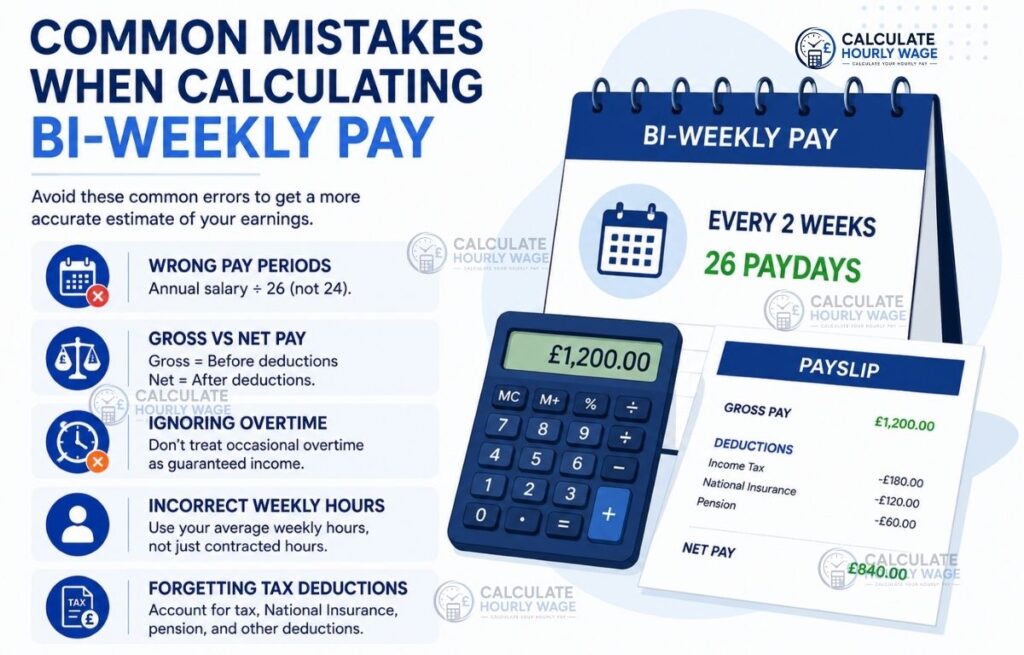
Common Mistakes When Calculating Bi-Weekly Pay
Small calculation errors can lead to unrealistic expectations about your income. Avoiding these common mistakes will help you estimate your earnings more accurately.
Confusing Bi-Weekly with Semi-Monthly
These payment schedules are different:
- Bi-weekly: Every two weeks (26 pay periods per year)
- Semi-monthly: Twice each month (24 pay periods per year)
Using the wrong schedule will produce inaccurate pay estimates.
Using the Wrong Number of Pay Periods
Annual salaries should normally be divided by 26, not 24 or 25. Using the wrong divisor results in incorrect bi-weekly pay calculations.
Mixing Gross and Net Pay
Don’t compare gross calculator results with the amount deposited into your bank account.
- Gross pay: Before tax and other deductions
- Net pay: After deductions
Use the correct figure depending on whether you’re comparing salaries or planning your budget.
Forgetting Overtime
If overtime is a regular part of your earnings, include it in your estimate. However, avoid treating occasional overtime as guaranteed income.
Ignoring Unpaid Leave
Unpaid leave reduces earnings for the affected pay period. Adjust your estimate if you expect unpaid time off.
Using Incorrect Weekly Hours
Hourly workers should use their average weekly hours rather than contracted hours if they regularly work more or fewer hours.
Assuming Every Month Has Two Paydays
Bi-weekly pay follows a 14-day cycle, so some months include three paydays. This is normal and can be useful for savings or larger expenses.
Forgetting Bonuses or Commission
Include bonuses or commission only if they are a regular part of your income. One-off or irregular payments should be calculated separately.
Ignoring Tax Deductions
Gross pay is useful for salary comparisons, but it doesn’t reflect your actual take-home income. If you’re budgeting, estimate your net pay as well.
Using Non-UK Payroll Assumptions
Many online calculators are designed for US payroll systems. When estimating UK earnings, use calculators based on UK payroll rules, including PAYE and National Insurance where applicable.
Expert Tips for More Accurate Bi-Weekly Pay Estimates
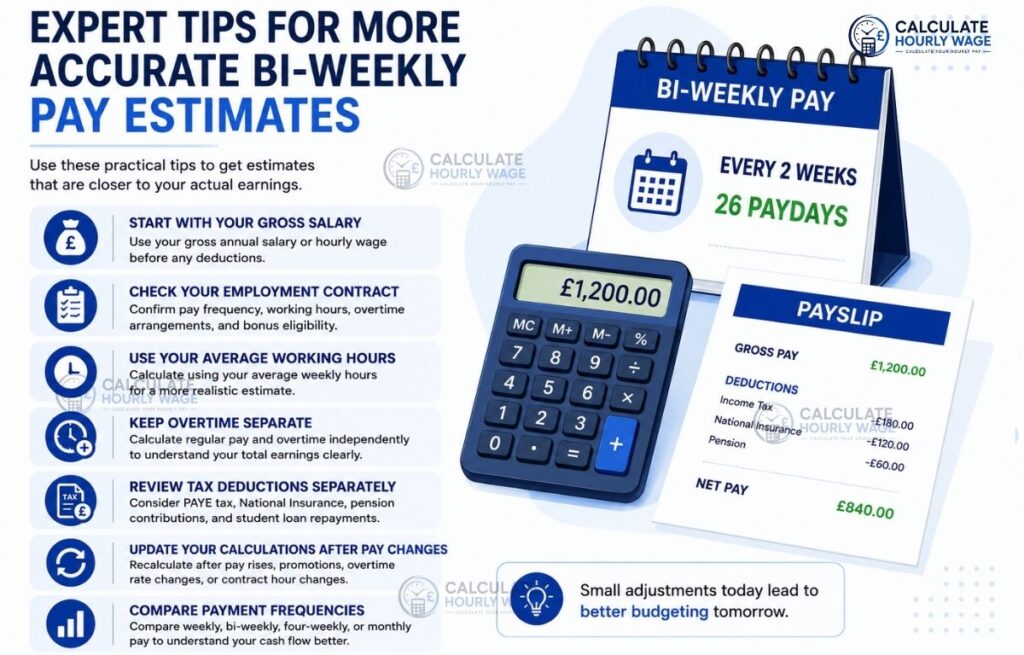
Small adjustments to your calculations can make a noticeable difference when planning a budget, comparing job offers, or checking your payslip. These practical tips will help you produce estimates that are closer to your actual earnings.
Start with Your Gross Salary
Begin with your gross annual salary or hourly wage before deductions. This matches the figures employers use for payroll calculations and provides the most accurate starting point.
Check Your Employment Contract
Before calculating your pay, confirm:
- Pay frequency
- Contracted working hours
- Hourly rate or annual salary
- Overtime arrangements
- Bonus eligibility
Using your contract ensures your calculations are based on current employment terms.
Use Your Average Working Hours
If you’re paid hourly and your schedule varies, calculate using your average weekly hours rather than an unusually busy or quiet week. This provides a more realistic estimate of your regular earnings.
Keep Overtime Separate
Calculate regular pay and overtime independently. This makes it easier to understand your standard income and see how additional hours affect your total earnings.
Review Tax Deductions Separately
A bi-weekly pay calculator usually estimates gross pay, not take-home income. For a realistic budget, also consider deductions such as:
- PAYE Income Tax
- National Insurance
- Pension contributions
- Student loan repayments
Update Your Calculations After Pay Changes
Recalculate your earnings whenever your pay changes, such as after:
- Annual pay reviews
- Promotions
- Overtime rate increases
- Changes in contracted hours
- Moving from hourly to salaried employment
Keeping your figures current improves budgeting accuracy.
Understand the 27th Pay Period.
Most years include 26 bi-weekly pay periods, but some payroll calendars contain a 27th payday. This doesn’t increase your annual salary—it only changes the timing of one payment.
Compare Payment Frequencies
When evaluating a job offer, consider both the salary and the pay schedule. Compare whether you’re paid:
- Weekly
- Bi-weekly
- Four-weekly
- Monthly
Payment frequency can affect your cash flow, budgeting, and bill management.
What is a bi-weekly pay calculator?
A bi-weekly pay calculator estimates how much you earn every two weeks based on your annual salary, monthly salary, weekly wage or hourly rate. Most calculators display gross earnings before deductions.
Is bi-weekly the same as fortnightly in the UK?
Yes. In UK payroll, fortnightly is the more commonly used term, but both generally refer to being paid once every two weeks.
How many bi-weekly pay periods are there in a year?
A standard year contains 26 bi-weekly (fortnightly) pay periods because there are 52 weeks in a year.
Some payroll calendars occasionally include a 27th payday depending on how dates fall.
How do I calculate bi-weekly pay from an annual salary?
Divide your gross annual salary by 26.
For example:
£39,000 ÷ 26 = £1,500 gross bi-weekly pay.
Can I calculate bi-weekly pay from an hourly wage?
Yes.
Multiply your hourly rate by your weekly working hours, then multiply the result by two.
For example:
£18 × 37.5 × 2 = £1,350 gross bi-weekly earnings.
Does this calculator estimate gross or net pay?
Most bi-weekly pay calculators estimate gross pay before deductions.
To estimate your take-home income, use a dedicated tax calculator that includes PAYE, National Insurance and other deductions.
Can I include overtime in the calculation?
Yes.
If your calculator allows additional hours, including overtime provides a more realistic estimate of your expected earnings, especially if overtime is a regular part of your working pattern.
Why do some years have a 27th pay period?
Because payroll follows calendar dates rather than exact annual divisions, some employers may process 27 fortnightly paydays within a tax year.
This affects payment timing rather than increasing your annual salary.
Is fortnightly pay common in the UK?
Monthly payroll is the most common payment schedule for salaried employees.
However, fortnightly payroll is still widely used in industries such as manufacturing, healthcare, retail, logistics and agency work.
Can I convert my monthly salary into bi-weekly earnings?
Yes.
Multiply your monthly salary by 12 to obtain your annual salary, then divide the result by 26.
This provides an estimated gross bi-weekly income.
Conclusion
Understanding your earnings by payday, not just by year, makes it much easier to budget, compare job offers and plan your finances with confidence. Whether you’re paid an annual salary, hourly wage or weekly income, a bi-weekly pay calculator UK provides a quick way to estimate what you’ll receive every two weeks.
While dividing an annual salary by 26 is the standard method for calculating gross fortnightly pay, remember that your actual take-home amount may differ after Income Tax, National Insurance, pension contributions and other deductions. If you’re making important financial decisions, it’s worth checking your payslip alongside dedicated tax calculators for a more complete picture.