
Holiday Pay Calculator UK
Use this free holiday pay calculator to estimate what your paid leave is worth from your hourly rate, working hours and holiday entitlement. Full-time workers on a 5-day week get at least 28 days (5.6 weeks) of paid leave per year.
Enter Your Work Details
Estimated Holiday Pay
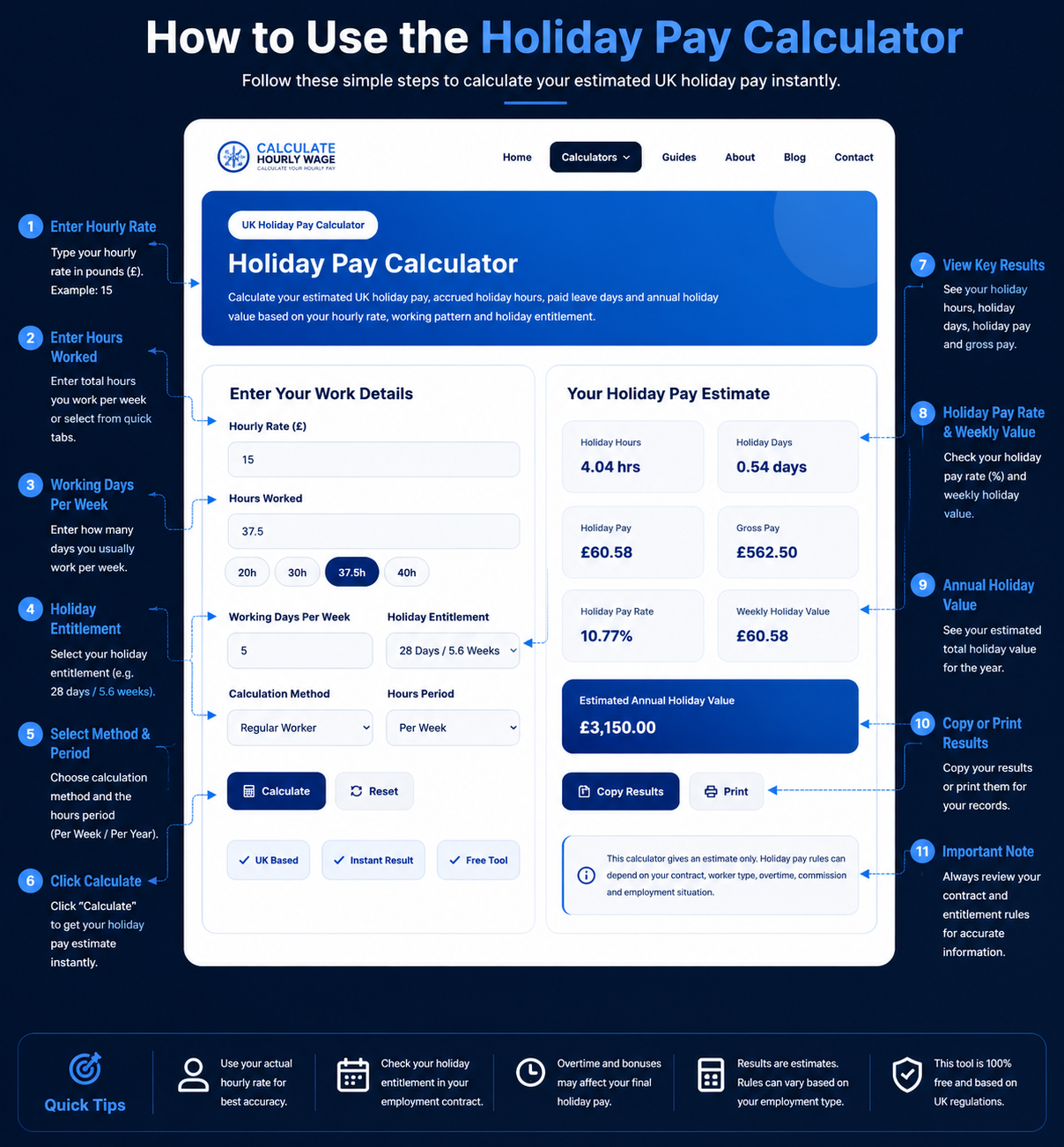
How to Use the Holiday Pay Calculator
If you've been asking how to calculate holiday pay without digging out old payslips, this gives you your holiday pay entitlement in under a minute.
- Enter your hourly rate and working hours: Type your hourly rate in pounds, then pick a preset (20, 30, 37.5 or 40 hours) or enter your own. Set the Working Hours Period to match how you entered your hours: per week, per month or per year. If you know your annual salary but not your hourly rate, you can use our Salary to Hourly Calculator before entering your rate.
- Add your working days per week: This lets the calculator convert your holiday into days as well as hours.
- Choose your holiday entitlement: Full-time workers on a 5-day week are entitled to 28 days (5.6 weeks) statutory leave. If your contract gives you a different amount, select 25 days, 20 days or Custom Days.
Note: On a 5-day week, statutory leave is at least 28 days. If you choose a lower figure, check your contract.
- Select your calculation method: Choose Regular Worker if you work the same hours each week. Choose Irregular Hours (12.07%) if your hours change from week to week.
- Click Calculate: Your results appear straight away. Use Copy Results or Print to save them, or Reset to start again.
Understanding Your Results
Each figure shows the holiday you build up for the work you do in a normal week. The full-year total is in Estimated Annual Holiday Value.
| Result | What it means |
|---|---|
| Gross Pay | Your normal pay for one week, before holiday and before tax |
| Holiday Pay Rate | The share of your pay that goes towards holiday (5.6 weeks out of 52 is 10.77%) |
| Holiday Hours / Holiday Days | The holiday hours and days you build up for each week you work |
| Holiday Pay / Weekly Holiday Value | The value of that holiday for one week of work |
| Estimated Annual Holiday Value | The total value of a full year of holiday (5.6 weeks of pay) |
This is an estimate before tax and National Insurance. Check the final figure against your contract and payslip.
How Holiday Pay Is Calculated in the UK
In the UK, your holiday pay is based on either your regular fixed pay or the average amount of money you made over the last 52 paid weeks. Which method applies to you depends on how you get paid and how regular your hours are.
Here's how to calculate holiday pay for fixed, shift and irregular-hours work.
Statutory Holiday Pay
Workers in the UK are entitled by law to at least 5.6 weeks of paid holiday a year the minimum holiday entitlement UK legislation sets.
On a standard 5-day week, that's 28 days (5.6 weeks in days), the minimum annual leave UK employers can offer. The entitlement is capped at 28 days, so someone working 6 or 7 days a week still gets 28, not more.
Part-time workers get the same 5.6 weeks, just spread over fewer days. To find your entitlement, multiply your working days per week by 5.6. If you are part-way through the leave year, your accrued amount may be different. Our Holiday Leave Accrual Calculator can help estimate how much leave you have built up so far. You can also check the official holiday entitlement rules for part-time workers if your working pattern is different.
The table below assumes an 8-hour day paid at the National Living Wage for workers aged 21 and over (£12.71/hour):
| Working pattern | Annual entitlement | Statutory pay value |
|---|---|---|
| 5.0 days/week | 28.0 days | £2,847.04 |
| 4.5 days/week | 25.2 days | £2,562.34 |
| 4.0 days/week | 22.4 days | £2,277.63 |
| 3.5 days/week | 19.6 days | £1,992.93 |
| 3.0 days/week | 16.8 days | £1,708.22 |
| 2.5 days/week | 14.0 days | £1,423.52 |
| 2.0 days/week | 11.2 days | £1,138.82 |
| 1.0 day/week | 5.6 days | £569.41 |
Under-21 workers: Age doesn't change how many holiday days you get. A 5-day-a-week worker gets 28 days at any age. Only the pay value changes, because the minimum hourly rate is lower for younger workers. To work it out, use the formula above with your own hourly rate.
Example: Under-21 Holiday Pay Breakdown
Based on a full-time entitlement of 28 days (8 hours/day = 224 total working hours):
| Age / Category | Minimum Rate | Total Holiday Pay |
|---|---|---|
| Age 18–20 | £10.85 / hr | £2,430.40 |
| Under 18 / Apprentice | £8.00 / hr | £1,792.00 |
Apprentices get the £8.00 minimum if they are under 19, or in their first year of apprenticeship. Your contract may pay more than these statutory minimums.
Bank Holidays
Bank holidays can be confusing because they are not always extra days off. It depends on what your employment contract says. Some employers include bank holidays within your 5.6 weeks of paid annual leave, while others give you bank holidays on top of your normal holiday allowance. You can check how bank holidays can be included in statutory annual leave if you're unsure how your entitlement works.
So, if you get 28 days of holiday in total and bank holidays are included, those days will use part of your 28-day allowance. This works in the same way for full-time and part-time workers.
When a bank holiday falls on a weekend, a weekday is normally used as the substitute day. For example, Christmas Day in 2027 falls on a Saturday, so Monday 27 December is the substitute bank holiday.
| UK Nation | Bank Holidays in 2027 | Days You Can Choose |
|---|---|---|
| England and Wales | 8 | 20 |
| Scotland | 9 | 19 |
| Northern Ireland | 10 | 18 |
Extra Leave
Your employer can give you more holiday than the legal minimum, for example 33 days instead of 28. The extra days come from your contract, not the law, so your employer can set its own conditions for them. For example, you might need to work there for a year before you can take them. Check your contract to see what applies to you.
Formula by Worker Type
One week of holiday is paid at one week's pay, while the full 5.6 weeks of annual leave is paid at 5.6 times your weekly pay. The main difference between workers is how their weekly pay is worked out. The official holiday pay guidance explains how a week's pay is calculated for fixed hours, shift work and irregular-hours workers.
| Working Pattern | How to Work Out a Week's Pay |
|---|---|
| Fixed hours, fixed pay (full-time or part-time) | Your normal pay for a week |
| Shift work with regular hours | Average weekly hours over the last 52 weeks × your average hourly rateIf you work different shifts with different pay rates, you can also use our Shift Pay Calculator to estimate your earnings for each shift. |
| Irregular hours or part-year work (zero-hours, casual, some term-time roles) | Your average weekly pay over the last 52 weeks in which you were paid |
| Salaried workers | Divide your annual salary by 52 to get a week's pay |
- Pay for a single day of holiday: Divide your week's pay by the number of days you work in a week. This gives you the value of one day off.
- If you're paid monthly and your hours vary: Divide the month's pay by the hours you worked that month. This is your average hourly rate. Multiply that rate by the hours you worked in the week. Do this for each of the last 52 weeks, then average the results. For example, £1,200 for 120 hours is £10 an hour, so a 30-hour week is worth £300.
- If you regularly earn overtime or commission: Your week's pay may be higher than your basic pay. See Basic vs Normal Rate of Pay below.
Basic vs Normal Rate of Pay
Your basic rate is the pay set in your contract, without extras. Your normal rate is what you usually earn, including regular extras. Which one your holiday is paid at depends on how you work.
| Worker Type | Rate Used for Holiday Pay |
|---|---|
| Regular hours (full-time or part-time) | 4 weeks at your normal rate, the remaining 1.6 weeks at your basic rate |
| Irregular hours or part-year | All 5.6 weeks at your normal rate |
Normal pay includes commission, regular overtime and payments linked to length of service or professional qualifications. It doesn't usually include bonus payments. If you're unsure whether a payment should be included, ACAS explains what holiday pay must include
Example: You're a regular-hours worker on £400 a week basic pay, plus £75 of regular overtime. A week of leave counted towards your 4 weeks pays £475. A week counted towards the remaining 1.6 weeks pays £400.
Holiday Pay for Casual, Zero-Hour and Irregular-Hours Workers
Casual and zero-hours workers who count as "workers" get the same 5.6 weeks of paid holiday as everyone else, so holiday pay for a zero-hours contract works the same way as any other role. Only the week's pay calculation is different, because no two weeks look alike.
To work out your average week's pay:
- Look at the 52 weeks before your holiday.
- Count only the weeks in which you were paid. If a week has no pay, skip it and go back further (up to 104 weeks) to find 52 paid weeks.
- Add up your pay for those weeks and divide by 52.
- Multiply that figure by your weeks of leave.
Regular overtime and commission count towards your pay (see Basic vs Normal Rate of Pay). Averaging stops one very busy or very quiet week from changing your holiday pay.
Some employers pay holiday as an extra amount on each payslip instead. See Rolled-Up Holiday Pay below.
Rolled-Up Holiday Pay
Rolled-up holiday pay means your employer adds your holiday pay to each payslip, instead of paying it when you take leave. It works out to 12.07% of your pay for hours worked. That figure is 5.6 weeks divided by the 46.4 weeks you actually work (52 minus 5.6). If you're using rolled-up holiday pay, our Holiday Pay Percentage Calculator can help you check the percentage against your earnings.
It is only allowed for irregular-hours and part-year workers. Employers can't use it for regular-hours workers, full-time or part-time. It also doesn't apply to leave years that began on or before 31 March 2024.
If your employer uses rolled-up pay, check your payslip. The holiday amount should be shown as a separate line.
Example: You earn £200 for the hours you worked. Rolled-up holiday pay is £200 × 12.07% = £24.14, so you're paid £224.14 in total.
Worked Examples of Holiday Pay Calculations
Here's how holiday pay is worked out in practice, with real numbers.
Example 1: Hourly Worker
James works 37.5 hours a week at £18.00 an hour.
| Calculation | Result |
|---|---|
| One week's holiday pay: £18 × 37.5 | £675 |
| Full 5.6 weeks: £675 × 5.6 | £3,780 |
Example 2: Salaried Employee
Emma earns £39,000 a year, paid monthly.
| Calculation | Result |
|---|---|
| Week's pay: £39,000 ÷ 52 | £750 |
| Monthly pay when she takes a week off | £3,250 |
| Value of that week | £750 |
| Full 5.6 weeks: £750 × 5.6 | £4,200 |
Her monthly pay stays at £3,250 when she takes a week off. The £750 is what that week is worth.
Example 3: Part-Time Worker
David works 3 days a week, 8 hours a day, at £15 an hour.
| Calculation | Result |
|---|---|
| Entitlement: 3 × 5.6 | 16.8 days |
| Week's pay: £15 × 24 hours | £360 |
| Full 5.6 weeks: £360 × 5.6 | £2,016 |
Example 4: Zero-Hour Worker (52-Week Average)
Sophie's hours change every week. Four weeks in the last year had no pay, so her employer looks back further to find 52 paid weeks. Her pay across those 52 weeks totals £26,000.
| Calculation | Result |
|---|---|
| Average week's pay: £26,000 ÷ 52 | £500 |
| Full 5.6 weeks: £500 × 5.6 | £2,800 |
Holiday Pay at Common Pay Rates (2026/27)
Figures assume a 5-day, 40-hour week and 5.6 weeks of leave. Salaried workers are paid these amounts as part of their normal salary.
| Pay Rate | Hourly Rate | Week's Pay | 5.6 Weeks (28 Days) |
|---|---|---|---|
| National Living Wage (21+) | £12.71 | £508.40 | £2,847.04 |
| £15 an hour | £15.00 | £600.00 | £3,360.00 |
| £20 an hour | £20.00 | £800.00 | £4,480.00 |
| £25,000 a year | £12.02 | £480.77 | £2,692.31 |
| £30,000 a year | £14.42 | £576.92 | £3,230.77 |
| £35,000 a year | £16.83 | £673.08 | £3,769.23 |
| £40,000 a year | £19.23 | £769.23 | £4,307.69 |
Holiday Pay When You Leave a Job
Even when you quit your job, you will still be able to claim any statutory holiday you have earned through your notice period. This entitlement is dependent upon the period elapsed during the leave year and the number of holidays that you have earned.
If the amount of holiday that you have taken exceeds the number of holidays that you have earned, then your employer can only make the deduction from your final salary when the arrangement was made prior to your employment in writing. It should usually be provided in your contract of employment.
In case you resign from employment with some statutory holiday left unused, your employer has to pay you for the holiday that has been unused regardless of the reason for termination of the employment. If you're leaving part-way through the leave year, our Holiday Leave Accrual Calculator can help you estimate how much leave you have built up.
Note: Payment instead of unused holiday is typically restricted to situations where employment is terminated.
Holiday Pay vs Holiday Entitlement
People often mix these up, but they're two different things. Entitlement is the time you can take off. You can calculate holiday entitlement using your working days per week, work out holiday entitlement in hours and days, or see the formula by worker type to work out holiday entitlement exactly.
Holiday pay is the money you get for that time. Most workers get at least 5.6 weeks of paid holiday a year. Part-time workers get the same 5.6 weeks, pro rata to their working days. You start building up holiday from your first day, including during probation, sick leave and statutory leave such as maternity leave.
| Feature | Holiday Entitlement | Holiday Pay |
|---|---|---|
| What it is | The paid leave you're allowed | The money you're paid for that leave |
| Measured in | Days, weeks or hours | Pounds (£) |
| Based on | Your working pattern | Your normal pay |
| Example | 28 days a year on a 5-day week | £508.40 for a week off at £12.71/hour, 40 hours a week |
Is 20 days' holiday legal? Only if you work about 3.5 days a week or fewer. On a 5-day week, the legal minimum is 28 days.
How many holidays do you get per month? On a 28-day entitlement, about 2.33 days a month (28 ÷ 12).
Statutory holiday entitlement is 5.6 weeks a year (28 days for a full-time worker). If you work part-time or irregular hours, use GOV.UK's calculator to check exactly how much holiday you are entitled to. (Source: GOV.UK — Calculate your holiday entitlement.)
Common Holiday Pay Mistakes
- Leaving out regular overtime or commission: These count as normal pay, so leaving them out gives a lower figure than you're owed.
- Using one week's pay instead of an average: If your pay varies, use your average over the last 52 paid weeks.
- Counting unpaid weeks in the average: Weeks with no pay must be skipped. Including them pulls your average down.
- Using 12.07% for regular-hours work: That rate is only for irregular-hours and part-year workers. It's not a flat rate for everyone.
- Assuming bank holidays are extra: Some employers count them inside your 5.6 weeks. Check your contract.
- Using contracted hours when your real hours differ: Use the hours you actually work.
Frequently Asked Questions
Find answers to common questions about UK holiday pay calculations, statutory leave entitlements, the 52-week average, overtime, and irregular-hours rules.
Fixed hours/pay: Normal weekly pay × leave weeks taken.
Variable pay (overtime, commission, irregular hours): Average weekly pay over the last 52 paid weeks × leave weeks taken.
Workers are entitled to a statutory minimum of 5.6 weeks of paid leave per year (28 days for full-time workers, capped at 28). The first 4 weeks must reflect your normal pay (including regular overtime and commission), while the remaining 1.6 weeks can lawfully be paid at your basic rate.
- Take the last 52 weeks in which you were paid.
- Skip any unpaid weeks (looking back up to 104 weeks if needed to complete 52 paid weeks).
- Add up your total pay across those 52 weeks.
- Divide the total by 52 to get your average weekly pay.
- Multiply by the number of weeks of leave being taken.
Yes — if paid regularly in the 52 weeks before leave. This is mandatory for the first 4 weeks of statutory leave (WTR reg 13, reg 16(3ZA) since Jan 2024). The extra 1.6 weeks can lawfully be paid at basic rate only.
Since April 2024, irregular-hours and part-year workers accrue leave at 12.07% of hours worked per pay period. Employers pay it either as rolled-up holiday pay (itemised separately on your payslip each period) or as a lump sum using the 52-week average when leave is taken.
Only for irregular-hours and part-year workers under the 2024 rules. The 12.07% figure comes from 5.6 weeks divided by the 46.4 actual working weeks in a year. Workers with fixed or regular hours use the standard weekly-pay method instead.
You are owed payment in lieu of accrued-but-untaken statutory leave, pro-rated for the portion of the leave year worked. This is calculated using the same weekly-pay method that applies to your employment pattern (fixed pay or 52-week average).
Conclusion
Our Holiday Pay Calculator helps you quickly estimate how much you could receive while taking annual leave. Whether you're paid hourly, weekly, monthly, or have irregular hours, simply enter your details to get an instant estimate.
Although the calculator provides a reliable estimate, your actual holiday pay may vary depending on your employment contract, payroll arrangements, and current UK employment rules.
To improve accuracy, compare your results with your recent payslips and keep your earnings information up to date. If you regularly check your pay, you may also find our other salary and wage calculators useful for managing your finances and understanding your income throughout the year.
For more detailed information about your statutory rights, you can also read the official UK government guidance on UK Holiday Pay Guidance.
Explore More UK Salary Calculators
Explore more free UK salary calculators to convert wages, estimate earnings, compare different pay options, and make informed financial decisions.
Hourly Rate Calculator
Calculate your hourly wage from your annual salary, monthly income or weekly earnings.
Calculate Now →Salary to Hourly Calculator
Convert your annual or monthly salary into an hourly wage using standard UK working hours.
Calculate Now →Holiday Pay Calculator
Estimate your statutory holiday pay based on your pay rate and working pattern.
Calculate Now →Shift Pay Calculator
Calculate earnings for day, evening, night and rotating shifts in just a few clicks.
Calculate Now →Overtime Pay Calculator
Work out overtime earnings using your hourly rate and overtime multiplier.
Calculate Now →