
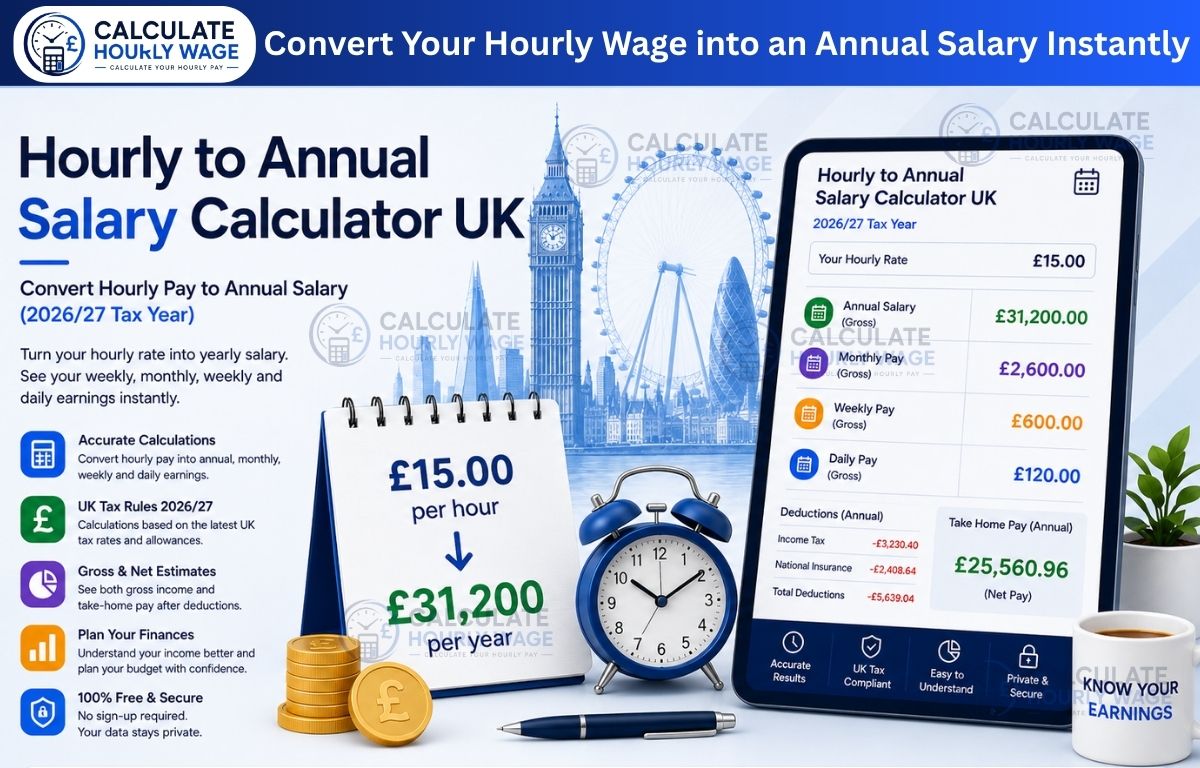
You’ve just been offered a job paying £16.50 an hour. It sounds decent on paper better than your last role, certainly but the moment you try to picture what that actually means for your life, things get fuzzy. Can you afford the flat you’ve been eyeing? Will the mortgage advisor take you seriously? How does it stack up against your mate’s £34,000 salary at the office down the road?
This is the exact moment thousands of people across the UK find themselves in every week. Whether you’re comparing a new job offer, working out if a zero-hours contract is worth taking, or simply trying to understand what your payslip means in the bigger picture, an hourly to annual salary calculator UK helps turn your hourly wage into a yearly salary you can actually compare. That’s the figure lenders ask for, the figure that determines your tax band, and the figure that lets you compare completely different jobs on equal terms.
The tricky part is that converting hourly pay into an annual figure isn’t always as simple as multiplying two numbers together. Your hours, your paid weeks, your contract type they all change the answer.
To skip the maths entirely, use the calculator below.
Click Here: Hourly Wage Calculator UK
Quick answer: To convert hourly pay to annual salary, multiply your hourly rate by your weekly hours, then by the number of paid weeks you work per year. For example, £15 an hour at 37.5 hours a week across 52 paid weeks works out at £29,250 a year before tax. If you take unpaid leave, work part-time, or have variable hours, your figure will differ the sections below show you exactly how.
All rates on this page reflect the 2026/27 tax year and the National Minimum Wage and National Living Wage rates that took effect on 1 April 2026, as confirmed by the government following Low Pay Commission recommendations. Figures are reviewed each April when new rates are announced.
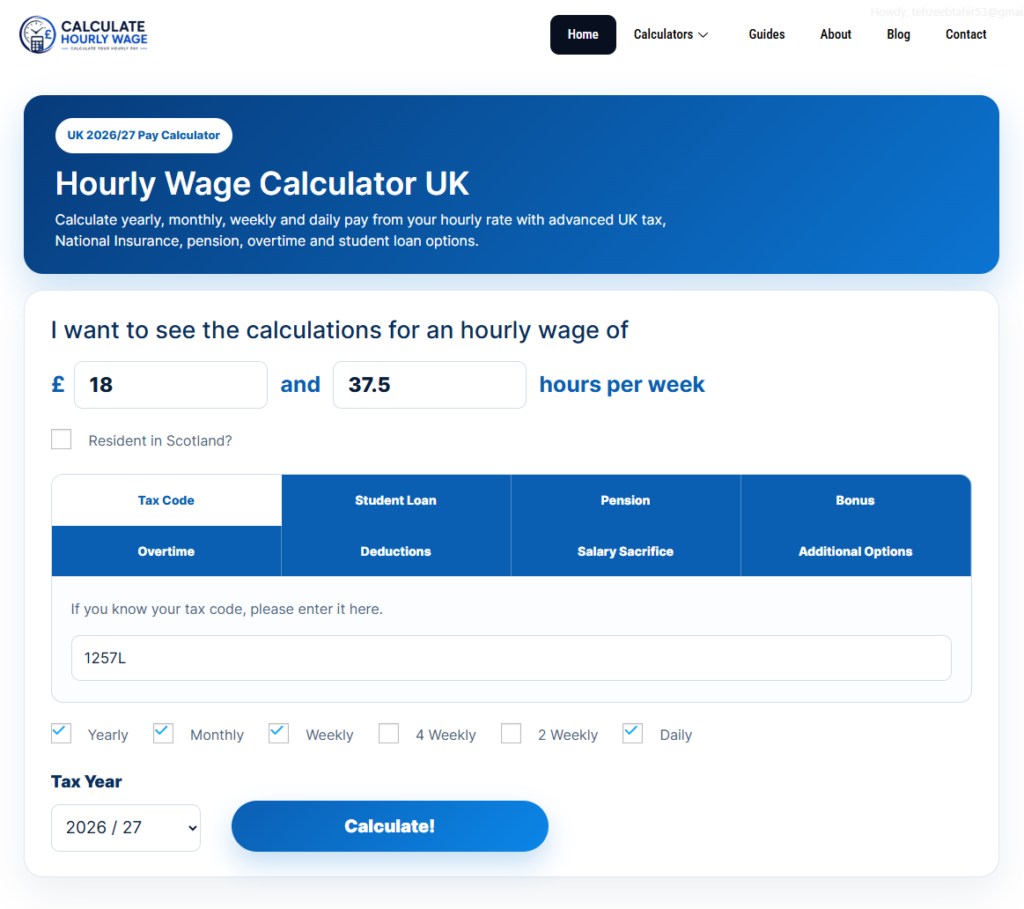
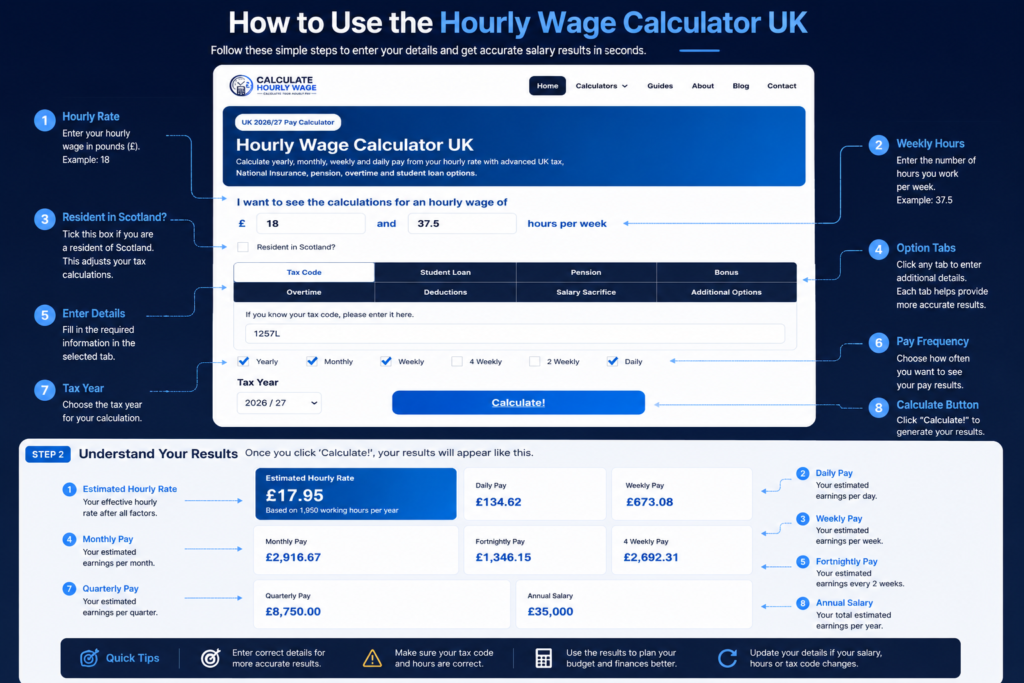
How to Use the Hourly Wage Calculator UK
What Does “Hourly to Annual Salary” Mean?
Converting hourly pay to an annual salary means taking what you earn per hour and projecting it over a full working year, resulting in a single figure that represents your total gross income.
It’s a projection, not a promise. Your actual annual salary depends on how many hours you genuinely work and how many of those weeks you’re paid for two things that vary far more than most people assume.
This figure matters for practical reasons. Mortgage lenders want an annual income figure. Rental applications ask for it. Job comparison sites list salaries, not hourly rates. Even student finance and Universal Credit calculations often work from annualised income rather than a per-hour rate. If you only think in hourly terms, you’re working with a currency almost nobody else in the financial system uses.
Read More: Salary to Hourly Calculator UKGross Annual Salary vs Take-Home Pay
It’s worth being clear about this early, because it trips a lot of people up: the annual salary figure you calculate from your hourly rate is your gross income the amount before Income Tax, National Insurance, student loan repayments, or pension contributions come off.
Nobody actually receives their gross annual salary in their bank account. What lands each month is your net, or take-home, pay and that can be considerably lower once deductions are applied, particularly once you cross into higher tax bands.
Knowing your gross figure is still essential. It’s what employers advertise, what you’ll quote when negotiating pay, and what most financial applications ask for. But if you want to know what actually hits your account, that’s a separate calculation.
Read More: Income Tax Calculator UKHow to Calculate Annual Salary from Hourly Rate (Formula)
The core formula is straightforward once you know which numbers to plug in.
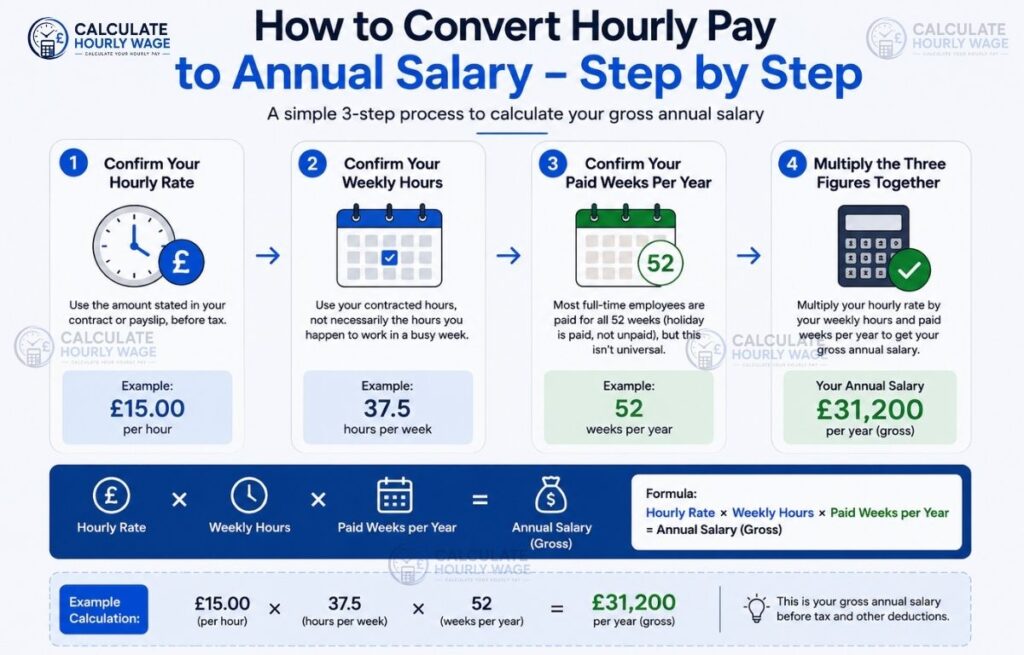
Annual Salary = Hourly Rate × Weekly Hours × Paid Weeks per Year
That’s it in its simplest form. The complexity comes from getting the second and third variables right — and that’s where most manual calculations, and even some online tools, go wrong.
Here’s how to work through it step by step:
- Confirm your hourly rate — the amount stated in your contract or payslip, before tax.
- Confirm your weekly hours — your contracted hours, not necessarily the hours you happen to work in a busy week.
- Confirm your paid weeks per year — most full-time employees are paid for all 52 weeks (holiday is paid, not unpaid), but this isn’t universal.
- Multiply the three figures together to get your gross annual salary.
| Example | Calculation |
|---|---|
| A simple example: £14 an hour, 40 hours a week, 52 paid weeks a year. | £14 × 40 × 52 = £29,120 a year |
That’s the baseline. The next two sections deal with the two variables people most often get wrong — hours per week, and paid weeks per year — because both can shift your final number by thousands of pounds.
Standard UK Working Hours (35 / 37.5 / 40-Hour Week)
There’s no single legal definition of “full-time” in the UK, which is exactly why this trips people up. Different sectors default to different weekly hours, and the difference between them genuinely changes your annual salary.
| Weekly Hours | Typical Use |
|---|---|
| 35 hours/week | Common in some office and public-sector roles |
| 37.5 hours/week | Very common across healthcare, retail management, and many corporate roles (usually reflects a working day with an unpaid lunch break) |
| 40 hours/week | The traditional “standard” full-time week, common in trades, hospitality, and manual roles |
Table 1: Annual Salary by Weekly Hours (52 Paid Weeks)
| Hourly Rate | 35 hrs/week | 37.5 hrs/week | 40 hrs/week |
|---|---|---|---|
| £11.44 | £20,821 | £22,308 | £23,795 |
| £12.71 | £23,132 | £24,784 | £26,437 |
| £15.00 | £27,300 | £29,250 | £31,200 |
| £18.00 | £32,760 | £35,100 | £37,440 |
| £22.00 | £40,040 | £42,900 | £45,760 |
| £25.00 | £45,500 | £48,750 | £52,000 |
Notice the gap. At £18 an hour, the difference between a 35-hour and a 40-hour contract is £4,680 a year simply down to hours, with no change in rate at all. Always check your actual contracted hours before assuming a “standard” week.
Visit Now: GOV.UKHow Many Weeks Count as “Paid Weeks”?
This is the variable people get wrong most often, because it’s easy to assume everyone gets paid for all 52 weeks of the year. Most full-time UK employees have statutory holiday entitlement (usually 5.6 weeks), which is paid leave, not unpaid, so it’s already baked into the 52-week figure.
But plenty of workers aren’t paid for the full year:
- Term-time-only staff (school support workers, some education roles) might only be paid for 39–42 weeks
- Contractors and freelancers often have genuine gaps between contracts that reduce their effective paid weeks
- Anyone taking extended unpaid leave — sabbaticals, unpaid parental leave, career breaks needs to subtract those weeks
Table 4: Impact of Paid Weeks on Annual Salary (at £18/hour, 37.5 hrs/week)
| Paid Weeks per Year | Scenario | Annual Salary |
|---|---|---|
| 52 weeks | Standard full-time, paid holiday | £35,100 |
| 50 weeks | 2 weeks unpaid leave | £33,750 |
| 46 weeks | Contractor with gaps between contracts | £31,050 |
| 39 weeks | Term-time-only worker | £26,325 |
At the same hourly rate, the difference between 52 paid weeks and 39 paid weeks is nearly £8,800 a year. If you’re comparing a term-time role against a standard full-time role, comparing hourly rates alone will badly mislead you.
2026/27 National Minimum Wage & Living Wage — Annual Salary Equivalents
The National Minimum Wage and National Living Wage set the legal floor for hourly pay in the UK, and both increased from 1 April 2026. Knowing these figures isn’t just useful for checking you’re being paid legally it also gives you a benchmark for what the lowest end of the pay scale actually looks like once annualised.
Table 2: 2026/27 NMW/NLW Rates and Annual Salary Equivalents
| Age Band | Hourly Rate (from April 2026) | Annual Salary (37.5 hrs, 52 wks) | Annual Salary (40 hrs, 52 wks) |
|---|---|---|---|
| 21 and over (National Living Wage) | £12.71 | £24,784 | £26,437 |
| 18–20 | £10.85 | £21,158 | £22,568 |
| 16–17 and apprentices | £8.00 | £15,600 | £16,640 |
A quick sanity check worth doing: if your hourly rate, once annualised, comes out below these figures for your age group, something’s wrong either the hours or rate quoted don’t reflect what’s actually being paid, and it’s worth raising with your employer or checking your payslip carefully.
Read More: National Insurance Calculator UKCommon Hourly Rates Converted to Annual Salary
If you just want a fast reference point without running your own numbers, here’s how common hourly rates translate to annual salary at a standard 40-hour week.
Table 3: Quick Reference — Hourly Rate to Annual Salary (40 hrs/week, 52 weeks)
| Hourly Rate | Weekly Pay | Monthly Pay (approx.) | Annual Salary |
|---|---|---|---|
| £11.00 | £440 | £1,907 | £22,880 |
| £13.00 | £520 | £2,253 | £27,040 |
| £15.00 | £600 | £2,600 | £31,200 |
| £17.00 | £680 | £2,947 | £35,360 |
| £19.00 | £760 | £3,293 | £39,520 |
| £21.00 | £840 | £3,640 | £43,680 |
| £24.00 | £960 | £4,160 | £49,920 |
| £27.00 | £1,080 | £4,680 | £56,160 |
These figures are a useful starting point, but they assume a fixed 40-hour week and 52 paid weeks, which, as covered above, isn’t true for everyone. For your exact figure based on your actual contract, the calculator does the heavy lifting.
Worked Examples: Hourly to Annual Salary calculator UK
Reference tables are useful for quick estimates, but real situations rarely match a tidy standard week. Here are eight original worked examples covering the scenarios people most commonly search for.
| Example | Calculation |
|---|---|
| Example 1 — Standard full-time on the 2026/27 National Living Wage | £12.71/hour × 40 hours × 52 weeks = £26,437.60 a year |
| Example 2 — Standard 37.5-hour office role | £15/hour × 37.5 hours × 52 weeks = £29,250 a year |
| Example 3 — Full-time worker taking 2 weeks unpaid leave | £18.50/hour × 40 hours × 50 weeks = £37,000 a year |
| Example 4 — Part-time worker on a 35-hour week | £22/hour × 35 hours × 52 weeks = £40,040 a year |
| Example 5 — 19-year-old student working part-time | £10.85/hour × 30 hours × 52 weeks = £16,926 a year |
| Example 6 — Contractor with realistic gaps between contracts | £25/hour × 40 hours × 46 weeks = £46,000 a year |
| Example 7 — Term-time-only school support worker | £16/hour × 32.5 hours × 39 weeks = £20,280 a year |
| Example 8 — Warehouse worker with regular overtime | Base: £20/hour × 40 hours × 52 weeks = £41,600Overtime: 5 hours/week × £30/hour (1.5x rate) × 52 weeks = £7,800Blended annual salary: £49,400 a year |
Notice how Example 8 shows something the basic formula misses entirely overtime paid at an enhanced rate needs to be calculated separately and added on top, not blended into your base hourly figure.
Annual Salary for Non-Standard Work Patterns
The formula assumes a tidy, consistent working pattern. Plenty of real UK jobs don’t work that way, so this section covers the patterns that need a different approach.
Part-Time and Term-Time-Only Workers
Part-time work is straightforward to annualise as long as your weekly hours are consistent just use your actual contracted hours in place of a full-time figure, as shown in Example 4 above.
Term-time-only roles need an extra adjustment. Rather than 52 paid weeks, you’re typically paid for the weeks you actually work, which for many school-based roles sits around 39 weeks (38 term weeks plus a small allowance, depending on the contract). Some employers “annualise” this pay, spreading it evenly across 12 months even though you’re not working every week. Worth checking your contract to see which method applies to you, since it affects how your monthly pay is structured even if the annual total is the same.
Zero-Hours and Variable-Hours Contracts
Zero-hours contracts don’t guarantee a set number of hours, which makes a single annual figure inherently an estimate rather than a fact. The most reliable approach is to use a 12-week rolling average, the same method used to calculate statutory holiday pay for irregular workers.
To do this:
- Add up your total hours worked over the last 12 weeks.
- Divide by 12 to get your average weekly hours.
- Multiply by your hourly rate, then by 52, to get an estimated annual salary.
This won’t be exact, but it’s the most defensible estimate you can produce, and it’s the same logic mortgage lenders and letting agents tend to apply when assessing variable income.
Overtime, Night Shifts and Enhanced Rates
Many hourly workers earn a blended rate across the week rather than a single flat figure night shifts, weekend work, and overtime are often paid at 1.25x, 1.5x, or even 2x the base rate.
The safest way to annualise this is to calculate your base pay and enhanced pay separately, then add them together, exactly as shown in Example 8. Trying to average an enhanced rate into your base hourly figure tends to either overstate or understate your real annual income, depending on how consistent the enhanced hours are week to week.
Read More: Overtime Pay Calculator UKGross vs Net: What Your Annual Salary Really Means After Tax
Once you’ve got your gross annual salary, the natural next question is: what will actually land in your account?
That depends on Income Tax, National Insurance, and, if applicable, student loan repayments and pension contributions. Here’s a rough illustration using standard UK tax rates and a typical 1257L tax code, with no student loan or pension deductions applied, to show the general pattern.
Table 5: Gross vs Approximate Net Annual Salary (Standard tax code UK)
| Gross Hourly Rate (40 hrs/wk) | Gross Annual Salary | Approx. Net Annual Salary |
|---|---|---|
| £12.71 | £26,437 | £23,010 |
| £15.00 | £31,200 | £26,533 |
| £20.00 | £41,600 | £33,395 |
| £25.00 | £52,000 | £40,151 |
These net figures are illustrative only your actual take-home pay depends on your specific tax code, whether you’re in Scotland (which uses different tax bands), any student loan plan, and pension contributions. For an exact figure based on your circumstances, use a dedicated take-home pay tool.
Read More: Income Tax Calculator UKReal-Life Scenarios: Hourly to Annual Salary in Practice
The maths only really means something once it’s applied to a real decision. Here are five scenarios that reflect the situations people actually search this topic for.
Scenario 1: Comparing a job offer against your current salary.
| Current Salary | New Job Offer | Annualised Calculation | Comparison |
|---|---|---|---|
| You’re on a £32,000 salary | Get offered a role at £16.50/hour, 37.5 hours a week | £16.50 × 37.5 × 52 = £32,175 | On paper, it’s a marginal improvement — but check whether the new role includes the same paid holiday entitlement, since a lower entitlement effectively reduces your real paid weeks and closes that gap. |
Scenario 2: A student balancing term-time and holiday hours.
| Term Time | Holiday Period | Total Annual Pay | Note |
|---|---|---|---|
| 15 hours/week × 30 weeks × £11.44/hour = £5,148 | 30 hours/week × 22 weeks × £11.44/hour = £7,550 | £5,148 + £7,550 = £12,698 a year | Blended patterns like this need to be calculated in two parts rather than averaged. |
Scenario 3: Estimating income for a mortgage application on a zero-hours contract.
| Method | Calculation | Estimated Annual Pay | Note |
|---|---|---|---|
| Using the 12-week rolling average method above | £14 × 28 × 52 | £20,384 a year | Most lenders will want to see this pattern held consistently over several months, sometimes years, before relying on it. |
Scenario 4: A care worker with night shift enhancements.
| Base Pay | Night Enhancement | Total Annual Pay |
|---|---|---|
| £13/hour × 32 hours × 52 weeks = £21,632 | 8 hours/week at an extra £2/hour × 52 weeks = £832 | £22,464 a year |
Scenario 5: A freelance web developer annualising a day rate
| Scenario | Realistic Annual Income | Naive Annual Income | Comparison |
|---|---|---|---|
| A £250 day rate, working 4 days a week, but realistically only billing 42 weeks a year after accounting for gaps and admin time | £250 × 4 × 42 = £42,000 a year | £250 × 4 × 52 = £52,000 | The realistic figure is noticeably lower because the naive calculation ignores unbillable time. |
Read More: Salary to Hourly Calculator UKCommon Mistakes When Converting Hourly Pay to Annual Salary
- Assuming 52 paid weeks when your role is term-time-only or has genuine unpaid gaps
- Using a default 40-hour week when your actual contract states 37.5 hours
- Treating your gross annual salary as if it’s your take-home pay
- Ignoring how rolled-up holiday pay changes the calculation compared with separately paid holiday
- Forgetting that overtime and enhanced rates need calculating separately, not blended in
- Applying the wrong National Minimum Wage band for your age
- Assuming Scottish tax bands are identical to the rest of the UK when estimating net pay
- Using this year’s figures without checking whether NMW/NLW rates have changed since April
- Mixing up contracted hours with the hours you actually tend to work
- Using an annualised income figure for a mortgage application without checking how your specific lender wants variable income presented
- Forgetting unpaid breaks reduce your genuinely paid hours per day
- Not accounting for unbillable weeks when a contractor or freelancer annualises a day rate
Expert Tips for Using Your Annual Salary Figure
- Always confirm your exact contracted weekly hours in writing before annualising don’t assume a “standard” week applies.
- Cross-check your hourly rate against the current NMW/NLW band for your age; underpayment is more common than people expect.
- If your hours vary, use a 12-week rolling average rather than a single “good week” or “bad week.”
- When comparing a salaried offer against an hourly one, convert both to gross annual figures before deciding never compare a salary directly against a raw hourly rate.
- Check whether holiday pay is included in your hourly rate or paid on top before annualising.
- For mortgage applications, ask your lender directly how they want variable hourly income presented methods differ between lenders.
- Recalculate every April, when National Minimum Wage and National Living Wage rates typically change.
- Separate “contracted hours” from “hours actually worked” unpaid overtime quietly lowers your real effective hourly rate.
- If your annualised income is close to £10,000, check whether you’re near the pension auto-enrolment threshold, as this can affect take-home pay through contributions.
- If you’re a contractor, always deduct a realistic number of non-billable weeks before quoting an annual equivalent to a client or lender overstating it can cause problems later.
How do I calculate annual salary from hourly rate in the UK?
Multiply your hourly rate by your weekly hours, then by the number of paid weeks you work per year. For a standard 40-hour week over 52 paid weeks, that’s Hourly Rate × 40 × 52.
What is £12.71 an hour annually (2026/27 National Living Wage)?
At 40 hours a week over 52 weeks, £12.71/hour works out at £26,437.60 a year gross.
How many hours is full-time in the UK for salary calculations?
There’s no single legal definition, but 35, 37.5, and 40 hours a week are the most common full-time patterns, varying by sector and employer.
Is annual salary calculated before or after tax?
Before tax. The annual salary figure from an hourly-to-annual calculation is your gross income, before Income Tax, National Insurance, and other deductions.
Does annual salary include holiday pay?
For most full-time employees, yes — statutory holiday is paid leave, so it’s already included when you use 52 paid weeks in the calculation.
What’s the difference between a 37.5- and 40-hour week for salary calculation?
At the same hourly rate, a 40-hour week produces a higher annual salary than a 37.5-hour week, since you’re being paid for 2.5 more hours each week.
How do I convert hourly pay to annual salary if I work part-time?
Use your actual contracted part-time hours in place of a full-time figure — the formula itself doesn’t change.
What is the National Minimum Wage in 2026/27 by age?
From April 2026: £12.71/hour for age 21 and over, £10.85/hour for ages 18–20, and £8.00/hour for ages 16–17 and most apprentices.
How do zero-hours contracts affect annual salary calculation?
Since hours vary, it’s best to use a 12-week rolling average of hours worked, then annualise that average, rather than assuming a fixed weekly figure.
How many weeks a year should I use if I take unpaid leave?
Subtract the number of unpaid weeks from 52. Two weeks of unpaid leave, for example, means using 50 paid weeks in the calculation.
What’s a good hourly rate in the UK in 2026?
There’s no single “good” rate, since it depends heavily on sector, location, and experience. A useful way to judge an offer is to compare it against the 2026/27 National Living Wage floor of £12.71/hour, then check typical pay for your specific role and region using sector-specific salary data — a rate several pounds above the NLW doesn’t automatically mean it’s competitive once local cost of living and industry norms are factored in.
How do I calculate annual salary with irregular hours?
Average your actual hours over a recent period (commonly 12 weeks), then apply the standard formula using that average.
Does overtime count toward annual salary calculation?
It can, but it should be calculated separately at its enhanced rate and added to your base annual salary, rather than blended into your standard hourly rate.
How do term-time-only workers calculate annual salary?
Use your actual paid weeks (often around 39, depending on the contract) rather than 52, since you’re not paid across the full year.
What’s the difference between gross and net annual salary?
Gross is your income before deductions; net is what you actually receive after Income Tax, National Insurance, and any student loan or pension contributions.
How do I use annual salary for a mortgage application if I’m paid hourly?
Most lenders want an averaged or annualised figure based on recent payslips, often over several months — check directly with your lender for their specific requirements.
How is annual salary calculated in Scotland vs the rest of the UK?
The gross annual salary calculation from hourly pay is identical across the UK — the difference only appears once Income Tax is applied, since Scotland uses different tax bands and rates.
What hourly rate equals £30,000 a year in the UK?
At a 40-hour week over 52 weeks, roughly £14.42/hour. At 37.5 hours, roughly £15.38/hour.
How often does the UK minimum wage change?
Typically once a year, on 1 April, following recommendations from the Low Pay Commission.
Can my employer pay me below minimum wage if I agree to it?
No. National Minimum Wage and National Living Wage rates are a legal minimum and cannot be waived by agreement, regardless of what’s stated in a contract.
Conclusion
Converting an hourly rate into an annual salary looks simple on the surface, but as this guide shows, the honest answer almost always depends on your specific hours, paid weeks, and contract type. The Hourly to Annual Salary Calculator UK above makes it easy to calculate your estimated annual earnings based on your real working pattern instead of relying on rough estimates.
Whether you’re comparing job offers, checking part-time income, or planning your finances, use the calculator whenever your hourly rate, working hours, paid weeks, or the annual National Minimum Wage (NMW) and National Living Wage (NLW) rates change to keep your calculations accurate.