If you want to claim tax back after leaving job P50 is the form HMRC wants you to use. If you stopped working part-way through the tax year, have been out of work for at least four weeks, are not claiming taxable state benefits, and do not expect to work again before 5 April, you can claim a refund of the Income Tax you overpaid — now, in the same tax year. The claim is free, and the quickest way to do it is online through your Personal Tax Account.
The Short Answer: Why Leaving Mid-Year Usually Means You Overpaid Tax
The tax year runs from 6 April to 5 April. Your Personal Allowance for 2026/27 is £12,570. Under PAYE, your employer does not give you the whole allowance at once — it is sliced into twelve equal pieces of £1,047.50, one for each monthly payslip. Each month, your employer adds up everything you have earned since 6 April, subtracts the allowance built up so far, and taxes the rest at 20% on the first £37,700 of taxable income, 40% above that, and 45% above £125,140.
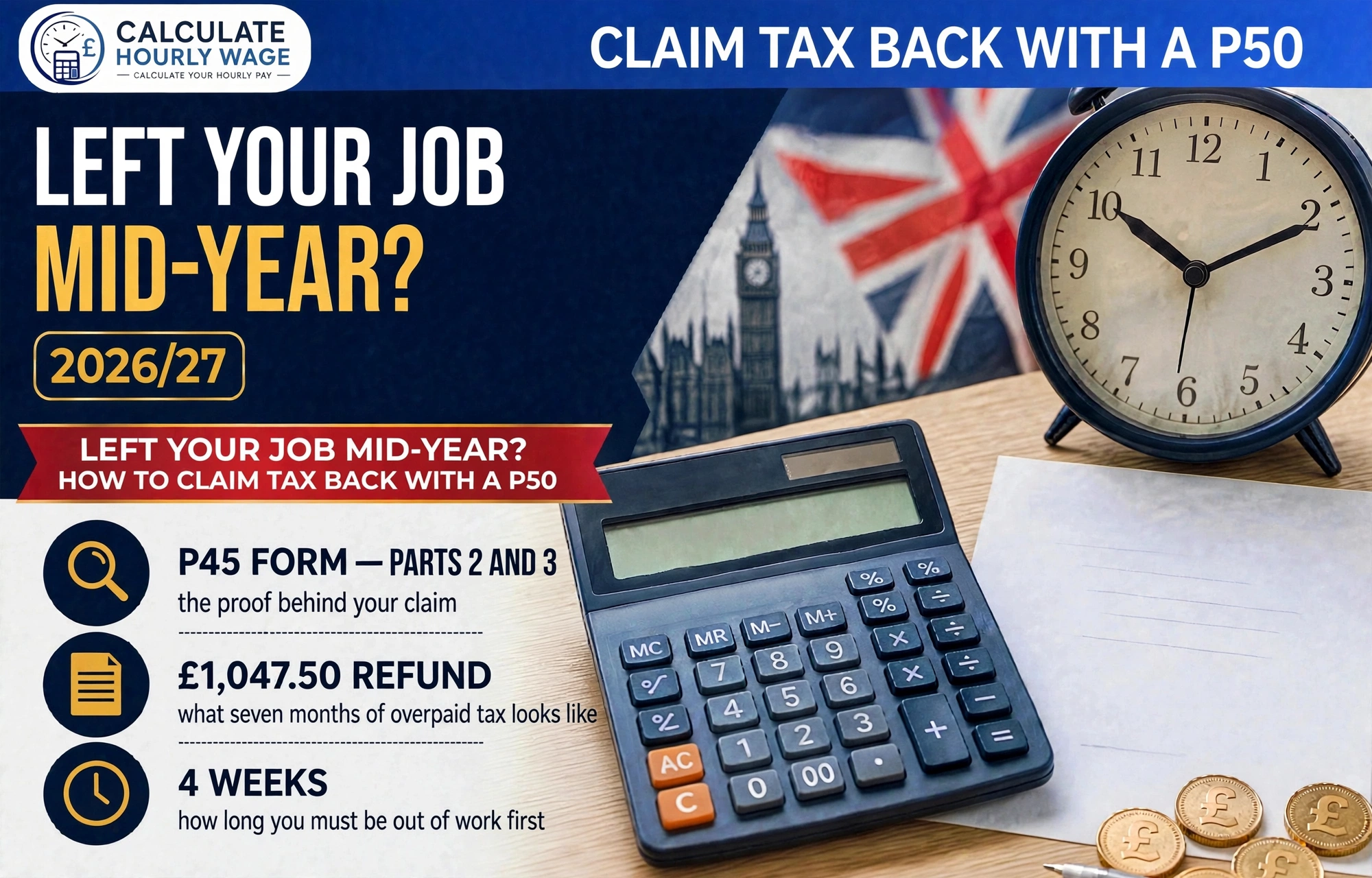
That system works perfectly if you work the full year. It breaks the moment you stop. Say you earn £2,500 a month and leave at the end of October. By then you have earned £17,500 and paid £2,033.50 in tax, because PAYE only gave you seven twelfths of your allowance — £7,332.50 — leaving £10,167.50 taxable at 20%. But if you earn nothing else before 5 April, the tax you actually owe is only £986. The difference, £1,047.50, is yours — but HMRC will not send it on its own. You have to ask, and the P50 is how you ask.
What Form P50 Is — and When It Is the Right Form
Form P50 is HMRC’s in-year repayment claim for people who have stopped working. Its full GOV.UK title is “Claim back Income Tax when you’ve stopped working (P50)”. It is not a tax return and it is not a benefits claim. It is a short form that tells HMRC: I have stopped working, here is what I earned and what tax I paid, please work out what I am owed and pay it back now.
GOV.UK says you may be able to claim on a P50 if you have recently stopped working — for example, if you have been unemployed for four weeks or more and are not claiming taxable state benefits, if you do not expect to go back to work, or if you have returned to full-time study. Redundancy, a career break, retirement without a pension from your old employer, and finishing work to go back to college all fit the same pattern.
The form asks for the facts HMRC needs to recalculate your year: your National Insurance number, your employer’s details, the dates you worked, the pay and tax figures from your P45, and any other income since 6 April. It also asks you to confirm you have had your final pay, because GOV.UK is clear that you cannot apply for the refund until your final pay has cleared.

Who Can Claim Tax Back After Leaving a Job with a P50
The four-week rule is the one that catches most people out. GOV.UK says you can claim once you have been unemployed for four weeks or more and are not claiming taxable state benefits. Four weeks means four full weeks since your last day of work. If your last working day was Friday 31 October, the earliest you can claim is the end of November.
The second condition is just as important: you must not be claiming taxable state benefits. Jobseeker’s Allowance and contribution-based Employment and Support Allowance are taxable, and while you are claiming them, any tax repayment for that year is handled through Jobcentre Plus, not through a P50.
The third condition is about what happens next. You should not expect to go back to work before the end of the tax year — at the time you claim, you have no job lined up and no expectation of taxable income before 5 April. If a job offer arrives after you have claimed, that is fine: HMRC rechecks everything at the end of the tax year. But if you already know you are starting a new job within four weeks, do not use a P50 at all — your new employer will repay you through your salary once you hand over parts 2 and 3 of your P45.
| Your situation | Can you use a P50? |
|---|---|
| Out of work 4+ weeks, no taxable benefits, no new job lined up | Yes — claim online |
| Starting a new job within 4 weeks | No — give your P45 to the new employer |
| Still registered with an employment agency | No — ask the agency to send HMRC your details |
| Claiming Jobseeker’s Allowance or contribution-based ESA | No — Jobcentre Plus handles the refund |
| Took a pension lump sum | No — use form P55 |
| Left the UK | No — use form P85 |
Worked Examples: How Much Tax Could You Get Back?
The size of the refund depends on how much you earned, when you stopped, and what tax code was used. The examples below use the 2026/27 rates — Personal Allowance £12,570, basic rate 20% on taxable income up to £37,700 — and assume a standard 1257L code and no other income. To estimate your own refund, use our income tax refund calculator, then file the P50 to claim it.
Example 1: £30,000 salary, leaves at the end of October. Emma earns £2,500 a month. She is made redundant at the end of October, seven months into the tax year, having earned £17,500 and paid £2,033.50 in tax. Her real bill, if she earns nothing else before 5 April, is £986. Her refund is £2,033.50 minus £986: £1,047.50.
Example 2: £45,000 salary, leaves at the end of September. Daniel earns £3,750 a month. He resigns at the end of September to go back to full-time study, six months in, having earned £22,500 and paid £3,243 in tax. His real bill is £1,986. His refund is £3,243 minus £1,986: £1,257.
Example 3: £60,000 salary, leaves at the end of June. Priya earns £5,000 a month. She leaves at the end of June, three months in, to take a career break, having earned £15,000 and paid £2,371.50 in tax. Her real bill is £486. Her refund is £2,371.50 minus £486: £1,885.50.
| Example | Salary | Left | Earned | Tax paid | Tax actually owed | Refund |
|---|---|---|---|---|---|---|
| Emma | £30,000 | End of October | £17,500 | £2,033.50 | £986 | £1,047.50 |
| Daniel | £45,000 | End of September | £22,500 | £3,243 | £1,986 | £1,257 |
| Priya | £60,000 | End of June | £15,000 | £2,371.50 | £486 | £1,885.50 |
There is one situation where the refund is bigger still: the wrong tax code. If you started your job without a P45 and spent months on an emergency tax code, only one month’s allowance was applied on each payslip. The same applies if a second job was taxed at the BR rate of 20% on every pound. A P50 claim picks up all of that overpayment in one go.
What You Need Before You Claim
Gather these before you start, and the online claim takes a few minutes. First, parts 2 and 3 of your P45. Your employer should have given you the P45 when you left. Part 1 went to HMRC. Parts 2 and 3 are yours, and they show your total pay and total tax for the tax year so far. If you do not have them, GOV.UK says to tell HMRC why — a lost P45 is not a dead end, but you will need the figures from your final payslip instead. If you are still waiting for your final pay, wait: you cannot apply until it has cleared.
You will also need your National Insurance number, your employer’s name and PAYE reference (both are on your P45 or your final payslip), the dates you started and left the job, and a note of any other income since 6 April — pensions, the State Pension, taxable benefits, and any self-employment profit. HMRC needs the full picture because the refund is worked out on your whole year’s income. Leaving something out gets you a letter asking for the missing figure, and a delay.
How to Claim Tax Back After Leaving Job P50: Step by Step
Step 1: Wait four weeks. Count four full weeks from your last day of work. While you wait, check that your final pay has arrived and find parts 2 and 3 of your P45.
Step 2: Sign in to your Personal Tax Account. Go to GOV.UK and sign in with your Government Gateway user ID and password. If you do not have one, you can create one as part of the process — you will need your National Insurance number and a form of ID.
Step 3: Find the P50 claim. In your Personal Tax Account, follow the route for claiming a tax refund after stopping work. The service will ask whether you have stopped working, how long you have been unemployed, and whether you are claiming taxable benefits.
Step 4: Enter your figures. Fill in your employer’s details, your leaving date, and the pay and tax figures from your P45. Then add any other income since 6 April. Check the numbers against your P45 and final payslip before you submit, because a wrong figure is the most common reason a claim comes back with questions.
Step 5: Submit and wait. GOV.UK says it may take 14 days to get a reply, and you should not contact HMRC during that period. The reply will confirm the amount HMRC has calculated, or ask for more information.
Step 6: Receive the repayment. Once HMRC agrees the figure, the repayment is made by payable order to you or your nominee. HMRC checks again at the end of the tax year to make sure the right amount was refunded.
If you cannot claim online, the postal route is the same form filled in by hand. Download the P50 from GOV.UK, fill it in, sign the declaration, attach parts 2 and 3 of your P45, and post it to the address printed at the end of the form. Keep a copy of everything you send.

How Long Does a P50 Refund Take?
The reply takes up to 14 days, and the money follows after that. GOV.UK says it may take 14 days to get a reply and asks you not to contact HMRC during that period. That 14 days is for HMRC to check the claim against the figures your employer sent through Real Time Information. If something does not match, the reply may ask for more information instead, and the clock restarts on that.
The payment itself is by payable order, which takes a few more days to arrive and to clear once you pay it into your bank. Altogether, most straightforward claims are resolved within three to five weeks. That is still far faster than waiting for the P800, which does not start until after the tax year ends in April.
If 14 days pass with no reply at all, that is the point to chase it. Before then, chasing does not help — the claim is in a queue. The one exception is if you realise you made a mistake on the form: contact HMRC as soon as you can. A delay is also likely if you claim too early — before the four weeks are up, or before your final pay has cleared.
When You Should NOT Use a P50
You are starting a new job within four weeks. Do not claim. Hand parts 2 and 3 of your P45 to your new employer on your first day, and the cumulative PAYE system will repay any overpayment through your first payslips — usually faster than a P50. If your new employer does not ask for the P45, offer it: without it, they may put you on an emergency code.
You are claiming Jobseeker’s Allowance or contribution-based ESA. Your refund is handled through Jobcentre Plus. Do not submit a P50 as well — a duplicate claim will only confuse the calculation. If you stop claiming the benefit and remain out of work, the P50 route opens up again once the four-week condition is met.
You are still registered with an employment agency. GOV.UK is clear that you cannot claim on a P50 while you are still registered. Contact the agency and ask it to send HMRC your final pay and tax details. Once the agency has done that, HMRC can process the repayment without a P50 at all.
You took a pension lump sum. If you flexibly accessed your pension and want the tax back, use form P55. If you took all of your pension as a lump sum and stopped work, use form P50Z. The P50 is for employment income, not pension income, and a pension claim on the wrong form will be sent back.
You left the UK. Use form P85, with parts 2 and 3 of your P45. The P85 covers the same idea — tax paid on part of a year’s earnings — but for people who have left the country, and HMRC treats it as a different claim.
You are self-employed as well. If you earned self-employment profit in the same tax year, it goes on the P50 and reduces or wipes out the refund. In some cases you will need a Self Assessment tax return instead. Check your taxable income position first — self-employment profit, rental income and savings interest all count, and all of them reduce the refund.
P50 or P800: Should You Claim Now or Wait?
If you have stopped work and qualify for a P50, you have a genuine choice: claim now on a P50, or wait for the P800. The P800 is HMRC’s automatic reconciliation. After the tax year ends on 5 April, HMRC compares the tax you paid against the tax you owed, and if you overpaid, it sends you a P800 calculation — usually in the summer.
The case for claiming now is simple: time. A P50 filed in November can put the money in your hands before Christmas. Waiting for the P800 means waiting until the summer, sometimes eight or nine months after you stopped work. The P50 claim is free, and HMRC rechecks the figures at the end of the year anyway.
The case for waiting is narrower. If you might start work again before April, the P50 is the wrong tool — claim nothing, let the new employer’s payroll fix it, or let the P800 sort it out after the year ends. If your affairs are complicated, the automatic reconciliation may handle the full picture more cleanly. And if you have already received a P800 for the year, do not submit a P50 for the same year — follow the P800 instead, as explained in our article What Is a P800 and How Do You Claim Your Refund?
What About National Insurance and Redundancy Pay?
National Insurance is not refunded on a P50. Class 1 National Insurance is worked out on each pay period separately, not across the whole year. Your employer takes 8% of your earnings above the Primary Threshold in each week or month, and 2% above the Upper Earnings Limit. Because it is calculated per period, there is no annual allowance to use up, and stopping mid-year does not create an overpayment. Our National Insurance calculator breaks it down by pay period.
Redundancy pay is mostly tax-free — but not all of it. The first £30,000 of a genuine redundancy payment is free of Income Tax and National Insurance. That covers statutory redundancy pay, any enhanced payment your employer adds, and non-cash benefits you keep — but it is one combined £30,000, not £30,000 per item. Anything above £30,000 is taxed as income at your marginal rate. What does not get the £30,000 treatment: pay in lieu of notice, holiday pay you had not taken, wages owed, and bonuses — all taxed as normal pay.
Can You Claim Tax Back for an Earlier Tax Year?
There is also a longer window worth knowing about. If the overpayment relates to an earlier tax year — because you only just discovered a wrong tax code from two years ago — you can claim for the current tax year and the previous four tax years. For the 2026/27 tax year, that means claims can go back to 2022/23. Older years are closed, however large the overpayment.
Common Mistakes That Delay a P50 Claim
Most P50 delays come from the same small handful of errors. Claiming before the four weeks are up: the four-week rule is not a suggestion, and a cancelled and reprocessed claim can trigger a 28-day block. Claiming before final pay clears: if a payment after leaving is still to come, the figures on your P45 are not final yet. Losing parts 2 and 3 of your P45: you can still claim without them, but you have to explain why. Photograph your P45 and final payslip the day you leave. Forgetting other income: a small pension, a few weeks of taxable benefit, a bit of self-employment profit — any of it changes the calculation. Using the wrong form: P50 for stopping work, P55 for a pension lump sum, P50Z for flexibly accessing all of a pension, P85 for leaving the UK. Paying a refund company: the claim is free through HMRC. Not updating your address: the repayment comes by payable order through the post.
The Bottom Line
Leaving a job mid-year almost always means you paid too much tax, because PAYE taxed you as if you would work the full year and only gave you part of your tax-free allowance. The P50 is HMRC’s way of giving that money back now, in the same tax year, instead of making you wait for the summer P800. If you have been out of work for four weeks or more, are not claiming taxable state benefits, and do not expect to work again before 5 April, claim online through your Personal Tax Account with parts 2 and 3 of your P45 in hand. Expect a reply within 14 days and a payable order after that. If you are starting a new job within four weeks, skip the form and give your P45 to the new employer. And if you are not sure how much you are owed, work out your figure first with our income tax refund calculator — then claim it, free, on a P50.
Frequently Asked Questions
How do I claim tax back after leaving a job with a P50?
Sign in to your Personal Tax Account on GOV.UK once you have been unemployed for four weeks or more and have received your final pay. Complete the P50 claim with your P45 figures — your employer, leaving date, total pay and total tax — plus any other income since 6 April. If you cannot claim online, fill in the P50 form on GOV.UK, print it, sign it and post it to HMRC with parts 2 and 3 of your P45.
How long do I have to be unemployed before I can claim on a P50?
Four full weeks from your last day of work. GOV.UK says you can claim once you have been unemployed for four weeks or more and are not claiming taxable state benefits. Claiming earlier will not speed anything up and can delay the repayment.
How long does a P50 tax refund take?
GOV.UK says it may take 14 days to get a reply, and you should not contact HMRC during that period. Once the refund is agreed, it is paid by payable order (a cheque), which takes a few more days to arrive and clear. Most straightforward claims are resolved within three to five weeks of submission.
Can I claim a P50 refund if I am on Jobseeker’s Allowance?
No. Jobseeker’s Allowance and contribution-based Employment and Support Allowance are taxable benefits, and while you claim them, any tax repayment for that year is handled through Jobcentre Plus, not on a P50. If you stop claiming the benefit and remain out of work, the P50 route opens up again.
Do I get National Insurance back when I leave a job mid-year?
Usually not. Class 1 National Insurance is worked out on each pay period separately, not across the whole tax year, so there is no annual allowance to use up and stopping mid-year does not normally create an overpayment. The P50 refunds Income Tax only.
What is the difference between a P50 and a P800?
A P50 is a claim you make yourself, in the same tax year, after stopping work — it gets the refund to you within weeks. A P800 is HMRC’s automatic reconciliation after the tax year ends, sent in the summer, which you do not need to apply for. If you qualify for a P50, claiming now is faster; if you wait, the P800 will catch the same overpayment later.
Sources
- GOV.UK — Claim back Income Tax when you’ve stopped working (P50)
- GOV.UK — Check how to claim a tax refund
- GOV.UK — Income Tax rates and Personal Allowances
- GOV.UK — Understanding your tax code
- GOV.UK — Tax on redundancy payments
- GOV.UK — Redundancy: your rights