Taxable Income Calculator UK
Your taxable income is the part of your income that Income Tax is actually charged on, after your Personal Allowance and any eligible deductions (pension contributions, salary sacrifice, Gift Aid) have been applied. It's not the same as your gross salary, and it's not the same as your take-home pay.
Your Estimated Tax
Income Calculation Flow
Tax Band Breakdown
| Tax Band | Rate | Income in Band | Tax |
|---|---|---|---|
| Total estimated Income Tax | £0.00 | ||
Assumptions
What the Calculator Shows You
Rather than a single number, the calculator breaks the calculation into steps so you can see how your income moves through it:
| Metric | Description |
|---|---|
| Gross Income | Everything you entered (employment income + additional taxable income), before any adjustments. |
| Adjusted Income | Your gross income after the deductions you entered (pension contributions, salary sacrifice) are applied. This is the figure your Personal Allowance is then set against — sometimes referred to as your adjusted taxable income. |
| Personal Allowance | The portion of income the standard allowance covers, where it applies in full. |
| Taxable Income | What's left once the Personal Allowance is deducted from your Adjusted Income. This is the amount Income Tax is calculated on. |
| Income Tax | The estimated tax due on your Taxable Income. |
| Total Deductions | The pension, salary sacrifice, Gift Aid and other deductions you entered, added together. |
Gross income and taxable income are rarely the same figure. Someone with £38,000 in employment income, for example, has a lower taxable income once their Personal Allowance is applied. Neither figure is your take-home pay — take-home pay is what you're left with after Income Tax, National Insurance and any other payroll deductions.
How to Use the Taxable Income Calculator
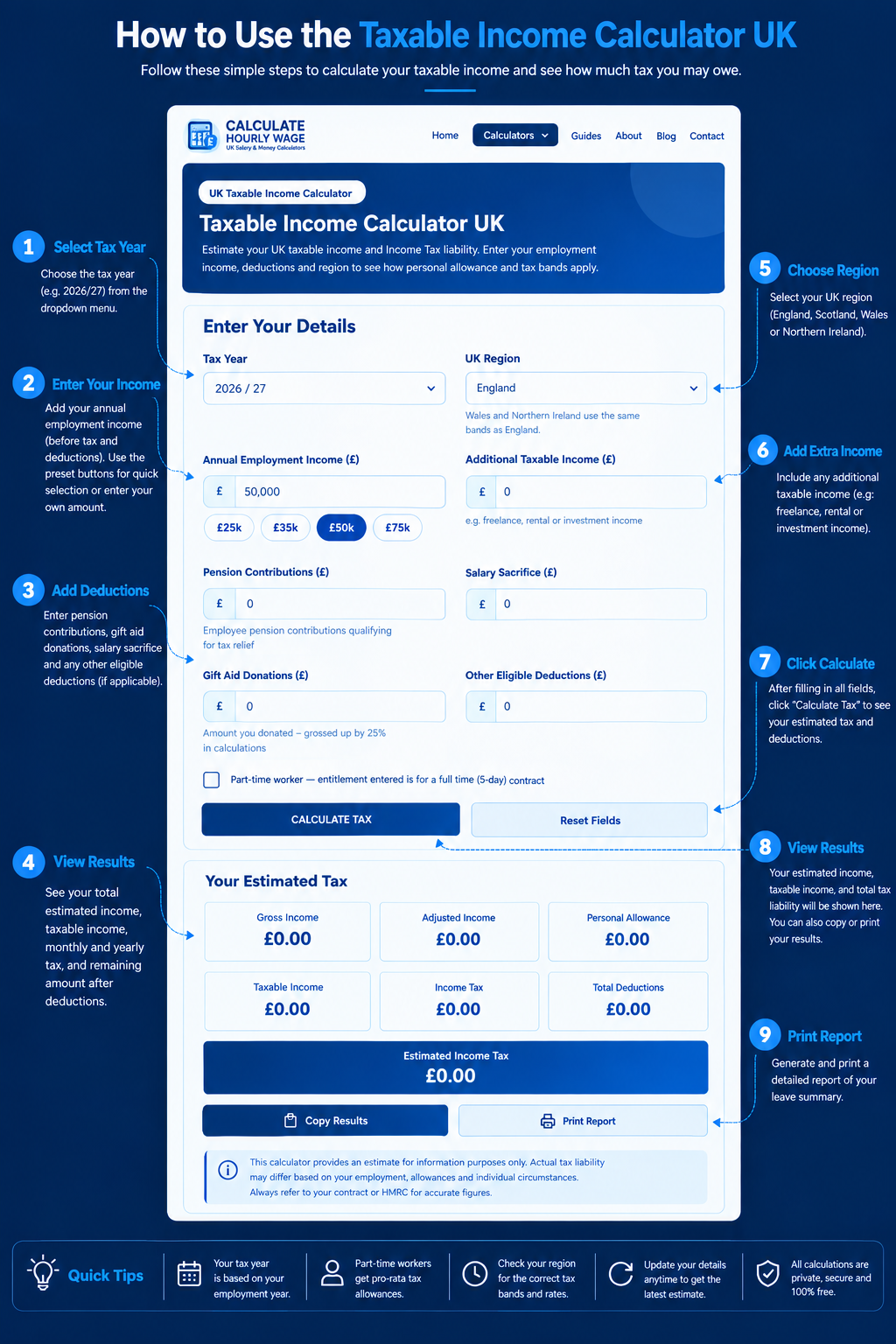
- Select your Tax Year and UK Region: Wales and Northern Ireland use the same bands as England; Scotland has its own Income Tax bands, so choosing the right region matters.
- Enter your Annual Employment Income: Use your gross annual salary, not your monthly take-home figure. If you only know a monthly amount — say £7,000 a month — multiply by 12 (£84,000/year) before entering it.
- Enter Additional Taxable Income: Add freelance, rental or investment income on top of your job if applicable. Leave at £0 if not applicable.
- Add any eligible deductions: Pension Contributions (qualifying employee contributions), Salary Sacrifice, Gift Aid Donations (grossed up by 25% in the calculation, since the donation has already had basic-rate tax reclaimed by the charity), and Other Eligible Deductions.
- Calculate your results: Select Calculate Tax to see your results, then use Copy Results or Print Report to save them.
How Taxable Income Is Calculated
Personal Allowance
The standard Personal Allowance for 2026/27 is £12,570 — the amount you can normally receive before Income Tax applies. It isn't guaranteed in full for everyone; it can be reduced at higher income levels.
Example: adjusted income of £38,000 with the full £12,570 allowance gives:
How Tax Bands Apply
Once your taxable income is worked out, UK Income Tax charges different rates on different portions of it — you don't pay your top rate on your entire income. England, Wales and Northern Ireland use one set of bands; Scotland uses its own. For the current band thresholds and rates, see our full breakdown: UK Tax Brackets 2026/27.
2026/27 UK Income Tax Bands at a Glance
For quick reference, here are the 2026/27 bands that decide how much of your taxable income is charged at each rate. Your Personal Allowance (£12,570) comes off first; the bands apply to what's left.
| Band | Taxable income | Tax rate |
|---|---|---|
| Personal Allowance | Up to £12,570 | 0% |
| Basic rate | £12,571 – £50,270 | 20% |
| Higher rate | £50,271 – £125,140 | 40% |
| Additional rate | Over £125,140 | 45% |
Remember the taper: the £12,570 Personal Allowance shrinks by £1 for every £2 you earn above £100,000, disappearing entirely at £125,140 — which is why the higher-rate band effectively starts earlier for very high earners. Source: GOV.UK — Income Tax rates and Personal Allowances. For the full breakdown with examples, see our 2026/27 UK tax brackets guide.
What Counts as Taxable Income
- Employment income, bonuses and overtime: your salary plus any additional employment earnings. Use a realistic annual figure rather than just your base salary if you expect bonuses or overtime.
- Self-employment and freelance income: enter this under Additional Taxable Income. Self-employed tax involves rules this calculator doesn't cover in full (allowable expenses, Self Assessment)
- Rental income, savings and dividends: also entered as additional taxable income, though these can be taxed differently from employment income.
- Tax-free income: not everything you receive counts. Some income is exempt or covered by separate reliefs, which is one reason this calculator is an estimate rather than a full assessment.
Allowances & Deductions That Reduce Taxable Income
| Allowance / Relief | Effect |
|---|---|
| Personal Allowance | Reduces the income Income Tax is charged on |
| Pension contributions | Qualifying employee contributions can reduce taxable income |
| Salary sacrifice | Entered separately — works differently to a pension contribution, depending on your workplace arrangement |
| Gift Aid | Donation is grossed up by 25%, which can extend the amount taxed at the lower rate |
| Marriage Allowance | Lets an eligible spouse/civil partner transfer part of an unused Personal Allowance |
| Blind Person's Allowance | An additional allowance for those who are eligible |
Marriage Allowance and Blind Person's Allowance aren't applied automatically — check eligibility before assuming either applies to you.
Worked Examples
| Scenario | Calculation & Breakdown |
|---|---|
| Standard employee £38,000 salary, no extra income or deductions |
Adjusted income £38,000, Personal Allowance £12,570 → taxable income £25,430. |
| Higher earner £110,000 salary |
Above £100,000, the standard Personal Allowance isn't guaranteed in full — this is where the calculator's Adjusted Income and Personal Allowance figures matter most, since taxable income here can't be found by simply subtracting one fixed allowance. |
| Multiple income sources £30,000 salary + £8,000 freelance income |
Gross income = £30,000 + £8,000 = £38,000, before Personal Allowance is applied. Keep records for each income source when entering figures like this. |
Getting an Accurate Estimate
Common mistakes to avoid:
- Entering net (take-home) pay instead of gross employment income
- Leaving Additional Taxable Income at £0 when you have freelance, rental or investment income
- Using the wrong tax year, or the wrong UK region (Scotland's bands differ)
- Forgetting to enter pension contributions, salary sacrifice, Gift Aid or other eligible deductions
- Assuming your whole income is taxed at one rate — UK Income Tax is progressive
To sharpen the estimate:
- Check a recent payslip or P60 for your actual annual employment income
- Recalculate after a job change, pay rise or new income source
- Cross-check important decisions against GOV.UK or HMRC directly
Limitations
This calculator gives an estimate for informational purposes and doesn't account for every relief, allowance or special case. Your actual tax liability may differ — particularly if you have multiple income sources, unusual deductions or a more complex tax position. It also doesn't calculate National Insurance or student loan repayments, both of which are separate from Income Tax and affect your take-home pay rather than your taxable income.
For more details on overall take-home earnings or payroll deductions, visit our National Insurance Calculator UK and Take-Home Pay Calculator UK.
For anything beyond a general estimate, check GOV.UK guidance or speak to a qualified tax adviser.
Common Salary Conversions
| Gross Annual Salary | Personal Allowance | Taxable Income |
|---|---|---|
| £20,000 | £12,570 | £7,430 |
| £25,000 | £12,570 | £12,430 |
| £30,000 | £12,570 | £17,430 |
| £35,000 | £12,570 | £22,430 |
| £40,000 | £12,570 | £27,430 |
| £50,000 | £12,570 | £37,430 |
| £60,000 | £12,570 | £47,430 |
| £80,000 | £12,570 | £67,430 |
| £100,000 | £12,570 | £87,430 |
| £120,000 | £2,570 (tapered) | £117,430 |
Source for Personal Allowance and taper thresholds: GOV.UK — Income Tax rates and Personal Allowances (gov.uk/income-tax-rates).
Frequently Asked Questions
Find answers to the most common questions about taxable income, adjusted income, Personal Allowance, tax deductions, and UK tax rules.
Take your gross income (employment plus any additional taxable income), apply eligible deductions like pension contributions or salary sacrifice to get your adjusted income, then subtract your Personal Allowance. What's left is your taxable income.
It depends on your income and which allowances and deductions apply to you — there's no single figure that applies to everyone. Enter your actual numbers into the calculator above for a personalised estimate.
In this calculator, it's your gross income after deductions such as pension contributions and salary sacrifice have been applied — the figure your Personal Allowance is then set against.
£7,000 a month is £84,000 a year in gross terms. That figure tells you your taxable income position, but not your take-home pay — for that you'd need to also account for National Insurance and any pension or student loan deductions. Use our Take-Home Pay Calculator UK for full net pay details.
No — National Insurance is a separate calculation from Income Tax and isn't included in the taxable income figures shown here. Check out our National Insurance Calculator UK for more information.
Qualifying employee pension contributions can affect the calculation — enter them in the Pension Contributions field. The exact tax treatment depends on how your contribution is made.
It's included as Additional Taxable Income here, but self-employed tax can involve rules — allowable expenses, Self Assessment — that go beyond a straightforward employment calculation. Use our Self-Employment Tax Calculator UK for a dedicated breakdown.
Scotland has its own Income Tax bands and rates, separate from England, Wales and Northern Ireland. Select Scotland as your region for an accurate estimate.
It's a reliable estimate when you enter accurate income, deductions, tax year and region — but it doesn't cover every relief or special case, so treat it as a starting point rather than a final figure.
Conclusion
Your taxable income is your gross income after eligible deductions and your Personal Allowance are applied — not your gross salary, and not your take-home pay. The table below shows common gross salaries converted to taxable income for 2026/27, based on the standard Personal Allowance of £12,570 (verified against GOV.UK, tapered £1 per £2 above £100,000 and reduced to zero at £125,140). It assumes no additional income, pension contributions or other deductions — use the calculator above for a figure based on your own numbers.
Explore More UK Salary Calculators
Explore more free UK salary calculators to convert wages, estimate earnings, compare different pay options, and make informed financial decisions.
Hourly Rate Calculator
Calculate your hourly wage from your annual salary, monthly income or weekly earnings.
Calculate Now →Salary to Hourly Calculator
Convert your annual or monthly salary into an hourly wage using standard UK working hours.
Calculate Now →Holiday Pay Calculator
Estimate your statutory holiday pay based on your pay rate and working pattern.
Calculate Now →Shift Pay Calculator
Calculate earnings for day, evening, night and rotating shifts in just a few clicks.
Calculate Now →Overtime Pay Calculator
Work out overtime earnings using your hourly rate and overtime multiplier.
Calculate Now →