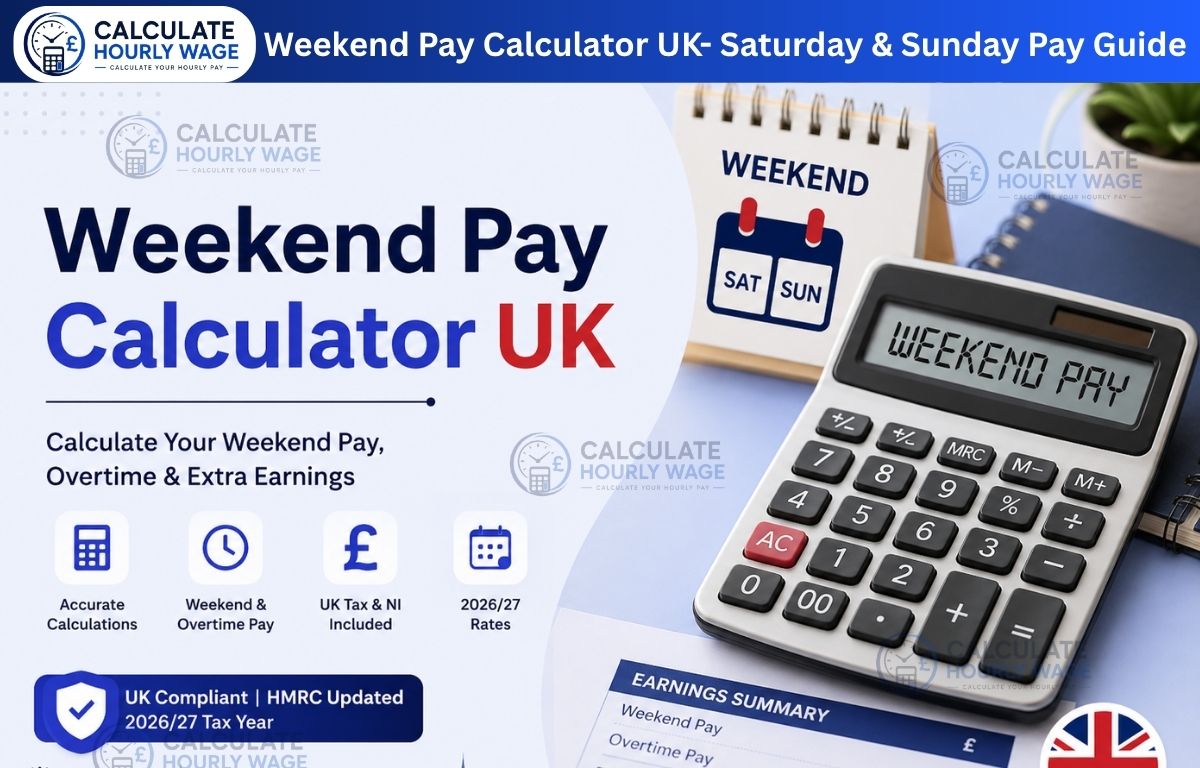
Weekend work does not automatically mean higher pay in the UK. Whether you receive a weekend premium depends mainly on your employment contract, workplace policy or collective agreement.
Some employers pay the normal hourly rate for Saturday and Sunday work. Others offer enhanced rates such as time-and-a-half, double time, a percentage uplift or a fixed weekend allowance.
Use a weekend pay calculator to work out what your Saturday and Sunday shifts could be worth based on your normal hourly rate and the enhanced rate that applies to you.
- UK law does not generally require employers to pay extra for working at weekends.
- Saturday and Sunday may have different pay rates if your contract or workplace policy provides for them.
- Weekend work is not automatically overtime. Overtime depends on the hours and conditions set by your contract.
- Employers may use time-and-a-half, double time, a fixed allowance or another enhanced rate for weekend shifts.
- Regular weekend premiums can also be relevant when working out holiday pay and checking your overall earnings.
Calculate Your Weekend Pay in Seconds
Use the Weekend Pay Calculator UK to estimate your Saturday and Sunday earnings.
You can use it to:
- Calculate Saturday pay
- Calculate Sunday pay
- Apply different weekend rates
- Compare standard pay with enhanced pay
- Include overtime or a weekend allowance
- Estimate your combined weekend earnings
Calculator inputs
- Standard hourly rate
- Saturday hours worked
- Sunday hours worked
- Saturday multiplier
- Sunday multiplier
- Weekend allowance, if applicable
- Whether overtime applies
- Unpaid breaks, if applicable
Calculator outputs
- Saturday earnings
- Sunday earnings
- Total weekend earnings
- Combined weekly earnings
How Weekend Pay Works in the UK
Weekend pay is the money you earn for working during Saturday or Sunday. The amount you receive depends on the rate that applies to those hours.
There is no single UK-wide weekend pay rate. An employer might pay the standard hourly rate, add a fixed weekend allowance or apply an enhanced multiplier.
| Example | Weekend Pay Rate |
|---|---|
| Standard Saturday pay of an employee | £12 per hour |
| Saturday pay at time-and-a-half | £18 per hour |
| Sunday pay at double time | £24 per hour |
The correct rate is the one that applies under the employee’s contractual or workplace arrangements.
Is weekend pay legally required in the UK?
There is no general legal requirement for employers to pay a higher rate simply because an employee works on Saturday or Sunday.
Higher weekend pay is normally a contractual arrangement.
This means two employees working similar weekend hours could receive different rates depending on their contracts and employers.
A contract might provide for enhanced weekend rates, while another contract might provide only the normal hourly rate.
Visit Now: GOV.UKDoes UK law require employers to pay extra for Saturday or Sunday work?
No. Working on a weekend does not automatically create a right to time-and-a-half or double pay.
Sunday work also does not automatically mean double pay.
The contract, workplace policy or relevant agreement should be checked before assuming that an enhanced rate applies.
Separate rules can apply to Sunday working and working hours, but these should not be confused with a general legal requirement for higher weekend pay.
When do employers offer enhanced weekend pay?
Enhanced weekend pay can be used where an employer wants to compensate employees for working less conventional hours.
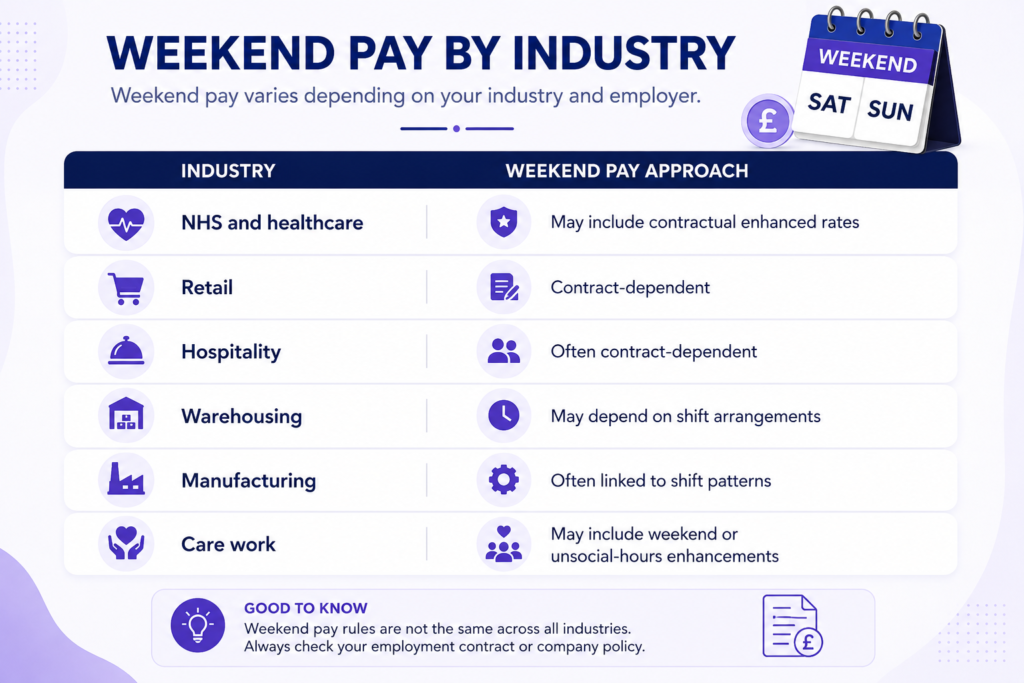
It can appear in sectors where weekend and shift work are common, including healthcare, retail, hospitality, warehousing, manufacturing and care work.
The enhancement might be:
- A percentage increase
- Time-and-a-half
- Double time
- A fixed amount per hour
- A separate shift or weekend allowance
Contractual weekend pay vs legal requirements
| Situation | What it means |
|---|---|
| Standard weekend rate | Weekend hours are paid at the normal rate |
| Contractual weekend premium | The contract provides an enhanced rate |
| Time-and-a-half | The normal hourly rate is multiplied by 1.5 |
| Double time | The normal hourly rate is multiplied by 2 |
| Fixed allowance | A set amount is added to the normal hourly rate |
| No weekend provision | The contract may simply use the normal rate |
How to Use the Weekend Pay Calculator UK
The calculation depends on how your employer pays weekend workers.
Calculate weekend pay using an enhanced hourly rate
If your employer uses a multiplier, multiply your normal hourly rate by the weekend multiplier and then multiply the result by the hours worked.
Formula
Weekend Pay = Hours × Hourly Rate × Multiplier
For example
| Calculation | Amount |
|---|---|
| Hourly rate | £10.00 |
| Hours worked | 8 hours |
| Weekend multiplier | 1.5× |
| Total Saturday pay | £120.00 |
Your enhanced Saturday rate is £15 an hour, so eight hours produces £120 of gross weekend pay.
The same approach can be used for Sunday if a different multiplier applies.
Calculate weekend pay using a fixed weekend allowance
Some employers do not use a multiplier. Instead, they add a fixed amount to the normal hourly rate.
For example, if your normal rate is £12 an hour and your contract provides a £3 weekend allowance:
| Calculation | Amount |
|---|---|
| Normal hourly rate | £12.00 |
| Weekend allowance | £3.00 |
| Weekend pay rate | £15.00 per hour |
| Hours worked | 8 hours |
| Total weekend pay | £120.00 |
Formula
Weekend Pay = Hours × (Hourly Rate + Weekend Allowance)
Check whether the allowance applies to every weekend hour or only to particular shifts.
Calculate total weekly earnings when weekend work is included
If you work both weekdays and weekends, calculate each group of hours separately and then combine them.
Formula
Total Weekly Pay = Weekday Earnings + Weekend Earnings
For example
| Calculation | Amount |
|---|---|
| Weekday hourly rate | £12.00 |
| Weekday hours worked | 30 hours |
| Total weekday earnings | £360.00 |
| Saturday hourly rate | £18.00 |
| Saturday hours worked | 8 hours |
| Total Saturday earnings | £144.00 |
| Combined weekly earnings | £504.00 |
This calculation gives gross earnings before deductions such as Income Tax, National Insurance or other payroll deductions.
Should unpaid breaks be deducted?
Yes, if your break is unpaid and is not counted as working time, it should not be included as paid hours in your calculation.
Suppose you are at work for nine hours but take a one-hour unpaid break. Your paid working time may be eight hours rather than nine.
Entering nine hours into a calculator when only eight hours are paid would overstate your weekend earnings.
Always check how your employer treats breaks.
How should split shifts be entered?
If you work separate Saturday or Sunday shifts, calculate the paid hours for each shift and combine them.
For example, if you work four paid hours in the morning and another four paid hours in the evening, your total paid weekend hours are eight.
If the two shifts have different rates, calculate them separately rather than applying one rate to the entire day.
Saturday Pay vs Sunday Pay
Is Saturday pay different from Sunday pay?
It can be.
There is no universal UK rule that says Saturday must be paid at one rate and Sunday at another. Employers can have different contractual arrangements.
For example, a workplace could pay the normal rate on Saturday and time-and-a-half on Sunday. Another employer could use the same enhanced rate for both days.
Your contract determines which arrangement applies to you.
Common Saturday pay structures
Saturday work may be paid:
- At the normal hourly rate
- With a fixed Saturday allowance
- At an enhanced percentage
- At time-and-a-half
- As overtime if the contractual overtime conditions are met
There is no automatic rule that Saturday work receives a premium.
Common Sunday pay structures
Sunday work can also be paid at the normal rate or an enhanced rate.
Some workplaces may use:
- Time-and-a-half
- Double time
- A Sunday allowance
- A separate unsocial-hours rate
Again, these arrangements are not automatic simply because the shift falls on Sunday.
Why some employers pay different rates on different days
Employers may choose different rates because of staffing requirements, shift patterns, workplace agreements or the nature of the work.
A Sunday shift might therefore have a different contractual rate from a Saturday shift.
Saturday pay vs Sunday pay
| Example arrangement | Saturday | Sunday |
|---|---|---|
| Standard rate | Normal rate | Normal rate |
| Weekend premium | Enhanced rate | Enhanced rate |
| Different weekend rates | One rate | Different rate |
| Fixed allowance | Contractual addition | Contractual addition |
| Overtime | Depends on contract | Depends on contract |
Weekend Pay vs Overtime Pay
Is weekend work automatically considered overtime?
No.
Weekend work and overtime are separate concepts.
Weekend work describes when you work. Overtime generally describes additional hours outside the hours covered by your normal contractual arrangements.
An employee could work every Saturday as part of their normal contracted pattern. Those Saturday hours would not automatically become overtime just because they take place at the weekend.
Likewise, an employee could work overtime during a weekday.
Whether additional weekend hours qualify for overtime depends on the employment contract or workplace arrangements.
Can you receive both overtime pay and a weekend premium?
It can be possible, but it depends on the applicable terms.
For example, an employer could have a weekend premium and a separate overtime arrangement. The contract or policy should make clear whether the two payments can be combined.
Do not automatically multiply every available premium together. Check the specific rules that apply to the shift.
What’s the difference between overtime, weekend pay, and unsocial-hours pay?
| Type | Meaning |
|---|---|
| Weekend pay | Pay associated with working Saturday or Sunday |
| Overtime | Pay associated with additional hours under the relevant arrangement |
| Unsocial-hours pay | Enhanced pay for working less conventional hours |
| Shift allowance | Additional payment linked to a particular shift pattern |
A single shift can potentially involve more than one category, but the applicable terms determine how the payments are calculated.
Read More: Overtime Pay Calculator UKCommon Weekend Pay Structures Used by UK Employers
Standard hourly pay
The simplest arrangement is normal hourly pay.
| Calculation | Amount |
|---|---|
| Hourly rate | £12.00 |
| Hours worked | 8 hours |
| Gross Saturday earnings | £96.00 |
There is no additional weekend calculation unless your contract provides for one.
Time-and-a-half
Time-and-a-half means the normal rate is multiplied by 1.5.
| Calculation | Amount |
|---|---|
| Hourly rate | £12.00 |
| Time-and-a-half multiplier | 1.5× |
| Enhanced hourly rate | £18.00 per hour |
| Hours worked | 8 hours |
| Total weekend pay | £144.00 |
Double time
Double time means the normal rate is multiplied by two.
| Calculation | Amount |
|---|---|
| Hourly rate | £12.00 |
| Double-time multiplier | 2× |
| Enhanced hourly rate | £24.00 per hour |
| Hours worked | 8 hours |
| Total weekend pay | £192.00 |
Double pay is not automatically required for Sunday work. It must apply under the relevant arrangement.
Fixed weekend allowances
A fixed allowance adds a specified amount to the normal hourly rate.
| Calculation | Amount |
|---|---|
| Normal hourly rate | £11.00 |
| Weekend allowance | £2.00 |
| Weekend pay rate | £13.00 per hour |
| Hours worked | 8 hours |
| Total weekend pay | £104.00 |
Shift premiums
A shift premium is additional pay associated with particular working patterns or hours.
Weekend work can form part of a wider shift allowance arrangement. This can be particularly relevant for employees working rotating or unsocial shifts.
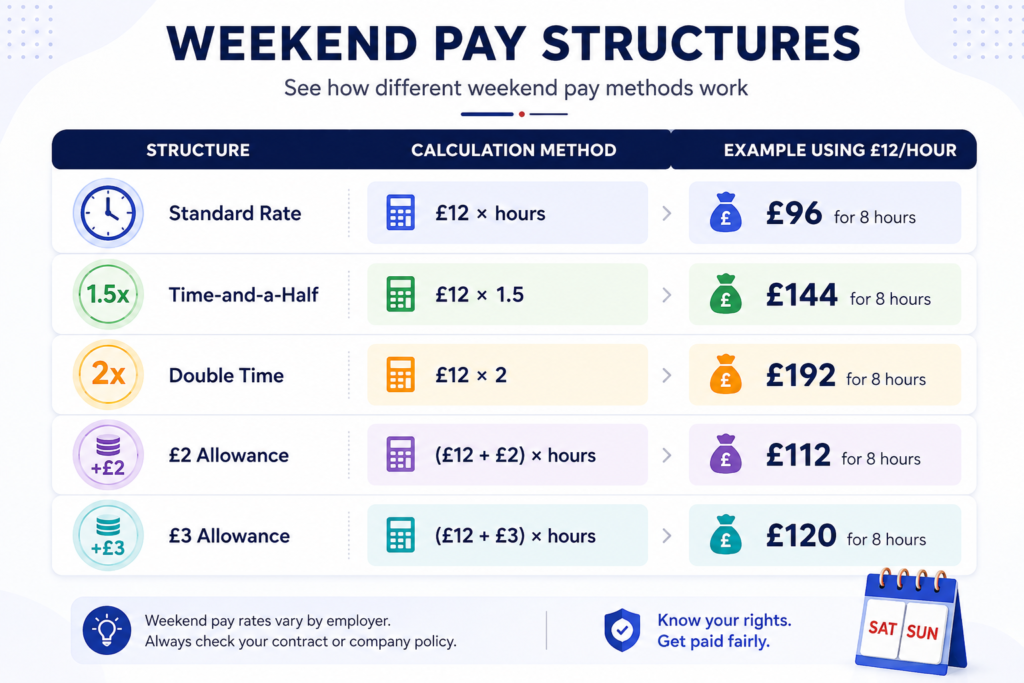
Common weekend pay structures
| Structure | Calculation method | Example using £12/hour |
|---|---|---|
| Standard rate | £12 × hours | £96 for 8 hours |
| Time-and-a-half | £12 × 1.5 | £144 for 8 hours |
| Double time | £12 × 2 | £192 for 8 hours |
| £2 allowance | (£12 + £2) × hours | £112 for 8 hours |
| £3 allowance | (£12 + £3) × hours | £120 for 8 hours |
Weekend Pay Examples
Saturday pay calculation example
| Calculation | Amount |
|---|---|
| Hourly rate | £11.00 |
| Hours worked | 8 hours |
| Gross Saturday earnings | £88.00 |
Read More: Shift Differential Pay Calculator UKSunday pay calculation example
| Calculation | Amount |
|---|---|
| Hourly rate | £12.00 |
| Double-time multiplier | 2× |
| Hours worked | 8 hours |
| Gross Sunday earnings | £192.00 |
Weekend pay with time-and-a-half
| Calculation | Amount |
|---|---|
| Hourly rate | £10.00 |
| Time-and-a-half multiplier | 1.5× |
| Enhanced hourly rate | £15.00 per hour |
| Hours worked | 8 hours |
| Gross Saturday earnings | £120.00 |
Weekend pay with double time
| Calculation | Amount |
|---|---|
| Hourly rate | £12.00 |
| Hours worked | 6 hours |
| Double-time multiplier | 2× |
| Effective Sunday rate | £24.00 per hour |
| Gross Sunday earnings | £144.00 |
Weekend pay using a flat-rate allowance
An employee earns £10 an hour and receives an additional £2 for each weekend hour.
| Calculation | Amount |
|---|---|
| Normal hourly rate | £10.00 |
| Weekend allowance | £2.00 |
| Weekend pay rate | £12.00 per hour |
| Hours worked | 8 hours |
| Total weekend pay | £96.00 |
The weekend allowance contributes £16 of the total.
Combined weekday and weekend earnings example
An employee works:
- 30 weekday hours at £12
- Eight Saturday hours at £15
| Calculation | Amount |
|---|---|
| Weekday hourly rate | £12.00 |
| Weekday hours worked | 30 hours |
| Total weekday earnings | £360.00 |
| Saturday hourly rate | £15.00 |
| Saturday hours worked | 8 hours |
| Total Saturday earnings | £120.00 |
| Combined weekly earnings | £480.00 |
This illustrates why weekend hours should be calculated separately when a different rate applies.
Weekend Pay in Different Industries
NHS and healthcare
Healthcare can involve regular weekend and shift work, with contractual arrangements that may provide enhanced rates.
The exact rate depends on the applicable employment terms and pay structure.
Employees should use their relevant workplace agreement rather than assuming a standard weekend multiplier.
Retail
Retail employees may regularly work Saturdays and Sundays.
Weekend pay can vary significantly between employers. Some contracts may offer enhanced Sunday or weekend rates, while others may pay the normal rate.
Sunday working arrangements can also have separate legal considerations.
Hospitality
Restaurants, hotels and other hospitality businesses often operate throughout weekends.
Weekend work does not automatically mean a higher hourly rate. The applicable contract determines whether an employee receives an allowance or premium.
Warehousing and logistics
Warehousing and logistics can involve rotating shifts and weekend operations.
Pay may depend on the shift pattern, overtime arrangements or a specific shift allowance.
Manufacturing
Manufacturing businesses operating around the clock may use rotating shifts that include weekends.
Weekend pay can therefore form part of a wider shift-pay structure rather than being a standalone Saturday or Sunday premium.
Care work
Care workers may work evenings, nights and weekends.
Where enhanced rates apply, the relevant contract or workplace arrangement should be checked to establish whether weekend, night and overtime payments are separate or combined.
Industry-specific weekend pay practices
| Industry | Weekend pay approach |
|---|---|
| NHS and healthcare | May include contractual enhanced rates |
| Retail | Contract-dependent |
| Hospitality | Often contract-dependent |
| Warehousing | May depend on shift arrangements |
| Manufacturing | Often linked to shift patterns |
| Care work | May include weekend or unsocial-hours enhancements |
Weekend Pay for Different Types of Workers
Salaried employees
A salaried employee receives an annual salary rather than a simple hourly wage.
If weekend work is already included within the employee’s contracted working pattern, there may be no additional payment.
If weekend work is paid separately, the applicable contract should explain how the payment is calculated.
An employee wanting to estimate an hourly equivalent can use an annual salary-to-hourly calculation before applying any relevant weekend rate.
Read More: Salary to Hourly CalculatorHourly paid employees
Hourly workers can generally calculate weekend earnings by multiplying their paid weekend hours by the rate that applies.
Where Saturday and Sunday have different rates, each should be calculated separately.
Read More: Hourly Wage Calculator UKShift workers
Shift workers may have different rates for different types of shifts.
A weekend shift might attract a premium, while a night shift could have another allowance.
The calculation should follow the employer’s specific pay structure rather than assuming that every premium can be added together.
Zero-hours contract workers
Zero-hours workers can have variable working patterns and may work weekends without having a fixed number of weekly hours.
Their weekend earnings depend on the hours actually worked and the applicable rate.
If the contract does not provide a weekend premium, working on Saturday or Sunday does not automatically create one.
Casual weekend workers
Someone taking occasional weekend shifts should check whether the shift is paid at the standard rate or an enhanced rate.
Casual work can involve changing hours, so keeping accurate records of hours, breaks and rates is particularly useful.
NHS nurse working a Sunday shift
An NHS nurse works a Sunday shift under an arrangement that provides an enhanced Sunday rate.
The nurse should use the applicable contractual rate rather than assuming that all NHS Sunday work has the same multiplier.
The calculator can then be used to check the gross value of the hours worked.
Supermarket employee working alternate weekends
A supermarket employee works eight hours every other Saturday.
If the contract pays the standard hourly rate, the weekend earnings are simply:
Hourly rate × eight hours
If the employer provides a Saturday premium, the enhanced rate should be used instead.
The fact that the shifts occur every other weekend does not by itself create a statutory weekend premium.
Restaurant worker receiving no weekend premium
A restaurant worker earns £11 an hour and works eight hours on Sunday.
If the contract does not provide an enhanced Sunday rate, the calculation is:
£11 × 8 = £88
Sunday work does not automatically turn £11 into double time.
Warehouse operative receiving both overtime and weekend pay
A warehouse operative works additional hours on Sunday and the workplace arrangement provides both weekend and overtime payments.
The worker should check how the contract treats overlapping payments.
The calculator can estimate the relevant amounts, but the employer’s rules determine whether the premiums are cumulative or whether one replaces another.
Salaried employee calculating an equivalent weekend hourly rate
A salaried employee may want to estimate the value of weekend work by converting their salary into an equivalent hourly rate.
Once that rate is established, an applicable weekend multiplier can be used to estimate the value of a weekend shift.
This is an estimate unless the employer actually calculates weekend payments using that hourly equivalent.
Zero-hours worker calculating weekend earnings
A zero-hours worker completes a six-hour Saturday shift at £13 an hour.
| Calculation | Amount |
|---|---|
| Hourly rate | £13.00 |
| Hours worked | 6 hours |
| Weekend pay without an allowance | £78.00 |
| Weekend allowance | £2.00 |
| Weekend pay rate with an allowance | £15.00 per hour |
| Weekend pay with an allowance | £90.00 |
The correct calculation depends on the agreed rate.
Does Weekend Pay Affect Taxes and Other Deductions?
Weekend earnings are part of your gross pay where they are paid as employment income. Additional earnings can therefore affect the amount deducted through payroll.
Does weekend pay affect Income Tax?
Additional weekend earnings can increase your gross pay and may affect the amount of Income Tax deducted through payroll.
The weekend premium itself is not treated as tax-free simply because it is paid for working Saturday or Sunday.
Use a take-home pay calculation if you want to estimate what remains after deductions.
Read More: Income Tax CalculatorDoes weekend pay affect National Insurance?
Additional employment earnings can also affect National Insurance deductions where the relevant thresholds and rules apply.
A weekend premium should therefore be considered part of your overall earnings when checking your expected take-home pay.
Read More: National Insurance CalculatorDoes weekend pay affect pension contributions?
A weekend allowance or enhanced payment may affect pensionable pay depending on the pension arrangement and how the payment is classified.
Do not assume every type of weekend payment is treated identically.
Check your workplace pension rules if the distinction matters to you.
Does weekend pay affect student loan repayments?
Higher gross earnings can affect deductions where student loan repayment rules apply.
The effect depends on your overall earnings and circumstances rather than simply on whether a payment is labelled as weekend pay.
Can weekend earnings affect other payments or benefits?
Additional earnings can potentially affect other income-related payments or benefits.
The effect depends on the particular payment and the person’s circumstances. Weekend pay should therefore be considered as part of total earnings rather than treated as separate income simply because it was earned at the weekend.
Understanding Weekend Pay on Your Payslip
What does a weekend allowance look like on a payslip?
A weekend payment may appear as a separate line from your basic pay.
For example, a payslip might distinguish between:
- Basic pay
- Weekend allowance
- Shift premium
- Overtime
- Enhanced pay
The exact wording varies between employers.
How employers label enhanced pay
Different payroll systems use different descriptions.
A payment might be labelled as a weekend premium, Sunday allowance, shift allowance, enhanced hours or another internal payroll term.
The label alone does not tell you whether the calculation is correct. Compare the amount against your contract and hours worked.
How to compare your calculated pay with your payslip
Start with the hours you actually worked.
Then check:
- Your normal hourly rate.
- Your Saturday or Sunday rate.
- Any applicable allowance.
- Whether breaks were paid.
- Whether overtime was included.
- The gross amount shown on your payslip.
If the figures do not match, check the workplace policy or payroll information before assuming that the payslip is incorrect.
Common Weekend Pay Calculation Mistakes
Assuming weekend work automatically means overtime
Working Saturday or Sunday does not automatically mean overtime.
Your normal contracted pattern may include weekend work.
Assuming Sunday always means double pay
There is no general rule requiring double pay for Sunday work.
Double time applies only where the relevant contractual or workplace arrangement provides for it.
Forgetting to deduct unpaid breaks
A long shift does not necessarily mean all of the time spent at the workplace is paid.
If a break is unpaid, remove it from the paid hours used in your calculation.
Using annual salary instead of an hourly rate
Salaried workers should not assume that dividing annual salary by a convenient number automatically produces the employer’s weekend rate.
The relevant contracted hours and payment arrangements should be considered when calculating an hourly equivalent.
Ignoring employment contract terms
The most common mistake is assuming that a standard weekend rule applies to everyone.
Check your contract, staff handbook or workplace agreement before applying time-and-a-half, double time or another premium.
Expert tips
- Check your employment contract before calculating weekend pay.
- Compare your calculation with your payslip.
- Keep records of weekend shifts and paid hours.
- Check whether your employer uses a multiplier or fixed allowance.
- Treat Saturday and Sunday separately if different rates apply.
- Do not assume overtime and weekend premiums are automatically combined.
- Keep unpaid breaks out of paid-hour calculations.
Is weekend pay legally required in the UK?
No. UK law does not generally require employers to pay a higher rate simply because someone works on Saturday or Sunday. Any weekend premium will normally depend on the employment contract, workplace policy or relevant agreement.
Do employers have to pay extra for Sunday work?
No. Sunday work does not automatically require additional pay. An employer may provide an enhanced Sunday rate under the applicable contractual arrangements.
Is Saturday considered overtime?
Not automatically. Saturday is only overtime if the relevant working arrangement treats those hours as overtime.
Is Sunday considered overtime?
Not automatically. Sunday work can form part of an employee’s normal contracted hours. Overtime depends on the applicable employment terms.
How do I calculate my weekend pay?
Multiply your paid weekend hours by the applicable hourly rate. If an enhanced multiplier applies, use:
Hours × Hourly Rate × Multiplier
If a fixed allowance applies, use:
Hours × (Hourly Rate + Weekend Allowance)
Can I receive both overtime pay and a weekend premium?
Possibly. It depends on the workplace rules. Some arrangements allow both payments, while others use one rate instead of combining them.
What is time-and-a-half?
Time-and-a-half means paying 1.5 times the normal hourly rate.
For a £12 hourly rate:
£12 × 1.5 = £18 per hour
What is double time?
Double time means paying twice the normal hourly rate.
For a £12 hourly rate:
£12 × 2 = £24 per hour
Double time is not an automatic UK entitlement for weekend work.
How do zero-hours contracts handle weekend pay?
Weekend pay depends on the agreed rate and whether the contract provides a weekend premium. If no premium applies, the worker generally uses the normal applicable hourly rate for the paid hours worked.
Can employers change weekend pay rates?
Weekend rates are governed by the applicable employment arrangements. If an employer proposes a change, the employee should check the contract and relevant workplace terms to understand what applies.
Does weekend pay affect taxes?
Additional weekend earnings can form part of your gross employment income and may affect payroll deductions such as Income Tax and National Insurance.
Does weekend pay affect pension contributions?
It can, depending on whether the weekend payment counts as pensionable pay under the relevant pension arrangement.
How does weekend pay affect holiday pay?
Regularly received weekend or shift-related payments can be relevant to holiday pay calculations. Where weekend earnings form part of regular pay, they may need to be reflected in the applicable average-pay calculation.
Does annual salary include weekend work?
It depends on the employment contract. Some salaried employees have weekend work included within their normal contracted duties, while others may receive separate payments for particular weekend shifts.
How do I calculate weekend pay from my payslip?
Compare the paid weekend hours with the hourly rate or allowance shown in your employment terms. Then check the weekend-related payment on your payslip against the expected amount.
Conclusion
A Weekend Pay Calculator UK can help you estimate your Saturday and Sunday earnings quickly, but the amount you receive will always depend on your employment contract and workplace pay policies. Before assuming that weekend work automatically means higher pay, check your agreed rates, compare your calculations with your payslip, and confirm whether overtime or shift allowances apply. Using your contract alongside a calculator is the easiest way to make sure your weekend pay has been calculated correctly.