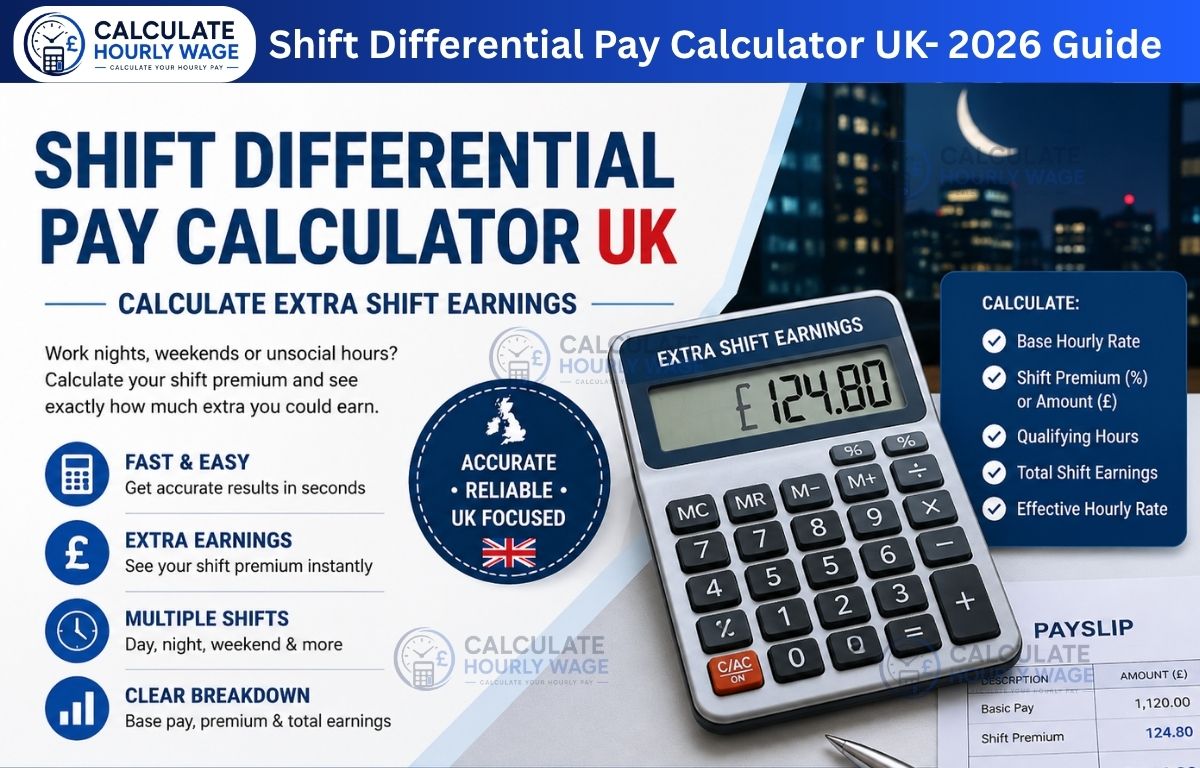
Shift differential pay is additional pay for working specified shifts, such as nights, evenings or weekends. In the UK, there is generally no universal legal requirement for employers to pay an additional shift premium. Where one applies, the amount and qualifying hours normally come from the employment contract, workplace policy or collective agreement. To calculate it, apply the agreed percentage or fixed premium to the qualifying hours and add it to your normal earnings.
Click Here: Shift Pay Calculator UK
How To Use Shift Differential Pay Calculator UK?
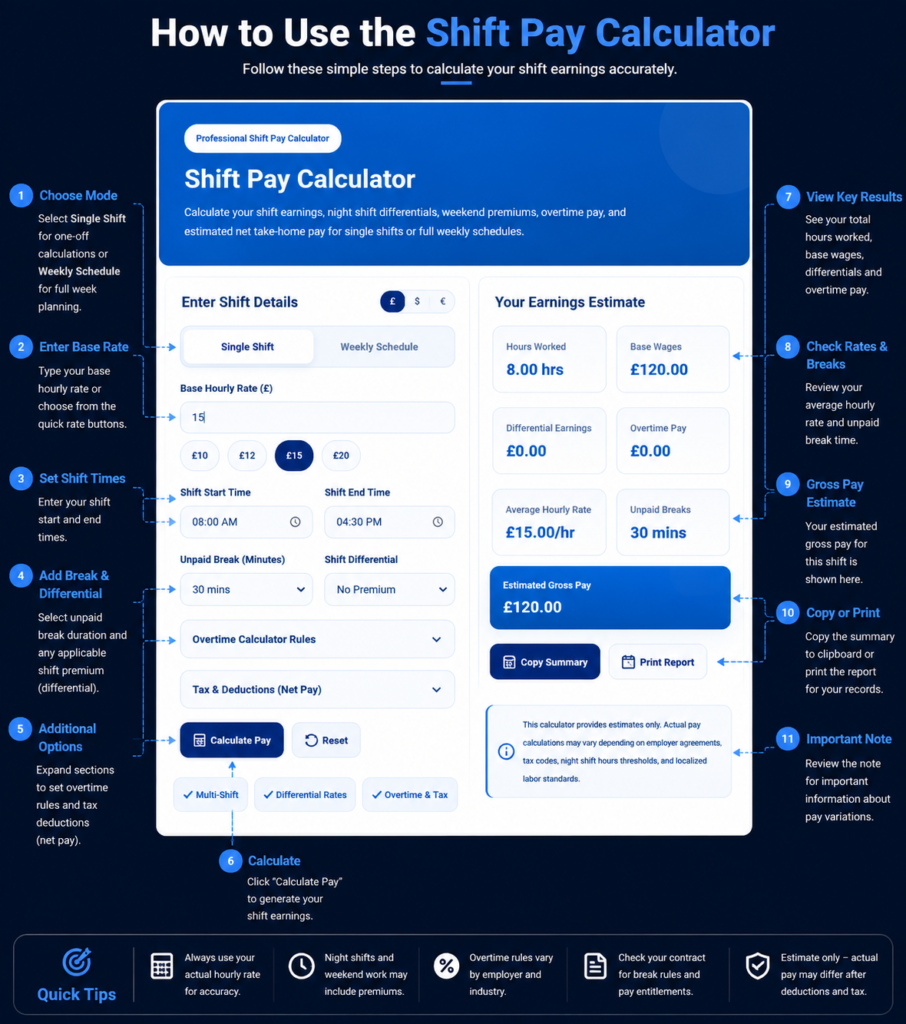
Enter:
- Base hourly rate
- Shift premium type: percentage or flat amount
- Premium rate or fixed amount
- Qualifying shift hours
- Optional normal working hours
- Optional multiple shift types
- Optional overtime details, where your employer’s contractual calculation method is known
Your results can show:
- Base earnings
- Extra shift premium
- Enhanced hourly rate
- Total gross shift earnings
- Effective hourly rate
Calculate your shift earnings using your actual contractual shift premium.
The calculator uses the premium you enter. It does not determine whether your employer is legally required to pay that premium. UK overtime and premium calculations can also depend on your employment contract or workplace policy.
What Is Shift Differential Pay?
Shift differential pay is extra compensation paid for working particular shifts or hours. Employers may use it to compensate employees for working less convenient hours, such as nights, weekends or other unsocial hours.
The term shift differential is particularly common in US payroll terminology. In the UK, you are more likely to encounter terms such as shift allowance, shift premium, unsocial-hours enhancement or night shift allowance.
These terms can describe similar arrangements, but they are not automatically interchangeable. The exact meaning depends on the employer’s contract and pay policy.
Shift Differential vs Shift Allowance vs Shift Premium
A shift allowance may be a fixed payment for working a particular shift pattern. A shift premium may be an additional amount paid on top of the normal hourly rate. A shift differential can describe the difference between standard pay and enhanced pay for particular working hours.
For example, an employer might pay:
- £14 per hour for ordinary hours
- £16.80 per hour for qualifying night hours
- £17 per hour for qualifying weekend hours
Another employer might instead specify a 20% night premium or a fixed £2 hourly shift allowance.
The terminology alone does not tell you what you are entitled to. Check the wording in your employment contract or workplace pay policy.
What Does a Shift Differential Actually Pay You For?
The premium normally relates to the type or timing of the shift, rather than simply the number of hours you work.
This makes it different from overtime.
For example, working eight hours during your normal daytime schedule may produce your ordinary hourly pay. Working eight qualifying night hours could produce additional pay if your contract provides a night premium.
The basic components are:
- Base pay: your ordinary hourly rate.
- Shift premium: the additional amount paid for qualifying shifts.
- Enhanced rate: base pay plus the shift premium.
- Total shift earnings: enhanced rate multiplied by qualifying hours.
Is Shift Differential Pay Required by UK Law?
There is generally no universal UK statutory entitlement to extra pay simply because you work nights, weekends or bank holidays.
An enhanced rate may instead be a contractual benefit agreed between the employer and employee.
UK law can still provide protections relating to areas such as minimum wage and working time. Those protections are separate from an employer choosing to pay an additional shift premium.
If you are unsure whether an allowance forms part of your contractual pay, check your employment terms before assuming that the premium is legally required.
How to Calculate Shift Differential Pay
The calculation depends on how your employer defines the premium.
Percentage-Based Shift Premium
If your contract gives you a percentage premium, first calculate the extra amount per hour.
| Step | Formula |
|---|---|
| Extra shift pay | Extra shift pay = Base hourly rate × Premium percentage |
| Enhanced hourly rate | Enhanced hourly rate = Base hourly rate + Extra shift pay |
| Shift earnings | Shift earnings = Enhanced hourly rate × Qualifying hours |
For example
| Step | Calculation | Result |
|---|---|---|
| Base hourly rate | £14 per hour | £14.00 |
| Shift premium | £14 × 20% | £2.80 extra per hour |
| Enhanced hourly rate | £14 + £2.80 | £16.80 per hour |
| Qualifying hours | 8 hours | 8 |
| Total shift earnings | £16.80 × 8 | £134.40 |
| Total shift premium | £2.80 × 8 | £22.40 |
Result: The shift premium adds £22.40, giving total earnings of £134.40 for eight qualifying hours.
Flat-Rate Shift Premium
Some employers use a fixed amount rather than a percentage.
For example, your contract could provide an additional £2 per qualifying hour.
| Step | Formula |
|---|---|
| Enhanced hourly rate | Enhanced hourly rate = Base hourly rate + Flat shift premium |
| Shift earnings | Shift earnings = Enhanced hourly rate × Qualifying hours |
| Step | Calculation | Result |
|---|---|---|
| Base hourly rate | Given | £14.00 |
| Flat shift allowance | Given | £2.00 per hour |
| Enhanced hourly rate | £14 + £2 | £16.00 per hour |
| Qualifying hours | Given | 8 hours |
| Total shift earnings | £16 × 8 | £128.00 |
| Extra shift premium | £2 × 8 | £16.00 |
Calculating Mixed Shifts
A working week may contain different types of shifts.
For Example
| Step | Calculation | Result |
|---|---|---|
| Ordinary hours | £14 × 24 | £336.00 |
| Night premium | 20% of £14 | £2.80 per hour |
| Night enhanced rate | £14 × 1.20 | £16.80 per hour |
| Qualifying night hours | Given | 16 hours |
| Night earnings | £16.80 × 16 | £268.80 |
| Total gross earnings | £336 + £268.80 | £604.80 |
The important point is to calculate each category separately rather than applying the night premium to all 40 hours.
Multiple or Stacked Premiums
Some contracts contain more than one type of enhancement. For example, an employer might have separate rules for night work, weekends and overtime.
There is no single UK calculation method that should automatically be applied to every combination.
An employer may specify whether premiums:
- are added together,
- are calculated separately,
- replace one another,
- apply to overtime,
- or only apply during defined qualifying hours.
Do not assume that a 20% night premium and an overtime rate can simply be combined without checking the employer’s rules.
Shift Differential Pay Examples
Example 1: 20% Shift Premium
| Step | Calculation | Result |
|---|---|---|
| Base hourly rate | Given | £15.00 |
| Shift premium | £15 × 20% | £3.00 extra per hour |
| Enhanced hourly rate | £15 + £3 | £18.00 per hour |
| Qualifying night hours | Given | 10 hours |
| Earnings with premium | £18 × 10 | £180.00 |
| Earnings without premium | £15 × 10 | £150.00 |
| Extra shift premium | £180 − £150 | £30.00 |
Example 2: Fixed £2 Per-Hour Shift Allowance
| Step | Calculation | Result |
|---|---|---|
| Base hourly rate | Given | £13.50 |
| Shift allowance | Given | £2.00 per hour |
| Enhanced hourly rate | £13.50 + £2 | £15.50 per hour |
| Qualifying hours | Given | 12 hours |
| Total shift earnings | £15.50 × 12 | £186.00 |
| Additional shift allowance | £2 × 12 | £24.00 |
Example 3: Mixed Day and Night Shifts
An employee earns £14 per hour.
| Step | Calculation | Result |
|---|---|---|
| Daytime earnings | £14 × 24 | £336.00 |
| Night premium | £14 × 20% | £2.80 per hour |
| Night enhanced rate | £14 + £2.80 | £16.80 per hour |
| Night earnings | £16.80 × 16 | £268.80 |
| Total gross earnings | £336 + £268.80 | £604.80 |
| Total hours | 24 + 16 | 40 hours |
| Effective hourly rate | £604.80 ÷ 40 | £15.12 per hour |
Example 4: Salaried Employee With a Shift Premium
A salaried employee may need to establish an hourly equivalent before calculating an hourly shift premium.
The exact conversion depends on the employee’s working pattern and the calculation being performed. Once an appropriate hourly basis has been established, the contractual shift enhancement can be applied to the qualifying hours.
For a broader salary-to-hourly conversion, use the site’s Salary to Hourly Calculator UK.
Read More: Salary to Hourly Calculator UKExample 5: Shift Premium and Overtime
Suppose an employee earns £15 per hour and receives a contractual night premium of 20%.
Their qualifying night rate is £18 per hour.
They then work overtime.
The correct overtime calculation depends on the employer’s contract or overtime policy. Some employers may specify that overtime is based on a particular underlying rate, while others may have rules covering the treatment of shift enhancements.
Do not assume that UK law automatically requires a US-style blended “regular rate” calculation.
Check:
- The overtime rate in the contract.
- Whether the shift premium applies during overtime.
- Whether the premium and overtime can be combined.
- Which hours qualify for each payment.
Read More: Overtime Pay Calculator UKWhat Counts as a Qualifying Shift?
A qualifying shift is whatever your employer’s contract or workplace policy defines as eligible for the premium.
There is no universal UK definition that makes every night or weekend shift automatically eligible for additional pay.
Night Shifts
Working at night and receiving a night premium are separate issues.
UK working-time rules can provide protections for night workers, but these protections do not create a universal entitlement to higher pay for night work.
Your employer may define qualifying night hours separately in your contract.
For example, the employer might specify a particular time window during which a night allowance applies. Another employer may use a different shift pattern or eligibility rule.
Always use your employer’s stated qualifying hours when entering information into the calculator.
Evening and Weekend Shifts
Evening and weekend premiums are also normally determined by workplace arrangements.
Your contract might provide an additional amount for:
- evening work,
- Saturday work,
- Sunday work,
- rotating shifts,
- particular shift patterns.
The premium might apply to the entire shift or only certain hours.
Bank Holiday Shifts
Working on a bank holiday does not automatically mean that you must receive double pay.
An employer may provide enhanced bank-holiday rates as part of the contract, but the actual rate depends on the applicable employment terms.
Do not automatically treat a bank holiday as a 2x rate unless your contract or employer policy says so.
Read More: Bank Holiday Pay Calculator UKUnpaid Breaks and Qualifying Hours
The number of hours you spend at your workplace is not necessarily the number of hours that should be entered as qualifying paid hours.
For example, if you are present for nine hours but have a one-hour unpaid break, you may have eight paid hours.
The treatment of breaks depends on the working arrangement, so use the hours that are actually eligible under your employer’s pay rules.
Shift Differential Pay vs Other Types of Pay
| Pay component | Purpose | Example | General treatment |
|---|---|---|---|
| Base pay | Normal working pay | £14/hour | Subject to applicable minimum-pay rules |
| Shift premium | Extra pay for qualifying shifts | +20% | Generally contractual |
| Shift allowance | Fixed or defined additional payment | +£2/hour | Generally contractual |
| Overtime | Pay associated with additional hours | Contract-specific | Generally contractual |
| Bank-holiday enhancement | Additional pay for specified days | Contract-specific | Depends on contract |
| Night-work protections | Working-time and health protections | Night work rules | Statutory protections |
Shift Premium vs Overtime
A shift premium is linked to the type or timing of work.
Overtime is generally linked to working additional hours beyond an employee’s normal contractual arrangement.
You can potentially have both, but the way they interact depends on the employment contract or workplace policy.
Shift Premium vs Night-Work Rights
A night worker may have statutory working-time protections even if their employer does not provide an additional night premium.
Therefore:
Night work does not automatically mean night premium pay.
The pay enhancement and the statutory working-time protections are separate issues.
Shift Premium vs Bank Holiday Pay
Bank-holiday working and shift premiums are also separate.
An employer can provide an enhanced bank-holiday rate, but working on a bank holiday does not automatically create a universal right to double pay.
How Shift Differential Pay Works Under UK Rules
Shift Premiums Are Usually Contractual
The first place to look is your employment contract.
Also check:
- workplace pay policies,
- collective agreements,
- staff handbooks,
- written amendments to your employment terms,
- rules defining qualifying shifts.
The contract should help establish the premium rate and when it applies.
An employer may also set conditions around the shift pattern, qualifying hours or type of work.
National Minimum Wage and Shift Premiums
National Minimum Wage treatment is more specific than simply asking whether something is called an allowance.
Certain payments are treated differently when calculating whether minimum wage requirements have been met. The nature of the payment matters.
This means you should not assume that every payment labelled “shift allowance” is automatically treated in exactly the same way.
Visit Now: GOV.UKShift Premiums and Overtime
UK overtime does not have one universal statutory calculation method that automatically applies a shift premium in every situation.
Your employer’s contractual overtime rules matter.
Check whether the employer:
- pays overtime on the basic rate,
- includes a relevant shift enhancement,
- applies a separate overtime rate,
- restricts certain premium combinations.
The calculator can show the arithmetic, but your contract determines the applicable contractual calculation.
Shift Premiums and Holiday Pay
Holiday-pay treatment can depend on the nature and regularity of the payment and the type of holiday entitlement involved.
Regular shift-related earnings may be relevant when determining normal remuneration for holiday pay. The treatment should not be simplified to “all shift allowances are included” or “all shift allowances are excluded”.
The Brazel decision is relevant to the wider UK holiday-pay framework, particularly around the calculation of holiday pay for certain workers.
If your shift earnings are regular and you are checking holiday pay, compare your payslip with the relevant contractual and holiday-pay rules.
Read More: Holiday Leave Accrual Calculator UK Tax and National Insurance
Shift differential earnings are normally part of your employment income.
That means additional shift earnings can affect the amount of pay subject to PAYE Income Tax and National Insurance.
A larger gross wage does not mean that every additional pound becomes take-home pay.
For a broader estimate of deductions and net earnings, use the site’s Take-Home Pay Calculator UK or PAYE Calculator UK.
Read More: PAYE Calculator UK How to Check Your Shift Pay on a Payslip
Identify Your Base Pay
Start with your ordinary hourly rate or the relevant salary-derived rate.
Make sure you are using the same rate that your employer uses for the shift calculation.
Identify the Shift Premium
Look for a separate payslip line showing the shift allowance, shift premium or another relevant enhancement.
Check whether it is shown as:
- an hourly amount,
- a percentage,
- a fixed allowance,
- or part of another pay category.
Check Qualifying Hours
Compare the number of hours shown on your payslip with the hours that actually qualify under your contract.
Pay particular attention to:
- night hours,
- weekend hours,
- bank-holiday hours,
- unpaid breaks,
- overtime hours.
Compare the Result With Your Contract
Check the following:
- premium percentage or fixed amount,
- qualifying shift times,
- qualifying days,
- overtime rules,
- exclusions,
- rules for combining premiums,
- relevant workplace policy.
This is more reliable than comparing your pay with a generic “typical” shift premium.
What If Your Shift Pay Looks Wrong?
First, recalculate the amount using your contractual rate and qualifying hours.
Then compare your result with the payslip and employment terms.
If there is a discrepancy, raise it with your employer or payroll team and ask them to explain how the amount was calculated.
If the issue concerns an employment right or contractual dispute, seek appropriate employment advice rather than assuming that a calculator result establishes a legal entitlement.
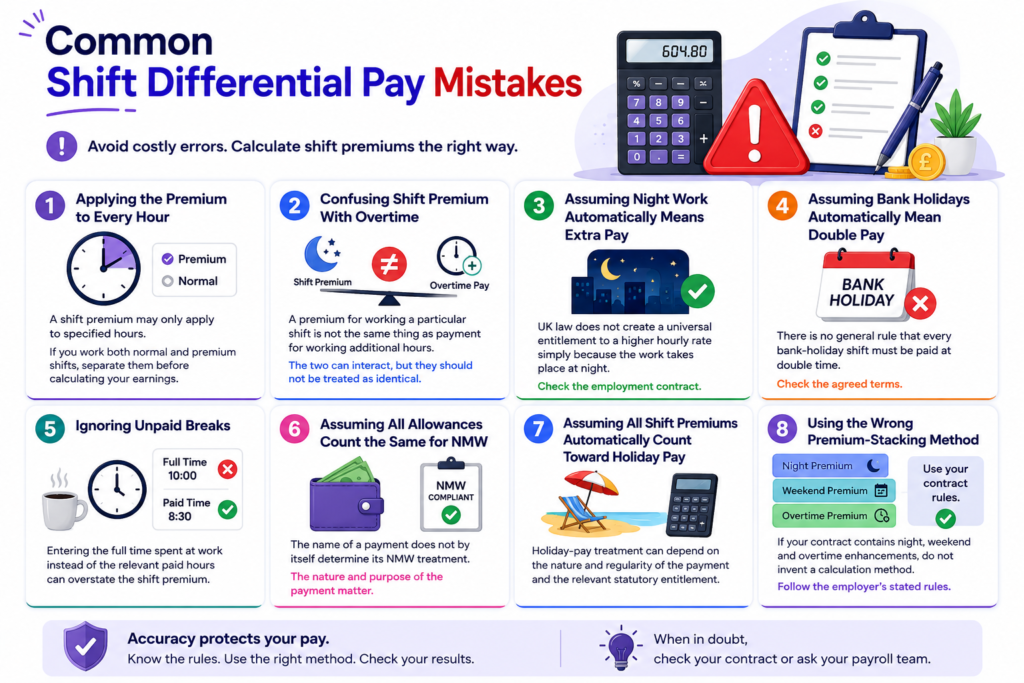
Common Shift Differential Pay Mistakes
Applying the Premium to Every Hour
A shift premium may only apply to specified hours.
If you work both normal and premium shifts, separate them before calculating your earnings.
Confusing Shift Premium With Overtime
A premium for working a particular shift is not the same thing as payment for working additional hours.
The two can interact, but they should not be treated as identical.
Assuming Night Work Automatically Means Extra Pay
UK law does not create a universal entitlement to a higher hourly rate simply because the work takes place at night.
Check the employment contract.
Assuming Bank Holidays Automatically Mean Double Pay
There is no general rule that every bank-holiday shift must be paid at double time.
Check the agreed terms.
Ignoring Unpaid Breaks
Entering the full time spent at work instead of the relevant paid hours can overstate the shift premium.
Assuming All Allowances Count the Same for NMW
The name of a payment does not by itself determine its NMW treatment.
The nature and purpose of the payment matter.
Assuming All Shift Premiums Automatically Count Toward Holiday Pay
Holiday-pay treatment can depend on the nature and regularity of the payment and the relevant statutory entitlement.
Using the Wrong Premium-Stacking Method
If your contract contains night, weekend and overtime enhancements, do not invent a calculation method.
Follow the employer’s stated rules.
Practical Shift Pay Scenarios
Employee Working Regular Night Shifts
An employee earns £14 per hour and receives a 20% contractual night premium.
| Step | Calculation | Result |
|---|---|---|
| Base hourly rate | Given | £14.00 |
| Night premium | 20% | £2.80 per hour |
| Night rate | £14 × 1.20 | £16.80 per hour |
| Qualifying night hours | Given | 40 hours |
| Weekly earnings with premium | £16.80 × 40 | £672.00 |
| Weekly earnings without premium | £14 × 40 | £560.00 |
| Extra earned from premium | £672 − £560 | £112.00 |
The contractual night premium therefore adds £112 for that week.
Employee Working Day and Weekend Shifts
An employee earns £14 per hour and receives a 15% weekend premium.
| Step | Calculation | Result |
|---|---|---|
| Weekday hours | Given | 24 hours |
| Weekday earnings | £14 × 24 | £336.00 |
| Weekend premium | 15% | £2.10 per hour |
| Weekend rate | £14 × 1.15 | £16.10 per hour |
| Qualifying weekend hours | Given | 16 hours |
| Weekend earnings | £16.10 × 16 | £257.60 |
| Total earnings | £336 + £257.60 | £593.60 |
This method prevents the weekend premium from being incorrectly applied to weekday hours.
Salaried Employee Moving Onto Shift Work
A salaried employee may move from ordinary daytime work to a role involving regular night or weekend shifts.
The employee should compare more than the headline annual salary.
Consider:
- annual salary,
- expected working hours,
- qualifying shift hours,
- contractual premium,
- total gross earnings,
- effective hourly rate.
This can show whether the enhanced shift arrangement materially changes the value of the role.
Comparing Two Jobs With Different Shift Premiums
Suppose two jobs offer different base rates and shift enhancements.
Job A may offer a higher base rate but no shift premium.
Job B may offer a lower base rate but a contractual premium for a large proportion of the working schedule.
Compare:
- Base hourly rate.
- Premium rate.
- Expected qualifying hours.
- Total gross earnings.
- Effective hourly rate.
This gives a more useful comparison than looking only at the advertised hourly rate.
Read More: Hourly Wage Calculator UKHow to Read Your Shift Pay Contract
Check the Premium Rate
Find out whether the enhancement is:
- a percentage,
- a fixed hourly amount,
- a fixed shift allowance,
- or another payment structure.
Do not assume that a percentage and a flat allowance produce the same result.
Check Which Hours Qualify
Look for the exact definitions of:
- night shifts,
- evening shifts,
- weekend shifts,
- Sunday work,
- bank-holiday work.
The contract may specify start and end times.
Check Whether Premiums Stack
If more than one enhancement could apply, look for wording explaining whether the payments can be combined.
This is particularly relevant to overtime and weekend or night work.
Check What Happens During Leave
Look for the employer’s rules on how contractual shift payments interact with periods of leave.
Regular shift earnings can raise separate holiday-pay questions, so avoid assuming that a shift allowance automatically continues or stops during leave.
Check Whether the Allowance Can Change
Some workplace arrangements may allow an employer to change shift patterns or allowances under specified conditions.
Check the contract and relevant workplace policy rather than relying on the name of the allowance.
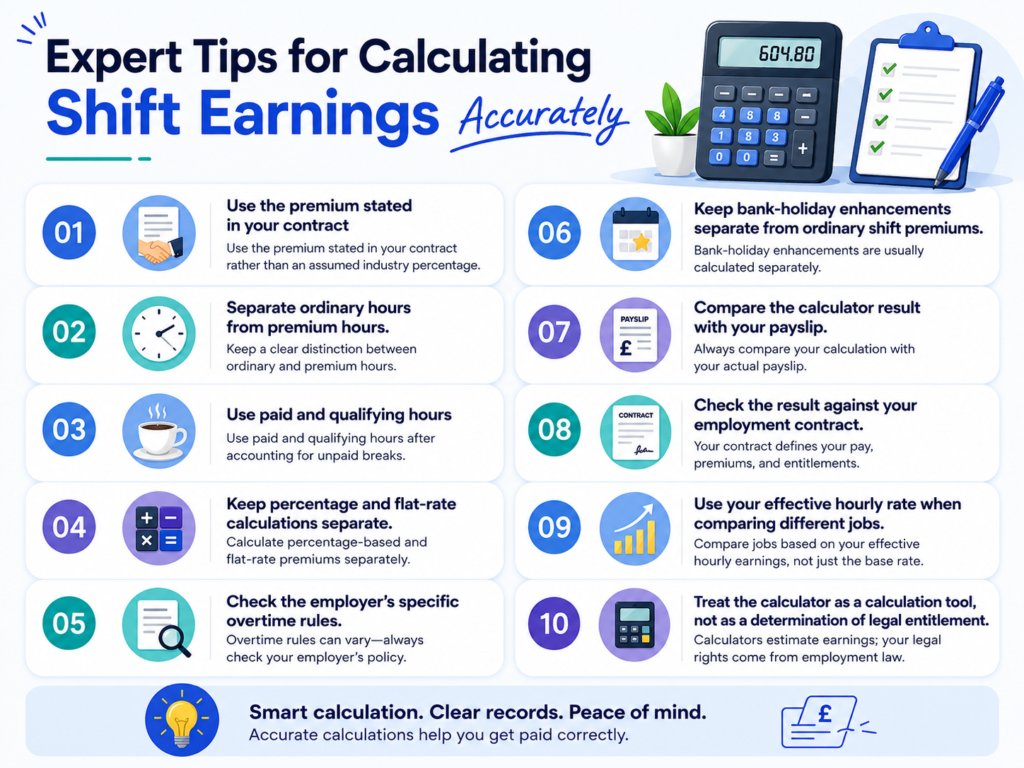
Expert Tips for Calculating Shift Earnings Accurately
- Use the premium stated in your contract rather than an assumed industry percentage.
- Separate ordinary hours from premium hours.
- Use paid and qualifying hours after accounting for unpaid breaks.
- Keep percentage and flat-rate calculations separate.
- Check the employer’s specific overtime rules.
- Keep bank-holiday enhancements separate from ordinary shift premiums.
- Compare the calculator result with your payslip.
- Check the result against your employment contract.
- Use your effective hourly rate when comparing different jobs.
- Treat the calculator as a calculation tool, not as a determination of legal entitlement.
What is shift differential pay?
Shift differential pay is additional compensation for qualifying shifts, such as certain night, evening or weekend hours. In the UK, the exact premium normally depends on the employer’s contractual arrangements rather than a universal statutory rate.
Is shift differential pay mandatory in the UK?
Generally, there is no universal legal requirement for employers to pay an additional premium simply because an employee works nights or weekends. The entitlement may come from the employment contract, workplace policy or collective agreement.
What is the difference between shift differential and shift allowance?
They can describe similar forms of enhanced shift pay, but terminology varies between employers. A shift allowance may be a fixed payment, while a shift premium or differential may be calculated as an additional amount or percentage of the base rate.
How do I calculate shift differential pay?
For a percentage premium, multiply the base hourly rate by the premium percentage to find the extra amount per hour. Add that amount to the base rate, then multiply the enhanced rate by the qualifying hours.
How do I calculate a percentage-based shift premium?
Use:
Extra premium = Base hourly rate × Premium percentage
Then:
Enhanced rate = Base hourly rate + Extra premium
For example, £15 per hour with a 20% premium gives an extra £3 per hour and an enhanced rate of £18.
How do I calculate a fixed shift allowance?
Add the fixed allowance to the base hourly rate.
For example, £14 per hour plus a £2 shift allowance gives an enhanced rate of £16 per hour for qualifying hours.
Is night shift pay higher in the UK?
It can be, if the employer provides a contractual night premium. There is no universal UK rule requiring every employer to pay more for night work.
Do weekend shifts have to be paid more?
Not automatically. Weekend or Sunday premiums depend on the employer’s contractual terms or workplace arrangements.
Do bank holidays automatically qualify for extra pay?
No. Enhanced bank-holiday pay depends on the applicable employment terms. Do not assume that bank-holiday work automatically means double pay.
Does shift differential count toward National Minimum Wage?
The treatment depends on the nature of the payment. Certain payments and premiums are treated differently for NMW purposes, so the label “shift allowance” alone is not enough to determine the treatment.
Does shift premium affect overtime pay?
It can, depending on the employer’s contractual overtime rules. There is no universal UK rule requiring every shift premium to be calculated using the US-style blended regular-rate approach.
Does shift allowance count toward holiday pay?
Regular shift-related earnings may be relevant to holiday pay, depending on the nature and regularity of the payment and the applicable holiday entitlement. The treatment should be checked against the relevant rules rather than assumed.
Is shift differential pay taxed?
Additional shift earnings are normally part of employment pay and can therefore affect PAYE Income Tax and National Insurance.
How can I check whether my employer calculated my shift pay correctly?
Compare your payslip with your employment contract. Check the base rate, premium, qualifying hours, overtime treatment and any exclusions. Then use the calculator to reproduce the arithmetic.
Can I calculate my effective hourly rate including shift premiums?
Yes. Add your normal and premium earnings together and divide by the total hours worked. This can be useful when comparing jobs with different base rates and shift patterns.
Conclusion
The Shift Differential Pay Calculator UK helps you quickly estimate how much extra you can earn for qualifying night, weekend, or other enhanced shifts. Enter your base rate, shift premium and qualifying hours to see your extra shift pay, enhanced hourly rate and total gross earnings.
Remember, shift premiums are generally contractual in the UK, so always compare your result with your employment contract or workplace pay policy.