
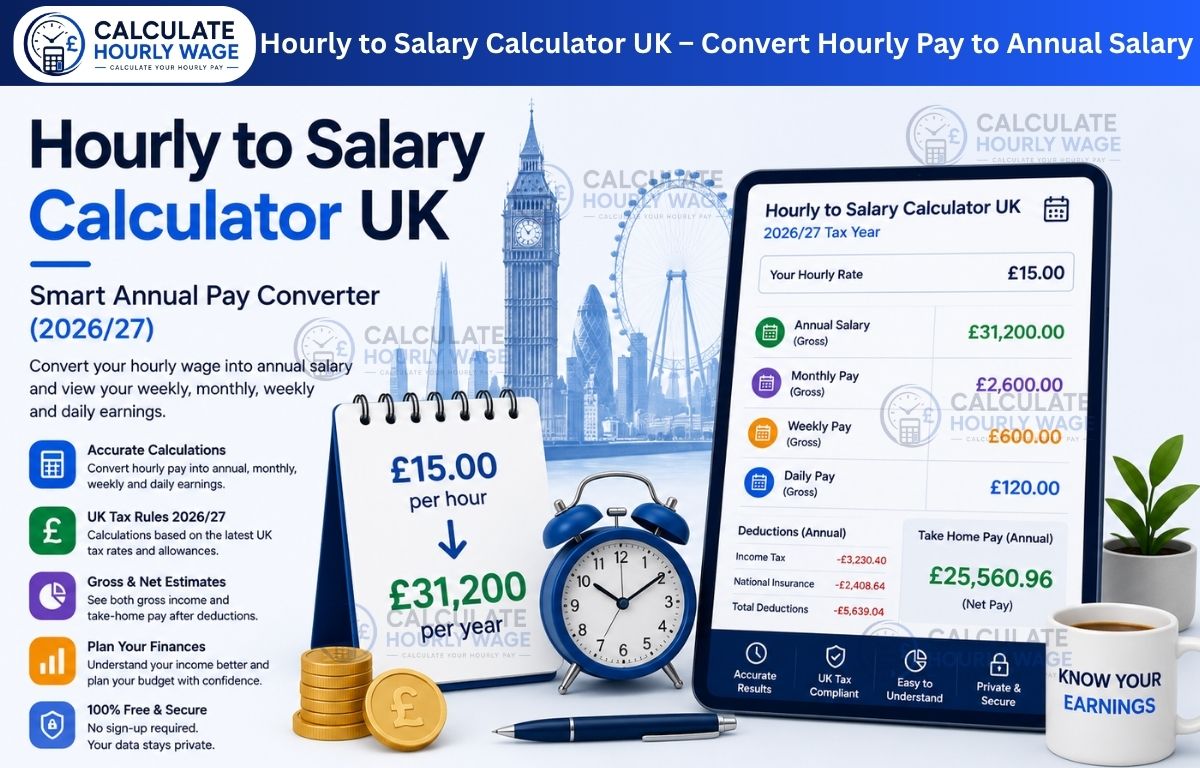
A job advert says £15 per hour and at first, it sounds easy to understand. You know what you will earn for each hour worked. However, when you start comparing that role with a £30,000 salaried position, planning your monthly bills or checking if you can afford a rental property, the hourly figure alone is not enough.
The real question is what does your hourly wage equal over a full year?
That answer depends on more than your hourly rate. Your weekly hours, paid holiday, unpaid breaks, overtime, pension contributions and tax deductions can all change the final figure. An Hourly to Salary Calculator UK gives you a clear view of your estimated yearly, monthly, weekly and daily earnings.
Use the calculator above to turn your hourly pay into an annual salary estimate. Then use this guide to understand exactly how the calculation works and what can affect your results.
Calculator
What Is an Hourly to Salary Calculator UK?
An Hourly to Salary Calculator UK converts your hourly wage into an estimated annual salary. It can also show your expected monthly, weekly and daily gross earnings.
| Item | Details |
|---|---|
| Formula | Annual Salary = Hourly Rate × Hours Per Week × Paid Weeks Per Year |
| Example | If you earn £15 per hour and work 37.5 hours each week for 52 paid weeks: £15 × 37.5 × 52 = £29,250 per year |
This is your estimated gross annual salary, which means your income before Income Tax, National Insurance, pension deductions, student loan repayments or other deductions.
How hourly pay converts into annual salary
Your hourly rate is only one part of the calculation. The final annual figure changes depending on:
- Your contracted weekly working hours
- The number of paid weeks you work each year
- Whether breaks are paid or unpaid
- Paid holiday entitlement
- Regular overtime
- Shift allowances or bonuses
- Unpaid leave or seasonal work
Someone earning £15 per hour for 40 hours each week will earn more annually than someone earning the same rate for 30 hours each week.
Who should use an hourly wage to salary calculator?
This calculator can be useful for:
- Full-time employees
- Part-time workers
- Agency staff
- Zero-hours contract workers
- Retail and hospitality workers
- Warehouse and delivery workers
- Care workers
- Construction workers
- Students with part-time jobs
- Freelancers estimating regular income
- Anyone comparing hourly and salaried job offers
Read More:Hourly Pay Calculator UKHourly to salary vs salary to hourly calculations
An hourly-to-salary calculation starts with your pay per hour and estimates your annual income.
A salary-to-hourly calculation works in reverse. It takes an annual salary and shows what it is worth per hour based on your working pattern.
Both calculations are useful when comparing job offers. A £32,000 annual salary sounds higher than £15 per hour, but the better option depends on contracted hours, holiday entitlement, overtime and benefits.
Why Converting Hourly Pay to Annual Salary Matters in the UK
Hourly pay can look simple on a payslip or job advert. However, annual salary is often the figure used for financial planning, job comparisons and affordability checks.
Compare job offers with confidence.
Imagine you are choosing between two roles:
| Job Offer | Pay Structure | Working Pattern | Estimated Annual Gross Pay |
|---|---|---|---|
| Job A | £16 per hour | 37.5 hours per week | £31,200 |
| Job B | £30,500 salary | Full-time | £30,500 |
At first, Job B may appear more stable because it has a fixed salary. However, Job A could offer a higher gross annual income if the hours are guaranteed and all 52 weeks are paid.
On the other hand, Job B may include better pension contributions, sick pay, paid leave or bonuses. This is why converting hourly pay into annual salary is only the first step.
Plan monthly budgets, savings and bills.
Many household costs are monthly. Rent, mortgage payments, utility bills, subscriptions, transport and savings goals are easier to manage when you know your likely monthly income.
Once you have estimated your annual salary, you can calculate:
| Item | Details |
|---|---|
| Formula | Monthly Gross Pay = Annual Salary ÷ 12 |
| Example | £29,250 ÷ 12 = £2,437.50 per month before deductions |
Your actual take-home pay will be lower after tax and other deductions, but knowing your gross annual salary gives you a useful starting point.
Understand your full-time equivalent earnings.
Part-time workers often need to understand their full-time equivalent salary, especially when comparing roles.
For example, earning £18 per hour for 20 hours per week gives a different annual income from earning £18 per hour for 37.5 hours per week.
The hourly rate stays the same. The annual salary changes because the number of paid hours changes.
Check whether your pay matches expectations
An annual salary estimate can help you spot issues such as:
- Fewer guaranteed hours than expected
- Unpaid breaks reducing paid hours
- Unpaid holiday affecting yearly income
- Overtime being treated as optional rather than guaranteed
- A job offer sounding better than it is in practice
How the Hourly to Salary Calculator UK Works
The calculator uses your hourly rate, weekly working hours and number of paid weeks per year to estimate your earnings.
Information you need before calculating your salary
| Input | Details |
|---|---|
| Hourly Rate | Enter the amount you earn for each paid hour worked. For example: £12.21 per hour, £14 per hour, £15.50 per hour, £20 per hour. Use your normal contracted rate unless you are specifically calculating overtime or shift work. |
| Weekly Working Hours | Enter the number of paid hours you work each week. This is important because unpaid breaks should not usually be included. For example: If you are at work for 40 hours each week but receive five unpaid one-hour lunch breaks, your paid weekly hours may be 35 rather than 40. |
| Paid Weeks Per Year | Most full-time employees with paid annual leave can use 52 weeks. However, you may need to use fewer weeks if you: Have unpaid holiday, Work seasonally, have unpaid time off, are on a zero-hours contract, Work only during school terms, or have irregular agency shifts. |
The hourly to annual salary formula
Use this formula:
| Item | Details |
|---|---|
| Formula | Annual Salary = Hourly Rate × Weekly Hours × Paid Weeks |
| Example | £18 × 37.5 hours × 52 weeks = £35,100 per year |
Formula for monthly, weekly and daily earnings
After calculating annual salary, you can estimate other pay periods.
| Pay Period | Formula |
|---|---|
| Weekly pay | Hourly rate × weekly hours |
| Monthly gross pay | Annual salary ÷ 12 |
| Four-weekly pay | Weekly pay × 4 |
| Daily pay | Weekly pay ÷ days worked per week |
These figures are gross estimates before deductions.
How to Calculate Annual Salary From an Hourly Wage Manually
You do not always need a calculator for a quick estimate. You can calculate your annual salary manually in three steps.
| Step | Details |
|---|---|
| Step 1: Multiply your hourly rate by weekly working hours | If you earn £15 per hour and work 37.5 hours each week: £15 × 37.5 = £562.50 per week |
| Step 2: Multiply weekly pay by paid weeks per year | If you are paid for 52 weeks: £562.50 × 52 = £29,250 per year |
| Step 3: Convert annual salary into monthly pay | £29,250 ÷ 12 = £2,437.50 per month before deductions |
| Quick hourly wage to annual salary calculation example | A worker earns £20 per hour and works 35 paid hours each week. £20 × 35 = £700 weekly gross pay £700 × 52 = £36,400 annual gross pay £36,400 ÷ 12 = £3,033.33 monthly gross pay |
Hourly Wage to Salary UK Conversion Table
The tables below use 52 paid weeks per year and show gross annual earnings before deductions.
Annual salary based on a 35-hour working week
| Hourly Rate | Weekly Pay | Annual Salary |
|---|---|---|
| £12.21 | £427.35 | £22,222.20 |
| £13 | £455 | £23,660 |
| £14 | £490 | £25,480 |
| £15 | £525 | £27,300 |
| £18 | £630 | £32,760 |
| £20 | £700 | £36,400 |
| £25 | £875 | £45,500 |
Annual salary based on a 37.5-hour working week
| Hourly Rate | Weekly Pay | Annual Salary |
|---|---|---|
| £12.21 | £457.88 | £23,809.50 |
| £13 | £487.50 | £25,350 |
| £14 | £525 | £27,300 |
| £15 | £562.50 | £29,250 |
| £18 | £675 | £35,100 |
| £20 | £750 | £39,000 |
| £25 | £937.50 | £48,750 |
Annual salary based on a 40-hour working week
| Hourly Rate | Weekly Pay | Annual Salary |
|---|---|---|
| £12.21 | £488.40 | £25,396.80 |
| £13 | £520 | £27,040 |
| £14 | £560 | £29,120 |
| £15 | £600 | £31,200 |
| £18 | £720 | £37,440 |
| £20 | £800 | £41,600 |
| £25 | £1,000 | £52,000 |
Hourly rate to monthly salary comparison table
| Hourly Rate | 35 Hours Per Week | 37.5 Hours Per Week | 40 Hours Per Week |
|---|---|---|---|
| £12.21 | £1,851.85 | £1,984.13 | £2,116.40 |
| £15 | £2,275 | £2,437.50 | £2,600 |
| £18 | £2,730 | £2,925 | £3,120 |
| £20 | £3,033.33 | £3,250 | £3,466.67 |
| £25 | £3,791.67 | £4,062.50 | £4,333.33 |
Read More: gov.ukExamples: Convert Hourly Pay to Salary in Different UK Work Scenarios
Example 1: £12.21 per hour for 37.5 hours a week
| Item | Details |
|---|---|
| Annual Gross Pay | £12.21 × 37.5 × 52 = £23,809.50 per year |
| Monthly Gross Pay | £23,809.50 ÷ 12 = £1,984.13 |
This assumes all 52 weeks are paid and there is no unpaid leave.
Example 2: £15 per hour for 40 hours a week
| Item | Details |
|---|---|
| Annual Gross Pay | £15 × 40 × 52 = £31,200 per year |
| Monthly Gross Pay | £31,200 ÷ 12 = £2,600 |
If your lunch breaks are unpaid, make sure 40 hours represents actual paid hours rather than time spent at work.
Example 3: £20 per hour for 35 hours a week
£20 × 35 × 52 = £36,400 per year
This may be a useful comparison against a salaried role offering around £36,000 per year.
Example 4: Part-time worker earning £14 per hour
A part-time worker earns £14 per hour and works 24 hours each week.
£14 × 24 = £336 weekly pay
£336 × 52 = £17,472 annual gross pay
This is a more realistic figure than comparing the hourly rate with a full-time salary.
Example 5: Zero-hours contract worker with changing weekly hours
A worker earns £13.50 per hour but works different hours each week. Over the year, their average is 22 hours per week.
£13.50 × 22 × 52 = £15,444 annual gross estimate
For zero-hours workers, it is usually better to calculate several scenarios:
| Average Weekly Hours | Estimated Annual Gross Pay at £13.50 Per Hour |
|---|---|
| 15 hours | £10,530 |
| 20 hours | £14,040 |
| 25 hours | £17,550 |
| 30 hours | £21,060 |
This helps you plan for quieter periods rather than relying on your busiest month.
How Many Working Weeks Should You Use in Your Calculation?
The default figure is often 52 weeks, but it is not always correct.
Using 52 paid weeks per year
Use 52 weeks if you are employed throughout the year and receive paid annual leave.
Most permanent employees can use this figure because paid holiday is included in their employment arrangement.
Calculating salary when holiday is unpaid
If you take unpaid holiday, reduce the number of weeks used in your calculation.
For example, if you work 48 paid weeks:
£15 × 37.5 × 48 = £27,000 per year
That is £2,250 lower than the same role calculated over 52 paid weeks.
How annual leave affects hourly to salary calculations
Some hourly-paid workers receive holiday pay separately. Others have holiday pay included in their normal pay arrangement.
Check your contract or payslip to understand whether holiday pay is:
- Paid when you take leave
- Rolled up into your hourly rate
- Paid separately
- Unpaid
Bank holidays, sick pay and paid leave considerations
Bank holidays do not automatically mean extra paid leave for every worker. Your contract should explain whether they are included in your annual leave entitlement.
Sick pay can also vary. Some employers offer contractual sick pay, while others only provide statutory sick pay where eligible.
These details can affect the true value of a job even if the hourly rate looks attractive.
Hourly Pay Before Tax vs Take-Home Salary After Tax
Your hourly-to-salary result normally shows gross pay, not the amount that reaches your bank account.
Gross annual salary explained
Gross annual salary is your earnings before deductions.
It may include:
- Basic hourly pay
- Guaranteed overtime
- Shift allowances
- Regular bonuses
- Commission, where predictable
Estimated Income Tax and National Insurance deductions
Your take-home pay can be reduced by:
- Income Tax
- National Insurance contributions
- Workplace pension contributions
- Student loan repayments
- Salary sacrifice arrangements
- Other deductions shown on your payslip
The exact amount depends on your personal circumstances, tax code, pension arrangement, student loan plan and whether you live in Scotland.
For a more realistic monthly budget, calculate your gross annual salary first and then use a UK take-home pay calculator.
Why your take-home pay may be lower than expected
A higher hourly rate does not mean you keep every extra pound.
As earnings increase, deductions may increase too. Overtime, bonuses and extra shifts can raise gross pay, but they may also affect Income Tax, National Insurance and student loan repayments.
When pension contributions and student loans affect net pay
Pension contributions can reduce take-home pay now, but they also help build retirement savings.
Student loan repayments usually begin only after earnings exceed the relevant repayment threshold. The amount depends on your repayment plan and income.
Full-Time, Part-Time and Overtime Hourly Salary Calculations
| Scenario | Details |
|---|---|
| Full-Time Hourly Wage to Annual Salary | A full-time UK working week is often between 35 and 40 hours, although contracts vary. For a standard 37.5-hour week: £16 × 37.5 × 52 = £31,200 per year |
| Part-Time Hourly Wage to Annual Salary | Part-time calculations use the same formula. The only difference is your weekly hours. For example: £16 × 20 × 52 = £16,640 per year |
| Including Regular Overtime in Annual Earnings | If overtime is genuinely regular and expected, you can calculate it separately. For example: A worker earns £18 per hour and works 10 overtime hours each month at time and a half. £18 × 1.5 = £27 overtime rate £27 × 10 = £270 overtime per month £270 × 12 = £3,240 annual overtime pay. Add this to your normal annual salary only if the overtime is consistent. |
Why overtime should not always be treated as guaranteed salary
Overtime can disappear when staffing levels change, demand slows or your employer changes schedules.
When applying for a mortgage, renting a property or setting a long-term budget, it is safer to separate:
- Guaranteed contracted pay
- Regular but variable overtime
- Occasional overtime
- Bonuses and commission
Read More:Overtime Pay Calculator UKMinimum Wage and Living Wage Considerations in the UK
Your hourly rate should always meet the legal minimum that applies to you.
Check your hourly pay against the National Minimum Wage.
Minimum wage rules can depend on your age, apprenticeship status and employment type. Rates can also change each tax year.
Check your actual paid hours carefully. Unpaid time spent working, required training or certain travel between jobs may affect whether your average pay meets the legal minimum.
National Living Wage and age-based pay rates
The National Living Wage applies to eligible adult workers, while lower minimum wage rates may apply to younger workers and apprentices.
If you are unsure whether your hourly pay is compliant, compare your payslip, contract and actual working hours rather than relying only on the figure shown in a job advert.
What to do if your hourly pay is below the legal minimum
Start by checking:
- Your hourly rate
- Paid and unpaid working time
- Deductions from wages
- Whether uniforms or work equipment affect your pay
- Your employment status and age category
If the figures still appear wrong, raise the issue with your employer or seek independent employment advice.
Read More:National Insurance Calculator UKComparing Hourly Pay With a Salaried Job Offer
Hourly pay and salaried pay should not be compared using annual income alone.
Hourly wage vs annual salary: key differences
| Factor | Hourly-Paid Role | Salaried Role |
|---|---|---|
| Pay certainty | Can vary with hours worked | Usually fixed monthly pay |
| Overtime | May be paid separately | May be unpaid or included |
| Holiday pay | Depends on contract | Usually included |
| Income during quiet periods | May reduce | Usually stays stable |
| Flexibility | Often higher | Can be lower |
| Budgeting | Can be less predictable | Usually easier |
Benefits that can change the value of a job offer
| Factor | Details |
|---|---|
| Paid Holiday Entitlement | A slightly lower hourly rate with generous paid leave can be more valuable than a higher rate with unpaid holiday. |
| Pension Contributions | Employer pension contributions add value beyond your basic pay. |
| Sick Pay and Family Leave Benefits | Enhanced sick pay, maternity pay, paternity pay, and parental leave can make a salaried role more secure. |
| Overtime Pay and Shift Allowances | Some hourly roles offer time-and-a-half, double time, night premiums, or weekend allowances. These can significantly improve earnings when they are consistent. |
Questions to ask before accepting an hourly or salaried role
- How many hours are guaranteed each week?
- Are breaks paid?
- Is holiday pay included, separate or unpaid?
- Is overtime optional or expected?
- What overtime rate applies?
- Are there shift allowances?
- What pension contribution does the employer make?
- Is sick pay available beyond statutory pay?
- Are bonuses guaranteed or discretionary?
Common Mistakes When Converting Hourly Wage to Annual Salary
| Common Mistake | Explanation |
|---|---|
| Forgetting to Use the Correct Weekly Working Hours | Do not automatically use 40 hours. Use the number of paid hours in your contract. |
| Assuming All 52 Weeks Are Paid | This may not apply if you have unpaid holidays, seasonal work or irregular shifts. |
| Including Irregular Overtime as Guaranteed Income | Overtime can be useful for estimating your best-case earnings, but it should not always be treated as your reliable annual salary. |
| Confusing Gross Salary With Take-Home Pay | Your annual salary estimate is normally before tax. Your bank account receives net pay after deductions. |
| Ignoring Unpaid Breaks and Unpaid Leave | A 40-hour working week may include unpaid lunch breaks. Always calculate using paid hours. |
Tips for Getting a More Accurate Hourly to Salary Estimate
- Use your contracted paid hours, not just your time at work.
- Check whether holiday pay is included in your hourly rate.
- Calculate guaranteed income separately from overtime and bonuses.
- Review your employment contract before comparing job offers.
- Use 52 weeks only when you are paid throughout the year.
- Check whether shift premiums apply to every shift or only certain hours.
- Use a take-home pay calculator after finding your gross annual salary.
- Recalculate after a pay rise, contract change or change in working hours.
Related Salary Calculators for UK Employees
After calculating your annual salary, you may also find these tools useful:
- Salary to Hourly Calculator UK
- Annual Salary to Monthly Pay Calculator
- Hourly Rate to Daily Rate Calculator
- Pro Rata Salary Calculator UK
- Take-Home Pay Calculator UK
- Overtime Pay Calculator UK
- Holiday Pay Calculator UK
How do I convert an hourly wage to an annual salary in the UK?
Multiply your hourly rate by your weekly paid hours and then multiply the result by the number of paid weeks in the year.
Hourly rate × weekly hours × paid weeks = annual salary
What is £15 an hour as a yearly salary in the UK?
At 37.5 hours per week for 52 paid weeks, £15 per hour equals £29,250 per year before deductions.
At 40 hours per week, it equals £31,200 per year before deductions.
What is £12.21 an hour annually for a 37.5-hour week?
£12.21 per hour for 37.5 hours per week over 52 paid weeks equals £23,809.50 per year before deductions.
How much is £20 per hour a year in the UK?
At 37.5 hours per week, £20 per hour equals £39,000 per year.
At 40 hours per week, it equals £41,600 per year.
Do I multiply my hourly wage by 52 weeks?
Use 52 weeks if you are paid throughout the year, including paid holiday. Use fewer weeks if you have unpaid leave, unpaid holiday or seasonal work.
Should I include paid holiday when calculating annual salary?
Yes, if your employer pays you during annual leave. If the holiday is unpaid, reduce the number of paid weeks in your calculation.
How do unpaid breaks affect my hourly to salary calculation?
Unpaid breaks reduce your paid hours. If your contract says you work 40 hours at the workplace but includes five unpaid lunch hours, your paid hours may only be 35 per week.
Does overtime count towards my annual salary?
It can increase your annual earnings, but only include it as guaranteed income if it is regular and reliable. Occasional overtime should be treated separately.
Is annual salary calculated before or after tax?
Hourly-to-salary calculations normally show gross annual salary before Income Tax, National Insurance, pension contributions and other deductions.
How can I calculate my monthly salary from an hourly rate?
First calculate your annual salary, then divide it by 12.
For example, £29,250 per year equals £2,437.50 gross per month.
Calculate Your UK Annual Salary From an Hourly Rate Accurately
An hourly rate tells you what you earn for one hour. An annual salary estimate shows what that rate could mean for your wider financial life.
Use your actual paid hours, check whether all weeks are paid, and keep guaranteed income separate from overtime or bonuses. Once you know your gross annual salary, you can make clearer decisions about job offers, budgeting and plans.