
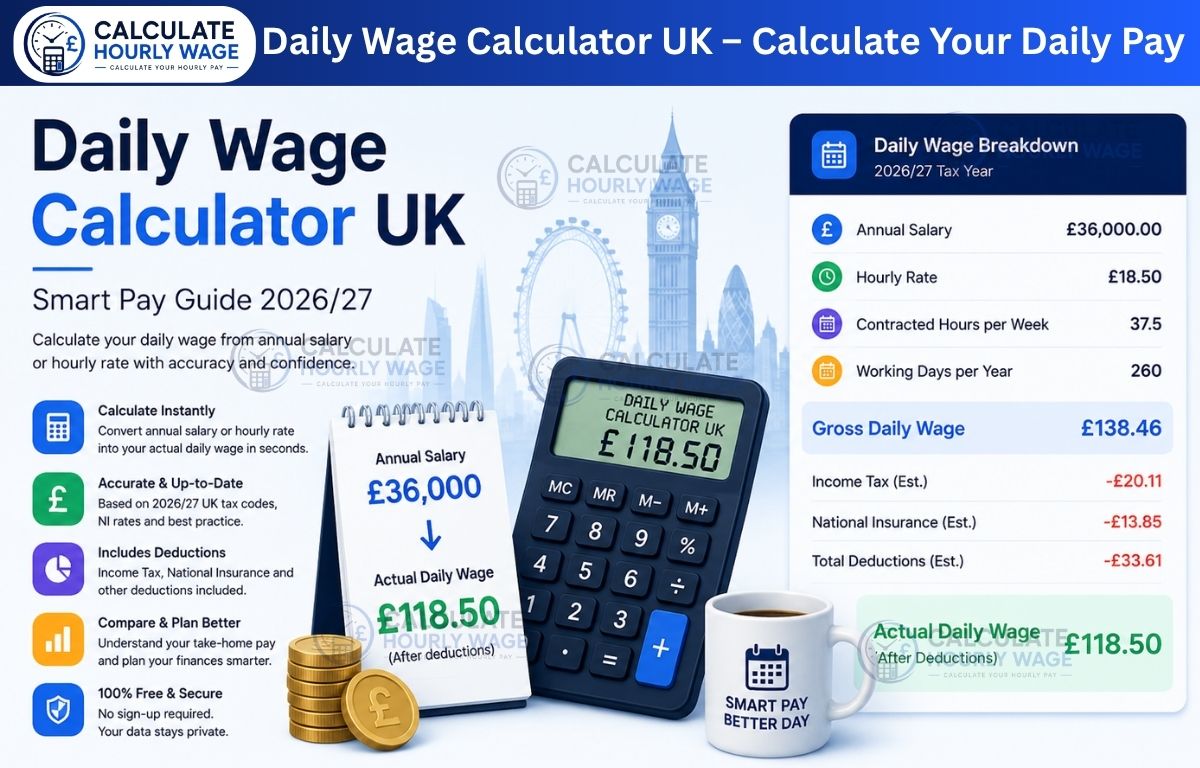
Imagine you’ve received two job offers.
The first promises an annual salary of £36,000, while the second displays an hourly rate of £18.50. At first, both opportunities seem attractive. However, once you start comparing your actual working days, overtime opportunities, and monthly expenses, one important question quickly comes to mind.
How much will I actually earn each day?
That’s where a Daily Wage Calculator UK becomes incredibly useful. Instead of manually converting annual salaries or hourly rates into daily earnings, the calculator performs the calculations for you in seconds. It can even estimate gross and net daily pay by taking payroll deductions into account.
Calculator
What Is a Daily Wage Calculator UK?
A Daily Wage Calculator UK is an online tool that estimates how much you earn for each working day based on your salary or hourly pay.
Instead of relying on rough calculations, the tool converts different pay types, including annual salaries, monthly salaries, weekly wages, or hourly rates into an estimated daily income.
Many calculators also account for deductions such as:
- Income Tax
- National Insurance Contributions (NIC)
- Workplace pension contributions
- Student Loan repayments (where applicable)
As a result, you can estimate both your gross daily wage and your net daily take-home pay.
What Does Daily Wage Mean?
Your daily wage is the amount you earn for one working day.
There are two ways to look at daily earnings:
- Gross Daily Wage – your earnings before any deductions.
- Net Daily Wage – the amount you actually receive after Income Tax, National Insurance, pension contributions, and other payroll deductions.
While employers usually advertise gross pay, your net daily wage is the figure that reflects your real spending power.
How Daily Earnings Are Calculated
The way your daily wage is calculated depends on how you’re paid.
If you’re on an annual salary, the calculation is usually based on the number of working days in a year.
| Item | Details |
|---|---|
| Formula | Daily Wage = Annual Salary ÷ Working Days Per Year |
| Example | Annual Salary: £39,000 Working Days: 260 £39,000 ÷ 260 = £150 per day (Gross) |
| If You’re Paid Monthly | Daily Wage = Monthly Salary ÷ Average Working Days Per Month |
| If You’re Paid Hourly | Daily Wage = Hourly Rate × Hours Worked Per Day |
Although these formulas seem simple, calculating take-home pay becomes more complex once payroll deductions are included. That’s why many people choose to use a dedicated calculator.
Read More: gov.ukWhy Use a Daily Wage Calculator?
Your daily wage can answer questions that annual salary figures cannot.
For example:
- How much money do you earn each working day?
- What is the value of one day’s annual leave?
- How much income would you lose from unpaid leave?
- Which job offer pays more per working day?
- Is working overtime financially worthwhile?
Instead of making rough estimates, a calculator provides fast and consistent answers based on your earnings.
How Does the Daily Wage Calculator UK Work?
- Although the calculations behind the scenes involve several payroll variables, using the calculator is simple.
- Most tools only require a few pieces of information before generating your estimated daily earnings.
| Step | Details |
|---|---|
| Step 1: Enter Your Salary or Hourly Rate | Enter your current pay. Depending on how you’re employed, this could be an annual salary, a monthly salary, weekly pay, or an hourly wage. For example: Annual Salary: £42,000 Monthly Salary: £3,500 Hourly Rate: £20 This figure becomes the foundation for all further calculations. |
| Step 2: Select Your Pay Frequency | Choose how you’re normally paid. Most calculators support annual, monthly, weekly, and hourly pay. Selecting the correct pay frequency ensures your daily wage is calculated accurately. For example, converting an annual salary requires a different approach than converting an hourly wage. |
| Step 3: Enter Working Days or Hours | Enter your typical working schedule, including hours worked each day, days worked each week, and working weeks per year. For example someone working five days a week will have more working days each year than someone working four days a week. These details help to make a more accurate estimate. |
| Step 4: View Your Estimated Daily Wage | After processing your information, the calculator displays an estimate of your daily earnings. Depending on the tool, you may see gross daily wage, estimated net daily wage, Income Tax deductions, National Insurance contributions, pension deductions, and total annual, monthly, and daily earnings. |
Rather than spending time performing manual calculations, you’ll have a clear picture of your daily income within seconds.
Why Use a Daily Wage Calculator UK?
- A daily wage may seem like a small number compared to your annual salary, but it can answer many practical financial questions.
- Instead of thinking about your earnings over an entire year, you can understand exactly what one working day is worth.
- This makes financial planning much easier.
Track Daily Income
- Knowing your daily earnings allows you to take a record of your income more effectively.
- For example, if you work additional days during the month, you can quickly estimate how much those extra shifts will add to your pay.
- Similarly, if you take unpaid leave, you’ll have a clearer idea of how much income you’ll temporarily lose.
Compare Job Offers
- Annual salaries don’t always tell the whole story.
- Two employers might offer similar salaries, but they require different working schedules.
For example:
| Job Offer | Annual Salary | Working Days | Gross Daily Wage |
| Company A | £36,000 | 260 | £138.46 |
| Company B | £36,000 | 230 | £156.52 |
Although both jobs pay the same annual salary, Company B offers a higher daily earning because you work fewer days.
This type of comparison can help you to evaluate work-life balance alongside income.
Budget Your Finances
Many household expenses occur daily rather than yearly.
Food, transport, childcare, and commuting costs are easier to compare with your daily income than your annual salary.
| Example | Details |
|---|---|
| Daily Commute Cost | £12 |
| Daily Wage | £160 |
| Calculation | Transportation consumes around 7.5% of your daily earnings. |
Estimate Leave or Overtime Value
Understanding your daily wage is particularly useful when calculating:
- Annual leave value
- Unpaid leave deductions
- Sick leave estimates
- Overtime opportunities
- Temporary reduced working hours
Instead of guessing, you can estimate the financial impact before making a decision.
What Information Do You Need?
- A Daily Wage Calculator UK only needs a few key details to generate an accurate estimate.
- The more accurate your information, the more reliable the result.
Annual, Monthly, or Hourly Pay
Most calculators accept different types of pay.
For example:
- Annual salary
- Monthly salary
- Weekly wage
- Hourly rate
The calculator converts whichever pay type you enter into an estimated daily wage.
Read More: Salary to Hourly Calculator UKHours Worked Per Day
Not all employees work the same number of hours.
Some typical schedules include:
| Working Pattern | Daily Hours |
| Full-Time | 7.5 |
| Full-Time | 8 |
| Part-Time | 5 |
| Casual Worker | Variable |
These working hours become important when calculating daily earnings from an hourly rate.
Days Worked Per Week
Your weekly schedule affects the number of working days in a year.
Common examples include:
- 5-day week
- 4-day week
- 3-day week
- Rotating shifts
Using the correct working pattern ensures more realistic daily wage estimates.
Pay Type (Gross or Net)
Many calculators allow you to choose whether you’d like to estimate:
- Gross daily earnings
- Net daily earnings
Gross pay represents your salary before deductions.
Net pay reflects the amount you actually receive after payroll deductions.
What Can Affect Your Daily Wage?
Two employees earning the same annual salary may still have different daily wages.
Many factors affect the final result.
Working Hours
Someone working 35 hours per week will usually have a different hourly value than someone working 40 hours, even if their salaries appear similar.
Working schedules matter.
Overtime Pay
Regular overtime can significantly increase daily earnings.
| Item | Details |
|---|---|
| Example | Suppose your hourly rate is £18 and you work 8 hours per day. |
| Hourly Rate | £18 |
| Daily Hours | 8 |
| Standard Daily Pay | £18 × 8 = £144 |
| Overtime Hours | 2 |
| Overtime Rate | £18 × 1.5 = £27 per overtime hour |
| Daily Total | £144 + (£27 × 2) = £198 |
| Increase in Daily Earnings | £54 in a single day |
Bonuses and Allowances
Some employees regularly receive:
- Performance bonuses
- Shift allowances
- Travel allowances
- Location pay
- Commission
Although these payments aren’t always included in standard salary calculations, they can noticeably increase average daily earnings.
Read More:Bonus Tax Calculator UKTax and Payroll Deductions
Your gross daily wage isn’t necessarily the amount you’ll receive.
Payroll deductions may include:
- Income Tax
- National Insurance Contributions
- Workplace pension
- Student Loan repayments
- Salary sacrifice arrangements
This is why gross and net daily earnings often differ.
Daily Wage Calculation Examples
Let’s look at some realistic scenarios.
Annual Salary to Daily Wage
| Item | Details |
|---|---|
| Example | Imagine Sarah earns: |
| Annual Salary | £40,000 |
| Working Days Per Year | 260 |
| Calculation | £40,000 ÷ 260 = £153.85 Gross Daily Wage |
Monthly Salary to Daily Wage
| Item | Details |
|---|---|
| Example | David earns: |
| Monthly Salary | £3,200 |
| Average Working Days Per Month | 21.67 |
| Calculation | £3,200 ÷ 21.67 ≈ £147.67 Gross Daily Wage |
Hourly Rate to Daily Wage
| Item | Details |
|---|---|
| Example | Emma earns: |
| Hourly Rate | £19 |
| Works | 8 hours per day |
| Standard Daily Wage | £19 × 8 = £152 Daily Wage |
| Overtime Hours | 1 |
| Overtime Rate | £19 × 1.5 = £28.50 |
| New Daily Earnings | £152 + £28.50 = £180.50 |
Gross Daily Wage vs Net Daily Wage
- Many employees confuse these two figures.
- Understanding the difference prevents unrealistic expectations.
Gross Daily Wage Explained
- Gross daily wage is your earnings before deductions.
- It includes your contractual pay but does not account for Income Tax, National Insurance, pensions, or other payroll deductions.
- Employers typically advertise salaries using gross pay.
Net Daily Wage Explained
- Net daily wage is the amount deposited into your bank account after deductions.
- This is the figure that matters most for budgeting and personal spending.
- Although it varies between individuals, net pay is almost always lower than gross pay.
Quick Comparison Table
| Feature | Gross Daily Wage | Net Daily Wage |
| Before Tax | ✔ | ✘ |
| After Tax | ✘ | ✔ |
| Includes Pension Deductions | No | Yes |
| Used in Job Offers | Yes | No |
| Actual Take-Home Pay | No | Yes |
Applying Daily Wage Calculations in Real Life
Once you know your daily earnings, financial decisions become much easier.
You can estimate the cost of taking unpaid leave, compare employment offers based on working schedules rather than salary alone, or understand whether overtime is worth accepting.
Instead of looking only at yearly income, a daily wage gives you a practical measure of what each working day contributes to your financial goals.
Who Can Benefit from a Daily Wage Calculator UK?
A Daily Wage Calculator UK is useful for converting a salary into a daily figure. It helps to understand your earnings, compare opportunities and make better financial decisions.
If you’re employed full-time, working freelance projects or managing payroll for a business, knowing your daily wage provides valuable financial insight.
Employees
| Who Can Benefit? | How a Daily Wage Calculator Helps |
|---|---|
| Employees | Estimate the value of annual leave, calculate the impact of unpaid leave, understand how salary increases affect daily income, compare job opportunities, and plan monthly spending more effectively. |
| Freelancers and Contractors | Convert annual income goals into daily rates, compare contract offers, price new projects, monitor average daily earnings, and identify the number of billable days needed to reach an annual income target. |
| Part-Time Workers | Estimate daily, weekly, and monthly earnings, and understand the financial benefit of taking additional shifts. |
| Employers and Payroll Teams | Estimate employee costs, calculate unpaid leave deductions, process payroll more accurately, explain salary calculations, and reduce payroll errors. |
Common Mistakes When Calculating Daily Earnings
Although calculating daily pay seems simple, but some common mistakes can lead to inaccurate results.
Avoiding these errors helps ensure your estimate is as reliable as possible.
Using the Wrong Number of Working Days
| Common Mistake | Explanation |
|---|---|
| Using the Wrong Number of Working Days | Dividing an annual salary by 365 days instead of working days can significantly underestimate your daily wage. For example, 5 working days per week × 52 weeks = 260 working days. |
| Confusing Gross Pay with Net Pay | Gross Daily Wage is before deductions, while Net Daily Wage is after deductions such as Income Tax, National Insurance, pension contributions, and other payroll adjustments. Understanding the difference helps with realistic budgeting. |
| Ignoring Overtime and Bonuses | Excluding overtime, shift allowances, commissions, or regular bonuses can produce an inaccurate estimate. Include consistent additional earnings where possible for a more realistic average daily income. |
| Choosing the Wrong Pay Frequency | Entering a monthly salary as an annual salary, or vice versa, can dramatically affect the result. Always confirm whether you’re entering annual salary, monthly salary, weekly pay, or hourly wage. |
| Forgetting Tax Deductions | Income Tax, National Insurance, workplace pension, Student Loan repayments, and salary sacrifice arrangements all reduce your take-home pay. If you’re budgeting for everyday expenses, using net daily earnings is often more practical. |
Tips for Getting More Accurate Daily Wage Estimates
Although online calculators provide quick estimates but the quality of the result depends on the information you enter.
Following these simple tips can improve accuracy.
Use Your Latest Salary Information
Always use your current salary or hourly rate.
If you’ve recently received:
- A pay rise
- A promotion
- An annual salary review
Update your figures before calculating your daily wage.
Include Regular Overtime
If overtime is a consistent part of your income, including it provides a more realistic estimate of your average daily earnings.
However, occasional overtime should usually be calculated separately.
Check Your Working Schedule
Confirm:
- Hours worked each day.
- Days worked each week.
- Paid working weeks each year.
Even small changes in your working pattern can affect your calculated daily wage.
Review Payroll Deductions
To estimate your net daily earnings more accurately, include any regular deductions such as:
- Income Tax
- National Insurance Contributions
- Workplace pension contributions
- Student Loan repayments
- Salary sacrifice arrangements
This provides a clearer picture of your actual take-home pay.
How do I calculate my daily wage in the UK?
The calculation depends on how you’re paid.
For an annual salary:
Daily Wage = Annual Salary ÷ Working Days Per Year
For hourly pay:
Daily Wage = Hourly Rate × Hours Worked Per Day
A Daily Wage Calculator UK performs these calculations automatically and can also estimate deductions.
Can I convert my annual salary into a daily wage?
Yes.
Simply divide your annual salary by the number of working days in a year. Many UK employees use approximately 260 working days, although your actual figure depends on your work schedule and contract.
Does the calculator work for hourly paid employees?
Absolutely.
If you’re paid by the hour, simply enter your hourly rate along with the number of hours you work each day. The calculator will estimate your daily earnings accordingly.
Is the daily wage calculated before or after tax?
Most calculators allow you to estimate both:
Gross Daily Wage (before deductions)
Net Daily Wage (after Income Tax, National Insurance, pension contributions, and other deductions)
This gives you a more complete understanding of your earnings.
Can I calculate both gross and net daily earnings?
Yes.
Many modern salary calculators display both figures, allowing you to compare contractual pay with your estimated take-home income.
How many working days are typically used in UK salary calculations?
For a standard five-day working week:
5 days × 52 weeks = approximately 260 working days
However, your actual number of working days may differ depending on:
Part-time schedules
Shift patterns
Compressed working weeks
Contractual arrangements
Using your own working pattern produces the most accurate estimate.
Final Thoughts
Knowing your daily earnings provides a clearer understanding of what your time is worth. A Daily Wage Calculator UK makes it easy to convert annual salaries, monthly pay, or hourly rates into meaningful daily figures while helping you estimate both gross and net earnings.
Whether you’re planning a budget, comparing job offers, calculating leave, or simply checking your pay, understanding your daily wage empowers you to make smarter financial decisions with confidence.