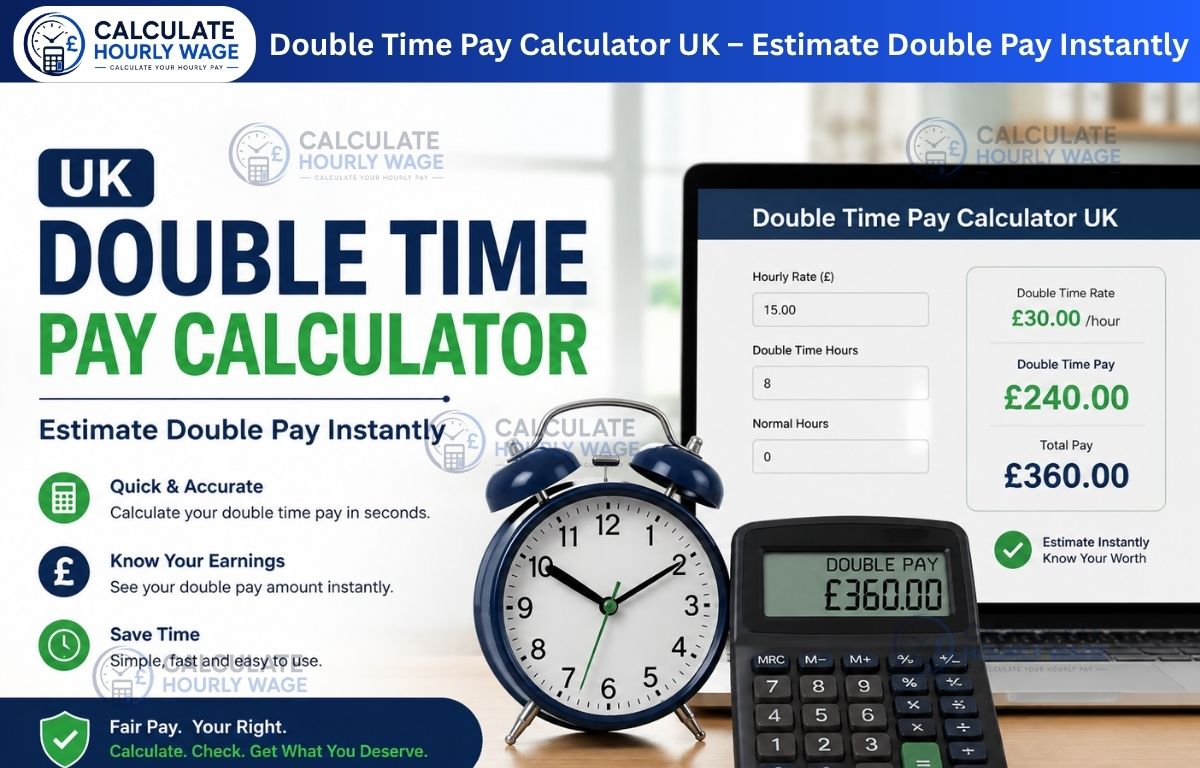
Double Time Pay Calculator UK helps you calculate 2× overtime pay based on your hourly rate and qualifying hours. The basic calculation is:
Double-time hourly rate = normal hourly rate × 2
Double-time earnings = double-time hourly rate × double-time hours
For example, if your normal hourly rate is £15 and you work 4 hours at double time:
£15 × 2 × 4 = £120
Double time is not automatically required by UK law. Whether you receive it usually depends on your employment contract, employer policy, collective agreement or another agreed workplace arrangement.
Calculator inputs:
- Normal hourly rate
- Double-time hours
- Optional normal hours
- Optional salary/hourly-rate pathway, where supported
Calculator results:
- Double-time hourly rate
- Double-time earnings
- Optional total gross pay
The calculator provides an estimate of gross pay. Actual pay can depend on your contract, payroll arrangements and applicable deductions.
What Is Double Time Pay?
Double time is an enhanced pay rate equal to twice the normal hourly rate.
For Example
| Step | Calculation |
|---|---|
| Standard rate | £12 per hour |
| Double-time rate | £12 × 2 = £24 per hour |
| Hours worked at double time | 5 hours |
| Double-time pay | £24 × 5 = £120 |
The key point is that double time doubles the pay rate, not the number of hours worked.
So, 5 hours at double time does not become 10 hours worked. You still worked 5 hours, but each of those hours is paid at twice the normal rate.
Double time is sometimes offered for particular overtime, holidays, weekends, shifts or other working arrangements. The exact circumstances depend on the arrangement that applies to you.
How Does Double Time Work in the UK?
In the UK, double time is generally a contractual or employer arrangement, rather than an automatic statutory entitlement.
This means two employees doing similar work could have different overtime arrangements. One contract might provide normal overtime pay, another might provide time and a half, while another might specify double time for particular hours.
The calculation is straightforward once you know the applicable rate. The harder question is often whether those hours qualify for double time in the first place.
That is why it helps to separate two questions:
- How much would double-time pay be?
- Am I actually entitled to double time?
The calculator answers the first question. Your employment contract and workplace arrangements help answer the second.
Read More: Hourly Rate CalculatorHow to Calculate Double Time Pay
| Double-Time Pay Formula | Calculation |
|---|---|
| Double-time hourly rate | normal hourly rate × 2 |
| Double-time earnings | normal hourly rate × 2 × double-time hours |
For example,
| Example | Calculation | Result |
|---|---|---|
| Double-time hourly rate | £14 × 2 | £28 double-time hourly rate |
| Double-time earnings | £28 × 6 | £168 double-time earnings |
How Many Hours Should You Enter?
Enter only the hours that are actually paid at the 2× rate.
For example, suppose you work a 10-hour shift and your arrangement says:
- 7 hours are paid at the normal rate
- 3 hours are paid at double time
You should not enter all 10 hours into the double-time calculation.
Only the 3 qualifying hours should be calculated at 2×.
This gives:
Normal earnings = normal hourly rate × 7
Double-time earnings = normal hourly rate × 2 × 3
You can then add the two amounts to find your total gross pay for those hours.
How to Calculate Total Pay With Normal and Double-Time Hours
When a pay period contains both normal and double-time hours, keep the calculations separate.
For example:
- Normal rate: £13
- Normal hours: 8
- Double-time hours: 4
| Pay Type | Calculation | Result |
|---|---|---|
| Normal earnings | £13 × 8 | £104 |
| Double-time earnings | £13 × 2 × 4 | £104 |
| Total gross pay | £104 + £104 | £208 |
The four double-time hours have the same value as eight normal hours because each double-time hour is worth twice the standard hourly rate.
Pay Rate Comparison
| Pay type | Multiplier | Example using £12/hour |
|---|---|---|
| Normal pay | 1× | £12/hour |
| Time and a half | 1.5× | £18/hour |
| Double time | 2× | £24/hour |
This table is useful when comparing different overtime arrangements, but the actual rate available to you depends on your applicable workplace terms.
Double Time Pay Calculator UK- Worked Examples
Example 1: Double Time Only
Suppose your normal hourly rate is £15 and you work 5 hours that qualify for double time.
| Step | Calculation | Result |
|---|---|---|
| Enhanced hourly rate | £15 × 2 | £30 |
| Double-time earnings | £30 × 5 | £150 |
| Estimated double-time pay | £15 × 2 × 5 | £150 gross |
This is the simplest situation because all of the hours being considered are paid at the same 2× rate.
Example 2: Normal Hours Plus Double-Time Hours
Suppose you work:
- 8 normal hours
- 4 double-time hours
- Normal rate: £14/hour
| Pay Type | Calculation | Result |
|---|---|---|
| Normal earnings | £14 × 8 | £112 |
| Double-time rate | £14 × 2 | £28/hour |
| Double-time earnings | £28 × 4 | £112 |
| Total gross pay | £112 + £112 | £224 |
The important part is keeping the two groups of hours separate.
Example 3: Time and a Half Plus Double Time
Some workers may have more than one overtime rate during a pay period.
Suppose your normal rate is £16/hour and you have:
- 5 normal hours
- 3 hours at 1.5×
- 2 hours at 2×
| Pay Type | Calculation | Result |
|---|---|---|
| Normal earnings | £16 × 5 | £80 |
| Time-and-a-half rate | £16 × 1.5 | £24/hour |
| Time-and-a-half earnings | £24 × 3 | £72 |
| Double-time rate | £16 × 2 | £32/hour |
| Double-time earnings | £32 × 2 | £64 |
| Total gross earnings | £80 + £72 + £64 | £216 |
This is why different overtime rates should not be combined into one calculation.
Example 4: Salaried Employee Calculating Double Time
A salaried employee may first need an appropriate hourly rate before calculating double-time pay.
Suppose an employee has an annual salary of £35,000 and their relevant working arrangement gives an hourly equivalent of £17.95.
| Calculation | Result |
|---|---|
| Double-time rate | £17.95 × 2 = £35.90/hour |
| Double-time earnings | £35.90 × 4 = £143.60 |
The salary-to-hourly conversion should be based on the appropriate working hours and arrangement rather than simply dividing the salary by an arbitrary number.
Read More: Salary-to-Hourly CalculatorExample 5: Part-Time Employee Working Double-Time Hours
Being part-time does not by itself determine whether you receive double time.
Suppose a part-time employee has a normal rate of £12.50/hour and works 6 hours, during which their applicable arrangement pays at double time.
| Pay Type | Calculation | Result |
|---|---|---|
| Double-time rate | £12.50 × 2 | £25/hour |
| Double-time earnings | £25 × 6 | £150 |
The calculation is the same as for a full-time employee. The question of whether the hours qualify for double time depends on the relevant workplace arrangement.
Double Time vs Time and a Half vs Normal Pay
The three rates have different multipliers:
| Pay type | Multiplier | How it affects hourly rate |
|---|---|---|
| Normal pay | 1× | Standard hourly rate |
| Time and a half | 1.5× | Standard rate × 1.5 |
| Double time | 2× | Standard rate × 2 |
For a normal rate of £14/hour:
- Normal pay = £14/hour
- Time and a half = £21/hour
- Double time = £28/hour
When Is Double Time More Valuable Than Time-and-a-Half?
Purely from a calculation perspective, double time produces a higher hourly payment than time and a half.
For example, with a £14 normal rate:
| Pay Type | Calculation | Result |
|---|---|---|
| Time and a half | £14 × 1.5 | £21/hour |
| Double time | £14 × 2 | £28/hour |
| Time and a half earnings | £21 × 5 | £105 |
| Double-time earnings | £28 × 5 | £140 |
The difference is £35 gross for those five hours.
This comparison tells you the financial difference between the rates. It does not determine which rate your employer should pay.
When Do You Get Double Time in the UK?
Is Double Time Required by UK Law?
Double time is not an automatic UK legal entitlement.
An employee may receive double time where it forms part of their employment terms or another applicable workplace arrangement. The rate can therefore depend on the particular employer, contract or agreement.
This distinction matters because seeing a calculation of double pay does not mean that every employee working overtime is legally entitled to receive twice their normal rate.
Your calculation can show what the payment would be if 2× applies. Your contract or workplace terms determine whether that rate actually applies to your hours.
Visit Now: GOV.UKCan Your Employment Contract Provide Double Time?
Your employment contract can set out overtime arrangements and enhanced rates.
Double time may also be associated with:
- An employer overtime policy
- A collective agreement
- Another agreed workplace arrangement
If your contract says specific hours qualify for double time, those terms provide the basis for the calculation.
If your contract uses different rates for different types of overtime, calculate each group of hours separately.
Do You Automatically Get Double Pay on Bank Holidays?
Working on a bank holiday does not automatically mean you receive double pay.
The applicable contract or workplace policy determines the rate.
For example, if your contract provides 2× pay for specified bank-holiday hours, those hours can be entered into the double-time calculation.
If the contract provides normal pay or another enhanced rate, the double-time calculation would not apply simply because the day is a bank holiday.
Do Sundays Automatically Qualify for Double Time?
Sunday work does not automatically mean you are paid at double time.
Some workplaces may have enhanced Sunday rates, but the actual multiplier depends on the applicable arrangement.
Check the terms that apply to your role before entering Sunday hours as double-time hours.
What About Night or Unsocial-Hours Work?
Night or other unsocial-hours work may have enhanced pay arrangements, but there is no general assumption that these hours are automatically paid at 2×.
The relevant workplace arrangement needs to specify the applicable rate.
| Factor | Automatically gives double time? |
|---|---|
| UK law | No |
| Employment contract | If specified |
| Employer policy | Potentially |
| Collective agreement | Potentially |
| Bank holiday | Not automatically |
| Sunday work | Not automatically |
Read More: Overtime Pay CalculatorDouble Time, Overtime and UK Pay Rules
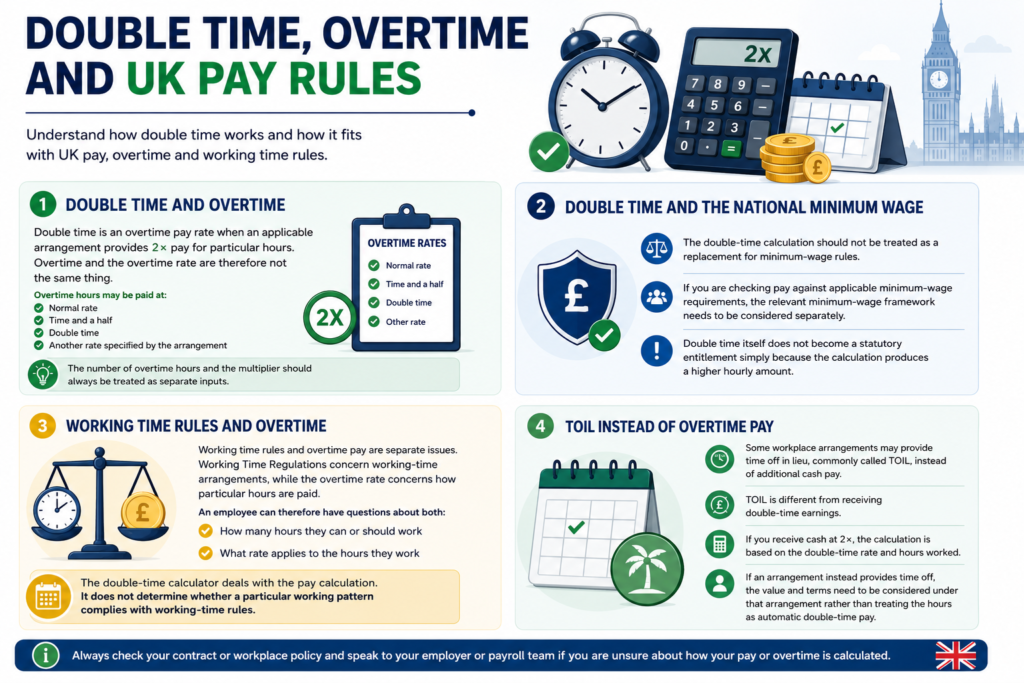
Double Time and Overtime
Double time is an overtime pay rate when an applicable arrangement provides 2× pay for particular hours.
Overtime and the overtime rate are therefore not the same thing.
For example, working beyond normal hours may be overtime, but those hours could be paid at:
- Normal rate
- Time and a half
- Double time
- Another rate specified by the arrangement
The number of overtime hours and the multiplier should always be treated as separate inputs.
Double Time and the National Minimum Wage
The double-time calculation should not be treated as a replacement for minimum-wage rules.
If you are checking pay against applicable minimum-wage requirements, the relevant minimum-wage framework needs to be considered separately.
Double time itself does not become a statutory entitlement simply because the calculation produces a higher hourly amount.
Working Time Rules and Overtime
Working time rules and overtime pay are separate issues.
Working Time Regulations concern working-time arrangements, while the overtime rate concerns how particular hours are paid.
An employee can therefore have questions about both:
- How many hours they can or should work
- What rate applies to the hours they work
The double-time calculator deals with the pay calculation. It does not determine whether a particular working pattern complies with working-time rules.
TOIL Instead of Overtime Pay
Some workplace arrangements may provide time off in lieu, commonly called TOIL, instead of additional cash pay.
TOIL is different from receiving double-time earnings.
If you receive cash at 2×, the calculation is based on the double-time rate and hours worked.
If an arrangement instead provides time off, the value and terms need to be considered under that arrangement rather than treating the hours as automatic double-time pay.
Does Double Time Affect Tax, National Insurance and Take-Home Pay?
Is Double-Time Pay Taxable?
Double-time earnings form part of your gross employment earnings.
The double-time calculator calculates the gross amount generated by the 2× rate. It does not automatically tell you how much of that amount you will keep after payroll deductions.
For example, if your double-time earnings are £200, that is a gross figure. Your final take-home pay can be different after applicable deductions.
Can Double Time Affect National Insurance?
Additional employment earnings can affect payroll deductions, including National Insurance where applicable.
National Insurance is separate from the calculation of the double-time rate.
The basic calculation remains:
Normal hourly rate × 2 × double-time hours
Any applicable payroll deductions are considered separately when estimating take-home pay.
Gross Double-Time Pay vs Take-Home Pay
These terms should not be confused:
- Double-time earnings: the gross amount generated by qualifying hours at 2×.
- Total gross pay: normal earnings plus enhanced earnings and other applicable gross pay.
- Tax and National Insurance: payroll deductions that may apply.
- Take-home pay: the amount remaining after applicable deductions.
If you only want to know what your double-time hours are worth before deductions, the basic calculator is sufficient.
Read More: Average Salary in the UKDouble Time and Holiday Pay
Is Double-Time Overtime Included in Holiday Pay?
Holiday-pay treatment can depend on the relevant circumstances and applicable rules.
There should not be a blanket assumption that every type of double-time payment is treated in exe same way for holiday pay.
The fact that an employee receives 2× pay for particular hours does not, by itself, answer every holiday-pay question.
Why Contract Terms and Holiday-Pay Rules Matter
Two separate issues need to be considered:
- What rate does the employee receive for the hours worked?
- How are relevant earnings treated for holiday-pay purposes?
The first is a double-time calculation question. The second concerns holiday-pay rules and the circumstances of the employment arrangement.
If you need to estimate holiday pay separately, use the appropriate calculator rather than adding a holiday-pay calculation to the double-time formula.
Read More: PAYE Calculator UKCommon Double-Time Pay Calculation Mistakes
Using 1.5× Instead of 2×
Time and a half and double time use different multipliers.
| Pay Rate | Calculation | Result |
|---|---|---|
| Time and a half (1.5×) | £15 × 1.5 | £22.50/hour |
| Double time (2×) | £15 × 2 | £30/hour |
Using the 1.5× multiplier when the applicable rate is 2× will understate the payment.
Doubling the Hours Instead of the Pay Rate
Double time means the rate is doubled.
| Calculation | Result |
|---|---|
| Double-time earnings | 5 × £30 = £150 |
It does not mean you should enter 10 hours at £15 and describe those as hours worked.
Applying Double Time to Normal Hours
Only hours that qualify for the 2× rate should be included in the double-time calculation.
If you work 8 normal hours and 4 double-time hours, do not calculate all 12 hours at 2×.
Calculate the normal and enhanced hours separately.
Assuming Bank Holidays or Sundays Automatically Mean Double Pay
A bank holiday or Sunday shift does not automatically turn the pay rate into 2×.
Check the applicable contract or workplace arrangement before using the double-time multiplier.
Doubling an Annual Salary Instead of Calculating the Hourly Rate
Double time is based on the relevant hourly rate.
If you are salaried, first establish the appropriate hourly equivalent before applying the 2× multiplier.
Simply doubling your annual salary does not calculate the value of double-time hours.
Confusing Gross Pay With Take-Home Pay
A double-time calculation normally produces a gross figure.
Tax, National Insurance and other applicable payroll deductions are separate.
Do not assume that the amount shown by a double-time calculator is the exact amount that will reach your bank account.
Assuming the Calculator Proves You Are Entitled to Double Time
A calculator can show what 2× pay would be worth.
It cannot establish whether your employer is required to pay that rate.
That depends on the applicable employment terms and workplace arrangements.
Practical Double-Time Pay Scenarios
Bank Holiday Worked at Double Time Under a Contract
Assume an employee earns £13/hour and their contract provides double time for specified bank-holiday hours.
They work 7 qualifying hours.
| Pay Type | Calculation | Result |
|---|---|---|
| Double-time rate | £13 × 2 | £26/hour |
| Double-time earnings | £26 × 7 | £182 |
The calculation assumes that the contract actually provides 2× pay for those hours.
The bank holiday itself is not what creates the calculation. The applicable contractual arrangement does.
Normal Shift Plus Double-Time Overtime
An employee earns £12/hour and works:
- 8 normal hours
- 3 double-time hours
| Pay Type | Calculation | Result |
|---|---|---|
| Normal earnings | £12 × 8 | £96 |
| Double-time rate | £12 × 2 | £24 |
| Double-time earnings | £24 × 3 | £72 |
| Total gross pay | £96 + £72 | £168 |
This approach keeps the two rates separate and makes the total easy to check against a payslip.
Part-Time Worker With Additional Double-Time Hours
A part-time employee earns £14/hour and works 4 hours that qualify for double time under the applicable arrangement.
| Pay Type | Calculation | Result |
|---|---|---|
| Double-time rate | £14 × 2 | £28 |
| Double-time earnings | £28 × 4 | £112 |
The calculation does not change because the employee is part-time. The relevant question is whether those hours qualify for the enhanced rate.
Salaried Employee With Contractual Double-Time Overtime
Suppose an employee’s appropriate hourly equivalent is £18 and their arrangement provides double time for certain overtime hours.
They work 5 qualifying hours.
| Pay Type | Calculation | Result |
|---|---|---|
| Double-time rate | £18 × 2 | £36 |
| Double-time earnings | £36 × 5 | £180 |
If the employee needs help establishing the hourly equivalent from their salary, a salary-to-hourly calculation should be completed first.
Employee With Different Overtime Rates in One Pay Period
Suppose an employee has a normal rate of £15/hour and works:
- 6 normal hours
- 4 hours at 1.5×
- 3 hours at 2×
| Pay Type | Calculation | Result |
|---|---|---|
| Normal earnings | £15 × 6 | £90 |
| Time-and-a-half earnings | £15 × 1.5 × 4 | £90 |
| Double-time earnings | £15 × 2 × 3 | £90 |
| Total | £90 + £90 + £90 | £270 |
Separating the rates prevents one multiplier from being incorrectly applied to every overtime hour.
Expert Tips for Using a Double Time Calculator
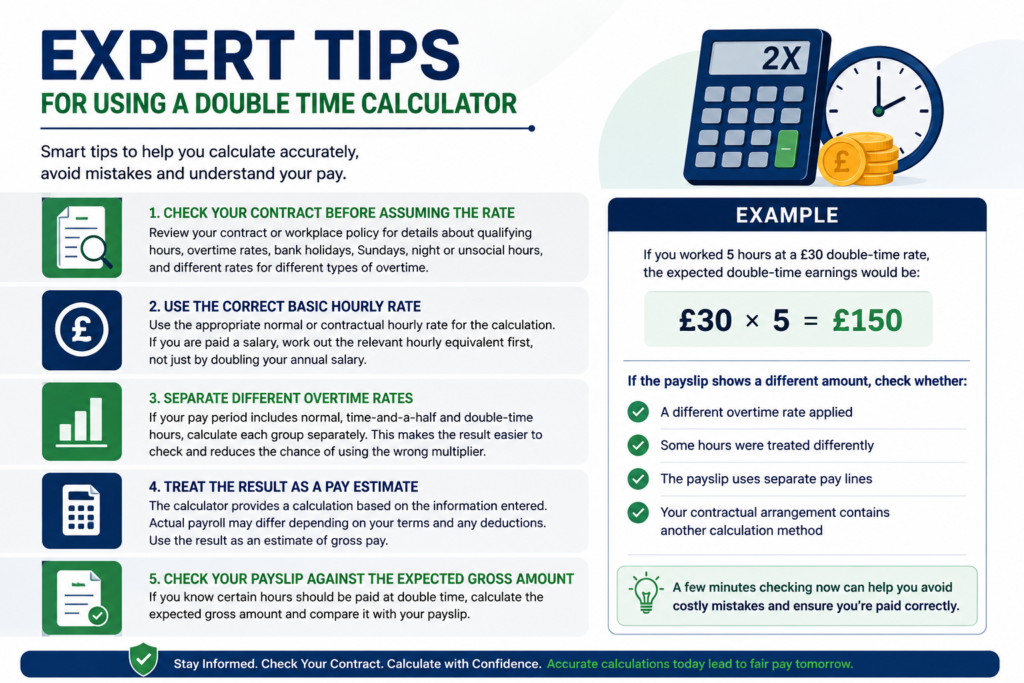
Check Your Contract Before Assuming the Rate
Before treating hours as double time, check the overtime section of your employment contract or the workplace policy that applies to you.
Look for details about:
- Qualifying hours
- Overtime rates
- Bank holidays
- Sundays
- Night or unsocial hours
- Different rates for different types of overtime
Use the Correct Basic Hourly Rate
The rate being doubled should be the appropriate normal or contractual hourly rate for the calculation.
If you are paid a salary, establish the relevant hourly equivalent first rather than simply doubling an annual figure.
Separate Different Overtime Rates
If your pay period contains normal, time-and-a-half and double-time hours, calculate each group separately.
This makes the result easier to check and reduces the chance of applying the wrong multiplier.
Treat the Result as a Pay Estimate
The calculator provides a calculation based on the information entered.
Your actual payroll figure can differ depending on the terms applying to your work and any relevant deductions.
Use the result as an estimate of gross pay rather than as proof of contractual entitlement.
Check Your Payslip Against the Expected Gross Amount
If you know that certain hours should be paid at double time, calculate the expected gross amount and compare it with the relevant payslip figures.
For example, if you worked 5 hours at a £30 double-time rate, the expected double-time earnings would be:
£30 × 5 = £150
If the payslip shows a different amount, check whether:
- A different overtime rate applied
- Some hours were treated differently
- The payslip uses separate pay lines
- Your contractual arrangement contains another calculation method
What is double time pay in the UK?
Double time means paying qualifying hours at twice the normal hourly rate. If your normal rate is £15/hour, the double-time rate is £30/hour.
How do I calculate double-time pay?
Multiply your normal hourly rate by 2, then multiply that enhanced rate by the number of hours paid at double time.
Hourly rate × 2 × double-time hours
Is double time mandatory in the UK?
No. Double time is not an automatic UK legal entitlement. Whether you receive it generally depends on the applicable employment contract, employer policy, collective agreement or other workplace arrangement.
When do employees get double time?
Employees receive double time when the applicable workplace arrangement provides a 2× rate for particular hours. The circumstances vary between employment arrangements.
Do you get double pay for working a bank holiday?
Not automatically. Working on a bank holiday does not by itself mean you receive double pay. The applicable contract or workplace policy determines the rate.
Do Sundays automatically qualify for double time?
No. Sunday work does not automatically qualify for 2× pay. Any enhanced Sunday rate depends on the relevant workplace arrangement.
What is the difference between double time and time and a half?
Time and a half pays 1.5× the normal hourly rate. Double time pays 2×.
For a £12 hourly rate:
Time and a half = £18/hour
Double time = £24/hour
How is double-time pay taxed?
Double-time earnings form part of gross employment earnings. Tax and other payroll deductions are separate from the 2× calculation, so the gross double-time amount is not necessarily the same as the amount you take home.
Can I receive TOIL instead of double-time pay?
Some workplace arrangements may provide time off in lieu instead of additional cash pay. TOIL and double-time pay are different arrangements, so the applicable workplace terms need to be checked.
Is double-time overtime included in holiday pay?
Holiday-pay treatment can depend on the relevant circumstances and applicable rules. It should not be assumed that every double-time payment is treated identically for holiday-pay purposes.
What if my employment contract does not mention an overtime rate?
You should not automatically assume that overtime is paid at double time. Check the other workplace arrangements that may apply, including employer policies or collective agreements.
How do I calculate double time from an annual salary?
First, establish the appropriate hourly equivalent of your salary based on the relevant working hours. Then multiply that hourly rate by 2 and multiply by the qualifying double-time hours.
Conclusion
The Double Time Pay Calculator UK makes it easy to estimate how much you could earn when qualifying hours are paid at 2× your normal hourly rate. Enter your hourly rate and double-time hours to calculate your estimated gross pay.
Remember, double time is not automatically required by UK law. Your employment contract, employer policy or other workplace agreement determines whether you are entitled to the enhanced rate.