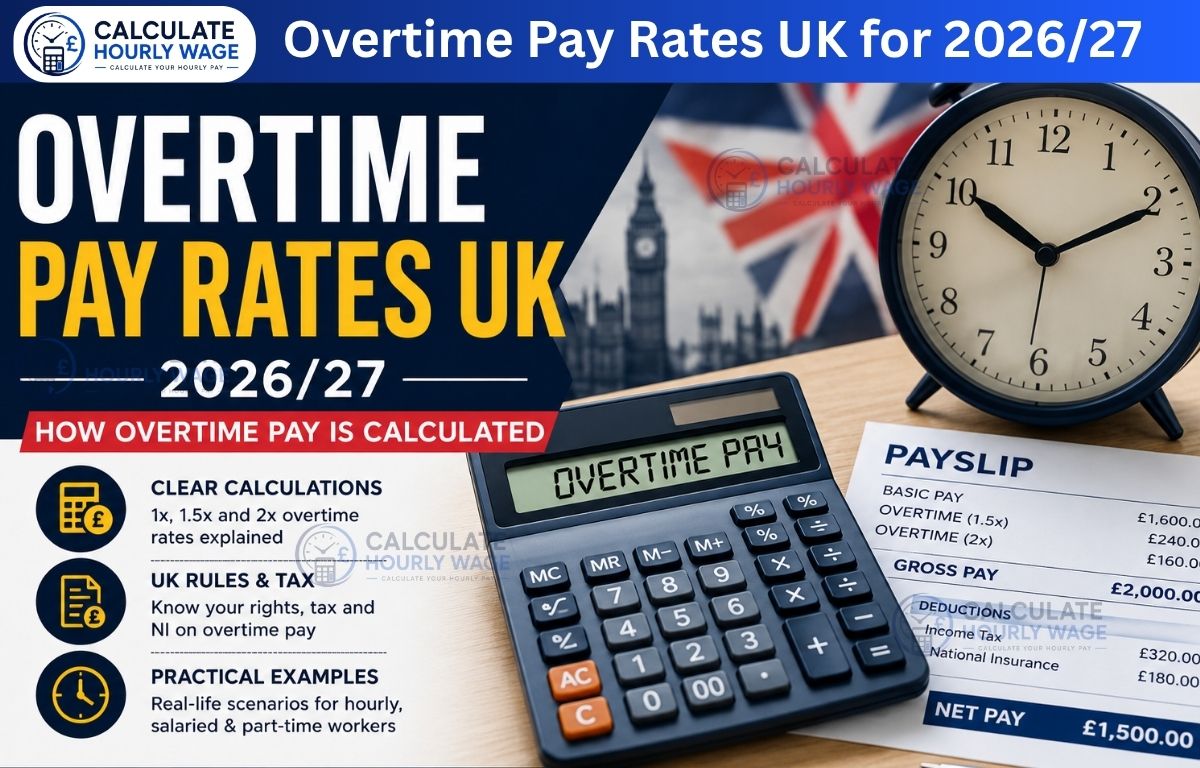
There is no general UK law requiring employers to pay overtime at time and a half or double time. Your overtime rate is usually determined by your employment contract, employer overtime policy or a collective agreement.
An employer may pay overtime at the normal hourly rate, 1.5 times the normal rate, twice the normal rate, or use another arrangement such as time off in lieu.
However, overtime arrangements still have to operate alongside National Minimum Wage requirements and working-time rules.
| Overtime arrangement | Multiplier | What it means | Automatically required by UK law? |
|---|---|---|---|
| Normal rate | 1× | Basic hourly rate | No |
| Time and a half | 1.5× | Basic rate plus 50% | No |
| Double time | 2× | Twice the basic rate | No |
| TOIL | Not applicable | Time off instead of additional pay | Contract or agreement dependent |
The key point is that “overtime pay rates UK” and “legal overtime rates UK” are not the same thing. UK employment law does not generally set a universal premium for extra hours. Your contract is usually the first place to check.
Calculator: Overtime Pay Calculator UK
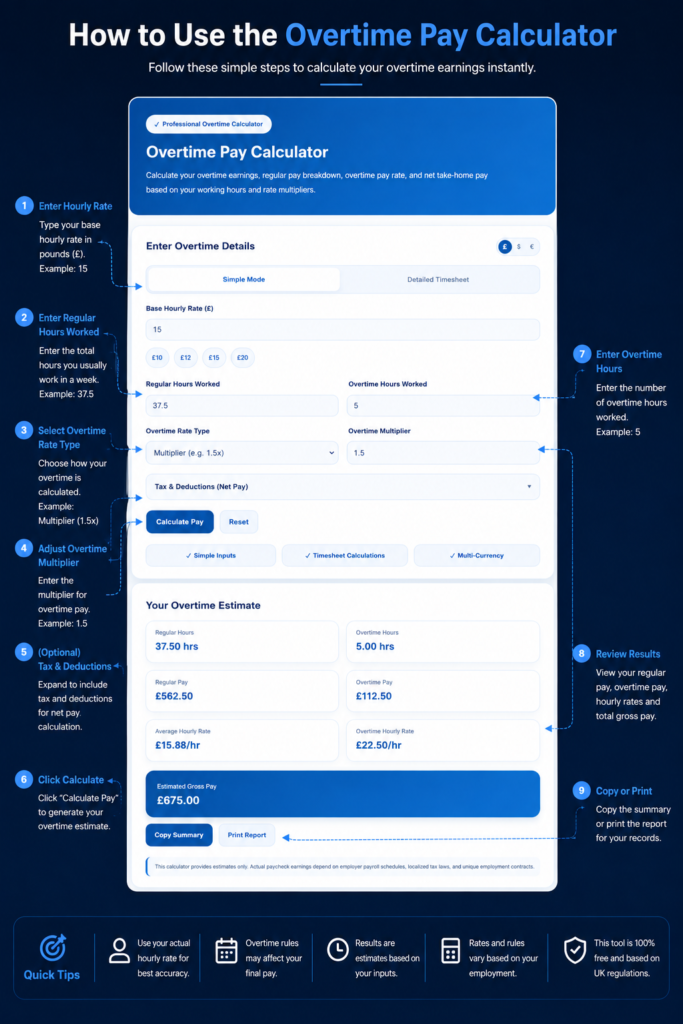
How To Use Overtime Pay Calculator UK
What Counts as Overtime in the UK?
Overtime generally means hours worked beyond the hours you are contracted to work. The exact definition depends on your employment arrangement.
For example, if your contract requires you to work 40 hours a week and you work an additional five hours, those five hours may be treated as overtime under your employer’s rules.
That does not automatically mean those five hours must be paid at 1.5 times your normal rate. Your employer’s overtime terms determine the rate.
It is useful to distinguish three separate ideas:
| Situation | What it means |
|---|---|
| Contracted hours | Hours you are normally required to work under your contract |
| Additional hours | Hours worked beyond your usual schedule |
| Overtime | Additional work treated as overtime under the employment arrangement |
| Working-time limit | Rules governing how much working time you can generally be required to work |
Someone can work additional hours without receiving an enhanced overtime rate. For example, an employer may agree that extra hours are paid at the normal hourly rate.
Read More: Ultimate Hourly Wage Calculator After Tax UK Is Overtime Pay Legally Required in the UK?
UK law does not generally require employers to pay a separate overtime premium.
There is therefore no universal legal rule saying that overtime must be paid at 1.5×, 2× or any other particular multiplier.
Your entitlement usually comes from your employment contract or another agreement covering your employment.
There is a separate legal requirement concerning minimum pay. An employee’s effective pay must not fall below the applicable National Minimum Wage requirements where those rules apply.
This means an employer’s freedom to set an overtime rate does not mean that minimum-pay protections disappear.
Can an Employer Require You to Work Overtime?
An employer may be able to require overtime where the employment contract allows it. Some contracts contain provisions requiring employees to work reasonable additional hours when necessary.
The exact wording of the contract matters.
Working-time rules are a separate issue. The amount of overtime an employer can ask you to work is not simply determined by the overtime rate. Working Time Regulations can affect working hours, rest and the average working week.
If you are unsure whether overtime is compulsory, check the overtime, working-hours and additional-hours sections of your contract.
How Overtime Pay Rates Work in the UK
The most common overtime multipliers are 1×, 1.5× and 2×, but these are contractual arrangements rather than universal statutory rates.
| Overtime rate | Multiplier | What it means | Automatically required by UK law? |
|---|---|---|---|
| Normal rate | 1× | One times the basic hourly rate | No |
| Time and a half | 1.5× | Basic hourly rate plus 50% | No |
| Double time | 2× | Twice the basic hourly rate | No |
| TOIL | Not applicable | Time off instead of additional pay | Contract or agreement dependent |
Visit Now: GOV.UKWhat Does Time and a Half Mean?
Time and a half means you receive 1.5 times your normal hourly rate for each eligible overtime hour.
| Example | Calculation |
|---|---|
| If your normal hourly rate is £16 | £16 × 1.5 = £24 per overtime hour |
| If you work eight hours at this rate | £24 × 8 = £192 |
The phrase “time and a half” describes the calculation. It does not mean that every UK employer has to use this rate.
What Does Double Time Mean?
Double time means receiving twice your normal hourly rate.
| Example | Calculation |
|---|---|
| For example | £16 × 2 = £32 per overtime hour |
| Ten overtime hours at double time would therefore produce | £32 × 10 = £320 |
Again, double time is not automatically required by UK law. It must generally come from the relevant employment terms or agreement.
Working on a weekend or bank holiday does not automatically mean you receive double time. Your contract or employer policy determines whether an enhanced rate applies.
What Determines Your Overtime Rate?
Your actual overtime rate can depend on:
- your employment contract
- your employer’s overtime policy
- a collective agreement
- your normal hourly rate
- the number and type of hours worked
- your worker status
- National Minimum Wage requirements
- applicable working-time rules
Always check the contractual rate before assuming that an overtime calculation should use 1.5× or 2×.
How to Calculate Overtime Pay
The basic calculation is straightforward when you already know your hourly rate and overtime multiplier.
Formula:
Overtime Pay = Hourly Rate × Overtime Multiplier × Overtime Hours
The multiplier should come from your actual overtime arrangement. Do not automatically use 1.5 simply because it is commonly associated with overtime.
Overtime at the Normal Hourly Rate
If your employer pays overtime at your normal rate, use:
Hourly Rate × Overtime Hours
| Example | Calculation |
|---|---|
| Suppose you earn £18 per hour and work six additional hours. | £18 × 6 = £108 |
Your overtime pay would be £108 before deductions.
Overtime at Time and a Half
| Example | Calculation |
|---|---|
| If your contract specifies 1.5× overtime, use: | Hourly Rate × 1.5 × Overtime Hours |
| Suppose your normal rate is £18 per hour and you work 10 overtime hours. | £18 × 1.5 × 10 = £270 |
| You would earn £270 in gross overtime pay. | £270 |
Overtime at Double Time
For double time:
Hourly Rate × 2 × Overtime Hours
| Example | Calculation |
|---|---|
| Suppose you earn £18 per hour and work five hours at double time. | £18 × 2 × 5 = £180 |
The five additional hours produce £180 in gross overtime pay.
How to Calculate Overtime From an Annual Salary
Calculating overtime for a salaried employee requires more care because there is no single universal statutory formula that converts an annual salary into an overtime rate.
You first need to establish the hourly equivalent used by your employment arrangement. The relevant factors can include your annual salary, contracted weekly hours, paid working time and the calculation method specified by your employer.
For example, suppose an employee earns £35,000 a year and has a 40-hour working week.
| Step | Calculation |
|---|---|
| Annual salary to weekly pay | £35,000 ÷ 52 = £673.08 per week |
| Weekly pay to hourly rate | £673.08 ÷ 40 = £16.83 per hour |
| Overtime rate at 1.5× | £16.83 × 1.5 = £25.25 per overtime hour |
| Five overtime hours | £25.25 × 5 = £126.25 |
This is an example of a calculation method, not a universal statutory formula. Your employer may specify a different contractual method for establishing the overtime rate.
Read More: Salary to Hourly Calculator UKHow to Calculate Monthly Overtime Pay
For monthly overtime, calculate the overtime attributable to the relevant pay period.
Suppose your contractual overtime rate is £24 per hour and you work 12 overtime hours during the month:
£24 × 12 = £288
Your gross monthly pay would then consist of your normal salary or wages plus the £288 overtime payment, before applicable deductions.
If overtime varies each month, calculate each pay period separately rather than assuming the same overtime amount every month.
Overtime Pay for Different Types of Workers
Overtime does not work identically for every worker. The employment arrangement determines how additional hours are treated.
Salaried Employees
Being paid an annual salary does not automatically mean that overtime is included or excluded.
Your contract may state:
- that overtime is paid separately
- that overtime is paid at a specific multiplier
- that additional hours are included within salary
- that TOIL is available
- that certain additional hours are expected as part of the role
If overtime is paid separately, the contract should help establish how the hourly equivalent is calculated.
Do not assume that annual salary divided by a particular number is always the legally required overtime rate.
Part-Time Employees
Part-time employees may work beyond their contracted hours without automatically receiving an enhanced overtime rate.
For example, someone contracted for 20 hours a week who works 25 hours has worked five additional hours. Whether those five hours qualify for an overtime premium depends on the applicable employment terms.
The important distinction is between working beyond your own contracted hours and being entitled to an enhanced overtime rate.
Zero-Hours and Irregular-Hours Workers
Workers with variable hours may have more complicated pay arrangements because the number of hours worked changes from one pay period to another.
The relevant agreement should establish how hours are paid and whether additional hours attract a different rate.
Minimum-pay rules still need to be considered where applicable.
Freelancers and Self-Employed Workers
Freelancers and self-employed people should not generally treat their additional work as employee overtime.
A freelancer usually agrees a price or hourly rate with the client. If additional work is required, the price for that work is normally determined by the agreement between the freelancer and client.
That is different from an employee’s contractual overtime entitlement.
Read More: Hourly Rate Calculator UKDoes UK Law Require a Minimum Overtime Rate?
There is no universal statutory requirement for employers to pay overtime at 1.5× or 2×.
The rate can be established by contract, employer policy or collective agreement.
| Situation | What determines payment? |
|---|---|
| Contractual overtime | Employment contract or applicable agreement |
| Enhanced overtime | Employer’s contractual or policy terms |
| Normal-rate overtime | Applicable employment arrangement |
| Minimum-pay protection | National Minimum Wage rules |
| Working-time limits | Working Time Regulations and related arrangements |
This distinction matters because a worker can have an overtime entitlement without having a statutory entitlement to a particular premium.
How National Minimum Wage Applies to Overtime
National Minimum Wage protection is separate from an overtime premium.
If an employee works additional hours, those hours can affect the relationship between total pay and total working time for minimum-wage purposes.
This is why an employer cannot simply argue that an employee has accepted unpaid or low-paid additional hours and ignore minimum-pay requirements.
The question is not whether UK law says “overtime must be paid at 1.5×”. It does not generally do so. The question is also whether the employee’s pay complies with the applicable minimum-wage rules.
Read More: National Insurance Calculator UKOvertime and the 48-Hour Working Week
The 48-hour rule belongs to working-time law, not overtime-pay law.
Working Time Regulations provide a framework around average weekly working time, rest and related matters. Workers can also agree to opt out of the average 48-hour limit in appropriate circumstances.
Therefore:
Working more than 48 hours does not automatically mean you should be paid double time.
Likewise, receiving 1.5× overtime does not remove working-time requirements.
Pay and working time need to be considered separately.
How Overtime Affects Tax and National Insurance
Overtime is normally added to your gross earnings. PAYE and National Insurance deductions can then reduce the amount you actually receive.
There is no separate “overtime tax rate” simply because the earnings came from overtime.
Is Overtime Taxed Differently?
Overtime forms part of your earnings and can therefore affect your PAYE deductions.
If you receive a larger payment in one pay period, the amount deducted can appear much higher than usual. That does not mean overtime itself has a special tax rate.
The additional earnings are treated within the normal tax system applicable to your circumstances.
This is why a £300 gross overtime payment does not necessarily result in £300 being added to your bank account.
Does Overtime Increase National Insurance?
Additional earnings can also affect National Insurance deductions where the relevant thresholds and rules apply.
The amount of National Insurance deducted depends on your earnings and applicable payroll circumstances.
For an accurate estimate of take-home pay, calculate gross overtime first, then account for the deductions that apply to your total earnings.
Gross Overtime vs Take-Home Overtime
| Example | Amount |
|---|---|
| Gross overtime | £270 |
| Amount received after payroll deductions | Not necessarily £270 |
Your payslip may show deductions for PAYE, National Insurance and any other applicable deductions.
Worked Example 6
| Example | Calculation / Result |
|---|---|
| An employee earns £18 per hour and receives 1.5× overtime. | £18 × 1.5 × 10 = £270 gross overtime |
| They work 10 overtime hours. | £270 gross overtime |
| The employee should treat £270 as the additional gross earnings, not guaranteed take-home pay. | £270 additional gross earnings |
The actual amount added to their bank account depends on their overall payroll position.
Read More: Net to Gross Salary Calculator UK Overtime, Bank Holidays, Weekends and Holiday Pay
These issues are often grouped, but they are not automatically the same.
Do You Get Extra Pay for Working on a Bank Holiday?
Working on a bank holiday does not automatically mean you receive double pay.
Whether you receive an enhanced rate depends on your employment terms.
A bank holiday can also relate to holiday entitlement, which is a separate issue from whether the hours attract an overtime premium.
Check your contract or employer’s policy for the applicable rate.
Does Weekend Work Count as Overtime?
Weekend work is not automatically overtime.
If your normal contract requires you to work Saturdays or Sundays, those hours may simply be normal contracted hours.
If you work additional hours beyond your contractual arrangement, they may qualify as overtime depending on the employer’s rules.
The key question is not simply “Was it a weekend?” but “How does my employment arrangement classify these hours?”
Does Overtime Affect Holiday Pay?
Regular overtime can be relevant when holiday pay is calculated.
The treatment of overtime depends on the nature and regularity of the overtime and the applicable holiday-pay rules.
For this reason, it is too broad to say that all overtime is automatically included in every holiday-pay calculation.
If your earnings vary because of regular overtime, check how your employer calculates holiday pay.
Read More: Holiday Pay Percentage Calculator UKOvertime Pay Scenarios: What Rate Applies?
You Work 5 Extra Hours at Your Normal Rate
| Example | Calculation / Result |
|---|---|
| You earn £16 per hour and your employer pays additional hours at the normal rate. | £16 × 5 = £80 |
| Your additional gross pay is £80. | £80 |
| There is no need to multiply by 1.5 unless your contract provides that premium. | No 1.5× multiplier required |
Your Contract Pays Time and a Half
| Step | Calculation / Result |
|---|---|
| You earn £16 per hour and your contract specifies 1.5× overtime. | £16 × 1.5 = £24 |
| For five hours | £24 × 5 = £120 |
| Your gross overtime is £120. | £120 |
Your Employer Pays Double Time
| Step | Calculation / Result |
|---|---|
| Your normal hourly rate is £16 and your contractual overtime rate is 2×. | £16 × 2 = £32 |
| Five overtime hours produce: | £32 × 5 = £160 |
The double-time payment exists because the applicable employment terms provide for it, not because UK law automatically sets that rate.
You Are Salaried and Work Extra Hours
| Step | Calculation / Result |
|---|---|
| Your normal hourly rate is £20 and your contractual overtime rate is 1.5×. | £20 × 1.5 = £30 |
| For four additional hours | £30 × 4 = £120 |
The key step is establishing the correct hourly equivalent under your employment arrangement before applying the multiplier.
You Work on a Bank Holiday
Suppose you normally earn £18 per hour and are asked to work on a bank holiday.
Do not automatically calculate:
£18 × 2
First check whether your contract provides an enhanced bank-holiday or overtime rate.
If it does not, the hours may be paid at the normal rate or according to another contractual arrangement.
Your Overtime Takes Your Effective Pay Close to NMW
Suppose your total earnings remain relatively low while your working hours increase substantially because of additional work.
The relevant question is whether your pay continues to satisfy applicable National Minimum Wage requirements.
An overtime premium is not the same thing as minimum-wage protection. An employer can choose not to pay 1.5×, but applicable minimum-pay requirements still have to be considered.
Common Overtime Pay Mistakes and Misconceptions
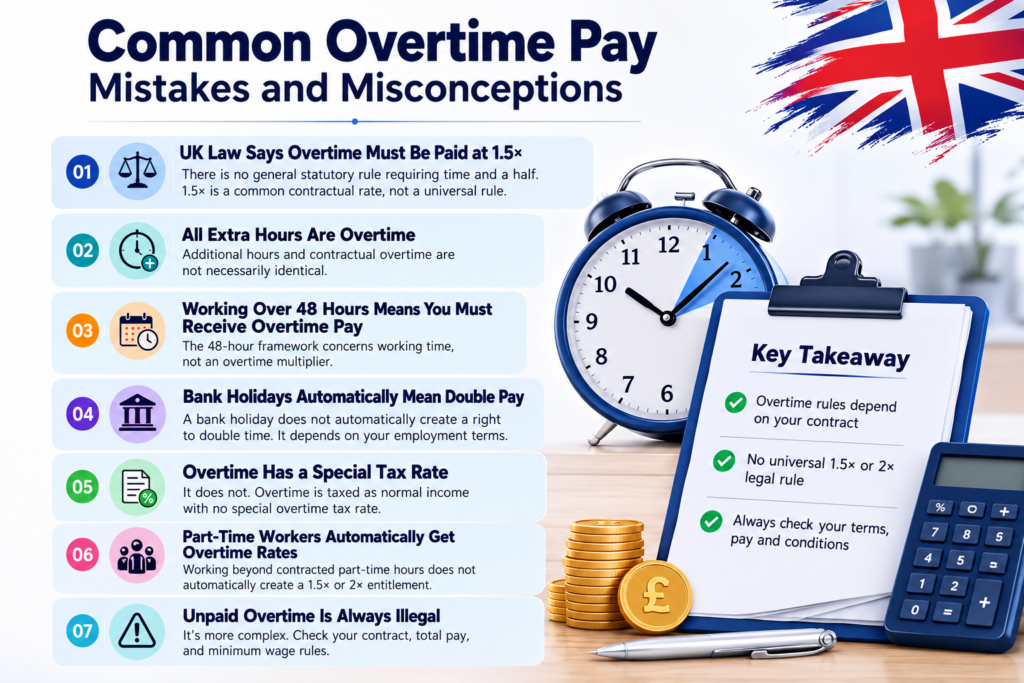
UK Law Says Overtime Must Be Paid at 1.5×
There is no general statutory rule requiring time and a half.
1.5× is a common contractual rate, not a universal legal requirement.
All Extra Hours Are Overtime
Additional hours and contractual overtime are not necessarily identical.
An employee can work beyond their normal schedule without receiving an enhanced rate, depending on their agreement.
Working Over 48 Hours Means You Must Receive Overtime Pay
The 48-hour framework concerns working time. It does not establish an overtime multiplier.
Working-time rules and pay rules should be checked separately.
Bank Holidays Automatically Mean Double Pay
A bank holiday does not automatically create a right to double time.
The applicable employment terms determine the pay arrangement.
Overtime Has a Special Tax Rate
It does not.
Overtime increases gross earnings and may increase payroll deductions, but it is not subject to a separate special overtime tax rate.
Part-Time Workers Automatically Get Overtime Rates After Their Contracted Hours
Working beyond contracted part-time hours does not automatically create a 1.5× or 2× entitlement.
The contract and applicable overtime arrangements matter.
Unpaid Overtime Is Always Illegal
The position is more complicated.
Unpaid additional work can raise contractual and minimum-pay issues, but the fact that work was unpaid does not by itself establish that a specific statutory overtime premium was owed.
The relevant contract, total pay and applicable minimum-wage requirements need to be considered.
How to Check Your Overtime Rate
If your overtime pay looks incorrect, work through the calculation rather than relying on a general overtime rate you have seen elsewhere.
- Check your employment contract. Look for overtime, additional hours, enhanced rates and TOIL.
- Check your employer’s overtime policy. Some workplaces have separate rates for different types of additional work.
- Check any collective agreement. This may establish rates or conditions that apply to your role.
- Identify your basic hourly rate. If you are salaried, check how your employer defines the hourly equivalent.
- Identify the correct multiplier. Do not automatically use 1.5×.
- Check the total overtime hours. Small errors in recorded hours can affect the final payment.
- Compare the calculation with your payslip. Check gross overtime separately from deductions.
- Consider National Minimum Wage requirements. This is particularly relevant where additional hours are unpaid or low paid.
- Check working-time requirements separately. A pay calculation does not answer whether working hours comply with working-time rules.
- Keep your own record of overtime. This makes it easier to compare your hours with your payslips and employer records.
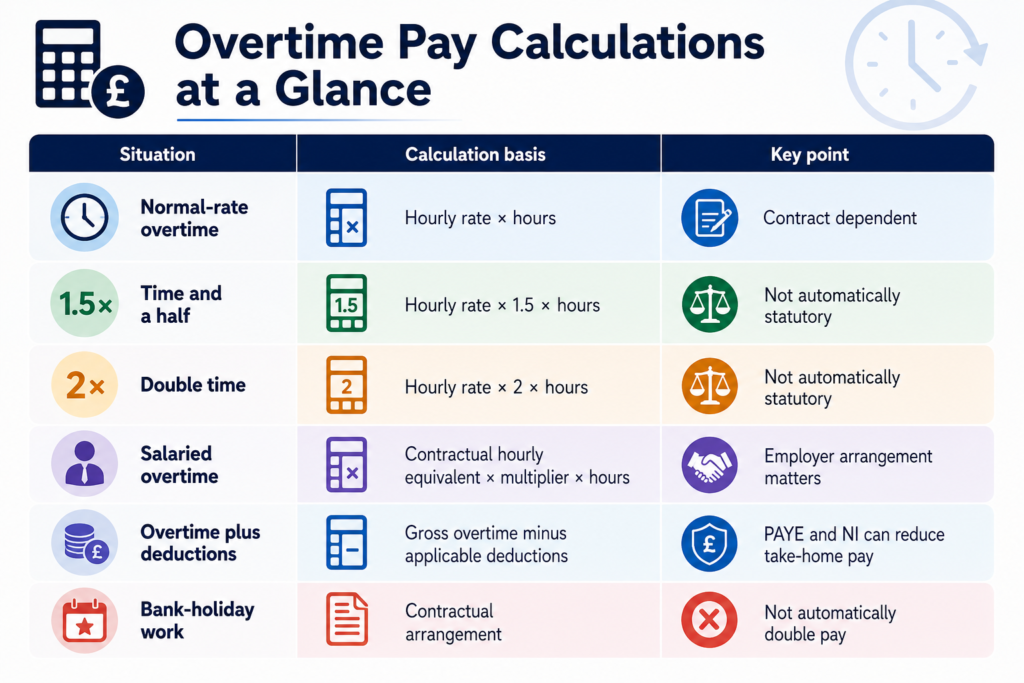
Overtime Pay Calculation- Quick Reference
| Situation | Calculation basis | Key point |
|---|---|---|
| Normal-rate overtime | Hourly rate × hours | Contract dependent |
| Time and a half | Hourly rate × 1.5 × hours | Not automatically statutory |
| Double time | Hourly rate × 2 × hours | Not automatically statutory |
| Salaried overtime | Contractual hourly equivalent × multiplier × hours | Employer arrangement matters |
| Overtime plus deductions | Gross overtime minus applicable deductions | PAYE and NI can reduce take-home pay |
| Bank-holiday work | Contractual arrangement | Not automatically double pay |
Main overtime formula:
Overtime Pay = Hourly Rate × Overtime Multiplier × Overtime Hours
What is the overtime pay rate in the UK?
There is no single statutory overtime rate. Your contract or applicable employer arrangement normally determines whether overtime is paid at the normal rate, 1.5×, 2× or another rate.
Is overtime legally required to be paid at time and a half?
No. UK law does not generally require employers to pay overtime at 1.5×. Time and a half is a common contractual rate.
What is 1.5× overtime pay in the UK?
1.5× means your normal hourly rate is multiplied by 1.5. For example, £20 per hour becomes £30 per overtime hour.
What is double-time overtime pay?
Double time means twice the normal hourly rate. A £20 hourly rate becomes £40 per overtime hour.
How do I calculate overtime from my hourly rate?
Multiply your hourly rate by the overtime multiplier and then by the number of overtime hours.
Hourly Rate × Multiplier × Overtime Hours
How do I calculate overtime from my annual salary?
First establish the hourly equivalent used under your employment arrangement. Then apply the contractual overtime multiplier and the number of overtime hours. There is no single universal statutory salary-to-overtime formula.
Is overtime taxed in the UK?
Overtime forms part of your earnings and can therefore be subject to normal PAYE treatment. It does not have a separate special overtime tax rate.
Does overtime increase National Insurance?
Additional earnings can affect National Insurance deductions where the relevant thresholds and rules apply. The exact deduction depends on your overall payroll circumstances.
Can an employer make me work overtime?
An employer may be able to require overtime where the employment contract permits it. Working-time rules also need to be considered.
Does overtime count towards the 48-hour working week?
Working additional hours can contribute to working time. The 48-hour framework is separate from overtime pay and does not establish an overtime rate.
Do part-time workers get overtime pay?
Part-time workers do not automatically receive an enhanced overtime rate simply because they work beyond their contracted hours. The applicable contract and overtime arrangement determine payment.
Do I get double pay for working on a bank holiday?
Not automatically. Bank-holiday pay depends on the employment terms. Working on a bank holiday does not by itself create a universal right to double time.
Does regular overtime affect holiday pay?
Regular overtime can be relevant to holiday-pay calculations. The treatment depends on the nature and regularity of the overtime and the applicable holiday-pay rules.
What happens if overtime takes my effective hourly pay below the National Minimum Wage?
The employer still needs to comply with applicable National Minimum Wage requirements. The absence of a statutory overtime premium does not remove minimum-pay protection.
What should I do if my overtime pay is incorrect?
Check your contract, overtime policy, recorded hours, applicable multiplier and payslip. If the figures still do not match, raise the issue with your employer or HR and check the relevant employment guidance.