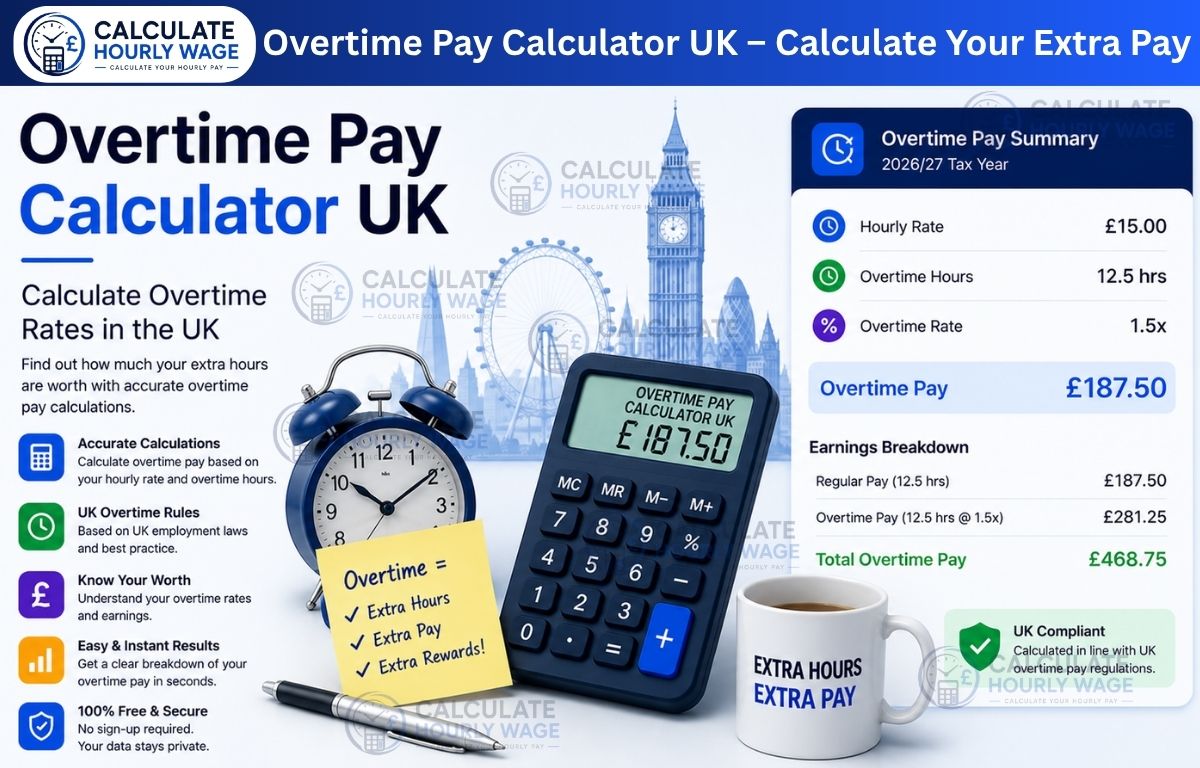
It starts like any normal workday.
Then a colleague takes sick leave, an important project must be completed by the end of the week, and your manager asks if you can work a few extra hours. You agree, knowing those additional hours should increase your paycheck. Weeks later, payday arrives, but the amount isn’t what you expected.
Was your overtime calculated correctly? That’s where an Overtime Pay Calculator UK becomes valuable. Instead of manual calculation, it quickly estimates how your additional work could increase your earnings.
You can compare your payslip with your own calculations, budget more effectively, and even decide whether accepting extra shifts is financially worthwhile.
Calculator
What Is an Overtime Pay Calculator UK?
An Overtime Pay Calculator UK is an online tool that estimates how much you’ll earn for working beyond your normal contracted hours.
Rather than relying on rough estimates, the calculator uses your hourly pay or salary, overtime hours, and your employer’s overtime rate to calculate your expected overtime earnings.
Many advanced calculators can also estimate deductions such as:
- Income Tax
- National Insurance Contributions (NIC)
- Pension contributions
- Student Loan repayments (where applicable)
As a result, you can often view both your gross overtime pay and your estimated net overtime pay.
Read More: gov.ukWhat Counts as Overtime?
Overtime refers to any hours worked beyond your normal contracted working hours.
For example, if your employment contract states that you work 37.5 hours per week, any additional approved hours may qualify as overtime.
However, overtime rules vary between employers. Some companies pay enhanced rates after a certain number of hours, while others may pay your standard hourly rate for every extra hour worked.
Common examples of overtime include:
- Working late after your regular shift
- Weekend shifts
- Bank Holiday work
- Emergency call-outs
- Extra shifts to cover absent colleagues
Always check your employment contract because overtime policies differ across industries.
How Overtime Pay Works in the UK
Unlike the National Minimum Wage, UK law does not require employers to offer a higher overtime rate in every situation.
| Overtime Pay Is Usually Determined By | Some Employers Pay |
|---|---|
| Your employment contract | Your standard hourly rate |
| Workplace policies | Time and a half (1.5×) |
| Collective agreements | Double time (2×) |
| Industry practices | Custom overtime rates |
For example, a hospital may pay enhanced rates for night shifts or Bank Holidays, while an office-based employer may simply pay your normal hourly rate for additional hours.
This is why it’s essential to know your employer’s overtime policy before estimating your earnings.
Why Use an Overtime Pay Calculator UK?
Calculating overtime manually can be confusing when different pay rates apply to weekdays, weekends and public holidays.
An overtime calculator provides a quick and reliable estimate, making the calculation process much easier.
It can help you:
- Estimate your overtime earnings before payday.
- Compare different overtime opportunities.
- Understand how taxes affect extra income.
- Check whether your payslip appears accurate.
- Plan your monthly budget.
- Decide whether taking additional shifts is financially valuable.
Understanding your estimated overtime pay makes it easy to decide if the extra hours are valuable.
Read More: Monthly Salary Calculator UKHow Does the Overtime Pay Calculator UK Work?
Although the calculations behind the scenes can seem complex, using the calculator is remarkably simple.
It only takes a few pieces of information to estimate your overtime pay.
Step 1: Enter Your Hourly Rate or Salary
The calculator first needs your basic pay.
| If You’re Paid Hourly | If You’re a Salaried Employee |
|---|---|
| Simply enter your standard hourly wage. | Many calculators can estimate your hourly rate by using your annual salary together with your contracted working hours. |
| For example: | For example: |
| £15 per hour | Annual Salary: £39,000 |
| £18.50 per hour | Weekly Hours: 37.5 |
| £22 per hour | Estimated Hourly Rate: Approximately £20 per hour |
This hourly rate becomes the foundation for all overtime calculations.
Step 2: Add Your Overtime Hours
Next, enter the number of additional hours you’ve worked.
These could include:
- Evening overtime
- Weekend shifts
- Bank Holiday work
- Emergency call-outs
- Extra scheduled shifts
Accuracy matters here.
Even small mistakes in recorded overtime hours can noticeably change your final earnings, especially if higher overtime multipliers apply.
Step 3: Select the Overtime Rate
This is where the calculation becomes more interesting.
Different employers reward overtime differently.
Common overtime rates include:
| Overtime Type | Multiplier |
| Standard Rate | 1× |
| Time and a Half | 1.5× |
| Double Time | 2× |
| Custom Rate | Employer Defined |
Once you’ve selected the correct multiplier, the calculator applies it to every overtime hour you’ve entered.
For example:
| Calculation | Result |
|---|---|
| Hourly Rate | £20 |
| Time and a Half | £20 × 1.5 = £30 per overtime hour |
| Double Time | £20 × 2 = £40 per overtime hour |
Step 4: View Your Estimated Overtime Pay
Finally, the calculator combines all the information you’ve entered and provides an estimate of your overtime earnings.
Depending on the calculator, the results may include:
- Gross overtime pay
- Estimated Income Tax
- National Insurance deductions
- Pension contributions
- Net overtime earnings
- Updated total pay for the week or month
Rather than waiting until payday, you’ll already have a realistic expectation of what your extra work is worth.
Common Overtime Rates in the UK
Overtime pay policies vary between employers. Some pay your standard hourly rate, while others offer enhanced rates to encourage employees to work extra hours.
Understanding these rates helps you estimate your overtime earnings more accurately before accepting additional shifts.
Time and a Half (1.5×)
Time and a half is the most common overtime rate in the UK.
Under this arrangement, every overtime hour is paid at 150% of your normal hourly wage.
| Item | Details |
|---|---|
| Formula | Overtime Pay = Hourly Rate × 1.5 × Overtime Hours |
| Example | Suppose your hourly wage is £16 and you work 8 overtime hours. |
| Hourly Rate | £16 |
| Overtime Multiplier | 1.5 |
| Overtime Hours | 8 |
| Calculation | £16 × 1.5 = £24 per overtime hour |
| Total Overtime Pay | £24 × 8 = £192 Gross |
This means you’ll earn £192 before deductions for those extra hours.
Double Time (2×)
Some employers offer double time for work completed on Bank Holidays, overnight shifts, or special occasions.
This means every overtime hour is worth twice your normal hourly wage.
| Item | Details |
|---|---|
| Formula | Overtime Pay = Hourly Rate × 2 × Overtime Hours |
| Example | Suppose your hourly wage is £18 and you work 10 overtime hours. |
| Hourly Rate | £18 |
| Overtime Multiplier | 2 |
| Overtime Hours | 10 |
| Calculation | £18 × 2 = £36 per overtime hour |
| Total Overtime Pay | £36 × 10 = £360 Gross Overtime Pay |
Double time can significantly increase your monthly earnings, especially for employees who regularly work weekends or public holidays.
Standard Hourly Rate
Not every employer pays an enhanced overtime rate.
Some employment contracts simply pay the normal hourly wage for any additional hours worked.
| Item | Details |
|---|---|
| Example | Suppose your hourly wage is £15 and you work 6 extra hours. |
| Hourly Rate | £15 |
| Extra Hours | 6 |
| Calculation | £15 × 6 = £90 |
| Total Overtime Pay | £90 Gross Overtime Pay |
Although there is no overtime premium, these additional hours still increase your overall earnings.
Custom Overtime Rates
Many organisations create their own overtime structures.
Examples include:
| Overtime Situation | Typical Rate |
| Evening Shift | 1.25× |
| Weekend Shift | 1.5× |
| Sunday Work | 1.75× |
| Bank Holiday | 2× |
| Night Shift | Employer Policy |
A flexible overtime calculator allows you to enter custom multipliers so the estimate matches your employer’s policy.
What Information Do You Need?
- The accuracy of any overtime calculation depends on the information you provide.
- Entering complete and correct details produces a much more reliable estimate.
| Input | Explanation |
|---|---|
| Basic Hourly Pay | Your standard hourly wage is the foundation of every overtime calculation. If you receive an annual salary, convert it to an hourly rate before calculating your overtime pay. A simplified formula is: Hourly Rate = Annual Salary ÷ Annual Working Hours. |
| Total Overtime Hours | Record every approved overtime hour carefully. Include additional weekday hours, weekend work, Bank Holiday shifts, emergency call-outs, and extra scheduled shifts. Even forgetting one or two hours can noticeably affect your final earnings. |
| Overtime Multiplier | Different overtime rates produce very different results. Common multipliers include 1×, 1.25×, 1.5×, 1.75×, and 2×. Choosing the correct overtime rate is as important as entering the correct number of hours. |
| Pay Period | Most calculators allow you to estimate overtime earnings for different pay periods. These usually include weekly, fortnightly, monthly, and annually. This helps employees understand how overtime affects both individual pay periods and annual income. |
What Can Affect Your Overtime Pay?
Working the same number of overtime hours doesn’t always produce the same earnings.
Several factors influence your final pay.
Employment Contract
Your employment contract explains:
- Whether overtime is paid
- Which overtime rates apply
- When enhanced rates begin
- Whether overtime must be approved
Some contracts even offer time off in lieu (TOIL) instead of additional pay.
Hourly Rate
Naturally, employees with higher hourly wages earn more for every overtime hour.
For example:
| Hourly Rate | 10 Hours at 1.5× |
| £14 | £210 |
| £18 | £270 |
| £22 | £330 |
| £28 | £420 |
The difference becomes even larger when overtime is worked regularly.
Weekend and Bank Holiday Overtime
Many employers reward weekend and public holiday work with higher overtime rates.
For example:
- Saturday: 1.5×
- Sunday: 1.75×
- Bank Holiday: 2×
These enhanced rates can substantially increase monthly earnings.
Tax and National Insurance Deductions
One of the biggest surprises for employees is that overtime isn’t tax-free.
Extra earnings usually increase:
- Income Tax
- National Insurance Contributions
- Pension deductions
- Student Loan repayments (where applicable)
This means your gross overtime pay will almost always be higher than your net overtime pay.
Overtime Pay Calculation Examples
Let’s see how different overtime situations affect earnings.
Time and a Half Example
| Item | Details |
|---|---|
| Example | Suppose your hourly wage is £17 and you work 12 overtime hours at time and a half (1.5×). |
| Hourly Rate | £17 |
| Overtime Hours | 12 |
| Overtime Multiplier | 1.5× |
| Calculation | £17 × 1.5 = £25.50 per overtime hour |
| Total Overtime Pay | £25.50 × 12 = £306 Gross Overtime Pay |
Double Time Example
| Item | Details |
|---|---|
| Example | Suppose your hourly wage is £20 and you work 8 overtime hours at double time (2×). |
| Hourly Rate | £20 |
| Overtime Hours | 8 |
| Overtime Multiplier | 2× |
| Calculation | £20 × 2 = £40 per overtime hour |
| Total Overtime Pay | £40 × 8 = £320 Gross Overtime Pay |
Monthly Overtime Earnings Example
Imagine Emma works as a warehouse supervisor.
- Hourly Rate: £18
- Overtime Rate: 1.5×
- Overtime Hours Each Week: 10
| Item | Details |
|---|---|
| Example | Her hourly rate is £18, she works 10 overtime hours per week, and her overtime rate is time and a half (1.5×). |
| Hourly Rate | £18 |
| Overtime Hours (Per Week) | 10 |
| Overtime Multiplier | 1.5× |
| Weekly Overtime Pay | £18 × 1.5 × 10 = £270 |
| Monthly Estimate (4 Weeks) | £270 × 4 = £1,080 Gross Overtime Pay |
Even after deductions, this additional income could significantly boost Emma’s monthly budget, help pay off debt, or increase savings.
Overtime Pay vs Regular Pay
Although both are based on your hourly wage, regular pay and overtime pay often differ considerably.
Regular pay covers your contracted working hours.
Overtime pay compensates you for working beyond those agreed hours and may include enhanced rates.
Key Differences
| Regular Pay | Overtime Pay |
| Contracted hours | Additional hours |
| Standard hourly rate | Standard or enhanced rate |
| Predictable each pay period | Varies depending on overtime worked |
| Guaranteed under contract | Depends on employer policy |
Comparison Table
| Example | Regular Pay | Overtime Pay |
| Hourly Rate | £20 | £30 (1.5×) |
| Hours Worked | 40 | 10 |
| Weekly Earnings | £800 | £300 |
| Total Gross Pay | £800 | £1,100 |
This simple comparison shows why overtime can make a meaningful difference to overall earnings, particularly for employees who regularly work extra shifts.
Applying These Calculations in Real Life
- Understanding overtime calculations allows you to make smarter financial choices.
- Before accepting an extra shift, you can estimate how much it will add to your paycheck rather than relying on guesswork.
- You can verify your payslip by comparing your calculations with your employer’s records.
- Over time, this understanding makes budgeting easier, improves financial planning, and helps you recognise the true value of every additional hour you work.
Who Should Use an Overtime Pay Calculator UK?
An overtime calculator isn’t only for occasional overtime workers. It is useful for those whose pay changes based on the amount of overtime they work.
If you’re comparing different job offers, checking your payslip or planning your budget, then understanding overtime earnings helps you make informed decisions.
| Who Can Benefit? | How an Overtime Pay Calculator Helps |
|---|---|
| Full-Time Employees | Most full-time employees occasionally work beyond their contracted hours. By using an Overtime Pay Calculator UK, they can estimate extra earnings before accepting overtime, verify that overtime has been paid correctly, understand how additional hours affect monthly income, and budget more accurately. This is particularly useful in industries where overtime is offered regularly rather than occasionally. |
| Part-Time Workers | Many part-time employees increase their income through additional shifts. A calculator helps them estimate weekly earnings, monthly earnings, whether extra hours are financially worthwhile, and the impact of taxes on additional income. They can calculate their expected income in advance instead of waiting for payday. |
| Shift Workers | Shift workers often receive different overtime rates depending on when they work. Examples include night shifts, weekend shifts, Bank Holiday shifts, and emergency call-outs. Since these rates can vary significantly, using a calculator removes the guesswork. |
| Payroll and HR Teams | Payroll professionals regularly calculate overtime for multiple employees. An overtime calculator provides a quick way to double-check payroll figures, estimate employee costs, explain overtime calculations to staff, and reduce manual calculation errors. Even experienced payroll teams benefit from having an efficient calculation tool. |
Common Mistakes When Calculating Overtime Pay
- Even a small mistake can noticeably affect your estimated earnings.
- You can avoid these mistakes with the help of these few key details.
| Common Mistake | Explanation |
|---|---|
| Using the Wrong Hourly Rate | Some employees accidentally use an outdated hourly wage after receiving a pay rise. Others forget to convert their annual salary into the correct hourly rate. Always use your current contractual hourly pay when calculating overtime. |
| Applying the Wrong Overtime Multiplier | Not every employer pays time and a half. Some pay Standard hourly rate, 1.25×, 1.5×, 1.75×, or 2×. Selecting the wrong multiplier can significantly overestimate or underestimate your earnings. |
| Forgetting Tax Deductions | One of the most common misunderstandings is assuming overtime pay is received in full. In reality, overtime earnings are generally subject to Income Tax, National Insurance Contributions, Pension deductions, and Student Loan repayments (where applicable). For this reason, your net overtime pay will usually be lower than your gross overtime pay. |
| Miscounting Overtime Hours | Entering incorrect hours is another common mistake. A small error, such as missing two overtime hours each week, can add up over a month. Keeping an accurate record of every extra shift helps ensure your calculations match your payslip. |
| Ignoring Contract Terms | Every employer has its own overtime policy. Some require management approval before overtime is paid. Others only pay enhanced rates after a minimum number of additional hours. Reading your employment contract carefully helps avoid incorrect assumptions. |
Tips to Estimate Your Overtime Earnings More Accurately
Although no calculator can predict every payroll adjustment perfectly, following a few simple practices can greatly improve the accuracy of your estimates.
| Tip | Explanation |
|---|---|
| Check Your Employment Contract | Your contract explains whether overtime is paid, which overtime rates apply, when enhanced rates begin, and whether overtime requires approval. This information should always be your starting point. |
| Record Your Overtime Hours | Maintain your own record of start times, finish times, breaks, weekend shifts, and Bank Holiday work. A simple spreadsheet or mobile app can make this much easier. |
| Confirm Your Employer’s Overtime Policy | Policies sometimes change over time. Before estimating future earnings, confirm current overtime multipliers, weekend rates, Bank Holiday rates, and night shift enhancements. Using up-to-date information produces far more reliable estimates. |
| Use the Correct Tax Year | Income Tax thresholds and National Insurance rates can change between tax years. Choosing the correct tax year helps ensure your overtime pay estimates are as accurate as possible. |
How is overtime pay calculated in the UK?
Overtime pay is generally calculated by multiplying your normal hourly rate by the applicable overtime multiplier and then multiplying the result by the number of overtime hours worked.
Formula:
Overtime Pay = Hourly Rate × Overtime Multiplier × Overtime Hours
Is overtime legally required to be paid?
There is no general legal requirement for UK employers to pay enhanced overtime rates. Whether overtime is paid and at what rate usually depends on your employment contract, workplace policy, or collective agreement. However, your average pay must not reduce your earnings below the applicable National Minimum Wage.
Does overtime pay include Income Tax and National Insurance?
Yes.
Like your regular earnings, overtime pay is generally subject to:
Income Tax
National Insurance Contributions
Pension deductions (where applicable)
Student Loan repayments (if applicable)
Therefore, your take-home overtime pay will usually be lower than your gross overtime earnings.
Can salaried employees receive overtime pay?
Yes.
Many salaried employees receive overtime if their employment contract provides for it.
Some employers calculate an hourly equivalent of the annual salary before applying the overtime multiplier.
How do I calculate time and a half?
Multiply your normal hourly wage by 1.5.
For example:
Hourly Rate = £20
Time and a Half Rate =
£20 × 1.5 = £30 per hour
If you work 6 overtime hours:
£30 × 6 = £180 Gross Overtime Pay
Can I calculate overtime for weekly and monthly pay?
Absolutely.
Most overtime calculators allow you to estimate overtime earnings for:
Weekly pay
Fortnightly pay
Monthly pay
Annual earnings
This makes it easier to understand both short-term and long-term financial impact.
Final Thoughts
Working extra hours should come with a clear understanding of what you’ll earn in return. An Overtime Pay Calculator UK removes the uncertainty by helping you estimate overtime pay quickly and accurately based on your hourly rate, overtime hours, and your employer’s overtime policy.
Whether you’re checking a payslip, comparing job opportunities, or planning your finances, knowing how overtime is calculated allows you to make confident decisions and better manage your income.