
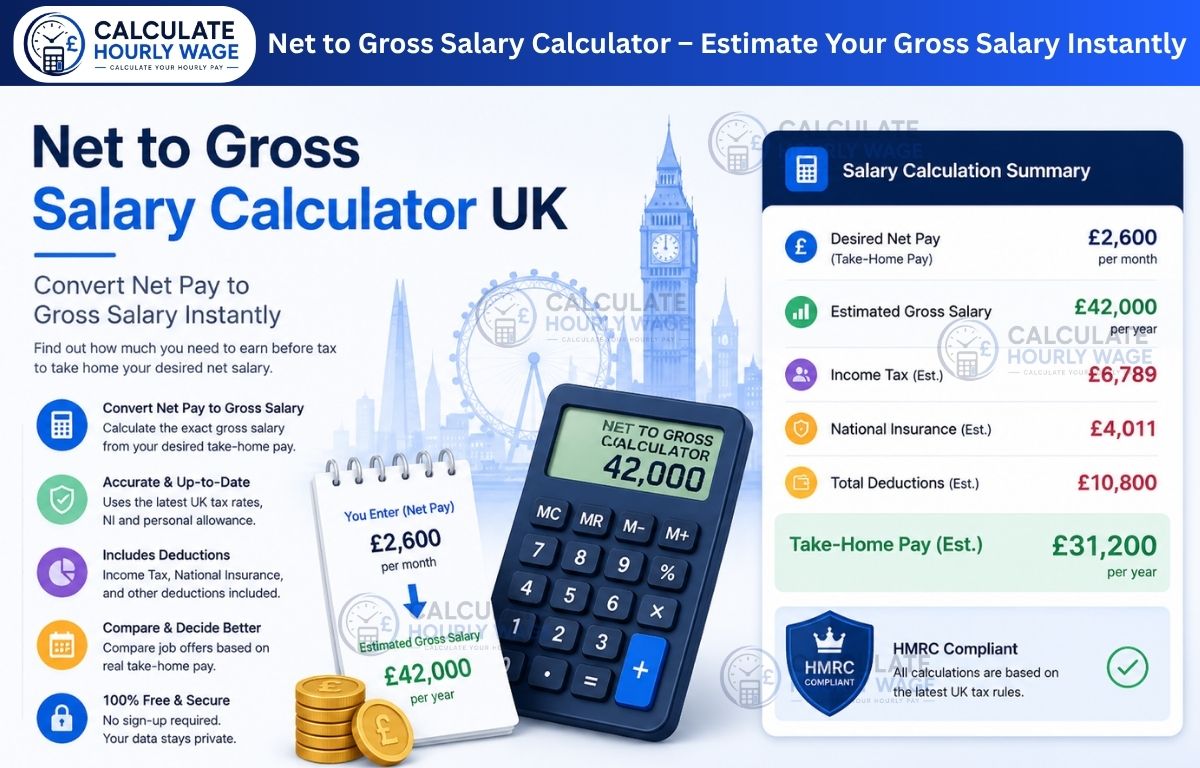
Imagine you’ve just received a job offer with take-home pay of around £2,600 per month.
And another employer offers a gross salary of £42,000 per year instead of a take-home figure.
Now you’re stuck between which offer actually pays more.
This is exactly where a Net to Gross Salary Calculator UK becomes valuable.
Calculator
Instead of guessing or trying to do calculations manually, the calculator estimates your gross salary by working backwards from your net pay.
If you’re:
- Negotiating a new job offer
- Checking payroll accuracy
- Applying for a mortgage
- Planning your personal finances
Understanding the relationship between net and gross income helps you to make smarter financial decisions.
What Is a Net to Gross Salary Calculator UK?
A Net to Gross Salary Calculator UK estimates your total salary before deductions using the amount you actually receive after taxes and other payroll deductions.
Rather than calculating take-home pay from gross earnings, it reverses the process.
This allows you to estimate how much your employer is paying before Income Tax, National Insurance, pension contributions, and other deductions are taken.
Read More: Salary to Hourly Calculator UKWhat is Net Salary?
| Net Salary | Description |
|---|---|
| Definition | Net salary is your take-home pay. |
| Explanation | It is the amount that reaches your bank account after all mandatory deductions are taken from your gross salary. |
| Typical Deductions Include | • Income Tax • National Insurance • Workplace pension • Student loan repayments • Salary sacrifice arrangements • Other payroll deductions |
| Formula | Net Salary = Gross Salary − Total Deductions |
What Is Gross Salary?
| Gross Salary | Description |
|---|---|
| Definition | Gross salary is the total amount your employer agrees to pay before any deductions. |
| Explanation | It represents your contractual salary and is commonly used in: |
| Common Uses | • Job advertisements • Employment contracts • Mortgage applications • Salary negotiations • Pension calculations |
Why People Need to Convert Net Pay to Gross Salary?
Many people know exactly how much they receive each month but have no idea what their actual salary is before deductions.
Common situations include:
- Comparing job offers
- Applying for loans
- Checking payslips
- Budget planning
- Salary negotiations
- Estimating tax liability
How Does the Net to Gross Salary Calculator UK Work?
Although the calculation looks complicated, the calculator follows a logical process.
Step 1: Enter Your Net Salary
Start by entering your take-home pay.
This can be:
- Weekly
- Every two weeks
- Monthly
- Four-weekly
- Annually
For example:
Monthly Net Salary = £2,500
Step 2: Add Tax and National Insurance Back
The calculator estimates deductions that would normally have been removed, including:
- Income Tax
- National Insurance Contributions (NIC)
- Pension contributions
- Student Loan repayments
- Other deductions if selected
Because deductions vary depending on tax code and earnings, the calculator uses current UK tax rules to estimate them.
Read More: National Insurance Calculator UKStep 3: Estimate Your Gross Salary
After reversing the deductions, the calculator estimates your gross earnings.
For example:
| Net Monthly Pay | Estimated Gross Monthly Salary |
| £2,000 | Around £2,500 |
| £2,500 | Around £3,250 |
| £3,000 | Around £4,000 |
| £4,000 | Around £5,650 |
Figures are illustrative estimates and vary depending on tax code and deductions.
Factors That Can Affect the Result
Several variables influence the estimate:
- Tax code
- Income Tax bands
- National Insurance thresholds
- Pension contribution percentage
- Student loan plan
- Salary sacrifice
- Bonuses
- Overtime
- Additional taxable income
Why Use a Net to Gross Salary Calculator UK?
| Benefit | Description |
|---|---|
| Save Time on Manual Calculations | Reverse salary calculations involve multiple tax bands and deduction rules. A calculator performs these calculations instantly. |
| Estimate Salary Before Accepting a Job | Some employers discuss take-home pay while others advertise gross salary. A calculator helps you compare job offers fairly. |
| Understand Tax Deductions Better | Understanding how deductions reduce your salary helps you to understand where your money goes each month. |
| Plan Your Personal Budget | If you’re buying a house, renting, or saving for retirement, knowing your gross salary helps you to make long-term financial plans. |
What Information Do You Need?
To make an accurate estimate, you’ll need the following information.
| Information Required | Description |
|---|---|
| Net Salary Amount | The amount deposited into your bank account after deductions. |
| Pay Frequency | Choose the correct pay period: • Weekly • Monthly • Yearly Using the wrong option produces inaccurate results. |
| Tax Year | Tax thresholds change regularly. Always select the correct UK tax year when using the calculator. |
| Pension Contributions (If Applicable) | If you’re enrolled in a workplace pension, your contribution affects take-home pay. |
| Student Loan or Other Deductions | Include: • Student Loan repayments • Postgraduate Loan • Child maintenance • Other payroll deductions |
These significantly affect reverse calculations.
What Is Included When Estimating Gross Salary?
Income Tax
Income Tax is normally the largest deduction from your salary.
The amount depends on:
- Tax code
- Tax bands
- Annual earnings
National Insurance Contributions
- Employees also pay National Insurance based on earnings.
- NIC rates and thresholds change over time, making automated calculations much easier than manual ones.
Pension Contributions
- Many employees contribute between 3% and 8% through workplace pensions.
- These deductions reduce take-home pay.
Read More: gov.ukStudent Loan Repayments
Repayments only begin after earnings exceed the repayment threshold for your loan plan.
Salary Sacrifice Arrangements
Benefits such as:
- Cycle to Work
- Electric vehicles
- Extra pension contributions
can reduce taxable salary and influence gross estimates.
Example of Net to Gross Salary Conversion
This is where the calculator becomes especially useful.
Monthly Net Salary Example
Suppose your monthly take-home pay is:
Net Pay = £2,700
Estimated deductions might look like this:
| Deduction | Example |
| Income Tax | £360 |
| National Insurance | £185 |
| Pension | £155 |
| Calculation Result | Amount |
|---|---|
| Estimated Gross Salary (Per Month) | £3,400 |
| Annual Gross Salary | £40,800 |
Annual Net Salary Example
Suppose you receive:
Annual Net Income = £36,000
Estimated reverse calculation:
| Item | Amount |
| Net Salary | £36,000 |
| Estimated Income Tax | £5,200 |
| National Insurance | £2,700 |
| Pension | £2,100 |
| Calculation Result | Amount |
|---|---|
| Estimated Gross Salary (Annually) | Around £46,000 |
Again, actual figures depend on your personal circumstances.
Net vs Gross Salary – What’s the Difference?
Understanding the difference between net and gross Salary helps you to avoid misunderstandings during salary discussions.
Gross Salary Explained
Gross salary is:
- Before deductions
- Employment contract amount
- Used for tax calculations
Net Salary Explained
Net salary is:
- After deductions
- Money received
- Spendable income
Quick Comparison Table
| Feature | Gross Salary | Net Salary |
| Before Tax | ✔ | ✘ |
| After Tax | ✘ | ✔ |
| Includes Pension Deductions | Before | After |
| Used in Contracts | ✔ | ✘ |
| Paid Into Bank | ✘ | ✔ |
Who Should Use a Net to Gross Salary Calculator UK?
Employees
Employees can verify payslips and estimate salary before changing jobs.
Job Seekers
Job advertisements usually mention gross salary.
Reverse calculations help compare offers based on actual take-home pay.
Freelancers and Contractors
Contractors switching to permanent employment can estimate equivalent salaries.
Employers and Recruiters
Recruiters can estimate gross salaries when candidates specify desired take-home pay.
Common Reasons Your Gross Salary Estimate May Differ
Even accurate calculators produce estimates.
Several personal factors affect the final result.
| Factor | How It Affects Your Salary |
|---|---|
| Different Tax Codes | Incorrect tax codes change Income Tax calculations. |
| Pension Contributions | Higher pension contributions reduce net income. |
| Salary Sacrifice Schemes | Salary sacrifice lowers taxable income. |
| Bonuses and Overtime | Variable earnings may move part of your income into different tax bands. |
| Student Loan Repayments | Loan plans have different repayment thresholds and percentages. |
Common Mistakes to Avoid
| Common Mistake | Explanation |
|---|---|
| Entering Gross Salary Instead of Net Salary | The calculator works backwards. Entering gross salary defeats its purpose. |
| Choosing the Wrong Pay Period | Monthly and annual figures cannot be mixed. Always select the matching pay frequency. |
| Ignoring Pension Deductions | Leaving pension contributions out often leads to overestimated gross salary. |
| Using an Outdated Tax Year | Tax rates and thresholds change. Always use the latest available tax year. |
| Forgetting Additional Income | Bonuses, overtime, commission, and taxable benefits all affect your gross estimate. |
How do I calculate gross salary from net salary in the UK?
Estimate the deductions that were taken from your pay, such as Income Tax, National Insurance, pension contributions, and student loan repayments, and add them back to your net salary. A Net to Gross Salary Calculator automates this process using current UK tax rules.
Is the calculator accurate?
Yes, it provides a reliable estimate when you enter the correct details. However, your actual gross salary may differ because of your tax code, pension arrangements, bonuses, or other deductions.
Does it include Income Tax and National Insurance?
Yes. Most Net to Gross Salary Calculators factor in both Income Tax and National Insurance. Many also allow you to include pension contributions and student loan repayments for a more personalised estimate.
Can I convert monthly net pay to annual gross salary?
Absolutely. Simply enter your monthly net pay, choose the monthly pay frequency, and the calculator will estimate both your monthly and annual gross salary.
Why is my employer’s gross salary different from the estimate?
Your employer uses your exact payroll information, including your tax code, pension contributions, salary sacrifice arrangements, and any additional taxable benefits. A calculator provides an estimate based on the information you enter.
Can I use this calculator for weekly or hourly pay?
Yes. Many calculators support weekly, fortnightly, monthly, and annual pay frequencies. Some also estimate hourly rates if you provide your working hours.
Final Thoughts
Understanding the difference between net pay and gross salary removes much of the confusion surrounding UK payroll. A Net to Gross Salary Calculator UK gives you a fast, practical estimate of your pre-tax earnings, helping you compare job offers, plan your finances, and better understand how deductions shape your take-home pay.