

Your net annual salary is the amount you have left from your gross annual salary after applicable deductions such as Income Tax, National Insurance, workplace pension contributions and student loan repayments. Your exact take-home pay can also depend on your tax code, salary sacrifice arrangements, location and other payroll circumstances.
Enter your gross annual salary and relevant deductions to estimate your annual, monthly and weekly take-home income for the 2026/27 tax year.
Net Annual Salary Calculator UK shows:
| Calculation | Result |
|---|---|
| Gross annual salary | £X |
| Income Tax | £X |
| National Insurance | £X |
| Pension deduction | £X |
| Student loan deduction | £X |
| Net annual salary | £X |
| Estimated monthly take-home | £X |
| Estimated weekly take-home | £X |
The result is an estimate rather than a guaranteed payslip amount. Your actual pay can differ because payroll calculations may reflect your tax code, pension arrangements, student loan position, salary sacrifice, bonuses, overtime, multiple jobs or other deductions.
What Is Net Annual Salary?
Gross Salary vs Net Salary
Gross annual salary is your pay before deductions. If an employer offers you an annual salary, the figure normally refers to your gross salary.
Net annual salary is the amount left after applicable deductions have been taken from your earnings.
For example, someone offered a job with a stated annual salary is usually being quoted a gross figure. Their bank account will not normally receive that full amount because payroll deductions may be taken before they are paid.
Net annual salary is therefore the more useful figure when you want to understand how much income you actually have available after payroll deductions.
Net Pay vs Take-Home Pay
Net pay and take-home pay are commonly used to describe the amount an employee receives after applicable deductions.
The terms can be useful when comparing salaries, but the figure should always be understood in context. A calculator estimate may use standard assumptions, while your actual payslip can include personal circumstances that change the result.
Your taxable income is also not necessarily the same thing as your gross salary. Deductions and arrangements such as pension contributions or salary sacrifice can affect how income is treated for calculation purposes.
What Can Be Deducted From Your Salary?
The main deductions relevant to a net salary calculation include:
- Income Tax
- National Insurance
- Workplace pension contributions
- Student loan repayments
- Other applicable payroll deductions
Not every employee will have every deduction.
Someone without a student loan, for example, will not have a student loan repayment deducted. Similarly, pension arrangements vary between employees.
How Is Net Annual Salary Calculated in the UK?
Formula Box
Net annual salary = Gross annual salary − Income Tax − National Insurance − applicable deductions
The basic idea is straightforward, but the individual calculations behind each deduction can vary.
Income Tax and National Insurance are calculated separately. Pension and student loan deductions may also apply depending on your circumstances.
Step 1: Start With Gross Annual Salary
The calculation starts with your gross annual salary.
This is the salary figure before the relevant payroll deductions have been taken.
For a straightforward salary calculation, the annual gross figure is the starting point for working out how much income remains after deductions.
If you are comparing two job offers, use the gross annual salary for each role as the starting point, then compare the estimated net income rather than comparing the headline salaries alone.
Step 2: Calculate Income Tax
Income Tax is not normally calculated by simply taking one percentage of your entire salary.
The calculation takes account of your Personal Allowance and the relevant tax bands. Different portions of taxable income can therefore be subject to different rates.
Your tax code can also affect how much Income Tax is deducted through payroll.
This is why two employees with the same gross salary can potentially have different take-home amounts.
Read More: Income Tax Calculator UKStep 3: Calculate National Insurance
Employee National Insurance is calculated separately from Income Tax.
It has its own thresholds and applicable rates. As a result, you should not treat National Insurance as part of the Income Tax calculation or simply add the two together as if they were one deduction.
A net annual salary calculator needs to account for National Insurance separately when estimating take-home pay.
Step 4: Include Pension and Student Loan Deductions
Once the relevant statutory deductions have been considered, additional deductions may need to be included.
A workplace pension contribution can reduce the amount you take home. Student loan repayments can also apply where the employee meets the relevant conditions.
The effect depends on the individual’s circumstances and the assumptions used by the calculator.
Step 5: Calculate Annual and Monthly Take-Home Pay
Once the applicable deductions have been calculated, they can be taken from gross annual salary to estimate net annual salary.
The annual result can then be converted into approximate monthly and weekly figures.
Worked Example
Suppose you start with a gross annual salary of £40,000.
The calculation follows this sequence:
£40,000 gross salary − Income Tax − National Insurance − applicable pension/student loan deductions = estimated net annual salary
The resulting annual figure can then be divided into an approximate monthly figure and an approximate weekly figure.
The exact net amounts should come from the calculator using the relevant 2026/27 assumptions rather than applying a single tax percentage to the full £40,000.
UK Income Tax and National Insurance for 2026/27
The calculator should use the correct 2026/27 assumptions when calculating take-home pay.
The supplied research identifies Personal Allowance, Income Tax bands, National Insurance thresholds and applicable employee rates as core parts of the calculation. Numerical figures should be verified against the relevant official source before publication.
2026/27 Income Tax Bands and Personal Allowance
The Income Tax calculation uses the Personal Allowance and applicable tax bands.
The main concepts to understand are:
- Personal Allowance
- Basic-rate band
- Higher-rate band
- Additional-rate threshold
- Progressive taxation
Comparison Table: 2026/27 Income Tax
| Income Tax element | 2026/27 treatment |
|---|---|
| Personal Allowance | Use verified 2026/27 figure |
| Basic-rate band | Use verified 2026/27 figure |
| Higher-rate band | Use verified 2026/27 figure |
| Additional-rate threshold | Use verified 2026/27 figure |
The key point is that moving into a higher tax band does not mean your entire salary is suddenly taxed at the higher rate. The applicable rate applies to the relevant portion of taxable income.
Visit Now: GOV.UK2026/27 National Insurance
National Insurance has separate thresholds and rates from Income Tax.
For an employee salary calculator, the relevant employee National Insurance treatment needs to be applied separately from Income Tax.
Comparison Table: 2026/27 Employee National Insurance
| National Insurance element | 2026/27 treatment |
|---|---|
| Relevant employee threshold | Use verified 2026/27 figure |
| Main employee rate | Use verified 2026/27 figure |
| Higher earnings treatment | Use verified 2026/27 figure |
The exact figures should be taken from the verified official 2026/27 source before publication.
Read More: National Insurance Calculator UKWhy Income Tax and National Insurance Are Calculated Separately
Income Tax and National Insurance are different deductions.
They have different rules, thresholds and rates. This matters because calculating your net salary as:
Gross salary × one tax percentage
will not give an accurate result.
A proper calculation considers the relevant Income Tax treatment and National Insurance treatment separately before accounting for other applicable deductions.
What Affects Your Net Annual Salary?
Your gross salary alone does not always determine your final take-home pay.
Tax Code
Your tax code can affect the amount of Income Tax deducted from your pay.
This means two employees with the same gross salary can have different net pay if their individual tax circumstances are different.
If your calculator result does not match your payslip, checking the tax code used by your employer is one of the areas to consider.
Workplace Pension Contributions
A workplace pension contribution can affect take-home pay because money is being directed towards your pension rather than being received as current income.
Comparison Table: Pension Effect
| Situation | Effect on take-home pay |
|---|---|
| No pension deduction included | Higher estimated take-home pay |
| Pension contribution included | Lower estimated take-home pay |
| Salary sacrifice arrangement | Can affect taxable pay and take-home calculation |
The precise effect depends on the pension arrangement and calculator assumptions.
Student Loan Repayments
Student loan repayments can reduce take-home pay where the relevant repayment conditions apply.
Not every employee has a student loan deduction.
Comparison Table: Student Loan Consideration
| Employee situation | Student loan deduction |
|---|---|
| No applicable student loan repayment | Not included |
| Applicable repayment circumstances | Included in calculation |
| Different repayment circumstances | Result may differ |
The calculator should therefore allow the relevant student loan circumstances to be accounted for rather than assuming every employee has the same deduction.
Salary Sacrifice
Salary sacrifice is another factor that can affect a take-home calculation.
Under a salary sacrifice arrangement, an employee gives up part of their salary in return for a benefit. This can affect the income figures used for certain payroll calculations.
The calculator should therefore make its salary sacrifice assumptions clear.
Scotland vs England, Wales and Northern Ireland
Location can affect the Income Tax calculation.
Scottish taxpayers have different Income Tax treatment from taxpayers in England, Wales and Northern Ireland.
Comparison Table: UK Location
| Location | Income Tax treatment |
|---|---|
| England | Relevant UK Income Tax rules |
| Wales | Relevant UK Income Tax rules |
| Northern Ireland | Relevant UK Income Tax rules |
| Scotland | Scottish Income Tax treatment |
The calculator should ask for or otherwise account for the relevant location when this affects the result.
Bonuses and Overtime
Bonuses and overtime increase earnings and can change the amount of tax and other deductions applied through payroll.
Practical Scenario: Bonus or Overtime
An employee may have a regular annual salary but receive additional overtime or a bonus during the year.
Their gross earnings are then higher than the basic salary figure. The additional payment can affect the payroll calculation, so simply adding the full bonus to the employee’s take-home pay may produce an inaccurate estimate.
For a clearer result, treat the additional earnings as part of the relevant gross-pay calculation and account for the applicable deductions.
Read More: Bonus Tax Calculator UKMore Than One Job
Having more than one job can create a different payroll situation from having one employment.
Practical Scenario: Two Jobs
An employee may receive income from two separate employments. The calculation cannot necessarily be treated as though both salaries were one simple payslip.
Tax codes and the treatment of each employment can affect the resulting take-home income.
If you have multiple jobs, use your actual payroll information and tax-code circumstances when checking a calculator estimate.
These figures should be populated using the verified 2026/27 calculator assumptions before publication. They should not be produced by applying a single percentage to each salary.
Example: Standard Employee With No Additional Deductions
A standard calculation begins with the gross salary.
For example:
Gross annual salary = £40,000
The calculation then considers:
- Income Tax
- National Insurance
- Any applicable deductions
The resulting figure is the employee’s estimated net annual salary.
The annual result can then be converted into monthly and weekly estimates.
This example demonstrates why the calculator needs to process each deduction separately rather than treating the entire salary as subject to one percentage.
Example: Employee With a Workplace Pension
Consider an employee earning £40,000 who also has a workplace pension contribution.
Their calculation becomes:
£40,000 gross salary − Income Tax − National Insurance − applicable pension deduction = estimated net annual salary
The pension contribution means the employee’s take-home pay is different from the result produced by a calculation that excludes pension deductions.
The calculator should allow the user to include the relevant pension assumption.
Example: Employee With a Student Loan
An employee with the same gross salary may have a different take-home amount if a student loan repayment applies.
The calculation becomes:
Gross salary − Income Tax − National Insurance − student loan deduction = estimated net salary
If the employee also has a pension contribution, that needs to be considered as well.
This is why salary calculators should ask about relevant deductions rather than treating every employee as identical.
Example: Higher-Rate Taxpayer
A higher-rate taxpayer should not calculate tax by applying the higher rate to the whole salary.
Income Tax uses bands, meaning different portions of taxable income can be subject to different rates.
The correct calculation therefore works through the relevant bands before arriving at the total Income Tax deduction.
Example: Salary Above £100,000
Higher earnings can create additional complexity because the Personal Allowance can be affected at higher income levels.
This means an employee earning above £100,000 should not assume that the standard Personal Allowance automatically applies in full.
The calculator needs to account for the Personal Allowance taper where applicable.
Example: Scottish Taxpayer
A Scottish taxpayer may receive a different net salary from an employee elsewhere in the UK even where their gross salary is the same.
The reason is that Scottish Income Tax treatment differs.
The calculator should therefore use the appropriate location when estimating the employee’s net annual salary.
How Much of Your Salary Do You Take Home Each Month and Week?
Annual Salary to Monthly Take-Home Pay
Your annual net salary can be converted into an approximate monthly amount.
Approximate monthly net pay = Net annual salary ÷ 12
This provides a useful budgeting figure for someone who receives a regular monthly salary.
Actual monthly payslips can still vary where bonuses, overtime, irregular deductions or other payroll changes occur.
Read More: Monthly Salary Calculator UK – Convert Annual Salary to Monthly PayAnnual Salary to Weekly Take-Home Pay
A weekly estimate can also be produced from annual net income.
Approximate weekly net pay = Net annual salary ÷ applicable weeks
The weekly figure is an estimate when you are paid monthly. Your actual payment schedule depends on your employment and payroll arrangements.
Annual Net Salary vs Monthly Net Salary
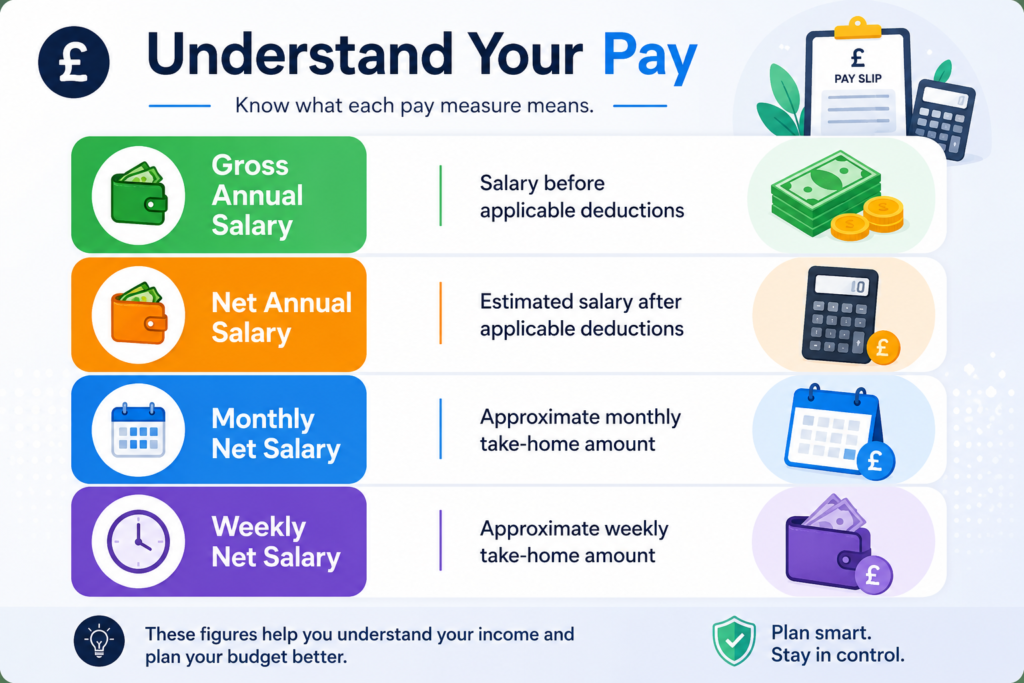
Comparison Table
| Pay measure | What it tells you |
|---|---|
| Gross annual salary | Salary before applicable deductions |
| Net annual salary | Estimated salary after applicable deductions |
| Monthly net salary | Approximate monthly take-home amount |
| Weekly net salary | Approximate weekly take-home amount |
Annual net salary is useful for comparing employment income. Monthly net salary is often more useful for household budgeting.
Why Your Payslip May Differ From the Calculator
An online salary calculator provides an estimate based on the information and assumptions entered.
Your payslip may contain additional or different information.
Different Tax Code
Your tax code can change the amount of Income Tax deducted.
If the calculator assumes a standard tax-code position but your employer uses a different code, the resulting figures may not match.
Pension or Salary-Sacrifice Differences
A calculator may use a pension contribution assumption that differs from your workplace pension.
Salary sacrifice can also change the figures used in payroll calculations.
Check the pension and salary-sacrifice details before comparing an estimate with your payslip.
Student Loan or Other Deductions
Student loan repayments and other payroll deductions can change your final net pay.
If these are not included in the calculator, its result will naturally differ from a payslip that includes them.
Bonuses, Overtime or Irregular Pay
A calculator based on a regular annual salary may not reproduce a payslip containing overtime, bonuses or other irregular earnings.
Additional earnings can change the relevant deductions.
Read More: Overtime Pay Calculator UKStarting or Leaving a Job During the Tax Year
A person who starts or leaves employment during the tax year may have a different payroll position from someone who works throughout the year.
This can affect the comparison between a simple annualised calculator estimate and an actual payslip.
Multiple Jobs or Other Employment Income
Multiple employments can involve different tax-code and payroll circumstances.
A simple calculator result may therefore not match the combined position shown across your actual payslips.
Practical Scenario
Imagine a calculator estimates your net pay from a standard annual salary, but your payslip is lower.
Before assuming the calculator is wrong, check:
- Tax code
- Pension contribution
- Salary sacrifice
- Student loan deduction
- Bonus or overtime
- Other payroll deductions
- Multiple employment income
The difference may come from an assumption rather than a calculation error.
Common Net Annual Salary Calculator UK Mistakes
Applying One Tax Rate to the Whole Salary
Income Tax uses relevant bands rather than one percentage applied to the entire salary.
A higher-rate taxpayer does not simply pay the higher rate on every pound earned.
Confusing Gross Pay With Take-Home Pay
The salary advertised by an employer is generally a gross figure.
Your net salary is the amount remaining after applicable deductions.
Forgetting National Insurance
National Insurance is separate from Income Tax.
Leaving it out can produce an unrealistic take-home estimate.
Ignoring Pension Contributions
A pension contribution can reduce the amount received as current take-home pay.
If you want to compare a calculator result with your payslip, include the relevant pension assumption.
Ignoring Student Loan Repayments
A student loan repayment can affect net salary for employees to whom the relevant rules apply.
Do not assume the same net result for employees with and without this deduction.
Using the Wrong Tax Year
Tax thresholds and rates can change between tax years.
A 2026/27 calculation should use the correct 2026/27 assumptions.
Assuming Everyone Has the Same Tax Code
Tax codes are personal payroll information.
Two people earning the same gross salary may therefore have different deductions.
Treating the Calculator Result as an Exact Payslip
A calculator is an estimate based on the information entered.
Your actual payslip can include individual circumstances that the calculator does not fully reproduce.
Practical Ways to Use Your Net Annual Salary
Comparing Job Offers
A higher gross salary does not automatically tell you how much additional money you will receive.
Use estimated net annual and monthly income to make a more meaningful comparison between job offers.
Consider the effect of:
- Income Tax
- National Insurance
- Pension
- Student loan
- Location
- Other relevant deductions
Evaluating a Pay Rise
A pay rise increases gross salary, but the entire increase does not necessarily appear in your bank account.
Practical Scenario
Suppose your employer increases your annual salary.
The useful question is not only:
“How much higher is my gross salary?”
It is also:
“How much higher is my estimated net salary?”
Run both salary figures through the calculator and compare the resulting take-home income.
This gives you a clearer picture of the actual increase available to spend or save.
Comparing Bonuses or Overtime
A bonus or overtime payment increases gross earnings.
However, deductions can also apply to the additional earnings.
When comparing overtime opportunities, consider the expected additional net income rather than assuming the full gross payment will be received.
Planning Monthly Spending
Monthly net pay is generally more useful for budgeting than gross annual salary.
Use your estimated monthly take-home amount when planning regular spending, saving and other household commitments.
Remember that the monthly figure is an estimate and can change if your earnings or deductions change.
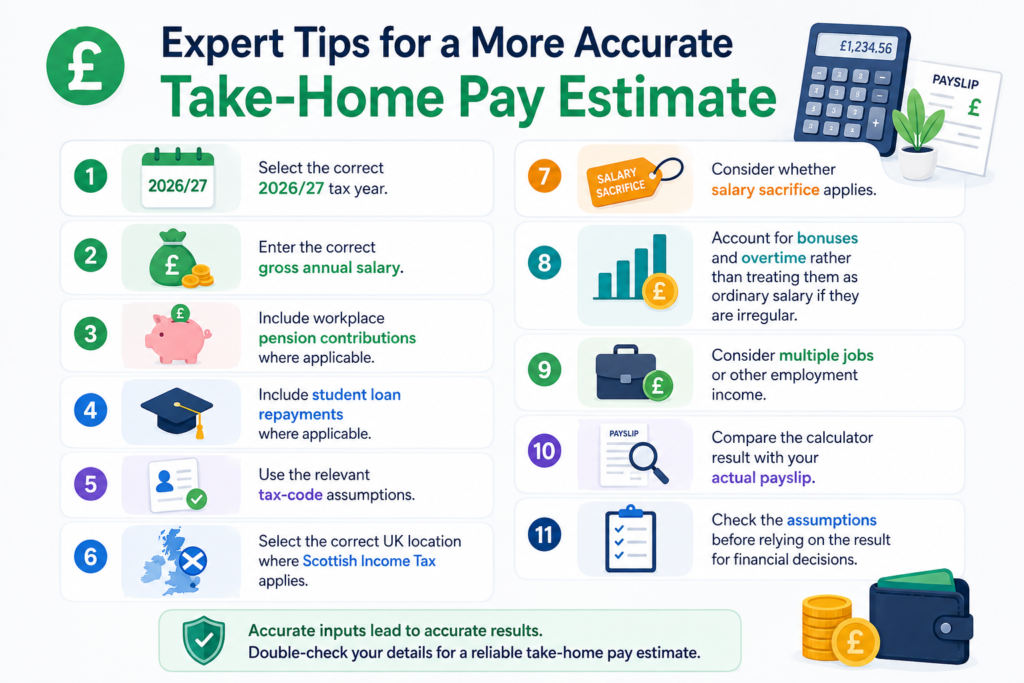
Expert Tips for Getting a More Accurate Take-Home Pay Estimate
- Select the correct 2026/27 tax year.
- Enter the correct gross annual salary.
- Include workplace pension contributions where applicable.
- Include student loan repayments where applicable.
- Use the relevant tax-code assumptions.
- Select the correct UK location where Scottish Income Tax applies.
- Consider whether salary sacrifice applies.
- Account for bonuses and overtime rather than treating them as ordinary salary if they are irregular.
- Consider multiple jobs or other employment income.
- Compare the calculator result with your actual payslip.
- Check the assumptions before relying on the result for financial decisions.
The more closely the calculator inputs match your actual payroll circumstances, the more useful the estimate will be.
Net Salary vs Gross Salary: Key Differences
| Factor | Gross Salary | Net Annual Salary |
|---|---|---|
| Meaning | Salary before deductions | Salary after applicable deductions |
| Income Tax | Not deducted | Deducted |
| National Insurance | Not deducted | Deducted |
| Pension | May be deducted later | Reflected where applicable |
| Student Loan | May be deducted later | Reflected where applicable |
| Used for take-home budgeting | Less useful | More useful |
The main difference is simple: gross salary describes earnings before applicable deductions, while net salary describes the amount remaining after those deductions.
For job comparisons and monthly budgeting, net annual salary gives a clearer indication of the income you may actually receive.
What is net annual salary in the UK?
Net annual salary is the amount remaining from your gross annual salary after applicable deductions such as Income Tax, National Insurance and other relevant payroll deductions.
How do I calculate my net annual salary?
Start with gross annual salary and subtract Income Tax, National Insurance and applicable deductions such as pension or student loan repayments.
Net annual salary = Gross annual salary − Income Tax − National Insurance − applicable deductions
Is take-home pay the same as net salary?
The terms are commonly used to describe the amount received after applicable deductions. Both are useful ways of referring to the income left after payroll deductions.
How much of my annual salary do I take home?
It depends on your gross salary and individual circumstances. Income Tax, National Insurance, pension, student loan repayments, tax code, salary sacrifice and location can all affect the result.
How much is £30,000 a year after tax?
The exact 2026/27 net amount depends on the assumptions used for Income Tax, National Insurance and any applicable deductions. Use the calculator with the appropriate circumstances rather than applying one percentage to £30,000.
How much is £40,000 a year after tax?
A £40,000 gross annual salary is reduced by applicable Income Tax, National Insurance and any relevant deductions. The calculator can estimate annual, monthly and weekly take-home pay based on the selected assumptions.
How much is £50,000 a year after tax?
Your take-home pay from a £50,000 gross salary depends on the applicable 2026/27 tax and payroll circumstances. Pension, student loan and tax-code details can also change the result.
What deductions are taken from my salary?
Common deductions include Income Tax, National Insurance, workplace pension contributions and student loan repayments. Other payroll deductions may also apply depending on your circumstances.
Does pension reduce my take-home pay?
A workplace pension contribution can reduce the amount you receive as current take-home pay. The exact effect depends on the pension arrangement and how it is treated in the calculation.
Does a student loan reduce my take-home pay?
Where the applicable repayment conditions are met, student loan repayments can reduce take-home pay. Employees without an applicable repayment do not have the same deduction.
Conclusion:
Net annual salary gives you a clearer picture of how much of your gross income you may actually take home. Income Tax, National Insurance, pension contributions, student loans, tax code and other payroll circumstances can all affect the final amount. Use the Net Annual Salary Calculator UK with accurate 2026/27 details to get a useful estimate, but always compare the result with your actual payslip.