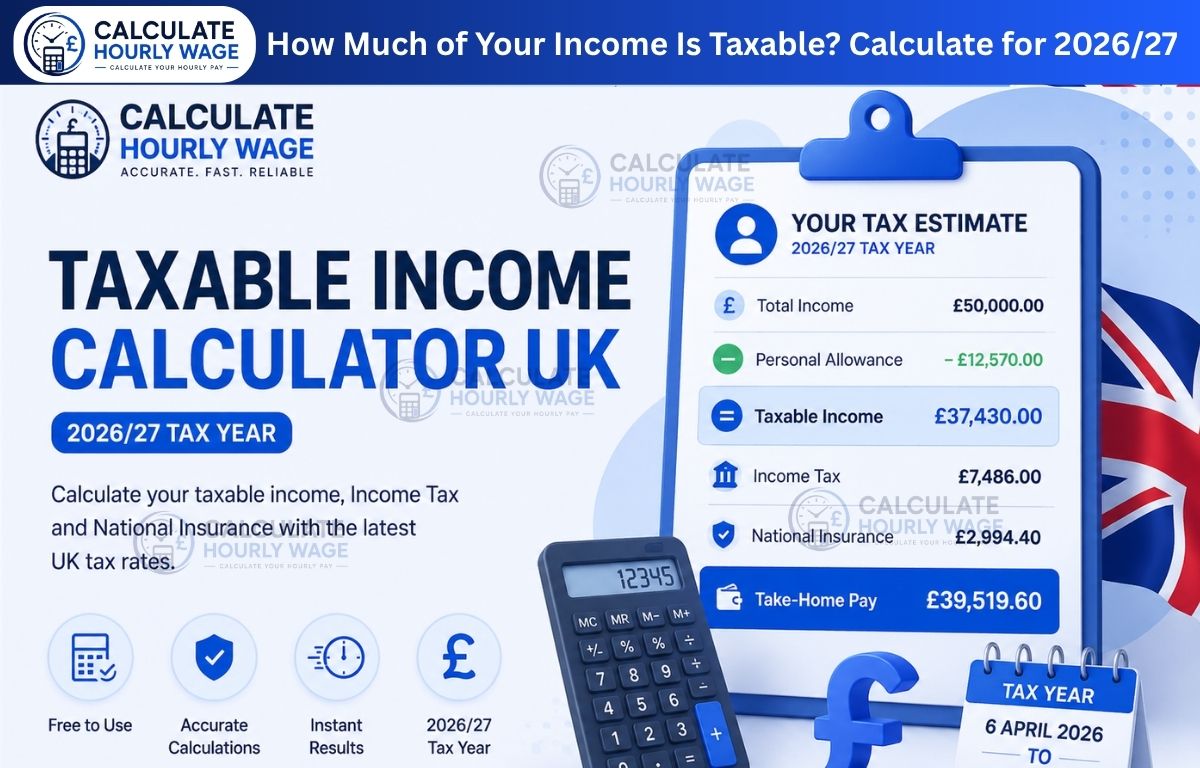
A taxable income calculator estimates how much of your income is subject to Income Tax after applying the Personal Allowance and any eligible tax reliefs or deductions. It also estimates your Income Tax and National Insurance for the 2026/27 tax year.
It is suitable for employees, self-employed workers, freelancers, pensioners and anyone with multiple income sources, including salary, dividends, rental income and savings interest.
Tax Year: 6 April 2026 to 5 April 2027
Taxable Income Calculator
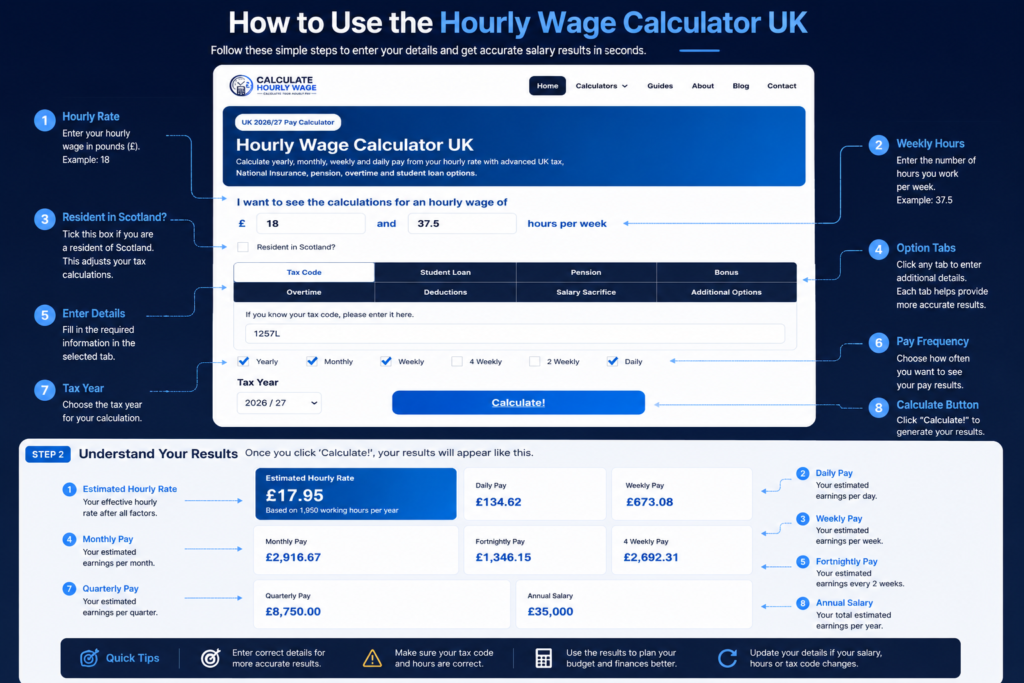
Use the calculator below to estimate your taxable income, Income Tax and National Insurance for the 2026/27 tax year.
Click Here: Hourly Wage Calculator UK
How To Use The Hourly Wage Calculator UK
What Is Taxable Income?
Taxable income is the part of your total income that is subject to Income Tax after applying any tax-free allowances and eligible deductions. It is usually lower than your gross income because most taxpayers receive a Personal Allowance and may qualify for additional tax reliefs.
Knowing your taxable income helps you:
- estimate your Income Tax bill
- identify your tax band
- plan pension contributions
- check whether you are close to the £100,000 Personal Allowance taper
- prepare for Self Assessment
Taxable Income Formula
The basic calculation is:
Taxable Income = Total Income − Tax-Free Allowances − Allowable Deductions
The calculator automatically identifies eligible income, applies available allowances and deductions, then calculates your taxable income.
Taxable Income vs Gross Income vs Net Income vs Adjusted Net Income
These terms are often confused, but they describe different stages of your income.
| Term | Meaning |
|---|---|
| Gross Income | Your total income before tax or deductions. |
| Taxable Income | The amount that remains after applying eligible allowances and deductions. |
| Net Income | Your income after Income Tax, National Insurance and other deductions have been taken. |
| Adjusted Net Income | A tax calculation used for rules such as the Personal Allowance taper and some benefit calculations. |
Read More: Net to Gross Salary Calculator UKWhat Counts as Taxable Income?
Different income sources are taxed in different ways. Knowing which ones count towards your taxable income helps you estimate your tax more accurately.
Employment Income
For most employees, taxable employment income includes:
- salary
- wages
- bonuses
- overtime
- commission
- certain workplace benefits
Income received through PAYE is still taxable even though tax may already have been deducted from your payslip.
Self-Employment Income
If you are self-employed, taxable income is usually based on your business profits rather than your total sales.
Business expenses that qualify for tax purposes are normally deducted before calculating taxable profit.
Self-employed people also receive the Personal Allowance if they meet the normal eligibility rules.
Pension Income
Most pension income is taxable after any available tax-free amount has been applied, although the exact treatment depends on the type of pension.
Rental Income
Rental profits are usually taxable after allowable expenses have been deducted. They may also affect your tax band and other tax calculations.
Dividend Income
Dividend income has its own tax rules. Although a Dividend Allowance may apply, dividends still count towards your overall income for tax purposes.
Savings Interest
Interest earned on savings can also be taxable depending on:
- your total income
- your tax band
- your available Personal Savings Allowance
Whether savings interest is taxable depends on your total income, tax band and Personal Savings Allowance.
Benefits in Kind
Some workplace benefits increase your taxable income even though they are not paid as cash.
Examples include:
- company cars
- private medical insurance
- employer-provided accommodation
- fuel benefits
These benefits can increase the amount of Income Tax you pay.
Income That Usually Isn’t Taxable
Some types of income are normally outside the scope of Income Tax or covered by specific exemptions.
| Income Type | Usually Taxable? | Notes |
|---|---|---|
| Employment salary | Yes | Usually taxed through PAYE |
| Self-employed profits | Yes | Based on taxable profit |
| Rental profits | Yes | After allowable expenses |
| Dividends | Usually | Subject to dividend rules |
| Savings interest | Sometimes | Depends on allowances |
| Company benefits | Often | Depends on the benefit provided |
| Certain tax-free allowances | No | Subject to eligibility rules |
Visit Now: GOV.UKWhat Reduces Your Taxable Income?
Several allowances and tax reliefs can reduce the amount of income you pay tax on. Some apply automatically, while others must be claimed.
Personal Allowance
For the 2026/27 tax year, the standard Personal Allowance is:
£12,570
If your total income is within this allowance, you normally will not pay Income Tax.
For higher earners, the allowance starts to reduce once your adjusted net income exceeds £100,000. It decreases by £1 for every £2 above this threshold until it reaches zero at £125,140.
Pension Contributions
Pension contributions can reduce your taxable income depending on how they are made.
Depending on how they are made, pension contributions can reduce your taxable income and Income Tax while increasing your retirement savings.
- Lower taxable income
- Reduced Income Tax
- Improved retirement savings
Higher-rate taxpayers often use pension contributions to remain below key tax thresholds.
Salary Sacrifice
Salary sacrifice works differently from making a personal pension contribution.
Instead of paying into a pension after receiving your salary, you agree to reduce your salary in exchange for your employer making the pension contribution.
This can reduce:
- taxable income
- Income Tax
- National Insurance
Because National Insurance is also reduced, salary sacrifice can sometimes provide greater savings than making personal contributions after tax.
Gift Aid
Gift Aid donations to eligible charities may reduce your adjusted net income.
This can be particularly useful if your income is close to the Personal Allowance taper threshold or another important tax limit.
Blind Person’s Allowance
Eligible taxpayers can claim an additional Blind Person’s Allowance.
For the 2026/27 tax year, the allowance is:
£3,250
This is added to the standard Personal Allowance, increasing the amount of income you can receive before paying Income Tax.
Marriage Allowance
Marriage Allowance allows one spouse or civil partner to transfer part of their unused Personal Allowance to the other if they meet the eligibility rules.
For 2026/27:
- Transferable amount: £1,260
- Maximum annual tax saving: Up to £252
Married Couple’s Allowance
Married Couple’s Allowance is different from Marriage Allowance.
It is generally available only to couples where one partner was born before 6 April 1935 and is subject to its own eligibility rules.
Trading Allowance
Eligible people with small amounts of trading income may benefit from the £1,000 Trading Allowance.
The allowance is:
£1,000
For some individuals, income below this level may not need to be taxed or reported, depending on their circumstances.
Property Allowance
A separate £1,000 Property Allowance may apply to qualifying property income.
This can simplify tax reporting for landlords with relatively small property income.
2026/27 Allowances at a Glance
| Allowance | Amount | Eligibility | Automatic or Claimed? |
|---|---|---|---|
| Personal Allowance | £12,570 | Most taxpayers | Automatic |
| Blind Person’s Allowance | £3,250 | Eligible individuals | Claimed |
| Marriage Allowance | £1,260 transfer | Eligible couples | Claimed |
| Married Couple’s Allowance | Up to applicable limits | Born before 6 April 1935 | Claimed |
| Trading Allowance | £1,000 | Eligible trading income | Automatic if applicable |
| Property Allowance | £1,000 | Eligible property income | Automatic if applicable |
UK Income Tax Bands (2026/27)
Your taxable income determines which Income Tax band applies. The UK uses a progressive tax system, so only the portion of income within each band is taxed at that rate.
England, Wales and Northern Ireland Tax Bands
| Tax Band | Taxable Income | Rate |
|---|---|---|
| Personal Allowance | Up to £12,570 | 0% |
| Basic Rate | £12,571 to £50,270 | 20% |
| Higher Rate | £50,271 to £125,140 | 40% |
| Additional Rate | Over £125,140 | 45% |
Only the income within each band is taxed at that band’s rate.
Scottish Income Tax Bands
Scottish taxpayers use different Income Tax bands for employment income and pensions.
| Band | Taxable Income | Rate |
|---|---|---|
| Personal Allowance | Up to £12,570 | 0% |
| Starter Rate | £12,571 to £16,537 | 19% |
| Basic Rate | £16,538 to £29,526 | 20% |
| Intermediate Rate | £29,527 to £43,662 | 21% |
| Higher Rate | £43,663 to £75,000 | 42% |
| Advanced Rate | £75,001 to £125,140 | 45% |
| Top Rate | Over £125,140 | 48% |
If Scottish Income Tax applies to you, select the Scotland option in the calculator for a more accurate estimate.
Why Scotland Uses Different Tax Bands
Scottish Income Tax applies to most employment and pension income. It is based on your main place of residence, so two people earning the same salary may pay different amounts of Income Tax depending on where they live.
Dividends and Savings for Scottish Taxpayers
Scottish Income Tax applies to employment and pension income, but dividend income and most savings interest continue to follow UK-wide tax rules.
National Insurance Explained
Income Tax and National Insurance are calculated separately, even though both usually appear on your payslip.
Employee National Insurance
Employees normally pay Class 1 National Insurance on earnings above the Primary Threshold.
For the 2026/27 tax year:
- 0% up to the Primary Threshold
- 8% between the Primary Threshold and Upper Earnings Limit
- 2% above the Upper Earnings Limit
Self-Employed National Insurance
Self-employed people may pay Class 2 contributions where applicable and Class 4 contributions based on taxable profits.
For 2026/27:
- Class 4 is charged at 6% between the relevant thresholds.
- Income above the upper threshold is charged at 2%.
Why National Insurance Is Different from Income Tax
Although both are deducted from earnings, they serve different purposes.
| Income Tax | National Insurance |
|---|---|
| Based on taxable income | Based on earnings or profits |
| Uses Income Tax bands | Uses NI thresholds |
| Funds public services | Helps fund state benefits and pensions |
| Applies different rates | Uses separate contribution rates |
How to Calculate Taxable Income (Step by Step)
The calculator completes the calculation automatically, but understanding the steps can help you check your results.
Step 1: Add All Taxable Income
Start by adding together all sources of income that may be subject to Income Tax.
This could include:
- Employment salary or wages
- Self-employed profits
- Pension income
- Rental profits
- Dividend income
- Savings interest
- Taxable benefits in kind
Suppose your income for the year is:
| Income Source | Amount |
|---|---|
| Salary | £38,000 |
| Rental Profit | £4,000 |
| Dividends | £2,000 |
| Total Income | £44,000 |
Step 2: Apply Tax-Free Allowances
Next, subtract any tax-free allowances that apply to your circumstances.
For most people this includes the Personal Allowance of £12,570.
Apply any additional allowances you qualify for.
If your income exceeds £100,000, your Personal Allowance may begin to reduce.
Example:
| Item | Amount |
|---|---|
| Total Income | £44,000 |
| Personal Allowance | £12,570 |
| Remaining Taxable Income | £31,430 |
Step 3: Apply Eligible Deductions
Apply eligible deductions such as pension contributions, salary sacrifice and Gift Aid before calculating Income Tax.
The calculator automatically includes any deductions entered by the user before estimating Income Tax.
Step 4: Identify Your Tax Band
Compare your taxable income with the relevant tax bands to identify which rates apply. Only the income within each band is taxed at that rate.
Step 5: Calculate Income Tax
Income Tax is calculated progressively, so each part of your taxable income is taxed at the rate for that band rather than your entire income.
The higher rate only applies to the amount above the threshold, not your entire income.
This is one of the most common misunderstandings about the UK tax system.
Step 6: Calculate National Insurance
National Insurance is calculated separately using the relevant employee or self-employed rates before the calculator displays your estimated deductions and take-home pay.
Read More: National Insurance Calculator UK 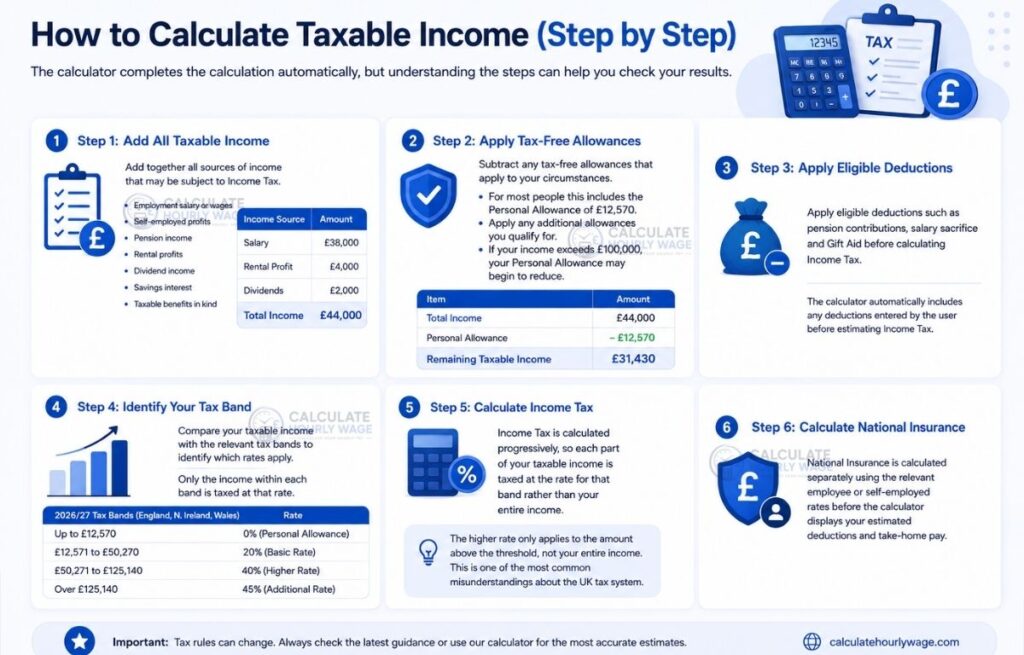
Worked Examples
The examples below show how taxable income may be calculated for different situations using the 2026/27 tax rules.
These examples are simplified to help explain the calculation process.
PAYE Employee (£30,000 Salary)
| Item | Amount |
|---|---|
| Salary | £30,000 |
| Personal Allowance | £12,570 |
| Taxable Income | £17,430 |
| Income Tax | £3,486.00 |
| Employee National Insurance | £1,394.40 |
| Total Deductions | £4,880.40 |
| Estimated Take-Home Pay | £25,119.60 |
This is a straightforward Basic Rate taxpayer with no additional income or reliefs.
Read More: Ultimate Hourly Wage Calculator After Tax UKHigher Rate Employee (£60,000 Salary)
| Item | Amount |
|---|---|
| Salary | £60,000 |
| Personal Allowance | £12,570 |
| Taxable Income | £47,430 |
| Income Tax | £11,432.00 |
| National Insurance | £3,210.60 |
Only part of the income is taxed at 40%.
The rest continues to be taxed at the Basic Rate.
£110,000 Salary (Personal Allowance Taper)
| Item | Amount |
|---|---|
| Salary | £110,000 |
| Reduced Personal Allowance | £7,570 |
| Taxable Income | £102,430 |
| Income Tax | £33,432.00 |
| National Insurance | £4,210.60 |
This example demonstrates the Personal Allowance taper.
Once adjusted net income exceeds £100,000, the Personal Allowance gradually reduces, increasing the amount of income subject to tax.
Self-Employed Sole Trader (£45,000 Profit)
| Item | Amount |
|---|---|
| Trading Profit | £45,000 |
| Personal Allowance | £12,570 |
| Taxable Income | £32,430 |
| Income Tax | £6,486.00 |
| Class 4 National Insurance | £1,945.80 |
This example shows that self-employed people receive the same Personal Allowance as employees but use different National Insurance rules.
Scottish Taxpayer (£45,000 Salary)
A Scottish taxpayer earning £45,000 uses the Scottish Income Tax bands instead of the standard UK bands for earned income.
A Scottish taxpayer earning £45,000 uses the Scottish Income Tax bands instead of the standard UK bands, so their Income Tax calculation differs from someone earning the same salary elsewhere in the UK.
This produces a different Income Tax calculation from someone earning the same salary elsewhere in the UK.
Multiple Income Sources
Emma earns:
- Salary: £33,000
- Freelance income: £6,000
Both income sources are combined when calculating taxable income. If additional reporting is required, she may also need to complete a Self Assessment tax return.
Salary Plus Side Business
Emma earns:
- Salary: £33,000
- Freelance Profit: £6,000
Both income sources contribute towards her taxable income.
She may also need to consider Self Assessment depending on her circumstances.
Salary Sacrifice Comparison
Employee A contributes to a pension after receiving salary.
Employee B uses salary sacrifice.
Although both save for retirement, Employee B may pay less National Insurance because the sacrificed salary is no longer treated as taxable earnings for NI purposes.
Salary sacrifice can reduce both Income Tax and National Insurance because the sacrificed salary is no longer treated as taxable earnings.
Practical Scenarios
First Full-Time Job
Starting your first full-time job often means paying Income Tax for the first time.
If your annual earnings exceed the Personal Allowance, part of your salary becomes taxable. Your employer normally deducts Income Tax and National Insurance through PAYE before your wages are paid.
The calculator helps estimate your taxable income, Income Tax, National Insurance and expected take-home pay before you receive your first payslip.
Receiving a Bonus
Work bonuses count as taxable employment income.
Receiving a bonus may:
- increase your taxable income
- move part of your earnings into a higher tax band
- increase your National Insurance deductions
Only the portion of income that falls into the higher tax band is taxed at the higher rate.
For example, if your salary is £48,000 and you receive a £5,000 bonus, only part of that bonus may be taxed at the Higher Rate.
Working Overtime
Overtime pay is treated in the same way as your normal salary.
Extra earnings from overtime increase your total employment income, which may:
- increase taxable income
- increase National Insurance
- move part of your earnings into a higher tax band
Overtime increases your employment income and may move part of your earnings into a higher tax band.
Read More: Overtime Pay Calculator UKMultiple Jobs
Having two or more jobs does not mean each job is taxed separately for your annual tax liability.
HMRC considers your total income across all jobs when calculating your annual tax liability, so entering every income source provides a more accurate estimate.
Freelancers
Freelancers often receive income from multiple clients throughout the year.
Your taxable income is generally based on your business profit after allowable business expenses have been deducted.
If you also have employment income, both sources contribute towards your overall taxable income.
Small Side Hustle
Income from a side hustle may become taxable depending on how much you earn and the allowances available.
Depending on the amount earned and the available allowances, some or all of this income may become taxable.
Adding side income to the calculator gives a better picture of your total annual tax position.
Landlords
Rental profits are added to your other taxable income and may move part of your earnings into a higher tax band.
If rental income pushes you into a higher tax band, only the additional amount above the threshold is taxed at the higher rate.
Higher Earners Near £100,000
People earning close to £100,000 should monitor their taxable income carefully.
Crossing this threshold can gradually reduce the Personal Allowance.
This means that a relatively small increase in income may lead to a much larger increase in tax than expected.
Planning pension contributions or salary sacrifice before the end of the tax year may help reduce adjusted net income where appropriate.
Couples Claiming Marriage Allowance
Eligible couples may reduce their overall tax bill by transferring part of an unused Personal Allowance where the rules allow.
Self-Employed Near the Making Tax Digital Threshold
Self-employed individuals with growing businesses should monitor their annual income throughout the tax year.
Approaching the Making Tax Digital threshold may mean additional reporting requirements in the future.
Monitoring taxable profit throughout the year can help you prepare for future Making Tax Digital reporting requirements.
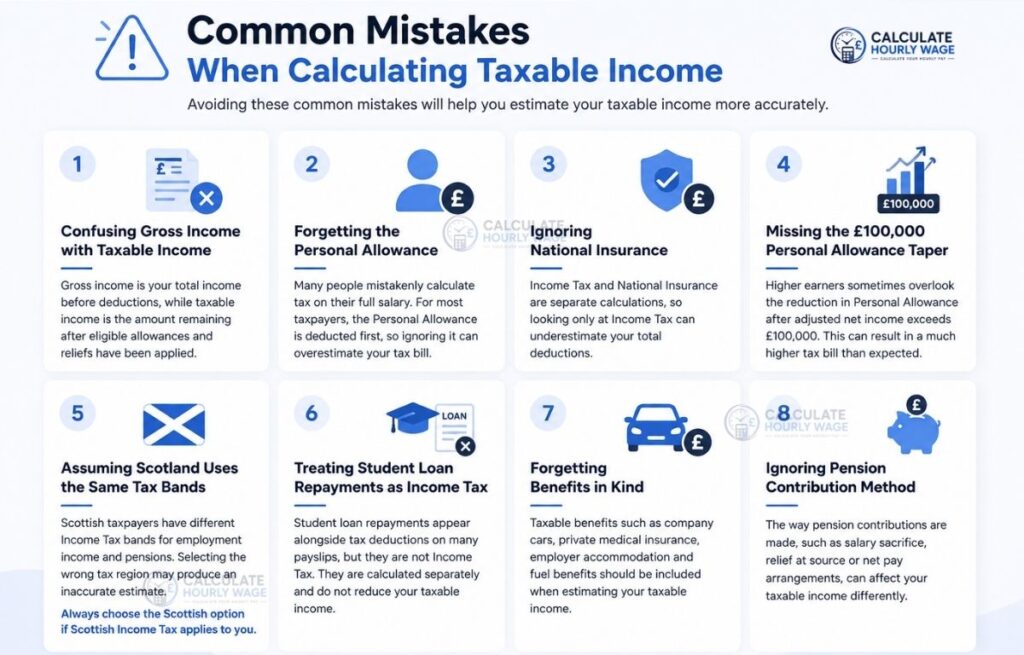
Common Mistakes When Calculating Taxable Income
Avoiding these common mistakes will help you estimate your taxable income more accurately.
Confusing Gross Income with Taxable Income
Gross income is your total income before deductions, while taxable income is the amount remaining after eligible allowances and reliefs have been applied
Forgetting the Personal Allowance
Many people mistakenly calculate tax on their full salary. For most taxpayers, the Personal Allowance is deducted first, so ignoring it can overestimate your tax bill.
Ignoring National Insurance
Income Tax and National Insurance are separate calculations, so looking only at Income Tax can underestimate your total deductions.
Missing the £100,000 Personal Allowance Taper
Higher earners sometimes overlook the reduction in Personal Allowance after adjusted net income exceeds £100,000.
This can result in a much higher tax bill than expected.
Checking your estimated taxable income during the year gives you more time to plan if you are approaching this threshold.
Assuming Scotland Uses the Same Tax Bands
Scottish taxpayers have different Income Tax bands for employment income and pensions.
Selecting the wrong tax region may produce an inaccurate estimate.
Always choose the Scottish option if Scottish Income Tax applies to you.
Treating Student Loan Repayments as Income Tax
Student loan repayments appear alongside tax deductions on many payslips, but they are not Income Tax.
They are calculated separately and do not reduce your taxable income.
Forgetting Benefits in Kind
Taxable benefits such as company cars, private medical insurance, employer accommodation and fuel benefits should be included when estimating your taxable income.
Ignoring Pension Contribution Method
The way pension contributions are made, such as salary sacrifice, relief at source or net pay arrangements, can affect your taxable income differently.
Expert Tips to Reduce Your Taxable Income Legally
Using available tax reliefs and allowances may reduce your taxable income if you are eligible.
Increase Pension Contributions
Increasing pension contributions may reduce your taxable income while boosting your retirement savings.
Use Salary Sacrifice Where Available
If your employer offers salary sacrifice, it may reduce both Income Tax and National Insurance.
Not every employer provides this option, so check your workplace benefits.
Claim Marriage Allowance
Eligible couples should check whether they can claim Marriage Allowance.
Claim Blind Person’s Allowance
If you qualify, claiming Blind Person’s Allowance increases the amount of income you can receive before paying Income Tax.
Check Your Tax Code
Check your tax code regularly to make sure the correct amount of tax is being deducted.
Plan Around the £100,000 Threshold
If your adjusted net income is close to £100,000, reviewing pension contributions or Gift Aid donations before the end of the tax year may help preserve more of your Personal Allowance.
Prepare Early for Making Tax Digital
Self-employed individuals should keep accurate records throughout the year.
Accurate records make tax calculations easier and help prepare for Making Tax Digital reporting.
Related UK Tax Rules Worth Knowing
Personal Allowance Taper
Most taxpayers receive the standard Personal Allowance. However, once your adjusted net income exceeds £100,000, your Personal Allowance starts to reduce.
The allowance decreases by £1 for every £2 of income above £100,000 until it is completely removed at £125,140.
If your income is close to this threshold, reviewing pension contributions or Gift Aid donations before the end of the tax year may help reduce your adjusted net income.
Student Loan Repayments
Student loan repayments are separate from Income Tax, use their own repayment thresholds and do not reduce your taxable income.
Tax Codes
Your tax code tells your employer how much tax-free income you are entitled to receive through PAYE.
Student loan repayments are separate from Income Tax, use their own repayment thresholds and do not reduce your taxable income.
If your calculator result differs significantly from your payslip, checking your tax code is a sensible first step.
PAYE vs Self Assessment
The way you pay tax depends on how you earn your income.
PAYE
Employees usually pay Income Tax automatically through PAYE.
Self Assessment
Self-employed people and some taxpayers with additional income, such as landlords or those receiving significant dividend income, usually report their tax through Self Assessment.
Making Tax Digital
If Making Tax Digital applies to you, keeping accurate digital records throughout the year makes estimating and reporting your tax much easier.
If you are self-employed or receive qualifying property income, keeping accurate digital records throughout the year can make tax calculations much easier.
What is taxable income in the UK?
Taxable income is the portion of your total income that remains after eligible allowances and deductions. Income Tax is calculated using this amount rather than your total earnings.
How do I calculate taxable income?
Add together your taxable income sources, subtract any eligible allowances and deductions, then apply the relevant Income Tax bands.
What is the Personal Allowance for 2026/27?
The standard Personal Allowance for the 2026/27 tax year is £12,570 for most taxpayers.
What is the difference between taxable income and gross income?
Gross income is your total income before deductions, while taxable income is the amount remaining after eligible allowances and reliefs have been applied.
Do pension contributions reduce taxable income?
They can, depending on how the pension contribution is made and the type of pension arrangement you use.
What counts as taxable income?
Taxable income may include employment income, self-employed profits, rental income, pension income, dividends, savings interest and certain taxable workplace benefits.
Is National Insurance included in taxable income?
No.
National Insurance is calculated separately from Income Tax using its own thresholds and contribution rates.
How is Scottish Income Tax different?
Scottish taxpayers use different Income Tax bands for employment income and pensions.
Dividend income and most savings income continue to follow UK-wide tax rules.
What happens if I earn more than £100,000?
Your Personal Allowance gradually reduces, increasing the amount of income that becomes taxable.
Does overtime increase taxable income?
Yes.
Overtime forms part of your employment income and may increase your taxable income.
Are benefits in kind taxable?
Many benefits in kind are taxable, including company cars and private medical insurance.
What happens if I have two jobs?
HMRC considers your total taxable income across all employments when calculating your annual tax liability.