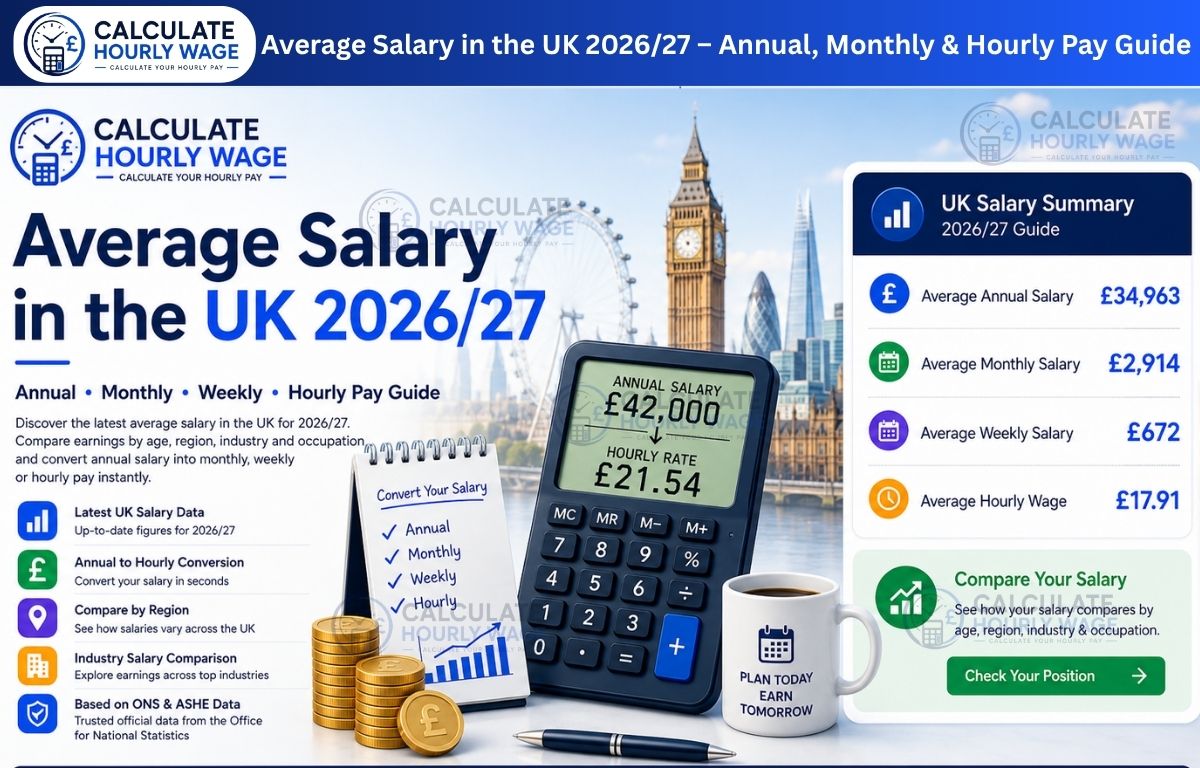
Imagine you’ve just received a new job offer. The salary looks attractive at first but a question quickly comes to your mind: Is this actually a good salary for the UK? Possibly you’re a graduate comparing your first role, an experienced professional considering a career move or simply wondering if your earnings keep up with the national average.
Searching for the average salary in the UK isn’t just about getting the information you need. It helps you to benchmark your income, negotiate with confidence, plan your finances and compare your salary with people in similar careers, industries and locations. But finding the right answer can be difficult. Different sources quote different figures: some refer to average earnings, others to median pay and many don’t explain what those numbers actually mean.
This guide brings everything together in one place. You’ll learn the latest UK salary trends for 2026/27, understand the difference between average and median earnings, compare salaries of different age groups and regions and discover how to convert an annual salary into monthly, weekly or hourly pay. If you’re planning your career or simply checking where you stand, this guide will help you make more informed financial decisions.
Find Your Equivalent Hourly, Weekly or Monthly Pay
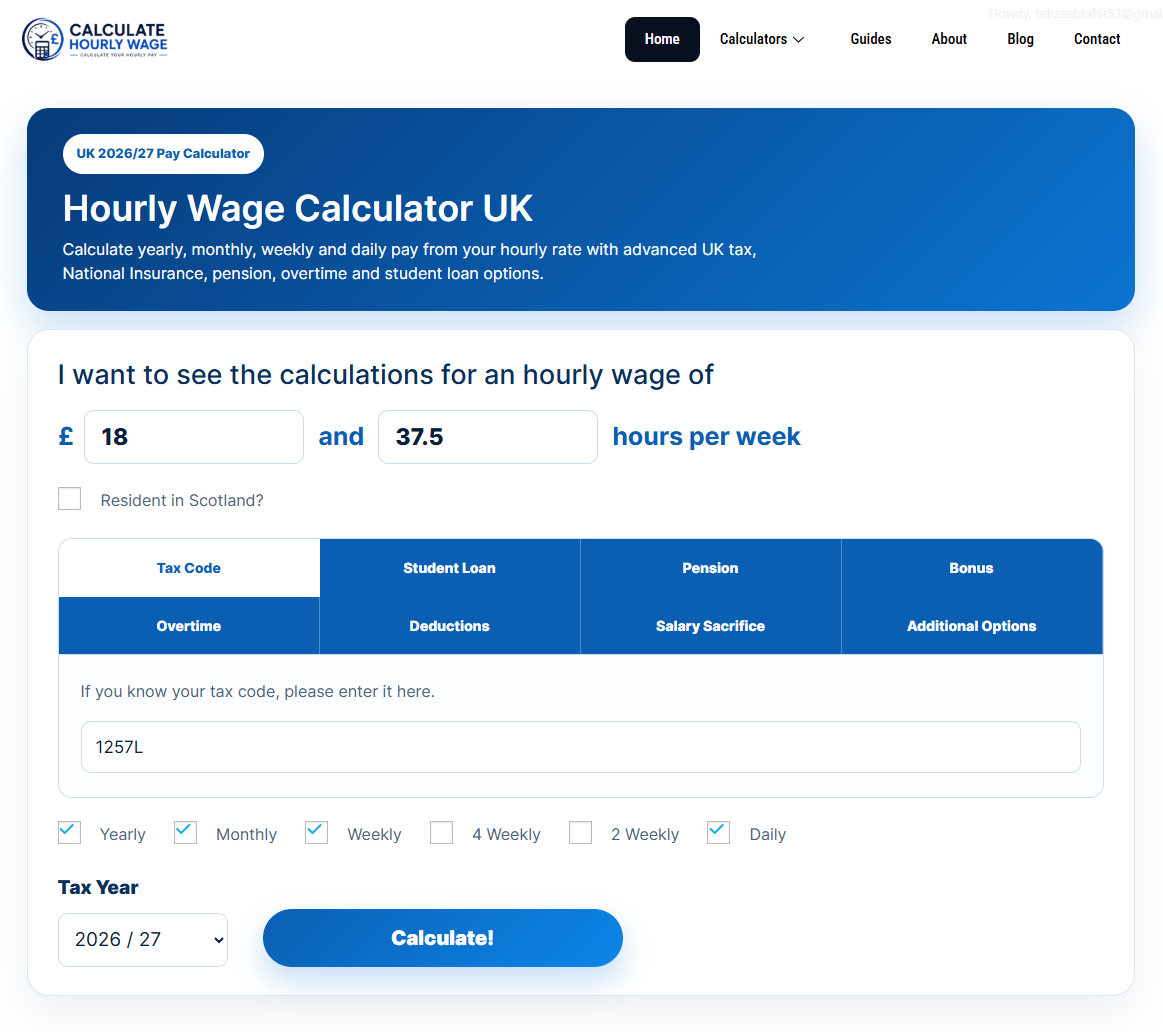
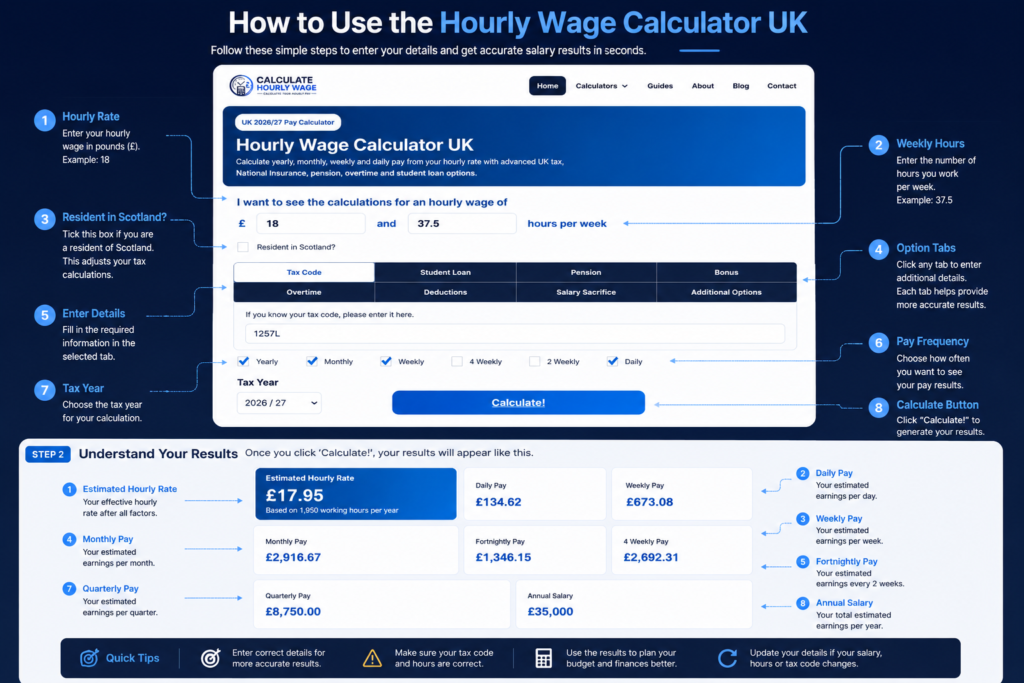
Want to know what your annual salary works out to per month, week or hour? Use our calculator to convert your earnings instantly without doing the maths yourself.
Click here: Hourly Wage Calculator UK
How to use the Hourly Wage Calculator UK
Quick Answer
The average salary in the UK is commonly measured using both mean (average) and median earnings. While the mean salary includes all incomes, the median salary represents the midpoint of UK earnings and is generally a better indicator of what a typical full-time employee earns. Official figures are published annually by the Office for National Statistics (ONS) through the Annual Survey of Hours and Earnings (ASHE). Your actual earnings may differ depending on your age, industry, occupation, region, qualifications and working hours.
What Is the Average Salary in the UK in 2026/27?
There isn’t a single salary that represents every UK worker. Earnings differ depending on location, occupation, experience, education, working hours and industry.
When people search for the average UK salary, they’re usually interested in one of four figures:
- Annual salary
- Monthly salary
- Weekly salary
- Hourly wage
Understanding all four makes it easier to compare job offers and budget effectively.
Average Annual Salary
Annual salary is your total gross earnings before Income Tax, National Insurance and pension deductions.
It’s the figure most employers advertise and is commonly used when comparing jobs.
Keep in mind that bonuses, overtime and commission may not always be included in advertised salaries.
Average Monthly Salary
Monthly salary simply divides annual earnings across 12 months.
This figure is useful for:
- Budget planning
- Mortgage affordability
- Rent calculations
- Household expenses
- Savings goals
Although employers advertise annual salaries, most employees think in terms of monthly income because that’s how they’re paid.
Average Weekly Salary
Weekly earnings are particularly useful if you:
- Work variable hours
- Compare weekly budgets
- Receive weekly wages
- Calculate overtime
Many official labour market reports also publish weekly earnings to show wage growth over time.
Average Hourly Wage
Hourly pay allows fair comparisons between jobs with different working hours.
For example:
| Annual Salary | Weekly Hours | Hourly Rate |
|---|---|---|
| £32,000 | 37.5 | Higher |
| £32,000 | 45 | Lower |
Although both jobs offer the same annual salary, the employee working fewer hours earns more per hour.
If you’re comparing multiple offers, converting annual pay into an hourly rate often provides a clearer picture.
Read More: Salary to Hourly Calculator UKWhere These Figures Come From (ONS & ASHE)
Reliable salary information comes from the Office for National Statistics (ONS).
Its Annual Survey of Hours and Earnings (ASHE) collects payroll data from employers across the UK instead of relying on estimates or public surveys.
Visit Now: Office for National Statistics (ONS)This makes it one of the most trusted sources for:
- Average earnings
- Median earnings
- Regional salaries
- Industry pay
- Occupation salaries
- Wage growth
Because new data is released annually, salary figures naturally change over time due to inflation, labour demand and economic conditions.
Factors That Affect the Average Salary
The national average provides a useful benchmark, but no single figure reflects every employee’s earnings. Several factors influence how much someone earns in the UK.
These include:
- Industry and profession
- Years of experience
- Education and professional qualifications
- Location within the UK
- Full-time or part-time employment
- Management responsibilities
- Shift work, overtime and bonuses
For example, two employees earning the same annual salary may have very different take-home pay if one receives regular bonuses or contributes more to their workplace pension.
Understanding these factors helps you compare salaries more accurately instead of relying solely on the national average.
Average Salary vs Median Salary – What’s the Difference?
Many people assume “average salary” and “median salary” mean the same thing. They don’t.
Knowing the difference helps you interpret salary statistics correctly.
What Is the Average (Mean) Salary?
The mean salary is calculated by adding everyone’s earnings together and dividing by the number of workers.
For example:
| Employee | Salary |
|---|---|
| A | £24,000 |
| B | £28,000 |
| C | £32,000 |
| D | £36,000 |
| E | £180,000 |
Because one employee earns significantly more than the others, the average rises considerably.
This can make average salaries appear higher than what most people actually earn.
What Is the Median Salary?
The median salary is the middle value after arranging salaries from lowest to highest.
Half of workers earn above it.
Half earn below it.
Unlike the mean, extremely high salaries don’t distort the result.
That’s why economists and career advisers often use median earnings when discussing what a “typical” worker earns.
Why Median Often Gives a Better Picture
Median pay provides a more realistic benchmark because it reflects the centre of the earnings distribution rather than being influenced by a relatively small number of high earners.
It’s particularly useful when:
- Comparing your salary
- Negotiating pay
- Researching career options
- Understanding national earnings
When You Should Compare Against the Average Instead
Average salary is still valuable when:
- Studying economic growth
- Comparing industries
- Analysing payroll budgets
- Reviewing national wage trends
Employers and policymakers often rely on average earnings to assess broader labour market performance.
Average vs Median Salary
| Average (Mean) | Median |
|---|---|
| Influenced by high earners | Less affected by extremes |
| Useful for economic analysis | Better for personal comparisons |
| Can appear higher than typical earnings | Represents the middle worker |
| Suitable for national trends | Suitable for salary benchmarking |
How to Convert an Annual Salary into Monthly, Weekly and Hourly Pay
Converting your salary into smaller time periods makes it much easier to compare jobs, understand your income and estimate your earnings for different working patterns.
| Conversion | Formula |
|---|---|
| Monthly Salary | Annual Salary ÷ 12 |
| Weekly Salary | Annual Salary ÷ 52 |
| Hourly Wage | Annual Salary ÷ (Weekly Hours × 52) |
The hourly calculation assumes you work consistently throughout the year.
Worked Example – £25,000 Salary
| Pay Period | Amount |
|---|---|
| Annual | £25,000 |
| Monthly | £2,083.33 |
| Weekly | £480.77 |
| Hourly (37.5 hrs/week) | £12.82 |
Worked Example – £30,000 Salary
| Pay Period | Amount |
|---|---|
| Annual | £30,000 |
| Monthly | £2,500.00 |
| Weekly | £576.92 |
| Hourly (37.5 hrs/week) | £15.38 |
Worked Example – £40,000 Salary
| Pay Period | Amount |
|---|---|
| Annual | £40,000 |
| Monthly | £3,333.33 |
| Weekly | £769.23 |
| Hourly (37.5 hrs/week) | £20.51 |
Worked Example – £50,000 Salary
| Pay Period | Amount |
|---|---|
| Annual | £50,000 |
| Monthly | £4,166.67 |
| Weekly | £961.54 |
| Hourly (37.5 hrs/week) | £25.64 |
Rather than calculating these figures manually every time, you can use our calculator to convert salaries instantly.
Read more: Hourly to Salary Calculator UKAverage Salary by Age in the UK
Salary typically increases with experience, skills and career progression. While every profession is different, earnings often follow a similar pattern throughout a working life.
18–21
Many people in this age group are:
- Apprentices
- Students
- Entry-level employees
- Part-time workers
As a result, average earnings are generally lower than older age groups.
22–29
This is often the period of fastest salary growth.
Graduates enter full-time employment, gain experience and begin progressing into higher-paying roles.
30–39
Many professionals reach mid-level or senior positions during this stage of their careers.
Higher responsibility often leads to stronger earning potential.
40–49
For many workers, earnings peak during these years due to accumulated experience, specialist skills and management responsibilities.
50–59
Although salary growth may slow, experienced professionals often remain among the highest earners within their organisations.
60+
Some employees reduce working hours or move into flexible or part-time roles, which can lower average earnings despite significant experience.
Average Salary by Age (Illustrative Structure)
| Age Group | Typical Career Stage | General Earning Trend |
|---|---|---|
| 18–21 | Apprentices, students, entry-level roles | Lower |
| 22–29 | Early career professionals | Increasing rapidly |
| 30–39 | Experienced professionals | Above average |
| 40–49 | Senior and managerial positions | Often highest |
| 50–59 | Experienced specialists | Stable to high |
| 60+ | Flexible or reduced working hours | Varies |
Average Salary by UK Region
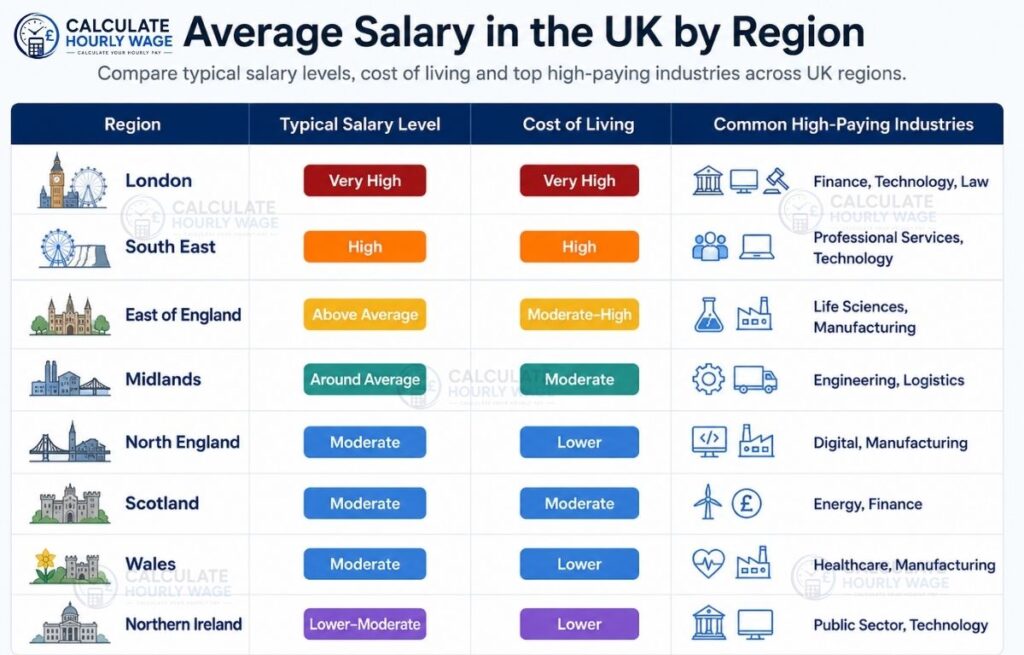
Where you live can have a significant impact on your earning potential. Salaries often reflect the local job market, cost of living and concentration of industries. For example, financial and technology roles tend to offer higher salaries in London, while manufacturing or public sector employment may be more common in other parts of the UK.
It’s important to compare salaries within the same region rather than against the national average alone.
London
London consistently offers some of the highest average salaries in the UK. Higher pay is driven by industries such as finance, technology, law and professional services.
However, higher earnings are often offset by increased housing, transport and everyday living costs.
South East
The South East benefits from a strong economy and proximity to London. Many professionals commute into the capital while others work for major employers based across the region.
East of England
This region has a diverse economy covering technology, life sciences, manufacturing and agriculture. Earnings are generally competitive, particularly around major business hubs.
Midlands
The East and West Midlands have strong engineering, logistics and manufacturing sectors. Salaries vary considerably depending on occupation and city.
North England
Northern regions include thriving cities such as Manchester, Leeds and Newcastle. Although average salaries may be lower than London, lower housing costs often improve overall affordability.
Scotland
Scotland has strong employment opportunities in energy, financial services, healthcare and the public sector. Salaries differ between cities and rural areas.
Wales
Wales has a growing economy supported by manufacturing, education, healthcare and tourism. Salary levels vary depending on industry and location.
Northern Ireland
Northern Ireland generally reports lower average salaries than many other UK regions, although living costs are often lower as well.
Comparison Table: Average Salary by Region
| Region | Typical Salary Level | Cost of Living | Common High-Paying Industries |
|---|---|---|---|
| London | Very High | Very High | Finance, Technology, Law |
| South East | High | High | Professional Services, Technology |
| East of England | Above Average | Moderate–High | Life Sciences, Manufacturing |
| Midlands | Around Average | Moderate | Engineering, Logistics |
| North England | Moderate | Lower | Digital, Manufacturing |
| Scotland | Moderate | Moderate | Energy, Finance |
| Wales | Moderate | Lower | Healthcare, Manufacturing |
| Northern Ireland | Lower–Moderate | Lower | Public Sector, Technology |
Average Salary by Industry
Industry plays a major role in determining earning potential. Two employees with similar experience may earn very different salaries simply because they work in different sectors.
Technology
Technology remains one of the UK’s strongest-paying industries, with demand for software developers, data professionals, cybersecurity specialists and cloud engineers continuing to grow.
Finance
Banking, investment, insurance and accountancy roles often offer competitive salaries, particularly in London and other financial centres.
Healthcare
Healthcare salaries vary widely depending on role and experience. Doctors and specialist consultants generally earn significantly more than entry-level healthcare staff.
Engineering
Engineering careers can provide strong long-term earning potential across civil, mechanical, electrical and software engineering disciplines.
Education
Teaching salaries usually follow structured pay scales, allowing employees to understand expected salary progression over time.
Retail
Retail earnings differ greatly between entry-level shop roles and senior management positions.
Hospitality
Many hospitality jobs include shift work, overtime or service-related payments alongside basic pay.
Manufacturing
Manufacturing salaries depend on technical skills, qualifications and supervisory responsibilities.
Which Industries Usually Offer the Fastest Salary Growth?
While current salary is important, future earning potential can be equally valuable.
Industries that frequently experience stronger wage growth include:
- Technology
- Artificial Intelligence
- Cyber Security
- Financial Services
- Renewable Energy
- Data Analytics
- Engineering
These sectors often face skills shortages, encouraging employers to increase salaries to attract experienced professionals.
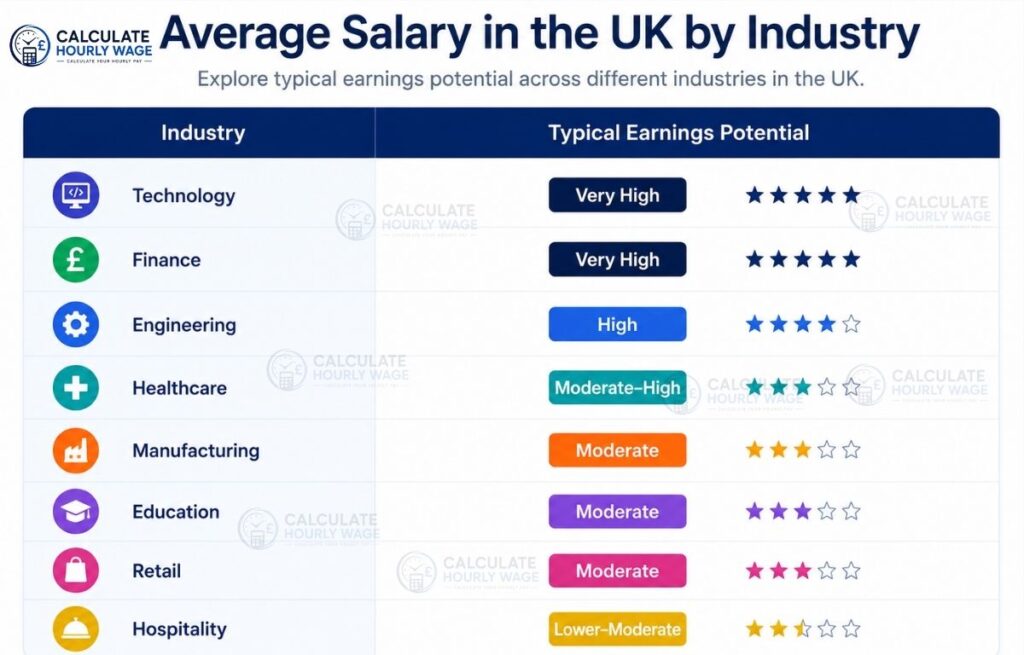
Industry Salary Comparison
| Industry | Typical Earnings Potential |
|---|---|
| Technology | Very High |
| Finance | Very High |
| Engineering | High |
| Healthcare | Moderate–High |
| Manufacturing | Moderate |
| Education | Moderate |
| Retail | Moderate |
| Hospitality | Lower–Moderate |
Average Salary by Occupation
Looking at salaries by occupation provides a more meaningful comparison than using the national average alone.
Professional Roles
Professionals such as accountants, software developers, solicitors and architects often command above-average salaries due to specialist qualifications.
Skilled Trades
Electricians, plumbers, gas engineers and other skilled tradespeople can achieve excellent earnings, particularly when self-employed or working overtime.
Administrative Jobs
Administrative and office support roles provide stable career opportunities with salaries that generally increase alongside experience and responsibility.
Service Sector Jobs
Customer service, hospitality and retail positions usually offer lower starting salaries but can lead to supervisory or management opportunities.
Entry-Level Positions
Entry-level roles provide valuable experience and often act as stepping stones towards higher-paying careers.
Occupation Comparison
| Occupation Category | Typical Salary Level | Progression Potential |
|---|---|---|
| Professional Roles | High | Excellent |
| Skilled Trades | Moderate–High | High |
| Administrative Jobs | Moderate | Moderate |
| Service Sector | Lower–Moderate | Moderate |
| Entry-Level Roles | Lower | High |
Graduate and Entry-Level Salaries
Starting salaries vary depending on your degree, employer and industry.
Graduates entering sectors such as technology, engineering or finance often receive higher starting salaries than those entering creative or hospitality industries.
Average Graduate Salary
Graduate salaries should be viewed as the beginning of a career rather than long-term earning potential. Many graduate schemes include structured pay reviews after the first year.
Apprenticeship Earnings
Apprentices earn while they learn, gaining practical experience alongside recognised qualifications. Although initial earnings may be lower, apprentices often progress into well-paid skilled careers.
Entry-Level Salaries by Industry
Competitive sectors usually offer stronger starting salaries but may also have more demanding recruitment processes.
First Job Salary Expectations
When evaluating your first offer, consider more than salary alone.
Ask yourself:
- Does the role provide training?
- Are there promotion opportunities?
- Is hybrid or remote working available?
- Are bonuses included?
- Does the employer contribute to your pension?
A slightly lower starting salary can sometimes lead to stronger long-term career growth.
Full-Time vs Part-Time Salaries
Comparing salaries without considering working hours can be misleading.
A full-time employee earning £38,000 and a part-time employee earning £24,000 may have very similar hourly rates.
Average Full-Time Earnings
Full-time salaries are generally used when discussing national average earnings because they provide more consistent comparisons.
Average Part-Time Earnings
Part-time workers often receive lower annual salaries simply because they work fewer hours, not necessarily because their hourly pay is lower.
Hourly Pay Differences
Converting salaries into hourly rates allows fair comparisons between jobs with different working patterns.
Read More: Hourly to Salary Calculator UKWhich Is Better for Comparing Earnings?
If two jobs have different weekly hours, compare:
- Hourly pay
- Pension contributions
- Paid leave
- Overtime opportunities
- Other employee benefits
Full-Time vs Part-Time Comparison
| Factor | Full-Time | Part-Time |
|---|---|---|
| Annual Salary | Higher | Lower |
| Hourly Rate | Similar or Higher | Similar |
| Flexibility | Lower | Higher |
| Benefits | Usually Greater | Varies |
Gross Salary vs Net Salary
Many people focus on their advertised salary but overlook what actually reaches their bank account.
Your gross salary is not the same as your take-home pay.
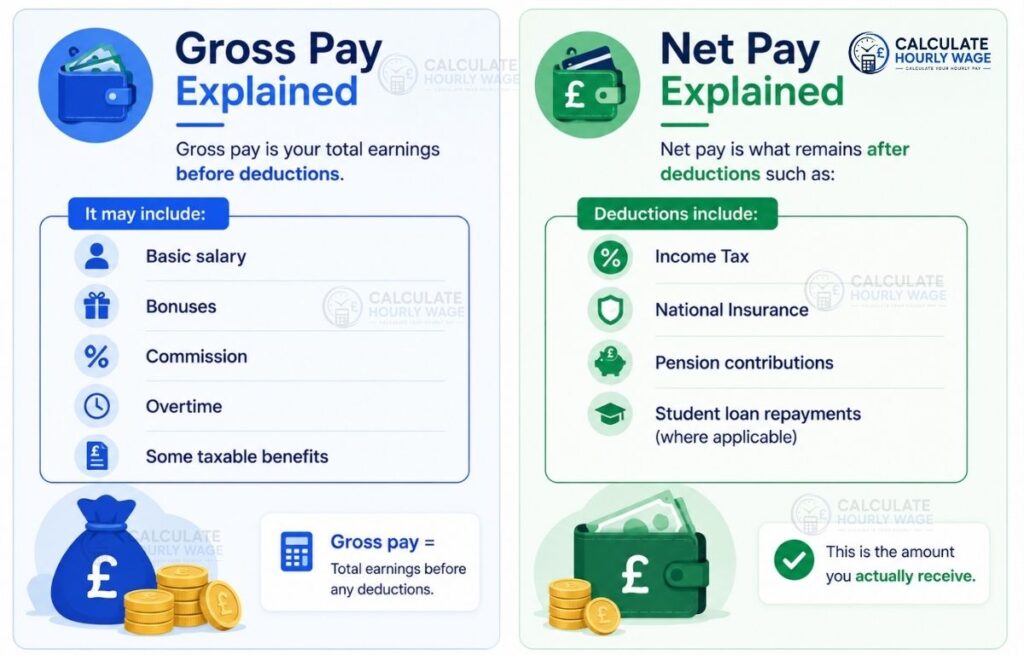
Gross Pay Explained
Gross pay is your total earnings before deductions.
It may include:
- Basic salary
- Bonuses
- Commission
- Overtime
- Some taxable benefits
Net Pay Explained
Net pay is what remains after deductions such as:
- Income Tax
- National Insurance
- Pension contributions
- Student loan repayments (where applicable)
This is the amount you actually receive.
Why Two Employees with the Same Salary May Take Home Different Amounts
Even when two people earn the same gross salary, their net pay can differ because of:
- Pension contribution rates
- Student loan repayments
- Tax codes
- Salary sacrifice schemes
- Taxable workplace benefits
This is why comparing gross salaries alone doesn’t always provide an accurate picture of disposable income.
Income Tax
Income Tax depends on your taxable income and the relevant UK tax bands.
Read More: Income Tax Calculator UKNational Insurance
National Insurance contributions help fund state benefits and are deducted alongside Income Tax for most employees.
Read More: National Insurance Calculator UKPension Deductions
Many workplace pension schemes deduct contributions directly from your salary. While this reduces immediate take-home pay, it helps build retirement savings.
Worked Example
Suppose two employees each earn £42,000 annually.
- Employee A contributes to a workplace pension.
- Employee B opts out.
Although both have the same gross salary, their monthly take-home pay will differ because pension contributions affect net earnings.
Using a salary calculator is the easiest way to estimate these deductions accurately.
Read More: Net to Gross Salary Calculator UKWhat Is Considered a Good Salary in the UK?
There is no single figure that qualifies as a “good” salary because it depends on your location, career stage, household size and lifestyle. A salary that provides a comfortable standard of living in one part of the UK may not stretch as far in another.
Instead of asking whether a specific salary is good, it’s more useful to ask:
- How does it compare with the average or median salary?
- Does it cover your essential living costs?
- Can you save and invest regularly?
- Does it support your long-term financial goals?
Visit Now: HM Revenue & Customs (HMRC)Comparing Your Salary with National Averages
National averages provide a useful benchmark, but they shouldn’t be your only reference point.
For example, a software engineer earning £45,000 may be below average within the technology sector but above average compared with the UK workforce as a whole.
When comparing salaries, consider:
- Your profession
- Years of experience
- Qualifications
- Location
- Working hours
- Employment benefits
A meaningful comparison always uses similar roles and similar circumstances.
Salary Percentiles Explained
Salary percentiles show where your earnings sit compared with other workers.
For example:
- 25th percentile – You earn more than 25% of workers.
- 50th percentile – This is the median salary.
- 75th percentile – You earn more than three-quarters of workers.
Percentiles provide more context than simply comparing against the national average because they reflect the distribution of earnings rather than a single figure.
Cost of Living Considerations
A salary should always be viewed alongside living expenses.
Monthly costs such as rent, transport, childcare and utilities vary considerably across the UK.
Someone earning £38,000 in a lower-cost area may have higher disposable income than someone earning £50,000 in central London.
Before accepting a new role, consider:
- Housing costs
- Commuting expenses
- Council Tax
- Childcare costs
- Utility bills
- Lifestyle spending
Why Location Matters
Regional differences affect both salaries and expenses.
Higher salaries are often offered in areas where employers face greater competition for skilled workers or where living costs are significantly higher.
Rather than focusing solely on headline salary figures, compare your expected disposable income after all regular expenses.
Comparison Table: Salary Bands and Lifestyle
| Annual Salary | General Position | Typical Interpretation |
|---|---|---|
| Under £25,000 | Entry-Level | Suitable for early career roles |
| £25,000–£40,000 | Around National Range | Common across many skilled occupations |
| £40,000–£60,000 | Above Average | Experienced professionals and specialists |
| Over £60,000 | High Income | Senior professionals, managers and specialists |
UK Salary Trends and Wage Growth
Salaries change every year as the labour market responds to economic conditions, inflation and employer demand.
Understanding these trends helps you decide whether your pay is keeping pace with the wider market.
Recent Salary Growth
Recent years have seen wage increases across many sectors due to:
- Skills shortages
- Higher inflation
- Increased competition for talent
- Rising National Living Wage rates
However, wage growth differs significantly between industries.
Technology, engineering and finance have generally experienced stronger salary growth than some traditional sectors.
Visit Now: GOV.UKInflation and Real Earnings
A salary increase doesn’t always mean you’re financially better off.
If inflation rises faster than your pay, your purchasing power actually falls.
For example:
- Salary increase: 3%
- Inflation: 5%
Although your salary has increased, everyday goods and services have become more expensive, reducing your real income.
This is why economists distinguish between:
- Nominal earnings – Your salary before considering inflation.
- Real earnings – Your salary after adjusting for inflation.
Why Salaries Change Each Year
Several factors influence annual salary changes:
- Economic growth
- Labour shortages
- Government policy
- Inflation
- Productivity improvements
- Changes in minimum wage legislation
Employers also review salaries to remain competitive when recruiting and retaining skilled employees.
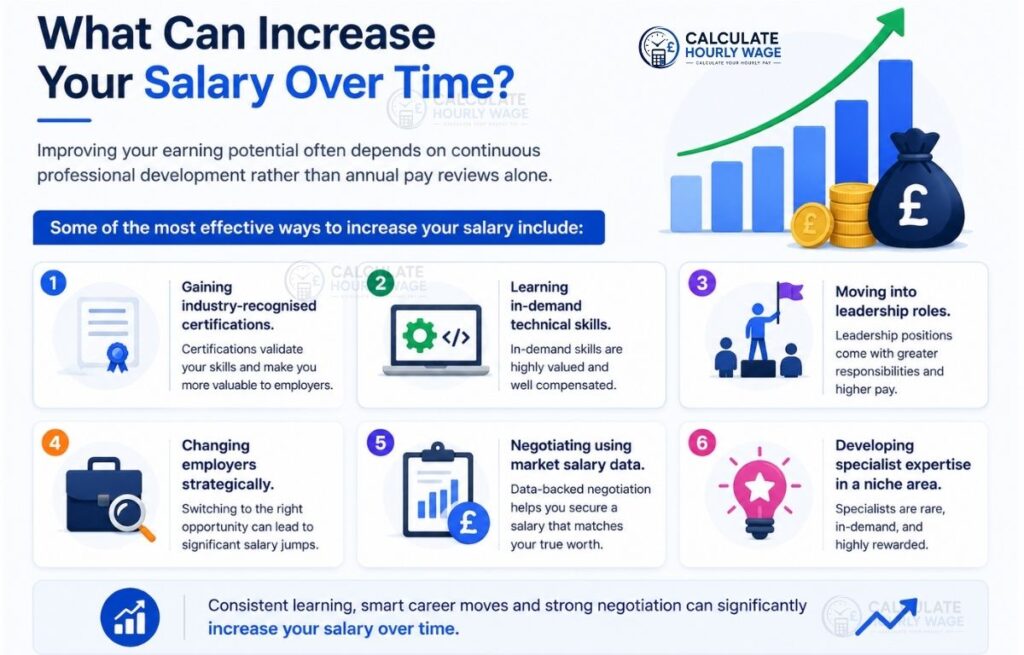
What Can Increase Your Salary Over Time?
Improving your earning potential often depends on continuous professional development rather than annual pay reviews alone.
Some of the most effective ways to increase your salary include:
- Gaining industry-recognised certifications.
- Learning in-demand technical skills.
- Moving into leadership roles.
- Changing employers strategically.
- Negotiating using market salary data.
- Developing specialist expertise in a niche area.
Factors That May Affect Your Future Pay
Your earning potential depends on more than annual pay reviews.
You can often increase your salary by:
- Developing specialist skills.
- Gaining professional certifications.
- Moving into management.
- Changing industries.
- Negotiating based on market rates.
- Taking on additional responsibilities.
Historical Salary Growth (Illustrative)
| Factor | Effect on Salaries |
|---|---|
| Inflation | May reduce purchasing power |
| Skills shortages | Push wages higher |
| Economic growth | Supports pay increases |
| Labour demand | Increases competition for workers |
Worked Salary Conversion Examples
The following examples assume a standard 37.5-hour working week and are intended as simple gross salary conversions before deductions.
Example 1 – £25,000 Salary
| Pay Period | Amount |
|---|---|
| Annual | £25,000 |
| Monthly | £2,083.33 |
| Weekly | £480.77 |
| Hourly | £12.82 |
Example 2 – £30,000 Salary
| Pay Period | Amount |
|---|---|
| Annual | £30,000 |
| Monthly | £2,500.00 |
| Weekly | £576.92 |
| Hourly | £15.38 |
Example 3 – £35,000 Salary
| Pay Period | Amount |
|---|---|
| Annual | £35,000 |
| Monthly | £2,916.67 |
| Weekly | £673.08 |
| Hourly | £17.95 |
Example 4 – £40,000 Salary
| Pay Period | Amount |
|---|---|
| Annual | £40,000 |
| Monthly | £3,333.33 |
| Weekly | £769.23 |
| Hourly | £20.51 |
Example 5 – £45,000 Salary
| Pay Period | Amount |
|---|---|
| Annual | £45,000 |
| Monthly | £3,750.00 |
| Weekly | £865.38 |
| Hourly | £23.08 |
Example 6 – £50,000 Salary
| Pay Period | Amount |
|---|---|
| Annual | £50,000 |
| Monthly | £4,166.67 |
| Weekly | £961.54 |
| Hourly | £25.6 |
Example 7 – £60,000 Salary
| Pay Period | Amount |
|---|---|
| Annual | £60,000 |
| Monthly | £5,000.00 |
| Weekly | £1,153.85 |
| Hourly | £30.77 |
Example 8 – £75,000 Salary
| Pay Period | Amount |
|---|---|
| Annual | £75,000 |
| Monthly | £6,250.00 |
| Weekly | £1,442.31 |
| Hourly | £38.46 |
For personalised calculations based on your own salary and working hours, use our conversion tools.
Read more: Salary to Hourly Calculator UKReal-Life Salary Scenarios
New Graduate Comparing Job Offers
A graduate receives two offers:
- £30,000 with excellent training and career progression.
- £33,000 with limited development opportunities.
Although the second offer pays more initially, the first could lead to faster salary growth over time.
Employee Negotiating a Pay Rise
An employee compares their salary with market averages for similar roles and uses reliable salary data to support a performance review discussion.
Moving to London for Work
A job in London offers a higher salary than one in Manchester.
After factoring in rent and commuting costs, the overall financial benefit may be smaller than expected.
Comparing Full-Time and Part-Time Jobs
One role offers a higher annual salary but requires longer hours.
Converting both salaries into hourly pay helps identify which role offers better value.
Switching Careers into Technology
An experienced worker changes industries and accepts a lower starting salary in exchange for stronger long-term earning potential and career progression.
Freelancer vs Employee Income
A freelancer charging a high hourly rate must also cover expenses such as taxes, pensions, equipment and unpaid leave.
Comparing gross earnings alone does not provide a fair comparison with salaried employment.
How to Compare Two Job Offers Fairly
When evaluating multiple offers, don’t focus only on annual salary.
Consider:
- Gross and net pay
- Weekly working hours
- Bonus opportunities
- Pension contributions
- Annual leave entitlement
- Flexible or remote working
- Career progression
- Training and professional development
- Private healthcare or other employee benefits
A slightly lower salary with stronger benefits may provide better long-term value than a higher salary with limited progression.
Common Mistakes When Comparing Salaries
Avoid these common errors when evaluating your earnings:
- Comparing gross salary instead of take-home pay.
- Assuming the average salary represents every worker.
- Confusing average and median earnings.
- Ignoring regional differences in living costs.
- Comparing jobs with different weekly hours.
- Overlooking pension contributions.
- Ignoring bonuses and other benefits.
- Using outdated salary data.
- Forgetting the impact of inflation.
- Comparing salaries across unrelated industries.
Expert Tips for Understanding UK Salaries
- Compare salaries using median earnings whenever possible.
- Benchmark your salary against people in similar roles, industries and regions.
- Convert annual salaries into hourly rates before comparing job offers.
- Consider total compensation, including bonuses, pension contributions and benefits.
- Review the latest ONS earnings data each year instead of relying on outdated figures.
- Compare your salary after tax, not just gross pay.
- Factor inflation into long-term salary comparisons.
- Invest in skills that are in demand within your industry.
- Use salary calculators to estimate take-home pay before accepting a new role.
- Remember that a higher salary does not always result in a higher standard of living if living costs increase significantly.
What is the average salary in the UK?
The average salary varies each year and depends on whether you’re referring to mean or median earnings. Official figures are published annually by the Office for National Statistics (ONS).
What is the average monthly salary in the UK?
Monthly salary is calculated by dividing annual gross earnings by 12. Your actual take-home pay will be lower after deductions.
What is the average hourly wage in the UK?
Hourly earnings depend on annual salary and weekly working hours. Converting annual pay into an hourly rate provides a fair comparison between jobs.
What is the median salary?
The median salary is the midpoint of all earnings, meaning half of workers earn more and half earn less. It is generally a better indicator of typical pay than the mean.
Is £30,000 a good salary?
Whether £30,000 is a good salary depends on your location, experience, occupation and living costs. It may be competitive in some regions and below average in others.
Is £40,000 above the UK average?
For many occupations, £40,000 represents a competitive salary, although comparisons should always be made within your profession and region.
Is £50,000 considered a high salary?
£50,000 is above the earnings of many UK workers, but its purchasing power varies depending on where you live and your household expenses.
Which UK region has the highest salaries?
London generally reports the highest average salaries, although it also has the highest cost of living.
Which jobs pay the highest salaries?
Professional careers in finance, technology, medicine and law are among the highest-paying sectors in the UK.
What is the average graduate salary?
Graduate salaries vary by employer and industry. STEM and finance roles often offer higher starting salaries than many other sectors.
How much tax is deducted from the average salary?
The amount depends on your taxable income, tax code, National Insurance contributions and any pension or student loan deductions.
What is the difference between gross and net salary?
Gross salary is your pay before deductions. Net salary is the amount you receive after Income Tax, National Insurance and other deductions.
How often are UK salary figures updated?
Official earnings data is typically updated each year through the Annual Survey of Hours and Earnings (ASHE).
How can I calculate my hourly wage from my annual salary?
Divide your annual salary by the number of hours you work in a year, or use a salary conversion calculator for an instant result.
Where does UK salary data come from?
The most reliable salary statistics come from the Office for National Statistics (ONS), which publishes data based on the Annual Survey of Hours and Earnings (ASHE).
How does inflation affect salaries?
If inflation rises faster than your salary, your purchasing power decreases even if your pay has increased.
What salary is considered comfortable in the UK?
A comfortable salary depends on household size, location, housing costs and lifestyle. There is no universal figure that suits everyone.
How does London compare with the rest of the UK?
London typically offers higher salaries than other regions, but higher housing and living costs can reduce the financial advantage.
Does the average salary include bonuses?
Some official earnings datasets include bonuses, while others report regular pay separately. Always check how the salary figure has been calculated before making comparisons.
Why do different websites show different average salaries?
Different sources may use different datasets, reporting periods or statistical measures. Some quote mean earnings, while others use median earnings, leading to different figures.
Is the average salary the same as average household income?
No. Salary refers to an individual’s employment earnings, whereas household income includes the combined income of everyone living in the household, along with other income sources where applicable.
Conclusion
Understanding the average salary in the UK is about more than knowing a single number. It helps you benchmark your earnings, compare job opportunities and make informed financial decisions. By considering factors such as median pay, regional differences, industry trends and take-home income, you’ll gain a more accurate picture of where your salary stands. Whether you’re negotiating a new role, planning your career or budgeting for the future, using reliable data alongside practical salary calculators will help you make better-informed decisions with confidence.