You finish a long week at work, look at your work schedule and try to work out what should appear on your next payslip. You know your hourly rate, but the answer is rarely as simple as multiplying it by the number of shifts you worked.
You stayed late twice, had unpaid lunch breaks, a weekend shift or worked overtime at a higher rate. Maybe your hours change every week and you are trying to budget before payday arrives.
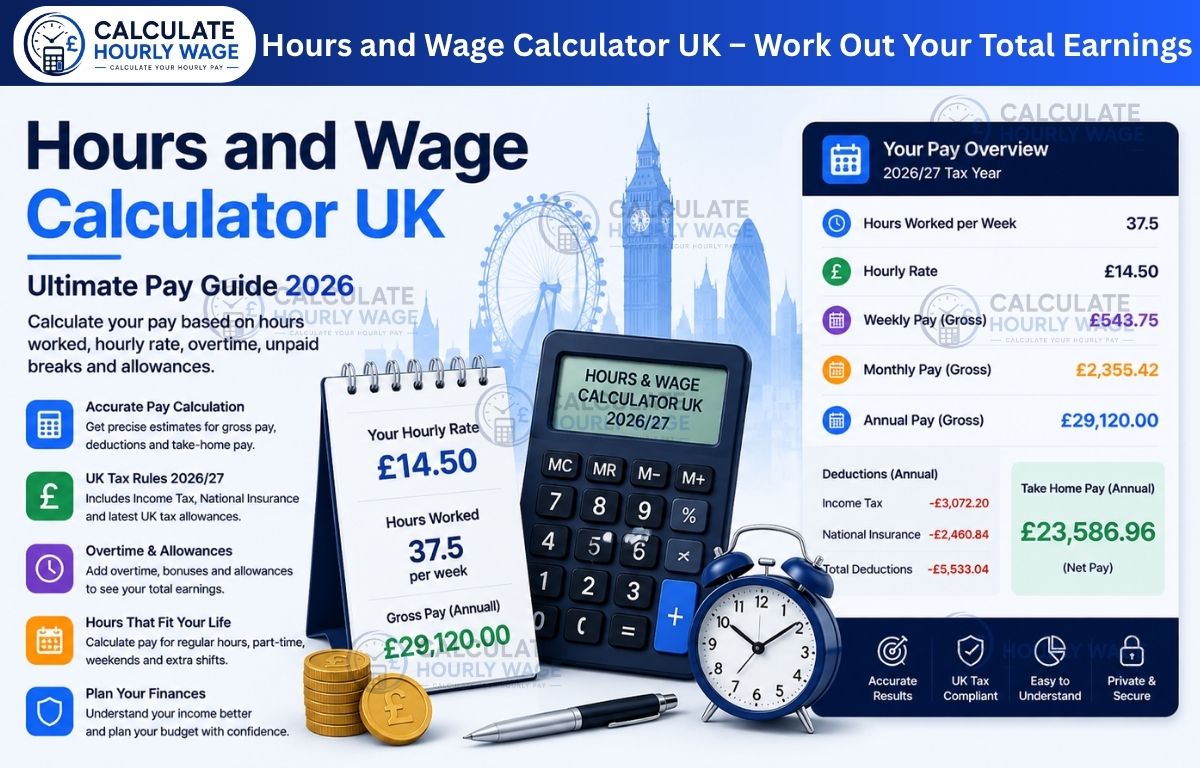
An Hours and Wage Calculator UK helps turn those scattered details into a clear pay estimate. Enter your hourly rate and hours worked, then account for unpaid breaks, overtime and allowances to see your estimated gross earnings.
This guide explains how to calculate your total pay accurately, what to include, what to leave out, and why your final payslip may still look different from the number shown by a calculator.
Calculator
What Is an Hours and Wage Calculator UK?
An Hours and Wage Calculator UK is a tool that estimates your pay based on the number of paid hours you work and your hourly wage.
It can help you calculate:
- Pay for one shift
- Daily earnings
- Weekly wages
- Monthly income estimates
- Annual earnings from regular hours
- Overtime pay
- Additional pay from shift allowances or bonuses
The calculation is useful for hourly-paid workers because earnings can change from one week to the next. A salaried employee usually receives the same basic monthly amount. An hourly-paid worker earns more or less depending on their working schedule, overtime, unpaid breaks and paid leave.
What the calculator helps you work out
At its simplest, the calculator multiplies your paid hours by your hourly rate.
| Item | Details |
|---|---|
| Formula | Total Pay = Paid Hours × Hourly Rate |
| Example | If you work 35 paid hours in a week at £15 per hour: 35 × £15 = £525 gross weekly pay |
However, most real-world pay calculations need a little more detail. You may need to separate standard hours from overtime, remove unpaid break time or add night-shift and weekend allowances.
Who can use an hours worked and pay calculator?
An hours and wage calculator can be useful for almost anyone paid by the hour, including:
- Full-time employees
- Part-time employees
- Retail workers
- Hospitality staff
- Care workers
- Warehouse operatives
- Delivery drivers
- Security staff
- Agency workers
- Shift workers
- Students with part-time jobs
- Zero-hours contract workers
- Freelancers who charge by the hour
- Contractors estimating project income
It is also useful if you are checking whether your payslip matches your own record of hours worked.
Hours and wage calculator vs salary calculator
An hours and wage calculator starts with the hours you worked and your hourly rate.
A salary calculator usually starts with a yearly salary and breaks it into monthly, weekly or hourly figures.
| Calculator | Starting Point | Main Result |
|---|---|---|
| Hours and Wage Calculator UK | Hours worked and hourly rate | Total pay for a shift, week or month |
| Wage Calculator UK | Hourly rate and regular working hours | Weekly, monthly and annual earnings |
| Salary Calculator | Annual salary | Monthly, weekly and daily salary |
| Salary to Hourly Calculator UK | Annual salary and working hours | Estimated hourly rate |
| Take-Home Pay Calculator | Gross income and deductions | Estimated net pay after tax |
If your working hours vary, an hours and wage calculator is usually more useful than a standard salary calculator.
Why Calculating Hours and Wages Accurately Matters
A small mistake in your hours can make a noticeable difference to your pay. Missing one unpaid break, forgetting overtime, or using the wrong pay rate can affect your estimate by more than you expect.
Accurate calculations help you understand what you are earning and give you a clearer basis for checking your payslip.
Check your payslip against hours worked.
Your payslip should show your gross pay, deductions and net pay. However, it may not always show every shift, break or overtime detail clearly.
Keeping your own record can help you compare:
- Hours shown on your rota
- Hours you actually worked
- Unpaid break time
- Overtime hours
- Weekend or night-shift hours
- Holiday pay
- Bonuses or commission
- Gross pay on your payslip
If your estimate is different from your payslip, it does not automatically mean there is an error. Payroll deadlines, tax adjustments and unpaid leave can all affect the amount. Still, a clear record makes it easier to ask the right questions.
Budget using expected weekly or monthly earnings
Hourly income can be less predictable than a fixed salary. Your earnings change because of extra shifts, cancelled shifts, seasonal demand, sickness, unpaid leave or overtime.
A wage calculation helps you estimate what you can reasonably expect to earn before payday. This can be useful for:
- Planning rent and household bills
- Setting aside money for savings
- Managing transport and food costs
- Deciding if to accept extra shifts
- Comparing a new job offer
- Estimating your income for a month with fewer working days
For monthly budgeting, it is often sensible to use your normal contracted hours rather than your busiest month.
Track variable shifts, overtime and part-time work
Workers with changing rotas often need more than one estimate.
For example, a zero-hours worker may have one week with 15 hours and another with 32 hours. A care worker may receive additional pay for evenings. A warehouse worker may earn a higher rate for night shifts. A retail employee may work extra hours during busy periods.
Separating standard hours from higher-paid hours gives you a more realistic total.
Compare job offers with different hourly rates
A job offer with a higher hourly rate is not always the better option.
For example, compare these two roles:
| Job | Hourly Rate | Guaranteed Hours | Estimated Weekly Gross Pay |
|---|---|---|---|
| Job A | £16 | 20 hours | £320 |
| Job B | £14.50 | 30 hours | £435 |
Job A has the higher hourly rate, but Job B provides more guaranteed weekly income.
You should also compare paid holiday, pension contributions, overtime rates, travel costs, shift allowances and job security before deciding which role offers better overall value.
How the Hours and Wage Calculator UK Works
The calculator uses your hourly rate and paid working hours to estimate gross pay.
You can use it for a single shift, a full week, a month or a regular annual working pattern.
Enter your hourly wage
Start with your normal hourly rate.
This should be the amount you receive for each paid hour worked. You can usually find it in your employment contract, job offer, payslip or staff portal.
For example:
- £12.21 per hour
- £13.50 per hour
- £15 per hour
- £18 per hour
- £22 per hour
If you receive different rates for nights, weekends or overtime, calculate those hours separately.
Add daily or weekly working hours
Next, add the hours you worked.
You can calculate pay from:
- One shift
- One day
- One week
- Four weeks
- A monthly working schedule
- An average week for annual estimates
For workers with regular hours, weekly calculations are often easiest. For workers with changing shifts, recording each shift separately may be more accurate.
Include unpaid breaks
Unpaid breaks should normally be removed from your paid hours.
| Item | Details |
|---|---|
| Example | You may be scheduled from 9 am to 5 pm. That is 8 hours at work. If you have a 1-hour unpaid lunch break, you are paid for 7 hours. |
| Calculation | 8 hours at work − 1 unpaid break = 7 paid hours |
| Gross Pay | At £15 per hour: 7 × £15 = £105 gross pay for the day |
| Paid Breaks | If your break is paid, you do not need to subtract it. |
| Important | Your contract should explain whether meal breaks, rest breaks, and other breaks are paid or unpaid. |
Add overtime hours and overtime pay rates.
Overtime may be paid at your normal hourly rate or at a higher rate such as time and a half or double time.
For example, if your normal rate is £16 per hour:
| Overtime Type | Calculation | Overtime Rate |
|---|---|---|
| Normal rate | £16 × 1 | £16 per hour |
| Time and a half | £16 × 1.5 | £24 per hour |
| Double time | £16 × 2 | £32 per hour |
If you work five overtime hours at time and a half:
5 × £24 = £120 overtime pay
This should be added to your standard pay, not mixed into your normal hours.
View your total gross pay instantly.
The final figure is usually your gross pay. This means your earnings before deductions.
Your actual take-home pay may be lower after:
- Income Tax
- National Insurance
- Workplace pension contributions
- Student loan repayments
- Union fees
- Salary sacrifice arrangements
- Other deductions shown on your payslip
A calculator can give you a useful wage estimate, but it cannot always predict every deduction that applies to your personal situation.
Hours Worked and Wage Calculation Formula
The basic formula is simple, but accurate results depend on using paid hours and the correct rate.
| Item | Details |
|---|---|
| Basic Total Pay Formula | Total Gross Pay = Paid Hours × Hourly Rate |
| Example | 32 paid hours × £14 per hour = £448 gross pay |
| Different Pay Rates | If your work includes different rates, calculate each group of hours separately and add them together. |
| Combined Formula | Total Pay = Standard Pay + Overtime Pay + Allowances + Bonuses |
Formula for daily pay
| Item | Details |
|---|---|
| Formula | Daily Pay = Paid Hours Per Day × Hourly Rate |
| Example | For example, a worker earns £15 per hour and works 7.5 paid hours: 7.5 × £15 = £112.50 daily gross pay |
Formula for weekly pay
| Calculation | Formula / Example |
|---|---|
| Weekly Pay Formula | Weekly Pay = Total Paid Weekly Hours × Hourly Rate |
| Example | 37.5 hours × £15 = £562.50 weekly gross pay |
If you work overtime, add it separately.
| Pay Type | Calculation | Amount |
|---|---|---|
| Standard pay | 37.5 × £15 | £562.50 |
| Overtime pay | 4 × £22.50 | £90 |
| Total weekly gross pay | £562.50 + £90 | £652.50 |
Formula for monthly pay
| Calculation | Formula / Example |
|---|---|
| Monthly Gross Pay Formula | Monthly Gross Pay = Annual Gross Pay ÷ 12 |
| Annual Gross Pay Formula | Annual Gross Pay = Weekly Pay × Paid Weeks Per Year |
Then divide by 12.
| Step | Calculation | Amount |
|---|---|---|
| Annual gross pay | £562.50 weekly pay × 52 | £29,250 |
| Monthly gross pay | £29,250 ÷ 12 | £2,437.50 |
Do not simply multiply weekly pay by four if you want an average monthly figure. Most months are longer than four weeks.
Formula for annual earnings
| Calculation | Formula / Example |
|---|---|
| Annual Earnings Formula | Annual Earnings = Hourly Rate × Weekly Paid Hours × Paid Weeks Per Year |
| Scenario | Calculation | Annual Gross Earnings |
|---|---|---|
| Standard example | £17 × 40 × 52 | £35,360 |
| With unpaid holiday or seasonal work (48 paid weeks) | £17 × 40 × 48 | £32,640 |
How to Calculate Your Total Pay Step by Step
An Hours and Wage Calculator UK can give you a quick result, but understanding the steps helps you spot errors before payday.
The most reliable approach is to calculate your standard hours first, then add overtime and any extra payments separately.
Step 1: Record your total working hours
Start with the total time you were scheduled to work.
For example, imagine you worked these shifts:
| Day | Shift Time | Total Time at Work |
|---|---|---|
| Monday | 9 am–5 pm | 8 hours |
| Tuesday | 9 am–5 pm | 8 hours |
| Wednesday | 10 am–6 pm | 8 hours |
| Thursday | 9 am–5 pm | 8 hours |
| Friday | 9am–4pm | 7 hours |
Total time at work:
8 + 8 + 8 + 8 + 7 = 39 hours
This is not necessarily your paid time. You still need to remove unpaid breaks.
Step 2: Subtract unpaid break time
If you had a one-hour unpaid break each day, subtract five hours from your total.
39 total hours − 5 unpaid break hours = 34 paid hours
If your breaks are paid, do not subtract them.
Some workers have different break arrangements on different shifts. For example, a six-hour shift may include a 30-minute unpaid break, while a longer shift may include one unpaid hour. Record each shift carefully if your rota changes.
Step 3: Multiply paid hours by your standard hourly rate
Once you know your paid hours, multiply them by your normal hourly wage.
For example, if you earned £14.50 per hour:
34 paid hours × £14.50 = £493 gross standard pay
This is your gross pay before deductions and before adding overtime or allowances.
Step 4: Calculate overtime pay separately
Overtime should be calculated separately when it is paid at a different rate.
Suppose you worked five overtime hours at time and a half.
Your normal rate is £14.50 per hour.
£14.50 × 1.5 = £21.75 overtime rate
Now calculate overtime pay:
5 overtime hours × £21.75 = £108.75 overtime pay
Step 5: Add bonuses, commission or shift allowances
Some roles include extra payments that are not part of your basic hourly rate.
These may include:
- Night-shift allowance
- Weekend premium
- Bank holiday pay
- Travel allowance
- Attendance bonus
- Commission
- Performance bonus
- Tips paid through payroll
- On-call payments
For example, if you received a £30 night-shift allowance and a £25 attendance bonus:
£30 + £25 = £55 additional pay
Step 6: Check your estimated gross wage
Add each part together.
| Pay Type | Amount |
|---|---|
| Standard pay | £493.00 |
| Overtime pay | £108.75 |
| Allowances and bonuses | £55.00 |
| Estimated gross wage | £656.75 |
This is the figure to compare with the gross pay shown on your payslip.
Your take-home pay will usually be lower because payroll deductions are removed after gross pay is calculated.
Quick summary:
Total gross pay = standard pay + overtime pay + allowances + bonuses.
Hours and Wage Calculator UK Examples
The following examples show how different work patterns can affect total pay.
Example 1: Standard 37.5-hour working week
A full-time employee earns £15 per hour and works 37.5 paid hours each week.
| Calculation | Formula | Amount |
|---|---|---|
| Weekly gross pay | 37.5 × £15 | £562.50 |
| Annual gross pay (using 52 paid weeks) | £562.50 × 52 | £29,250 |
| Average monthly gross pay | £29,250 ÷ 12 | £2,437.50 per month |
This example assumes the worker is paid for all 52 weeks, including paid holiday.
Example 2: 40-hour working week with unpaid lunch breaks
A worker is scheduled for 40 hours each week but has five unpaid one-hour lunch breaks.
| Calculation | Formula | Amount |
|---|---|---|
| Paid hours | 40 hours − 5 unpaid break hours | 35 paid hours |
| Weekly gross pay (correct) | 35 × £16 | £560 |
| Weekly gross pay (if 40 paid hours were used) | 40 × £16 | £640 |
| Weekly difference | £640 − £560 | £80 per week |
| Annual difference (52 weeks) | £80 × 52 | £4,160 |
This is why unpaid breaks matter when calculating wages.
Example 3: Part-time employee working three days per week
A part-time worker earns £13.50 per hour and works three seven-hour paid shifts each week.
| Calculation | Formula | Amount |
|---|---|---|
| Weekly paid hours | 3 days × 7 hours | 21 paid hours |
| Weekly gross pay | 21 × £13.50 | £283.50 |
| Annual gross pay | £283.50 × 52 | £14,742 |
| Average monthly gross pay | £14,742 ÷ 12 | £1,228.50 per month |
Part-time workers should use their actual contracted hours rather than comparing their pay with a full-time salary.
Example 4: Employee earning time-and-a-half overtime
A worker earns £18 per hour and normally works 37.5 hours per week. This week, they work six additional overtime hours at time and a half.
| Calculation | Formula | Amount |
|---|---|---|
| Standard pay | 37.5 × £18 | £675 |
| Overtime rate | £18 × 1.5 | £27 |
| Overtime pay | 6 × £27 | £162 |
| Total weekly gross pay | £675 + £162 | £837 |
If the overtime is occasional, it is better to treat it as extra income rather than part of guaranteed earnings.
Example 5: Shift worker with night or weekend allowances
A care worker earns £14 per hour and works 36 paid hours per week.
| Calculation | Formula | Amount |
|---|---|---|
| Standard pay | 36 × £14 | £504 |
| Night-shift allowance | 12 × £2 | £24 |
| Total weekly gross pay | £504 + £24 | £528 |
The worker still earns £14 per hour as their basic rate. The night premium is added separately.
Example 6: Zero-hours contract worker with different weekly hours
A zero-hours worker earns £13 per hour. Their hours vary each week.
| Week | Paid Hours | Gross Pay |
|---|---|---|
| Week 1 | 16 | £208 |
| Week 2 | 24 | £312 |
| Week 3 | 18 | £234 |
| Week 4 | 30 | £390 |
| Calculation | Formula | Amount |
|---|---|---|
| Four-week total gross pay | £208 + £312 + £234 + £390 | £1,144 |
| Average weekly pay | £1,144 ÷ 4 | £286 |
| Average weekly hours | 88 hours ÷ 4 | 22 hours |
| Annual gross estimate (if average continued for 52 weeks) | £286 × 52 | £14,872 |
However, zero-hours workers should be cautious about using annual estimates because future shifts are not always guaranteed.
Hours to Pay Conversion Table for UK Workers
The following tables show gross pay before deductions. They are designed for quick comparisons and assume all hours are paid at the standard rate unless stated otherwise.
Weekly pay by hourly rate and total hours worked
| Hourly Rate | 20 Hours | 25 Hours | 30 Hours | 35 Hours | 37.5 Hours | 40 Hours |
|---|---|---|---|---|---|---|
| £12.21 | £244.20 | £305.25 | £366.30 | £427.35 | £457.88 | £488.40 |
| £13 | £260 | £325 | £390 | £455 | £487.50 | £520 |
| £14 | £280 | £350 | £420 | £490 | £525 | £560 |
| £15 | £300 | £375 | £450 | £525 | £562.50 | £600 |
| £16 | £320 | £400 | £480 | £560 | £600 | £640 |
| £18 | £360 | £450 | £540 | £630 | £675 | £720 |
| £20 | £400 | £500 | £600 | £700 | £750 | £800 |
Daily pay table for common shift lengths
| Hourly Rate | 6 Hours | 7.5 Hours | 8 Hours | 10 Hours | 12 Hours |
|---|---|---|---|---|---|
| £12.21 | £73.26 | £91.58 | £97.68 | £122.10 | £146.52 |
| £13 | £78 | £97.50 | £104 | £130 | £156 |
| £15 | £90 | £112.50 | £120 | £150 | £180 |
| £16 | £96 | £120 | £128 | £160 | £192 |
| £18 | £108 | £135 | £144 | £180 | £216 |
| £20 | £120 | £150 | £160 | £200 | £240 |
Note: These figures assume every hour shown is paid. Deduct unpaid breaks before using the table.
Monthly and annual earnings from regular weekly hours
This table uses 52 paid weeks per year. Monthly figures are annual pay divided by 12.
| Hourly Rate | Weekly Hours | Weekly Gross Pay | Monthly Gross Pay | Annual Gross Pay |
|---|---|---|---|---|
| £12.21 | 37.5 | £457.88 | £1,984.13 | £23,809.50 |
| £14 | 35 | £490 | £2,123.33 | £25,480 |
| £15 | 37.5 | £562.50 | £2,437.50 | £29,250 |
| £16 | 40 | £640 | £2,773.33 | £33,280 |
| £18 | 37.5 | £675 | £2,925 | £35,100 |
| £20 | 40 | £800 | £3,466.67 | £41,600 |
Overtime pay comparison: standard rate vs time-and-a-half vs double time
The table below shows how a £16 hourly rate changes when overtime is paid at different rates.
| Overtime Hours | Standard Rate (£16) | Time and a Half (£24) | Double Time (£32) |
|---|---|---|---|
| 2 hours | £32 | £48 | £64 |
| 4 hours | £64 | £96 | £128 |
| 6 hours | £96 | £144 | £192 |
| 8 hours | £128 | £192 | £256 |
| 10 hours | £160 | £240 | £320 |
Overtime arrangements vary between employers. Your contract, staff handbook or rota policy should explain whether overtime is paid and which rate applies.
Read More: gov.ukHow to Use Your Wage Estimate in Real Life
A total pay calculation is more useful when you use it for a specific decision rather than treating it as just another number.
For example, you can use your estimated gross pay to decide whether an extra shift is worth taking, compare a part-time role with a full-time offer, or check whether a payroll figure seems reasonable.
Use guaranteed pay for essential bills.
When planning rent, utilities, food and loan repayments, base your budget on guaranteed contracted hours.
Overtime, bonuses and extra shifts can improve your income, but they may not be available every month. Treating variable income as guaranteed can make budgeting harder during quieter periods.
Keep a simple weekly hours record.
A basic timesheet can prevent confusion at the end of the month.
Record:
- Date
- Start time
- Finish time
- Unpaid break time
- Paid hours
- Overtime hours
- Pay rate
- Allowances
- Notes about shift swaps or approved overtime
You do not need a complicated spreadsheet. A phone note, calendar entry or paper record can be enough if it is updated after each shift.
Compare your estimate with your payslip.
When your payslip arrives, compare your own total with:
- Gross pay
- Hours paid
- Overtime pay
- Holiday pay
- Allowances
- Tax and National Insurance deductions
- Pension contributions
- Net pay
If there is a difference, check the payroll cut-off date first. A shift worked near the end of a pay period may be paid in the following month.
Gross Pay vs Take-Home Pay: What Will You Actually Receive?
An Hours and Wage Calculator UK normally shows your gross pay. This is the amount you earn before tax, National Insurance and other deductions.
Your payslip may show a lower amount paid into your bank account. That lower figure is your net pay, also called take-home pay.
What gross wages mean
Gross wages are your total earnings before payroll deductions.
They may include:
- Basic hourly pay
- Overtime pay
- Shift premiums
- Night-work allowances
- Weekend pay
- Bank holiday pay
- Bonuses
- Commission
- Holiday pay
- Tips paid through payroll
For example, if your total gross wage for the week is £650, your employer calculates deductions from that amount before paying you.
Income Tax and National Insurance deductions
Most employees have Income Tax and National Insurance deducted through PAYE.
The amount deducted can depend on:
- Your total income
- Your tax code
- Your pay frequency
- Overtime and bonuses
- Whether you live in Scotland
- Changes made by HMRC
- Previous pay earlier in the tax year
A worker may earn the same hourly rate every month but receive different net pay because their hours, overtime or deductions change.
Read More: National Insurance Calculator UKPension, student loan and other payslip deductions
Your take-home pay may also be affected by:
- Workplace pension contributions
- Student loan repayments
- Union subscriptions
- Childcare vouchers or salary sacrifice arrangements
- Cycle-to-work scheme deductions
- Court-ordered deductions
- Repayment of an advance or overpayment
Some deductions are optional, while others apply automatically when relevant conditions are met.
Why your net pay may differ from calculator results
A calculator is useful for estimating gross pay, but it cannot always predict your exact take-home pay.
Your final payslip can differ because of:
- Tax code changes
- Payroll cut-off dates
- Previous tax adjustments
- Pension contribution percentages
- Overtime paid in a different period
- Holiday pay timing
- Unpaid leave
- Sick pay
- Bonus payments
- Student loan repayments
Use an hours and wage calculation to check your earnings first, then use a UK take-home pay calculator for a more detailed net-pay estimate.
Factors That Affect Your Total Wage Calculation
Your hourly rate is important, but it is not the only figure that affects your total pay.
Paid breaks vs unpaid breaks
Paid breaks count as paid working time. Unpaid breaks do not.
For example, a worker who is at work for eight hours with a one-hour unpaid lunch break is paid for seven hours.
8 hours at work − 1 unpaid hour = 7 paid hours
Always check your employment contract, staff handbook or rota policy to understand your break arrangements.
Holiday pay and bank holiday pay
Workers may receive holiday pay in different ways.
Some employees receive normal pay while taking annual leave. Some hourly-paid workers receive holiday pay separately. Others may see holiday pay included in their regular pay arrangement.
Bank holidays are not automatically paid extra for every worker. Your contract should explain whether bank holidays are included in annual leave, paid at a higher rate or treated as normal working days.
Read More: Salary to Hourly Calculator UK Overtime rules in your employment contract
Overtime is not always paid at a higher rate. Some employers pay normal hourly pay for extra hours, while others offer time and a half, double time or time off in lieu.
Check:
- Whether overtime needs approval
- Which hours count as overtime
- Whether overtime is paid or converted into time off
- Whether different rates apply on weekends or bank holidays
- Whether overtime is guaranteed or optional
Shift premiums, night work and weekend rates
Many workers receive extra pay for working less popular shifts.
This can include:
- Night-shift premiums
- Weekend allowances
- Unsocial-hours payments
- Bank holiday rates
- Split-shift payments
- On-call allowances
These payments may be fixed amounts or additional hourly rates. Calculate them separately from your standard wage to avoid mistakes.
Tips, commission and performance bonuses
Tips, commission and bonuses can increase your total earnings, but they are often variable.
For budgeting, separate them into two groups:
| Income Type | How to Treat It |
|---|---|
| Guaranteed contracted pay | Use for essential monthly costs |
| Variable tips, overtime, commission and bonuses | Treat as extra income or savings money |
This approach can make your budget more stable if shifts or sales change.
PAYE tax code and payroll timing
Payroll timing can explain why your calculation and payslip do not match.
For example, your employer may use a payroll cut-off date several days before payday. If you work overtime after that date, it may appear on the following payslip.
Tax code changes can also affect take-home pay. If a deduction seems unusual, check your payslip and tax code before assuming your hourly wage was calculated incorrectly.
UK Minimum Wage Checks When Calculating Pay
Your hourly rate should meet the legal minimum that applies to your situation.
The exact minimum wage rate can change, so check current official guidance when reviewing your pay.
Read More:Wage Calculator UK How to check your hourly rate against minimum wage rules
To estimate whether your pay meets minimum wage requirements, divide your pay for the relevant pay period by the hours that count as working time.
Average Hourly Pay = Total Pay ÷ Total Working Time
This may not always be the same as the hourly rate shown in your contract.
For example, unpaid time spent completing required tasks, attending mandatory training or preparing for work may affect the calculation in some situations.
National Living Wage and age-based minimum wage rates
Minimum wage rules can depend on:
- Your age
- Whether you are an apprentice
- Your employment status
- The current tax year
- Whether a special arrangement applies to your work
Rates can change each year. Check the current rate before deciding whether your pay is below the legal minimum.
Apprenticeship pay and training time
Apprentices may have different minimum wage rules depending on their age and stage of apprenticeship.
Training time can also matter. If training is required by your employer or apprenticeship programme, it may count as working time for pay purposes.
What counts as working time for minimum wage purposes?
Working time can include more than the hours spent actively doing your main job.
Depending on the role, it may include:
- Required training
- Mandatory meetings
- Time spent opening or closing a workplace
- Required security checks
- Travel between work locations
- Waiting time where you must be available for work
It does not always include commuting from home to your normal workplace.
If you are unsure, review your contract and seek independent employment advice.
Common Mistakes When Using an Hours and Wage Calculator
A calculator only works as well as the information entered. These mistakes can lead to inaccurate results.
| Common Mistake | Explanation |
|---|---|
| Forgetting to deduct unpaid breaks | This is one of the most common mistakes. If you work five eight-hour shifts with one unpaid hour each day, you are at work for 40 hours but may only be paid for 35 hours. |
| Counting unpaid travel time as paid working hours | Travel between home and your normal workplace is usually not paid time. However, travel between client locations, job sites or work locations may be treated differently. Check your contract and employer policy. |
| Applying the standard rate to overtime hours | If overtime is paid at time and a half or double time, using your normal rate will underestimate your wages. Calculate standard and overtime hours separately. |
| Assuming every week has the same number of shifts | Variable rotas, shift swaps, sickness, annual leave and cancelled shifts can all change your pay. Use your actual hours for a payslip check. Use average hours only for longer-term estimates. |
| Confusing gross pay with take-home pay | Your gross pay is not the amount you receive in your bank account. Tax, National Insurance, pension contributions and other deductions can reduce your net pay. |
| Ignoring holiday pay or shift allowances | Holiday pay, weekend premiums and night allowances can make a meaningful difference to total earnings. Check whether these are included in your normal hourly rate or paid separately. |
Tips for Tracking Hours and Calculating Wages More Accurately
The easiest way to avoid pay confusion is to keep a simple record of your work.
Use a timesheet or clock-in record
Track each shift with:
- Date
- Start time
- Finish time
- Unpaid break length
- Paid hours
- Overtime hours
- Hourly rate
- Extra payments
- Notes about changes
This can be a spreadsheet, notes app, calendar or paper timesheet.
Check working schedule changes and shift swaps.
If you swap shifts, accept extra work or leave early, update your record immediately.
Waiting until payday makes it easier to forget the details.
Keep overtime approval records.
If overtime needs manager approval, keep a copy of the rota, email, message or timesheet showing that it was agreed.
This can be useful if the payment is missing from your payslip.
Compare calculations with your payslip
When you receive your payslip, compare:
- Hours paid
- Basic pay
- Overtime pay
- Holiday pay
- Shift allowances
- Gross pay
- Deductions
- Net pay
If you spot a difference, check the payroll cut-off date first. Then ask payroll or your manager for a clear explanation.
Review your contract for pay rates and allowances.
Your contract should explain your basic hourly rate, overtime rules, holiday entitlement, break arrangements and any shift premiums.
If the wording is unclear, ask your employer for clarification before relying on an estimate.
Hours and Wage Calculator UK for Different Work Types
| Worker Type | Guidance |
|---|---|
| Full-time employees | Full-time workers can use the calculator to check weekly wages, overtime and annual earnings. Use your contracted paid hours rather than assuming every full-time job is 40 hours per week. |
| Part-time employees | Part-time workers should enter their actual paid hours and review how holiday pay is handled. A part-time role may have fewer hours but still offer useful benefits such as paid holiday and pension contributions. |
| Agency workers | Agency workers may have different rates for different assignments, shifts or locations. Track each assignment separately if rates vary. |
| Zero-hours contract workers | Zero-hours workers should calculate actual hours worked each week and use average earnings cautiously for monthly budgeting. It can help to calculate a low-income, average-income and busy-period scenario. |
| Shift workers | Shift workers should separate standard hours from night, weekend and bank-holiday hours. This gives a clearer picture of which part of their income is guaranteed and which part depends on the rota. |
| Freelancers and self-employed workers | Freelancers can use the calculator to estimate revenue from billable hours. However, self-employed workers should also allow for unpaid admin time, business expenses, insurance, equipment, tax payments, National Insurance, pension savings, unpaid holiday and sick days. A freelancer charging £30 per hour does not necessarily keep £30 for every hour worked. |
Related UK Pay Calculators
You may also find these tools useful:
- Salary to Hourly Calculator UK
- Hourly to Salary Calculator UK
- Wage Calculator UK
- Overtime Calculator UK
- Take-Home Pay Calculator UK
- Pro Rata Salary Calculator UK
- Holiday Pay Calculator UK
How do I calculate my pay from hours worked in the UK?
By your hourly rate.
Paid hours × hourly rate = gross pay
If you work overtime or receive allowances, calculate those separately and add them to your standard pay.
How do I calculate wages if I work different hours every week?
Record your paid hours each week and calculate each week separately. For monthly budgeting, use an average from several recent weeks rather than relying on one unusually busy week.
Do I get paid for lunch breaks in the UK?
It depends on your contract. Some employers pay breaks, while others treat lunch breaks as unpaid. Check your employment contract, staff handbook or payslip.
How do I calculate overtime pay at time and a half?
Multiply your normal hourly rate by 1.5, then multiply that rate by your overtime hours.
For example, £16 per hour becomes £24 per hour at time and a half.
How much is 40 hours a week at £15 per hour?
At 40 paid hours per week:
40 × £15 = £600 gross pay per week
Over 52 paid weeks, that equals £31,200 gross per year.
Can I use an hours and wage calculator for part-time work?
Yes. Enter your actual paid hours, your hourly rate and any overtime or allowances. The same formula works for part-time and full-time workers.
Does the calculator show gross pay or take-home pay?
Most hours and wage calculators show gross pay before deductions. Use a take-home pay calculator for an estimate after Income Tax, National Insurance, pension contributions and other deductions.
How do shift allowances affect my total pay?
Shift allowances are added to your standard pay. They may be fixed payments or additional hourly amounts for nights, weekends, bank holidays or unsociable hours.
What should I do if my payslip does not match my hours worked?
Check your timesheet, rota, unpaid breaks, overtime, payroll cut-off date and deductions. If the difference remains unexplained, ask your manager or payroll team for a breakdown.
Does holiday pay count as working hours for wage calculations?
Holiday pay is usually paid separately from hours physically worked. If you receive paid annual leave, it can still be part of your overall earnings, but it should not be treated as extra hours worked.
Calculate Your Total Pay From Hours Worked With Confidence
Your hourly rate is only the starting point. Accurate pay calculations depend on paid hours, unpaid breaks, overtime rates, allowances and the way your employer processes payroll.
Use an Hours and Wage Calculator UK alongside your own timesheet and payslip. It can help you understand your earnings, spot possible errors and make better decisions about shifts, overtime and monthly budgeting.