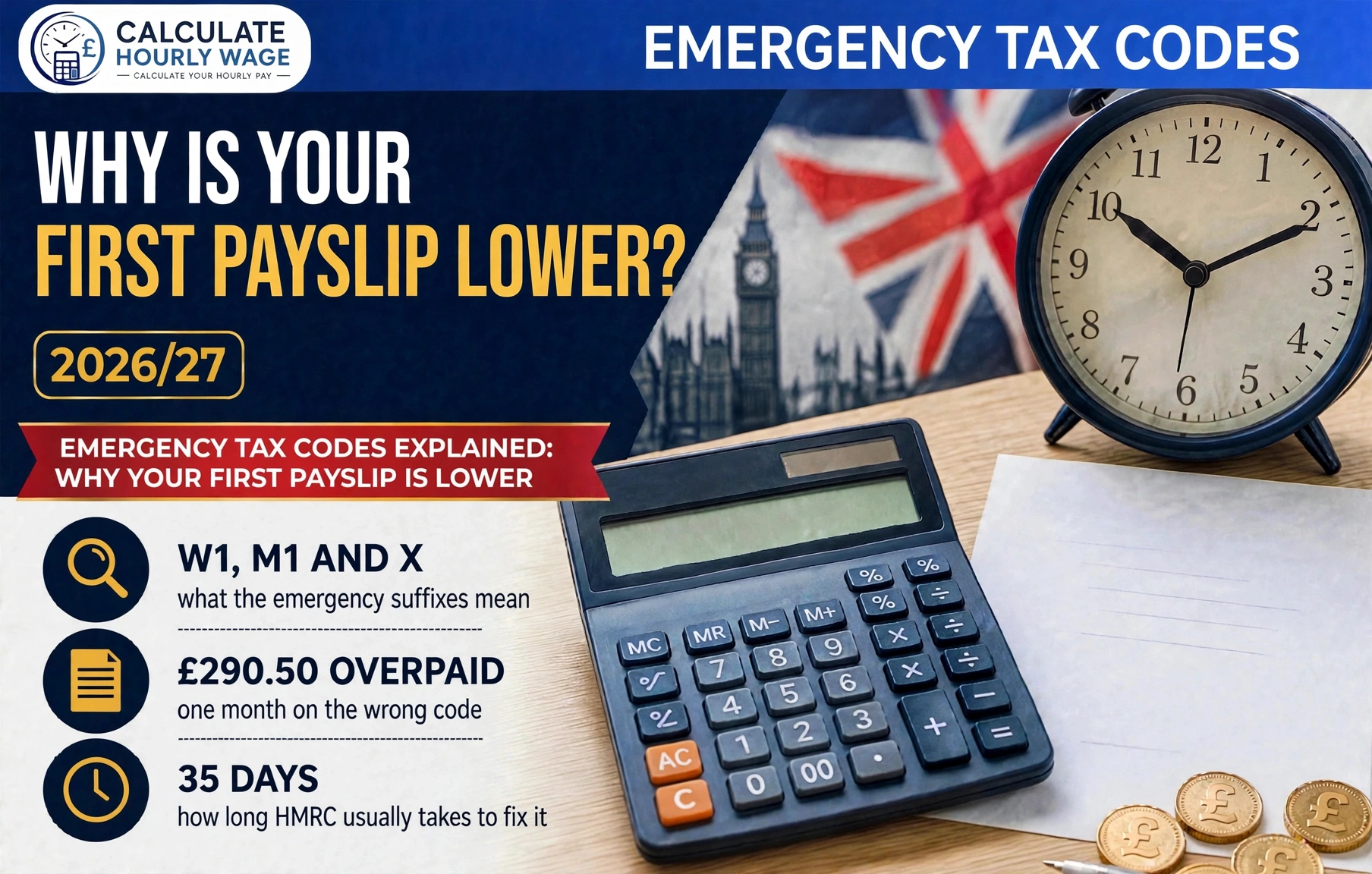
If you are on an emergency tax code in the UK, here is the direct answer: an emergency tax code is a temporary code HMRC uses when your employer does not yet have enough information to tax you correctly. It usually appears on your first payslip in a new job, it ends in W1, M1 or X, and it taxes each week or month on its own instead of looking at what you have earned so far this tax year. That is why your first payslip is lower than you expected — the code ignores the tax-free allowance you built up before you started, so too much tax comes off. The good news: it is temporary, not a fine, and any overpaid tax comes back.
You have done nothing wrong. Emergency codes are routine: they appear when you start a new job without a P45, when HMRC has not yet received your details, or when you take your first pension payment. GOV.UK says HMRC usually issues the correct code within 35 days of you starting. Until then, your employer must use the emergency code, and your take-home pay takes the hit.
The Short Answer: What an Emergency Tax Code Does to Your Pay
A tax code tells your employer how much tax-free income to give you before deducting Income Tax. For most people with one job, the standard code for 2026/27 is 1257L, giving the full £12,570 Personal Allowance tax-free across the year.
An emergency code keeps that number — 1257L — but adds a suffix: W1 if paid weekly, M1 if monthly, X if pay dates vary. That suffix changes how the code is applied. Instead of the normal cumulative method, where each payday looks back at everything earned since 6 April, an emergency code is non-cumulative: it taxes that one week or month alone, as if you were paid the same amount all year.
The practical difference is the allowance. Under the normal code, starting in September gives you five months of unused Personal Allowance at once — roughly £5,237 of tax-free pay in your first month. Under an emergency code you get just one month’s slice, £1,047.50, and everything above it is taxed at 20% (or 40% if the month’s pay is high enough). On a £2,500 monthly salary, that costs you £290.50 in extra tax in your first month alone.
What Is an Emergency Tax Code in the UK?
An emergency tax code in the UK is a temporary, non-cumulative code your employer uses when HMRC does not yet have your full income details. It is not a special rate of tax or a penalty — just a placeholder instruction that lets payroll pay you while HMRC sorts out your correct code.
Every tax code is made of numbers and letters. The number is your tax-free allowance with the last digit removed — 1257L means £12,570 of Personal Allowance — and the letter tells payroll how to apply it. In an emergency code, that letter is replaced by one of three suffixes:
- W1 — you are paid weekly, and the code is applied on a week 1 basis.
- M1 — you are paid monthly, and the code is applied on a month 1 basis.
- X — your pay dates vary, so the code is applied on a non-cumulative basis without a fixed week or month.
Some payroll software prints NONCUM on the payslip instead of a suffix. It means exactly the same thing.
The key word is non-cumulative. Under a normal code, your employer adds up everything earned since 6 April, applies the allowance built up so far, and works out the tax due on the total. Under an emergency code, each payday stands alone: payroll takes one twelfth of your Personal Allowance (£1,047.50 a month, or about £242 a week), taxes the rest of that period’s pay, and ignores everything that came before.
That is why an emergency code is only a problem when you start part-way through the tax year. Start on 6 April and there is no built-up allowance to lose. Start in September, October or January, and months of unused allowance are simply not applied — tax comes off as if you had been earning that amount all year. The same applies to a first pension payment.
What Do W1, M1 and X Mean on Your Payslip?
The suffix tells you how payroll should apply the code:
| Code you might see | What it means | When it is used |
|---|---|---|
| 1257L W1 | Emergency code, weekly basis | You are paid weekly |
| 1257L M1 | Emergency code, monthly basis | You are paid monthly |
| 1257L X | Emergency code, variable dates | Your pay dates vary |
| 1257L NONCUM | Emergency code, shown differently | Some payroll software prints NONCUM instead of a suffix |
| S875L M1 | Emergency code, Scottish rates | Monthly-paid worker in Scotland |
| C663L X | Emergency code, Welsh rates | Worker in Wales with variable pay dates |
The number at the front can change — in Scotland your code starts with an S, in Wales with a C — but the suffix is what marks it as an emergency code. If your code does not end in W1, M1, X or NONCUM, you are not on an emergency tax code, and the fix is different.
Two things catch people out. First, 1257L with no suffix is the normal code for most people with one job — if your payslip shows that, you are not on emergency tax. Second, a BR code is not an emergency code: BR taxes all income from that job at 20% with no Personal Allowance, and it is used for a second job — our guide to second job tax explains why. You can also check what any code means using GOV.UK’s tax code tool, and see the code HMRC holds for you in your Personal Tax Account.
Why Your First Payslip Is Lower on an Emergency Tax Code
The reason is simple: an emergency code gives you one month’s allowance instead of the allowance you have built up since 6 April. The later in the tax year you start, the bigger the gap — and the bigger the tax bill. Here is the maths for a monthly-paid worker on a £2,500 salary who starts in September, month six of the tax year, having earned nothing since 6 April.
On the correct code (1257L): by September you have built up six months of allowance — 6 × £1,047.50 = £6,285 — against pay so far of just £2,500. Taxable pay is £0, so Income Tax is £0.
On the emergency code (1257L M1): you get one month’s allowance — £1,047.50. Taxable pay is £2,500 − £1,047.50 = £1,452.50, taxed at 20% = £290.50.
It gets worse on a higher salary, because the emergency code can push part of your pay into the 40% band even though your total earnings for the year are nowhere near it. Take £5,000 a month, again starting in September with no earlier income: on the correct code, your built-up allowance of £6,285 covers the £5,000 pay, so Income Tax is £0. On the emergency code, taxable pay is £5,000 − £1,047.50 = £3,952.50 — the first £3,141.67 taxed at 20% (£628.33) and the remaining £810.83 at 40% (£324.33). Total tax: £952.67.
Nearly a thousand pounds of tax on a first payslip, when the correct answer is nothing at all — and it is all refundable once the correct code arrives.
Weekly-paid workers see the same effect in smaller slices — on a £600 weekly wage starting in October, the emergency code takes £71.65 a week where the correct code would take nothing, because roughly 28 weeks of built-up allowance (about £6,768) would cover one week’s pay of £600.
| Situation | Correct code tax | Emergency code tax | Extra tax paid |
|---|---|---|---|
| £2,500 a month, starts September | £0 | £290.50 | £290.50 |
| £5,000 a month, starts September | £0 | £952.67 | £952.67 |
| £600 a week, starts October | £0 | £71.65 a week | £71.65 a week |
One more thing: your tax code does not affect your National Insurance. NI is worked out separately on each pay period, so an emergency code changes your Income Tax but not your NI — on a £2,500 monthly salary, employee NI is £116.20 for the month (8% on earnings between £12,570 and £50,270 a year), whether your code is 1257L or 1257L M1. If your payslip looks wrong, check the tax line first — and check your own NI figure with our National Insurance calculator.

Can an Emergency Tax Code Ever Mean You Pay Too Little Tax?
Yes — and this is the part people rarely hear about. It happens when you have already used up your Personal Allowance and basic-rate band in an earlier job in the same tax year, and then start a new one.
Imagine you earned £80,000 in your first job, left in August, then start a new job in September paying £4,000 a month. On the correct code, your allowance and basic-rate band are already used up, so the whole £4,000 for September should be taxed at 40% — £1,600. But the emergency code gives a fresh month’s allowance of £1,047.50 and taxes the rest at 20%, taking only £590.50: you have underpaid by £1,009.50 in that one month.
When the correct code arrives, payroll recalculates and the shortfall comes out of a later payslip — or, if you have left, HMRC writes to you about it. It is not a fine, but it is a nasty surprise if you have already spent the money. So if you earned a lot earlier in the tax year, do not treat a low tax deduction as a windfall: set the difference aside until your code is corrected.
Why Do You Get an Emergency Tax Code?
HMRC puts you on an emergency code when it does not have enough information to give your employer the right code. The commonest reasons are:
- You started a new job without giving your employer a P45. The P45 is the document your old employer gives you when you leave, showing what you earned and how much tax you paid so far this tax year. Without it, your new employer cannot tell HMRC where you stand.
- You did not complete the starter checklist properly. If you have no P45, your employer asks you to fill in a starter checklist (the form that replaced the old P46): is this your only job, do you have another job or pension? If it is missing or incomplete, payroll defaults to the emergency code.
- HMRC has not yet received your details. Even when you do everything right, HMRC needs the information from both employers through Real Time Information, the system employers use to report pay. GOV.UK says this can take up to 35 days.
- You took your first payment from a pension. A new pension is a new source of income, and if HMRC has not issued the right code yet, the pension provider uses the emergency code on the first payment.
- Your circumstances changed. Starting work after self-employment, or returning from time abroad, can leave HMRC without a current picture of your income.
None of these is a black mark against you. HMRC does not use emergency codes as a punishment, and your employer is not doing anything wrong by applying one — it is the system’s holding position while the paperwork catches up.
How Long Does an Emergency Tax Code Last?
For most people, a few weeks. GOV.UK says HMRC usually updates your code once it has your details from your new and previous employers, which can take up to 35 days from when you start. In practice, many people see the correct code on their second or third payslip.
There are two hard limits. First, you stay on an emergency code until the end of the tax year if HMRC never gets the information it needs — the code does not fix itself. If you are still on W1 or M1 two months after starting, something is stuck: check the code HMRC holds for you online, confirm payroll has your P45 or starter checklist, and contact HMRC. Second, in the new tax year you are put on a non-emergency code, but a new tax year does not refund the tax you overpaid in the old one. The longer an emergency code runs, the more tax you overpay — on a £2,500 salary, £290.50 a month, every month, until it is fixed.
How to Fix an Emergency Tax Code
In most cases you do not need to do anything — HMRC updates the code automatically once it has your details. But you can speed it up:
- Give your new employer your P45. Hand it over on day one if you have it. It is the single fastest way for HMRC to issue the right code.
- If you have no P45, complete the starter checklist in full. Answer every question, especially whether this is your only job and whether you have another job or a pension. An incomplete checklist is one of the commonest reasons an emergency code drags on.
- Check the code HMRC holds for you. Sign in to your Personal Tax Account on GOV.UK. If it shows the correct code but your payslip still shows W1 or M1, payroll has not applied the update yet — tell them.
- Contact HMRC if nothing has changed after 35 days. If that time has passed, contact HMRC with your National Insurance number ready and ask what is holding it up.
Only HMRC can issue or change a tax code — your employer cannot change it for you. Payroll can only apply the code HMRC sends them.

How Do You Get Your Overpaid Tax Back?
There are two routes, depending on whether you are still in the job:
Still employed — it comes back through your pay. Once HMRC sends the correct cumulative code, payroll recalculates your tax for the whole tax year so far. The overpaid tax is repaid in a later payslip, usually the very next one — you will see it as a lower tax deduction, sometimes no tax at all. You do not need to claim anything.
Left the job — claim it from HMRC. If you left before the code was corrected, the overpayment will not come through payroll. Use GOV.UK’s “Check how to claim a tax refund” tool, or sign in to your Personal Tax Account and claim online with your National Insurance number and the job’s details. Claim online by bank transfer and HMRC normally pays within 5 working days. If the tax year has already ended, you may receive a P800 letter instead — our guide to what a P800 is and how to claim your refund explains that route step by step.
If you left mid-year and are not starting another job, claim in-year with a P50, sent to HMRC with your P45. To see roughly what you are owed first, use our income tax refund calculator to estimate the figure.
One warning: never pay a tax refund company to do this for you. They typically charge 25% to 40% of your refund for the same online form you can complete yourself in about five minutes.
Emergency Tax Code vs BR Code: What Is the Difference?
People often confuse these two, because both make take-home pay lower than expected:
| Emergency code (1257L W1/M1/X) | BR code | |
|---|---|---|
| Who gets it | New starter on a main job, or first pension payment | Someone with a second job or second pension |
| Personal Allowance | One month’s or one week’s slice (£1,047.50 / £242) | None at all |
| How tax is worked out | Each pay period on its own (non-cumulative) | 20% on every pound, every period |
| How long it lasts | Until HMRC issues the correct code, usually within 35 days | For as long as you have the second job |
| What to do | Give your P45, complete the starter checklist, wait for HMRC | Check HMRC has split your allowance correctly between your jobs |
If your code is BR, your Personal Allowance has already been used up by your main job, so there is nothing to fix. If your code ends in W1, M1 or X, it is a placeholder and it should change. For the full picture, see our guide to second job tax, and our guide to what counts as taxable income in the UK.
The Bottom Line
An emergency tax code in the UK is a temporary placeholder, not a punishment and not a mistake. It taxes each week or month on its own, ignoring the tax-free allowance you built up earlier in the year — and that is why your first payslip is lower. On a £2,500 monthly salary starting in September, it costs £290.50 in extra tax in the first month alone; on £5,000 a month, £952.67. The money comes back once the correct code arrives.
Check your payslip for W1, M1, X or NONCUM. Hand over your P45, complete the starter checklist, and give HMRC up to 35 days. If it is still there after that, chase it — every month it runs is another month of overpaid tax. When the correct code arrives, the money comes back through your pay, or you claim it from HMRC online in about five minutes. To see roughly what you are owed, try our income tax refund calculator.
What is an emergency tax code in the UK?
An emergency tax code in the UK is a temporary, non-cumulative tax code — usually 1257L W1, 1257L M1 or 1257L X — that your employer uses when HMRC does not yet have enough information to tax you correctly. It taxes each week or month on its own instead of looking at your earnings for the whole tax year so far.
How long does an emergency tax code last?
HMRC usually issues the correct code once it has your details from your old and new employers, which GOV.UK says can take up to 35 days from when you start the job. You stay on the emergency code until the end of the tax year if HMRC never gets the information, and in the new tax year you are put on a non-emergency code.
Will I get my emergency tax back?
Yes. If you are still in the job, the overpaid tax comes back automatically through your pay once the correct cumulative code arrives — usually in the next payslip. If you have left the job, claim it from HMRC online through your Personal Tax Account; a bank transfer refund normally arrives within 5 working days.
Is 1257L M1 an emergency tax code?
Yes. 1257L is the standard code for 2026/27, giving the full £12,570 Personal Allowance, and the M1 suffix makes it an emergency code for monthly-paid workers. W1 is the weekly equivalent, X is used when pay dates vary, and some payslips show NONCUM instead.
Can an emergency tax code mean I pay too little tax?
Yes. If you already used up your Personal Allowance and basic-rate band in an earlier job in the same tax year, the emergency code gives you a fresh monthly allowance and taxes the rest at 20%, which can leave you underpaying — sometimes by over £1,000 in a month. HMRC collects the shortfall later, so do not spend it.
What is the difference between an emergency tax code and a BR code?
An emergency code is a temporary placeholder on a main job or first pension payment, giving you one month’s or one week’s slice of Personal Allowance, and it should change within about 35 days. A BR code is for a second job, gives no Personal Allowance at all, taxes everything at 20%, and lasts for as long as you have the second job.
Sources
- GOV.UK — Tax codes: https://www.gov.uk/tax-codes
- GOV.UK — Income Tax rates and Personal Allowances: https://www.gov.uk/income-tax-rates
- GOV.UK — Check how to claim a tax refund: https://www.gov.uk/claim-tax-refund