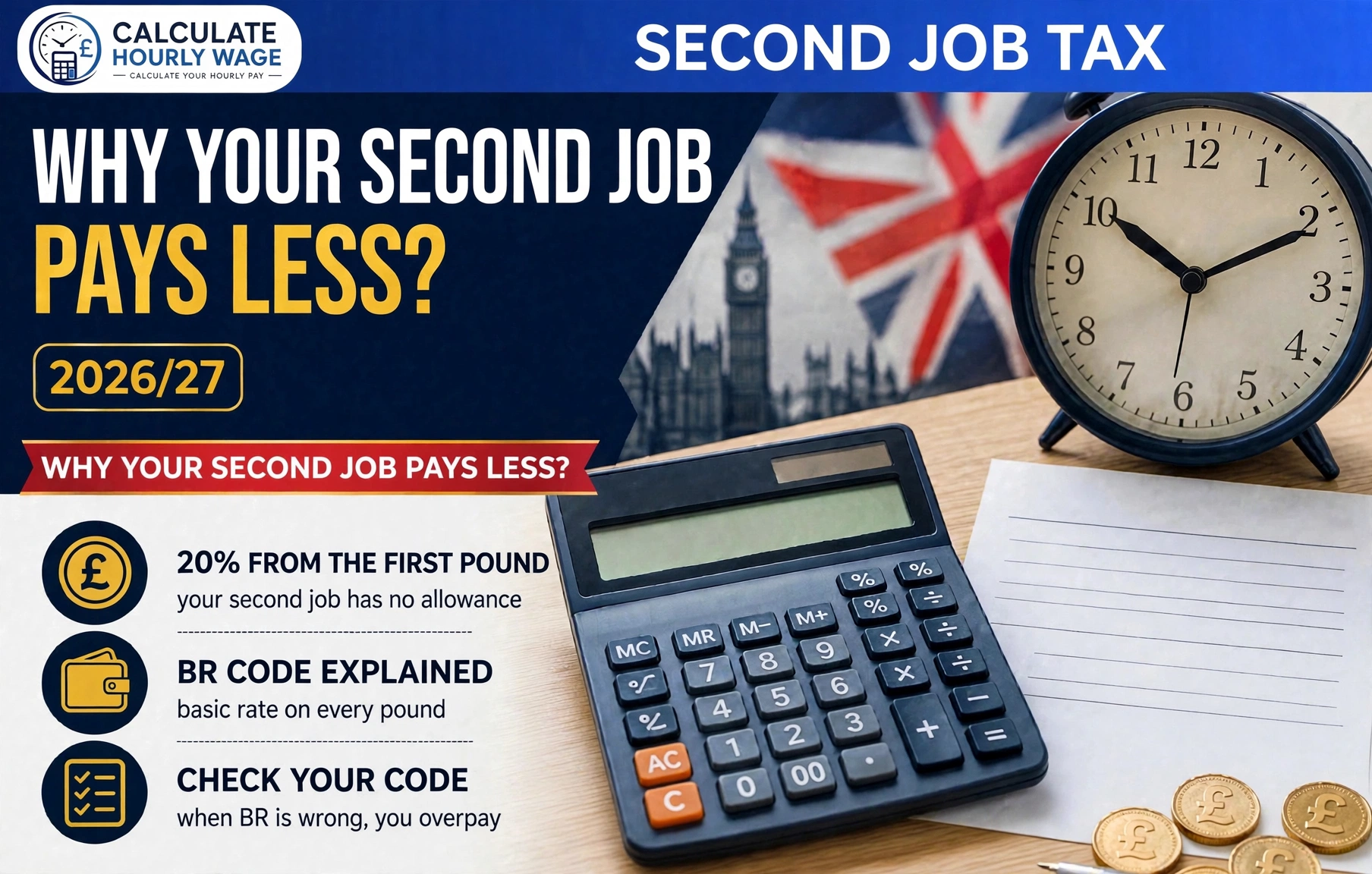
If you are wondering about second job tax in the uk, here is the direct answer: your second job pays less because it is taxed from the very first pound. Your Personal Allowance — the £12,570 you can earn tax-free in 2026/27 — is already used up by your main job, so your second employer has no tax-free slice left. Instead, your second job usually sits on a BR tax code, which takes 20% of every pound you earn there.
That is why the same £500 of gross pay leaves you with about £400 from a second job but the full £500 from your main job, before National Insurance. The work is the same, the hourly rate is the same, but the tax treatment is completely different — and it catches almost everyone by surprise on their first second-job payslip.
The good news is that this is usually fair, not a mistake: when your total income stays inside the basic-rate band, the tax on your second job is exactly what you would have paid in one job. The exceptions are the problem — combined income over the 40% band leaves you underpaying, and two part-time jobs can leave you overpaying. This guide works through all three situations with real numbers.
The Short Answer: Why Your Second Job Pays Less
The UK tax system gives you one Personal Allowance per tax year, not one per job. For 2026/27 that allowance is £12,570. HMRC normally puts the whole allowance against your highest-paying job, which is usually your main job, and your second job then gets a tax code with no allowance at all — most often BR.
BR stands for basic rate. It tells your second employer to take 20% Income Tax from every pound of your pay, with no tax-free amount. There is no mistake and no penalty involved: the allowance has simply already been spent on your main job.
Take the same £500 of monthly gross pay in each job. From your main job on the standard 1257L code, the monthly tax-free allowance is £1,047.50, so the £500 sits entirely inside it and no Income Tax is due. From your second job on BR, the same £500 is taxed at 20% from the first pound, so £100 comes off and you take home £400. National Insurance is a separate story — and, as the section below shows, it can actually work in your favour on a second job.
The Personal Allowance: One Allowance, Not One Per Job
The Personal Allowance is the foundation of the whole system, and the rule that matters most for second-job workers is that you only get one of them. GOV.UK puts it plainly: you only get one Personal Allowance for each tax year, even if you have income from more than one job, pension or other source. It does not matter whether you have two jobs, three jobs or a job plus a pension — the £12,570 is shared across all of them.
For 2026/27 the Income Tax bands for England, Wales and Northern Ireland are:
| Band | Taxable income | Tax rate |
|---|---|---|
| Personal Allowance | Up to £12,570 | 0% |
| Basic rate | £12,571 to £50,270 | 20% |
| Higher rate | £50,271 to £125,140 | 40% |
| Additional rate | Over £125,140 | 45% |
The bands apply to your total income from all sources added together, not to each job separately. That is the key to second job tax: HMRC looks at the combined figure at the end of the year. Your employers cannot see each other’s payrolls, so the tax codes split the job between them — the allowance on one payroll, a flat rate on the other — so the total comes out roughly right.
What the BR Code Means on Your Payslip
Your tax code tells your employer how much tax-free income to give you. The number is your tax-free amount with the last digit removed, so 1257 means £12,570, and the letter tells your employer which rules to apply. Here are the codes a second-job worker is most likely to see:
| Code | What it means | When you see it |
|---|---|---|
| 1257L | The standard code — £12,570 tax-free, then 20% / 40% / 45% on the rest | Your main job, when it holds your full Personal Allowance |
| BR | All income taxed at the basic rate, 20%, with no tax-free amount | Your second job, when your total income stays in the basic-rate band |
| D0 | All income taxed at the higher rate, 40%, with no tax-free amount | Your second job, when your total income is in the higher-rate band |
| D1 | All income taxed at the additional rate, 45%, with no tax-free amount | Your second job, when your total income is above £125,140 |
| 0T | No Personal Allowance, taxed at 20%, 40% and 45% in bands | Often a new job where the employer had no details — not the same as BR |
BR is a deliberate allocation: HMRC knows you have another job and has put the allowance there. That is why BR on a second job is usually correct, while BR on your only job is almost always wrong — if you have just one income coded BR, you get no Personal Allowance at all and lose roughly £209 a month in extra tax.
The code to watch out for is 0T. It also gives you no allowance, but it is often a gap in information rather than a decision: it appears when you start a job and your employer does not have the details to give you a proper code, for example if the starter checklist was not filled in. A 0T code on a new second job is the one to chase, because it can mean nobody has told HMRC what is happening. Scotland and Wales use SBR and CBR instead of BR, but the principle is the same. Our article on what counts as taxable income in the uk explains how the allowance and the bands fit together across all your income.
Worked Example 1: When BR Costs You Nothing Extra
Take Sarah: her main job pays £28,000 a year and her weekend job pays £6,000, £34,000 in total. Her Personal Allowance of £12,570 sits against her main job, and her weekend job is coded BR.
Her main job: £28,000 minus the £12,570 allowance leaves £15,430 taxable, all inside the basic-rate band, so the tax is £15,430 × 20% = £3,086. Her weekend job: all £6,000 is taxed at 20% under BR, so the tax is £1,200. Her total Income Tax for the year is £4,286.
Now compare that with earning the same £34,000 in a single job. The taxable income would be £34,000 minus £12,570 = £21,430, all at 20%, which is £4,286. Exactly the same. The BR code has cost Sarah nothing at all — it only looks worse because the tax is visible on the second payslip instead of being spread across one.
This is the situation most second-job workers are in. As long as your total income stays below the £50,270 higher-rate threshold, BR is doing its job correctly: 20% on every pound of the second job is exactly what those pounds would have been taxed at anyway. Work out your own combined figure with our taxable income calculator to confirm where you stand.
Worked Example 2: When BR Leaves You Underpaying
The picture changes when your two jobs together push you over the £50,270 higher-rate threshold. Take James: his main job pays £45,000 and his evening job pays £10,000, £55,000 in total.
What comes off his payslips: his main job uses the full £12,570 allowance, so £45,000 minus £12,570 leaves £32,430 taxable at 20%, which is £6,486. His evening job is coded BR, so all £10,000 is taxed at 20%, which is £2,000. Total tax paid: £8,486.
What he actually owes: total taxable income is £55,000 minus £12,570 = £42,430. The first £37,700 is taxed at 20%, which is £7,540, and the remaining £4,730 falls in the higher-rate band at 40%, which is £1,892. His correct total tax is £9,432 — £946 more than he has paid.
The gap exists because BR only ever charges 20%, while the top slice of James’s income should have been charged at 40%. His second employer cannot know his total income, so the BR code cannot fix this on its own. HMRC catches up after the tax year ends, by changing his tax code so the extra is collected from his main job over the following year, or by sending a bill. If your combined income is over £50,270 and your second job is still on BR, it is worth asking HMRC for a D0 code on the second job, which takes 40% from the first pound and stops the shortfall building up — or D1 at 45% if your total goes over £125,140. Our income tax refund calculator can help you estimate whether you have paid the right amount overall.
National Insurance on a Second Job: The Surprise in Your Favour
Here is the part almost nobody expects: National Insurance works the opposite way from Income Tax on a second job, and it can leave you better off. Income Tax gives you one Personal Allowance shared across all your jobs. National Insurance gives each job its own threshold.
For 2026/27, employees pay Class 1 National Insurance at 8% on earnings between £12,570 and £50,270 a year, and 2% on anything above £50,270. The starting point is the Primary Threshold — £242 a week, or £1,048 a month — applied to each employment separately, not to your combined income. Each of your employers works out your National Insurance as if theirs were your only job.
Take two jobs paying £15,000 each. Job 1: (£15,000 − £12,570) × 8% = £194.40 of National Insurance. Job 2: exactly the same, £194.40. Total: £388.80. Now take the same £30,000 earned in a single job: (£30,000 − £12,570) × 8% = £1,394.40. Two jobs cost £1,005.60 less in National Insurance than one job paying the same total.
The effect is biggest for part-time second jobs. A second job paying £500 a month sits below the £1,048 monthly Primary Threshold, so no employee National Insurance is due on it at all — while the same £500 added to your main job’s salary would have been charged at 8%. Your second-job payslip can therefore look odd in two directions at once: heavily taxed for Income Tax, but untouched for National Insurance.
There is a limit to the advantage. If your main job already pays above the £50,270 Upper Earnings Limit (£967 a week), you may be able to defer National Insurance on your second job: apply to HMRC on form CA72A, and if they agree, your second job is charged at only 2% instead of 8% on earnings between the thresholds. National Insurance also stops altogether once you reach State Pension age, even if you carry on working in both jobs. To see the two deductions side by side on your own pay, try our National Insurance calculator.

When BR Is Wrong and You Are Overpaying
BR is right when your main job uses up the whole allowance. It is wrong when it does not — usually with two part-time jobs. Take Priya: job 1 pays £9,000 a year and job 2 pays £9,000 a year, £18,000 in total.
Her correct tax: total income £18,000 minus the £12,570 allowance leaves £5,430 taxable at 20%, which is £1,086. But if job 1 holds the 1257L code, it pays no tax at all because £9,000 is below the allowance, and job 2 on BR pays 20% on the full £9,000, which is £1,800. Priya has overpaid by £714 — money that should have stayed in her pay.
GOV.UK gives the same pattern in its own example: job 1 paying £8,000 and job 2 paying £7,000, £15,000 in total. The allowance covers the first £12,570, leaving £2,430 taxable at 20%, which is £486. If job 2 were coded BR with no allowance, the tax taken would be £1,400 — nearly three times the right amount.
The fix is to ask HMRC to split your Personal Allowance between your jobs, through your Personal Tax Account on GOV.UK or the HMRC app, or by contacting HMRC directly. They can allocate the unused part of the allowance to your second job, which cuts the tax taken during the year. One warning from GOV.UK: if your income varies or is irregular, a split allowance can itself go wrong, because the allowance is normally spread evenly across the year. If you have already overpaid, HMRC will usually send a P800 tax calculation letter after the tax year ends showing whether you are due a refund or owe tax.
There is one more overpayment trap: BR on your only job. If you left your main job and the second job became your only income but the BR code stayed, you are getting no allowance at all. Tell HMRC you have left the other job through your Personal Tax Account, and they will issue a corrected code.
Starting a Second Job: Get the Starter Checklist Right
Everything above depends on your new employer knowing you already have a job. When you start a second job, you will not get a P45 from your current employer, because you still work for them — instead, your new employer should ask you to fill in a starter checklist, and it is important to fill it in accurately.
The key part is the statement that says you have another job or receive a pension — statement C. Tick it, and your new employer will put you on BR from your first pay, which is correct if your main job already uses your allowance. Tick the wrong statement, and you may be put on the standard 1257L code, which gives you a second full allowance you are not entitled to — and you will underpay tax all year, with a bill waiting at the end of it. Fill in nothing at all, and you may land on the 0T emergency code, which takes tax at 20%, 40% and 45% in bands with no allowance, so you overpay from day one.
If you have already started and the code looks wrong, you do not need to wait for the tax year to end. Sign in to your Personal Tax Account and check which employment is using your Personal Allowance, what your tax codes are, and whether HMRC’s estimate of your total income looks right. HMRC can issue a corrected code, which usually takes effect within a few weeks. If your first payslip arrived on an emergency code, the overpaid tax is usually corrected automatically once the right code lands — the subject of our next article in this series on emergency tax codes.
A Second Income That Is Self-Employed, Not a Second Job
Not every second income is a second job. If your extra money comes from freelance work, a side business or a casual hustle rather than an employer, there is no BR code — the tax is worked out separately through Self Assessment, and your Personal Allowance usually stays with your employed job.
GOV.UK’s own example makes the mechanics clear: you earn £22,000 from your job and £3,500 from weekend dog walking, £25,500 in total, all inside the basic-rate band. Your job uses the full allowance, so £9,430 of it is taxable at 20% (£1,886). The dog walking is separate: the first £1,000 is tax-free under the trading allowance, so only £2,500 is taxable at 20% (£500) through Self Assessment. Total tax: £2,386.
The £1,000 trading allowance is the line that matters. If your self-employed income is £1,000 or less in the tax year, you usually do not need to tell HMRC or declare it. Above £1,000, you need to register for Self Assessment and declare it, choosing between the flat £1,000 allowance and your actual expenses. And if your employed income is below the Personal Allowance, the leftover allowance can sometimes be used against your self-employed income instead — ask HMRC whether yours can be allocated that way.
How to Check and Fix Your Tax Codes
You do not need to guess whether your codes are right. HMRC’s Personal Tax Account on GOV.UK — or the HMRC app — shows which employment is using your Personal Allowance, your tax codes, and their estimate of your total income. Check it when you start a second job, when you leave one, and whenever a payslip surprises you. If your records wrongly show two jobs because an employer never reported that you left, correct the record — your code may be wrong.
If you have overpaid during the year, HMRC will usually send a P800 tax calculation letter after the tax year ends, and you can claim the refund online through your Personal Tax Account — the money typically arrives by bank transfer within about five working days. If you have underpaid, HMRC will usually collect it by changing your tax code for the following year, so the extra comes off gradually rather than as a single bill. Our income tax refund calculator estimates whether a refund is due before the letter arrives.
The Bottom Line on Second Job Tax in the UK
Second job tax in the uk comes down to one rule: you get one Personal Allowance of £12,570 a year, and it is normally spent on your main job. Your second job is then taxed at 20% from the first pound on a BR code — harsh on the payslip, but exactly right whenever your total income stays below the £50,270 higher-rate threshold. If your two jobs together cross that line, BR undertaxes you by charging 20% where 40% is due, and you should ask for a D0 code. If both your jobs are part-time and your total is under the allowance, BR overtaxes you, and you should ask HMRC to split the allowance between your jobs.
Frequently Asked Questions
Why is second job tax in the uk so high?
Because your Personal Allowance of £12,570 is already used by your main job, so your second job is taxed at 20% from the first pound on a BR code, with no tax-free amount. It looks high next to your main job, where the first £1,047.50 a month is tax-free — but if your total income stays below £50,270, the total tax is exactly the same as earning the same amount in one job.
What is a BR tax code on a second job?
BR stands for basic rate. It tells your second employer to take 20% Income Tax from every pound you earn, with no Personal Allowance. HMRC uses it when your main job already holds your full £12,570 allowance. If your total income is in the higher-rate band, your second job should be on D0 (40%) instead, or D1 (45%) above £125,140.
Do I pay National Insurance on a second job?
Yes, if that job pays above the £242-a-week Primary Threshold — but each job gets its own threshold, unlike Income Tax. A second job paying £500 a month owes no employee National Insurance at all, and two jobs at £15,000 each cost £1,005.60 less in National Insurance than one £30,000 job. If your main job already pays above £50,270, you may be able to defer National Insurance on the second job by applying to HMRC on form CA72A.
Am I overpaying tax on my second job?
You are overpaying if your total income from all jobs is below your £12,570 Personal Allowance but your second job is coded BR, or if your main job does not use the whole allowance. Ask HMRC through your Personal Tax Account to split your allowance between your jobs. If you have already overpaid, HMRC will usually send a P800 tax calculation after the tax year ends and you can claim the refund online.
What happens if my second job pushes me into the 40% tax band?
Your BR code only charges 20%, so you will underpay on the slice of income above £50,270. For example, a £45,000 main job plus a £10,000 second job leaves a £946 shortfall for the year. HMRC will collect it by changing your tax code or sending a bill. Ask HMRC for a D0 code on the second job so the 40% rate is taken during the year instead.
What tax code should I be on when starting a second job?
Fill in the starter checklist and tick statement C, which says you have another job. Your new employer will then put you on BR from your first pay, which is correct if your main job uses your full allowance. If you tick the wrong statement or fill in nothing, you may end up on the standard 1257L code and underpay, or on the 0T emergency code and overpay — so check your first payslip and your Personal Tax Account.
Sources
- GOV.UK — How tax works if you have more than one job: https://www.gov.uk/guidance/how-tax-works-if-you-have-more-than-one-job
- GOV.UK — Income Tax rates and Personal Allowances: https://www.gov.uk/income-tax-rates
- GOV.UK — Understanding your tax code: https://www.gov.uk/employee-tax-codes/print
- GOV.UK — Rates and thresholds for employers 2026 to 2027: https://www.gov.uk/guidance/rates-and-thresholds-for-employers-2026-to-2027
- GOV.UK — Income Tax: introduction: https://www.gov.uk/income-tax