After months of hard work, your employer rewards you with a performance bonus. You already have plans for the extra money.
Then payday arrives.
Instead of receiving the full bonus, you notice a much larger deduction than expected. What seemed like a generous reward suddenly feels disappointing.
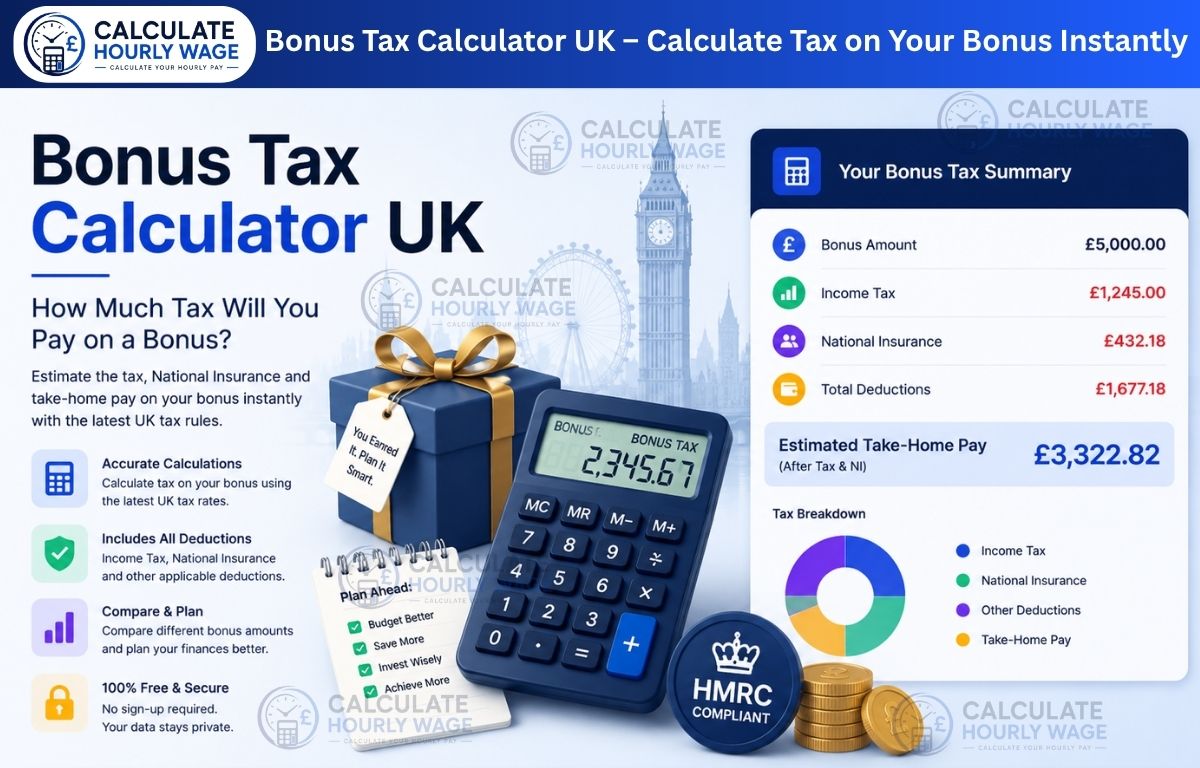
A Bonus Tax Calculator UK helps you avoid that surprise. Before payday, you can estimate how much Income Tax, National Insurance, and other deductions may be taken from your bonus.
With a clear estimate in advance, you can plan your budget more confidently, compare different bonus amounts, and know what to expect when your payslip arrives.
Calculator
What Is a Bonus Tax Calculator UK?
A Bonus Tax Calculator UK is an online tool that helps you estimate how much of your bonus you are likely to keep after tax and other deductions.
Simply enter your annual salary and bonus amount, and the calculator applies the latest UK tax rules to provide an estimated breakdown of your taxes and net bonus.
Instead of manually working through different tax bands and contribution rates, the calculator does all the calculations for you in just a few seconds, giving you a realistic estimate before your employer processes your payroll.
How It Estimates Tax on Bonuses
Although bonuses may appear separate from your regular salary, HMRC generally treats them as employment income.
The calculator estimates your deductions by considering factors such as:
- Your annual salary
- Gross bonus amount
- Selected tax year
- Income Tax thresholds
- National Insurance rates
- Student Loan deductions (where applicable)
- Pension salary sacrifice or workplace pension contributions
After combining these details, it estimates:
| Calculation | Result |
| Gross Bonus | Total bonus before deductions |
| Estimated Income Tax | Tax deducted under PAYE |
| National Insurance | Employee NI contribution |
| Other deductions | Student Loan or Pension (if applicable) |
| Net Bonus | Amount likely to reach your bank account |
Remember that the calculator provides an estimate. Your actual payslip may vary slightly depending on your payroll settings and tax code.
Who Should Use a Bonus Tax Calculator UK?
This calculator is useful for almost anyone receiving additional earnings through their employer.
It is particularly valuable for:
- Employees receiving annual bonuses
- Performance-based workers
- Sales professionals earning commission bonuses
- Managers receiving incentive payments
- Company directors taking taxable bonuses
- Anyone planning future finances around an upcoming bonus
Even if your bonus is relatively small, understanding the deductions beforehand helps you make informed financial decisions.
How to Use the Bonus Tax Calculator UK
Most bonus calculators are intentionally simple to use. You only need a few pieces of information to receive an estimate.
| Step | Description |
|---|---|
| Enter Your Annual Salary | • Start by entering your gross annual salary before tax. • This figure is important because UK Income Tax is progressive. • Your existing salary determines which tax bands your bonus may fall into. • The more accurate your salary information, the more reliable the estimate. |
| Add Your Bonus Amount | • Enter the gross value of your expected bonus. • This should be the amount your employer has awarded before any deductions. • Whether your bonus is £300 or £30,000, the calculator will include it when estimating your taxable income. |
| Select the Tax Year | • Tax rules change over time. • Income Tax thresholds, National Insurance limits, and other payroll rules may differ between tax years. • Selecting the correct tax year ensures your calculation reflects the latest available rates. • Using the wrong year could produce misleading results. |
| View Your Estimated Tax and Net Bonus | After entering your information, the calculator instantly estimates: • Gross bonus • Income Tax deduction • National Insurance contribution • Student Loan repayment (if applicable) • Pension contribution (where applicable) • Total deductions • Estimated take-home bonus |
This allows you to understand what your employer may deduct before payday arrives.
How Are Bonuses Taxed in the UK?
Many employees believe bonuses are taxed differently from regular salary.
This is one of the biggest misconceptions surrounding workplace bonuses.
In reality, there is no separate “bonus tax” in the UK.
Your bonus is simply treated as additional employment income under the Pay As You Earn (PAYE) system. However, because it increases your taxable earnings during the pay period, the deductions can appear much higher than expected.
Understanding why this happens can prevent unnecessary concern when you receive your payslip.
Why Bonuses Are Taxable
Bonuses are considered part of your employment income.
Since they represent additional earnings from your employer, they are generally subject to the same taxes as your regular salary.
Depending on your circumstances, your bonus may be liable for:
- Income Tax
- National Insurance Contributions (NICs)
- Student Loan repayments
- Workplace pension deductions (where applicable)
The exact deductions depend on your earnings and payroll arrangements.
Read More: gov.ukPAYE and Bonus Payments
Employers process bonuses through the Pay As You Earn (PAYE) system.
PAYE automatically calculates tax based on your total earnings during the payroll period.
If your bonus significantly increases your monthly or weekly pay, the payroll software may temporarily treat part of your income as falling into a higher tax band. This can result in a larger deduction on your payslip, even if your overall annual tax position remains unchanged.
This is one of the main reasons employees often feel they have been over-taxed on a bonus.
Read More: PAYE Calculator UKTemporary Higher Tax Deductions
Receiving a one-off bonus can temporarily push your earnings much higher for that specific pay period.
As a result:
- More Income Tax may be deducted initially.
- National Insurance may increase for that pay period.
- Student Loan repayments may also rise.
Although the deductions can seem excessive, they are often a consequence of how PAYE estimates tax during payroll rather than a special tax applied exclusively to bonuses.
How HMRC Adjusts Tax Later
If too much tax has been deducted because of payroll calculations, HMRC usually corrects the position over time.
This may happen through:
- Future payslips during the same tax year
- An updated tax code
- A tax refund after the end of the tax year, if required
For this reason, it’s important not to assume your first bonus deduction represents your final annual tax liability.
A Bonus Tax Calculator UK provides an estimate based on current tax rules, helping you understand why deductions occur and what your likely take-home bonus will be before payday.
What Deductions Apply to a Bonus?
When your employer pays a bonus, the amount shown in your employment contract is usually the gross bonus. This is the value before any mandatory deductions are made.
The amount that reaches your bank account, your net bonus, is often lower because several deductions may apply depending on your circumstances.
Understanding each deduction helps you read your payslip with confidence and estimate your take-home pay more accurately.
| Deduction | Description |
| Income Tax | Bonuses are treated as employment income and taxed through the PAYE system. The amount of Income Tax depends on your total taxable income and tax band. If your bonus pushes part of your earnings into a higher tax band, more tax may be deducted for that pay period. A Bonus Tax Calculator UK estimates your Income Tax based on your salary, bonus amount, and the selected tax year. |
| National Insurance Contributions | Bonuses are also subject to National Insurance Contributions (NICs). National Insurance is calculated separately from Income Tax using its own thresholds and rates. A large one-off bonus can increase your National Insurance deduction for that payslip. |
| Student Loan Repayments | If you have a UK Student Loan, your bonus may increase your repayment. Student Loan deductions are based on earnings above the repayment threshold. A higher repayment can reduce your take-home bonus. |
| Pension Contributions (If Applicable) | Depending on your employer’s pension scheme, contributions may be deducted from your bonus before or after tax. This may include: Workplace pension contributions Salary sacrifice arrangements Voluntary pension contributions These deductions can affect your final take-home pay. |
How a Bonus Affects Your Take-Home Pay
- Receiving a bonus increases your earnings, but it doesn’t mean you’ll receive the entire amount.
- The actual impact depends on how much tax and other deductions apply after your bonus is processed through payroll.
- Looking beyond the gross figure helps you make better financial decisions.
Net Bonus After Tax
- Your net bonus is the amount you actually receive after all deductions have been made.
- A typical calculation looks like this:
Gross Bonus − Income Tax − National Insurance − Student Loan − Pension Contributions = Net Bonus
For example:
| Description | Amount |
| Gross Bonus | £2,000 |
| Income Tax | £400 |
| National Insurance | £160 |
| Student Loan | £45 |
| Pension | £40 |
| Estimated Net Bonus | £1,355 |
The exact figures will vary based on your salary, tax code, and individual circumstances, but this example illustrates why the amount arriving in your bank account is often lower than expected.
Monthly Take-Home Pay
Your monthly salary usually increases in the pay period when the bonus is paid.
For example:
| Item | Without Bonus | With a £2,000 Bonus |
| Gross Monthly Pay | £3,500 | £5,500 |
| Estimated Deductions | Lower | Higher |
| Net Monthly Pay | Higher than usual | Includes net bonus |
Although deductions increase, your overall take-home pay for that month is still higher than a normal payday.
Knowing this estimate in advance can help you plan larger purchases, savings goals, or debt repayments.
Annual Take-Home Pay
A one-off bonus also increases your annual earnings.
While the increase may not permanently change your tax position, it does affect your total income for the tax year.
This information can be useful when:
- Planning savings goals
- Applying for a mortgage
- Reviewing your yearly budget
- Estimating annual tax liabilities
- Comparing job offers with different bonus structures
Instead of focusing only on your monthly payslip, consider how the bonus contributes to your overall annual income.
Bonus and Hourly Pay Calculations
- Many employees wonder whether receiving a bonus increases their hourly wage.
- The answer depends on what you mean by “hourly pay.”
- A one-off bonus increases your total earnings, but it doesn’t permanently change the hourly rate stated in your employment contract.
- This distinction is especially useful if you’re also using a Salary-to-Hourly Calculator.
Read More: Salary to Hourly Calculator UK Does a Bonus Increase Your Hourly Rate?
Normally, no.
Your contractual hourly rate remains the same unless your employer changes your salary or working hours.
For example:
- Salary: £36,000
- Working Hours: 37.5 per week
Your hourly rate stays the same whether you receive a bonus or not.
The bonus is an additional payment, not an increase in your agreed rate of pay.
Annual Salary vs Hourly Earnings After a Bonus
Although your contractual hourly wage doesn’t change, your effective earnings per hour for the year can increase because you’ve earned more money overall.
Example:
| Annual Income | Effective Earnings |
| Salary Only | £36,000 |
| Salary + £4,000 Bonus | £40,000 |
If you divide your total annual earnings by the hours worked during the year, your effective hourly earnings become higher.
This doesn’t replace your official hourly wage it simply reflects that you’ve earned more over the same number of working hours.
Why One-Off Bonuses Don’t Permanently Change Your Hourly Wage
Bonuses are generally classified as variable pay, not contractual salary.
Because they are discretionary or performance-based, they don’t automatically increase:
- Your hourly rate
- Your monthly salary going forward
- Future overtime rates (unless your contract states otherwise)
- Your standard rate of pay
This is why employers list bonuses separately from regular salary on payslips.
If you’re comparing jobs or calculating your normal hourly wage, use your contractual salary rather than including one-off bonuses. However, if you’re evaluating your total annual earnings, including bonuses, it provides a more complete picture of your compensation.
Bonus Tax Calculation Examples
Numbers often make the bonus tax easier to understand than explanations alone. While the exact deductions depend on your salary, tax code, National Insurance category, pension arrangements, and other factors, the following examples show how a bonus can affect your take-home pay.
These examples are illustrative and help you understand why the amount paid into your bank account is usually lower than the gross bonus.
£500 Bonus Example
A smaller bonus may have a relatively modest impact on your deductions, making it a pleasant boost to your monthly income.
| Description | Amount |
| Gross Bonus | £500 |
| Estimated Income Tax | £100 |
| Estimated National Insurance | £40 |
| Estimated Net Bonus | £360 |
Although around £140 has been deducted, the employee still receives most of the bonus. This makes smaller bonuses useful for covering seasonal expenses, paying bills, or adding to emergency savings.
£2,000 Bonus Example
A medium-sized bonus usually results in higher Income Tax and National Insurance deductions because your taxable earnings increase during that payroll period.
| Description | Amount |
| Gross Bonus | £2,000 |
| Estimated Income Tax | £400 |
| Estimated National Insurance | £160 |
| Estimated Student Loan | £45 |
| Estimated Net Bonus | £1,395 |
At this level, many employees are surprised by the deductions. However, these amounts are generally calculated through PAYE rather than being subject to a separate bonus tax.
£5,000 Bonus Example
A larger one-off payment can noticeably increase deductions, especially if it temporarily pushes part of your earnings into a higher tax band during that pay period.
| Description | Amount |
| Gross Bonus | £5,000 |
| Estimated Income Tax | £1,000 |
| Estimated National Insurance | £400 |
| Estimated Student Loan | £135 |
| Estimated Pension Contribution | £100 |
| Estimated Net Bonus | £3,365 |
Even though the deductions are larger, receiving a £5,000 bonus still provides a significant increase in take-home pay. Using a Bonus Tax Calculator UK beforehand helps you set realistic expectations and plan how you’ll use the money.
Common Mistakes When Calculating Bonus Tax
Bonus calculations are often misunderstood because employees focus only on the gross payment shown by their employer. Avoiding a few common mistakes can lead to much more accurate estimates.
| Common Mistake | Explanation |
| Confusing Bonus Tax With a Separate Tax Rate | One of the biggest misconceptions is that bonuses have their own tax rate. The UK does not have a separate bonus tax. Bonuses are treated as employment income and taxed through the PAYE system alongside your salary. The amount deducted depends on your total taxable earnings, not the bonus alone. |
| Ignoring National Insurance | Many people calculate only Income Tax and overlook National Insurance Contributions. NI is calculated separately from Income Tax. Excluding NI can make your estimated take-home bonus much higher than the actual amount. A reliable calculator includes both deductions automatically. |
| Using the Wrong Tax Year | Tax bands, thresholds, and contribution rates can change each tax year. Using outdated rates may produce inaccurate estimates. Always select the correct tax year when using a Bonus Tax Calculator UK. |
| Comparing Gross Bonus Instead of Net Bonus | It’s easy to focus on the bonus your employer announces. Financial planning should always be based on your net bonus. Budgeting with the gross amount can leave you short of money when payday arrives. |
| Assuming Every Bonus Is Taxed the Same Way | Two employees receiving identical bonuses may not receive identical net payments. Several factors influence the final deduction, including: Annual salary Tax code National Insurance category Student Loan Plan Pension contributions Payroll timing For this reason, personalised calculations are more useful than relying on someone else’s payslip. |
Benefits of Using a Bonus Tax Calculator
A Bonus Tax Calculator UK does much more than estimate deductions. It helps you make informed financial decisions before your bonus reaches your account.
Estimate Your Net Bonus Quickly
- Manual calculations can be time-consuming and confusing, especially when multiple deductions apply.
- A calculator provides an estimated breakdown within seconds, allowing you to see how much of your bonus you’re likely to keep.
Plan Your Budget More Accurately
- Knowing your expected take-home bonus makes budgeting much easier.
- Whether you’re planning a holiday, reducing debt, investing, or increasing your savings, realistic figures help you make smarter financial choices.
Understand Tax Deductions Before Payday
- Unexpected deductions often lead to disappointment.
- Using a calculator beforehand gives you a clearer picture of how Income Tax, National Insurance, Student Loan repayments, and pension contributions affect your bonus.
- This removes much of the uncertainty surrounding bonus payments.
Compare Different Bonus Amounts
A calculator also makes it easy to compare different scenarios.
For example, you can estimate:
- £500 bonus vs £1,000 bonus
- £2,000 bonus vs £5,000 bonus
- Bonus with pension contributions
- Bonus without Student Loan deductions
These comparisons can be particularly useful during salary negotiations or when considering different employment offers.
Is a bonus taxed differently from salary?
No. Bonuses are generally treated as employment income and taxed through PAYE in the same way as your regular salary. There is no separate UK bonus tax rate.
Why was more tax deducted from my bonus?
A bonus increases your earnings during that payroll period. PAYE may temporarily deduct more tax because your income appears higher for that specific pay cycle. HMRC usually adjusts any overpayment if necessary.
Does a bonus affect my tax bracket?
It can. If your total taxable income increases enough, part of your bonus may fall within a higher tax band. However, this does not mean your entire income is taxed at the higher rate.
Can I calculate my bonus after tax?
Yes. A Bonus Tax Calculator UK estimates your net bonus by considering Income Tax, National Insurance, Student Loan repayments, pension contributions, and other applicable deductions.
Does a bonus change my hourly pay?
Not permanently.
A one-off bonus increases your total annual earnings but does not change your contractual hourly wage. If you’re calculating your normal hourly rate, use your agreed salary rather than including occasional bonus payments.
Final Thoughts
A bonus is a rewarding addition to your income, but the amount you receive is rarely the same as the amount you’re awarded. Understanding how PAYE, Income Tax, National Insurance, and other deductions work allows you to set realistic expectations before payday.
A Bonus Tax Calculator UK simplifies these calculations, helping you estimate your net bonus, plan your finances with confidence, and make better decisions about how to use your extra earnings.