Thousands of employees across the UK are surprised on their payday every year. After seeing the gross salary, they quickly start planning their monthly budget, thinking about rent, savings, and holidays. Then, on payday, the amount that lands in their bank account is much lower than they expected.
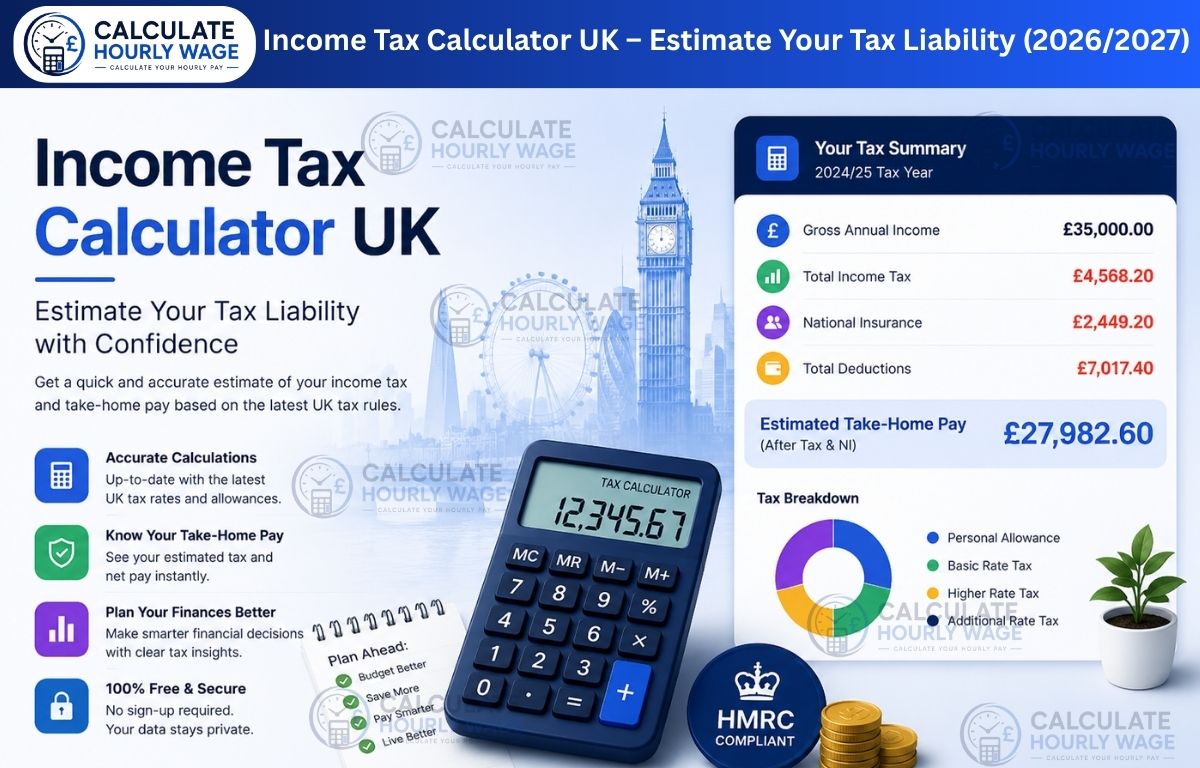
This is exactly where an Income Tax Calculator UK becomes valuable. Instead of making rough estimates or trying to understand complicated tax rules yourself, the calculator provides a quick estimate of your tax liability and expected take-home pay based on the latest UK tax rules.
Whether you’re accepting a new job, negotiating a salary increase, planning freelance income, or simply reviewing your finances, knowing your estimated tax before payday helps you make smarter financial decisions.
What Is an Income Tax Calculator UK?
An Income Tax Calculator UK is an online tool that estimates how much Income Tax you’ll have to pay in a tax year based on your earnings and personal circumstances.
Rather than manually calculating tax bands, allowances, and deductions, the calculator processes your information in seconds and provides an estimated breakdown of your income.
Although it’s an estimate rather than an official HMRC calculation, it offers an excellent starting point for budgeting, salary planning, and understanding your finances.
How Does an Income Tax Calculator UK Work?
The calculator applies the latest UK tax rules to your income.
After entering your annual salary or other taxable income:
| What the calculator considers | • Personal Allowance • Income Tax bands • National Insurance contributions • Student Loan deductions (if applicable) • Pension contributions (optional) • Tax year selection |
| What the calculator estimates | • Annual Income Tax • Monthly Income Tax • National Insurance • Total deductions • Net annual income • Monthly take-home pay • Weekly earnings • Hourly pay |
Instead of spending time with tax tables and formulas, the calculator performs these calculations instantly.
Who Should Use an Income Tax Calculator UK?
An Income Tax Calculator is useful for almost anyone earning taxable income in the UK.
It is particularly helpful for:
- Employees paid through PAYE
- Self-employed individuals
- Freelancers and contractors
- Job seekers comparing salary offers
- Employers estimating payroll costs
- Students starting full-time work
- Anyone planning their annual budget
If your income changes during the year due to bonuses, overtime, or promotions, using the calculator can help you to understand how those changes may affect your take-home pay.
How to Use the Income Tax Calculator UK?
Using the calculator is simple and usually takes less than a minute.
Enter Your Gross Income
Start by entering your gross annual salary.
Gross income means your total earnings before any deductions are taken.
For example:
| Salary Type | Example |
| Annual Salary | £35,000 |
| Monthly Salary | £2,916.67 |
| Weekly Salary | £673.08 |
Always enter your gross income rather than your take-home pay to receive an accurate estimate.
Select the Tax Year
UK Income Tax rules change over time.
Choosing the correct tax year ensures the calculator uses the right:
- Personal Allowance
- Income Tax bands
- National Insurance thresholds
- Tax rates
The current tax year runs from 6 April 2026 to 5 April 2027.
Selecting the wrong tax year can significantly change your estimated tax.
Include Salary, Bonuses, and Other Income
Many people mistakenly calculate tax using only their basic salary.
However, taxable income may also include:
- Annual bonuses
- Commission
- Overtime
- Self-employed income
- Rental profits (above applicable allowances)
- Certain investment income
Including all taxable income provides a more realistic estimate of your overall tax liability.
View Your Estimated Tax Results
Once you’ve entered your details, the calculator generates an estimate showing:
| Calculation Result | What It Shows |
|---|---|
| Gross annual income | Your total yearly income before any tax or deductions. |
| Tax-free allowance | The portion of your income that is not subject to Income Tax. |
| Income Tax payable | The amount of Income Tax you are expected to pay. |
| National Insurance | Your estimated National Insurance contributions. |
| Student Loan deductions (if selected) | Any Student Loan repayments deducted from your salary. |
| Pension contributions (if selected) | The amount contributed to your workplace or personal pension. |
| Net annual income | Your yearly take-home income after deductions. |
| Monthly take-home pay | Your estimated take-home pay each month. |
| Weekly pay | Your estimated take-home pay each week. |
| Hourly earnings | Your estimated earnings per hour based on your income. |
This breakdown helps you understand exactly where your income is going, rather than just seeing a single final number.
How Income Tax Is Calculated in the UK
Many people think Income Tax is applied to their entire salary.
In reality, the process is more structured.
Your income is divided into different tax bands, and each band is taxed at its own rate. Before any tax is charged, most individuals also receive a tax-free Personal Allowance.
Understanding these stages makes your tax estimate much easier to follow.
For the 2026/27 tax year, the standard Personal Allowance is £12,570.
This means most people do not pay Income Tax on the first £12,570 of taxable income.
For example:
| Annual Income | Tax-Free Amount |
| £12,570 | £12,570 |
| £25,000 | First £12,570 |
| £45,000 | First £12,570 |
| £60,000 | First £12,570 |
However, higher earners should be aware of an important rule.
| Scenario | What Happens |
|---|---|
| Adjusted net income exceeds £100,000 | Your Personal Allowance is reduced by £1 for every £2 earned above that threshold. |
| Income reaches £125,140 or above | The standard Personal Allowance is reduced to £0. |
| Eligible for Blind Person’s Allowance | Eligible individuals may qualify for a Blind Person’s Allowance, which increases the amount of income they can earn before paying Income Tax. |
Income Tax Bands
After your Personal Allowance is deducted, the remaining taxable income falls into different tax bands.
Each band has its own tax rate.
Rather than taxing your entire salary at one percentage, only the portion of income within each band is taxed at that band’s rate.
This progressive system ensures that people with higher earnings pay a higher rate only on the income above each threshold.
Tax Rates Explained
For the 2026/27 UK tax year (excluding Scotland), the standard Income Tax bands are:
| Tax Band | Taxable Income | Tax Rate |
| Personal Allowance | Up to £12,570 | 0% |
| Basic Rate | £12,571 – £50,270 | 20% |
| Higher Rate | £50,271 – £125,140 | 40% |
| Additional Rate | Over £125,140 | 45% |
These bands apply to taxable income after considering the standard Personal Allowance, where applicable.
For individuals earning more than £125,140, the Personal Allowance is no longer available, meaning more of their income becomes taxable.
Read More:gov.ukPAYE vs Self Assessment
Not everyone pays Income Tax in the same way.
| Situation | How Income Tax Is Collected |
|---|---|
| If you’re employed | Your employer usually deducts Income Tax automatically through the Pay As You Earn (PAYE) system before your salary reaches your bank account. |
| If you’re self-employed or have additional taxable income | You may need to complete a Self Assessment tax return if your income isn’t taxed at source. |
| Regardless of how your tax is collected | An Income Tax Calculator can still provide a useful estimate of your expected tax liability before payments are made. |
Income Tax Rates and Bands (Year 2026/2027)
One of the biggest misconceptions is that moving into a higher tax band means your entire salary is taxed at the higher rate. Fortunately, that’s not how the UK tax system works.
Instead, only the portion of your income that falls within each tax band is taxed at that rate. This progressive approach means you keep more of your earnings than many people expect.
Basic Rate
The Basic Rate applies to taxable income between £12,571 and £50,270.
Income within this band is taxed at 20%.
| Situation | Explanation |
|---|---|
| Annual salary of £30,000 | You won’t pay 20% on the full £30,000. The first £12,570 is generally covered by your Personal Allowance, and only the remaining taxable portion falls into the Basic Rate band. |
| Most UK employees | For millions of UK employees, this is the only Income Tax band they will pay during the year. |
Higher Rate
| Situation | Explanation |
|---|---|
| Taxable income exceeds £50,270 | Once your taxable income exceeds £50,270, the amount above this threshold enters the Higher Rate band. |
| Higher Rate tax | This income is taxed at 40%. |
| How the tax is applied | Your earnings below £50,271 continue to be taxed at the lower rates. Only the additional income above the threshold is taxed at 40%. |
| Effect of a pay rise | Receiving a pay rise doesn’t usually leave you worse off. Although part of your extra income may be taxed at a higher rate, you still take home more money overall. |
Additional Rate
| Situation | Explanation |
|---|---|
| Taxable income exceeds £125,140 | If your taxable income exceeds £125,140, you enter the Additional Rate band. |
| Additional Rate tax | Income above this threshold is taxed at 45%. |
| Personal Allowance | At this level, the standard Personal Allowance is no longer available, meaning a larger proportion of your income becomes taxable. |
| Who this affects | This affects a relatively small percentage of taxpayers, but it’s an important consideration for high-income professionals, business owners, and individuals with multiple income sources. |
What Is Included in Your Tax Estimate?
A quality Income Tax Calculator UK does much more than estimate Income Tax.
It gives you a complete picture of your deductions so you can understand why your take-home pay differs from your gross salary.
Income Tax
- Income Tax is the primary deduction calculated using the Personal Allowance and the applicable tax bands.
- The calculator estimates how much Income Tax you’ll pay over the year and breaks it down into monthly, weekly, and sometimes daily figures.
- This makes it much easier to plan your finances and avoid unexpected deductions.
National Insurance Contributions
For most employees, National Insurance Contributions (NICs) are another significant deduction.
Although National Insurance is separate from Income Tax, both reduce your take-home pay.
Your National Insurance helps fund services and benefits such as:
- State Pension
- NHS funding
- Certain state benefits
Because Income Tax and National Insurance are calculated differently, many people underestimate their total deductions when looking only at tax rates.
Read More: National Insurance Calculator UK Student Loan Repayments (Optional)
- If you have a UK Student Loan, repayments may also be deducted once your income exceeds your repayment threshold.
- Most Income Tax Calculators allow you to choose your Student Loan plan before calculating your estimated take-home pay.
- Including Student Loan repayments helps produce a more accurate estimate, especially for recent graduates.
Pension Contributions (Optional)
- Many employees contribute to a workplace pension.
- These contributions may reduce your taxable income depending on how your pension scheme operates.
- Most calculators include an optional field where you can enter your pension contribution percentage or annual amount.
- Doing so provides a more personalised estimate of your final take-home pay.
From Annual Salary to Hourly Pay
- Many people know their annual salary but struggle to understand what it means in practical terms.
- Converting yearly income into monthly, weekly, daily, or hourly earnings makes budgeting much easier.
- This is especially useful when comparing job offers, negotiating pay, or calculating overtime.
How Annual Salary Converts to Hourly Pay
A typical full-time employee works:
| Time Period | Typical Amount |
| Weeks per year | 52 |
| Hours per week | 37.5 |
| Total hours per year | 1,950 |
A simple formula is:
| Example | Details |
|---|---|
| Formula | Hourly Rate = Annual Salary ÷ Total Annual Working Hours |
| Example Annual Salary | Approximate Hourly Rate (Before Tax) |
| £25,000 | £12.82 |
| £40,000 | £20.51 |
| £60,000 | £30.77 |
These figures represent gross hourly pay, before Income Tax and other deductions.
Hourly Rate Before Tax vs After Tax
- This is where many employees are surprised.
- Your advertised hourly wage is rarely the amount you actually keep.
- After Income Tax, National Insurance, pension contributions, and other deductions, your effective hourly earnings become lower.
For example:
| Salary | Gross Hourly | Estimated Net Hourly |
| £25,000 | £12.82 | Lower after deductions |
| £40,000 | £20.51 | Lower after deductions |
| £60,000 | £30.77 | Lower after deductions |
Actual figures depend on your tax code, pension contributions, National Insurance, Student Loan repayments, and personal circumstances.
Using an Income Tax Calculator alongside a Salary-to-Hourly Calculator gives you a much clearer picture of what you’re actually earning for each hour worked.
Read More: Salary to Hourly Calculator UKWhy Taxes Affect Your Hourly Earnings
Understanding your after-tax hourly wage helps you make better financial decisions.
For example, it can help you:
- Compare two job offers fairly.
- Evaluate overtime opportunities.
- Calculate freelance rates.
- Plan household budgets.
- Decide whether a salary increase improves your take-home income.
Looking only at gross salary can be misleading. Your net hourly pay is often the figure that matters most in day-to-day life.
Examples of UK Income Tax Calculations
Numbers become much easier to understand when you see them applied to real salaries.
The following examples are simplified illustrations based on the standard Personal Allowance and current UK Income Tax bands. But actual results may vary depending on your personal circumstances.
£25,000 Salary Example
- Sarah starts a new office job with an annual salary of £25,000.
- Since her income is below the Higher Rate threshold, all of her taxable income falls within the Basic Rate band.
Estimated Breakdown
| Item | Amount |
|---|---|
| Gross Salary | £25,000 |
| Personal Allowance | £12,570 |
| Taxable Income | £12,430 |
| Estimated Income Tax | £2,486 |
Sarah also pays National Insurance, which means her actual take-home pay will be lower than her gross salary.
£40,000 Salary Example
- James earns £40,000 per year.
- His income also remains within the Basic Rate band after deducting the Personal Allowance.
Estimated Breakdown
| Item | Amount |
|---|---|
| Gross Salary | £40,000 |
| Personal Allowance | £12,570 |
| Taxable Income | £27,430 |
| Estimated Income Tax | £5,486 |
- Although his Income Tax increases compared with Sarah’s, James still remains entirely within the Basic Rate tax band.
- This demonstrates that a higher salary increases tax gradually rather than dramatically.
£60,000 Salary Example
- Emma receives a promotion that raises her annual salary to £60,000.
- Some people worry that this means their entire salary will suddenly be taxed at 40%.
- Fortunately, that isn’t the case.
- Only the portion of Emma’s taxable income above £50,270 enters the Higher Rate band.
Estimated Breakdown
| Tax Band | Amount Taxed |
|---|---|
| Personal Allowance | £12,570 |
| Basic Rate (20%) | First taxable portion up to £50,270 |
| Higher Rate (40%) | Only income above £50,270 |
- This example highlights why understanding progressive tax bands is so important.
- A pay rise may increase your tax bill, but it also increases your overall take-home income.
- Rather than relying on assumptions, using an Income Tax Calculator helps you see exactly how changes in salary affect your finances.
Common Mistakes When Estimating Income Tax
In the Income Tax Calculator UK, small mistakes can lead to inaccurate estimates. Most errors happen because users enter incorrect information that affects their taxable income.
Understanding these common mistakes can help you to get a more reliable estimate and make better financial decisions.
| Common Mistake | Why It Matters |
|---|---|
| Using Net Salary Instead of Gross Salary | Enter your gross salary, not your take-home pay. The calculator estimates deductions from your gross income, so using your net salary will produce incorrect results. Check your payslip or employment contract for your gross annual salary. |
| Choosing the Wrong Tax Year | Tax rules, Personal Allowances, Income Tax bands, and National Insurance thresholds can change every year. Select the correct tax year (e.g., 2026/27) for an accurate estimate. |
| Ignoring National Insurance | National Insurance is a major salary deduction. Ignoring it can make your expected take-home pay appear higher than it actually is. |
| Forgetting Bonuses or Overtime | Include all taxable income, such as bonuses, commission, overtime, freelance income, and taxable benefits. Leaving these out can underestimate your tax liability. |
| Not Updating Personal Circumstances | Recalculate your tax if your circumstances change, such as changing jobs, receiving a promotion, starting freelance work, joining a pension, repaying a Student Loan, or becoming eligible for additional tax allowances. |
Benefits of Using an Income Tax Calculator UK
An Income Tax Calculator isn’t just about calculating tax, it’s a practical financial planning tool that can help you make more informed decisions throughout the year.
| Benefit | How It Helps |
|---|---|
| Saves Time | Manually calculating Income Tax requires understanding tax bands, allowances, and deductions. A calculator completes these calculations quickly and reduces the risk of errors. |
| Helps with Budgeting | Knowing your estimated take-home pay makes it easier to plan for rent, utilities, savings, and other monthly expenses. |
| Estimates Take-Home Pay | Job adverts usually show gross salary, not what you’ll actually receive. A calculator estimates your:• Annual take-home pay• Monthly income• Weekly earnings• Daily pay• Hourly wage |
| Supports Salary Comparisons | Compare the estimated take-home pay from different job offers to see how salary, pension contributions, and deductions affect the amount you’ll actually receive. |
How accurate is an Income Tax Calculator UK?
An Income Tax Calculator provides a reliable estimate using the latest UK tax rules, including Personal Allowance and Income Tax bands. However, your actual tax may vary depending on your tax code, National Insurance category, pension contributions, Student Loan repayments, benefits in kind, and any additional allowances or tax reliefs.
Does the calculator include National Insurance?
Yes. Most modern Income Tax Calculators estimate National Insurance Contributions (NICs) alongside Income Tax, giving you a more realistic picture of your take-home pay.
Can I calculate tax on bonuses?
Yes.
If your calculator allows additional income entries, you can include bonuses, commission, overtime, or other taxable earnings. Including all taxable income generally provides a more accurate estimate of your annual tax liability.
Can I estimate my monthly and hourly pay?
Absolutely.
Most Income Tax Calculators automatically convert your annual salary into:
Monthly pay
Weekly pay
Daily earnings
Hourly rate
Many also estimate both gross and after-tax income, helping you understand what you’ll actually earn.
Is the Income Tax Calculator UK free to use?
Yes.
Most online Income Tax Calculators are completely free and can be used as often as needed. They’re particularly useful when changing jobs, negotiating a salary, or planning your finances for the year ahead.
Final Thoughts
Understanding your Income Tax doesn’t have to be complicated. With an Income Tax Calculator UK, you can quickly estimate your tax liability, National Insurance, and expected take-home pay using the latest 2026/27 tax rules.
Whether you’re starting a new job, comparing salaries, or planning your finances, knowing how your income is taxed helps you budget with confidence and make smarter financial decisions.