
Imagine receiving a job offer that looks fantastic on paper. The salary looks higher than your current income, and you think it is more than enough to cover your expenses.
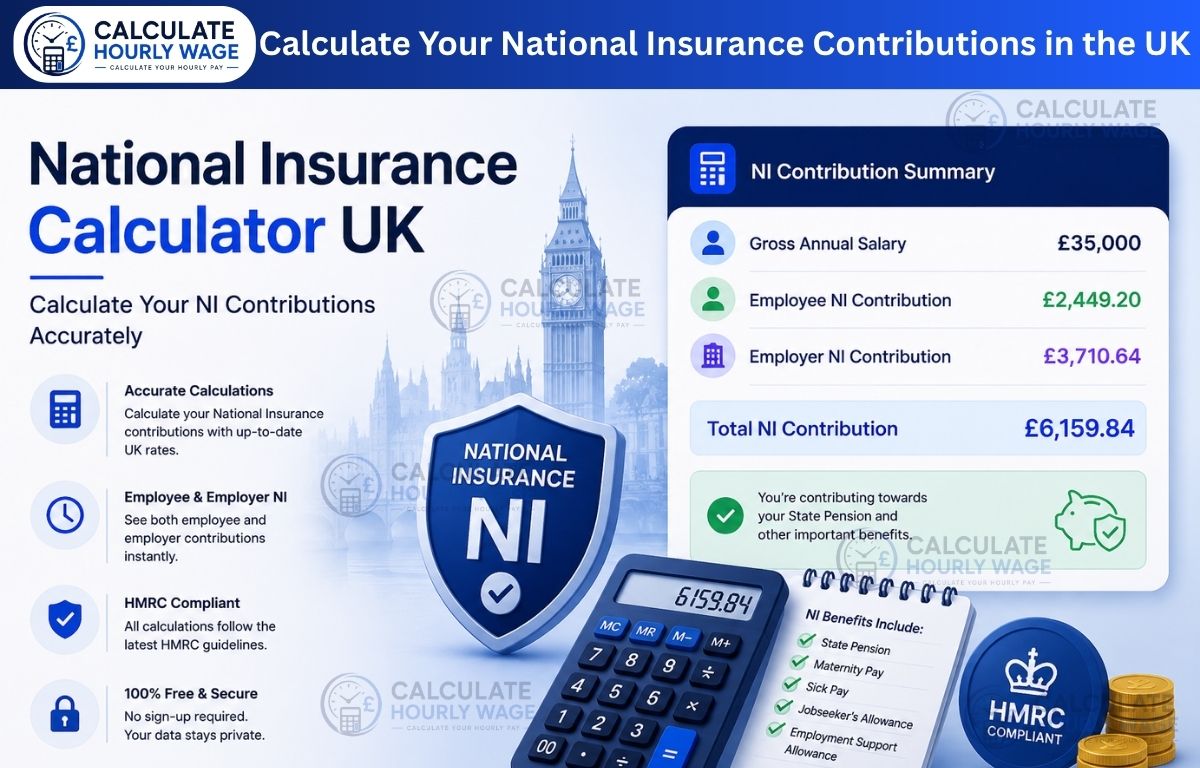
Before accepting, using a National Insurance Calculator UK can help you understand how much National Insurance you’ll pay and what your actual take-home pay will be.
Many workers are surprised on their payday when the amount credited to their bank account is noticeably lower than expected.
This is where a National Insurance Calculator UK becomes incredibly useful.
Instead of calculating thresholds, percentages, tax years, and contribution categories manually, a calculator can quickly estimate how much NI you have to pay and how much income you will receive.
It helps you to understand what National Insurance is, why it exists, and how it affects your earnings.
Calculator
What Is a National Insurance Calculator UK?
A National Insurance Calculator UK is an online tool that estimates how much National Insurance you have to pay based on your earnings, employment status, tax year, and contribution category.
The calculator helps workers to understand deductions before receiving their payslip.
It can also estimate take-home pay, employer contributions, and hourly earnings after NI deductions.
Meaning of National Insurance
National Insurance is a contributory system in the UK that helps fund public services and state benefits.
These contributions support programs such as:
- State Pension
- Maternity Allowance
- Employment and Support Allowance
- Bereavement Benefits
- Certain unemployment-related benefits
Most working individuals contribute through payroll deductions.
Why National Insurance Contributions Matter
National Insurance affects more than just your monthly pay.
Your contribution record can influence eligibility for future benefits and your State Pension entitlement.
Missing contributions over long periods may impact future claims.
Difference Between Income Tax and National Insurance
Many people assume Income Tax and National Insurance are the same thing.
They are not.
| Income Tax | National Insurance |
| Funds government spending | Funds, benefits and pensions |
| Based on tax bands | Based on NI thresholds |
| Paid on taxable income | Paid on qualifying earnings |
| Different rates apply | Different contribution classes apply |
Although both reduce take-home pay, they are calculated separately.
Who Pays National Insurance in the UK?
National Insurance can apply to:
- Full-time employees
- Part-time workers
- Self-employed individuals
- Company directors
- Workers with multiple jobs
- Employees receiving bonuses and overtime
The exact amount depends on earnings and contribution category.
How Does the National Insurance Calculator UK Work?
A calculator follows a straightforward process.
| Step | Details |
|---|---|
| Enter Your Gross Salary | Start by entering your annual, monthly, weekly, or hourly earnings before deductions. This is known as gross pay. |
| Choose Your Tax Year | National Insurance thresholds change regularly. Selecting the correct tax year ensures accurate estimates. |
| Select Your Pay Frequency | Most calculators allow: • Annual salary • Monthly salary • Weekly pay • Daily earnings • Hourly wages |
| Add Your Employment Type | Your status affects the calculation. Options may include: • Employee • Self-employed • Director • Contractor |
| Calculate Your NI Contributions | The calculator applies current HMRC thresholds and rates to determine contributions. |
| View Your Take-Home Pay After NI | Most advanced calculators also estimate: • Income Tax • National Insurance • Pension deductions • Net pay |
This gives a clearer picture of your actual earnings.
UK Salary to Hourly NI Calculator
Many workers receive their annual salaries, but they want to know their effective hourly rates.
A salary-to-hourly NI calculator helps bridge that gap.
Read More: Salary to Hourly Calculator UK Annual Salary to Hourly NI Breakdown
- A £40,000 annual salary may sound impressive.
- However, deductions reduce actual hourly income.
- Calculating NI helps reveal your real earnings.
Monthly Salary to Hourly NI Breakdown
- Monthly salary figures can also be converted into hourly rates after deductions.
- This helps workers understand what they truly earn for every hour worked.
Weekly Pay and NI Contributions
- Weekly-paid employees often notice deductions depending on overtime and bonus payments.
- A calculator can estimate these changes.
Why Hourly Workers Should Check NI Deductions
- Hourly workers often focus on gross hourly rates.
- However, NI deductions can significantly affect actual earnings.
How NI Affects Your Real Hourly Take-Home Pay
- Knowing your after-deduction hourly rate helps with:
- Evaluating overtime opportunities
- Budget planning
- Comparing job offers
Key Inputs Used in a National Insurance Calculator
Accurate results depend on accurate information.
| Item | Details |
|---|---|
| Gross Annual Salary | This forms the foundation of all calculations. |
| Monthly or Weekly Pay | Some calculators allow direct entry of periodic earnings. |
| Tax Year | Rates and thresholds vary each tax year. |
| National Insurance Category Letter | Contribution percentages differ according to category letters. Examples include: • A • B • D • F • H • J • L • M • N • V • Z |
| Employment Status | Employees and self-employed workers follow different contribution rules. |
| Pension Contributions | Workplace pensions can affect taxable earnings. |
| Salary Sacrifice | Salary sacrifice arrangements may reduce NI liability. |
| Bonus or Overtime Pay | Additional earnings can increase contributions. |
| Multiple Jobs or Extra Income | Having more than one source of income may affect calculations. |
What Results Does the NI Calculator Show?
Most calculators provide several useful outputs.
Annual National Insurance Contributions
It displays the total amount of National Insurance you are expected to pay over the entire tax year based on your income and the selected tax year.
Monthly NI Contributions
It shows the estimated National Insurance deduction from your salary each month, helping you to understand your regular monthly costs.
Weekly NI Contributions
Provides an estimate of how much National Insurance you are likely to pay each week if you are paid weekly.
Net Pay After NI
Calculates the amount of income you keep after National Insurance contributions have been deducted from your gross earnings.
Take-Home Pay After Tax and NI
Gives a complete estimate of your take-home pay by including both Income Tax and National Insurance deductions, and in some cases other deductions such as pension contributions.
Employer National Insurance Estimate
Some advanced calculators also estimate the amount of National Insurance that your employer is required to pay on top of your salary. This does not reduce your take-home pay but helps employers estimate payroll costs.
Hourly Pay After NI Deductions
Shows your estimated hourly earnings after National Insurance has been deducted, making it easier to compare jobs or understand your effective hourly income.
National Insurance Classes Explained
- Not everyone pays NI in the same way.
- Different contribution classes exist.
| National Insurance Type | Description |
|---|---|
| Class 1 National Insurance for Employees | Most employees pay Class 1 contributions through PAYE payroll systems. |
| Class 2 National Insurance for Self-Employed Workers | Historically, paid by self-employed individuals to maintain contribution records. |
| Class 3 Voluntary National Insurance | Voluntary payments help fill gaps in NI records. |
| Class 4 National Insurance for Self-Employed Profits | Based on business profits rather than wages. |
| Employer National Insurance Contributions | Employers also contribute to employee earnings. These contributions are separate from employee deductions. |
National Insurance Rates and Thresholds (2026/27)
A National Insurance Calculator UK uses the latest HMRC thresholds and contribution rates to estimate your National Insurance deductions. The figures below apply to the 2026/27 tax year.
National Insurance Weekly Thresholds
| Threshold | Weekly Amount |
| Lower Earnings Limit (LEL) | £129 |
| Primary Threshold (PT) | £242 |
| Secondary Threshold (ST) | £96 |
| Upper Earnings Limit (UEL) | £967 |
| Upper Secondary Threshold (UST) | £967 |
| Apprentice Upper Secondary Threshold (AUST) | £967 |
| Freeports Upper Secondary Threshold (FUST) | £481 |
| Investment Zones Upper Secondary Threshold (IZUST) | £481 |
| Veterans Upper Secondary Threshold (VUST) | £967 |
Read More: gov.ukNational Insurance Monthly Thresholds
| Threshold | Monthly Amount |
| Lower Earnings Limit (LEL) | £559 |
| Primary Threshold (PT) | £1,048 |
| Secondary Threshold (ST) | £417 |
| Upper Earnings Limit (UEL) | £4,189 |
| Upper Secondary Threshold (UST) | £4,189 |
| Apprentice Upper Secondary Threshold (AUST) | £4,189 |
| Freeports Upper Secondary Threshold (FUST) | £2,083 |
| Investment Zones Upper Secondary Threshold (IZUST) | £2,083 |
| Veterans Upper Secondary Threshold (VUST) | £4,189 |
Employee National Insurance Rates (Class 1)
| Contribution Band | Rate |
| Between Primary Threshold and Upper Earnings Limit | 8% |
| Above Upper Earnings Limit | 2% |
| Married Women’s Reduced Rate | 1.85% |
| Employees Deferring National Insurance | 2% |
Self-Employed National Insurance (Class 2 & Class 4)
| Item | Amount |
| Small Profits Threshold (per year) | £7,105 |
| Weekly Class 2 Rate | £3.65 |
Voluntary Class 3 Contributions
| Item | Amount |
|---|---|
| Weekly Class 3 Contribution | £18.40 |
Class 1 National Insurance Rates (Employers) – 2026/27
| Contribution Type | Rate |
|---|---|
| Employer NIC above Secondary Threshold | 15% |
| Below Upper Secondary Threshold | 0% |
| Below Freeports Upper Secondary Threshold | 0% |
| Below Apprentice Upper Secondary Threshold | 0% |
| Below Investment Zones Upper Secondary Threshold | 0% |
| Below Veterans Upper Secondary Threshold | 0% |
| Class 1A on Expenses & Benefits | 15% |
Special National Insurance Rates – 2026/27
| Contribution Type | Rate |
|---|---|
| Share Fishermen (Class 2) | £4.30/week |
| Volunteer Development Workers (Class 2) | £6.45/week |
| Additional Class 4 Rate (Deferred NIC) | 2% |
How National Insurance Thresholds Work
Lower Earnings Limit (LEL):
Earnings above this level count towards certain National Insurance benefits, even if no contributions are due.
Primary Threshold (PT):
Employees begin paying National Insurance once earnings exceed this threshold.
Secondary Threshold (ST):
Employers start paying National Insurance contributions above this level.
Upper Earnings Limit (UEL):
Employee contributions are reduced to the upper rate once earnings exceed this limit.
Why National Insurance Rates Change Each Year
HMRC reviews National Insurance thresholds and contribution rates before each tax year. Government policy, inflation, and fiscal changes can all affect these figures, which is why using an up-to-date National Insurance Calculator UK is important.
Why Calculator Results Are Estimates
Although a National Insurance Calculator UK provides a reliable estimate, your actual deductions may differ depending on:
- Your National Insurance category letter
- Salary sacrifice arrangements
- Pension contributions
- Payroll frequency (weekly or monthly)
- Other taxable benefits or deductions
National Insurance Calculation Example
Let’s examine a practical scenario.
Example Salary
| Item | Value |
|---|---|
| Example Salary | £40,000 Per Year |
| NI Category | Category A |
Step 1: Weekly Earnings
| Calculation | Result |
|---|---|
| £40,000 ÷ 52 | Approximately £769.23 per week |
Step 2: Calculate National Insurance
| Item | Value |
|---|---|
| Earnings subject to NI | Between £242 and £769.23 |
| NI Rate | 8% |
| Taxable NI Earnings | £769.23 − £242 = £527.23 |
| Weekly NI | £527.23 × 8% = £42.18 |
Estimated National Insurance Contributions
| Contribution | Amount |
|---|---|
| Annual NI Contribution | Approximately £2,193 |
| Monthly NI Deduction | Approximately £183 |
| Weekly NI Deduction | Approximately £42 |
Estimated Hourly Pay After NI
| Item | Value |
|---|---|
| Working Hours | 40 hours per week |
| Annual Hours | 40 × 52 = 2,080 |
| Gross Hourly Rate | £40,000 ÷ 2,080 = £19.23 |
| Hourly NI Reduction | £2,193 ÷ 2,080 = £1.05 |
| Effective Hourly Pay | Around £18.18 before Income Tax deductions |
Why Use a National Insurance Calculator?
A calculator provides benefits beyond simple curiosity.
Understand Your Real Take-Home Pay
Know exactly how much income remains after deductions.
Plan Your Monthly Budget
Budgeting becomes easier when deductions are predictable.
Compare Job Offers Easily
Two salaries may look similar but produce different net incomes.
Check Salary-to-Hourly Pay Accurately
Understand your effective hourly earnings.
Estimate Bonus and Overtime Deductions
Avoid surprises when receiving additional pay.
Avoid Manual Calculation Mistakes
Threshold-based calculations can become complicated quickly.
Read More: National Insurance Calculator UKNational Insurance for Different Workers
Different workers experience NI differently.
| Worker Type | Description |
|---|---|
| Full-Time Employees | Usually, pay Class 1 contributions through payroll. |
| Part-Time Employees | May pay reduced contributions depending on earnings. |
| Hourly Workers | Deductions vary with hours worked and weekly income. |
| Self-Employed Workers | Often deal with Class 4 and other self-employment rules. |
| Company Directors | Special annual earnings calculations may apply. |
| Workers with More Than One Job | Each employment can be assessed separately. |
| Employees with Bonus or Overtime | Additional earnings may increase NI deductions. |
Common Mistakes When Calculating National Insurance
Many inaccurate estimates come from simple errors.
| Common Mistake | Explanation |
|---|---|
| Using Net Salary Instead of Gross Salary | Always calculate using pre-deduction income. |
| Choosing the Wrong Tax Year | Rates can change annually. |
| Ignoring NI Category Letters | Category letters significantly affect contributions. |
| Forgetting Bonus or Overtime | Extra earnings can alter calculations. |
| Confusing Income Tax with National Insurance | They are separate deductions. |
| Not Checking Weekly or Monthly Thresholds | NI often uses specific earnings thresholds. |
| Ignoring Salary Sacrifice or Pension Contributions | These arrangements may change deductions. |
| Relying Only on Annual Salary | Weekly and monthly payroll calculations can produce different results. |
What is National Insurance in the UK?
National Insurance is a contribution system that helps fund state benefits and pensions.
How do I calculate my National Insurance contributions?
You calculate NI by applying the correct contribution rate to earnings above the relevant threshold for your category.
Does National Insurance reduce take-home pay?
Yes. NI deductions reduce the amount of money you receive after payroll processing.
Is National Insurance the same as Income Tax?
No. They are separate systems with different rules and purposes.
Do part-time workers pay National Insurance?
Yes, if earnings exceed the applicable thresholds.
Do self-employed people pay National Insurance?
Yes. Self-employed workers may pay different classes of NI depending on profits.
How do I calculate NI from hourly pay?
Convert hourly earnings into weekly or annual income and apply the relevant thresholds and rates.
Does the calculator include employer NI?
yes. Many advanced calculators provide employer NI estimates alongside employee deductions.
Are NI calculator results exact or estimated?
Most calculators provide estimates. Actual payroll figures may vary slightly.
Is this National Insurance Calculator free to use?
Most online National Insurance calculators are free for personal use.
Final Thoughts
National Insurance is one of the most important deductions affecting UK workers, yet many people only notice it when reviewing their payslip. A reliable National Insurance Calculator UK removes the guesswork, helping you understand deductions, compare salaries, and plan your finances with confidence. The better you understand NI today, the fewer surprises you’ll face on payday tomorrow.