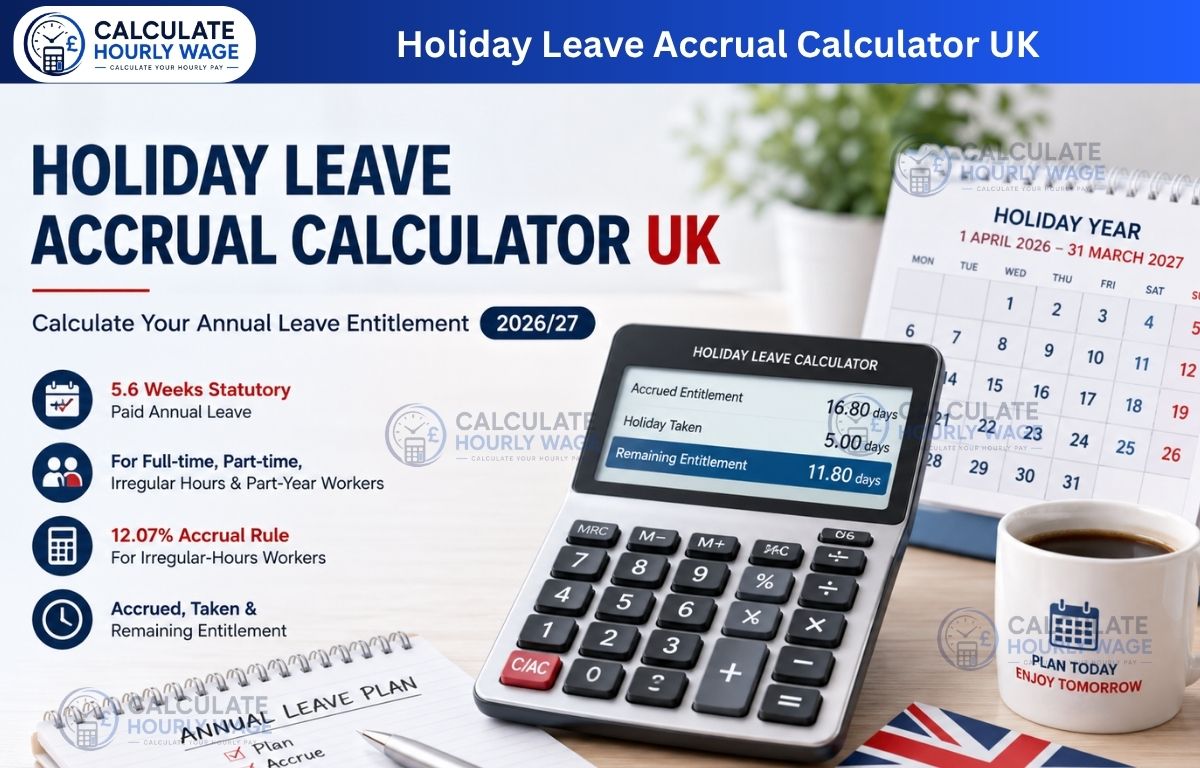
Most UK workers are entitled to 5.6 weeks of statutory paid annual leave each year. For a regular five-day worker, this equals 28 days. A fixed-hours worker can generally calculate entitlement using days worked per week × 5.6, subject to the 28-day statutory cap.
For applicable irregular-hours and part-year workers, holiday accrues at 12.07% of hours worked in each pay period.
CLICK HERE:
Use the Holiday Leave Accrual Calculator to enter your working pattern, holiday year, start or end date, holidays already taken, bank holiday treatment, and any contractual entitlement above the statutory minimum.
The result should show your accrued entitlement, holidays already taken and remaining entitlement.
How the Holiday Leave Accrual Calculator Works
What is holiday accrual?
Holiday accrual is the process of building up paid annual leave during a holiday year.
Your annual entitlement is the total leave available for the full year. Your accrued entitlement is how much of that leave you have earned at a particular point.
This distinction matters if you start or leave a job part-way through the holiday year, work irregular hours or have already taken some holiday.
For example, a worker may have a full-year entitlement of 28 days but have earned only part of those 28 days when they leave employment.
Accruing holiday and taking holiday are also separate. You can build up entitlement without taking it immediately. Your remaining balance depends on how much you have accrued and how much leave you have already used.
What is the statutory holiday entitlement in the UK?
The statutory minimum is 5.6 weeks of paid annual leave for most workers.
| Work Schedule | Calculation | Result |
|---|---|---|
| Five days a week | 5 days × 5.6 | 28 days |
The statutory calculation has a 28-day cap. A person working six days a week does not automatically receive 33.6 statutory days simply because 6 × 5.6 produces that figure.
An employer can provide more than the statutory minimum through the employment contract. Any additional contractual leave should be considered separately because its terms may differ from the statutory entitlement.
What is the holiday year?
The holiday year is the period an employer uses to calculate and manage annual leave. Its dates are normally set by the employment contract or employer policy.
This matters when someone starts or leaves during the year. The worker may be entitled to only a proportion of their full annual allowance.
The holiday year also matters if the employee changes their working pattern during the year.
Read More: PAYE Calculator UKHow to Calculate Holiday Entitlement
Fixed-hours workers
For a worker with a regular working pattern, the basic statutory calculation is:
| Holiday Entitlement | Example |
|---|---|
| Holiday entitlement = days worked per week × 5.6 | 3 days × 5.6 = 16.8 days |
This calculation is appropriate for a regular fixed-days pattern. It should not automatically be used for workers whose hours vary substantially.
The calculation should also distinguish between statutory leave and any additional contractual holiday.
Part-time workers
Part-time workers receive holiday on a pro-rata basis according to their working pattern.
| Days worked per week | Statutory annual entitlement |
|---|---|
| 1 | 5.6 days |
| 2 | 11.2 days |
| 3 | 16.8 days |
| 4 | 22.4 days |
| 5 | 28 days |
For example,
| Working Days per Week | Calculation | Holiday Entitlement |
|---|---|---|
| Four days a week | 4 × 5.6 | 22.4 days |
| Two days a week | 2 × 5.6 | 11.2 days |
Fractional results should not simply be discarded. The applicable rounding rules must be followed so that statutory entitlement is not reduced.
Calculating holiday in hours
Hours can be more useful where a worker has fixed weekly hours but different shift lengths.
For example, an employee might work 30 hours across four days, with some shifts longer than others.
Worked Example
| Description | Calculation | Result |
|---|---|---|
| The employee works four days per week | 4 × 5.6 | 22.4 days |
| Their average working day is | 30 hours ÷ 4 days | 7.5 hours |
| Their annual entitlement expressed in hours is | 22.4 × 7.5 | 168 hours |
Note: This avoids assuming that every holiday day is automatically an eight-hour day.
Read More: Daily Wage Calculator UKHow to Calculate Holiday for Irregular-Hours and Part-Year Workers
Who is an irregular-hours or part-year worker?
Irregular-hours workers do not work a consistent number of hours in every pay period.
Zero-hours workers are a common example. Seasonal and other part-year workers may also fall into this category where their work is limited to particular periods.
Their calculation differs from a standard fixed-hours worker because holiday needs to reflect the hours actually worked.
How the 12.07% holiday accrual calculation works
For applicable irregular-hours and part-year workers:
Holiday accrued = hours worked × 12.07%
The calculation is applied to hours worked in each pay period.
For example,
| Hours Worked | Calculation | Result |
|---|---|---|
| 30 hours | 30 × 12.07% | 3.621 hours |
The applicable rounding rules then need to be considered.
The 12.07% rate is linked to the statutory 5.6 weeks of annual leave. It should not automatically be applied to every part-time employee. A regular fixed-hours worker should first be assessed using the appropriate fixed-hours calculation.
How to calculate accrued holiday when hours change
Irregular workers may complete different numbers of hours from one pay period to another.
For example:
| Pay period | Hours worked | 12.07% accrual |
|---|---|---|
| 1 | 20 | 2.414 hours |
| 2 | 30 | 3.621 hours |
| 3 | 25 | 3.018 hours |
The applicable holiday earned from each period is accumulated to determine total accrued entitlement.
This method avoids using an average number of hours that does not reflect the worker’s actual pattern.
Contractual entitlement above 5.6 weeks
Some employers provide more than the statutory 5.6 weeks.
Additional contractual leave should be separated from statutory leave when calculating entitlement. Where the contract provides enhanced leave, the calculation may need to be adjusted to reflect the additional entitlement.
Practical Scenario: If an employee receives more than the statutory minimum, do not assume that the statutory result shown by the calculator is their complete contractual allowance.
How to Calculate Holiday When You Start or Leave Mid-Year
Starting a job part-way through the holiday year
A worker who starts after the beginning of the holiday year will generally have a proportion of the full annual entitlement available for that period.
A simple monthly illustration is:
| Description | Calculation | Result |
|---|---|---|
| Full annual entitlement ÷ 12 × months worked | — | — |
| Five-day worker with 28 days | 28 ÷ 12 | 2.33 days per month |
| Six months of the holiday year are worked | 28 × 6 ÷ 12 | 14 days |
The actual calculation should reflect the relevant holiday-year dates and applicable accrual rules.
Read More: Monthly Salary Calculator UKLeaving a job before the holiday year ends
When employment ends, calculate the proportion of the annual entitlement earned up to the leaving date and compare it with holiday already taken.
A basic calculation is:
Full annual entitlement × proportion of year worked
Worked Example
| Description | Calculation | Result |
|---|---|---|
| Annual entitlement after seven months | 28 × 7 ÷ 12 | 16.33 days |
| Holiday already taken | — | 12 days |
| Remaining balance | Accrued entitlement − holiday taken | 4.33 days |
Subject to the relevant rounding treatment.
How unused holiday is handled when employment ends
Accrued but untaken holiday can result in payment when employment ends.
The entitlement calculation determines how much leave has been earned. The holiday pay calculation determines how much money is due.
If more holiday has been taken than accrued, the position can be different and may depend on the employment terms and applicable rules.
How Bank Holidays Affect Holiday Entitlement
Are bank holidays included in the 28 days?
Bank holidays are not automatically additional statutory leave.
An employer can include bank holidays within the worker’s statutory annual leave allowance. Alternatively, the contract may provide bank holidays separately.
For example, an employee may have 28 days total statutory leave, with some days allocated to bank holidays. Another employer may provide bank holidays on top of the statutory allowance.
The employment contract and employer policy determine the treatment.
Read More: Overtime Pay Calculator UKHow bank holidays affect part-time workers
Part-time workers do not automatically receive an additional day’s holiday simply because a bank holiday occurs.
Their entitlement depends on their working pattern and the terms of their employment.
| Bank-holiday treatment | What it means |
|---|---|
| Included within statutory entitlement | Bank holidays use part of the available leave |
| Provided in addition | Employer gives bank holidays separately |
| Part-time worker | Effect depends on normal working pattern and contract |
Bank holidays and UK nations
Public holidays differ between England and Wales, Scotland and Northern Ireland.
However, the number of public holidays in each nation does not itself change the statutory annual leave minimum.
A calculator should therefore treat bank-holiday arrangements separately rather than assuming every worker receives the same number of additional days.
How Holiday Accrual Is Affected by Sick, Maternity and Other Leave
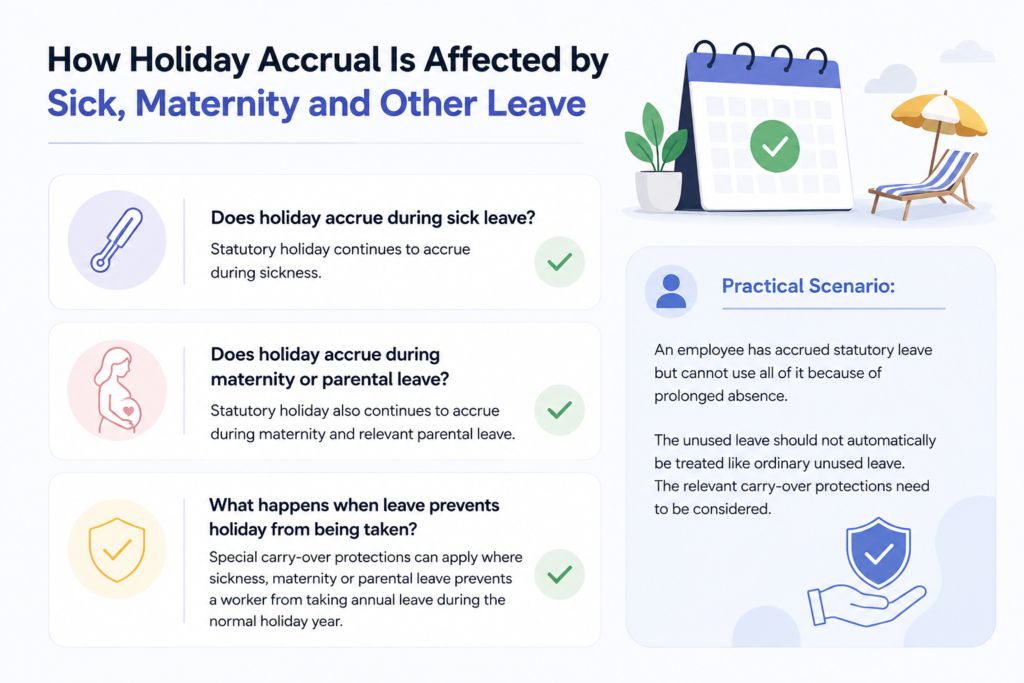
Does holiday accrue during sick leave?
Statutory holiday continues to accrue during sickness.
A worker should not assume that a period of sickness automatically stops annual leave from building up.
Does holiday accrue during maternity or parental leave?
Statutory holiday also continues to accrue during maternity and relevant parental leave.
This can become significant where an employee is away from work for a long period and has not been able to use all of their annual leave.
What happens when leave prevents holiday from being taken?
Special carry-over protections can apply where sickness, maternity or parental leave prevents a worker from taking annual leave during the normal holiday year.
Practical Scenario: An employee has accrued statutory leave but cannot use all of it because of prolonged absence. The unused leave should not automatically be treated like ordinary unused leave. The relevant carry-over protections need to be considered.
Holiday Carry-Over Rules
What happens to unused holiday at the end of the holiday year?
The general position is that annual leave should be used during the relevant holiday year.
An employer’s contract or policy may contain rules about carrying leave forward. Workers should therefore check the terms applying to their employment rather than assuming that all unused leave automatically transfers.
When can statutory holiday be carried over?
Special circumstances can provide additional protection.
These include situations involving long-term sickness and maternity or parental leave where the worker has been unable to take their holiday.
| Situation | Carry-over consideration |
|---|---|
| Normal unused leave | Contract, policy and statutory rules apply |
| Long-term sickness | Special statutory protection can apply |
| Maternity/parental leave | Special statutory protection can apply |
How to Convert Holiday Entitlement Between Days and Hours
When should holiday be calculated in days?
Days are generally easiest for workers with a regular working pattern, such as someone working a fixed number of days every week.
The basic calculation is:
Days worked per week × 5.6
When should holiday be calculated in hours?
Hours become more useful where shifts have different lengths or where the working pattern varies.
Hours are also central to the 12.07% calculation used for applicable irregular-hours and part-year workers.
How to calculate a holiday day when daily hours vary
A worker who completes different numbers of hours on different days should not automatically assume that one holiday day equals eight hours.
An average-day approach can help convert entitlement between days and hours while reflecting the worker’s actual working pattern.
Worked Example
| Description | Calculation | Result |
|---|---|---|
| Average working day | 30 ÷ 4 | 7.5 hours |
| Annual statutory entitlement | 4 × 5.6 | 22.4 days |
| Converted into hours | 22.4 × 7.5 | 168 hours |
Holiday Accrual Rounding Rules
Why holiday calculations produce fractions
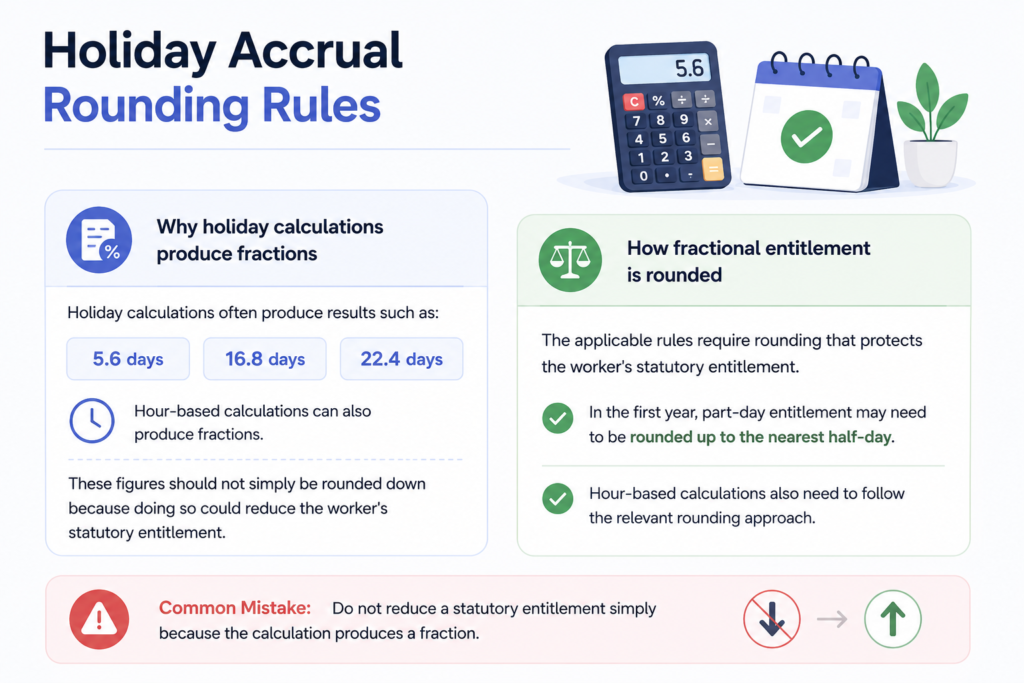
Holiday calculations often produce results such as:
- 5.6 days
- 16.8 days
- 22.4 days
Hour-based calculations can also produce fractions.
These figures should not simply be rounded down because doing so could reduce the worker’s statutory entitlement.
How fractional entitlement is rounded
The applicable rules require rounding that protects the worker’s statutory entitlement. In the first year, part-day entitlement may need to be rounded up to the nearest half-day. Hour-based calculations also need to follow the relevant rounding approach.
Common Mistake: Do not reduce a statutory entitlement simply because the calculation produces a fraction.
Visit Now: GOV.UKCommon Holiday Accrual Calculation Mistakes
- Treating bank holidays as automatically additional leave.
- Applying the 12.07% calculation to every part-time worker.
- Using 28 days for every worker without considering their working pattern.
- Assuming a six-day worker automatically receives 33.6 statutory days.
- Rounding statutory entitlement down.
- Forgetting that statutory holiday can accrue during sickness or maternity leave.
- Confusing holiday entitlement with holiday pay.
- Ignoring the employer’s holiday-year dates.
- Treating contractual additional leave exactly like statutory leave.
- Failing to subtract holiday already taken when calculating the remaining balance.
Holiday Accrual Examples for Common UK Working Patterns
Full-time employee working five days per week
| Description | Calculation | Result |
|---|---|---|
| Worker completes five days per week | 5 × 5.6 | 28 days |
| Statutory annual entitlement | — | 28 days |
| Annual entitlement divided by 12 | 28 ÷ 12 | 2.33 days per month |
This monthly figure helps explain accrual but does not replace consideration of the actual holiday year and applicable calculation method.
Part-time employee working three days per week
| Working Days per Week | Calculation | Annual Holiday Entitlement |
|---|---|---|
| Three days per week | 3 × 5.6 | 16.8 days |
The fractional result must be handled using the applicable rounding rules rather than simply rounding down.
Employee starting part-way through the holiday year
| Description | Calculation | Result |
|---|---|---|
| Five-day worker with a 28-day annual entitlement | 28 × 6 ÷ 12 | 14 days |
This represents the proportional entitlement for the six months, subject to the applicable accrual and rounding rules.
Employee leaving part-way through the year
| Description | Calculation | Result |
|---|---|---|
| Worker with 28 days annual entitlement leaves after seven months | 28 × 7 ÷ 12 | 16.33 days |
If 12 days have already been taken, the remaining balance is based on accrued entitlement less the leave already used.
Irregular-hours worker
| Description | Calculation | Result |
|---|---|---|
| Worker completes 30 hours during a relevant pay period | 30 × 12.07% | 3.621 hours |
The applicable rounding treatment should then be applied. The calculation is repeated for each relevant pay period.
Worker whose hours change during the year
A worker initially completes three days each week and later moves to four days.
The original entitlement should not simply remain unchanged. The calculation needs to account for the working-pattern change and when it occurred during the holiday year.
If the worker instead moves into an irregular-hours arrangement, the applicable hours-based accrual method should be considered.
Practical Holiday Accrual Scenarios
Zero-hours worker with changing weekly hours
A zero-hours worker can complete substantially different numbers of hours from one period to another.
Where the irregular-hours rules apply, record the hours worked during each relevant pay period and calculate 12.07% of those hours.
Seasonal or part-year worker
A seasonal worker may work only during part of the year.
For an applicable part-year worker, holiday accrual can be calculated from hours worked using the 12.07% method rather than assuming the person works a standard full year.
Part-time employee taking maternity leave
A part-time worker continues to accrue statutory holiday during maternity leave.
If the employee cannot take the leave because of the absence, carry-over protections may need to be considered.
Employee who has taken more holiday than accrued
If the amount of holiday already taken exceeds the accrued entitlement, the calculator should show the difference rather than treating the full annual allowance as available.
Any adjustment or deduction at the end of employment depends on the employment terms and applicable rules.
Holiday Entitlement vs Holiday Pay
Holiday entitlement is the amount of paid annual leave a worker is entitled to take.
Holiday pay is the amount the worker receives for that leave.
For example, a calculator showing 16.8 days has calculated leave entitlement, not its monetary value.
What can affect holiday pay?
Holiday pay can reflect normal earnings and, where applicable, regular overtime or commission.
Statutory and contractual leave can also be treated differently.
This is why a holiday accrual calculator and holiday pay calculator serve different purposes.
What happens to unused holiday when you leave?
First calculate the accrued but untaken holiday. The monetary value can then be calculated separately.
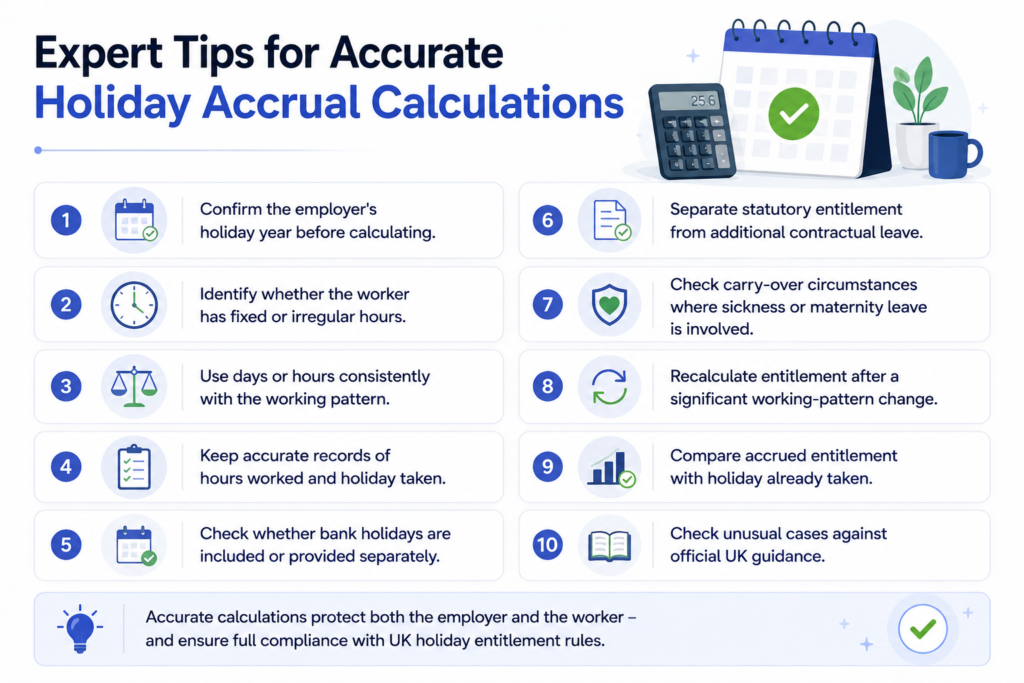
Expert Tips for Accurate Holiday Accrual Calculations
- Confirm the employer’s holiday year before calculating.
- Identify whether the worker has fixed or irregular hours.
- Use days or hours consistently with the working pattern.
- Keep accurate records of hours worked and holiday taken.
- Check whether bank holidays are included or provided separately.
- Separate statutory entitlement from additional contractual leave.
- Check carry-over circumstances where sickness or maternity leave is involved.
- Recalculate entitlement after a significant working-pattern change.
- Compare accrued entitlement with holiday already taken.
- Check unusual cases against official UK guidance.
How is holiday entitlement calculated in the UK?
Most workers receive 5.6 weeks of statutory paid annual leave. For a regular fixed-hours worker, multiply days worked per week by 5.6, subject to the 28-day statutory cap. Different rules apply to applicable irregular-hours and part-year workers.
How much holiday do I get if I work 1, 2, 3 or 4 days a week?
Using the basic statutory calculation:
1 day = 5.6 days
2 days = 11.2 days
3 days = 16.8 days
4 days = 22.4 days
The applicable rounding rules should be applied to fractional entitlement.
How much statutory holiday do I get in the UK?
The statutory minimum is 5.6 weeks per year. For a five-day worker, that equals 28 days.
How do I calculate holiday accrual per month?
For a standard five-day worker with 28 days annual entitlement, divide 28 by 12:
28 ÷ 12 = 2.33 days per month
The actual calculation should reflect the employer’s holiday year and the worker’s circumstances.
What is the 12.07% holiday accrual rule?
For applicable irregular-hours and part-year workers, holiday accrues at 12.07% of hours worked in each pay period.
How do irregular-hours workers calculate holiday?
Record the hours worked in each relevant pay period and calculate 12.07% of those hours. Accumulate the resulting entitlement and apply the applicable rounding rules.
Do zero-hours workers get paid holiday?
Qualifying zero-hours workers can accrue statutory paid holiday. Where the irregular-hours rules apply, the 12.07% calculation can be used to determine accrual from hours worked.
Do bank holidays count towards the 28 days?
They can. Bank holidays are not automatically additional statutory leave. An employer can include them within the 28-day statutory entitlement or provide them separately under the contract.
How do I calculate holiday if I start a job mid-year?
Start with the full annual entitlement and calculate the proportion applicable to the period worked. A monthly illustration is full entitlement divided by 12, multiplied by the relevant months worked.
How do I calculate holiday if I leave my job mid-year?
Calculate the proportion of the full annual entitlement earned up to the leaving date, then subtract holiday already taken. Untaken accrued entitlement may be payable when employment ends.
Can I carry unused holiday into the next year?
Unused leave is generally subject to the employer’s holiday policy and the rules applying to statutory entitlement. Special carry-over protections can apply where sickness, maternity or parental leave prevents holiday from being taken.
Does holiday accrue during sick or maternity leave?
Statutory holiday continues to accrue during sickness and maternity leave. Special carry-over rules may also apply where the worker cannot take leave because of the absence.
What happens if I take more holiday than I have accrued?
The holiday balance can become negative. If employment ends while more holiday has been taken than accrued, any adjustment or deduction depends on the employment terms and applicable rules.
How should fractional holiday entitlement be rounded?
Statutory entitlement should not simply be rounded down. The applicable rules provide for rounding that protects the worker’s entitlement, including relevant first-year and hour-based rules.
How do I calculate holiday pay for unused leave?
First calculate the amount of accrued but untaken holiday. Holiday pay is then calculated separately using the applicable earnings rules. A holiday pay calculator can be used for the monetary calculation.
Conclusion
Calculating holiday entitlement in the UK depends on your working pattern, holiday year and whether you work fixed or irregular hours. For regular workers, the basic calculation is usually based on 5.6 weeks of statutory annual leave, while applicable irregular-hours and part-year workers accrue holiday at 12.07% of hours worked.
For an accurate result, check your holiday year, account for any holiday already taken, understand how bank holidays are treated and apply the correct rounding and carry-over rules. If you are starting or leaving a job mid-year, changing your working pattern or working irregular hours, use the Holiday Leave Accrual Calculator to estimate your accrued and remaining annual leave.