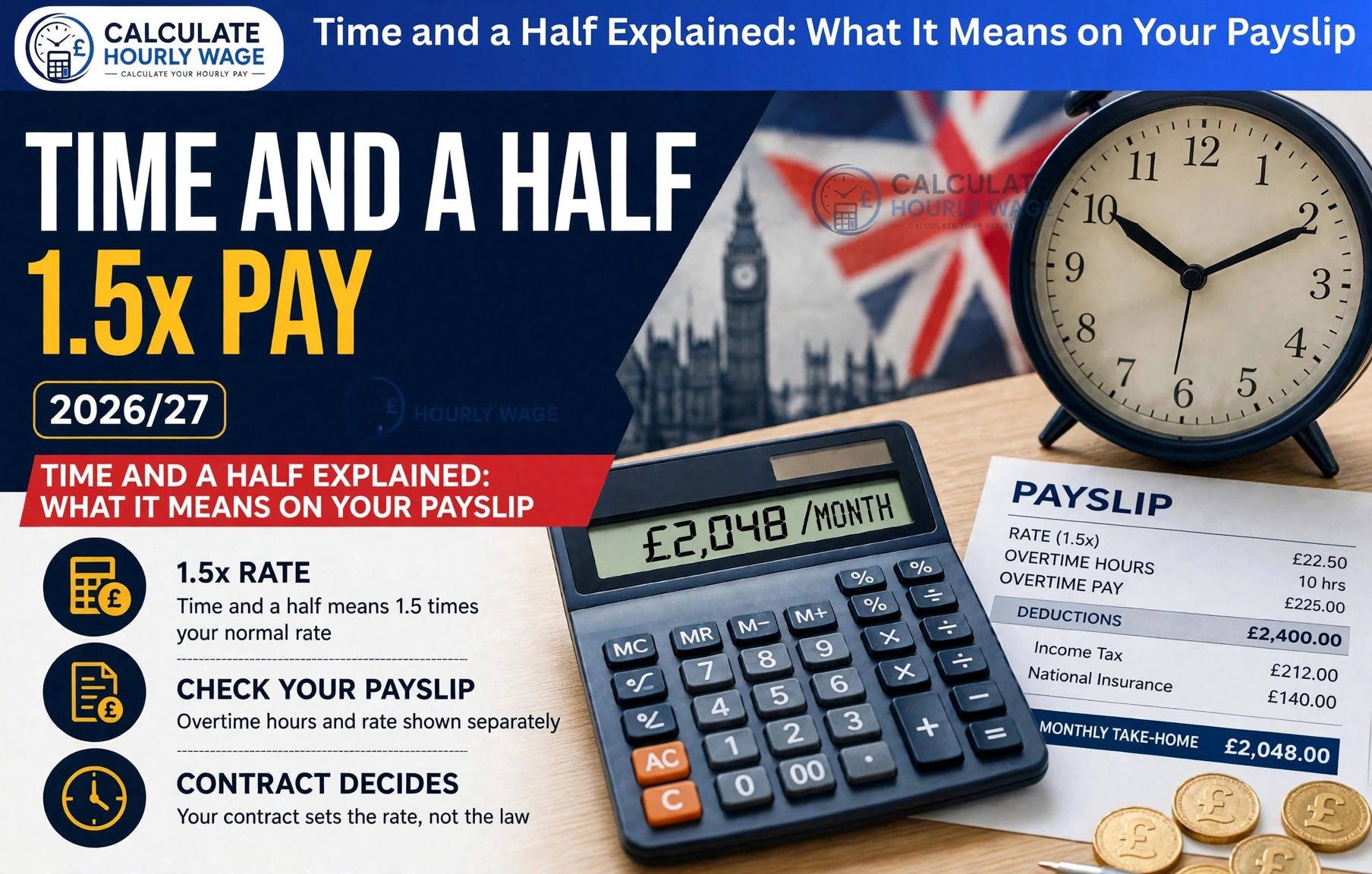
If you are wondering what is time and a half in the uk, here is the short answer: time and a half means you are paid one and a half times your normal hourly rate for certain extra hours. If your usual rate is £14 an hour, your time-and-a-half rate is £21 an hour. On a payslip it usually appears as a separate line, such as “overtime — time and a half”, with its own hours and rate, so you can check it apart from your basic pay.
One catch is worth stating at the start. Time and a half is not a legal right in the UK: no law says your employer must pay it. It is a term in your contract, staff handbook, or collective agreement. If your contract promises it, your employer must pay it. If it says nothing about it, or pays overtime at your normal rate, time and a half does not apply — however many extra hours you worked.
What Is Time and a Half in the UK?
Time and a half is simply a multiplier: your normal hourly rate multiplied by 1.5 for the hours that qualify. The extra half is the premium for working beyond your normal hours, or at times your employer finds hardest to cover, such as evenings, weekends, or bank holidays. You may also see it written as “1.5x” or “150%” — the same thing. A rate described as “time and a third” is different: 1.33 times the normal rate.
It helps to separate three things that are often mixed up. Overtime is the extra hours themselves — time beyond the normal hours fixed by your contract. The overtime rate is what those hours are paid at, set by the contract. Time and a half is one possible rate, and a very common one, but not the only one: some contracts pay overtime at the normal rate, some pay double time for Sundays or bank holidays, and some offer time off in lieu instead of extra pay.
GOV.UK confirms the legal background: employers do not have to pay workers for overtime, but average pay for the total hours worked must not fall below the National Minimum Wage, and your contract will usually set out any overtime rates. The government sets a floor under your average pay; the premium itself comes from your agreement with your employer. Our guide on whether UK employers have to pay overtime explains that distinction in full.
How to Work Out Time and a Half
Take your normal hourly rate and multiply it by 1.5. That gives your time-and-a-half rate. Then multiply that rate by the number of qualifying overtime hours. That gives the gross pay for those hours, before tax and National Insurance.
At £14 an hour: time and a half is £14.00 × 1.5 = £21.00. Six overtime hours pay 6 × £21.00 = £126.00, compared with 6 × £14.00 = £84.00 at the normal rate. The premium alone is worth £42.00 for those six hours.
If your rate has pence in it, payroll will normally round to the nearest penny at the end. At £13.75 an hour, time and a half is £13.75 × 1.5 = £20.625, shown as £20.63 an hour, so four hours pay 4 × £20.63 = £82.52. Some payroll systems round only the final total, so the last penny can differ by a penny or two. A difference of a few pence is rounding; a difference of pounds is a mistake worth querying.
If you are salaried, find your hourly equivalent first: divide your annual salary by 52, then by your contracted weekly hours. A £32,000 salary on a 37.5-hour week gives £16.41 an hour, so time and a half is £24.62 an hour. Our salary to hourly calculator and overtime pay calculator can do both steps for you.
| Normal hourly rate | Time-and-a-half rate (× 1.5) | Pay for 5 overtime hours | Extra over plain rate |
|---|---|---|---|
| £12.71 (National Living Wage, 21+) | £19.07 | £95.33 | £31.78 |
| £14.00 | £21.00 | £105.00 | £35.00 |
| £16.00 | £24.00 | £120.00 | £40.00 |
| £18.00 | £27.00 | £135.00 | £45.00 |
| £20.00 | £30.00 | £150.00 | £50.00 |
The first row deserves a note. £12.71 is the National Living Wage for workers aged 21 and over from 1 April 2026, and £12.71 × 1.5 = £19.065. Payroll may show five hours as £95.33 (from the unrounded rate) or £95.35 (from the rounded £19.07 rate) — either way, the difference is pennies, not pounds. (Younger workers’ rates from the same date — £10.85 for ages 18 to 20, £8.00 for under-18s and apprentices — are listed in the legal-floor table below.)
Worked Examples: Time and a Half on Real Payslips
Example 1: A warehouse worker on £16 an hour
Sarah is contracted to 40 hours a week at £16 an hour. One week she works 46 hours, and her contract pays time and a half for hours over 40. Basic pay is 40 × £16.00 = £640.00. Overtime is 6 hours at £16.00 × 1.5 = £24.00, which is 6 × £24.00 = £144.00. Gross pay for the week is £640.00 + £144.00 = £784.00. At her normal rate the week would have been £736.00, so time and a half is worth an extra £48.00.
Example 2: A care worker on £14.50 an hour with weekend hours
James is contracted to 37.5 hours a week at £14.50 an hour. His contract pays time and a half for Saturday hours, whatever his weekly total. One week he works his normal 37.5 hours plus an 8-hour Saturday shift. Basic pay is 37.5 × £14.50 = £543.75. The Saturday shift pays 8 × (£14.50 × 1.5) = 8 × £21.75 = £174.00. Gross pay for the week is £543.75 + £174.00 = £717.75. James’s Saturday hours attract the premium because of when they fall, not because his weekly total passed a threshold. Some contracts pay a premium only for hours above the weekly total; others pay it for unsocial times regardless of the total. The contract, not the day of the week, decides.
Example 3: A salaried supervisor on £40,000 a year
Priya earns £40,000 a year on a 40-hour contract. Her hourly equivalent is £40,000 ÷ 52 ÷ 40 = £19.23 an hour. Her contract pays time and a half for hours over 40, and one week she works 44 hours. Basic weekly pay is £40,000 ÷ 52 = £769.23. Overtime is 4 × (£19.23 × 1.5) = 4 × £28.85 = £115.40. Gross pay for the week is £769.23 + £115.40 = £884.63. One trap for salaried workers: if your contract says your salary already covers a reasonable amount of extra hours, the first few overtime hours may not be paid separately at all. That clause does not remove the minimum wage floor or the 48-hour average limit, but it does change when a premium starts.
Is Time and a Half a Legal Right? The Honest Answer
No. UK law does not set an overtime premium, and it does not require time and a half, double time, or any enhanced rate. GOV.UK’s overtime guidance says employers do not have to pay workers for overtime at all. The law still protects you in three important ways.
First, a contractual promise must be honoured. If your contract, handbook, or collective agreement says overtime is paid at time and a half, that rate is part of your pay, and failing to pay it can amount to an unlawful deduction from wages. Keep a copy of the clause.
Second, your average pay across all hours worked must not fall below the National Minimum Wage or National Living Wage for your age. This floor catches unpaid or low-paid overtime, salaried workers most often. Take a worker paid £13 an hour for 40 contracted hours who regularly works 10 unpaid extra hours. Weekly pay is 40 × £13 = £520, but the hours worked are 50, so the average rate is £520 ÷ 50 = £10.40 an hour — below the £12.71 National Living Wage for workers aged 21 and over. The employer would owe arrears to bring average pay up to the floor, even though the contract said nothing about overtime pay. The formal calculation works over pay reference periods, so this weekly average is a guide, but the principle is the same: unpaid hours still count when the floor is tested.
| Worker | Minimum hourly rate from 1 April 2026 |
|---|---|
| Aged 21 and over (National Living Wage) | £12.71 |
| Aged 18 to 20 | £10.85 |
| Under 18 | £8.00 |
| Apprentice | £8.00 |
Third, working time limits still apply: you cannot usually be forced to work more than 48 hours a week on average, normally averaged over 17 weeks, unless you have agreed in writing to opt out, and you only have to work overtime at all if your contract says so.
What Time and a Half Looks Like on Your Payslip
A clear payslip breaks overtime out from basic pay. You should normally see the number of overtime hours, the rate applied to them, and the amount paid for them, either as separate lines or as a breakdown by rate. Common labels include “overtime”, “overtime — time and a half”, “OT 1.5”, “enhanced hours”, or a weekend or bank holiday line with its own rate. Wording varies by payroll system, and a label alone does not prove the rate is right — you need the hours and the rate beside it.
GOV.UK’s payslip guidance explains why the hours matter: your payslip must show the number of hours you worked if your pay varies depending on time worked. Since April 2019, overtime hours should therefore be visible on the payslip, either as a single total or broken down by rate. If your payslip shows only a lump sum for overtime, with no hours and no rate, you cannot check it — ask payroll to explain. Our guide to how to read your payslip walks through every line.
Here is a quick check. Find the overtime line, divide the overtime amount by the overtime hours, and compare the result with your time-and-a-half rate. If your normal rate is £16, your time-and-a-half rate is £24, and your payslip shows 6 overtime hours paid as £144, then £144 ÷ 6 = £24 — correct. If it shows £96 for those 6 hours, then £96 ÷ 6 = £16 — you have been paid plain rate, not time and a half. If it shows £120, then £120 ÷ 6 = £20 — neither plain rate nor time and a half, which suggests a different rate, a part-week, or an error.

When Does Time and a Half Start?
This is where most payslip arguments begin, because time and a half does not always start at the same point. The trigger depends entirely on your contract, and there are four common patterns.
First, any hour over your own contracted hours qualifies. If you are contracted to 37.5 hours and you work 40, the extra 2.5 hours are paid at time and a half. Second, a higher threshold, usually the full-time hours for your role: a part-time worker contracted to 20 hours might be paid at the normal rate for extra hours up to 37.5, with time and a half only beyond that. That is lawful if the contract says so, but it catches part-time workers by surprise. Our guide to part-time salary to hourly pay explains pro-rata pay, and part-time workers must not be treated less favourably than a comparable full-time worker.
Third, a premium for when you work, not how much: Saturday, Sunday, night, or bank holiday hours attract time and a half (or double time) even if your weekly total is below your contracted hours — common in retail, care, hospitality, and shift work. Our shift pay calculator can price a week of shifts, but only your contract can say which shifts qualify. Fourth, a combination: a premium for hours over a threshold, and a higher premium for certain times — for example, hours over 40 at time and a half, and bank holiday hours at double time. Where a shift could qualify under both, the contract should say which rate applies. Also check for a minimum block of overtime before any premium is paid, or rounding down to the nearest 15 minutes: lawful if stated in the contract, but it should be stated, not discovered on a payslip.
Time off in lieu (TOIL) is the main alternative to a premium rate: paid time off instead of extra pay. Check how much time each extra hour earns, how long you have to take it, and what happens to unused TOIL when you leave.

Tax, National Insurance, and Holiday Pay
Time-and-a-half pay is taxable like your normal pay: it is added to your gross pay for the period, and income tax and National Insurance are worked out on the total, not on the overtime alone. A heavy overtime week does not change your tax code or your annual allowances, and if you are paid monthly, a single heavy month may look as though you were taxed more, but the tax system works across the year.
Holiday pay is the area most workers miss. Regular overtime can count towards holiday pay, because holiday pay is meant to reflect your normal remuneration, not just your basic rate — in particular, regular overtime is generally included when working out pay for the first four weeks of statutory leave, a detail covered in our next article, on whether overtime counts towards holiday pay. If you regularly earn time and a half, your holiday pay may be higher than your basic rate alone suggests, so keep your overtime records. Our holiday pay calculator can help with the arithmetic once you know which hours count.
What to Do If Your Payslip Shows the Wrong Rate
If your check shows plain rate where time and a half was promised, or a rate that matches neither, work through these steps in order. First, re-read the overtime clause in your contract and any handbook it refers to, confirming the multiplier, the trigger point, and any minimum block or rounding rule. Second, re-do the arithmetic from the payslip itself: overtime amount divided by overtime hours, compared with your time-and-a-half rate. Third, check whether the hours are right before you dispute the rate — a missing hour and a wrong rate look similar in the total, but they are different errors with different fixes. Fourth, raise it in writing with payroll or your manager, giving the pay period, the hours worked, the rate promised, and the rate paid. Fifth, if the answer does not match the contract, ask for the calculation in writing. If it still does not resolve, Acas offers free and confidential advice.
Do not rely on what a colleague is paid, because their contract may differ from yours, and do not assume a verbal promise overrides a written clause. Do not let a small underpayment slide for months: payslip errors are far easier to correct in the month they happen, when rotas and timesheets are still to hand. Check your own figures first with our overtime pay calculator.
Time and a half is a simple idea with a complicated trigger: the multiplier is always your rate times 1.5, but whether it applies, and from which hour, only your contract can answer. Once you know your rate, your trigger, and how to read the overtime line on your payslip, you can check any week’s pay in a minute.
What is time and a half in the UK?
Being paid 1.5 times your normal hourly rate for certain extra hours. At £16 an hour, time and a half is £24 an hour. It is a contractual rate, not a legal right — your contract must promise it.
Is time and a half a legal requirement in the UK?
No. UK law does not require any overtime premium. GOV.UK states that employers do not have to pay workers for overtime, but average pay across all hours worked must not fall below the National Minimum Wage, and a contractual promise of time and a half must be honoured.
How do I calculate time and a half from my hourly rate?
Multiply your normal hourly rate by 1.5, then multiply by the number of qualifying overtime hours. At £18 an hour, time and a half is £27 an hour, so 8 hours pays 8 × £27 = £216, compared with £144 at the plain rate.
Does time and a half start after 40 hours a week?
Not automatically. The trigger depends on your contract: some pay time and a half for any hour over your own contracted hours, some only over the full-time threshold such as 37.5 or 40 hours, and some for weekend or bank holiday hours regardless of the weekly total.
What should time and a half look like on my payslip?
As a separate line or breakdown showing the overtime hours, the rate applied, and the amount paid — for example, “overtime — time and a half, 6 hours at £24.00 = £144.00”. Divide the amount by the hours to check the rate: it should equal your normal rate multiplied by 1.5.
Is time and a half taxed differently from normal pay?
No. It is added to your gross pay and taxed in the same way as normal pay, with income tax and National Insurance worked out on the period’s total. A heavy overtime week increases that period’s gross pay, but it does not change your tax code or annual allowances.
Sources
- GOV.UK — Overtime: your rights: https://www.gov.uk/overtime-your-rights/print
- GOV.UK — Payslips: employee rights: https://www.gov.uk/payslips
- GOV.UK — Maximum weekly working hours: https://www.gov.uk/maximum-weekly-working-hours/print
- GOV.UK — The National Minimum Wage in 2026 (rates from 1 April 2026): https://www.gov.uk/government/publications/the-national-minimum-wage-in-2026/the-national-minimum-wage-in-2026