
Annual Salary Calculator UK
Calculate your yearly salary, monthly pay, weekly earnings and total gross income from your hourly rate, working hours, overtime and bonus.
Your Estimated Pay
Salary Breakdown
| Item | Amount |
|---|---|
| Total gross earnings | £0.00 |
How We Calculated This
What Does the Annual Salary Calculator UK Calculate?
This calculator turns your hourly rate into a full picture of your earnings. From a single hourly figure, it works out your pay across every common time period, so you can see exactly what your rate adds up to over a day, a week, a month and a year.
It calculates:
- Hourly, daily, weekly, monthly and annual gross pay
- Base salary, overtime pay and total gross earnings
If you already know your annual salary and want to work backwards to find your hourly rate, use the Salary to Hourly Calculator UK instead.
How to Use the Annual Salary Calculator
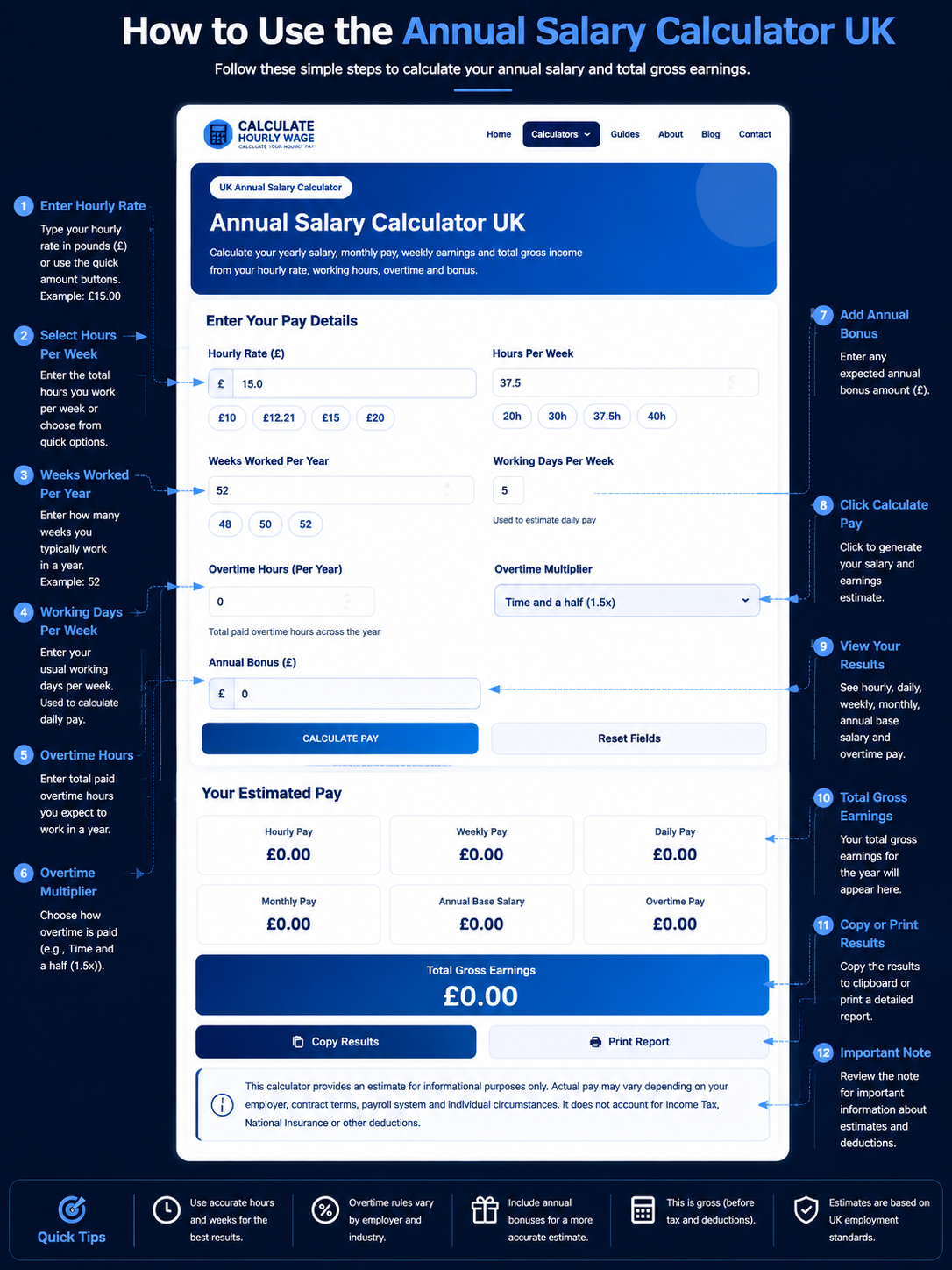
The calculator is built around six inputs, each shown as a labelled field with quick-select options where useful.
- Enter your hourly rate: Type your rate into the Hourly Rate field, or tap one of the preset buttons (£10, £12.21, £15, £20) if one matches your pay.
- Enter your hours per week: Add your usual weekly hours in the Hours Per Week field. Preset buttons for 20h, 30h, 37.5h and 40h are there for common working patterns.
- Choose your weeks worked per year: Most full-time employees work 52 weeks a year, which is the default setting. Use the 48 or 50 buttons if you take extended unpaid leave or don't work a full calendar year.
- Enter working days per week: This field, set to 5 by default, is used only to estimate your daily pay by splitting your weekly earnings across your working days.
- Add overtime hours and overtime rate: If you work paid overtime, enter your total overtime hours for the year and select your overtime multiplier from the dropdown (for example, Time and a half at 1.5x).
- Add any annual bonus: If you receive a bonus, enter the total amount in the Annual Bonus field. Leave it at 0 if this doesn't apply.
Once your details are entered, select Calculate Pay to see your results, or Reset Fields to start again.
How Is Annual Salary Calculated?
The calculator uses straightforward multiplication to move between hourly, weekly and annual figures.
Formula:
| CONVERSION | HOW TO CALCULATE |
|---|---|
| Hourly rate to annual salary | Multiply your hourly rate by your weekly hours, then by your weeks worked per year. A £15 hourly rate at 37.5 hours a week over 52 weeks gives an annual base salary of £29,250. |
| Annual salary to hourly rate | Divide your annual salary by weeks worked per year, then by weekly hours. This is the reverse calculation used by the Salary to Hourly Calculator UK. |
| Monthly salary to annual salary | Multiply your monthly figure by 12. This works cleanly for a fixed monthly salary, but is only an approximation if your monthly pay varies with the number of working days in that month. |

How to Interpret Your Calculator Results
The results section breaks your pay down into six figures plus a total.
| RESULT | DESCRIPTION |
|---|---|
| Hourly Pay | The rate you entered, shown back for reference. |
| Daily Pay | Your weekly pay divided by your working days per week. It's an estimate, since real daily pay can vary if your hours aren't spread evenly across the week. |
| Weekly Pay | Your hourly rate multiplied by your weekly hours, before any overtime or bonus. |
| Monthly Pay | Your annual base salary divided by 12. This is the standard way employers calculate a fixed monthly salary. |
| Annual Base Salary | Your core yearly earnings from regular hours only, excluding overtime and bonus. |
| Overtime Pay | Shows what your overtime hours are worth, based on the hours, hourly rate and multiplier you entered. |
| Total Gross Earnings | Combines your annual base salary, overtime pay and annual bonus into one yearly figure. This is your gross income, meaning it's calculated before Income Tax, National Insurance or any other deductions. |
What Hours and Weeks Should You Use?
Getting accurate results depends on entering realistic hours and weeks, not just the numbers in your contract.
| SCENARIO | WHAT TO ENTER |
|---|---|
| Full-time working hours | Full-time in the UK typically means somewhere between 35 and 40 hours a week, though this varies by employer and industry. Use your actual contracted hours rather than a generic figure. |
| 52-week salary assumption | Most salary calculations assume 52 working weeks, since paid annual leave is included in a standard salary rather than subtracted from it. Use 52 weeks unless you have unpaid leave or work on a fixed-term or seasonal basis. |
| Paid holiday vs unpaid leave | If your holiday is paid, as it is for most full-time UK employees, you don't need to reduce your weeks worked. If you take unpaid leave beyond your entitlement, subtract those weeks from the total. |
| Part-time, seasonal and irregular work | If you work part of the year, such as a school-term contract or seasonal role, enter the actual number of weeks you work rather than 52. This gives a realistic annual figure instead of overstating your earnings. |
Annual Salary Conversion Table
The table below shows how common hourly rates convert to weekly, monthly and annual pay, based on a 37.5-hour week and 52 weeks worked per year.
| Hourly Rate | Weekly Pay (37.5h) | Monthly Pay | Annual Salary |
|---|---|---|---|
| £12.00 | £450.00 | £1,950.00 | £23,400.00 |
| £15.00 | £562.50 | £2,437.50 | £29,250.00 |
| £18.00 | £675.00 | £2,925.00 | £35,100.00 |
| £20.00 | £750.00 | £3,250.00 | £39,000.00 |
| £25.00 | £937.50 | £4,062.50 | £48,750.00 |
Weekly hours also affect your annual salary at the same hourly rate. The table below compares a £15 hourly rate across three common weekly schedules, still assuming 52 weeks worked.
| Weekly Hours | Weekly Pay | Annual Salary |
|---|---|---|
| 35 hours | £525.00 | £27,300.00 |
| 37.5 hours | £562.50 | £29,250.00 |
| 40 hours | £600.00 | £31,200.00 |
Common Annual Salaries Converted
Common UK salary figures also convert down to monthly, weekly, daily and hourly pay, based on a 37.5-hour week, 52 weeks worked and 5 working days per week.
| Annual Salary | Monthly Pay | Weekly Pay | Daily Pay | Hourly Rate |
|---|---|---|---|---|
| £20,000 | £1,666.67 | £384.62 | £76.92 | £10.26 |
| £25,000 | £2,083.33 | £480.77 | £96.15 | £12.82 |
| £28,000 | £2,333.33 | £538.46 | £107.69 | £14.36 |
| £30,000 | £2,500.00 | £576.92 | £115.38 | £15.38 |
| £35,000 | £2,916.67 | £673.08 | £134.62 | £17.95 |
| £40,000 | £3,333.33 | £769.23 | £153.85 | £20.51 |
| £45,000 | £3,750.00 | £865.38 | £173.08 | £23.08 |
| £50,000 | £4,166.67 | £961.54 | £192.31 | £25.64 |
| £60,000 | £5,000.00 | £1,153.85 | £230.77 | £30.77 |
Gross Salary vs Net Pay: What Is the Difference?
Gross salary is your total pay before any deductions. It's the figure this calculator produces, and it's usually the number quoted in job adverts and contracts.
Net pay, often called take-home pay, is what actually lands in your bank account after deductions. The main deductions in the UK are Income Tax, National Insurance and, for many employees, workplace pension contributions.
Because this calculator doesn't account for tax, National Insurance or pension deductions, your actual take-home pay will be lower than the gross figures shown here. To see an estimate of your pay after these deductions, use the Annual Salary After Tax UK Calculator.
Worked Examples
Full-Time Hourly Worker
Hourly rate £15.00, 37.5 hours per week, 52 weeks worked, 5 working days per week, no overtime or bonus.
| PAY TYPE | CALCULATION & AMOUNT |
|---|---|
| Weekly pay | £15.00 × 37.5 = £562.50 |
| Annual base salary | £562.50 × 52 = £29,250.00 |
| Daily pay | £562.50 ÷ 5 = £112.50 |
| Monthly pay | £29,250.00 ÷ 12 = £2,437.50 |
| Total gross earnings | £29,250.00 |
Part-Time Worker
Hourly rate £12.21, 20 hours per week, 52 weeks worked, 5 working days per week, no overtime or bonus.
| PAY TYPE | CALCULATION & AMOUNT |
|---|---|
| Weekly pay | £12.21 × 20 = £244.20 |
| Annual base salary | £244.20 × 52 = £12,698.40 |
| Daily pay | £244.20 ÷ 5 = £48.84 |
| Monthly pay | £12,698.40 ÷ 12 = £1,058.20 |
| Total gross earnings | £12,698.40 |
Salary Including Regular Overtime
Hourly rate £18.00, 40 hours per week, 52 weeks worked, 100 overtime hours per year at time and a half (1.5x).
| PAY TYPE | CALCULATION & AMOUNT |
|---|---|
| Weekly pay | £18.00 × 40 = £720.00 |
| Annual base salary | £720.00 × 52 = £37,440.00 |
| Overtime pay | 100 × £18.00 × 1.5 = £2,700.00 |
| Total gross earnings | £37,440.00 + £2,700.00 = £40,140.00 |
Seasonal/Part-Year Worker
Hourly rate £14.00, 30 hours per week, 40 weeks worked (rather than the full 52), 5 working days per week.
| PAY TYPE | CALCULATION & AMOUNT |
|---|---|
| Weekly pay | £14.00 × 30 = £420.00 |
| Annual base salary | £420.00 × 40 = £16,800.00 |
| Daily pay | £420.00 ÷ 5 = £84.00 |
This example shows why entering an accurate number of weeks worked matters. Using the default 52 weeks here would overstate this worker's annual earnings by more than £5,000.
Practical Scenarios
Comparing a Salaried Job With an Hourly Job
To compare a salaried offer with an hourly role, convert the hourly rate into an annual figure using the same hours and weeks the salaried job assumes. For example, an hourly job paying £16 at 37.5 hours a week over 52 weeks comes to £31,200 a year. Line this up against the salaried offer to see which pays more before you factor in other differences like holiday allowance, pension contributions or job security.
Comparing Full-Time and Part-Time Work
Part-time pay looks lower in cash terms simply because the hours are lower, not necessarily because the rate is worse. Compare the hourly rate first, then look at the annual figure separately to understand the real difference in take-home earnings. A part-time role at a higher hourly rate can sometimes pay similarly per hour to a full-time role, even though the annual total is much smaller.
Comparing an Employee Salary With a Contractor Day Rate
Contractor day rates aren't directly comparable to an employee salary, since contractors usually don't receive paid holiday, sick pay, pension contributions or employer National Insurance. To roughly compare the two, convert the day rate into an hourly and annual figure using this calculator, then remember the contractor figure needs to cover benefits an employee would otherwise get for free.
Estimating Earnings With Overtime or Bonuses
If overtime or bonus payments vary from year to year, it's worth running the calculator twice: once with just your base hours to see your guaranteed income, and once including a realistic estimate of overtime and bonus. This separates what you can rely on from what depends on extra hours or performance, which is useful when budgeting or applying for credit.
Common Mistakes When Calculating Annual Salary
| COMMON MISTAKE | WHY IT MATTERS |
|---|---|
| Using incorrect hours or weeks | Entering contracted hours that don't match what you actually work, or leaving weeks worked at 52 when you don't work a full year, throws off every figure the calculator produces. |
| Confusing gross and net salary | The annual figure this calculator gives you is gross pay. Treating it as take-home pay leads to overestimating what you'll actually receive. |
| Treating occasional overtime or bonuses as guaranteed | If overtime or bonus payments aren't fixed, including them at full value every year overstates your reliable income. |
| Misunderstanding monthly vs 4-week pay | A year has 52 weeks but not exactly 12 four-week periods. If you're paid every 4 weeks rather than monthly, you'll receive 13 payments a year, not 12, so dividing your annual salary by 12 won't match your actual pay packet. |
| Ignoring unpaid leave | Career breaks, unpaid parental leave or extended time off without pay all reduce your weeks worked. Leaving the calculator at 52 weeks in these cases inflates your annual figure. |
| Using outdated figures | Pay rises, contract changes or a new hourly rate should be reflected in a fresh calculation. An old hourly rate carried forward will give you a salary figure that's no longer accurate. |
| Failing to check whether a salary is full-time or pro-rata | A quoted salary in a job advert may be a full-time equivalent, meaning it would be reduced if the actual role is part-time. Always check which basis a figure is quoted on before comparing it to your own calculation. |
Expert Tips for More Accurate Salary Estimates
| EXPERT TIP | ACTION TO TAKE |
|---|---|
| Use contractual hours and pay rates | Base your calculation on what's written in your contract, not a rough estimate, especially if your hours vary week to week. |
| Separate guaranteed and variable income | Keep your base salary calculation separate from overtime and bonus estimates, so you always know your minimum reliable income. |
| Consider your effective hourly rate | If you regularly work unpaid extra hours, your true hourly rate is lower than your contracted rate. Divide your total pay by your actual hours worked to see this. |
| Recalculate after pay or contract changes | A pay rise, a change in hours, or a new overtime arrangement should prompt a fresh calculation rather than an adjustment made by memory. |
| Check estimates against payslips | Compare the gross figures from this calculator with the gross pay shown on an actual payslip to confirm your inputs are accurate. |
FAQs About Annual Salary Calculations
Find answers to key questions about calculating your annual salary, tax deductions, pro-rata pay, bonuses, and holiday entitlements.
Multiply your hourly rate by your weekly hours, then multiply that figure by the number of weeks you work per year.
An annual salary figure is almost always quoted gross, meaning before Income Tax, National Insurance and other deductions.
Most full-time employees should use 52 weeks, since paid holiday is included in a standard salary. Use a lower figure only if you take unpaid leave or work part of the year.
Yes. Multiply your monthly salary by 12. This works well for a fixed monthly salary but is an approximation if your pay varies month to month.
Gross salary is your total pay before deductions. Net salary, or take-home pay, is what you receive after Income Tax, National Insurance and any pension contributions are taken off.
The main deductions are Income Tax, National Insurance and, for most employees, a workplace pension contribution. Some people also have student loan repayments or salary sacrifice arrangements deducted.
Salary sacrifice reduces your gross salary in exchange for a benefit such as extra pension contributions, which can lower the amount of Income Tax and National Insurance you pay, but also reduces the gross figure shown on your payslip.
A pro-rata salary is a full-time salary figure scaled down to match part-time hours. It applies whenever a job is advertised with a full-time equivalent salary but the actual hours are less than full-time.
Divide your annual salary by your weeks worked per year, then divide that figure by your weekly hours.
Yes, this calculator lets you add overtime hours with a chosen multiplier and an annual bonus, which are added to your base salary to give total gross earnings.
Estimates like this one show gross pay only. Your actual take-home pay depends on your tax code, National Insurance category, pension contributions and any other personal deductions.
For most full-time UK employees, paid holiday is built into the standard 52-week salary calculation rather than treated separately, since you're paid during your leave.
Explore More UK Salary Calculators
Explore more free UK salary calculators to convert wages, estimate earnings, compare different pay options, and make informed financial decisions.
Hourly Rate Calculator
Calculate your hourly wage from your annual salary, monthly income or weekly earnings.
Calculate Now →Salary to Hourly Calculator
Convert your annual or monthly salary into an hourly wage using standard UK working hours.
Calculate Now →Holiday Pay Calculator
Estimate your statutory holiday pay based on your pay rate and working pattern.
Calculate Now →Shift Pay Calculator
Calculate earnings for day, evening, night and rotating shifts in just a few clicks.
Calculate Now →Overtime Pay Calculator
Work out overtime earnings using your hourly rate and overtime multiplier.
Calculate Now →Annual Salary to Hourly Rate: Common Salary Conversions UK (40 Hours a Week)
The annual salary calculator UK table below converts common UK salaries to hourly rates, assuming 52 working weeks a year. The 40-hour column suits full-time contracts; the 20-hour column shows the same salaries on a part-time pattern.
| Annual Salary | 40 hrs / week | 20 hrs / week (part-time) |
|---|---|---|
| £15,000 | £7.21 | £14.42 |
| £20,000 | £9.62 | £19.23 |
| £25,000 | £12.02 | £24.04 |
| £30,000 | £14.42 | £28.85 |
| £35,000 | £16.83 | £33.65 |
| £40,000 | £19.23 | £38.46 |
| £45,000 | £21.63 | £43.27 |
| £50,000 | £24.04 | £48.08 |
| £60,000 | £28.85 | £57.69 |
| £70,000 | £33.65 | £67.31 |
| £80,000 | £38.46 | £76.92 |
| £90,000 | £43.27 | £86.54 |
| £100,000 | £48.08 | £96.15 |
One figure to watch: £15,000 at 40 hours a week is just £7.21 an hour — well below the National Living Wage of £12.71 an hour for workers aged 21 and over from April 2026. For the reverse calculation, use our Salary to Hourly Calculator, and see our UK Tax Brackets page for the tax and National Insurance breakdown.