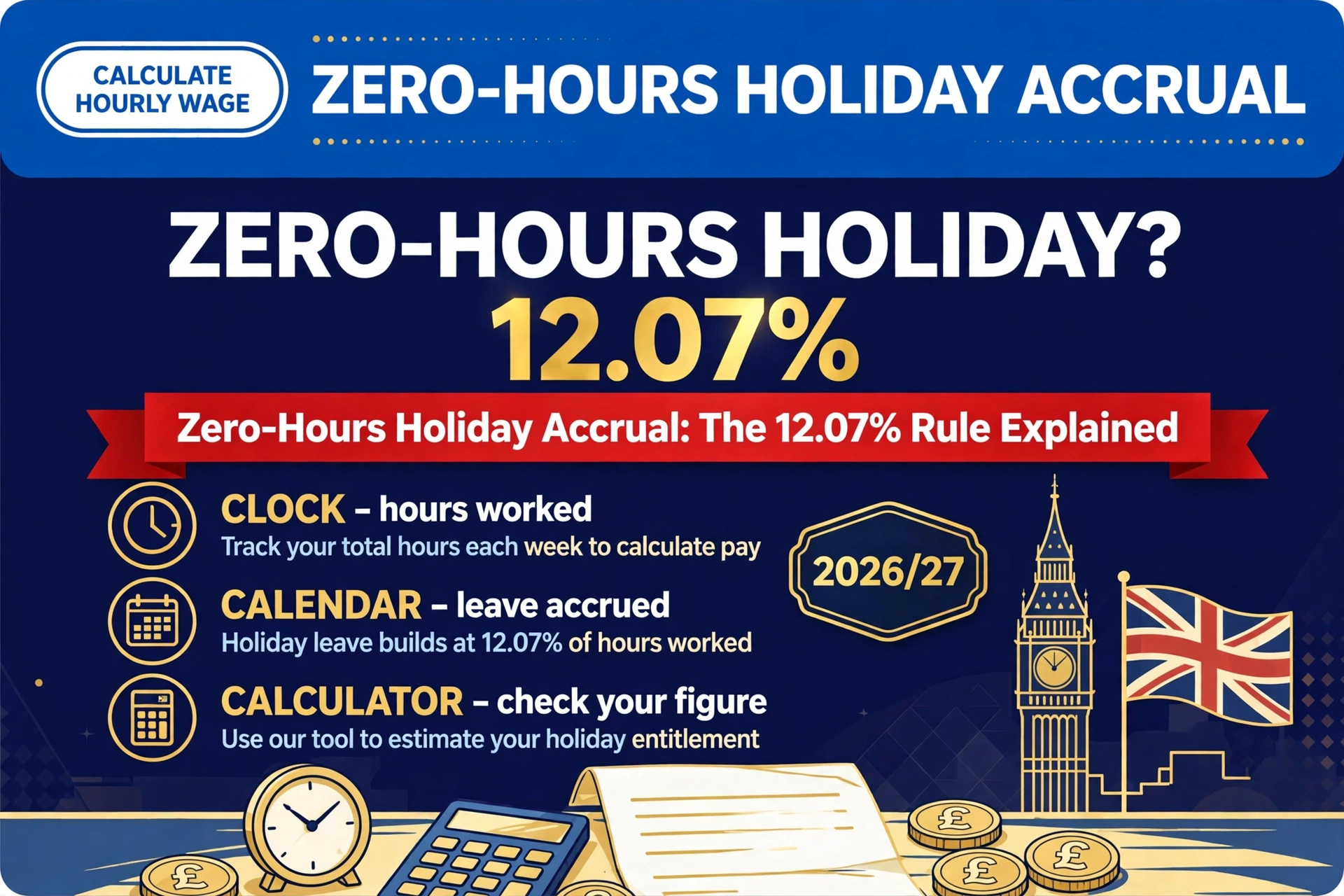
If you are trying to make sense of zero hours holiday accrual 12.07%, here is the direct answer: if you work irregular hours, your paid holiday builds up as you work, at a rate of 12.07% of the hours you work in each pay period. Work 30 hours in a week and you earn about 4 hours of paid leave. Work 68 hours in a month and you earn 8 hours. There is no fixed number of days handed to you at the start of the year, because your hours are not fixed — so your leave grows in step with the hours you actually put in.
That is the whole idea in one paragraph, but the details matter: the rounding rule, when the leave becomes available, what you are paid when you take it, and how this differs from rolled-up holiday pay. This article works through all of it with worked examples you can check against your own payslips.
Who the 12.07% Rule Applies To
The 12.07% accrual system applies to two groups of workers, for leave years beginning on or after 1 April 2024. The first group is irregular-hours workers: people whose paid hours in each pay period are wholly or mostly variable. Zero-hours contracts are the most common example, but casual and bank staff with genuinely varying hours fall in the same group. The second group is part-year workers: people who are required to work only part of the year, with periods of at least a week in which they do no work and receive no pay — term-time staff are the classic example.
What matters is the pattern of your work, not the label on your contract. A contract that says “zero hours” does not automatically put you in the irregular-hours group if your hours are in fact the same every week, and a worker whose hours genuinely vary from period to period may still be covered. If you are unsure, check your contract and your recent payslips together: if the hours change often or always, the 12.07% system is almost certainly the one your employer should be using.
Workers with fixed, regular hours are not covered by this system at all. If you work the same days and hours every week, your entitlement is the straightforward 5.6 weeks a year — 28 days for a five-day week, or the same 5.6 weeks pro-rated for part-time patterns (three days a week gives 16.8 days). The 12.07% method exists precisely because a fixed-days approach does not work when nobody knows from one pay period to the next how many hours you will do.
Where the 12.07% Figure Comes From
The percentage looks oddly specific, but it is not arbitrary. Almost every worker in the UK is legally entitled to 5.6 weeks of paid holiday a year. A year has 52 weeks, so if you take your 5.6 weeks off, the weeks you actually spend working come to 52 minus 5.6, which is 46.4 weeks. Divide the holiday weeks by the working weeks and you get the rate at which leave is earned for each week worked:
5.6 ÷ 46.4 = 0.1207, or 12.07%
It is simply the statutory entitlement expressed as a proportion of time worked, so an irregular-hours worker builds up leave at the same rate, relative to hours worked, as a full-time worker.
It is worth knowing where the number came from, because it explains why it became law. Before April 2024, many employers already used 12.07% as a shortcut for casual staff, but the Supreme Court ruled in the Harpur Trust v Brazel case that the shortcut was not always correct for part-year workers. The government then changed the rules so that, for leave years starting on or after 1 April 2024, the 12.07% accrual method is the statutory method for irregular-hours and part-year workers. It is no longer a rule of thumb — it is the rule.
How to Work Out Your Accrual
The calculation itself is simple, and it is done separately for each pay period — weekly if you are paid weekly, monthly if you are paid monthly. Take the hours you worked in that pay period, multiply by 12.07%, and apply the rounding rule:
Hours worked in the pay period × 0.1207 = hours of leave accrued
There is one rounding rule, and it is easy to get wrong. The result must be rounded up to the nearest whole hour if the fraction is half an hour or more. If the fraction is less than half an hour, it rounds down. So 3.621 hours becomes 4 hours, because 0.621 is more than half an hour, while 8.21 hours becomes 8 hours, because 0.21 is less than half an hour. The rounding happens for each pay period on its own — you do not add up unrounded fractions across the year and round once at the end.
Three points follow from this that are easy to miss. First, a pay period in which you work no hours at all accrues no leave: 0 × 12.07% is 0. Second, the leave you accrue in one pay period becomes available to take from the next pay period — you do not have to wait until the end of the year to use it. Third, your employer should be keeping records of your accrual, and from 6 April 2026 employers must keep detailed records of annual leave and holiday pay for at least six years, so the figures should be checkable.
If you want to track your own accrual without doing the maths by hand each period, use our holiday leave accrual calculator — it applies the same 12.07% calculation and rounding to the hours you enter.

Worked Example 1: Weekly-Paid Zero-Hours Worker
Priya works on a zero-hours contract in a warehouse and is paid weekly. Her hours vary: some weeks she works 20 hours, other weeks 35. In one particular week she works 30 hours. Her accrual for that week is:
30 × 0.1207 = 3.621 hours, which rounds up to 4 hours of leave
Those 4 hours are hers to take from the following pay period. If she works another 30-hour week the next week, she accrues another 4 hours, giving her 8 hours banked. If the week after that she works only 16 hours, she accrues 16 × 0.1207 = 1.931 hours, which rounds up to 2 hours, taking her total to 10 hours.
Notice how the rounding helps slightly in her favour on small numbers: 1.931 hours becomes 2, not 1. Each period is rounded on its own, so check your employer’s figures period by period rather than trying to average the year.
Worked Example 2: Monthly-Paid Casual Worker
Daniel works casual shifts in a hotel kitchen and is paid monthly. In June he works 68 hours. His accrual for June is:
68 × 0.1207 = 8.2076 hours, which rounds down to 8 hours of leave
This is the government’s own worked example, and it shows the other side of the rounding rule: the fraction here is only about 0.21 of an hour, well under half an hour, so it rounds down to 8 rather than up to 9. Daniel can take those 8 hours from July onwards.
To put a money value on it, suppose Daniel is paid the National Living Wage of £12.71 an hour, which has applied to workers aged 21 and over since 1 April 2026. When he takes those 8 hours as paid leave, they are worth 8 × £12.71 = £101.68 at that rate — though, as the next section explains, the rate actually paid for holiday is based on an average, not necessarily the rate in the week the leave was earned.
Worked Example 3: Three Months of Varying Hours
A single month rarely tells the full story for an irregular-hours worker, so here is a quarter. Sam works in a bar on a zero-hours contract, paid monthly, at £13.00 an hour. His hours over three months are:
| Month 1: 52 hours — 52 × 0.1207 = 6.276 — 6 hours |
| Month 2: 84 hours — 84 × 0.1207 = 10.139 — 10 hours |
| Month 3: 40 hours — 40 × 0.1207 = 4.828 — 5 hours |
| Total: 176 hours — 21 hours |
Sam has banked 21 hours of paid leave after three months. At his £13.00 hourly rate, that is worth £273.00 when taken. Two things are worth noting. First, each month is rounded separately: month 1 rounds down (0.276 is under half an hour) while month 3 rounds up (0.828 is over half an hour). Second, Sam’s accrual follows his hours: the busy month earns more than twice as much leave as the quiet month, which is exactly how the system is meant to work.
When You Can Take the Leave
Leave accrued in one pay period can be taken from the next pay period. You do not need to wait until you have built up a full week, and you do not need to wait until the end of the leave year. If you accrue 4 hours in a weekly pay period, you can book 4 hours off the following week, subject to the normal process of requesting leave and your employer agreeing the dates.
In practice, most irregular-hours workers let the balance build up and take it in larger blocks, which is fine — the accrued hours sit in your balance until you use them. But do not assume an unused balance rolls forward automatically. Your contract says how much leave you can carry over: if you get 28 days, you can carry over a maximum of 8 days. There are exceptions — if you were sick, an irregular-hours worker can carry over up to 28 days, and your whole entitlement carries over if you were not given a reasonable opportunity to take it, were not told you would lose it, or did not receive rolled-up holiday pay you were entitled to.
What You Are Paid When You Take the Leave
Accrual answers the question “how much leave have I earned?” — but a second question follows: “what am I paid for it?” For irregular-hours workers, holiday pay is normally based on average earnings over the previous 52 weeks in which you were paid, known as the 52-week reference period. Weeks in which you earned nothing are skipped, and the average is taken over the weeks you were actually paid. If you have not worked for 52 weeks yet, the average is taken over however many paid weeks you have.
This matters because your hourly rate may have changed since you earned the leave, or because your hours vary so much that no single week’s pay is representative. The 52-week average smooths that out: a worker whose hours swing between 15 and 40 a week gets holiday pay based on their typical week, not on their quietest or busiest one. If you are checking a holiday payment, ask for the average-week figure your employer used, and check it against your own payslips over the same period.
One common confusion is worth clearing up. The 12.07% figure also appears in a different context: rolled-up holiday pay, where an employer adds a 12.07% uplift to your normal pay on each payslip instead of paying you separately when you take leave. That is a payment method, not an accrual method, and it is lawful only for irregular-hours and part-year workers for leave years from 1 April 2024. If you receive rolled-up holiday pay, you are not also accruing separate hours of leave — the uplift is the holiday pay, paid in advance. Our separate article on rolled-up holiday pay explains that system in full.
Sickness, Family Leave and Gaps in Work
Two situations cause the most confusion for irregular-hours workers. The first is time off sick or on family leave, such as maternity or paternity leave. During these periods you continue to accrue leave under the same rules, with the accrual worked out on the basis set out in the government’s guidance for those situations — you do not simply stop earning holiday because you are not on shift. If you return from a long absence to find your balance unchanged, ask your employer how the accrual was calculated for the absence period.
The second is a gap between engagements. If you are on a zero-hours contract and simply are not offered hours for a few weeks, those weeks accrue nothing, because the calculation is based on hours actually worked. That is different from being on sick leave or family leave, where the law protects your accrual. The distinction decides whether a quiet period costs you leave or not.
Checking Your Own Figures
If your employer’s numbers do not match your own calculation, work through this checklist before raising it. First, confirm your pay period: weekly and monthly workers accrue on different cycles, and mixing them up is the most common error. Second, confirm the hours: use the paid hours on your payslip, not the hours you think you worked. Third, apply the rounding period by period, not to a yearly total. Fourth, check whether you are on rolled-up holiday pay instead of accruing hours — if you are, there will be no separate leave balance, and the payslip should itemise the holiday element separately.
If the figures still do not agree, raise it with your employer in writing, showing your own period-by-period calculation. Employers must keep detailed leave records, so they should be able to show you theirs. Most discrepancies turn out to be a pay-period mix-up or a rounding difference that a single email clears up.
Common Mistakes to Avoid
The first mistake is applying 12.07% to your pay instead of your hours. The accrual system is about hours of leave, not money: 12.07% of 30 hours is 3.621 hours of leave, not 12.07% of your wages. The money question is answered separately, by the 52-week average, when you take the leave.
The second mistake is using the old shortcut without the rounding rule. Before April 2024, some employers applied 12.07% loosely, without rounding each period to whole hours. The statutory method rounds each pay period, and that rounding can change your balance by an hour or two over a year — small, but real.
The third mistake is assuming the 12.07% system applies to everyone on a casual-looking contract. If your hours are actually fixed, your entitlement is the fixed 5.6 weeks, and applying 12.07% instead could understate what you are owed — particularly if you work regular hours for only part of the year, where the old court case showed the shortcut could short-change workers. Check the pattern, not the label.
The fourth mistake is forgetting that the statutory minimum is a floor, not a ceiling. Your contract may give you more than 5.6 weeks’ worth of leave, and any extra contractual leave follows your contract rather than the statutory accrual rules.
The Bottom Line on Zero Hours Holiday Accrual 12.07%
Zero hours holiday accrual 12.07% is a simple idea once the arithmetic is clear: every hour you work earns you 0.1207 hours of paid leave, worked out pay period by pay period, rounded to the nearest whole hour when the fraction reaches half an hour, and available to take from the next pay period. It applies to irregular-hours and part-year workers for leave years from 1 April 2024, it replaces the old informal shortcut with a statutory method, and it sits alongside — but is separate from — rolled-up holiday pay. Track your hours from your payslips, apply the formula period by period, and check the result against your employer’s balance.
Frequently Asked Questions
Does zero hours holiday accrual 12.07% apply to me if my hours are the same every week?
No. If your hours are fixed, you are not an irregular-hours worker for these rules, and your entitlement is worked out as 5.6 weeks a year, pro-rated if you work part-time. The 12.07% method is for workers whose paid hours are wholly or mostly variable in each pay period, and for part-year workers.
How do I work out my zero hours holiday accrual 12.07% for one pay period?
Multiply the hours you worked in that pay period by 0.1207, then round to the nearest whole hour if the fraction is half an hour or more. For example, 30 hours × 0.1207 = 3.621 hours, which rounds up to 4 hours of leave.
When can I take the holiday I have accrued?
From the next pay period after the one in which you earned it. You do not have to wait until the end of the year, and you can let the balance build up and take it in larger blocks if you prefer.
Is rolled-up holiday pay the same as zero hours holiday accrual 12.07%?
No. Accrual builds up hours of paid leave that you take later; rolled-up holiday pay adds a 12.07% uplift to your pay on each payslip instead. Both use the same percentage, and both are lawful for irregular-hours and part-year workers from April 2024, but they are different systems and must not be applied at the same time.
What am I paid when I take my accrued holiday?
Normally your average weekly pay over the previous 52 weeks in which you were paid. Weeks with no pay are skipped, and if you have worked fewer than 52 weeks, the average is taken over the paid weeks you have.
What if I work no hours in a pay period?
You accrue no leave for that period, because 12.07% of zero hours is zero. This is different from sick leave or family leave, where accrual continues under the government’s rules for those situations.