If you have paid more Income Tax through PAYE than you actually owe for the tax year, you may be due a tax refund.
An overpayment can happen for several reasons. You may have changed jobs, stopped working part-way through the tax year, been placed on an emergency tax code, had an incorrect tax code, or become entitled to certain tax reliefs.
Your estimated Income Tax refund is broadly the difference between the Income Tax you have already paid and the Income Tax you actually owe after your income, allowances and eligible reliefs have been considered.
Estimated tax refund = Income Tax already paid − final Income Tax liability
If you want to check whether you may have overpaid tax, use our Income Tax Refund Calculator UK to get an estimate based on your income and tax paid.
Click Here: Calculator
Enter your relevant income and tax figures above to estimate whether you may have overpaid Income Tax for 2026/27. Have your P60, P45 or recent payslips available before entering your figures. This can make your estimate more accurate.
The calculator provides an estimate. It does not confirm that HMRC owes you money. Your final position can depend on information held by HMRC that is not included in an online calculation.
A tax refund is also different from a National Insurance refund. Only overpaid Income Tax should be included in an Income Tax refund calculation.
Read More: Income Tax Calculator UK 2026/27 – Accurate & Free CalculatorHow the Income Tax Refund Calculator UK Works
The calculator compares the Income Tax you have already paid with an estimate of the Income Tax you should have paid for the relevant tax year.
If you have paid more than your estimated liability, the difference may represent an overpayment.
What the calculator estimates
Depending on the information entered, an Income Tax refund calculator can help estimate:
- Your taxable income
- Your Income Tax liability
- Income Tax already deducted through PAYE
- The potential difference between tax paid and tax due
- Your estimated refund
The result is not necessarily the amount HMRC will pay you.
For example, if your calculator shows that you may have overpaid £400, HMRC may calculate a different amount if it has information about another employment, pension income, benefits, tax reliefs or previous adjustments.
What information you need
The more accurate your inputs, the more useful the estimate is likely to be.
You may need:
- Gross or taxable pay
- Income Tax already paid
- Your tax code
- The relevant tax year
- Employment dates
- Information about eligible allowances
- Relevant tax reliefs
- P60 figures
- P45 figures
- Payslip information
If you changed jobs during the tax year, you may need information from both employments.
Read More:PAYE Calculator UK – Best PAYE Tax & Net Pay Guide 2026/27Where to find the figures on your P60 or P45
A P60 provides your pay and Income Tax information for the tax year from your employer. It is particularly useful when checking your position after the tax year has ended.
A P45 is issued when you leave an employment. It records information about your pay and tax deducted from that employment.
Your payslips can also help you check current or individual pay-period deductions.
| Document | What it shows | When it is useful |
|---|---|---|
| P60 | Annual pay and Income Tax information | Checking a completed tax year |
| P45 | Pay and tax information when employment ends | Checking employment you left during the year |
| Payslip | Pay, tax and other deductions | Checking individual pay periods |
| P800 | HMRC’s PAYE calculation | Checking an HMRC year-end tax result |
Use the exact figures requested by the calculator. Do not automatically enter every deduction shown on your payslip.
Why your calculator result may differ from HMRC
An online calculator only works with the information you provide.
HMRC may have additional information about your tax affairs, including:
- Other employment income
- Pension income
- Benefits
- Changes to your tax code
- Allowances
- Tax reliefs
- Previous refunds
- Other taxable income
Your calculator result should therefore be treated as an estimate.
If HMRC later provides a P800 or another official calculation, that figure should be used when checking your actual tax position.
How to Calculate an Income Tax Refund
The calculation is based on comparing what you paid with what you should ultimately owe.
Basic refund calculation
Formula Box
Estimated tax refund = Income Tax already paid − final Income Tax liability
For example, if you have paid £5,500 in Income Tax and your final Income Tax liability is £5,000:
| Calculation | Result |
|---|---|
| £5,500 − £5,000 = £500 | Your estimated overpayment would therefore be £500. |
| If you paid £4,800 but your final liability was £5,000 | The calculation would instead show a £200 shortfall. |
| £200 shortfall | That means there would be no Income Tax refund based on those figures. |
| Note | The formula is useful for understanding the basic principle, but calculating the final liability can involve several steps. |
How taxable income affects the calculation
Your income for the relevant tax year is considered first.
Applicable allowances and reliefs are then taken into account to determine the amount on which Income Tax is due.
The resulting taxable income is applied to the relevant Income Tax bands.
The estimated tax liability can then be compared with the Income Tax already deducted through PAYE.
This is why looking at one payslip is not enough to determine whether you have overpaid tax for the whole year.
How tax reliefs and allowances can affect a refund
Your tax position can be affected by allowances and reliefs that apply to your circumstances.
These can include:
- Personal Allowance
- Marriage Allowance
- Blind Person’s Allowance
- Eligible pension contributions
- Gift Aid
- Certain employment expenses
A qualifying expense does not normally mean the full amount is returned as cash.
Instead, tax relief can reduce your tax liability. If you have already paid PAYE based on a higher liability, the reduction may contribute to an overpayment.
Read More: Taxable Income Calculator UKUK Income Tax Rates and Allowances for 2026/27
The UK tax year runs from 6 April to 5 April.
Using the correct tax year is essential when estimating a refund because the relevant rates, allowances and circumstances depend on the year being calculated.
Personal Allowance for 2026/27
The Personal Allowance identified for 2026/27 is £12,570.
For someone eligible for the full Personal Allowance, the first £12,570 of income is covered by the allowance rather than being charged at the basic Income Tax rate.
Your individual circumstances can affect the allowance available to you, so the calculator should use the relevant information rather than assuming every taxpayer has exactly the same position.
Income Tax bands for 2026/27
The standard figures identified in the approved research are:
| Tax band | Income range | Rate |
|---|---|---|
| Personal Allowance | Up to £12,570 | 0% |
| Basic rate | £12,571 to £50,270 | 20% |
| Higher rate | £50,271 to £125,140 | 40% |
| Additional rate | Above £125,140 | 45% |
These figures should be applied according to the taxpayer’s circumstances and the relevant UK tax rules.
Visit Now: GOV.UKScotland, Wales, England and Northern Ireland
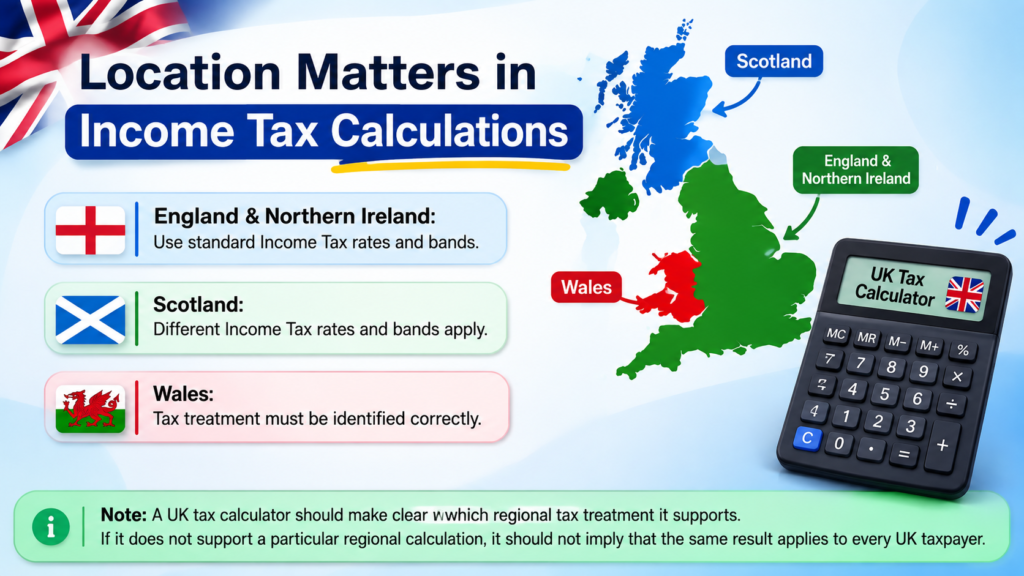
Your location can matter when calculating Income Tax.
Scottish taxpayers have different Income Tax rates and bands from those used for the standard calculation applying to England and Northern Ireland.
Welsh taxpayers also need to be identified correctly within the UK tax system.
A UK calculator should therefore make clear which regional tax treatment it supports.
If a calculator does not support a particular regional calculation, it should not imply that the same result applies to every UK taxpayer.
Why You Might Be Owed an Income Tax Refund
There is no single reason why someone might overpay Income Tax. Several common employment situations can change the amount deducted through PAYE.
You started or left a job part-way through the tax year
PAYE is deducted as you receive employment income.
If you only work for part of the tax year, the amount deducted during your employment may not match your final annual tax liability.
For example, someone who leaves work in November and has no further employment may have a different final tax position from someone who continues working throughout the year.
Your P45 can provide useful information about the pay and tax already deducted.
You were placed on an emergency tax code
Emergency tax treatment can be used when the information needed to apply the correct tax code is not yet available.
Codes such as W1 and M1 are examples of emergency treatment.
Being placed on an emergency tax code does not automatically mean that you are due a refund.
However, if more Income Tax was deducted than you ultimately owe, correcting the tax position can result in a refund.
Your tax code was wrong
Your tax code helps your employer calculate how much Income Tax to deduct from your pay.
Examples such as 1257L, BR and D0 can result in different PAYE treatment.
A tax-code error can therefore lead to too much or too little Income Tax being deducted.
Check your tax code if you have:
- Started a new job
- Left another job
- Taken a second job
- Received taxable benefits
- Had a change in circumstances
You had more than one job
Having two jobs does not automatically mean you have overpaid tax.
Your total taxable income and the Income Tax deducted across your employments need to produce the correct overall position.
Multiple employments can make PAYE more complicated, particularly if information about one employment is missing or has not been updated.
When checking your refund, consider all relevant employments rather than looking at one employer in isolation.
You paid for allowable work expenses
Some employees may qualify for tax relief on certain employment-related expenses.
Depending on the circumstances, these can include:
- Work clothing or uniforms
- Certain work-related travel
- Tools required for work
- Certain professional subscriptions
The relevant conditions must be met, and the expense may need to have been paid by you rather than reimbursed by your employer.
P87 can be relevant for certain employment expense claims.
Other allowances or tax reliefs apply
Other factors can also change your tax position.
These include:
- Marriage Allowance
- Blind Person’s Allowance
- Pension contributions
- Gift Aid
The effect depends on the individual circumstances and the relevant rules.
Worked Income Tax Refund Examples
These examples demonstrate how the calculation works. They are illustrations rather than personal HMRC calculations.
Example 1: Full-year employee with tax overpaid
| Step | Calculation / Explanation |
|---|---|
| Annual income | Suppose an employee earns £45,000 during the tax year and is eligible for the full £12,570 Personal Allowance. |
| Income after Personal Allowance | £45,000 − £12,570 = £32,430 |
| Income Tax rates | The applicable Income Tax rates are then applied to the relevant taxable income. |
| Tax already paid | Suppose the employee has already paid £6,800 through PAYE and their final estimated Income Tax liability is £6,500. |
| Refund estimate | £6,800 − £6,500 = £300 |
| Estimated overpayment | The estimated overpayment is therefore £300. |
| Important point | The refund is not calculated as a percentage of salary. It is the difference between tax already paid and the final tax liability. |
Example 2: Employee who changed jobs during the tax year
| Step | Explanation |
|---|---|
| Previous employment | James leaves one employer and starts a new job. |
| P45 | His previous employer gives him a P45. |
| Emergency tax treatment | At the new job, the information needed for the correct tax code is not immediately available, so emergency treatment is used for part of the year. |
| Temporary overpayment | As a result, James may temporarily have more Income Tax deducted than his final annual liability requires. |
| Tax code adjustment | When his correct information is processed, his tax code may be adjusted. |
| Potential refund | If the total Income Tax deducted is higher than his final liability, the difference can result in a refund. |
| Important figures | For James, the important figures are not just his new salary. He needs to consider his previous employment, new employment and the tax already deducted from both. |
Example 3: Employee who received a large bonus
| Step | Explanation |
|---|---|
| Normal salary and bonus | An employee receives their normal salary plus a large one-off bonus. |
| PAYE treatment | The bonus is employment income and PAYE applies through payroll. |
| Payslip deduction | The deduction shown on the payslip containing the bonus may look unusually high. |
| Important point | That does not necessarily mean the employee has permanently been charged an unusually high rate of tax on the bonus. |
| Final annual position | The final annual tax position depends on total taxable income for the tax year and the applicable tax bands. |
| Potential refund | A refund can arise if the total Income Tax deducted during the year is greater than the final liability. |
Example 4: Employee claiming allowable work expenses
| Step | Explanation |
|---|---|
| Work-related expenses | An employee pays for qualifying work-related expenses and does not receive reimbursement from their employer. |
| Tax relief eligibility | If the expenses meet the relevant conditions, the employee may be entitled to tax relief. |
| Effect on tax liability | The relief can reduce the final tax liability. |
| Potential overpayment | If PAYE has already been deducted without taking that relief into account, the lower final liability may result in an Income Tax overpayment. |
| Important point | The employee should calculate the eligible relief rather than assuming that the entire cost of the expense will be refunded. |
Common Tax Refund Situations
Leaving employment
| Point | Explanation |
|---|---|
| Leaving employment | Leaving employment can change your annual tax position because your income for the tax year may be lower than expected. |
| P45 | Your P45 records the pay and tax from the employment you left. |
| P50 | Depending on your circumstances, P50 may be relevant when seeking a refund after leaving work. |
| Important point | Leaving a job does not automatically guarantee a refund. Your final tax position still needs to be considered. |
Changing jobs
| Point | Explanation |
|---|---|
| Changing jobs | If you changed jobs and your new employer did not initially have the information required for the correct tax code, emergency tax treatment may have been used. |
| Check your records | Check your P45 and the tax code being used by your new employer. |
| Potential adjustment or refund | If too much Income Tax was deducted, a later correction can result in an adjustment or refund. |
Two jobs
| Point | Explanation |
|---|---|
| Two jobs | Two jobs do not automatically create a refund. |
| Total income and tax deducted | The calculation needs to consider your total taxable income and the tax deducted across both employments. |
| Tax code or HMRC information | If the tax codes are incorrect or the information held by HMRC is incomplete, your PAYE deductions may need to be corrected. |
Part-year employment
| Point | Explanation |
|---|---|
| Part-year employment | Part-year employment is a common reason to check your tax position. |
| Stopping work before the tax year ends | If you stopped working before the end of the tax year, the amount of tax deducted while you were employed may not match your final annual liability. |
| P45 | Your P45 can help establish the pay and tax already deducted. |
Tax-code change
| Point | Explanation |
|---|---|
| Tax-code change | A tax-code change can alter the amount deducted from later pay. |
| Payroll correction | A correction may already have returned some or all of an earlier overpayment through payroll. |
| Check recent payslips | Check your recent payslips before assuming that the entire estimated refund remains outstanding. |
Other taxable income
| Point | Explanation |
|---|---|
| Other taxable income | Your employment salary may not be your only taxable income. |
| Pension and other income | Pension income and other taxable income can affect your overall tax position. |
| Several income sources | If you have several income sources, a basic PAYE refund calculator may not provide a complete answer. |
Leaving the UK
| Point | Explanation |
|---|---|
| Leaving the UK | Leaving the UK can involve different tax considerations from simply leaving an employer. |
| Form P85 | Form P85 may be relevant to someone leaving the UK, depending on their circumstances. |
| Important point | A standard Income Tax refund calculation should not be treated as a complete assessment of the tax position of someone moving abroad. |
How to Claim an Income Tax Refund from HMRC
When HMRC may identify an overpayment
HMRC can review PAYE information after the end of the tax year.
If its calculation shows that you have paid too much Income Tax, it may issue a P800 showing the result.
An overpayment can also be corrected during the tax year if your tax code is updated.
Claiming while you are still employed
If your tax code is corrected during the tax year, your employer may adjust the PAYE calculation through payroll.
This can mean the overpayment is reflected in a later payslip rather than being paid separately by HMRC.
Check your payslips after a tax-code correction so you can see whether the adjustment has already been made.
Claiming after leaving a job
Your P45 provides the pay and tax information from the employment you left.
Depending on your circumstances, P50 may be relevant if you have stopped working and want to claim an available refund.
The correct route depends on what happened after you left your employment.
Claiming tax relief for employment expenses
P87 can be relevant to certain employment expense claims.
Examples may include qualifying work-related travel, uniforms, tools or professional subscriptions where the conditions for relief are met.
Not every expense connected with your job qualifies.
Keep appropriate records and check the relevant HMRC guidance before making a claim.
What a P800 means
A P800 is an HMRC calculation of your PAYE tax position after the tax year.
It can show that you:
- Paid too much tax
- Paid too little tax
- Paid the correct amount
A P800 is not the same as a P60.
Your P60 is an employment document showing annual pay and tax information. A P800 is HMRC’s calculation of your PAYE position.
How far back can you claim?
The approved research identifies a general four-year principle for certain Income Tax overpayment claims.
This means that, when checking previous tax years, you should consider whether the relevant claim is still within the applicable period.
The exact deadline can depend on the type of claim. The four-year principle should not be treated as a universal deadline for every type of tax relief or repayment.
Check the relevant HMRC guidance for the specific claim.
What Does Not Count as an Income Tax Refund?
Income Tax vs National Insurance
Income Tax and National Insurance are separate deductions.
| Deduction | What it is | Included in an Income Tax refund? |
|---|---|---|
| Income Tax | Tax charged on taxable income | Yes, where Income Tax has been overpaid |
| National Insurance | Separate contribution system | No |
| Student loan repayment | Repayment towards a student loan | No |
| Pension contribution | Contribution towards a pension | No |
If your payslip shows both Income Tax and National Insurance, do not add the two figures together when calculating an Income Tax refund.
Separate rules can apply to National Insurance overpayments.
Read More: National Insurance Calculator UKTax refund vs tax relief
| Term | Explanation |
|---|---|
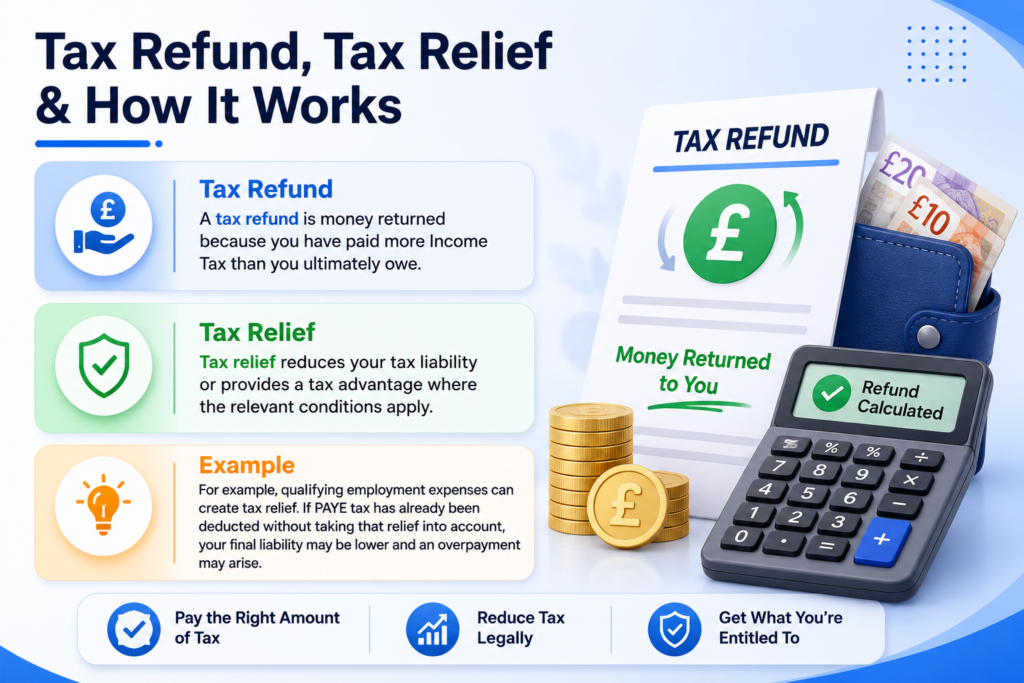
| Tax refund | A tax refund is money returned because you have paid more Income Tax than you ultimately owe. |
| Tax relief | Tax relief reduces your tax liability or provides a tax advantage where the relevant conditions apply. |
| Example | For example, qualifying employment expenses can create tax relief. If PAYE tax has already been deducted without taking that relief into account, your final liability may be lower and an overpayment may arise. |
Student loan repayments
Student loan repayments are separate from Income Tax.
If your payslip shows a student loan deduction, that amount should not be entered into an Income Tax refund calculator as Income Tax already paid.
A refund calculation should keep the two deductions separate.
How to Check Whether Your Tax Refund Estimate Is Correct
| Check | What to do |
|---|---|
| Compare the result with your P60 | For a completed tax year, compare the pay and Income Tax figures used in your calculation with the figures on your P60. Make sure the tax year matches. |
| Check your tax code | Look at the tax code on your payslip. If it changed during the year, consider how that change affected the amount deducted from later payments. |
| Check whether you have already received a refund | A tax-code correction can result in an adjustment through payroll. Check recent payslips and HMRC correspondence before treating an estimated overpayment as money that is still outstanding. |
| Compare with HMRC’s figures | If HMRC has issued a P800 or provided updated tax information, use that information when checking your actual tax position. An online calculator is useful for estimating and understanding your figures, but HMRC’s calculation is the relevant figure for an actual refund. |
Common Income Tax Refund Mistakes
| Common mistake | What to check |
|---|---|
| Entering the wrong tax year | The UK tax year runs from 6 April to 5 April. Do not combine figures from different tax years. |
| Entering gross pay incorrectly | Check whether the calculator asks for gross pay, taxable pay or another specific figure. Using the wrong figure can change the estimated result. |
| Entering Income Tax and National Insurance together | Only use the Income Tax amount when the calculator asks for Income Tax already paid. National Insurance is separate. |
| Ignoring previous employment | If you changed jobs, your previous employment can be relevant to your final tax position. Use your P45 where appropriate. |
| Ignoring tax-code changes | Your tax code may have changed during the year. A calculation that ignores those changes may not reflect what actually happened through payroll. |
| Forgetting allowable expenses or reliefs | If you qualify for tax relief and leave it out of your calculation, your estimated tax liability may be higher than it should be. |
| Assuming every overpayment means an immediate refund | An estimated overpayment is not the same as a payment being issued immediately. The amount must be dealt with through the appropriate HMRC or payroll process. |
Expert Tips for Estimating Your UK Tax Refund
| Tip | Explanation |
|---|---|
| Use your P60 or P45 where possible | Official employment documents provide more reliable figures than trying to remember your total pay and tax deductions. |
| Check your tax code before calculating | A tax-code issue may be the reason you are checking your refund. |
| Keep separate records for each tax year | Store P60s, P45s and relevant records by tax year so that figures do not become mixed. |
| Check whether tax has already been refunded | Review recent payslips and HMRC correspondence before assuming that your entire estimated overpayment is still due. |
| Use the calculator as an estimate, then verify with HMRC | A calculator can help you understand your tax position and identify a possible overpayment. It cannot confirm the final amount HMRC will refund. |
| Know when the calculator is not enough | A basic refund calculator may not be suitable for more complicated circumstances, including:• Self Assessment• Foreign income• Several complicated income sources• Complex pension arrangements• Other circumstances outside the calculator’s inputs• In these situations, use the relevant HMRC guidance or seek appropriate professional advice. |
How do I know if I am owed a UK tax refund?
You may be owed a refund if the Income Tax you have already paid is greater than your final Income Tax liability. Incorrect tax codes, job changes, part-year employment and qualifying tax reliefs can all affect your position.
Can I calculate my tax refund using my P60?
Yes. A P60 provides useful pay and Income Tax figures for a completed tax year. Use the figures requested by the calculator and select the correct tax year.
What figures do I need for an Income Tax refund calculator?
You may need your income, Income Tax already paid, tax code, tax year and details of relevant allowances or reliefs. A P60, P45 or payslip can help you find the required figures.
How do I claim back overpaid Income Tax?
The process depends on your circumstances. HMRC may identify an overpayment through its PAYE reconciliation, or you may need to use the relevant HMRC service or form.
Who is eligible for a UK tax refund?
Anyone who has paid more Income Tax than they ultimately owe may potentially be due a refund. Your complete tax position determines whether an overpayment exists.
Can I get a tax refund if I changed jobs?
You may be due a refund if changing jobs caused too much PAYE to be deducted. Check your P45, tax codes and Income Tax paid across both employments.
Can I get a refund if I paid emergency tax?
Possibly. If emergency tax treatment caused more Income Tax to be deducted than you ultimately owe, the overpayment may be corrected. An emergency tax code alone does not guarantee a refund.
Can I claim tax back after leaving my job?
Possibly. Leaving employment can change your annual tax position. Your P45 and, where applicable, P50 may be relevant to the process.
How far back can I claim an Income Tax refund?
Certain Income Tax overpayment claims can generally be considered within a four-year period, but the exact rules depend on the type of claim. Check the relevant HMRC guidance for your circumstances.
What is a P87 form?
P87 is relevant to certain claims for tax relief on eligible employment expenses. It may apply where qualifying work expenses have not been reimbursed.
What is a P800?
A P800 is an HMRC calculation showing your PAYE tax position after the tax year. It can show whether you have paid too much or too little tax.
Can I claim a refund if I have two jobs?
Possibly. Having two jobs does not automatically mean you have overpaid. Your total taxable income and Income Tax deducted across your employments need to be considered.
Does National Insurance form part of my tax refund?
No. National Insurance is separate from Income Tax. An Income Tax refund calculation only concerns overpaid Income Tax.
Will I pay tax on a tax refund?
A tax refund is the return of Income Tax that you previously overpaid. It is not additional employment income simply because the overpayment is being returned.
Why is my calculator estimate different from HMRC?
An online calculator uses the information you enter. HMRC may have additional information about your income, tax codes, allowances, benefits or other circumstances, so its final calculation can differ.
Conclusion
An Income Tax refund may be due when you have paid more PAYE Income Tax than your final tax liability for the tax year. Use your P60, P45 and payslips to check your figures, then use the Income Tax Refund Calculator UK to estimate any potential overpayment. Remember that the calculator provides an estimate, while HMRC confirms your actual tax position and refund.