Yes. Employment bonuses are normally taxable in the UK.
A cash bonus is treated as employment income, which means your employer usually adds it to your salary for the relevant pay period and processes it through payroll. PAYE Income Tax, employee National Insurance and other applicable deductions are taken before the remaining amount is paid to you.
There is no separate flat “bonus tax rate” for most employees. The amount deducted depends on factors such as your total taxable income, tax code, National Insurance category, student loan status and pension contributions.
This guide explains how bonus tax works during the 2026/27 tax year, which runs from 6 April 2026 to 5 April 2027.
How HMRC Treats a Cash Bonus
HMRC normally treats a cash bonus as taxable employment income, similar to salary, overtime or commission.
This means a bonus may affect:
- Your Income Tax band
- Personal Allowance
- Adjusted net income
- Student Loan deductions
- Pension contribution limits
The name of the payment does not usually change its tax treatment. A reward described as a performance bonus, incentive payment or retention bonus can still be taxable.
Visit Now: GOV.UK Is There a Separate Bonus Tax Rate?
No. Most bonuses are taxed using the same Income Tax rules as your normal earnings.
Your bonus is added to your total taxable income and the tax rate depends on where that additional income falls within the Income Tax bands.
For example, if part of your bonus falls within the basic-rate band and part moves into the higher-rate band, the two portions may be taxed differently.
A bonus is not automatically taxed entirely at 40% just because your income reaches the higher-rate threshold.
What Deductions Are Taken From a Bonus?
A bonus may have several payroll deductions depending on your circumstances.
PAYE Income Tax
Income Tax is deducted through PAYE based on your tax code, taxable pay and the Income Tax bands that apply.
Read More: PAYE Tax & Net Pay GuideNational Insurance
Cash bonuses are normally subject to employee Class 1 National Insurance. Unlike Income Tax, National Insurance is usually calculated based on earnings in each pay period, so a large bonus may increase deductions in that month.
Student Loan Repayments
If your earnings exceed the relevant threshold, your employer may deduct Student Loan or Postgraduate Loan repayments from your bonus through payroll.
Pension and Other Payroll Deductions
Some workplace pension schemes include bonuses as pensionable pay, while others do not. Other authorised deductions, such as salary sacrifice arrangements or Payroll Giving, may also affect your final bonus payment.
Read More: How Much Tax Will You Pay on a Bonus UK Bonus Tax Rates for 2026/27
For employees in England, Wales and Northern Ireland, bonuses are normally taxed using the same Income Tax structure as salary.
Personal Allowance for 2026/27
The standard Personal Allowance is £12,570.
This is the amount of income many people can receive before paying Income Tax. The actual allowance can differ if your tax code includes adjustments or if your income is above £100,000.
The Personal Allowance begins to reduce once adjusted net income exceeds £100,000.
Basic, higher and additional Income Tax rates
For England, Wales and Northern Ireland, the main 2026/27 rates are:
| Tax band | Taxable income | Rate |
|---|---|---|
| Personal Allowance | Up to £12,570 | 0% |
| Basic rate | £12,571 to £50,270 gross income for many employees | 20% |
| Higher rate | Above £50,270 and up to £125,140 | 40% |
| Additional rate | Above £125,140 | 45% |
The £50,270 figure assumes the employee receives the full standard Personal Allowance.
Your exact position differs if your Personal Allowance is reduced or your tax code includes other adjustments.
Read More: UK Income Tax ratesEmployee National Insurance rates
For a standard category A employee, National Insurance is generally charged at:
| Earnings level | Employee NI rate |
|---|---|
| Below the Primary Threshold | 0% |
| Between the Primary Threshold and Upper Earnings Limit | 8% |
| Above the Upper Earnings Limit | 2% |
The thresholds are applied to the relevant weekly or monthly earnings period.
Read More: National InsuranceWhy your marginal rate matters
Many people think that once their income crosses a tax threshold, the whole bonus is taxed at the higher rate. That is not how the UK tax system works.
Only the part of your income that falls inside a higher tax band is taxed at that higher rate.
For example, if you earn £49,000 and receive a £4,000 bonus:
- Around £1,270 of the bonus remains within the basic-rate band and is taxed at 20%.
- The remaining £2,730 falls into the higher-rate band and is taxed at 40%.
Understanding this often explains why the tax deducted from a bonus is lower than people expect.
How Is Tax on a Bonus Calculated?
Although payroll calculations can be complex, the basic process is straightforward.
Step 1: Your bonus is added to your pay
Your employer adds the gross bonus to your salary for that pay period. The combined amount is then used to calculate payroll deductions.
| Payment | Amount |
|---|---|
| Monthly salary | £3,000 |
| Gross bonus | £2,000 |
| Total gross pay | £5,000 |
Step 2: Payroll calculates the deductions
Your employer applies your tax code and calculates Income Tax, National Insurance and any other deductions, such as Student Loan repayments or workplace pension contributions, where applicable.
Step 3: You receive your net bonus
Your gross bonus is the amount awarded before deductions. Your net bonus is the amount paid after payroll deductions have been applied.
The figures shown on your payslip are the easiest way to see how your bonus has been calculated.
Will My Whole Bonus Be Taxed at 40%?
Not necessarily.
A higher-rate taxpayer may pay 40% Income Tax on a bonus, but an employee crossing the threshold may pay 20% on one part and 40% on another.
How progressive tax bands work
UK Income Tax is progressive.
Each slice of taxable income is charged at the rate for that band. Entering a higher band does not move all previous income into that higher rate.
Bonus partly inside the basic-rate band
Suppose your gross annual salary is £48,000 and you receive a £5,000 bonus.
Your total income becomes £53,000.
Assuming the full Personal Allowance is available:
- £2,270 of the bonus takes income from £48,000 to £50,270
- That portion remains within the basic-rate range
- The remaining £2,730 falls into the higher-rate range
The bonus is not entirely taxed at 40%.
Bonus partly inside the higher-rate band
Suppose your salary is £120,000 and you receive a £10,000 bonus.
Part of the bonus may fall within the higher-rate range, while income above £125,140 may be taxed at the additional rate.
The Personal Allowance is also likely to be fully withdrawn at this income level.
Bonus income above the additional-rate threshold
Income above £125,140 is normally charged at 45% for taxpayers in England, Wales and Northern Ireland.
Employee National Insurance may also apply, usually at 2% above the Upper Earnings Limit for a standard category A employee.
Other deductions, such as student loans, can increase the total amount removed from the bonus.
Bonus Tax Examples for 2026/27
These simplified examples show how a bonus may be taxed. Actual deductions depend on your tax code, payroll settings and any pension or Student Loan deductions.
£1,000 bonus for a basic-rate taxpayer
An employee earning £30,000 receives a £1,000 bonus.
As the bonus remains within the basic-rate band, it is generally subject to:
| Deduction | Typical treatment |
|---|---|
| Income Tax | 20% |
| Employee National Insurance | Up to 8%, depending on the pay period |
| Student Loan | Only if applicable |
| Pension | Depends on the scheme |
£5,000 bonus crossing the higher-rate threshold
An employee earning £48,000 receives a £5,000 bonus, taking total income to £53,000.
| Bonus portion | Income Tax rate |
|---|---|
| First £2,270 | 20% |
| Remaining £2,730 | 40% |
Only the part of the bonus above the higher-rate threshold is taxed at 40%.
£20,000 bonus for an additional-rate taxpayer
An employee earning £130,000 receives a £20,000 bonus.
Most or all of the bonus is likely to fall within the additional-rate band. The employee may also lose their Personal Allowance, increasing the overall tax cost. National Insurance, pension contributions and Student Loan deductions may further reduce the final payment.
Why Has My Bonus Been Taxed So Much?
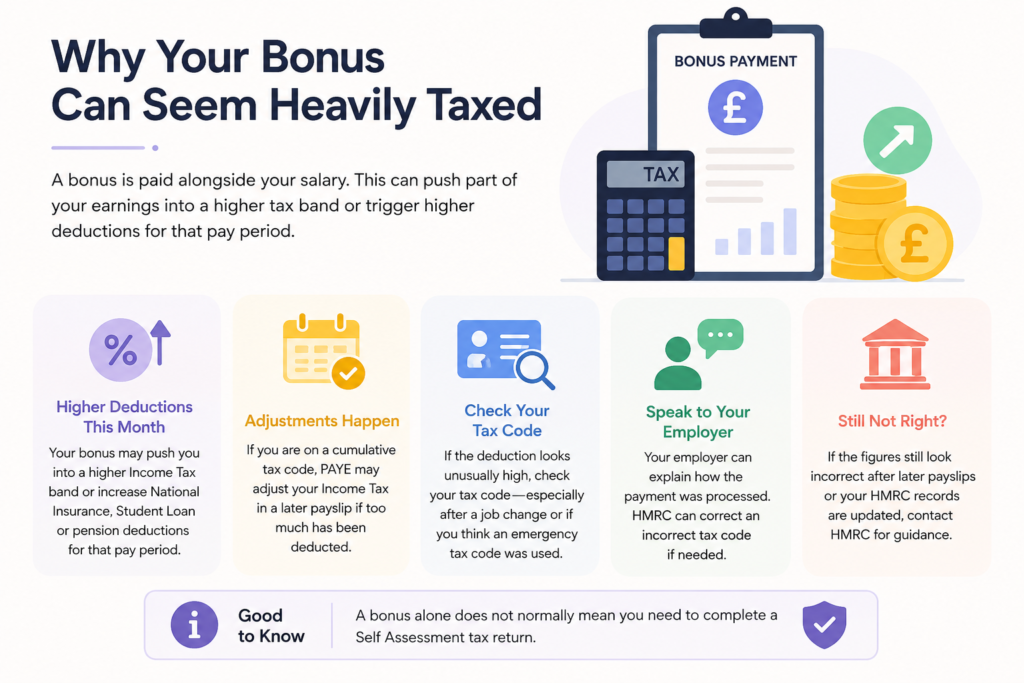
A bonus can seem heavily taxed because it is paid alongside your salary. This may push part of your earnings into a higher Income Tax band or trigger higher National Insurance, Student Loan or workplace pension deductions for that pay period.
A larger deduction does not always mean you have paid too much tax for the year. If you are on a cumulative tax code, PAYE may adjust your Income Tax in a later payslip if too much has been deducted.
Check your tax code if the deduction looks unusually high, particularly if you have recently changed jobs or think an emergency tax code has been used. Your employer can explain how the payment was processed, while HMRC can correct an incorrect tax code if needed.
If the figures still appear incorrect after later payslips or your HMRC records have been updated, contact HMRC for further guidance. A bonus alone does not normally mean you need to complete a Self Assessment tax return.
Are Bonuses Subject to National Insurance?
Cash bonuses are normally subject to employee and employer National Insurance.
Class 1 National Insurance on cash bonuses
A cash bonus paid through payroll is generally included in Class 1 National Insurance earnings.
The employee contribution is deducted from pay. The employer may also owe employer National Insurance.
Monthly and weekly earnings thresholds
National Insurance thresholds are divided according to pay frequency.
Monthly employees use monthly thresholds. Weekly employees use weekly thresholds.
A one-off bonus can push earnings into or through the main NI band within that period.
The 8% and 2% employee NI bands
For a standard category A employee, the main employee rate is generally 8% between the Primary Threshold and Upper Earnings Limit.
The rate normally falls to 2% above the Upper Earnings Limit.
An employee whose regular monthly salary already exceeds the upper limit may therefore pay 2% employee NI on much of the bonus.
Why Income Tax and NI calculations differ
Income Tax can operate cumulatively.
National Insurance is generally calculated for each earnings period. Unused NI thresholds from earlier months are not normally carried forward in the same way as PAYE allowances.
This is why an Income Tax adjustment may appear later while National Insurance remains unchanged.
Read More: Income Tax CalculatorEmployer National Insurance
Employer National Insurance is a cost paid by the employer.
It is not normally shown as a deduction from the employee’s net bonus.
An employer may consider its own National Insurance cost when designing a bonus scheme, but it should not simply deduct employer NI from an agreed gross bonus unless the arrangement permits this.
Are Student Loans Deducted From Bonuses?
Yes, where the bonus pushes earnings above the applicable pay-period threshold.
Pay-period thresholds
Student loan deductions are based on earnings in each pay period.
This differs from a simple annual calculation. A large one-off bonus may trigger a deduction even where normal monthly pay is below the threshold.
Plan 1, Plan 2, Plan 4 and Plan 5
For 2026/27, the approved annual thresholds are:
| Plan | Annual threshold |
|---|---|
| Plan 1 | £26,900 |
| Plan 2 | £29,385 |
| Plan 4 | £33,795 |
| Plan 5 | £25,000 |
Repayments are generally 9% of earnings above the relevant weekly or monthly threshold.
Postgraduate Loan deductions
The Postgraduate Loan threshold is £21,000.
Repayments are generally 6% of earnings above the relevant threshold.
A Postgraduate Loan may be deducted at the same time as a Plan 1, Plan 2, Plan 4 or Plan 5 loan.
Refunds where annual income remains below the threshold
An employee may be able to request a refund where deductions were made because of one or more high-pay periods but total annual income remained below the annual threshold.
The refund is not necessarily automatic.
Check the Student Loans Company process after the end of the tax year and keep payslips showing the deductions.
What Happens if a Bonus Pushes Income Over £100,000?
The £100,000 level affects more than the higher-rate tax band.
Adjusted net income
Adjusted net income is used for several tax rules.
It broadly starts with taxable income and is then adjusted for items such as certain pension contributions and Gift Aid donations.
A bonus can increase adjusted net income even where the employee’s basic salary remains below £100,000.
Personal Allowance taper
The Personal Allowance is reduced by £1 for every £2 of adjusted net income above £100,000.
Someone receiving a large bonus may lose part or all of the £12,570 allowance.
The allowance is fully withdrawn by the time adjusted net income reaches £125,140.
Effective marginal tax rate
Within the Personal Allowance taper range, an employee can face an effective Income Tax rate of 60% on part of their income.
This happens because the employee pays 40% higher-rate tax and also loses tax-free allowance.
National Insurance, student loans and other deductions can increase the total marginal deduction further.
High Income Child Benefit Charge and childcare thresholds
A bonus may affect income-based rules such as:
- High Income Child Benefit Charge
- Tax-Free Childcare eligibility
- Funded childcare eligibility
- Marriage Allowance eligibility
- Means-tested benefits
These are separate from payroll tax, but they can affect the wider financial value of the bonus.
Pension contributions and Gift Aid considerations
Certain pension contributions and Gift Aid donations can reduce adjusted net income.
This may restore part of the Personal Allowance or help with other income-based thresholds.
The treatment depends on the type of pension contribution and how it is made. Use an [Adjusted Net Income Calculator] and check professional advice where the figures are significant.
Are Bonuses Taxed Differently in Scotland?
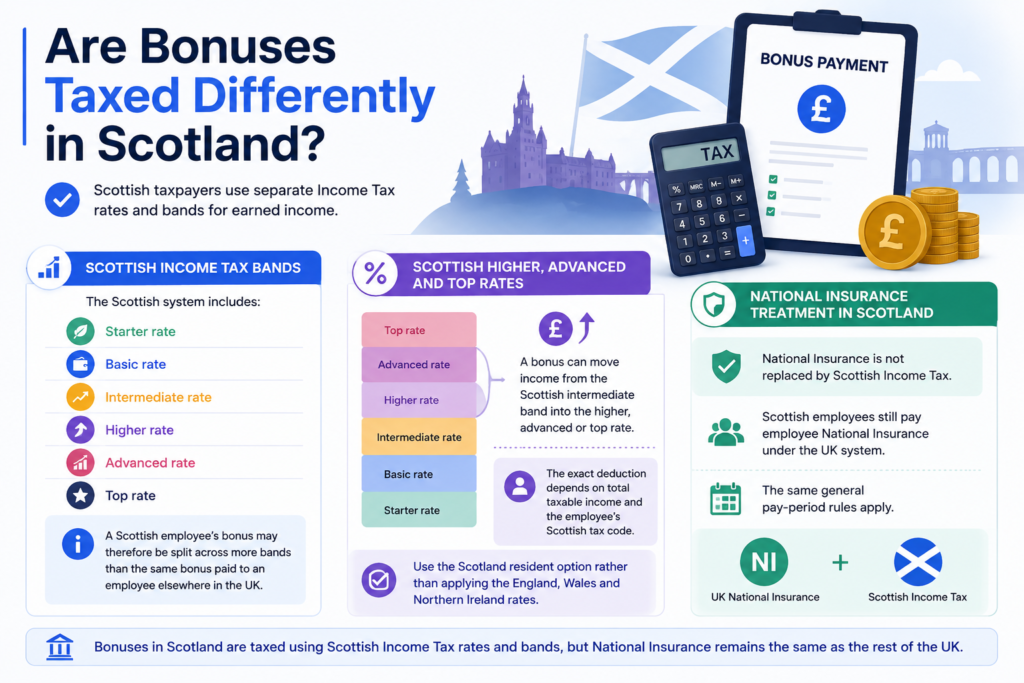
Scottish taxpayers use separate Income Tax rates and bands for earned income.
Scottish Income Tax bands
The Scottish system includes:
- Starter rate
- Basic rate
- Intermediate rate
- Higher rate
- Advanced rate
- Top rate
A Scottish employee’s bonus may therefore be split across more bands than the same bonus paid to an employee elsewhere in the UK.
Scottish higher, advanced and top rates
A bonus can move income from the Scottish intermediate band into the higher, advanced or top rate.
The exact deduction depends on total taxable income and the employee’s Scottish tax code.
Use the Scotland resident option rather than applying the England, Wales and Northern Ireland rates.
National Insurance treatment in Scotland
National Insurance is not replaced by Scottish Income Tax.
Scottish employees still pay employee National Insurance under the UK system. The same general pay-period rules apply.
Example for a Scottish taxpayer
Suppose a Scottish employee is already close to the next Scottish tax threshold and receives a £5,000 bonus.
Part of the bonus may remain in the current band while the rest moves into one or more higher bands.
Applying a single rate to the full bonus would give a misleading estimate.
Are Cash and Non-Cash Bonuses Taxed Differently?
The tax treatment depends on the type of bonus you receive.
Cash bonuses
Cash bonuses are normally treated as employment income. They are processed through payroll and are usually subject to PAYE Income Tax and employee National Insurance.
Non-cash bonuses
Non-cash rewards, such as gift cards, vouchers or shares, can follow different tax rules. Some are taxed through payroll, while others may be treated as benefits in kind or reported separately to HMRC.
If you receive shares or another non-cash award, check your employer’s scheme or seek professional advice, as the tax treatment can be more complex than a standard cash bonus.
Does the Bonus Payment Date Affect the Tax?
The payment date can decide which tax year includes the bonus.
UK tax-year dates
The 2026/27 tax year runs from:
6 April 2026 to 5 April 2027
A bonus paid within those dates is normally included in that tax year’s payroll records.
Bonuses paid before or after 6 April
A bonus paid on 5 April 2026 normally falls within 2025/26.
A bonus paid on 6 April 2026 normally falls within 2026/27.
This can affect the tax bands, Personal Allowance position and total adjusted net income for each year.
Bonuses paid after leaving employment
A bonus paid after an employee leaves can still be taxable employment income.
The payroll treatment may differ because the employer may have already issued a P45. The tax code used for a payment after leaving may produce a larger deduction.
The payment should still appear in HMRC records.
Deferred and multi-year bonus arrangements
Deferred bonuses and awards linked to several years may have special timing or reporting rules.
The relevant tax point is not always the date the performance was completed.
Employees with deferred cash, shares or securities should check the scheme documents and obtain advice where needed.
Can You Reduce Tax on a Bonus Legally?
A bonus cannot simply be made tax-free, but legitimate tax planning may help reduce the amount of tax paid or change when the income is taxed.
Use Bonus Sacrifice into a Workplace Pension
Some employers allow employees to exchange part or all of a future bonus for an employer pension contribution.
This arrangement usually needs to be agreed before the bonus becomes a right to receive as cash. When valid, salary sacrifice may reduce taxable pay and employee National Insurance contributions.
Make Pension Contributions
Personal pension contributions do not normally remove a bonus from payroll, but they may provide tax relief and reduce adjusted net income depending on how contributions are made.
This can be especially useful for higher earners, including those whose bonus pushes income above £100,000 and affects their Personal Allowance.
Consider Gift Aid Donations
Gift Aid donations may reduce adjusted net income for certain tax calculations. This can help with issues such as the Personal Allowance reduction.
However, Gift Aid should only be used for genuine charitable donations, as the donation itself still costs money.
Check Pension Limits and Rules
Pension-related tax planning is subject to rules and limits, including:
- Pension annual allowance
- Tapered annual allowance
- Carry-forward rules
- Employer scheme requirements
Large contributions should be reviewed carefully to ensure they follow current tax rules.
Avoid “Tax-Free Bonus” Claims
A bonus is normally taxable income. Legal tax planning means using approved reliefs and arrangements, not disguising taxable earnings.
Incorrectly treating a bonus as tax-free may result in PAYE adjustments, interest or penalties.
How to Check Whether Your Bonus Was Taxed Correctly
Start with the payslip and compare it with your HMRC records.
Check gross bonus and taxable pay
Confirm that the gross bonus matches the amount awarded.
Check whether the payslip shows the bonus separately and whether total taxable pay includes the correct salary and bonus.
Check the tax code
Look at the tax code used for the payment.
A code ending in W1, M1 or X may indicate non-cumulative treatment. A Scottish code normally begins with S.
Compare the code with your HMRC Personal Tax Account.
Check taxable pay to date
For a cumulative code, check taxable pay and tax paid to date.
Missing prior pay or duplicate income can result in an incorrect deduction.
Check National Insurance category
The payslip should show the National Insurance category letter.
Category A is common, but other categories use different rates.
Do not assume an online estimate is correct if it uses the wrong category.
Check student-loan plan
Confirm that payroll is using the correct Student Loan plan and whether a Postgraduate Loan also applies.
An incorrect plan can change the deduction.
Compare the payslip with HMRC records
Check that the employer, pay amount and tax deduction appear correctly in your HMRC account.
Speak to payroll first where the gross pay or deduction data appears wrong. Contact HMRC where the tax code or PAYE record needs correction.
Is there a separate tax rate for bonuses in the UK?
No. A cash bonus is normally added to your employment income and taxed through PAYE using your normal Income Tax bands and tax code. Your bonus is not automatically taxed at a special bonus rate.
Will my bonus be taxed at 40%?
Only the portion of your income that falls within the higher-rate tax band is taxed at 40%. If a bonus moves part of your income into a higher band, only that part is taxed at the higher rate.
Why was my bonus taxed so much?
A bonus may appear heavily taxed because it can increase Income Tax, National Insurance, or student loan deductions in the pay period it is received. A bonus paid using a Month 1 tax code or an incorrect tax code can also affect the amount deducted.
Can I get a tax refund after receiving a bonus?
You may receive a refund if too much tax was deducted. HMRC may correct this through future payroll payments or after reviewing your tax year. Student loan overpayments may require a separate refund request in certain situations.
Do I pay National Insurance and student loan deductions on a bonus?
Yes. Cash bonuses are normally included in earnings for employee National Insurance calculations. If the bonus takes your income above the relevant threshold, student loan deductions may also apply.
Can a bonus reduce my Personal Allowance?
Yes. If a bonus increases your adjusted net income above £100,000, your Personal Allowance may be reduced. The reduction is £1 for every £2 of income above this level.
Are bonuses taxed differently in Scotland?
Scottish taxpayers pay Income Tax using Scottish tax bands, which differ from the rest of the UK. However, National Insurance and student loan rules generally follow the wider UK system.
Can a company pay a tax-free bonus?
A normal cash bonus is usually taxable. Some approved benefits, pension arrangements, or non-cash rewards may have different tax treatment, but simply changing the name of a payment does not make it tax-free.