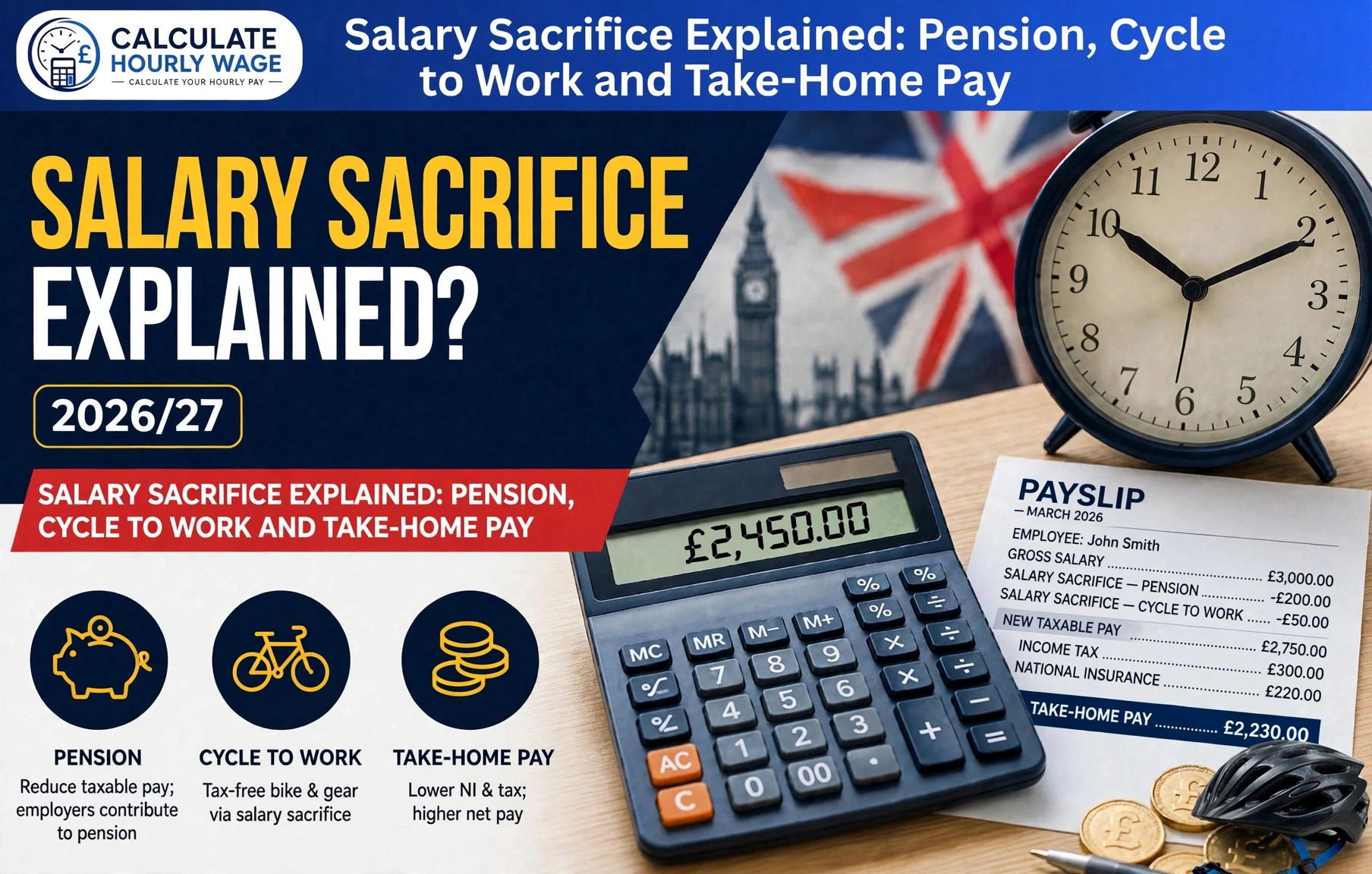
If you are wondering how salary sacrifice in the UK works, the short answer is this: you agree with your employer to give up part of your gross salary, and in return your employer gives you something else of the same value — most commonly a payment into your pension, or the hire of a bike through Cycle to Work. Because that part of your pay is never paid to you as cash salary, no Income Tax or employee National Insurance is charged on it. Your take-home pay falls, but by less than the amount you gave up, and the pension or bike gets the full amount.
That gap is the whole point: give up £2,000 for your pension and take-home pay falls by about £1,440, not £2,000, because £400 of Income Tax and £160 of National Insurance simply never arise. The pension still receives the full £2,000.
It is not free money, though. A lower contractual salary can affect your mortgage application, your statutory maternity or sick pay, and the pension contributions your employer calculates for you. And salary sacrifice only works if your employer offers it — you cannot set one up on your own.
How Salary Sacrifice in the UK Works
A salary sacrifice arrangement is a change to your employment contract. You agree that your cash salary will be lower by a set amount, and your employer agrees to provide a non-cash benefit of that value instead. GOV.UK describes it exactly that way: an agreement to reduce an employee’s entitlement to cash pay, usually in return for a non-cash benefit. The contract must stay clear about what your cash pay is and what your non-cash entitlement is.
The tax effect follows from that contract change. Tax and National Insurance are charged on the cash salary you are actually entitled to after the sacrifice, not on the salary you had before. So if your salary is £40,000 and you sacrifice £2,000 into your pension, your employer runs payroll on £38,000. Income Tax and National Insurance are worked out on £38,000, and the £2,000 goes straight into your pension without ever passing through your bank account.
Three conditions matter, and GOV.UK states all three plainly. First, the arrangement must be agreed in advance and written into your contract — it cannot be applied retrospectively to pay you have already earned. Second, you cannot chop and change whenever you like: as a general rule, if you swap between cash and a benefit whenever you please, the tax and National Insurance advantages will not apply. Most schemes let you change only once a year, or on a major life event such as marriage or divorce. Third, the sacrifice must not take your cash pay below the National Minimum Wage or National Living Wage. From 1 April 2026 the National Living Wage is £12.71 an hour for workers aged 21 and over, £10.85 for ages 18 to 20, and £8.00 for under-18s and apprentices. If a sacrifice would push your average hourly pay below your legal minimum, your employer must cap it.
That floor is not a technicality. A worker paid £13.00 an hour on a 37.5-hour week earns £25,350 a year, and could sacrifice at most 29p an hour — about £566 a year — before hitting the £12.71 floor. Anything more would be unlawful.
Salary sacrifice is also not available for every benefit. Most benefits that used to be offered this way lost their tax advantage in 2017. GOV.UK lists the benefits that keep the full exemption: payments into pension schemes, employer-provided pensions advice, workplace nurseries, certain older childcare arrangements, and bicycles and cycling safety equipment, including Cycle to Work. That is why this guide focuses on pensions and bikes.
Salary Sacrifice in the UK for Your Pension
Pension salary sacrifice is the most valuable use of the arrangement for most employees, because it saves both Income Tax and National Insurance. Under the ordinary way of paying into a workplace pension, your contribution comes out of your pay and tax relief is added back later. Under salary sacrifice, the money never becomes taxable pay in the first place, so you get full tax relief immediately plus the National Insurance saving. Your employer saves National Insurance too — 15% above £5,000 a year in 2026/27 — and some add part of that saving to your pension.
The size of your saving depends on your tax band. For 2026/27 in England, Wales and Northern Ireland, the Personal Allowance is £12,570, the basic rate is 20% on income from £12,571 to £50,270, the higher rate is 40% from £50,271 to £125,140, and the additional rate is 45% above £125,140. Employee National Insurance is 8% on earnings between £12,570 and £50,270, and 2% above £50,270. So a basic-rate taxpayer saves 28% on every pound sacrificed (20% tax plus 8% National Insurance), a higher-rate taxpayer saves 42% (40% plus 2%), and an additional-rate taxpayer saves 47% (45% plus 2%).
Worked example 1: £40,000 salary, £2,000 pension sacrifice
Without any sacrifice, taxable pay is £40,000 minus the £12,570 Personal Allowance, which is £27,430. Income Tax at 20% is £5,486. Employee National Insurance at 8% on the same £27,430 is £2,194.40. Total deductions are £7,680.40, so take-home pay is £32,319.60 a year, or £2,693.30 a month.
Sacrifice £2,000 and payroll runs on £38,000. Taxable pay is £25,430, Income Tax at 20% is £5,086, and National Insurance at 8% is £2,034.40. Total deductions are £7,120.40, so take-home pay is £30,879.60 a year, or £2,573.30 a month.
| £40,000 salary | No sacrifice | £2,000 pension sacrifice |
|---|---|---|
| Gross pay for tax and NI | £40,000 | £38,000 |
| Income Tax | £5,486.00 | £5,086.00 |
| Employee National Insurance | £2,194.40 | £2,034.40 |
| Take-home pay (year) | £32,319.60 | £30,879.60 |
| Take-home pay (month) | £2,693.30 | £2,573.30 |
| Paid into pension | £0 extra | £2,000 |
Take-home pay falls by £1,440 a year (£120 a month), but your pension gains £2,000 — a £560 saving (£400 Income Tax, £160 National Insurance). Your employer also saves £300 a year in National Insurance on the £2,000; if they pass half on, your pension gains another £150.
Worked example 2: £60,000 salary, £5,000 pension sacrifice
Higher-rate taxpayers save a bigger share in tax, even though their National Insurance slice is smaller. Without any sacrifice, a £60,000 salary gives Income Tax of £11,432: 20% on the £37,700 basic-rate slice (£7,540) plus 40% on the £9,730 above £50,270 (£3,892). National Insurance is £3,210.60: 8% on £37,700 (£3,016) plus 2% on £9,730 (£194.60). Total deductions are £14,642.60, so take-home pay is £45,357.40 a year, or £3,779.78 a month.
Sacrifice £5,000 and payroll runs on £55,000. Income Tax becomes £9,432 (£7,540 plus 40% on the £4,730 now above £50,270, which is £1,892). National Insurance becomes £3,110.60 (£3,016 plus 2% on £4,730, which is £94.60). Total deductions are £12,542.60, so take-home pay is £42,457.40 a year, or £3,538.12 a month.
| £60,000 salary | No sacrifice | £5,000 pension sacrifice |
|---|---|---|
| Gross pay for tax and NI | £60,000 | £55,000 |
| Income Tax | £11,432.00 | £9,432.00 |
| Employee National Insurance | £3,210.60 | £3,110.60 |
| Take-home pay (year) | £45,357.40 | £42,457.40 |
| Take-home pay (month) | £3,779.78 | £3,538.12 |
| Paid into pension | £0 extra | £5,000 |
Take-home pay falls by £2,900 a year, but the pension gains £5,000 — a £2,100 saving (£2,000 Income Tax, £100 National Insurance). Note the National Insurance saving shrinks for higher-rate taxpayers: only 2% above £50,270, against 8% below it.
To model your own salary before and after sacrifice, use our annual salary calculator: run it once on your full salary and once on your salary after sacrifice, and the difference in take-home pay is the true monthly cost of the pension contribution. Our guide to £40,000 after tax works through a full take-home breakdown the same way.
One question to ask your employer is what your pension contributions are calculated on after a sacrifice. Under automatic enrolment the legal minimum total contribution is 8% of qualifying earnings — the slice of pay between £6,240 and £50,270 a year in 2026/27 — with the employer paying at least 3%. GOV.UK notes that employers usually decide whether earnings-linked payments are based on the original salary or the reduced salary, and that this must be made clear to you. Many employers use the original, or “notional”, salary, so a sacrifice does not shrink your employer’s contribution. Some do not — get the answer in writing before you join.

Cycle to Work Through Salary Sacrifice
Cycle to Work works on the same principle with a different asset. Your employer buys or hires a bike and safety equipment for you, hires it to you over an agreed period — usually 12 or 18 months — and takes the cost back from your gross salary in monthly instalments. Because those instalments come out of your pay before tax and National Insurance, you save both on the whole price of the bike. The bike remains your employer’s property during the hire period; at the end you may be offered the chance to buy it at fair market value, extend the hire, or hand it back.
The saving follows the same percentages as pension sacrifice: 28% for a basic-rate taxpayer, 42% for a higher-rate taxpayer, and 47% for an additional-rate taxpayer, in England, Wales and Northern Ireland. Scotland sets its own Income Tax bands, so the saving there is different, but the mechanism is identical.
Worked example 3: a £1,200 bike over 12 months
A £1,200 bike and helmet package spread over 12 months means a sacrifice of £100 a month from gross pay. For a basic-rate taxpayer, the tax and National Insurance saved on each £100 is £28, so monthly take-home pay falls by only £72. Over the year the saving is £336, and the net cost of the £1,200 package is £864 before any end-of-hire payment. For a higher-rate taxpayer, the saving on each £100 is £42, so monthly take-home pay falls by £58, the yearly saving is £504, and the net cost is £696 before any end-of-hire payment.
| £1,200 bike, 12 months | Basic-rate taxpayer | Higher-rate taxpayer |
|---|---|---|
| Monthly sacrifice from gross pay | £100 | £100 |
| Tax and NI saved per month | £28 | £42 |
| Monthly take-home pay fall | £72 | £58 |
| Total saving over 12 months | £336 | £504 |
| Net cost before end-of-hire payment | £864 | £696 |
Two cautions belong with those figures. First, the end-of-hire payment is real: if you want to keep the bike, expect a final payment based on its market value at the time, and factor it into the total cost before you compare with buying outright. Second, the same minimum-wage floor applies, and the bike must be used mainly for qualifying journeys, including commuting between home and work.

When Salary Sacrifice Can Work Against You
Salary sacrifice is usually good value, but five situations can cost you more than they save. Check each one before you sign.
Mortgages and other borrowing. Lenders normally assess affordability on your contractual salary, which after a sacrifice is the lower figure. A £2,000 pension sacrifice on a £40,000 salary makes you look like a £38,000 earner, and that can reduce the amount you can borrow. If you plan to apply for a mortgage in the next year, ask your lender how they treat sacrificed salary first.
Statutory pay. GOV.UK warns that salary sacrifice can affect earnings-related benefits and statutory payments, and can even cause some employees to lose entitlement altogether if average weekly earnings fall below the lower earnings limit. Statutory maternity pay, statutory paternity pay, and Statutory Sick Pay are all calculated from average earnings, so a large sacrifice taken shortly before a claim can reduce what you receive. If you are planning a family or expect sick leave, time the sacrifice carefully.
Pension contributions calculated on the reduced salary. If your employer’s contribution is calculated on your post-sacrifice pay, you lose a little each month — £60 a year on a £2,000 sacrifice at 3%.
Holiday pay. Holiday pay for workers with variable pay is based on average earnings over a 52-week reference period, so a sacrifice can lower it slightly. To check what your leave is worth, use our holiday pay calculator, and to convert a reduced salary into an hourly figure, our salary to hourly calculator does that division for you.
A change coming in April 2029. From 6 April 2029, only the first £2,000 a year of pension contributions made through salary sacrifice will be free of National Insurance; contributions above that will attract National Insurance for both employee and employer, although Income Tax relief will be unchanged. For the £2,000 example in this guide, nothing changes. For the £5,000 example, the National Insurance saving from 2029 would apply only to the first £2,000. The Income Tax relief alone is still worth having, but know that the National Insurance part is capped from 2029.
Before You Sign: A Seven-Point Checklist
- Confirm the benefit is exempt. Pension contributions and Cycle to Work bikes keep the full saving. For anything else, ask payroll to confirm the tax treatment in writing.
- Check the minimum-wage floor. Confirm your hourly rate after the sacrifice stays at or above £12.71 an hour (or your age-appropriate rate).
- Ask what rises and overtime are based on. Original salary or reduced salary? The answer affects every future pay rise.
- Ask what pension contributions are based on. If the employer’s contribution uses the reduced salary, factor that loss into your saving.
- Check statutory pay and borrowing. If a mortgage application or statutory-pay claim is on the horizon, get advice on timing first.
- Read the change rules. Find out when you can increase, reduce, or stop the sacrifice, and which life events allow an in-year change.
- Check your first payslip. Your gross salary itself should have fallen by the sacrificed amount, and your tax and National Insurance should both be lower.
Salary Sacrifice in the UK: Is It Worth It?
For most employees with a pension or a bike to buy, yes — with the checks above done first. A basic-rate taxpayer putting £2,000 a year into a pension through salary sacrifice pays £1,440 of take-home pay for £2,000 of pension, a £560 saving that the ordinary route cannot match. A higher-rate taxpayer sacrificing £5,000 pays £2,900 of take-home pay for £5,000 of pension, a £2,100 saving. A cyclist buying a £1,200 bike through the scheme pays £864 or £696 of take-home pay instead of £1,200, before any end-of-hire payment.
The cases where it is not worth it are just as clear. If the sacrifice would take you below the minimum wage, it cannot happen. If you need your full contractual salary for a mortgage application soon, the timing may be wrong. And if your employer does not offer a scheme at all, take this guide to them — the employer’s National Insurance saving gives them a reason to say yes.
If you are deciding between a pension sacrifice and a pay rise, our guide to how to negotiate a salary rise in the UK covers what a rise is worth after tax. And to see exactly what any salary — before or after a sacrifice — is worth each month, our annual salary calculator will run the numbers for you.
Does salary sacrifice reduce my take-home pay?
Yes, but by less than the amount you sacrifice. A basic-rate taxpayer sacrificing £2,000 into a pension sees take-home pay fall by about £1,440. A higher-rate taxpayer sacrificing £5,000 sees take-home pay fall by £2,900 against a £5,000 pension contribution.
Can salary sacrifice take my pay below the minimum wage?
No. GOV.UK states that a salary sacrifice arrangement must not reduce cash earnings below the National Minimum Wage or National Living Wage rates. From 1 April 2026 the National Living Wage is £12.71 an hour for workers aged 21 and over. Your employer must cap the sacrifice so your average hourly pay stays at or above your legal minimum.
Is salary sacrifice available to everyone?
No — only if your employer offers it, because it requires a change to your employment contract. It is also not available for every benefit: pensions and Cycle to Work bikes keep the full tax and National Insurance exemption, while most other benefits lost that advantage in 2017.
Does salary sacrifice affect my pension?
It increases the amount going into your pension, because the full sacrificed amount is paid in. But check whether your employer’s own contribution is calculated on your original salary or your reduced salary: if it uses the reduced salary, you lose a small amount of employer contribution.
What happens to salary sacrifice if I leave my job?
The arrangement ends with your employment. Pension contributions already made stay in your pension, which belongs to you even after you leave. For Cycle to Work, leaving mid-hire usually means settling the outstanding hire balance from your final pay — check those terms before you sign.
Will salary sacrifice still be worth it after April 2029?
Yes, but slightly less so for large pension sacrifices. From 6 April 2029 only the first £2,000 a year of pension salary sacrifice will be free of National Insurance; Income Tax relief is unchanged. A £2,000 sacrifice is unaffected, while a £5,000 sacrifice will save National Insurance on only the first £2,000.