
Annual salary only tells you how much you earn over a year. Your hourly rate shows what you're actually paid for the time you work. This makes it easier to compare job offers, understand overtime, negotiate a pay rise and see how changes to your working hours affect your earnings.
How to Use This Calculator
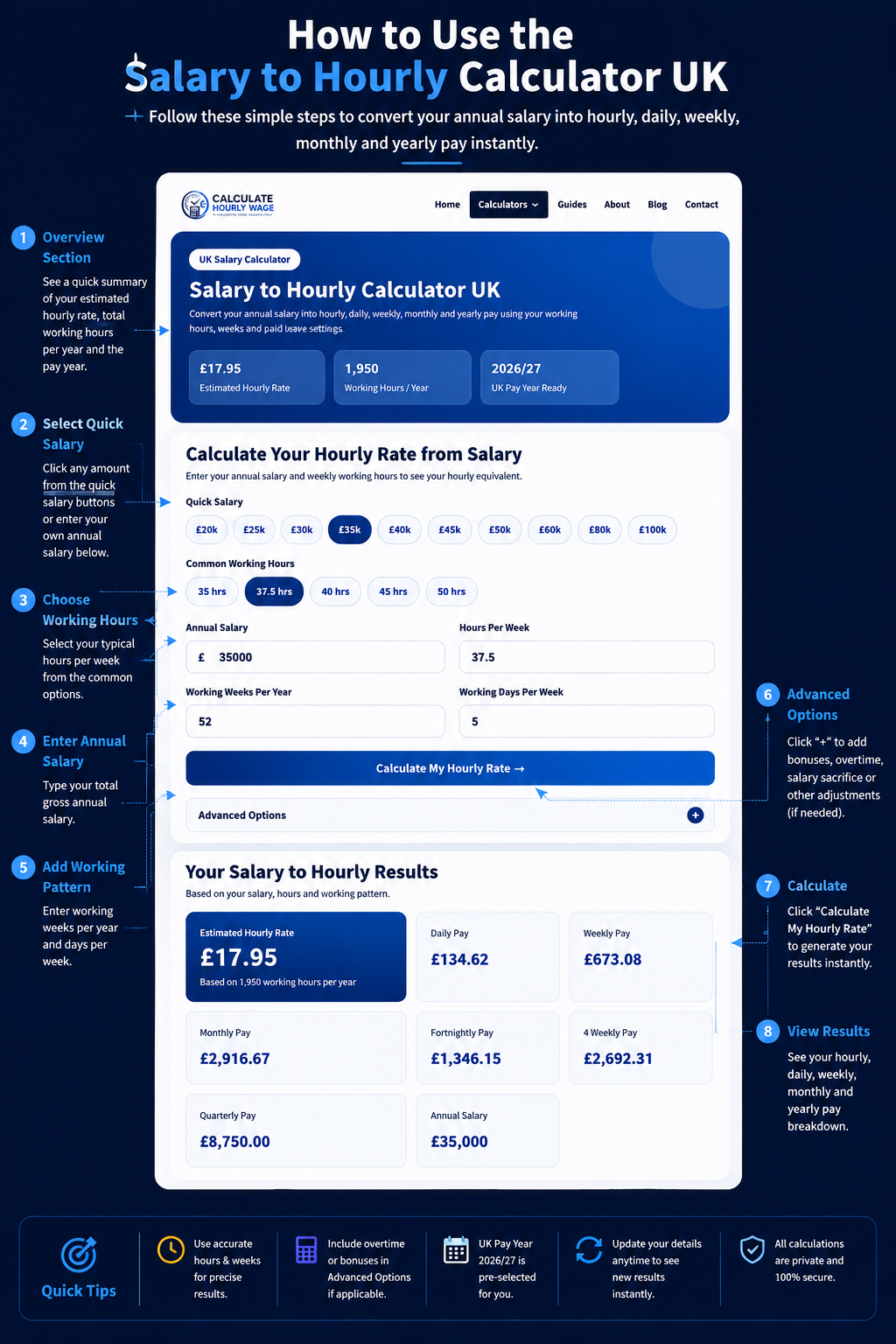
- Enter your annual salary: Type your salary or pick a quick-salary preset (£20k–£100k).
- Set your weekly hours: Choose a common pattern (35, 37.5, 40, 45, 50 hrs) or enter custom hours.
- Confirm working schedule: Set working weeks and days per week—adjust if you take unpaid leave.
- Open Advanced Options: Add bonuses, extra pay, or salary sacrifice (pension, cycle-to-work, etc.).
- Calculate: Click Calculate My Hourly Rate.
- Review and Save: Check your hourly, daily, weekly, fortnightly, 4-weekly, monthly, and quarterly pay. Use Copy, Print, or Share to save it.
How the Salary to Hourly Calculator Works
Our Salary to Hourly Calculator UK converts your annual salary into an estimated hourly rate using your contracted working pattern. Enter your gross annual salary along with your weekly working hours and working weeks per year, and the calculator automatically calculates your equivalent hourly, daily, weekly and monthly earnings.
| Input | Description | Example |
|---|---|---|
| Annual Salary | Your gross annual salary before deductions. | £35,000 |
| Hours per Week | Your contracted working hours each week | 37.5 Hours |
| Working Weeks per Year | Usually 52 unless unpaid leave reduces your working weeks. | 52 Weeks |
| Working Days per Week | Used to calculate your daily pay. | 5 Days |
Formula
For example, if you earn £35,000 per year, work 37.5 hours each week and work 52 weeks a year, your total working hours are 1,950. Dividing £35,000 by 1,950 gives an estimated hourly rate of £17.95 per hour.
| Result | What It Shows |
|---|---|
| Hourly Pay | Your estimated pay for each hour worked. |
| Daily Pay | Estimated earnings for a standard working day. |
| Weekly Pay | Your equivalent weekly income. |
| Fortnightly Pay | Estimated earnings over two weeks. |
| 4-Weekly Pay | Pay equivalent over a four-week period. |
| Monthly Pay | Estimated monthly salary before deductions. |
| Quarterly Pay | Estimated earnings every three months. |
| Annual Salary | Your original salary entered into the calculator. |
Change your salary, contracted hours or working weeks at any time, and the calculator instantly updates every result to help you compare different working patterns and pay scenarios.
£35,000 Salary to Hourly and Other Common UK Salaries
One of the quickest ways to estimate your hourly earnings is to compare your salary with common UK pay levels. The figures below assume a standard 37.5-hour working week and 52 working weeks per year.
| Annual Salary | 35 hrs/week | 37.5 hrs/week | 40 hrs/week |
|---|---|---|---|
| £20,000 | £10.99 | £10.26 | £9.62 |
| £25,000 | £13.74 | £12.82 | £12.02 |
| £30,000 | £16.48 | £15.38 | £14.42 |
| £35,000 | £19.23 | £17.95 | £16.83 |
| £40,000 | £21.98 | £20.51 | £19.23 |
| £45,000 | £24.73 | £23.08 | £21.63 |
| £50,000 | £27.47 | £25.64 | £24.04 |
| £60,000 | £32.97 | £30.77 | £28.85 |
| £80,000 | £43.96 | £41.03 | £38.46 |
| £100,000 | £54.95 | £51.28 | £48.08 |
What Affects Your Hourly Rate
- Working hours — Same salary, fewer weekly hours = higher hourly rate.
- Working weeks & unpaid leave — Unpaid leave reduces total annual hours, which changes your effective hourly rate even if salary stays the same. For statutory holiday pay specifically, see our Holiday Pay Calculator.
- Bonuses & salary sacrifice — Use Advanced Options to include guaranteed bonus pay, or exclude pension/cycle-to-work salary sacrifice, for a more accurate personal rate. For overtime or shift premiums, see our Overtime Pay Calculator or Shift Pay Calculator.
Practical Salary to Hourly Examples
Real-life examples make it easier to understand how working hours affect your hourly earnings.
Example 1 – Same Salary, Longer Hours
David earns £35,000 per year, but he works 45 hours each week.
| Detail | Amount |
|---|---|
| Annual Salary | £35,000 |
| Weekly Hours | 45 |
| Estimated Hourly Rate | £14.96 |
Although David earns the same annual salary as a standard 37.5-hour employee (£17.95/hr), his actual hourly rate is lower because he works 7.5 additional hours every week.
Example 2 – Part-Time Employee
Sophie earns £24,000 per year and works 30 hours per week.
| Detail | Amount |
|---|---|
| Annual Salary | £24,000 |
| Weekly Hours | 30 |
| Estimated Hourly Rate | £15.38 |
Who Can Use This Salary to Hourly Calculator?
Our calculator is useful for anyone who wants to compare pay, understand their hourly earnings or check salary information more accurately.
| Who It's For | How It Helps |
|---|---|
| Job Seekers | Compare job offers with different salaries, working hours and holiday entitlements using a consistent hourly rate. |
| Employees | Check whether a salary increase improves your hourly earnings or simply reflects longer working hours. |
| Part-Time Workers | Estimate your hourly pay when working part-time, compressed hours or other flexible schedules. |
| Freelancers & Contractors | Compare permanent salary offers with your current hourly or day rate to support better career decisions. |
| Employers & HR Teams | Use the calculator to explain salary conversions during recruitment or internal pay discussions. |
| Minimum Wage Checks | Compare your calculated hourly rate with current UK National Minimum Wage and National Living Wage rates. If your pay appears below the legal minimum, contact HM Revenue & Customs (HMRC) for official guidance. |
Common Mistakes When Calculating Hourly Pay
Converting an annual salary into an hourly rate is straightforward, but small mistakes can lead to inaccurate results. Keep these points in mind when comparing salaries.
| Mistake | Why It Matters |
|---|---|
| Using net instead of gross salary | Enter gross salary before Income Tax and NI unless stated otherwise. |
| Ignoring contracted hours | Same salary, different hours = different real hourly rate. |
| Forgetting unpaid leave | Unpaid leave changes your total working weeks and hours. |
| Overlooking salary sacrifice | Pension or cycle-to-work schemes can change the salary figure used. |
| Comparing salary alone | Always compare hourly rate and hours together, not salary in isolation. |
Expert Tips for Comparing Salaries
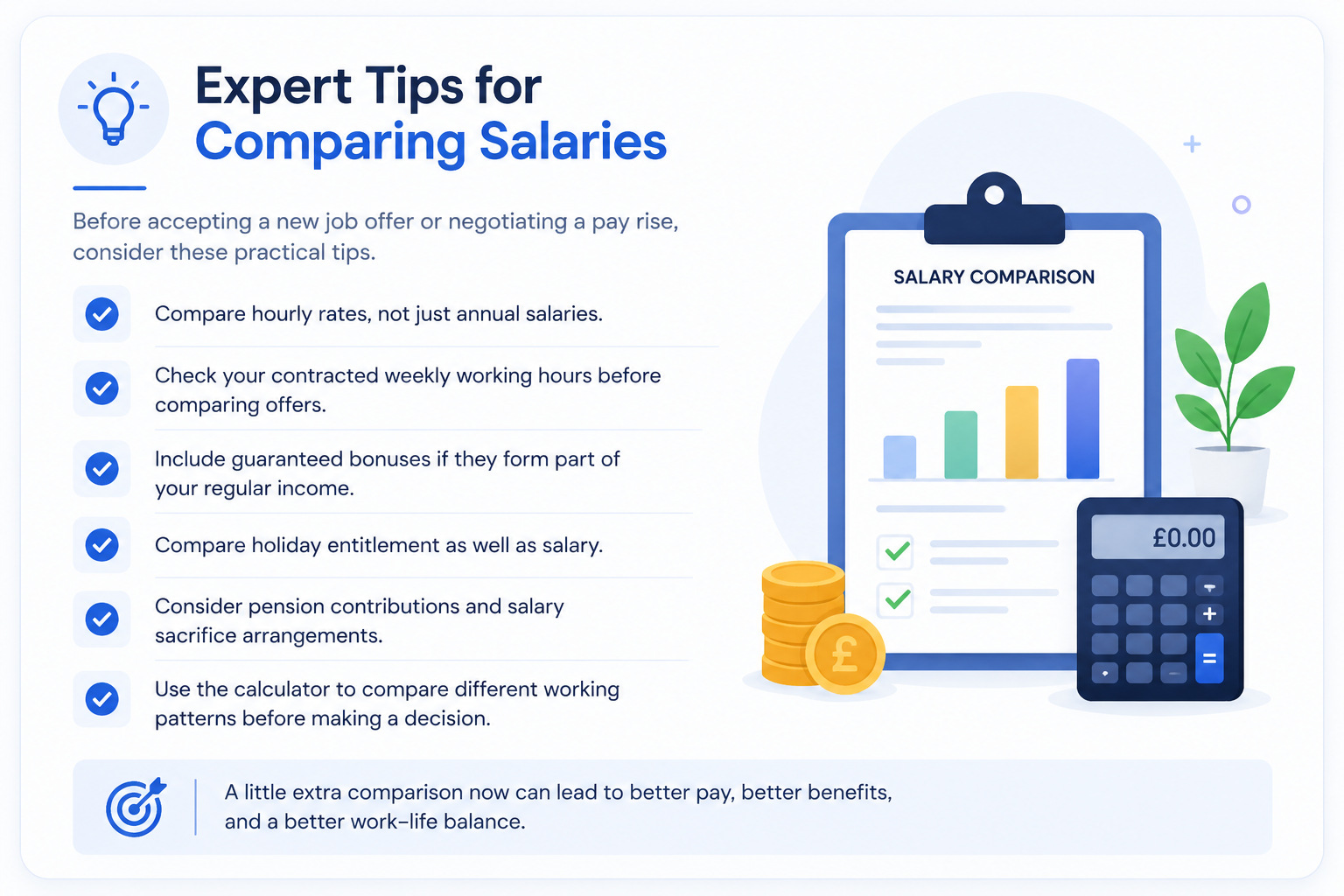
Before accepting a new job offer or negotiating a pay rise, consider these practical tips.
- Compare hourly rates, not just annual salaries.
- Check your contracted weekly working hours before comparing offers.
- Include guaranteed bonuses if they form part of your regular income.
- Compare holiday entitlement as well as salary.
- Consider pension contributions and salary sacrifice arrangements.
- Use the calculator to compare different working patterns before making a decision.
Frequently Asked Questions
At 37.5 hours/week over 52 weeks, that's roughly £17.95/hour (1,950 hours/year). Enter your exact hours and weeks above for your precise figure.
Divide your annual salary by your total working hours for the year (working weeks × weekly hours). The calculator above does this automatically and also accounts for unpaid leave, bonuses and salary sacrifice.
There's no single figure — it depends entirely on your salary and contracted hours, which is what this calculator works out for you. If you're checking against the legal minimum, compare your result to the current National Minimum Wage / National Living Wage rates on GOV.UK.
No — all figures are gross, before deductions. For a take-home estimate, see our UK Tax Brackets page.
Unpaid leave reduces your total annual working hours, which changes the number your salary is divided by — even if your salary itself doesn't change.
Both are legal minimum pay rates set by the UK government, applying to different age bands, with the National Living Wage covering older workers. Current rates are published on GOV.UK.
No — National Minimum Wage and National Living Wage are legal minimums and can't be waived by agreement. If you think you're being underpaid, GOV.UK and ACAS have guidance on what to do next.
No — it works for part-time, compressed or flexible hours too, just adjust the inputs. Daily pay is estimated as weekly hours ÷ working days, so if your daily hours vary a lot, treat the daily figure as an average estimate rather than exact.
Start Calculating Your Hourly Rate
Use the Salary to Hourly Calculator UK above to convert your annual salary into an estimated hourly, daily, weekly and monthly rate in seconds. Whether you're comparing job offers, reviewing a pay rise or planning your finances, the calculator provides a quick and transparent way to understand your earnings.