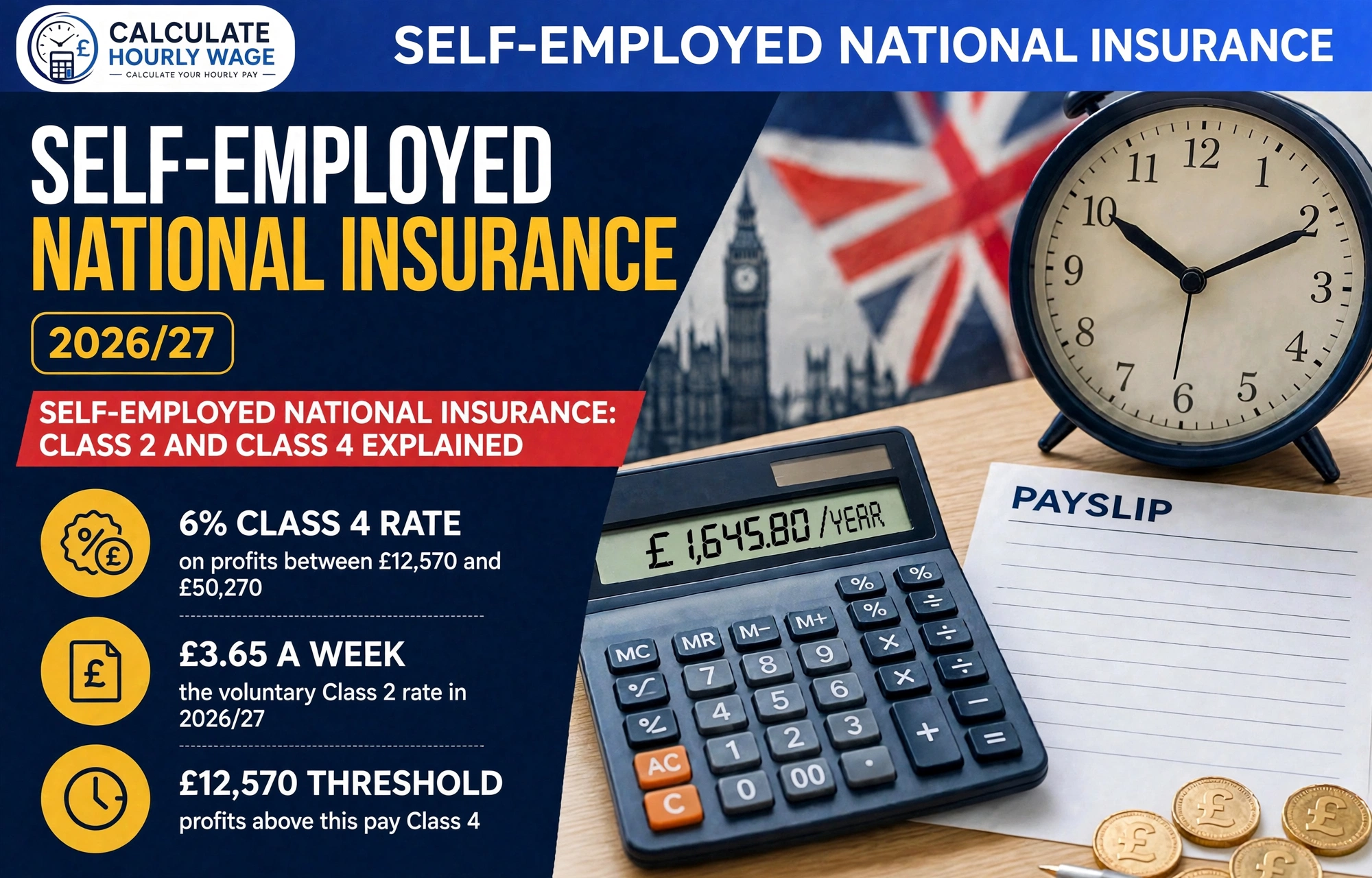
If you are looking for the self employed National Insurance rates in the UK, here they are for the 2026/27 tax year: Class 4 is 6% on profits between £12,570 and £50,270, and 2% on profits above £50,270. Class 2 is a flat £3.65 a week — but since April 2024 you no longer have to pay it. If your profits are £7,105 or more a year, Class 2 is treated as paid automatically, and you only choose to pay it if your profits fall below that line.
Self Employed National Insurance Rates in the UK: The Short Answer
Self-employed people in the UK pay National Insurance through Self Assessment, not through an employer’s payroll. There are two classes, and they work very differently from the Class 1 National Insurance that employees pay.
Class 4 is the main charge: a percentage of your annual profits — what is left after allowable business expenses come off your self-employed income. In 2026/27 you pay nothing on the first £12,570 of profit, then 6% on profits between £12,570 and £50,270, and 2% above £50,270.
Class 2 is a flat weekly amount — £3.65 a week in 2026/27 — and it is the class that protects your State Pension record. Since 6 April 2024, compulsory Class 2 has been abolished. If your profits are £7,105 or more in the year (the Small Profits Threshold), your Class 2 is treated as having been paid, so you get the qualifying year for your State Pension without paying a penny. If your profits are below £7,105, you pay nothing — but you can choose to pay the voluntary Class 2 rate of £3.65 a week to keep your record complete.
Class 2 vs Class 4 at a Glance
| Class 2 | Class 4 | |
|---|---|---|
| What it is | Flat weekly contribution that protects your National Insurance record | Percentage charge on your annual profits |
| 2026/27 rate | £3.65 a week (£189.80 a year), voluntary only | 6% on profits £12,570–£50,270; 2% above £50,270 |
| When you pay it | Only if you choose to, when profits are below £7,105 | Automatically, when profits are above £12,570 |
| Profits £7,105 or more | Treated as paid — no payment needed | Nothing until profits pass £12,570 |
| Profits below £7,105 | Optional: £3.65 a week to protect your record | Nothing |
| Counts towards State Pension? | Yes — each paid or credited year is a qualifying year | No — Class 4 alone does not build entitlement |
| How you pay | Through your Self Assessment return | Through your Self Assessment return |
If your profits sit between £7,105 and £12,570, you are in the sweet spot: Class 2 is treated as paid, so your State Pension record is protected, and you owe no Class 4 at all — many part-time self-employed people land exactly here and pay no National Insurance on their self-employed income.
Class 2 National Insurance Explained
Before April 2024, Class 2 was compulsory for anyone with profits above the Small Profits Threshold, at £3.45 a week. The government abolished the compulsory charge from 6 April 2024 and replaced it with a simple rule: if your profits reach the Small Profits Threshold — £7,105 a year in 2026/27 — your Class 2 is treated as having been paid.
Most self-employed people never think about Class 2 at all: you do not pay it, you file nothing extra for it, and your record still gets its qualifying year, all handled inside your Self Assessment return.
Class 2 only becomes a decision when your profits are low. If your profits are below £7,105 in a tax year, you owe nothing — but that year does not count as a qualifying year for your State Pension unless you do something about it. The something is voluntary Class 2: £3.65 a week, or £189.80 for the full year, paid through Self Assessment. Compare that with voluntary Class 3 contributions at £18.40 a week — about £956.80 a year. If you are self-employed with low profits, always check Class 2 before paying Class 3.
One qualifying year is worth roughly £6.89 a week of new State Pension — about £358 a year, for every year of your retirement — so paying £189.80 to secure one is usually good value. But if you already have 35 qualifying years, or will reach 35 easily before State Pension age, an extra year adds nothing: check your forecast on GOV.UK before you pay.
Class 4 National Insurance Explained
Class 4 is where the real money is. It is charged on your profits — not your turnover, and not your total income. That distinction is the single most common misunderstanding in self-employed National Insurance. Your profits are your self-employed income minus your allowable expenses: the materials, travel, phone, software and other costs of running your business. If you take in £40,000 and spend £8,000 on expenses, your profits are £32,000, and Class 4 is worked out on £32,000, not £40,000.
The rates for 2026/27 are set out on GOV.UK, unchanged since April 2024, when the main rate was cut from 9% to 6%:
| Your profits (2026/27) | Class 4 rate |
|---|---|
| Up to £12,570 (the Lower Profits Limit) | 0% — nothing to pay |
| £12,570 to £50,270 | 6% |
| Above £50,270 (the Upper Profits Limit) | 2% |
The Lower Profits Limit of £12,570 matches the Personal Allowance, so the first £12,570 of your profits is free of both Income Tax and Class 4. Above that, both apply — Income Tax at 20% where Class 4 is 6% — which is why self-employed National Insurance feels lighter than the 8% Class 1 rate employees pay.
One thing Class 4 does not do is build your State Pension: it does not count towards your qualifying years or your entitlement to contributory benefits. That is Class 2’s job — which is why the government kept Class 2 alive as a voluntary payment. Class 4 is worked out once a year on your total profits for the tax year, not week by week like an employee’s Class 1, so a very good month cannot push you into a higher rate on its own.
Worked Examples: What Self-Employed National Insurance Costs at Real Profits
The examples below use the 2026/27 rates and a standard Personal Allowance of £12,570, with no pension contributions or other deductions.
Example 1: £5,000 profit. Aisha runs a small craft stall at weekends and makes £5,000 profit. She pays no Class 4 and no Income Tax, because her profits are below both the £12,570 Lower Profits Limit and the Personal Allowance. Her profits are also below the £7,105 Small Profits Threshold, so Class 2 is not treated as paid — but she can choose to pay voluntary Class 2 at £3.65 a week, £189.80 for the year, to keep the year counting towards her State Pension.
Example 2: £8,000 profit. Ben freelances as a photographer alongside part-time work and makes £8,000 profit. He still pays no Class 4 and no Income Tax. But his profits are above the £7,105 threshold, so his Class 2 is treated as paid automatically and he pays nothing at all in National Insurance on his self-employed income.
Example 3: £25,000 profit. Chloe is a self-employed plumber with £25,000 profit. Her Class 4 is 6% of the £12,430 above the Lower Profits Limit: £745.80 a year. Her Income Tax is 20% of the same £12,430: £2,486. Together they come to £3,231.80, leaving her £21,768.20 a year, or £1,814.02 a month.
Example 4: £40,000 profit. Dan is a self-employed electrician with £40,000 profit. His Class 4 is 6% of £27,430: £1,645.80 a year. His Income Tax is 20% of £27,430: £5,486. Together they come to £7,131.80, leaving take-home pay of £32,868.20 a year, or £2,739.02 a month. Work out your own figure with our National Insurance calculator (https://calculatehourlywage.com/national-insurance-increase/) to see exactly what these rates mean for your profits.
Example 5: £60,000 profit. Emma runs a consultancy with £60,000 profit. Her Class 4 is 6% of the £37,700 between £12,570 and £50,270 (£2,262) plus 2% of the £9,730 above £50,270 (£194.60) — £2,456.60 a year. Her Income Tax is 20% of £37,700 (£7,540) plus 40% of £9,730 (£3,892) — £11,432. Together they come to £13,888.60, leaving take-home pay of £46,111.40 a year, or £3,842.62 a month.
| Annual profit | Class 4 | Income Tax | Total deductions | Take-home per month |
|---|---|---|---|---|
| £5,000 | £0 | £0 | £0 (+ £189.80 voluntary Class 2 if chosen) | £416.67 |
| £8,000 | £0 | £0 | £0 | £666.67 |
| £25,000 | £745.80 | £2,486 | £3,231.80 | £1,814.02 |
| £40,000 | £1,645.80 | £5,486 | £7,131.80 | £2,739.02 |
| £60,000 | £2,456.60 | £11,432 | £13,888.60 | £3,842.62 |
Notice how the effective rate stays low: on £60,000 of profit, Class 4 is just over 4% of the total, because the first £12,570 is free and the rate drops to 2% above £50,270.

How and When You Pay
You pay Class 2 and Class 4 through Self Assessment. GOV.UK says you must tell HMRC when you become self-employed as a sole trader or as a partnership, and register by 5 October after the end of the tax year in which you started — miss that deadline and you can be fined.
Your Self Assessment return and payment are both due by 31 January after the tax year ends — for 2026/27, that is 31 January 2028. Your Class 4 is calculated on the return itself, and any voluntary Class 2 is added to the same bill, so one payment covers Income Tax, Class 4 and Class 2 together.
If your tax bill is large enough, HMRC will also ask for payments on account: advance payments towards next year’s bill, due on 31 January and 31 July. They catch many newly self-employed people by surprise — the first January can mean paying last year’s tax plus half of next year’s in one go — so set aside roughly 25–30% of every payment you receive, in a separate account. Our guide to what counts as taxable income (https://calculatehourlywage.com/what-counts-as-taxable-income-in-the-uk/) explains which income HMRC taxes.
What Class 2 and Class 4 Actually Buy You
National Insurance is not just a bill — it buys you a record, and that record is what the state pays you back with later. But the two classes buy different things.
Class 2 is what turns a year of self-employment into a qualifying year for the State Pension. You need at least 10 qualifying years to receive any new State Pension, and 35 for the full amount — £241.30 a week in 2026/27 — with each year worth about £6.89 a week, or around £358 a year, for the rest of your retirement. That is why the treated-as-paid rule matters: with profits of £7,105 or more, you get the qualifying year free, and with profits below that, the £189.80 voluntary payment is the cheapest way to buy one — far cheaper than Class 3 at £18.40 a week.
Class 2 also gives you access to Maternity Allowance if you are self-employed and have a baby, and counts towards contribution-based Employment and Support Allowance if illness stops you working. Class 4 does none of this — it is a revenue charge on your profits that builds no entitlement on its own.
That split answers a common worry — “I pay thousands in National Insurance, but does it count towards my pension?” The Class 2 part counts and the Class 4 part does not, but because Class 2 is treated as paid for anyone with profits over £7,105, the pension side is normally taken care of without you doing anything.
You can check where you stand free on GOV.UK, using the “Check your National Insurance record” service. It shows how many qualifying years you have, which years have gaps, and what your State Pension forecast looks like — and whether paying voluntary Class 2 is worth £189.80, or whether you already have enough years.

Self-Employed vs Employed: Who Pays More National Insurance?
Self-employed people usually pay less National Insurance than employees on the same income — one of the real financial differences between the two ways of working.
| Employee on £40,000 salary | Self-employed on £40,000 profit | |
|---|---|---|
| Main NI rate | 8% Class 1 | 6% Class 4 |
| NI paid | £2,194.40 a year | £1,645.80 a year |
| Income Tax | £5,486 | £5,486 |
| Take-home pay | £32,319.60 a year | £32,868.20 a year |
| Employer’s NI on top | £5,250 a year (15% above £5,000) | None — no employer |
| State Pension qualifying year | Yes, automatic | Yes — Class 2 treated as paid |
On £40,000, the self-employed worker keeps £548.60 a year more, because Class 4 at 6% is lower than Class 1 at 8%. The gap is wider than that in reality, because an employer also pays 15% National Insurance on top of an employee’s salary — £5,250 on a £40,000 salary — which is a real cost of employing someone, even though it never appears on the payslip.
But the comparison cuts both ways. Employees get Statutory Sick Pay, paid holiday and employer pension contributions, none of which come automatically with self-employment, and they have their National Insurance deducted week by week while self-employed people face one large annual bill. If you are weighing the two, our salary to hourly calculator (https://calculatehourlywage.com/salary-to-hourly-calculator/) helps you compare a salaried offer with what you would need to earn self-employed to match it.
Employed and Self-Employed at the Same Time
Many people are both: an employee during the week and self-employed on the side. The two incomes are treated separately for National Insurance.
Your employer deducts Class 1 from your wages through PAYE, on each job separately. Your self-employed profits are dealt with separately through Self Assessment, and Class 4 applies to profits above £12,570 — the threshold applies to your self-employed profits alone, not to your combined income. So if you earn £30,000 as an employee and make £15,000 profit from a side business, you pay Class 1 on the £30,000 through your payslip and Class 4 on the £2,430 of profit above £12,570 (6% of £2,430 is £145.80), plus Income Tax on the combined income.
The one place the two incomes do interact is Income Tax: your Personal Allowance is normally used up by your main job, so your self-employed profits are usually taxed at 20% from the first pound — the same reason a second job (https://calculatehourlywage.com/second-job-tax-why-your-second-job-pays-less/) can feel so heavily taxed.
When Do You Stop Paying National Insurance?
If you are self-employed, you stop paying Class 4 from 6 April — the start of the tax year — after you reach State Pension age, currently 66 and rising to 67 between 2026 and 2028. You do not need to do anything: your Self Assessment return simply stops including Class 4 from that April.
Income Tax does not stop, so if you keep working past State Pension age, you still pay Income Tax on profits above the Personal Allowance — you just stop paying National Insurance on them, which is £1,645.80 a year back in your pocket on £40,000 of profit.
Common Mistakes Self-Employed People Make
Working it out on turnover, not profit. The most expensive mistake is calculating Class 4 on everything you take in, before deducting expenses. If you take in £40,000 and spend £8,000 on expenses, your profit is £32,000 and your Class 4 is 6% of £19,430 — £1,165.80 — not 6% of £27,430.
Forgetting to register. You must tell HMRC you are self-employed and register by 5 October after the tax year you started in — people who drift into freelancing often miss this and end up with a fine on top of the tax they owe.
Ignoring low-profit years. If your profits are below £7,105, it is tempting to forget about National Insurance entirely. But a year with no qualifying credit is a hole in your State Pension record, and holes are expensive to fill later: Class 3 costs £18.40 a week, against £3.65 for voluntary Class 2. Pay the cheaper one while you can.
Paying Class 3 when Class 2 would do. If you have gaps in your record and you are self-employed, check whether voluntary Class 2 is available to you before paying Class 3. At £189.80 a year against £956.80, the difference over several gap years runs into thousands.
Not setting money aside. Class 4 and Income Tax arrive together in one January bill, and the first year can include payments on account. Put aside 25–30% of every payment you receive, in a separate account, and the bill stops being a shock. If you do overpay, you can claim the money back — our guide to claiming a tax refund with a P800 (https://calculatehourlywage.com/what-is-a-p800-and-how-do-you-claim-your-refund/) explains how.
What Is Changing in April 2027?
The Autumn Budget on 28 October 2026 left the main self-employed rates unchanged for 2027/28: Class 4 stays at 6% and 2%, and the £12,570 and £50,270 profit limits stay frozen. Three smaller figures do rise from 6 April 2027: the Small Profits Threshold from £7,105 to £7,355 a year, voluntary Class 2 from £3.65 to £3.80 a week, and voluntary Class 3 from £18.40 to £19.05 a week.
In practice, the line for free Class 2 treatment moves up slightly — you will need £7,355 of profit in 2027/28 — and voluntary Class 2 will cost £197.60 for the year instead of £189.80. The 2026/27 figures in this guide remain the ones that apply to the tax year you are in now.
The Bottom Line
Self-employed National Insurance in the UK comes in two classes: Class 4, the percentage charge on your profits — 6% between £12,570 and £50,270, and 2% above that — and Class 2, the flat £3.65 a week that protects your State Pension record. Since April 2024, Class 2 is voluntary and treated as paid whenever your profits reach £7,105, so most self-employed people pay only Class 4.
The practical steps are simple: work out your profits properly — income minus allowable expenses — because that figure decides everything; check your National Insurance record on GOV.UK to see whether you need voluntary Class 2; and set aside money through the year, so the January bill is a routine payment, not a surprise. If you want to know what self-employed National Insurance costs on your exact profits, work out your own figure with our National Insurance calculator (https://calculatehourlywage.com/national-insurance-increase/) — then use our annual salary calculator (https://calculatehourlywage.com/annual-salary-calculator-uk/) to see the full picture.
Frequently Asked Questions
What are the self employed National Insurance rates in the UK for 2026/27?
In 2026/27, self-employed National Insurance is Class 4 at 6% on profits between £12,570 and £50,270, and 2% on profits above £50,270. Class 2 is a flat £3.65 a week, but it is voluntary: if your profits are £7,105 or more, Class 2 is treated as paid automatically, and you only choose to pay it if your profits are below £7,105.
Do self-employed people have to pay Class 2 National Insurance?
No — not since 6 April 2024, when compulsory Class 2 was abolished. If your profits are £7,105 or more a year, your Class 2 is treated as having been paid, so your State Pension record is protected without any payment. If your profits are below £7,105, you can choose to pay voluntary Class 2 at £3.65 a week to keep the year counting as a qualifying year.
How much National Insurance do I pay on £40,000 profit?
On £40,000 of self-employed profit in 2026/27, you pay Class 4 of £1,645.80 a year — 6% of the £27,430 above the £12,570 Lower Profits Limit. You also pay Income Tax of £5,486, giving total deductions of £7,131.80 and take-home pay of £32,868.20 a year, or £2,739.02 a month. Your Class 2 is treated as paid, so the year counts towards your State Pension.
Is National Insurance worked out on turnover or profit?
On profit — your self-employed income minus your allowable business expenses. If you take in £40,000 and spend £8,000 on expenses, your profits are £32,000, and Class 4 is worked out on £32,000. Keeping records of your expenses directly reduces your National Insurance and Income Tax bills.
Does Class 4 National Insurance count towards my State Pension?
No. Class 4 on its own does not build your State Pension entitlement or your access to contributory benefits — that is Class 2’s job. But in practice, if your profits are £7,105 or more, your Class 2 is treated as paid automatically, so the year still counts as a qualifying year. Only people with profits below £7,105 need to act, by paying voluntary Class 2.
When do self-employed people stop paying National Insurance?
You stop paying Class 4 from 6 April — the start of the tax year — after you reach State Pension age, which is currently 66 and rising to 67 between 2026 and 2028. Income Tax does not stop, so you keep paying tax on profits above the Personal Allowance. You do not need to apply; your Self Assessment return simply stops including Class 4 from that April.
Sources
- GOV.UK — Self-employed National Insurance rates: https://www.gov.uk/self-employed-national-insurance-rates
- GOV.UK — Rates and allowances: National Insurance contributions: https://www.gov.uk/government/publications/rates-and-allowances-national-insurance-contributions/rates-and-allowances-national-insurance-contributions
- GOV.UK — National Insurance: introduction: https://www.gov.uk/national-insurance
- GOV.UK — Voluntary National Insurance: https://www.gov.uk/voluntary-national-insurance-contributions
- GOV.UK — Check your National Insurance record: https://www.gov.uk/check-national-insurance-record
- GOV.UK — Set up as a sole trader: https://www.gov.uk/set-up-as-sole-trader