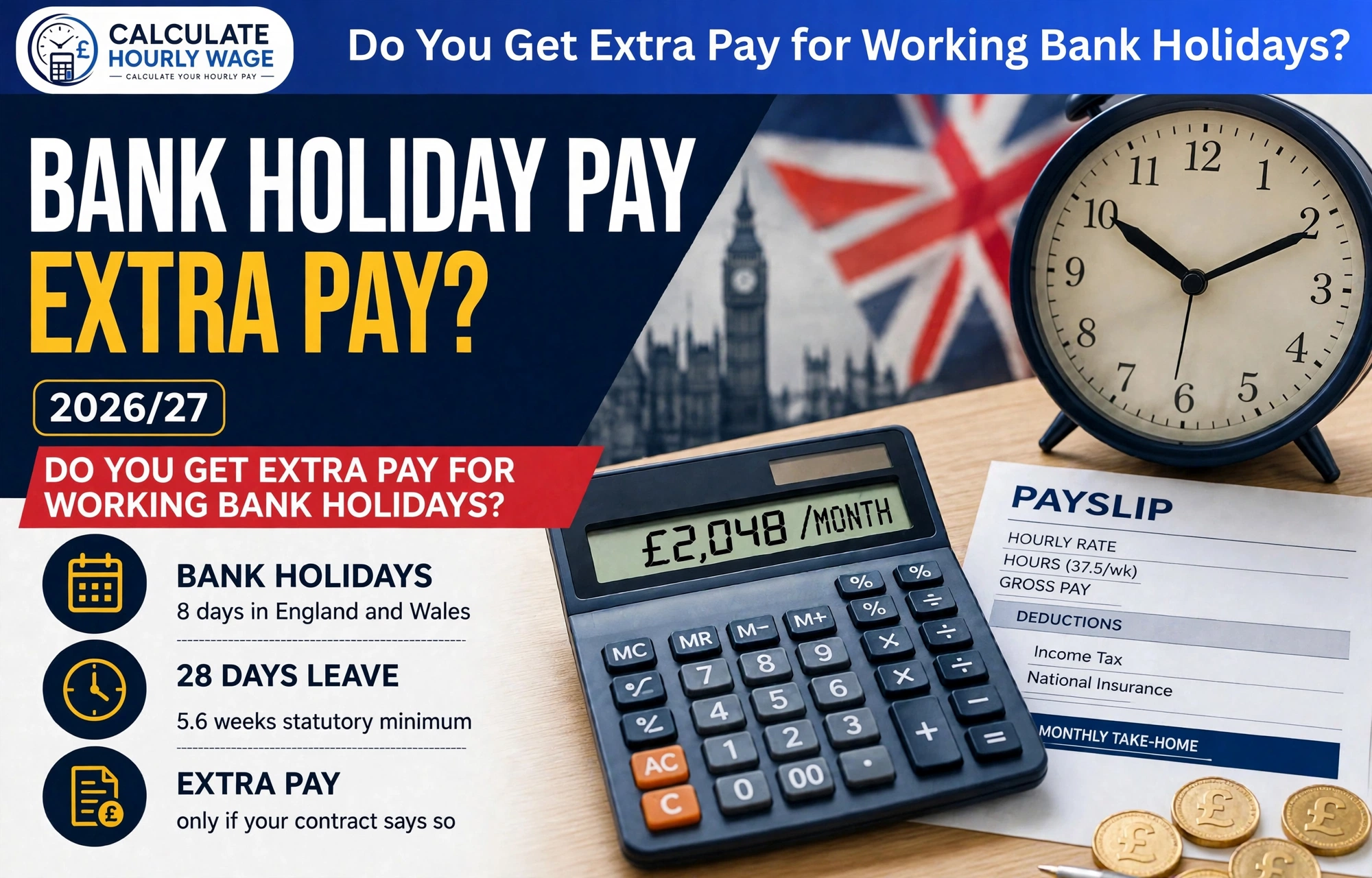
If you are asking about bank holiday pay in the uk, here is the direct answer: no, there is no automatic legal right to extra pay for working a bank holiday. A bank holiday is not, in itself, a paid day off under UK law, and working one does not automatically earn you time and a half, double pay, or any premium at all. Whether you get extra pay, a day off in lieu, or nothing beyond your normal rate depends on your employment contract and your employer’s policy — not on the fact that the day is a bank holiday.
Shops, hospitals, care homes and transport services all need staff on bank holidays, and many of those staff work at their ordinary rate. The law’s real protection is different: almost every worker is entitled to 5.6 weeks of paid annual leave a year, and your employer can count bank holidays inside that entitlement. So the question is never just “is it a bank holiday?” It is “what does my contract say, and are bank holidays inside or on top of my annual leave?” The figures here come from GOV.UK; premium rates in the examples are contract illustrations only, as the government sets no bank-holiday premium.
Bank Holiday Pay in the UK: The Short Answer
Bank holiday pay in the uk works like this. First, there is no statutory right to paid leave on a bank or public holiday. GOV.UK states this plainly: bank or public holidays do not have to be given as paid leave. Second, there is no statutory right to extra pay for working one. No law sets a bank-holiday multiplier, and no law says Christmas Day, Boxing Day or a May bank holiday must be paid at a higher rate than an ordinary Monday. Third, what you actually get is decided by your contract: the rate for bank-holiday working, whether you get a day in lieu, and whether bank holidays are included in your annual leave or given on top of it.
That means two people working on the same bank holiday, in different jobs, can legitimately be paid quite differently — one on double pay because their contract promises it, the other on their normal rate because their contract says bank holidays are ordinary working days. Neither employer is breaking the law by paying the contract rate, as long as average pay stays above the minimum wage and the worker still receives their full statutory leave. Read the contract before the bank holiday arrives, not after the payslip lands.
Why a Bank Holiday Is Not Automatically a Day Off
The confusion comes from what a bank holiday actually is. Bank holidays are days when banks and many businesses close, set out in the government’s official calendar. But a place on that calendar does not create a personal right to time off. The legal right workers have is to paid annual leave: 5.6 weeks a year, which for someone working five days a week is 28 days. That entitlement is the same whether or not any of those days happen to be bank holidays.
Your employer can include bank holidays as part of that statutory annual leave — 20 days you choose plus the 8 bank holidays in England and Wales — or offer them on top, giving 36 days in total. Both are lawful; the second is a contractual benefit, not a legal minimum, and anything above 28 days takes its terms from the contract.
Statutory paid holiday is also capped at 28 days, even if you work six days a week. So “28 days including bank holidays” is the legal minimum in full; “25 days plus bank holidays” is 33 days in England and Wales; “28 days plus bank holidays” is 36 days. If your contract is silent about bank holidays, do not assume they are extra — most employers treat them as inside your overall annual leave entitlement.
How Bank Holidays Fit Inside Your 28 Days
There are really only three contract patterns, and almost every job fits one of them. Work out which one you are on, and most bank-holiday questions answer themselves.
The first pattern is “28 days including bank holidays”: the statutory minimum, with the bank holidays part of it — in England and Wales, 20 days you choose plus 8 bank holidays. If you work a bank holiday under this pattern, you have not used that day’s leave, so it is still owed to you, normally as a day off on another date (a day in lieu), unless your contract instead pays you for working it. It is not extra leave; it is the same leave, taken on a different day.
The second pattern is “28 days plus bank holidays”, or a figure such as “25 days plus bank holidays”. Here the bank holidays are additional to your annual leave. If you are given the bank holiday off, you keep your full annual leave for other dates. If you are required to work a bank holiday under this pattern, your contract should say what happens instead: extra pay, a day in lieu, or both. Because the bank holiday was additional, working it does not reduce your annual leave, but the contract still has to explain the compensation for working a day that would otherwise have been a paid day off.
The third pattern is “bank holidays are normal working days”. Some contracts, especially in retail, hospitality, health and care, say expressly that bank holidays are ordinary working days, or that the rota includes bank holidays. Under this pattern, working a bank holiday is simply working a normal shift. You are paid your normal rate unless the contract also promises a premium, and there is no day in lieu, because no leave was due on that day in the first place. That can feel harsh, but it is lawful, provided your total annual leave still reaches the statutory minimum. A useful test is to count your total days: if leave plus bank holidays, as your contract describes them, adds up to 28, bank holidays are inside it. If it adds up to more, the extra is contractual. Work out what a bank-holiday shift is worth for you with our holiday pay calculator, and compare that figure with what your contract promises.

If You Work a Bank Holiday: Extra Pay, a Day in Lieu, or Nothing Extra?
There are three possible outcomes when you work a bank holiday, and your contract decides which one applies.
The first is extra pay, often called a premium or an enhancement. This is entirely contractual. Common contract premiums include time and a half, double pay, or a flat extra amount per hour. None of these is set by law. A contract may also pay a premium only for certain bank holidays — Christmas Day and New Year’s Day, for example — and the normal rate for the rest. Always check whether the premium applies to all bank holidays or only to the ones your contract names.
The second outcome is a day in lieu, sometimes written as TOIL, or time off in lieu. Instead of extra money, you get another paid day off at a later date. A day in lieu is most common where the bank holiday was part of your annual leave, or where it was an additional paid day off that you worked. The replacement day should be a full day’s leave, not a few hours tacked onto another shift, unless your contract says otherwise. Some contracts offer both: a premium rate for working the bank holiday and a day in lieu as well. That is generous, but it is a contract term, so check whether yours promises one, the other, or both.
The third outcome is nothing extra: your normal rate, and no replacement day. This is where the contract treats bank holidays as ordinary working days. It is disappointing, but not automatically unlawful — it becomes a problem only if your contract promised something different, if total leave falls below the statutory minimum, or if average pay falls below the minimum wage. Note also that a premium usually applies only to the hours actually worked on the bank holiday, not to the whole week, and that overtime on a bank holiday does not automatically stack two premiums: the contract should say whether only the higher one applies. If your contract also pays overtime, work out the combined figure with our overtime pay calculator.
Worked Examples: What a Bank-Holiday Shift Is Really Worth
These examples use made-up contract rates to show the arithmetic. They are not official rates, and your own figure will depend on your contract. In each example, the worker’s normal rate is £14.00 an hour, and the shift is 8 hours long.
Example 1: Normal rate, no premium
Megan works in a shop. Her contract says bank holidays are normal working days, and her annual leave is 28 days on its own. She works 8 hours on the spring bank holiday at £14.00 an hour, so her pay is 8 times £14.00, which is £112.00. There is no premium and no day in lieu, because no leave was due on that day. Her position is lawful: she still receives her full 28 days of annual leave on other dates. The lesson is that “working a bank holiday” and “being owed extra” are two different things.
Example 2: Time and a half under the contract
James works in a warehouse. His contract pays bank holidays at time and a half, so his bank-holiday rate is 1.5 times £14.00, which is £21.00 an hour. He works 8 hours on the early May bank holiday, so his pay is 8 times £21.00, which is £168.00 — an extra £56.00 over an ordinary £112.00 shift. If James had worked only 4 hours, the premium would apply only to those 4 hours: 4 times £21.00 is £84.00, not a full day at the higher rate.
Example 3: Double pay on Christmas Day only
Priya works in a care home. Her contract pays double pay on Christmas Day and New Year’s Day, and time and a half on other bank holidays. At £28.00 an hour, 8 hours on Christmas Day pays £224.00 — exactly double an ordinary shift — while the same 8 hours on the spring bank holiday, at time and a half, pays £168.00. Check which bank holidays a premium covers: the two wordings give very different answers for the same hours.
Example 4: Working a bank holiday that was inside the 28 days
Dan works five days a week on 28 days including bank holidays: 20 days he chooses, plus 8 bank holidays. Rostered to work the summer bank holiday, he does not take that day as leave, so one day is still owed to him on another date — a day in lieu — whether or not his contract also pays a premium. If his employer refused both, Dan’s total leave would fall to 27 days, below the statutory minimum.
The payslip check follows from these examples: multiply the hours you actually worked on the bank holiday by the rate your contract promises, and compare the result with the payslip.

Part-Time, Shift and Irregular-Hours Workers
Bank holiday pay in the uk gets more complicated for part-time workers, and the complication is about fairness, not a different premium. Part-time workers are entitled to the same 5.6 weeks of paid leave, worked out pro rata. Someone working three days a week is entitled to 5.6 times 3, which is 16.8 days a year. The question is what happens when a bank holiday falls on a day they do not normally work.
The rule is that a part-time worker should not be treated less favourably than a comparable full-time worker, so they should receive a pro-rata share of the bank-holiday benefit, whichever days they work. Many employers do this by giving a total annual leave figure that already includes a pro-rata share of bank holidays. Giving a part-time worker only the bank holidays that fall on their working days would leave someone who never works Mondays with far fewer paid bank holidays than a colleague who always works Mondays. There is no automatic right to a substitute day for each bank holiday on a non-working day; the right is to the pro-rata total.
Shift workers face the same question in a different form: bank holidays will sometimes fall on days off and sometimes on working days. A premium applies only to hours actually worked on the day, so a bank holiday on your rest day earns no premium automatically. For the wider shift picture, see our guide to weekend and bank-holiday shift pay, and work out your own shift earnings with our shift pay calculator.
If your hours vary, a week’s holiday pay is normally your average pay over the previous 52 weeks in which you were paid — the rate for a week’s leave, including a bank holiday taken as leave. If you work the bank holiday instead, any contract premium applies to the hours worked that day, while holiday pay for other leave follows the 52-week average.
Bank Holidays Across the UK, and the 2026 Dates
Bank holiday pay in the uk is not identical in every nation, because the calendars differ. England and Wales have 8 bank holidays a year. Scotland has 9, and Northern Ireland has 10. The employment rules — the 5.6 weeks, the 28-day cap, and the absence of a statutory premium — are the same in principle, but the number of bank holidays inside your entitlement, and the dates themselves, depend on where you work.
For England and Wales in 2026, the bank holidays are: New Year’s Day on Thursday 1 January, Good Friday on Friday 3 April, Easter Monday on Monday 6 April, the early May bank holiday on Monday 4 May, the spring bank holiday on Monday 25 May, the summer bank holiday on Monday 31 August, Christmas Day on Friday 25 December, and Boxing Day on Monday 28 December as a substitute day. The substitute-day rule is worth knowing: if a bank holiday falls on a weekend, a substitute weekday becomes a bank holiday, normally the following Monday. Boxing Day in 2026 falls on a Saturday, which is why the substitute is Monday 28 December. Your employer does not have to give you paid leave on a bank holiday or a substitute day, but if your contract gives you bank holidays off, the substitute day is normally the day that counts.
Scotland adds 2 January and St Andrew’s Day (30 November), with its summer bank holiday on the first Monday in August; Northern Ireland adds St Patrick’s Day (17 March) and the Battle of the Boyne holiday in July. Because bank holidays can sit inside your 28 days, “28 days including bank holidays” leaves 20 days you choose in England and Wales, 19 in Scotland, and 18 in Northern Ireland — the same total, but less freedom over dates.
What to Check in Your Contract Before the Next Bank Holiday
Before the next bank holiday, find the holidays section of your contract or staff handbook, and answer five questions. First, are bank holidays included in your annual leave, or given on top of it? Second, can your employer require you to work on bank holidays, and if so, which ones? Third, what rate applies to bank-holiday hours — normal rate, time and a half, double pay, or a different figure — and does it apply to all bank holidays or only to named ones? Fourth, if you work a bank holiday, do you get a day in lieu, extra pay, both, or neither? Fifth, what happens if a bank holiday falls on your non-working day, or during sickness or other leave?
If any question has no answer in your contract, ask your employer in writing and keep the reply — a short email giving the date, the shift, and the rate or day in lieu you expect is enough. A bank holiday does not suspend your other rights either: a long bank-holiday shift still carries the 20-minute rest break if it lasts more than 6 hours, and 11 hours of rest before your next shift.
What to Do If Your Bank Holiday Pay Looks Wrong
Start with the payslip, not with an argument. Work out the hours you actually worked on the bank holiday, the rate your contract promises for those hours, and the total you should have received. Compare that figure with the payslip, line by line. If the hours are wrong, the rate is wrong, or a promised premium or day in lieu is missing, you have a specific, checkable query.
Raise it with your employer in writing, giving the date, the hours, the contract rate, and the amount or day in lieu you believe is due, and keep the rota and payslip together. Most errors are payroll mistakes — a premium code not applied, a shift coded as an ordinary day, a day in lieu not recorded — fixed quickly once pointed out with figures. If total leave has fallen below the statutory minimum because a bank holiday you worked was never replaced, that is a stronger point than a premium dispute, because the minimum is a legal floor, not a contract term.
Bank holiday pay in the uk comes down to one sentence: the law guarantees your annual leave, but your contract decides your bank-holiday pay. Know your total leave, whether bank holidays are inside it or on top of it, and the rate your contract promises — then check the payslip against that rate before the next bank holiday. Work out what your own bank-holiday shift should pay with our holiday pay calculator, and check any salary-to-hourly conversion with our salary to hourly calculator.
Frequently Asked Questions
Do you get extra pay for working a bank holiday in the UK?
Not automatically. There is no statutory right to extra pay for working a bank holiday in the UK. Any premium, such as time and a half or double pay, comes from your employment contract or your employer’s policy. If your contract pays your normal rate for bank holidays, that is lawful, provided your average pay does not fall below the minimum wage and you still receive your full statutory annual leave.
Can my employer make me work on a bank holiday?
Yes, if your contract requires it. UK law gives no automatic right to take bank holidays off, so an employer can roster you to work them if your contract allows it. If your contract gives you bank holidays as paid leave, your employer cannot simply remove that benefit without following the contract’s terms. Check what your contract says about bank-holiday working before assuming you have the day off.
Are bank holidays included in my 28 days of annual leave?
They can be. Your employer can include bank holidays as part of your statutory annual leave. For a full-time worker, “28 days including bank holidays” means 20 days you choose plus 8 bank holidays in England and Wales. If your contract says “28 days plus bank holidays”, the bank holidays are additional, giving 36 days in total. Your contract wording decides which arrangement applies to you.
What is a day in lieu for a bank holiday?
A day in lieu is a replacement paid day off, given because you worked on a day that would otherwise have been leave. It is most common where the bank holiday was part of your annual leave, or was an additional paid day off that you worked. It is not extra leave on top of your entitlement; it is the bank-holiday leave itself, taken on a different date, unless your contract also pays a premium for working the day.
Do part-time workers get bank holidays off?
Part-time workers are entitled to the same 5.6 weeks of paid leave, worked out pro rata — for example, 16.8 days for someone working three days a week. They should not be treated less favourably than comparable full-time workers, so they should receive a pro-rata share of the bank-holiday benefit, whichever days they work. There is no automatic right to a substitute day for each bank holiday that falls on a non-working day; the right is to the pro-rata total.
How is holiday pay worked out if I take a bank holiday as leave?
A week’s holiday pay is a week’s pay. For fixed hours and fixed pay, that is your normal weekly pay. For variable hours or pay, it is normally your average pay over the previous 52 weeks in which you were paid, counting back up to 104 weeks if needed to find 52 paid weeks. If you work on a bank holiday instead of taking it as leave, any premium depends on your contract, not on the holiday-pay rules.
Sources
- GOV.UK — Holiday entitlement: https://www.gov.uk/holiday-entitlement-rights
- GOV.UK — UK bank holidays: https://www.gov.uk/bank-holidays
- GOV.UK — Holiday pay: https://www.gov.uk/holiday-entitlement-rights/holiday-pay
- GOV.UK — Rest breaks at work: https://www.gov.uk/rest-breaks-work