
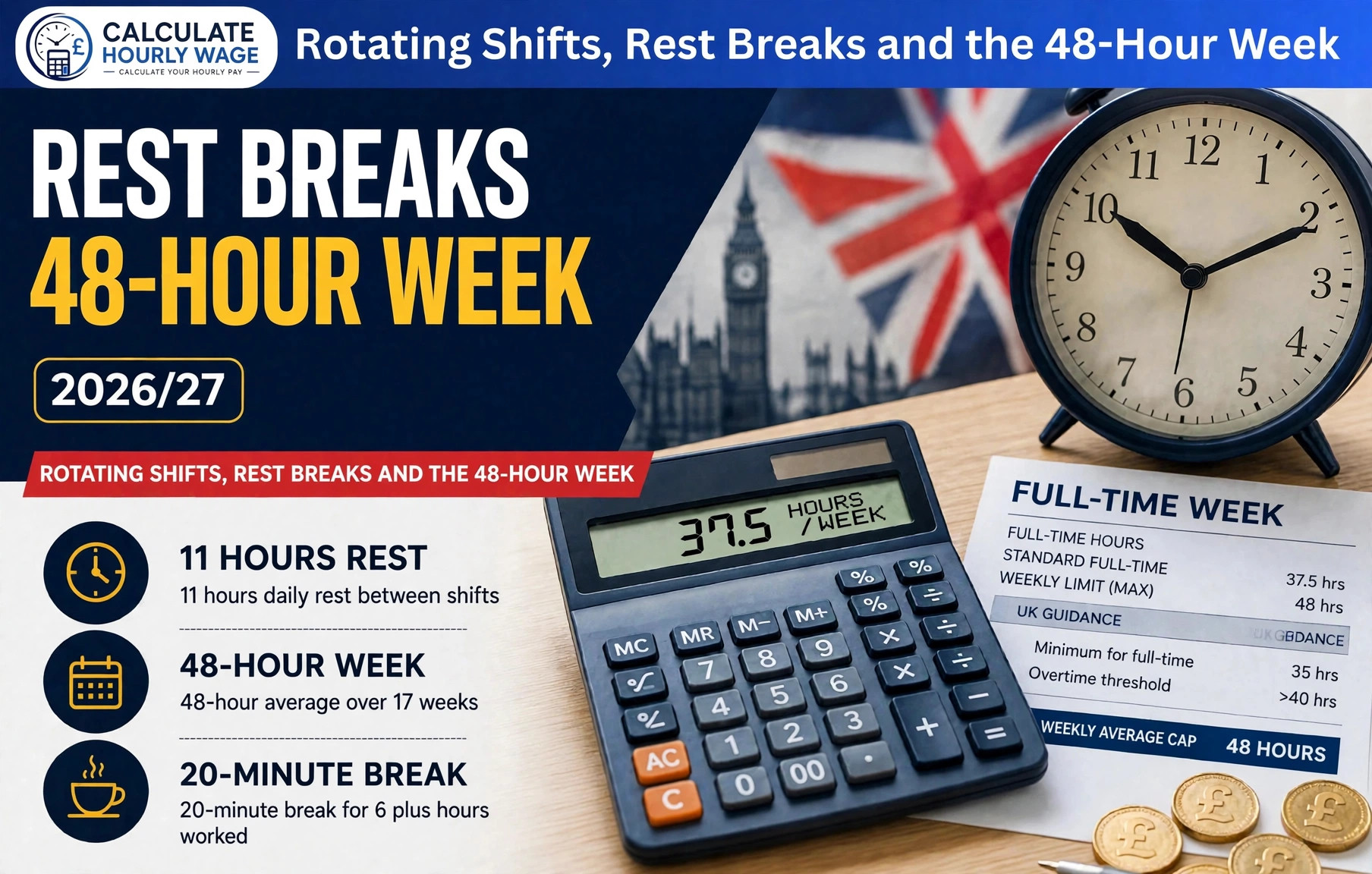
If you are checking shift worker rest breaks in the uk, here is the direct answer: an adult worker is entitled to one uninterrupted 20-minute break when a shift lasts more than 6 hours, 11 consecutive hours of rest between working days, and either 24 uninterrupted hours of rest each week or 48 uninterrupted hours each fortnight. On top of that, most workers must not work more than 48 hours a week on average, normally averaged over 17 weeks. These are separate rights. A rota can pass the 48-hour average and still break the rules, because a single short gap between two shifts, or a single missed break, is a problem on its own.
That distinction matters most on rotating shifts. Rotating patterns — early shifts one week, late shifts the next, nights after days — create exactly the gaps the law is designed to catch: a late finish followed by an early start, a run of long days with no full day off, or a week of heavy overtime that looks fine until you average it out. The figures here come from GOV.UK. Your contract may give you more — longer breaks, paid breaks, or a shorter working week — but it cannot take these minimums away, except in the limited compensatory-rest situations explained below.
Shift Worker Rest Breaks in the UK: The Three Rest Rights
GOV.UK sets out three types of break for workers over 18: rest breaks at work, daily rest, and weekly rest. Each one has to be satisfied on its own.
Rest breaks at work: 20 minutes when you work more than 6 hours
If you work more than 6 hours in a day, you have the right to one uninterrupted 20-minute rest break during your working day. That break should be taken away from your workstation, and not at the very start or end of the shift, where it would really just be arriving late or leaving early. A break does not count if you are called back to work before it finishes.
The break does not have to be paid. Whether you are paid for it depends on your employment contract. That is an important payslip point: a 12-hour shift with a 30-minute unpaid break is 11.5 paid hours, not 12. Check your payslip against the hours you were actually paid for, not just the hours you were on site.
There is no legal right to a smoking break, and no separate legal right to extra breaks for longer shifts beyond what your contract provides. A 12-hour shift still carries the same single 20-minute minimum as a 7-hour shift, unless your contract says more.
Daily rest: 11 consecutive hours between working days
Workers have the right to 11 hours of rest between working days. GOV.UK gives a simple example: if you finish work at 8pm, you should not start work again until 7am the next day. The 11 hours must be consecutive, and they are measured from the end of one shift to the start of the next.
This is the rule rotating rotas break most often. A late shift finishing at 10pm followed by an early shift starting at 6am leaves only 8 hours between shifts, and fails the test. A 9am start after a 10pm finish leaves 11 hours, and passes, but only just. Check every gap between shifts, not just the weekly total.
Weekly rest: 24 hours a week, or 48 hours a fortnight
Workers have the right to either an uninterrupted 24 hours without any work each week, or an uninterrupted 48 hours without any work each fortnight. This is separate from, and on top of, daily rest. A single day off that is really just the tail end of one shift’s daily rest and the start of the next shift’s daily rest does not automatically satisfy weekly rest. The weekly rest period must be a full, unbroken period with no work in it.
On a rotating rota, weekly rest is often the second thing to check after daily rest. A run of eight or nine shifts in a row, even with 11-hour gaps between them, can leave no 24-hour period free of work in that week. A four-on, four-off pattern, by contrast, usually gives a long break in every cycle.

Shift Workers and Compensatory Rest: The Exception That Is Not a Loophole
Some workers are entitled to compensatory rest instead of the usual rest breaks. GOV.UK names shift workers expressly: a shift worker may be entitled to compensatory rest if they cannot take daily or weekly rest breaks between ending one shift and starting another, for example when changing shift patterns.
Compensatory rest is the same length of time as the break, or part of the break, that was missed. If a shift changeover left only 8 hours between shifts instead of 11, the compensatory rest is 3 hours. It is not a free pass to skip rest altogether, and it is not extra pay. It is rest owed to you, to be taken later.
If your employer relies on compensatory rest, ask when it will be given. Rest that is promised but never scheduled is not rest. Keep a note of the shifts where full rest was not possible, the hours missed, and when the compensatory rest was actually taken.
Young workers have different, stronger rights. Workers above school leaving age and under 18 are usually entitled to a 30-minute rest break if they work more than 4.5 hours, 12 consecutive hours of daily rest, and 48 uninterrupted hours of weekly rest. They also cannot work more than 8 hours a day or 40 hours a week, and their hours cannot be averaged out.
The 48-Hour Week: An Average, Not a Weekly Cap
The second headline rule for shift worker rest breaks in the uk is the maximum weekly working time. You cannot work more than 48 hours a week on average, normally averaged over 17 weeks. This law is sometimes called the working time directive or the working time regulations. The key word is average. You can work more than 48 hours in one week, as long as the average over 17 weeks is less than 48 hours a week.
Here is how the average is worked out. Add up all the hours worked in the 17-week reference period, then divide by 17. The period can be extended to a maximum of 52 weeks if that is agreed, for example by a trade union. If you have two jobs with different employers, your combined hours should not average more than 48 a week. Overtime counts towards the total. A week of 60 hours does not break the rule by itself. Seventeen weeks of 60 hours does.
That averaging is why a rotating rota needs to be tested over the full reference period, not week by week. A rota with heavy weeks followed by light weeks can be lawful, while a rota steady at 50 hours every week is not, unless the worker has opted out.
Opting out of the 48-hour week
You can choose to work more than 48 hours a week on average if you are over 18. This is called opting out. Your employer can ask you to opt out, but you cannot be sacked or treated unfairly for refusing. The opt-out must be voluntary and in writing, it can be for a certain period or indefinitely, and your employer must keep a record that you have opted out.
You can also cancel an opt-out. GOV.UK’s example agreement says that if you change your mind, you give your employer notice in writing — the amount of notice is the figure in the agreement, up to 3 months, or 7 days if the agreement says nothing about notice. When the notice period ends, the 48-hour average limit applies again. An opt-out removes only the 48-hour weekly average. It does not waive your daily rest, your weekly rest, your rest breaks at work, or your annual leave. Anyone who tells you that signing an opt-out means giving up rest breaks is wrong.
You cannot opt out of the 48-hour week if you are under 18, and you cannot opt out of the night-work limit explained below. Some jobs have their own exceptions, but for most shift workers the 48-hour average and the opt-out rules are the ones that apply.
Night Shifts on a Rotating Rota: The 8-Hour Average
Rotating rotas often include nights, and night work has its own limit. Staff who regularly work at least 3 hours during the night period are night workers. The night period is 11pm to 6am, unless the worker and employer agree a different night period in writing. If they do, it must be 7 hours long and include midnight to 5am.
Night workers must not work more than an average of 8 hours in a 24-hour period. That average is usually calculated over 17 weeks, and it covers all normal working hours, not just the night hours. Daytime hours count too, and regular overtime counts. Night workers who deal with special hazards, or whose work involves mental or physical strain, cannot work longer than 8 hours in any 24-hour period at all — no averaging. Unlike the 48-hour week, you cannot opt out of the night-work limit.
Employers must also offer night workers a free health assessment before they become a night worker, and regular assessments throughout their employment. Workers do not have to accept the assessment, but the employer cannot skip offering it. If a health professional confirms that night working has affected a worker’s health, the employer must find them other suitable work where possible. If your rotating pattern includes regular nights and you have never been offered a health assessment, that is worth asking about in writing. Once your shift pattern is set, check what it earns with our shift pay calculator: https://calculatehourlywage.com/shift-pay-calculator/
Night work also interacts with rest breaks. A night shift finishing at 6am followed by a day shift starting at 2pm the same day leaves only 8 hours between shifts, and fails the 11-hour daily rest test. Build the recovery gap into the pattern, rather than treating the first day shift after nights as an ordinary shift.
How to Test Your Own Rota in Five Steps
Use this checklist on any rotating rota.
First, list every shift with its start and finish times, and work out the gap to the next shift. Every gap must be at least 11 hours, unless compensatory rest is genuinely due and actually scheduled. Flag late-to-early changeovers first, because those fail most often.
Second, look for a 24-hour period with no work in each week, or a 48-hour period with no work in each fortnight. If a run of shifts leaves no such period, the weekly rest test fails, even if every daily gap passes.
Third, find the 20-minute break in every shift longer than 6 hours. Check that it is uninterrupted, away from the workstation, and not at the very start or end of the shift. Then check your contract for whether it is paid.
Fourth, add up the hours over 17 weeks and divide by 17. If the average is over 48, check whether you have signed a voluntary, written opt-out. If you have not, the rota needs to change. Remember that an opt-out does not affect your rest breaks.
Fifth, if the rota includes regular nights, test the night-work average as well, and check whether a free health assessment has been offered. A rota can pass the 48-hour test and still fail the night-work test.
Keep your own copy of the rota, with your gap calculations on it. If a gap looks wrong, raise it before the shift, not after you have worked it, where that is possible. A manager can often swap a single early start and fix a daily-rest problem without changing the whole pattern.
Worked Examples: Rotating Rotas You Can Check
Example 1: A late finish followed by an early start
Priya works in a hospital kitchen. Her rota has a late shift finishing at 10pm on Friday, followed by an early shift starting at 6am on Saturday. The gap is 8 hours: from 10pm to 6am is 8 hours. That fails the 11-hour daily rest rule by 3 hours. If the shift change makes full rest impossible, Priya may be entitled to 3 hours of compensatory rest, to be taken later. A start time of 9am on Saturday would have left exactly 11 hours, and passed. The fix is a later start, a swapped shift, or scheduled compensatory rest — not simply accepting an 8-hour gap every week.
Example 2: Four on, four off, 12-hour shifts
Dan works in a warehouse on a four-on, four-off pattern, with 12-hour shifts from 6am to 6pm. His contract gives him a 30-minute unpaid break, so his paid hours per shift are 11.5 hours, not 12, and four shifts give 46 paid hours in a working block. Over 56 days, that is 28 shifts, or 322 paid hours, which averages to 40.25 hours a week over 8 weeks (322 divided by 8 is 40.25). That passes the 48-hour average comfortably. The daily gaps also pass: a 12-hour shift leaves 12 hours before the next shift, more than the 11-hour minimum. And four days off in a row comfortably contain a 24-hour weekly rest period.
Example 3: A 17-week average with heavy weeks and light weeks
Sam works in retail on a rotating rota. Over 17 weeks, Sam works 6 heavy weeks at 56 hours each, and 11 lighter weeks at 40 hours each. The total is 6 times 56, which is 336 hours, plus 11 times 40, which is 440 hours, giving 776 hours in total. Divide 776 by 17, and the average is 45.6 hours a week. That passes the 48-hour average, even though 6 individual weeks are well over 48 hours. If Sam had instead worked 50 hours every week for 17 weeks, the total would be 850 hours, the average would be 50 hours a week, and the rota would fail the 48-hour test unless Sam had opted out in writing. The same weekly total, spread differently, gives a different legal answer, which is why the average, not a single week, is the test.
Example 4: Nights on a rotating pattern, and the pay check
Aisha works in care on a rotating pattern that includes two night shifts a week, from 10pm to 6am, plus two day shifts. She regularly works at least 3 hours in the night period, 11pm to 6am, so she is a night worker. Her average hours must not exceed 8 hours in a 24-hour period, and she cannot opt out of that limit. Her employer must also offer her a free health assessment before she starts nights and regularly afterwards. On pay, her basic rate is £14.00 an hour, her contract pays an extra £2.00 an hour for night hours, and her night break is 30 minutes unpaid. One 8-hour night shift therefore pays 7.5 hours at £16.00 an hour, which is £120.00, not 8 hours at £16.00, which would be £128.00. The £8.00 difference is the unpaid break. Check the paid hours, the rate, and the break, line by line. Work out what your own rotating pattern earns with our shift pay calculator: https://calculatehourlywage.com/shift-pay-calculator/
These examples use contract rates for illustration, not official rates. The official figures in this guide — the 20 minutes, the 11 hours, the 24 hours, and the 48-hour average — are the GOV.UK minimums. Your contract may give you more, and if it does, the contract figure is the one to check against.

What to Do If Your Rota Breaks the Rules
Start with the rota itself. Point to the specific gap, week with no weekly rest, or shift with no break, and ask for that shift to be changed. Most daily-rest problems are fixed by moving one start time later or swapping one shift. Weekly-rest problems are usually fixed by inserting a full day off into a long run of shifts. A 48-hour average problem is fixed by cutting hours across the reference period, or by a voluntary written opt-out if you genuinely want the extra hours.
Put the request in writing, even if you first raise it in person. Give the dates, the shift times, the gap in hours, and the rule you are relying on, and keep a copy. If the pattern does not change, Acas offers free and confidential advice, and GOV.UK’s own guidance is the document to point to.
Also check the linked rights that sit alongside rest. Overtime on a rotating rota is compulsory only if your contract says so, and average pay must not fall below the National Minimum Wage. Holiday pay for workers with variable hours is worked out over a 52-week reference period, and regular overtime can count towards holiday pay for the first four weeks of statutory leave. If your overtime hours are pushing your average over 48, work out what they are worth with our overtime pay calculator: https://calculatehourlywage.com/overtime-pay-calculator/, and if a long run of shifts has eaten into your leave, check the value of that leave with our holiday pay calculator: https://calculatehourlywage.com/holiday-pay-calculator/
Shift worker rest breaks in the uk are therefore not one rule but a set of them, and a rotating rota has to pass all of them: a 20-minute break in every shift over 6 hours, 11 hours between shifts, a full day off each week or two days each fortnight, and an average week of no more than 48 hours, with a separate 8-hour average for regular night workers. Check the gaps first, then the week, then the average. Once you know those numbers, you can read any rotating rota in a few minutes, and you can spot the one shift that breaks an otherwise lawful pattern before you work it.
What are shift worker rest breaks in the uk, in simple terms?
For adult workers, they are one uninterrupted 20-minute break in any shift longer than 6 hours, 11 consecutive hours of rest between working days, and either 24 uninterrupted hours of rest each week or 48 uninterrupted hours each fortnight. Shift workers who cannot take daily or weekly rest because of a shift changeover may be entitled to compensatory rest of the same length instead.
How many hours must there be between shifts in the UK?
11 consecutive hours between working days for adult workers. A late shift finishing at 10pm followed by an early shift starting at 6am leaves only 8 hours, and fails the test by 3 hours. A 9am start after a 10pm finish leaves exactly 11 hours, and passes. Young workers under 18 are entitled to 12 consecutive hours instead.
What is the 48-hour week, and is it a limit on every single week?
No, it is an average. You must not work more than 48 hours a week on average, normally averaged over 17 weeks. You can work more than 48 hours in one week, as long as the average over 17 weeks stays below 48. You can opt out of the 48-hour average voluntarily and in writing if you are over 18, but you cannot be sacked or treated unfairly for refusing, and the opt-out does not affect your rest breaks.
Do rest breaks have to be paid?
No. The 20-minute rest break does not have to be paid — that depends on your employment contract. A 12-hour shift with a 30-minute unpaid break is 11.5 paid hours, not 12. Check your contract for whether your break is paid, and check your payslip against paid hours, not just hours on site.
Can my employer make me work nights on a rotating rota without a health check?
If you regularly work at least 3 hours between 11pm and 6am, you are a night worker, and your employer must offer you a free health assessment before you become a night worker and regularly afterwards. You do not have to accept it, but the employer cannot skip offering it. Night workers must also not average more than 8 hours in a 24-hour period, and cannot opt out of that limit.
What is compensatory rest, and when does it apply to shift workers?
Compensatory rest is rest of the same length as the break, or part of the break, that you missed. A shift worker may be entitled to it if they cannot take daily or weekly rest breaks between ending one shift and starting another, for example when changing shift patterns. It is rest owed to you, to be taken later — not extra pay, and not a reason to skip rest altogether.
Sources
- GOV.UK — Rest breaks at work: https://www.gov.uk/rest-breaks-work
- GOV.UK — Maximum weekly working hours: https://www.gov.uk/maximum-weekly-working-hours
- GOV.UK — Night working hours: https://www.gov.uk/night-working-hours
- GOV.UK — Holiday entitlement: https://www.gov.uk/holiday-entitlement-rights